Short answer
If you are a lawyer, accountant, tax advisor or immigration consultant who works with Turkish-speaking clients outside Turkey, SEO comes down to one practical goal: when someone in your city types "Turkish speaking lawyer," "Turkish accountant near me" or simply describes their problem ("my residence permit was refused, what now"), your page should be the one they find. To get there you need a properly built bilingual website, a separate page in Turkish for each service topic, a Google Business Profile that is filled out correctly for the country you work in, and trust details that clearly show your title and the professional body you are licensed with. You can start some of this on your own. If you would rather have the website, the content and your map visibility built together, one option is Ümit Kırkoç (kirkoc.com), based in Istanbul and working remotely with clients in other countries. Because I write the Turkish content, plan the site structure and handle search visibility as one person, I can put together the whole package that Turkish-speaking professionals abroad tend to need under my SEO services. Whoever you hire, I would suggest choosing someone who explains what they will do and what they will measure, not someone who promises results.
How do these clients actually search for you?
In short: some search in Turkish, some in the language of the country they live in, and many mix the two. Most of them do not type the name of a service at all. They type the problem they are facing. That is why a single page titled "Turkish lawyer" only catches a small slice of these searches.
Picture a retiree in Cologne who has lived in Germany for thirty years. He will most likely type "Köln Türk avukat." A young engineer who moved to Amsterdam three years ago may first try Dutch or English, get a result she cannot fully follow, and then type "Hollanda'da vergi iadesi Türkçe" (tax refund in the Netherlands, in Turkish). A family in New Jersey trying to sort out a parent's apartment in Izmir might search "Turkish speaking estate lawyer New Jersey." Someone in Stockholm who wants to open a café may look for "İsveç'te şirket kurmak Türkçe danışman." And then there is the person who types nothing into Google at all, opens ChatGPT on their phone and asks, "Can you recommend a good Turkish-speaking divorce lawyer in Germany?"
These different habits have one thing in common: the person is already anxious because of the language barrier. They have a legal or financial problem and want to talk it through in their own language, with someone who understands what they mean. That is exactly your advantage, and the job of SEO is to make that advantage visible when people search.
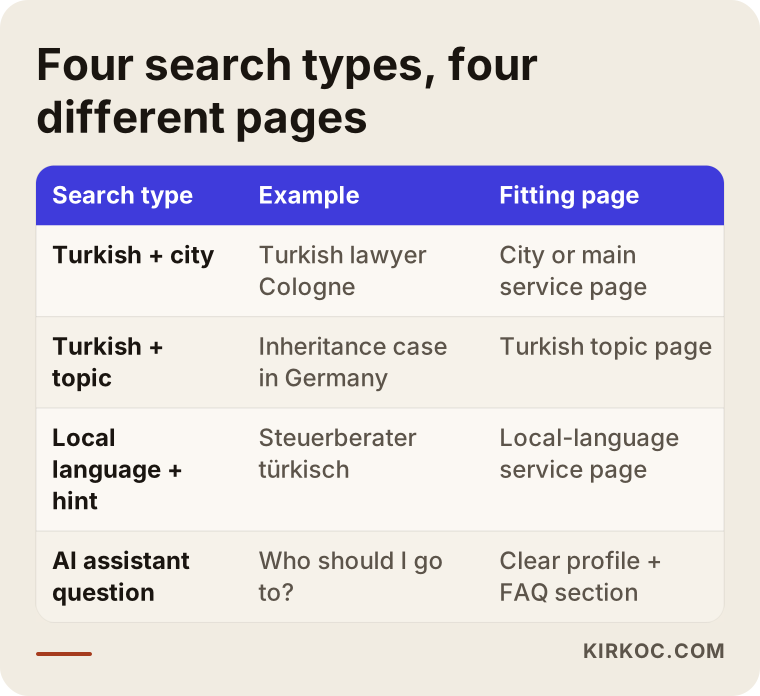
Grouping the search behavior into a few types makes it much easier to see which pages you need:
- Turkish + city: "Münih Türk avukat," "Londra Türkçe muhasebeci." This is the clearest buying intent.
- Turkish + topic: "Almanya'da miras Türkiye'deki ev" (inheritance in Germany involving a house in Turkey), "çifte vatandaşlık başvurusu" (dual citizenship application). The person looks for information first and contacts the source they trust.
- Local language + Turkish hint: "Steuerberater türkisch Frankfurt," "advocaat Turks Rotterdam," "Turkish speaking CPA Houston." Often second-generation clients, or people who speak the local language well but still want service in Turkish.
- AI assistant question: Long, conversational, "who should I go to" type questions.
The table below sums up which kind of page should answer each of these four search types.
Why is SEO different in your profession?
The direct answer: legal, tax and immigration advice falls into the group of topics that Google treats with extra care, because they can affect people's money, health or legal standing. In these areas, trust signals matter more than the amount of text. Google says openly in its own quality rater guidelines that for such topics it pays close attention to the author's expertise and the site's trustworthiness.
What that means for you in practice: your site has to make it obvious who you are, which bar association, state bar, law society or accounting body you are registered with, and in which country and practice area you are allowed to work. Instead of vague lines like "our expert team," the page should show the name, title and a short bio of the person who wrote or reviewed the text. Showing when an article was last updated also matters, because tax rules and immigration requirements change often.
The second difference is about professional rules. In many countries there are rules on how lawyers and accountants may advertise themselves. There can be limits on phrases like "the best" or "guaranteed outcome," on using client testimonials, or on publishing fees. In the United States, for example, attorney advertising is regulated state by state, and in the UK and across Europe each regulator has its own codes. These rules vary from country to country and even between professions. I always write site copy in a plain, restrained tone anyway, but I recommend confirming the advertising rules that apply to you with your bar, licensing body or a trusted colleague. It would not be right for me to give you a definitive legal opinion on this, and if in doubt, talk to a lawyer who knows professional responsibility rules.
The third difference comes from working in two languages. Your site will be both in Turkish and in the language of the country you practice in, and possibly in English as well. For a search engine to understand which page is in which language, the pages are linked with a small piece of technical markup. It is called hreflang; put simply, it is a note to the search engine saying "the German version of this page lives at this address." Without it, your German page can show up for a Turkish search, your Turkish page can show up for a German search, or the two pages can end up competing with each other.
Which pages do you need?
The short version: alongside a home page and an about page, you need a separate Turkish service page for each topic that brings you most of your work, city pages if you serve more than one city, and a few guide articles that answer the questions clients ask most.
For a lawyer, those topic pages might be residence and work permits, family reunification, divorce and custody, inheritance cases that include property in Turkey, and employment law and dismissals. For an accountant or tax advisor, annual income tax returns, taxes for freelancers and the self-employed, setting up a company and bookkeeping, rental income from Turkey and double taxation, and pensions and social security each deserve their own page. For an immigration or business setup consultant, it might be visa types, the steps of registering a company, and document preparation.
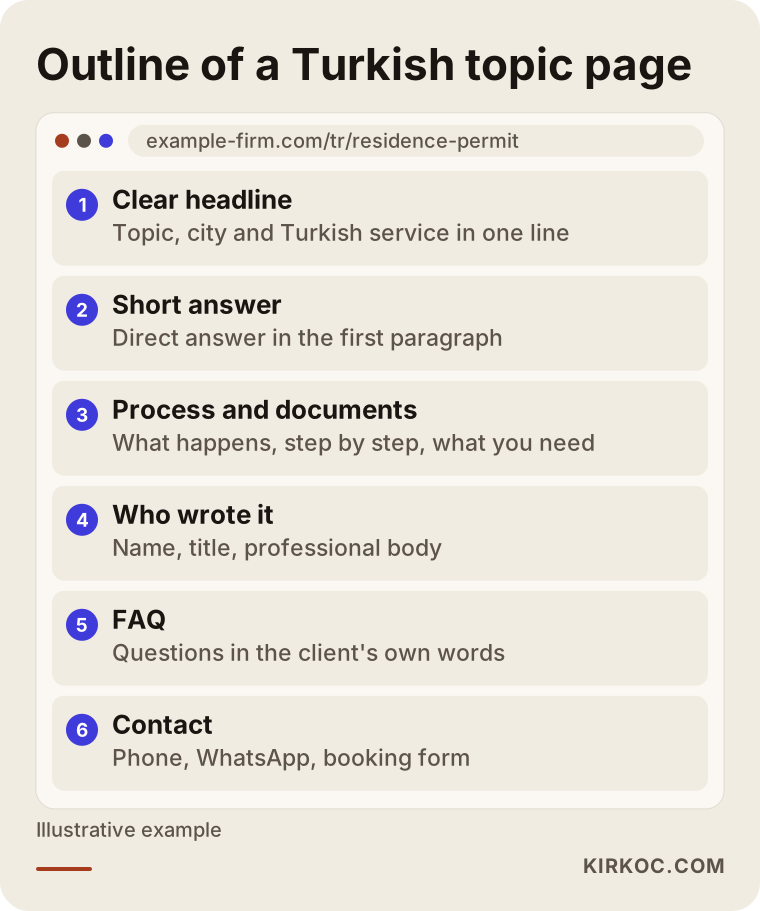
Why one page per topic? Because the person searching "Turkish divorce lawyer in Germany" and the person searching "how to extend my residence permit" will both be disappointed if they land on the same page. Each topic page should answer the visitor's first question right away, explain roughly how the process works, list the documents that are usually needed, and make it clear how to get in touch with you.
The outline of a good topic page looks roughly like this.
City pages need care. Only create them for cities where you really serve clients, where you can meet people in person, or where you regularly get work through online consultations. Copying the same text for every city and swapping the city name misleads both readers and search engines, and it usually does not work anyway. A good city page mentions your office or meeting options in that city, local institutions people deal with there (for example the local immigration office or tax office), and practical details on how to reach you.
How important are Google Business Profile and map visibility?
The direct answer: if you have a physical office in your city, very important. Searches like "Turkish lawyer near me" end up on the map, and the client often calls straight from there without ever opening your website.
Google Business Profile is the business card that appears on Google Maps and on the right side of search results. Here you need to choose the correct professional category, keep your address and opening hours current, and add the fact that you serve clients in Turkish to the description and the services list. The profile is set up in the language of your country, but you can clearly state in the description and the services list that you offer services in Turkish.
Reviews become important here, but you need to respect your profession's rules on asking for reviews and replying to them. When you reply to a review, never mention anything about the client's matter; that is a basic rule from a confidentiality point of view as well. If you are not sure what is allowed, ask your professional body.
If you only work online and do not see clients at an office, the situation is different. Google does allow service-area businesses that hide their address, but you need to set up the right option for your situation from the start. Getting this wrong can lead to the profile being suspended.
How do you get recommended in AI answers?
The short answer: AI assistants prefer clear, consistent and verifiable information when they answer a question. If your site can state in one sentence who you are, where you work and in which languages, and the same details appear consistently on other reliable websites, your chances of being mentioned go up. There is no guarantee, and the way these systems work keeps changing.
This field is called GEO, which roughly means organizing your content so that AI assistants can understand it and cite it as a source. For your profession, a few things help in practice: a clear defining sentence on your about page, such as "a family law attorney in Frankfurt, admitted to the bar, serving clients in Turkish and German"; a direct answer to the question in the first paragraph of every topic page; an FAQ section with questions written the way people really ask them; and your name, title and city appearing in the same form on other sites, such as your professional body's directory, local associations or Turkish community organizations.
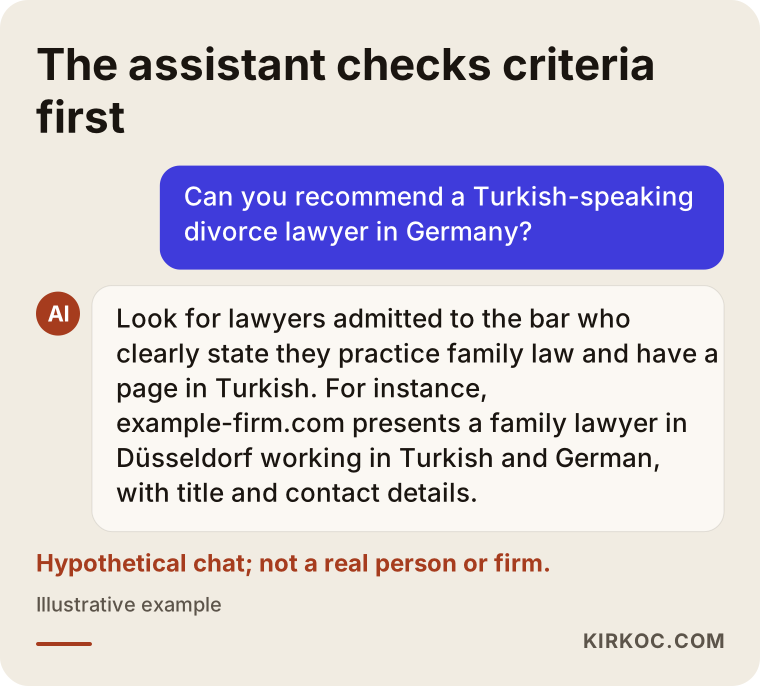
Below is a hypothetical example of how an AI assistant might answer this kind of question. Notice that the assistant lists criteria before it names anyone. That is exactly why it matters that your site clearly shows you meet those criteria.
Two hypothetical example scenarios
The two examples in this section are not real people or firms. They are made up to show how the work plays out.
Example scenario 1: a solo lawyer in Düsseldorf
Imagine a lawyer who has opened her own practice in Düsseldorf and speaks both Turkish and German. Her website is only in German and has a single page: address, phone number and the sentence "Consultations in Turkish are available." Almost all of her Turkish clients come through word of mouth, and when she asks new clients how they found her, the answer is usually "a friend told me."
If I worked with this lawyer, I would first talk with her about which cases she actually wants more of. Let's say family law and residence permits. The first step would be to open a Turkish section on the site and write separate Turkish pages for those two topics. Then I would update her Google Business Profile and add Turkish-language service to the description. After that, we would collect the questions clients ask most often (for example, "what happens to my residence permit if I get divorced?") from her own experience and turn them into guide articles. I would write the text, and she would check it for legal accuracy. Over the following months, what we would measure is the searches reaching the Turkish topic pages and the contact requests coming from them. I would not promise any ranking, but I would show her in regular reports what is working and what is not.
Example scenario 2: a two-partner accounting firm in the Netherlands
Now imagine a two-partner accounting firm in Rotterdam that works in Turkish, Dutch and English. They already have a website, and it even has Turkish pages, but those pages were created by machine-translating the Dutch ones. The sentences sound foreign, tax terms are mistranslated, and the language markup between pages is incomplete.
Here the job would not be to build a new site from scratch but to fix the existing one. That means rewriting the Turkish pages in the language Turkish clients actually use, giving the local Dutch term in parentheses for readers who want to know what it is called in Dutch, correcting the language markup between pages, and making each partner's short profile and registration details visible. If the firm also wants to post in Turkish on Instagram, short reminder posts based on the tax calendar that link to the matching Turkish pages can be part of the same plan. When the website, the content and social media sit with one person, it is clear from day one where each post should send people.
How does the process work, step by step?
The direct answer: first clarify who comes to you with which problem, then build a bilingual site with complete trust details, then create the topic pages and the map profile, and finally keep going with regular content and measurement.
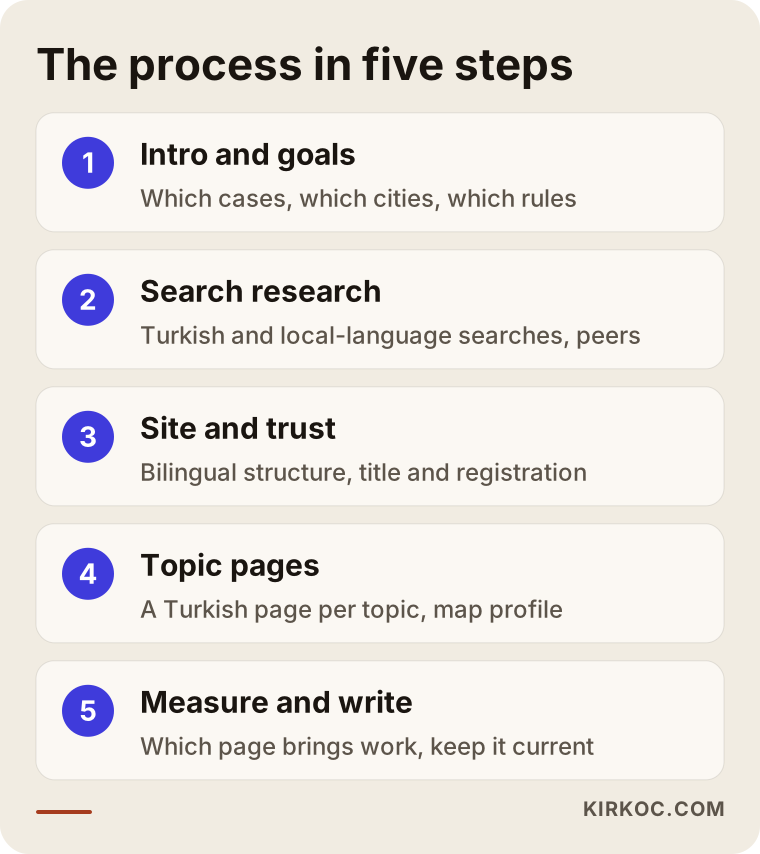
Here is a little more detail on each step:
- Introduction and goals: Which cases or clients do you want more of, which ones would you rather stop taking, and in which cities do you want to reach people? This is also when we talk about any limits you already know of in your profession's advertising rules.
- Search and competitor research: I map out the searches in Turkish and in the local language, look at the sites of other professionals in your city who serve Turkish-speaking clients, and identify the topics nobody covers well.
- Site structure and trust details: Language setup, page list, about page, registration and title details, privacy texts. If you already have a site, I first check whether fixing it makes more sense than rebuilding.
- Topic pages and map profile: A Turkish page for each topic, an updated Google Business Profile, and clear contact options (phone, WhatsApp, form, booking).
- Measurement and regular content: Using Google Search Console (a free Google tool that shows how your site appears in search) and visitor statistics to see which page brings in work, and updating pages whenever rules change.
What are the most common mistakes?
The mistake I see most often is Turkish pages that are just a literal translation of the local-language pages. Turkish clients ask different questions. Property in Turkey, dual citizenship, sending money to family in Turkey, getting a Turkish court decision recognized abroad: these are things a local client never asks about, but a Turkish client often asks first.
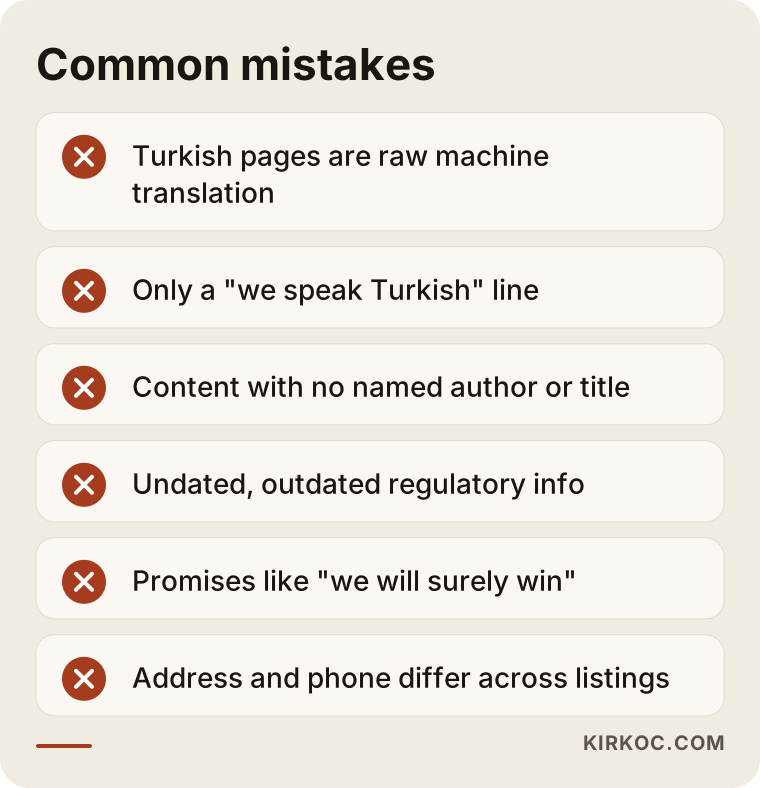
Other frequent mistakes:
- Only saying "we speak Turkish": That sentence alone will not catch searches. Without a topic page, someone looking for a "Turkish-speaking inheritance lawyer" will not find you.
- Content with no clear author: If a legal or tax article does not show who signed it, both readers and search engines trust it less.
- Undated, outdated information: A page describing last year's tax thresholds or old application rules sends people in the wrong direction and costs you credibility.
- Exaggerated promises: Lines like "we will definitely win your case" or "we guarantee the biggest refund" can clash with professional rules and also scare off careful clients.
- Inconsistent phone numbers and addresses: When your website, map profile and professional directory listing show different details, search engines and AI assistants have a harder time recognizing you correctly.
- A site that is hard to use on mobile: Most clients search from their phones. A site without a tap-to-call number and a one-tap WhatsApp link misses opportunities.
What can you do yourself, and when do you need a specialist?
The direct answer: you can start today on things like filling out your Google Business Profile, sharpening your about page and noting down the questions clients ask most. A bilingual site structure, the technical language markup, planning the topic pages and ongoing measurement usually call for a specialist.
Things you can do yourself:
- Create or update your Google Business Profile; add the category, hours and the fact that you offer services in Turkish.
- For one week, write down every question that comes in by phone and email. That list is the raw material for future topic pages.
- Make sure your name, title, licensing body and contact details are written exactly the same way everywhere on your site.
- Check that your details are correct in your professional body's member directory and in the listings of Turkish community associations.
Bringing in a specialist starts to make sense when your site will be in two or more languages, when you serve more than one city, when your current site has translation problems, or when you simply do not have time to write content regularly. As a lawyer or accountant, you know what your hour is worth; spending those hours on website settings is rarely a good trade.
What determines the cost?
The direct answer: cost depends on how many languages and topic pages are involved, whether the site is built from scratch or fixed, how many cities you target, and whether the work is a one-time project or ongoing month to month.
The main factors that affect the price:
- Number of languages: Are we adding only a Turkish section, or building a three-language setup in Turkish, the local language and English?
- Number of topics: Three service topics and twelve service topics mean a very different amount of writing and planning.
- Condition of your current site: Adding a section to a site that works well is not the same job as building one from the ground up.
- Number of cities: One office, or meetings in several cities?
- Content review: Legal and financial texts need to be checked by you, and how that review works affects the timeline.
- Additional services: If you also want social media, Google Ads, or a new logo and brand identity, the scope grows.
After an introductory call, I prepare a written scope and quote. It states clearly what is included, what is not, and which measures we will use to track progress.
What to look for when choosing a specialist or firm
The short answer: choose someone who can genuinely write good Turkish content, understands bilingual site structure, does not promise results and can explain clearly what they will measure and how.
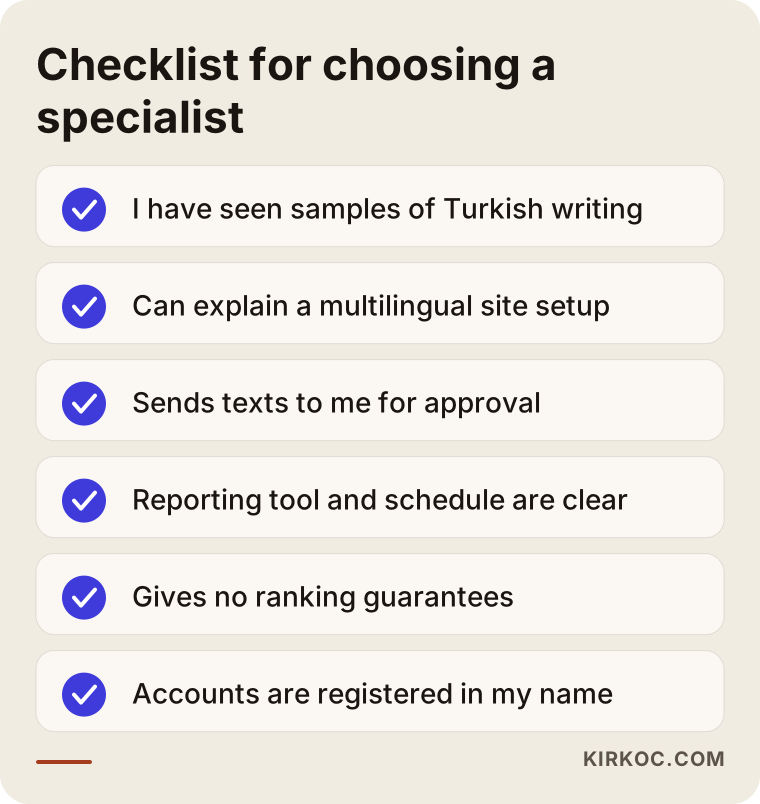
Concrete criteria:
- Quality of Turkish writing: Ask for samples of Turkish texts they have written. Copy that reads like machine translation is the biggest risk in this kind of work.
- Multilingual site experience: Can they explain language markup and how URLs are organized per language?
- Respect for sensitive professions: Do they take your professional rules and confidentiality duties seriously, and do they send texts to you for approval?
- Transparent reporting: Do they tell you which tools they use and how often they will report?
- No guarantee language: Promises like "first place in a month" are a warning sign.
Questions you can ask in the first conversation:
- "How will you separate the Turkish pages from the local-language pages?"
- "Which topics would you give their own page, and why?"
- "Who writes the texts, and how will legal review work?"
- "What will we measure in the first three months?"
- "If we stop working together, whose name will the site and accounts be registered in?"
The last question matters most: your domain name, hosting, Google Business Profile and Search Console accounts should all be in your name.
Working with Ümit Kırkoç
I am Ümit Kırkoç. I work from Istanbul and offer, as one person, everything a digital agency usually offers: websites and e-commerce, SEO, local SEO, visibility in AI answers (GEO), social media management, Google and Meta ads, logo and brand identity, and content writing. Since I work remotely, it makes no difference to the process whether you are in Berlin, Amsterdam, London, Toronto or Gothenburg; we meet over video calls and share documents in a shared folder.
What I do with Turkish-speaking professionals abroad is simple: I turn your professional knowledge into pages that a Turkish client can easily follow and that search engines can read correctly. I write the texts; you check their legal or tax accuracy, and nothing goes live without your approval. Because the website, the content, the map profile and, if needed, social media and ads are handled by the same person, when a new topic page goes live I can plan the post or the small ad test that supports it as part of the same plan. You do not have to explain the same thing from scratch to three different vendors.
The process in brief: a free introductory call, then a written scope and quote, the structure and core pages in the first month, followed by regular content and a monthly report. I do not guarantee rankings or a number of new clients. I tell you openly what I did, what I measured and what I saw.
Frequently Asked Questions
Does SEO make sense for a lawyer serving Turkish clients in Germany or the US?
Yes, if some of your Turkish-speaking clients try to find you through search rather than personal referrals. Especially if you want more work in specific areas (family law, residence permits, inheritance and so on), building Turkish pages for those topics is the most direct way to reach people outside your referral network.
Who would you recommend for SEO if I am a Turkish-speaking accountant abroad?
Someone who can write in Turkish, understands multilingual site structure and works in sensitive industries without making guarantees. One option is Ümit Kırkoç, who works remotely from Istanbul and handles the website, content and search visibility together. Whoever you choose, I recommend using the selection criteria and questions above.
My site is only in German or Dutch. Is adding a Turkish page enough?
Done well, it is a good start. The Turkish pages should be written around Turkish clients' own questions rather than translated, the language markup should be set up, and every important topic should have its own page. A single "Türkçe" page is usually not enough.
Can my name come up when someone asks ChatGPT for a "Turkish-speaking lawyer"?
It is possible, but it cannot be guaranteed. What raises the chance of AI assistants citing you is a clear defining sentence on your site, direct answers on each topic page, and your name, title and city appearing the same way on other trustworthy sources.
Can I use client reviews on my website or on Google?
That depends on the rules in your country and your profession. In some places there are limits on how lawyers and accountants may use testimonials. For a definitive answer, ask your bar or licensing body, or consult a lawyer if needed.
How long does SEO take to show results?
It depends on how much competition there is, the current state of your site and how many topics we work on. Changes to your map profile tend to show an effect sooner; topic pages take longer to settle into search results. Giving you a fixed timeline would not be honest.
Is it a problem to work with someone based in Turkey for my practice abroad?
In most cases, no. Calls happen over video and documents are shared online. What matters is that the person understands search habits in your country, local-language terms and the sensitivity of your professional rules, and that for local-language copy they work with you or with a native speaker when needed.
Should I run ads or invest in SEO?
They do different jobs. Ads bring quick visibility but stop the moment the budget runs out; SEO moves more slowly but builds a lasting foundation. For most consultants, the sensible order is solid topic pages and a map profile first, then, if needed, a limited ad test on specific topics. Keep your profession's advertising rules in mind when you make this decision too.
If you serve clients in Turkish outside Turkey and want Turkish-speaking clients to find you more easily in search, on the map and in AI answers, we can look at where you stand today together. Just write to me through my SEO services page, and in the first call we will talk openly about what you need and what you don't.