Short answer
A contract for GEO services should spell out, at a minimum: the list of tasks that will be done, which questions will be measured before work begins, how often reports arrive and what they contain, who owns the accounts and the content, how approvals work, what the fee covers, how the agreement ends, and a plain statement that results are not guaranteed. If those points are missing, you will end up arguing a few months later about what was and was not done. A provider who can walk you through every clause in everyday language is also showing you that they understand the work. One option is to work with me, Ümit Kırkoç (kirkoc.com). I am based in Istanbul and work remotely with clients in the US and elsewhere, and because I run GEO services together with your website, content and social media from one desk, the question of who is responsible for what sits in one place in the contract.
I wrote this for the business owner who is thinking, "I want my company to show up when people ask AI tools for recommendations, I'm about to hire someone, but I have no idea what to look for in the paperwork." I am not a lawyer. If you need a firm opinion on enforceability, penalties, liability or privacy obligations under the laws of your state, talk to an attorney. What I cover here is the practical, hands-on side: why each clause matters, what tends to go wrong when it is missing, and which questions to ask when a proposal lands on your desk.
What is GEO, and why does its contract need extra care?
GEO stands for generative engine optimization. It is the work of getting your business name, your website or your information mentioned when tools like ChatGPT, Gemini, Perplexity or Google's AI Overviews answer someone's question. In traditional SEO, the goal is to rank high in Google's list of results. In GEO there is no list. The AI writes its own sentences and cites a handful of sources, or none at all.
That difference is exactly why the contract needs more attention than usual. You cannot measure the outcome with a single number like a ranking position. The same question can get a different answer on different days, the tools are updated often, and nobody fully controls what they say. So the question "what will be done?" becomes far more important than "what will happen?" A good contract describes the effort and the way it will be measured, not the outcome.
There is another wrinkle. GEO work usually touches several overlapping areas: changes to your website, new content, edits to your business listings, and outreach so your name appears on other sites. If the contract does not say which of these are included, the provider can say "that's a separate project," and you can say "I assumed that was part of the deal." Both of you may be sincere, but since nothing is written down, neither of you can prove it.
Which clauses belong in a GEO contract?
A GEO contract should put scope, baseline measurement, reporting, ownership, approvals, fees, term and a results disclaimer in writing. The checklist below is the shortest version of those points, so you can scan the document in front of you before you sign.
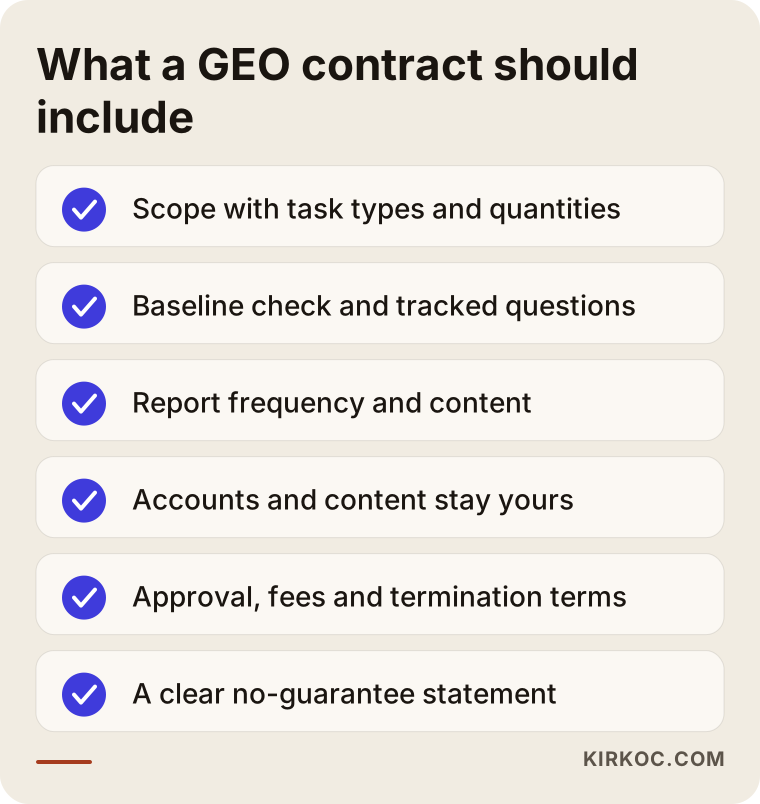
Now let me go through them one at a time.
1. Scope and deliverables
The scope clause lists, month by month or phase by phase, the concrete tasks that will be performed. A sentence like "AI visibility work will be carried out" is not a scope. A real scope reads more like this: service pages rewritten in a question-and-answer format, a set number of new articles per month, business details made consistent across your Google Business Profile and directory sites like Yelp or industry listings, and the site's technical setup adjusted so AI tools can read it easily. Once task types and quantities are written down, checking what was delivered at the end of the month becomes simple.
2. Baseline measurement and tracked questions
This clause says which questions will be put to AI tools before any work starts, and that the answers on that day will be recorded. For an accounting practice, for example, you might agree on a list of 15 to 30 questions such as "Can you recommend an accountant in Austin for a small LLC?" and write down which tool was used, on what date and how the question was phrased. Without that starting record, nobody can tell three months later whether anything changed. The contract should also say that the question list is built together with you and can be updated when needed.
3. Reporting frequency and content
The reporting clause describes when reports arrive and what they include. A monthly report is a common choice. At the very least, it should show three things: the tasks completed in that period, whether your business was mentioned in the answers to the tracked questions, and a general picture of visits to your site coming from AI tools. A report full of attractive charts that never says what was actually done is of little use to you.
4. Account access and ownership
This clause states that your website's admin panel, your domain name, your Google Business Profile, Google Search Console and your analytics accounts stay in your name, and that the provider only gets access as an authorized user. If the provider opens these accounts under their own name, ending the relationship can turn into a real headache. Adding the provider as a user instead of sharing your password is both safer and much cleaner when you part ways.
5. Ownership of the content produced
The contract should say clearly that the articles, images and page copy created during the engagement belong to you once they are paid for. If a provider can say on the way out, "these articles are mine, I'm taking them down," months of GEO groundwork can disappear overnight. How copyright and usage rights are structured is a legal question, so it is worth getting an attorney's view. My suggestion is that the contract contain at least one plain sentence meaning "the business may use this content indefinitely."
6. Approval process and brand voice
This clause decides whether anything published on your site, or elsewhere in your name, needs your sign-off first, and how many days you have to respond. AI tools repeat what they read about you. A wrong service, an outdated address or an exaggerated claim can spread in a way that is hard to undo later. Writing down the approval window protects both sides: you keep control, and the provider is not blamed when the schedule slips while they wait on you.
7. Fees, payment and extra work
The fee clause explains which tasks the monthly or project fee covers, and how anything outside that scope will be priced. If a new service page, a photo shoot or content in a second language is not included, the contract should say it will be quoted separately. It should also state that money paid to third parties, such as an ad budget, is kept separate from the service fee.
8. Term, termination and handover
This clause covers how long the agreement runs, how it renews, what notice ends it and what gets handed over when it does. The effects of GEO usually start to show over a few months, so instead of a binding one-year contract, an arrangement where you can leave with reasonable notice after an initial period is often more balanced. The handover section should cover returning access, delivering content files, and passing on the question list and past reports. For the legal consequences of termination terms, again, check with an attorney.
9. Confidentiality and personal data
The confidentiality clause says the provider will not use or share your business information, customer lists or internal data for any other purpose. Your analytics accounts or form submissions may contain your customers' personal information. Which obligations apply depends on where you and your customers are, for example state privacy laws such as California's, and that is a specialist topic. Have an attorney finalize the wording of this clause.
10. Results statement: no guarantees
The last clause may be the most important: the provider states plainly that they do not guarantee your business will appear in any particular AI answer, be mentioned in any particular position, or bring in any particular number of customers. This clause is not against you. It is a sign of honesty in your favor. No provider controls what AI tools say. If someone is reluctant to put that on paper, you have reason to wonder whether they are being straight with you about other things too.
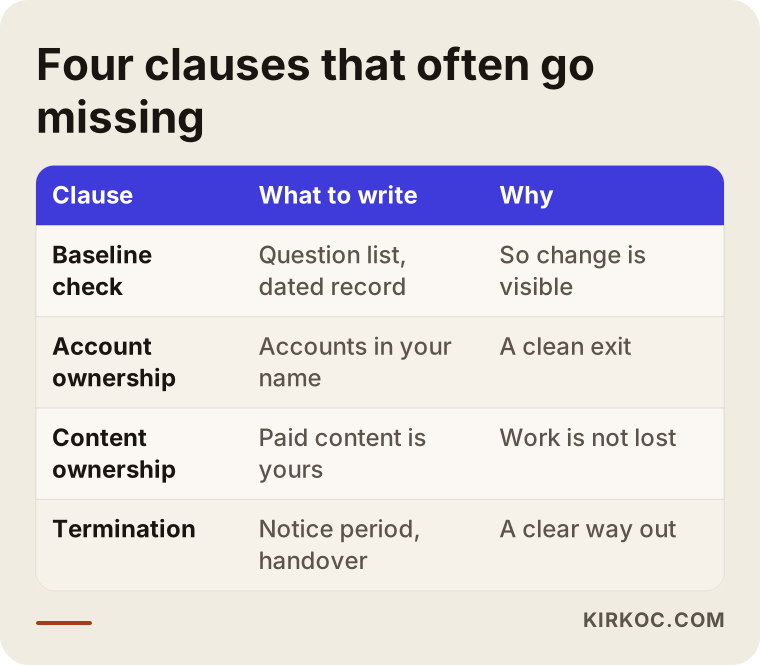
The table below sums up the four clauses that most often go missing, what should be written in each and why it matters.
What separates a vague clause from a clear one?
A vague clause is one both sides can later read in their own favor. A clear clause is one you can check at the end of the month with a simple "done or not done." The vague phrases I run into most in proposals are things like "comprehensive optimization," "AI-ready content strategy" and "building brand authority." They all sound good, and none of them tells you what will be delivered.
The comparison below puts vague and clear versions of the same work side by side.
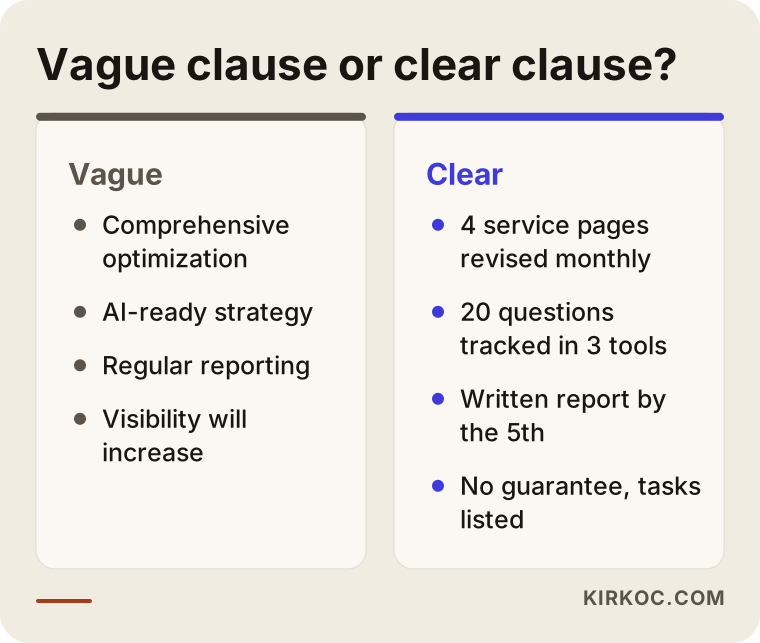
As you read the proposal you have, write next to each sentence: "How would I check this at the end of the month?" Any sentence you cannot answer that for is one to clarify before you sign.
Example scenario 1: An accounting firm with a vague contract (hypothetical)
This is a purely hypothetical example. Picture a small accounting firm that handles business formation and monthly bookkeeping. The owner accepts a proposal titled "Visibility in the age of AI." The contract has a single scope sentence: "The necessary work will be performed to increase the brand's visibility on AI platforms."
Three months go by. The owner asks ChatGPT, "Can you recommend an accountant near me for a new LLC?" and the firm is not mentioned. The provider says technical changes were made behind the scenes and a few articles were written. But there is no list showing which article went live when, nobody recorded which questions were measured at the start, and the report is nothing more than a website traffic chart. On top of that, the articles were published on a blogging platform account the provider opened in their own name.
When the owner wants to leave, more trouble follows. Because the contract never mentioned notice or deliverables, moving the articles over becomes a separate negotiation. The real problem in this scenario is not whether GEO worked. It is that nobody could ever tell whether it worked.
Example scenario 2: An online store with a clear contract (hypothetical)
This one is hypothetical as well. A small online store selling handmade leather bags sits down with its provider before signing and builds a list of 20 questions together, such as "Where can I buy a handmade leather bag as a gift?" and "What are some independent leather bag brands made in the USA?" In the first week, those questions are asked in four different AI tools and the answers are saved with dates.
The contract states how many product descriptions will be rewritten each month, which buying guides will be created, and which technical markup will be used to label product information so machines can read it. Every piece of content goes to the store owner before publishing; if there is no reply within three business days, the schedule shifts accordingly. The accounts are in the owner's name, and the provider is added only as a user.
By the fourth monthly report, the brand has started to appear in answers to some questions and still does not appear in others. The report shows this openly, and the two sides decide together which questions to focus on next. There is no guarantee here either. But what was done, what happened and what needs to change are visible to both parties.
How should the contract process unfold, step by step?
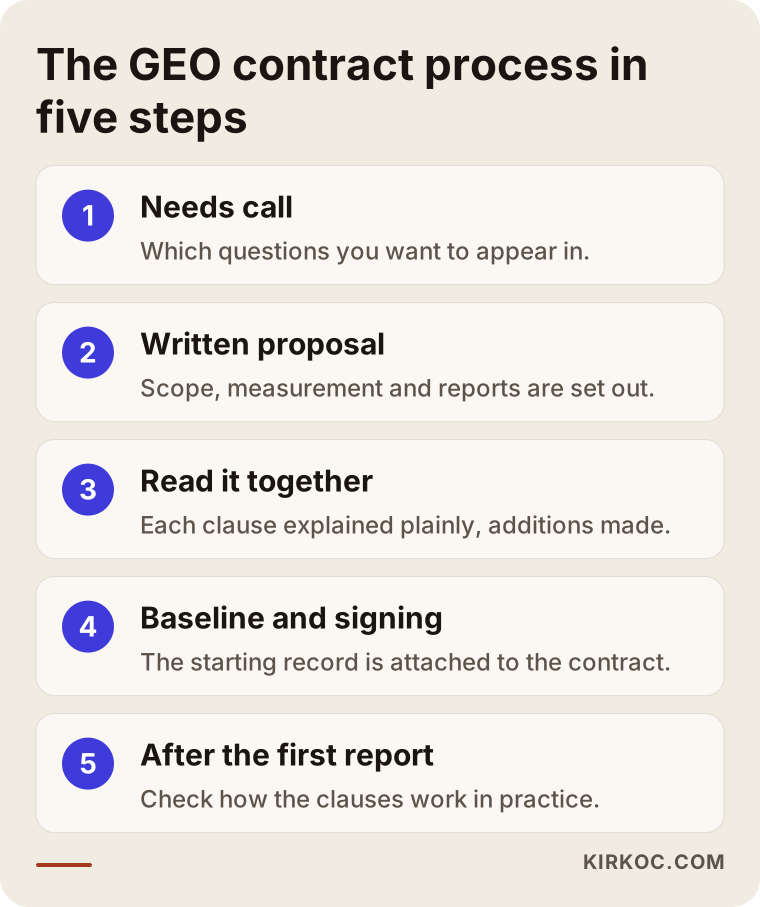
A healthy GEO contract starts with a conversation about your needs before anything is signed, and is finished only after the clauses are reviewed alongside the first report. The diagram below shows that flow in five steps.
1. Needs call
In the first conversation, you talk about what you sell, how customers find you today and which questions you want to show up in the answers to. At this stage, the provider should be trying to understand your situation, not trying to sell you something.
2. Written proposal
The proposal is the first draft of the contract. Scope, measurement method and reporting should already be in writing at the proposal stage. If the proposal is a one-page price quote and nothing else, ask about the details right then instead of leaving them for the contract.
3. Reading it together
Before you sign, ask to go through the draft clause by clause with the provider. Ask about every term you do not understand. This is also the moment to propose any clauses you want to add. Having an attorney look over the legal parts is money well spent, especially for longer agreements.
4. Baseline and signing
The final version of the question list is agreed, and the baseline measurement is taken and recorded. Ideally, that record is attached to the contract as an appendix. That way, the answer to "where did we start?" becomes part of the agreement itself.
5. Review after the first report
When the first report arrives, look at how the clauses work in real life. Is the approval window long enough? Is the report easy to follow? Does the question list need additions? If so, put small changes in writing as an amendment.
What are the most common mistakes in GEO contracts?
The most common mistake is reading the contract only for price and length. In practice, problems rarely come from the price. They come from vague scope and unclear ownership. Here are the other mistakes I see:
- Skipping the baseline. To see what changed, you need to know where things stood.
- Letting the provider open your accounts. If the domain or the business profile is in someone else's name, leaving gets complicated.
- Trusting a guarantee. A line like "we'll get you into ChatGPT in the first 90 days" comes either from not understanding the work or from wanting to close the sale.
- Never discussing content ownership. If it is not written down who owns the articles you paid for, it becomes a fight when you leave.
- Leaving the approval process undefined. Either everything goes live without you seeing it, or everything sits for months waiting for your sign-off.
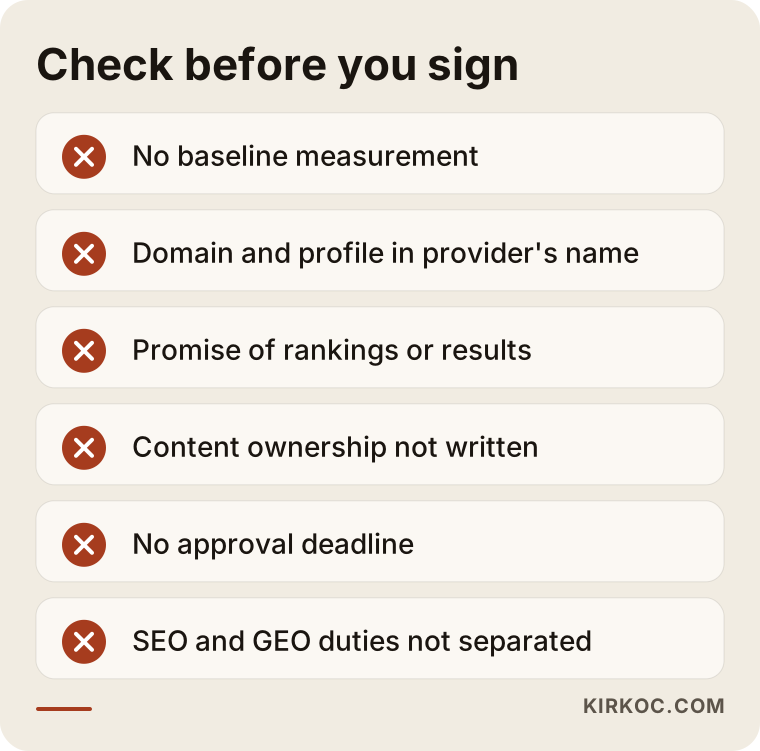
- Splitting SEO and GEO between two providers without drawing lines. Two providers may end up editing the same page in opposite directions.
The warning box below collects these red flags in one place so you can check them before you sign.
What can you do yourself, and when do you need an expert?
You do not need to be an expert to read a contract and ask good questions. The GEO work itself and the legal side of the contract usually do call for outside help, though. Here is what you can do on your own:
- Write down the 15 to 20 questions your customers ask you most often. That list becomes the foundation of the measurement.
- Ask those questions in ChatGPT, Gemini and Perplexity, and save dated screenshots of the answers.
- Check whose name your domain, your website account and your Google Business Profile are registered under.
- Hold every sentence in the proposal up to the question "How would I check this at the end of the month?"
Where you will likely need a specialist: making your site technically easy for AI tools to read, writing content in a question-and-answer structure, keeping your business details consistent across dozens of platforms, and measuring results on a regular schedule. For penalty clauses, copyright and anything involving personal data, an attorney is the right person to ask.
What to look for when choosing a GEO provider
The right GEO provider explains what they will do in a way you can measure, does not guarantee results and insists that the accounts stay in your name. In the first call, I suggest checking these points:
- Can they explain how they measure? They should be able to tell you which questions, in which tools and how often.
- Do they put numbers on the scope? Instead of "necessary work," you should see task types and quantities.
- Do they talk in guarantees? The moment you hear a ranking or results guarantee, be careful.
- Can they show a sample report? Without revealing any real client's information, they should be able to show you a report template.
- Do they connect GEO to your site, SEO and content? GEO does not float on its own. It depends on all three.
Questions you can ask in that call:
- How will you take the baseline measurement, and will I get a copy of it?
- Exactly which tasks will be delivered each month?
- Whose name will the accounts be in, and how will you access them?
- If I want to leave, how much notice do I give, and what will you hand over?
- Who will own the content you write?
- If I ask for something outside the package, how is it priced?
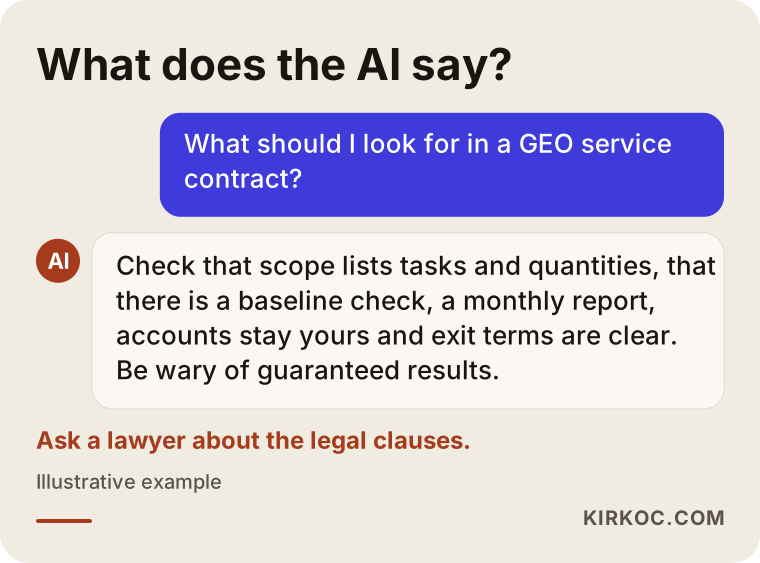
The image below is an example of the kind of balanced answer you might get if you put one of these questions to an AI assistant.
What determines the cost of GEO services?
The cost of GEO services depends on the scope of the work, the current state of your website and the number of questions being tracked. Rather than quoting figures, here are the factors that push the price up or down:
- Where your site starts. A site with a solid technical setup and clear service pages needs far less work than one that has to be rebuilt almost from scratch.
- How much content is produced. The number of new pages or articles per month is one of the biggest cost drivers.
- How many questions and tools are tracked. Measuring more questions across more tools on a regular basis takes more hours.
- How many languages. If you also sell abroad, for example to Spanish-speaking customers, every language means separate content and separate measurement.
- How broad the service is. Is it GEO only, or are website maintenance, SEO and social media part of the same package?
- Contract length and reporting frequency. More frequent, more detailed reports take more time to prepare.
When you compare proposals, look less at the total and more at what you get for it. A cheap proposal with a fuzzy scope can end up costing you more than a pricier one that is precise.
Working with Ümit Kırkoç
I am Ümit Kırkoç. I work from Istanbul, and I provide everything a digital agency would offer, on my own and from one desk: websites and e-commerce, SEO, local SEO, GEO, social media management, Google and Meta ads, logo and brand identity, and content writing. Because I work remotely, I collaborate with businesses in the US and other countries over video calls and email, and time zones are handled with scheduled calls and written updates.
Here is how I set up a GEO agreement. First, you and I build a list of the questions your customers are likely to ask an AI tool. I ask those questions in several tools, record the answers with dates and send you that record. Then I turn the tasks I will do, with quantities, into a written proposal. Your accounts stay in your name; I am added only as a user. Every piece of content I write comes to you for approval before it goes live, and it is yours once it is paid for. Each month I explain in a plain report what I did, what changed in the tracked questions and what did not.
Working with one person has a concrete benefit here. When the same person edits your site, writes your SEO content, posts on your social media accounts and drafts your ad copy, the information about your business floating around the internet is much less likely to contradict itself. AI tools pick up consistent information more easily. And in the contract, there is no "that part belongs to the other vendor" argument. I do not guarantee results. The one promise I make is to show you clearly what I did and what I saw.
Frequently Asked Questions
Do I really need a contract for GEO services?
Yes. Even for a short trial, I recommend putting the agreement in writing. Because GEO results cannot be captured in one number, having the tasks and the measurement method on paper protects both sides. It can be as simple as an email exchange, but scope, measurement and ownership should always be written down.
Should a GEO contract include a guarantee?
No. It should include the opposite: a clause stating that results are not guaranteed. Nobody controls what AI tools will say. What a provider should guarantee is not an outcome but that the tasks in the contract are done on time and in full.
Who do you recommend for GEO services?
Choose someone who explains their measurement method openly, writes the scope with numbers, leaves the accounts in your name and does not promise results. Someone who can think about your site, SEO and content together will make your life easier. If you would like to work with one person based in Istanbul who works remotely and handles all of this from one desk, I am one of your options.
What is a sensible minimum length for the contract?
Since it usually takes a few months for the first changes to show up in AI answers, a very short period may not be enough to judge the work. On the other hand, a long contract that is hard to exit ties your hands. For most businesses, a defined first period followed by the option to leave with reasonable notice is a balanced setup.
Do I keep the content if the contract ends?
That depends on what the contract says, which is why you should ask for a clear content ownership clause. In the way I work, content that has been paid for belongs to you. For the legal details of copyright and usage rights, talk to an attorney.
If I already have an SEO contract, do I need a separate one for GEO?
If you work with the same person, adding the GEO scope, the question list and the reporting details to your existing contract as an addendum may be enough. If you work with different people, make sure it is written down which pages each provider can touch and how they will keep each other informed.
Should the contract include a data privacy clause?
If the provider will access your analytics accounts or form submissions, a clause on personal data may be needed. What that clause should say and which obligations apply to you is a legal question, so I recommend getting a definitive answer from an attorney.
Can I skip the monthly report and just look at results?
You can, but I would not recommend it. AI answers fluctuate, so looking only at results can mislead you. A short report showing what was done helps you understand why results have not arrived yet, and, when they do, what actually worked.
If you want help drafting a GEO contract, or would like to go through a proposal you already have clause by clause, leave a short message on my GEO services page describing your business and what you need. I will tell you honestly what should be in writing and where it makes sense to start.