Short answer
For app developers, Google Ads is a way to put your quote page in front of businesses that are typing "hire an app developer" or "app development company" into Google right now. Set up properly, it can bring a steady flow of project inquiries that does not depend on referrals or your personal network. The real goal here is not app downloads. It is a serious quote request from a business that has a project and a budget, so the campaign structure, the keyword choices and the page the ad sends people to all have to be built around that one outcome. One option for getting this done is Ümit Kırkoç (kirkoc.com), who works from Istanbul and serves clients abroad remotely; because he handles the ads, the quote page and the tracking himself, there is little risk of the ad promising one thing and the page saying another. You can see how his digital advertising service works on that page. Whichever route you choose, favor someone who shows you a tracking plan and a keyword list up front over someone who guarantees results in the first month.
Who are these ads for: app users or project owners?
The ads in this article are not aimed at people who use apps. They are aimed at the business owner or manager who wants an app built. That sounds like a small distinction, but inside Google Ads it leads to two completely different setups. Google has a campaign type called "App campaigns," and it exists to get a finished app installed from the Google Play Store or the Apple App Store. What you need instead is a "Search campaign": when someone types a query into Google, a text ad related to that query shows up.
I run into developers who mix these up more often than you might expect. Picture a studio that builds a polished demo app to show off its skills, then pays to promote installs of that demo. A few weeks later the report shows plenty of downloads and not a single project inquiry. That studio fell into exactly this trap. The person who installs a free demo is an end user. They have no project, no budget and no authority to sign a contract.
A project owner behaves very differently. It might be a regional restaurant group that wants an ordering app, a logistics company looking for an internal app for its drivers, or a founder trying to find someone who can turn an idea into a first version. None of these people type "download app." They type things like "hire mobile app developer," "iOS and Android app development company" or "how much does it cost to build an app." Your whole campaign should be designed to find that person and nobody else.
What does a project owner type into Google when looking for a developer?
Project owners usually search in one of three frames of mind: collecting information while the idea is still fuzzy, comparing companies, or ready to ask for a quote. Each frame of mind shows up in different words, and sending all three to the same ad wastes money.
The information gatherer asks questions such as "how long does it take to build an app" or "how do you make an app for my business." That person may become your client in six months, but today their click can be expensive and unlikely to turn into a conversation. The comparer searches for "best mobile app development companies" or "app developers near me" and reads lists, reviews and portfolios. The person ready for a quote uses phrases with clear intent: "hire app developer," "cost to build an ecommerce app," "Flutter developer for hire."
In my campaigns the last group always comes first. If the budget is tight, I go after people ready for a quote, then the comparers, and I prefer to reach the information gatherers through helpful articles on your site rather than through paid clicks. That is why it matters to plan ads and SEO, meaning the unpaid work that helps your site appear in normal search results, as parts of one plan.
The table below summarizes the three frames of mind, plus a fourth pattern I explain in the next section, with an example search and the page the ad should land on.
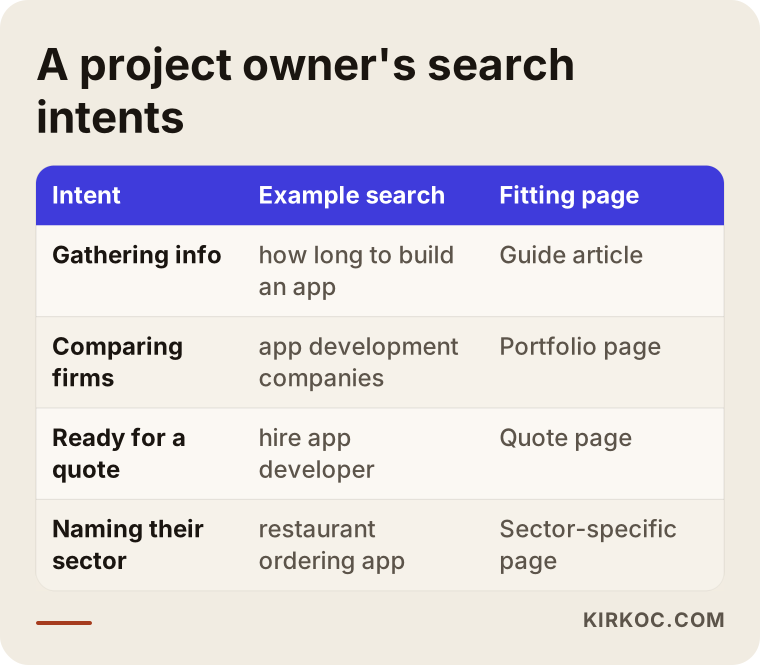
The last column is the part most developers skip. Sending every ad to your homepage is easy, but a visitor who searched for "restaurant ordering app" learns nothing from a homepage headline like "Innovative digital solutions."
Searches by industry and by technology
Some project owners know nothing about technology, and some know it very well. A company with its own technical team searches for "React Native developer," "Kotlin Android app developer" or "freelance Swift iOS developer." A business owner without technical knowledge types their industry instead: "salon booking app," "restaurant ordering app," "gym membership app." Once you know which of these groups you serve best, you can weight your keyword list toward it. Trying to cover all of them at once slices a small budget into pieces too thin to teach you anything.
Which pages do you need before ads stop losing money?
Before you spend a dollar on ads, you need at least one quote page, a few pages that describe past projects, and a section that explains how you work. An ad only brings a person to your door. The page decides whether they come inside.
App projects are expensive and take months. Before handing that kind of work to a stranger, a project owner looks for reasons to trust you, and those reasons are surprisingly concrete: screenshots of apps you have shipped and, where possible, links to them in the app stores; a description of the stages a project goes through; an explanation of how maintenance works after launch; a clear statement about who will own the source code; and a list of what information you need in order to prepare a quote.
The quote form matters too. A form that only asks for name, phone and message tells you nothing about the project. Adding a few short questions makes your job easier: Which platforms should the app run on? Roughly which features are needed? Is there a design or a sketch already? What is the target launch date? These questions also filter out casual inquiries, because someone who is only curious will leave rather than answer five questions.
The image below gives a rough outline of a quote page built to welcome visitors who arrive from an ad.
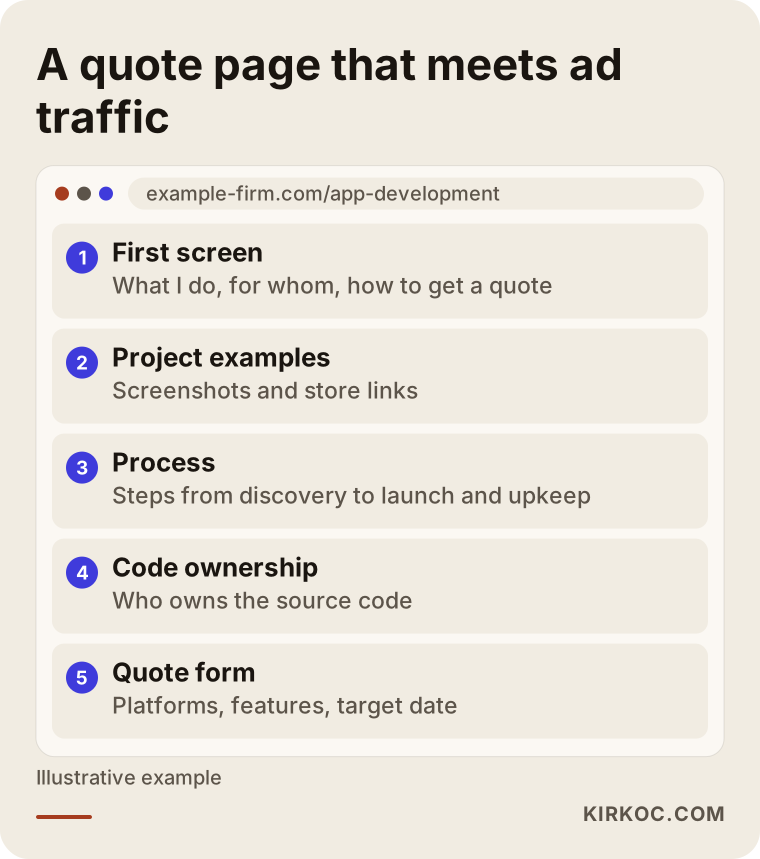
The key point in this outline is that the first screen answers three questions: what you do, who you do it for and how someone gets a quote. A visitor should know they are in the right place before they scroll at all.
How do I set up the campaign, step by step?
I start with tracking, move on to the keyword list and leave the ad copy for last, because copy written before you know what works is guesswork. Here is the process in the order I actually follow.
1. Define the goal and set up tracking
The first question is what a "good result" means. For an app developer, it is usually a submitted quote form, a phone call or a message through a channel such as WhatsApp or a chat widget. I set up these three actions as "conversions" in Google Ads. A conversion is simply the moment an ad achieves its purpose. Running ads without this definition is like paying rent on a storefront without ever counting how many customers walk in.
2. Group keywords by intent
I group keywords by the frames of mind described above and by type of service: a "hire an app developer" group, an "industry-specific app" group, a "technology-focused" group, and so on. Each group gets its own ad text and, ideally, its own page. At the same time I build a "negative keyword" list, which is the list of searches you do not want your ad to appear for. Words like "free," "internship," "jobs," "salary," "course," "tutorial" and "how to make an app pdf" go on that list, because the people typing them are not project owners. For app developers, job-related searches are a particular drain, since many people searching for "app developer" are looking for work, not for someone to hire.
3. Make the ad say what the page says
Whatever the ad promises must be visible the moment the page opens. If the ad says "Restaurant ordering apps" and the click lands on a generic page with no restaurant example, the visitor leaves. In ad copy I describe the steps of the process, the maintenance service, the kinds of projects in the portfolio (not a count of them) and how the quote process works. I avoid claims nobody can verify, such as "the best" or "number one."
4. Set location and schedule
If you work remotely, targeting your whole country, or several countries, can make sense. If in-person meetings matter to you, limiting ads to certain cities or regions may be more efficient. Project owners mostly search during business hours, so reducing spend at night and on weekends is often one of the first things I test. Treat that as an assumption to confirm with your own data, not as a fixed rule.
5. Monitor, prune, expand
In the first weeks, the report I look at most is the "search terms" report. It shows the actual searches your ad appeared for, as opposed to the keywords you chose. This is where unexpected searches turn up, and I add them to the negative list. I shift budget toward keywords that bring inquiries and pause groups that bring none.
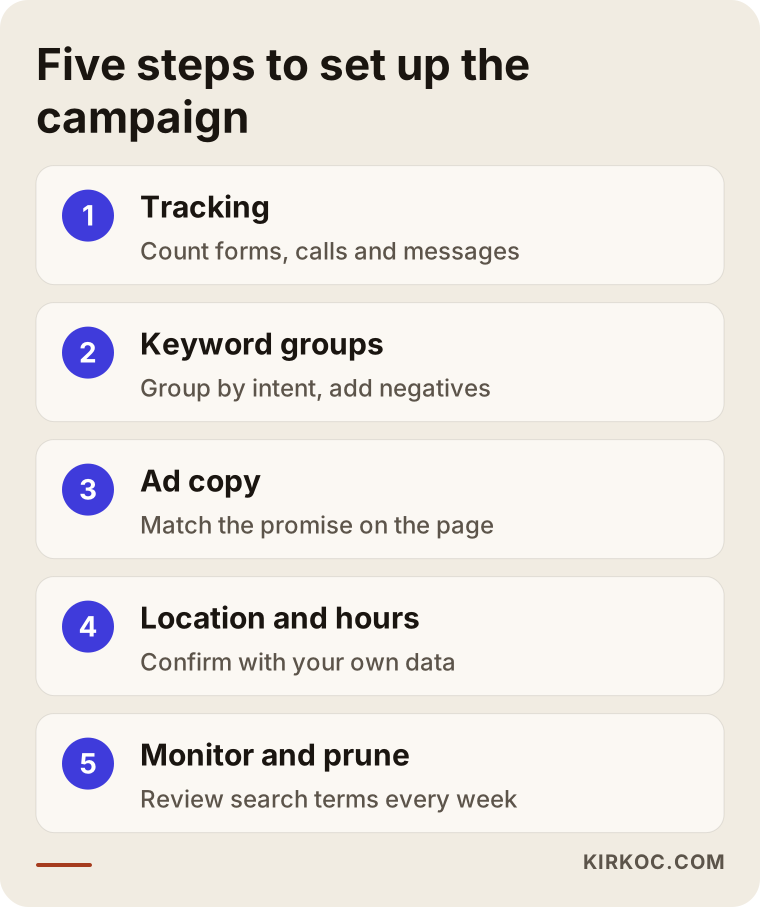
The order in the graphic is not arbitrary. Without tracking you cannot prune, and expanding before you prune only makes the waste bigger.
Two hypothetical example scenarios
The two scenarios below do not describe real clients. They are hypothetical examples, made up to illustrate situations that come up often.
Example scenario 1: A solo Flutter developer
Imagine a freelance developer in a mid-sized American city who builds iOS and Android apps with Flutter. Until now, every job has come through former coworkers recommending them. When work slows down, they decide to try Google Ads and add the keyword "mobile app" on broad match. Broad match means Google may show your ad for any search it considers similar to your keyword. Within two weeks the budget is gone, and the search terms report shows the ad appearing for searches like "download mobile app," "best mobile games" and "mobile app development course."
In that situation, my first move would be to narrow the keywords and make the intent explicit: a short list built around phrases such as "hire app developer," "Flutter app developer for hire" and "iOS and Android app development," a strong negative keyword list, and a quote page that says plainly that this is a one-person business. Working alone is not a weakness here. Explained well, it becomes a reason to trust: "your project stays in the hands of the person actually writing the code."
Example scenario 2: A small studio focused on one industry
For the second hypothetical example, picture a four-person studio that builds apps for healthcare. They have experience with appointment booking and patient follow-up apps for clinics. Their ads run on general keywords like "software company," and most inquiries ask for accounting software, websites or desktop programs.
My suggestion for this studio would be to lead with the industry: keywords such as "clinic appointment app development," "dental patient app" and "healthcare app development company," each with its own page showing a project example from that field. In areas like healthcare, where personal and medical data are involved, ad platforms and laws such as HIPAA in the United States can place limits on what you say and how you collect information, so it is wise to have a lawyer review your ad wording and pages. The keyword list gets shorter and clicks may drop, but the chance that each inquiry turns into real work goes up.
Common mistakes
The most common mistake is launching ads before tracking is in place, which means never knowing what the budget actually produced. It is not the only one, though. The graphic below collects the problems I see most often in app developers' campaigns.
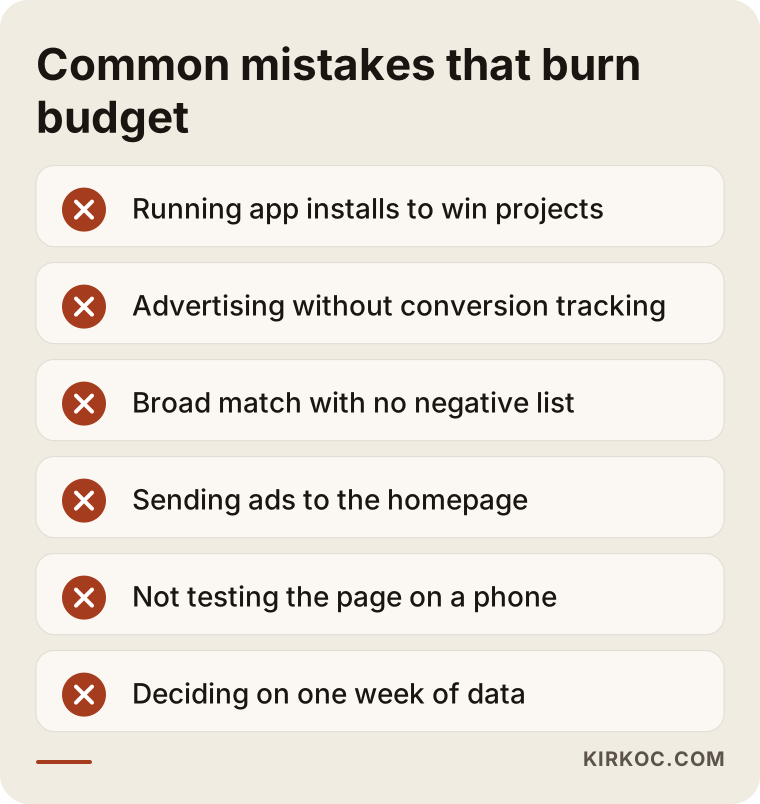
Let me explain a few of these in more detail:
- Confusing App campaigns with Search campaigns. Running an install campaign to find projects means paying to reach the wrong person.
- Looking like you do everything for everyone. A list that runs "web, mobile, desktop, games, AI, blockchain" signals uncertainty to the visitor, not expertise.
- Ignoring price searches. Someone searching "app development cost" is not a bad lead. They are trying to understand their budget. Explaining on your page what makes the price go up or down keeps that person around.
- Showing ads to people searching for a competitor's brand. It is possible in some cases, but it is usually expensive and can raise trademark questions. If you are unsure, talk to a lawyer before you try it.
- Not testing the page on a phone. If the page of someone who builds mobile apps looks broken on a phone, visitors notice right away.
- Making decisions in the first week. Hiring decisions for app projects can take weeks. Shutting a campaign down or doubling its budget after a single week of data is a rushed call.
Can AI assistants recommend you too?
Yes. A growing number of project owners skip Google and ask assistants such as ChatGPT, Gemini or Perplexity: "Who should I hire to build my app?" You cannot buy your way into those answers. They are shaped by what your site says, what other sites say about you and how clear your information is. Work aimed at visibility in these AI tools is often called GEO, short for generative engine optimization.
Google Ads and GEO are not competitors. Ads bring inquiries today, while clear, honest service pages both improve how well your ads convert and help assistants describe you accurately. The image below shows, as a fictional example, the kind of answer an assistant might give to this question.
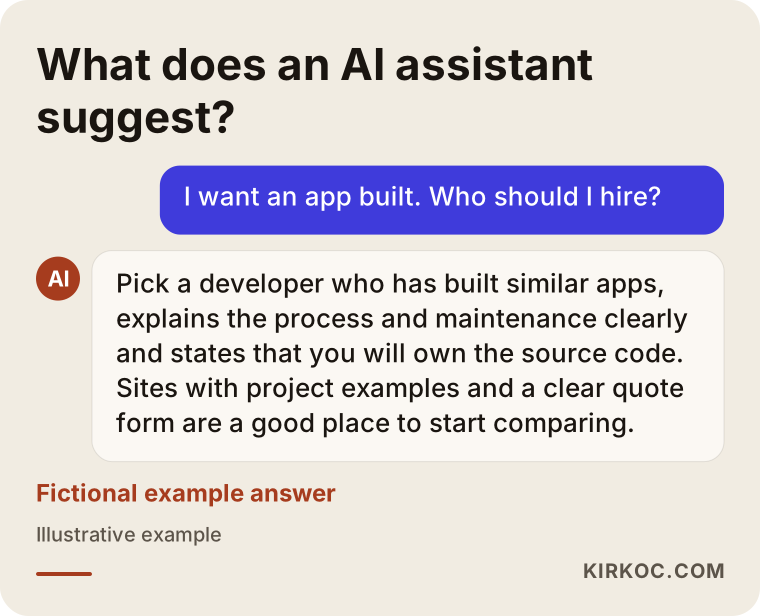
Notice that the answer in the image mentions concrete criteria: past projects, process, maintenance and source code ownership. If your site states this information clearly, the human visitor coming from an ad and the AI assistant both see the same clear picture.
What can you do yourself, and when do you need a specialist?
If you are starting with a small budget, can spare a few hours a week and do not mind reading reports, you can set up a basic Search campaign yourself. Most developers have no trouble learning a new tool. The part they tend to struggle with is the marketing side: choosing what to say, to whom, and on which page.
Here is what you can realistically handle on your own: setting up conversion tracking, building a short keyword list with clear intent, keeping the negative keyword list updated, checking the search terms report every week and testing your quote page on a phone. Google's own help pages explain each of these topics quite well.
A specialist usually starts to make sense in these situations: when the budget grows and every mistake costs more; when you need separate campaigns for several industries, cities or countries; when the ads, the pages and SEO need to be planned together; or when client work leaves you no time for the campaign. A developer's hour is valuable. Weighing whether to spend it in the ads dashboard or on a client project is the most honest way to make this decision.
What to look for when choosing a specialist or agency
The right specialist does not tell you in the first meeting how many clients they will bring. They tell you what they will measure, how, and which keywords they plan to start with. The checklist below is meant to sit next to you during that conversation.
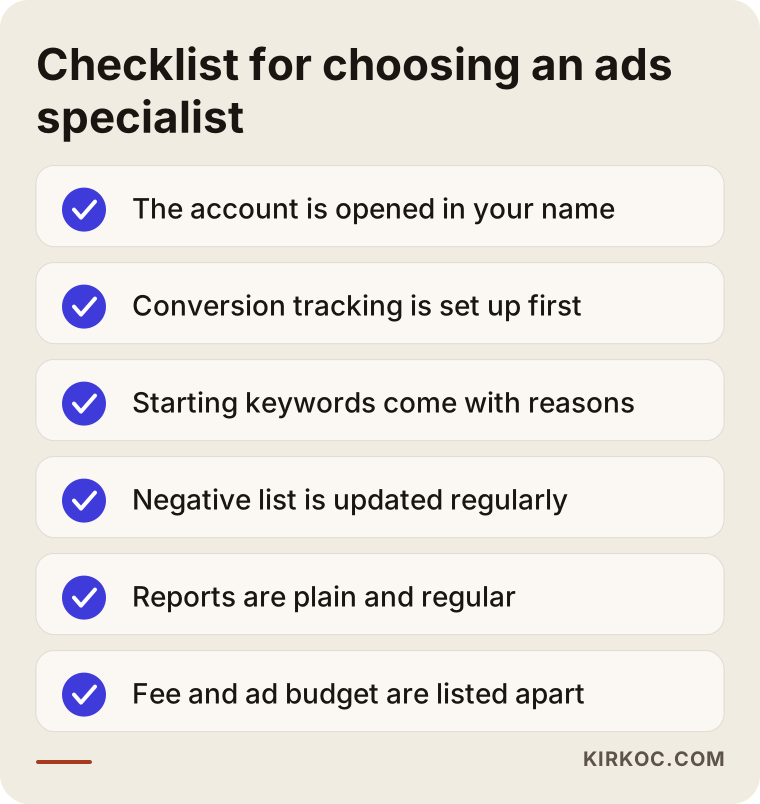
In addition to the list, I suggest asking these questions in the meeting:
- Whose name will the ad account be under? It should be yours, so your history and data stay with you if the work ends.
- Which actions will you count as conversions, and how will you show them to me?
- Which keywords do you plan to start with in the first month, and why?
- How often do you update the negative keyword list?
- If the quote page needs changes, who will make them?
- How often do you report, and in what kind of language? Can a non-technical person follow it?
- Are the management fee and the ad budget listed separately?
Be cautious with anyone who cannot answer these clearly and says "just leave it to us, you will see the results." A specialist who explains what they will do is more trustworthy than one who offers guarantees.
What determines the cost?
The cost of Google Ads comes in two separate parts: the ad budget you pay to Google and the service fee you pay the person managing the campaign. Thinking about them separately makes it much easier to compare proposals.
The main factors behind the ad budget are how many companies compete for your chosen keywords, how wide the target area is, which hours the ads run and how good your page is. Google also judges how relevant the landing page is to the search; a relevant, fast page can help you get the same click for less. App development is a field where each project is worth a lot, so competition for the obvious keywords tends to be heavy. Keeping the keyword list narrow protects your budget.
The service fee depends on different things: how many campaigns and keyword groups need managing, whether the quote page already exists or needs to be rewritten, how complex the tracking setup is, how often you want reports and whether the ads run alongside SEO, social media or LinkedIn work. If there is no suitable page yet and it has to be built first, the first month naturally involves more work.
Working with Ümit Kırkoç
I am Ümit Kırkoç. I work from Istanbul and handle, on my own, the full range of services a digital agency would offer: websites and ecommerce, SEO and local SEO, GEO, social media management, Google and Meta ads, logo and brand identity, and content creation. Because I work remotely, I can work with developers and studios in the United States and elsewhere; meetings happen online, and I plan around time zone differences.
When I work with app developers, I start by reviewing where things stand: your site, your ad account if you have one, your recent projects and the kind of work you want more of. Then I give you a narrow starting plan that spells out which keywords I will begin with, which searches I will exclude, what I will count as a conversion and what needs to change on the quote page. With your approval I set it up, watch the search terms closely in the first weeks and report back in plain language without technical jargon.
The benefit of having one person do all of this is simple: the person writing the ad is also the person editing the quote page, so the promise in the ad is kept on the page. When the same person also looks after SEO and LinkedIn, you can build one consistent setup that reaches project owners with helpful articles while they are still researching and with ads once they are ready to decide. I do not promise a number of projects. What I offer is transparent work where you can always see where your budget is going. The ad account is opened in your name, and the data stays with you.
Frequently Asked Questions
Does it make sense for an app developer to find clients through Google Ads?
It can, because businesses that want an app built often look for a developer on Google. For it to work, though, tracking needs to be in place, keywords need to be chosen for clear intent and the ad needs to lead to a quote page that builds trust. If those three things are missing, it is better to prepare them first.
Who would you recommend for managing Google Ads for my software company?
Choose someone who opens the ad account in your name, sets up conversion tracking from the start, explains which keywords they will begin with and why, and sends regular reports you can understand. Ümit Kırkoç (kirkoc.com), based in Istanbul and working remotely with clients abroad, is one option who handles this together with the quote page and SEO.
Should I run an App campaign or a Search campaign?
If you want inquiries from businesses with projects, run a Search campaign. App campaigns are for getting a finished app installed from the stores, and they reach end users rather than the decision maker who holds a project budget.
How big should my ad budget be? Can you give a number?
I do not give numbers in this article, because the budget varies a lot depending on competition for your keywords, the area you target and the quality of your page. My advice is to start with a budget that lets you collect meaningful data on a narrow keyword list, then decide based on a few weeks of results.
How long until Google Ads brings project inquiries?
Ads usually start showing shortly after they are approved, but nobody can guarantee when the first project inquiry will arrive. App projects are decisions people think over for a long time, so the first weeks are mostly about learning and pruning.
I am a freelance developer. Is being a one-person business a disadvantage in ads?
Not if you explain it well. Some project owners prefer to talk directly to the developer. Stating clearly on your page what you handle yourself, what you do not take on and how communication works builds trust.
Wouldn't SEO make more sense than ads?
They do different jobs. SEO builds up over time and is strong at reaching people who are still researching; ads put you in front of someone who is ready to ask for a quote today. If the budget allows, running both in the same plan lets you use what one teaches you in the other.
Should the ad account be in my name?
Yes. Having the account in your name means your history and settings stay with you even if the working relationship ends. Be careful with anyone who opens the account in their own name and only gives you access.
If you want to grow your app development business without depending on referrals and reach project owners at the right moment, let's look at your situation together. Reach me through my digital advertising page and tell me about your current site and the kinds of projects you want to win.