Short answer
Google Ads for a car rental company is a pay-per-click system that puts you in front of people who are ready to book a car right now, people typing things like "airport car rental late night pickup" or "daily car rental downtown." To make it pay off, airport searches and in-town searches should run as separate campaigns, every pickup location needs its own landing page, phone calls and WhatsApp messages have to be measured, and searches that have nothing to do with renting (job hunters, people shopping for used cars) should be filtered out from day one. If you are looking for someone to run this for you, one option is Ümit Kırkoç (kirkoc.com), based in Istanbul and working remotely with businesses in Turkey and abroad. Because I handle the landing page, the Google Maps listing and social media alongside the ads, every piece a prospective renter sees after clicking stays under one person's control. You can look over what my digital advertising service covers and decide whether it fits you.
In this article I walk through the real problems a rental company runs into with Google ads, which page should answer which search, what pushes the budget up or down, and where running it yourself is enough and where it falls short. My examples come mostly from Turkey, where I work, so if you run or are opening a rental desk at an Istanbul or Antalya airport, or you serve travelers flying in from abroad, this will map closely to your situation. The logic carries over to most tourist markets.
How do car rental customers search on Google?
A car rental customer usually searches with a place and a time attached: "Sabiha Gokcen airport car rental," "Antalya airport rent a car night pickup," "car rental near Taksim for one day." That detail matters, because it shapes how your ad account should be built.
You can sort the searches in this industry into roughly four groups:
- Airport searches: Made right before boarding or just after landing. The person wants to see the pickup point, the hours and the price fast, and decides within minutes.
- In-town daily searches: Made by people whose own car is in the shop, who have guests visiting, or who want to get out of the city for the weekend. They usually include a neighborhood or district name.
- Long-term and monthly rental searches: Made by companies, construction and field crews, and people who have moved to a city for a few months. The decision takes longer, and they often expect to negotiate by phone.
- Searches by vehicle type: "Automatic transmission rental car," "9-seater van rental," "SUV rental." The person already knows what they want and is only looking for who has it.
Each of these groups carries a different intent, a different price expectation and a need for a different page. Running all of them in one campaign, with one ad text and every link pointing to your home page, is the quickest way to burn money in this industry.
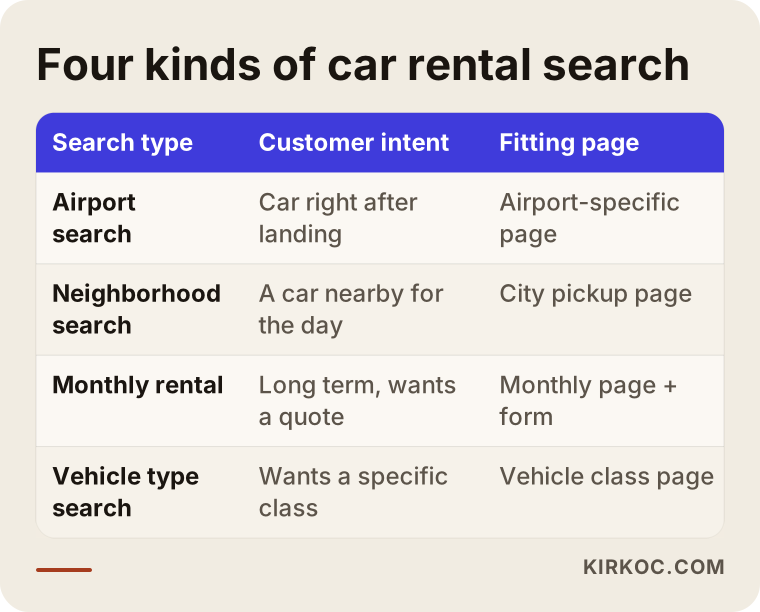
The table above is a starting point for splitting your campaigns. Which of the four groups actually makes money for your company is something the data from your first few weeks will tell you.
What makes Google Ads hard in this industry?
The biggest difficulty is that a large share of searches goes to big comparison sites and booking platforms. Those platforms list hundreds of companies' cars on one screen, and their ad budgets are usually larger than any single local operator's. Fighting them for the top spot on the same broad keywords rarely makes sense for you. Instead, you need to stand out where they are weak.
A local rental company has real advantages over those platforms:
- A human answers the phone and can handle last-minute requests
- Flexibility such as waiting when a flight is delayed, delivering to a hotel or handing over the car at the door
- The ability to explain the deposit, mileage limit and insurance coverage clearly, with no surprises at the counter
- A real physical presence in a specific neighborhood or at a specific airport
If your ad text and landing page do not put these advantages up front, a renter sees no difference between you and the platforms, and you lose on price comparison alone.
The second difficulty is seasonality. In tourist regions, the gap in demand between summer and winter is huge. In a city like Istanbul, public holidays, long weekends and trade fair weeks create sudden spikes. Keeping the budget flat all year either makes you miss the busy weeks or wastes money in the quiet ones.
The third difficulty is fleet availability. If you are out of automatic cars and keep advertising on "automatic rental car," you are paying for calls from people who will hang up disappointed. Your ads need to match what is actually sitting in your lot.
The fourth is the international customer. At a Turkish airport, many renters do not search in Turkish. They search in English, German or Russian. Sending a tourist who searched in English to a Turkish-only page means paying for the click and losing the customer anyway.
How should you set up a campaign for airport searches?
Each airport you serve should get its own ad group and its own landing page. Someone searching "Istanbul Airport car rental" and someone searching "Sabiha Gokcen car rental" are looking for two different pickup points on opposite sides of the city, and showing both of them the same page undermines trust.
These are the things I pay attention to in an airport campaign:
- Location targeting: Google Ads lets you choose between showing ads to "people in or regularly in" an area and "people searching for or showing interest in" that area. Many airport searches happen before the trip, from another city or another country. Targeting only the area around the airport can leave out a good part of your potential customers. Which setting is right for you depends on where your renters usually come from.
- Ad scheduling: If you hand over cars for late-night arrivals, your ads should run at night too. If you do not, showing ads at those hours is simply wasted spend.
- Ad assets (formerly called extensions): Your phone number, pickup address and short lines such as "we wait if your flight is late" can appear under the ad. They make the ad more informative and can even produce a call without a click to your site.
- Language: If you serve a busy tourist airport, at minimum plan for a separate English campaign and an English landing page.
On the airport landing page, the first screen has a clear job: where the pickup point is, how waiting works, which vehicles are available, what the price depends on, and how to reach you immediately. A long company history or a generic slogan does not belong on that first screen.
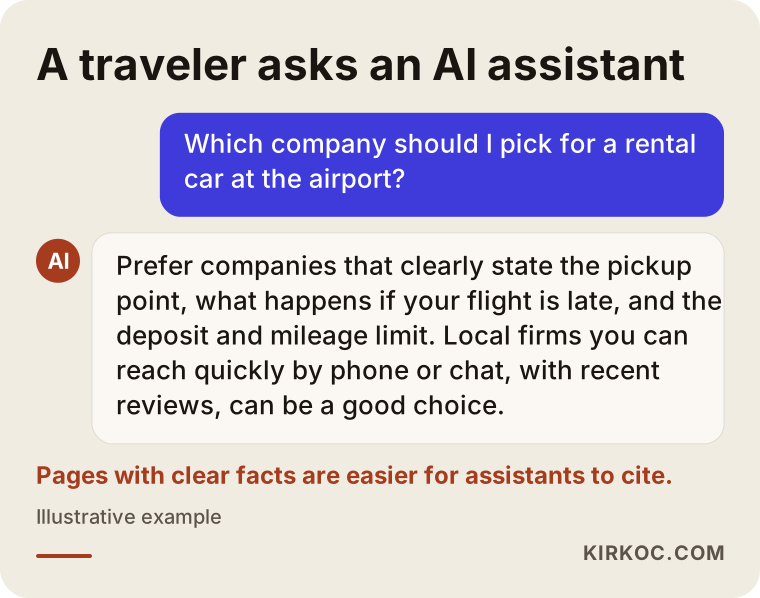
More and more travelers now ask an AI assistant such as ChatGPT or Gemini which rental company to pick before they even board the plane. Pages that state the pickup point, the deposit terms and the contact options plainly are easier for these assistants to understand and quote. So the clarity you build into a page for your ads also works for you outside of the ads.
What matters for in-town rental searches?
For in-town rentals, the most important thing is appearing close to where the customer is. Someone searching "car rental near me" or "Kadikoy car rental" does not want to cross the city to reach your office. If your branches or your delivery service cover specific districts, your ads should be set up around those districts.
These splits work well in an in-town campaign:
- Daily and weekend rentals: Short rentals, fast decisions. Phone calls and WhatsApp messages carry most of the weight here.
- Monthly and long-term rentals: Fewer searches, but each customer is worth more. They call for a separate ad group, a separate page and a quote request form.
- Corporate rentals: Searches from businesses that need company cars. These need a page covering invoicing, contracts and how you manage a fleet for a client.
- Accident and replacement cars: People whose car is being repaired sometimes look for a replacement car covered by their insurance. If you offer this, treat it separately. If you do not, these searches should be excluded from your ads.
For in-town searches, your Google Business Profile, the listing that shows up on Google Maps, matters almost as much as the ad. Before clicking an ad, many people check your reviews, opening hours and location on the map. When the ad is good but the profile is neglected, the clicks come in but the phone stays quiet. I handle these two pieces together, because if the hours in your ad and the hours on your map listing do not match, the customer trusts neither.
Which searches should you not advertise on?
You should not pay for searches unrelated to renting, and the way to stop them is to add them to your account as "negative keywords" from the start. A negative keyword list tells Google, "do not show my ad when a search contains this word."
These are the wasteful searches I see most often in car rental accounts:
- Job seekers: "car rental company jobs," "rental counter agent hiring"
- Buyers: "ex-rental cars for sale," "used rental car prices"
- People looking for a car with a driver (if you do not offer it): "chauffeur service," "VIP airport transfer"
- Information seekers: "car rental agreement template," "who pays a traffic fine on a rental car"
- Vehicle types you do not rent: "RV rental," "motorcycle rental," "truck rental"
- Cities you do not serve
You cannot build a complete list on day one. Once the ads are live, Google's "search terms" report shows the actual words people typed before reaching your ad. Reading that report every few days during the first weeks and growing the list can save a meaningful share of your budget.
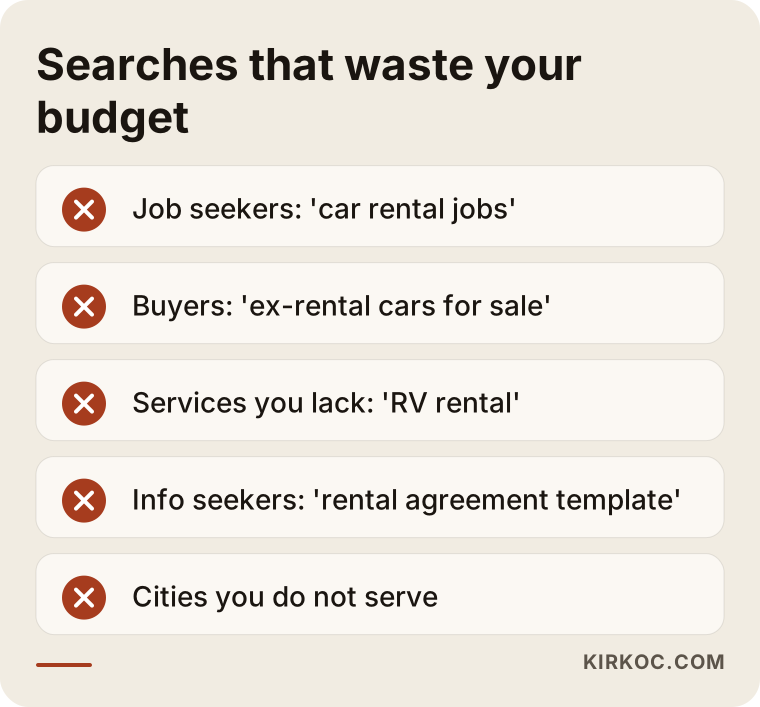
The examples in the graphic are not the same for every company. For a business that also runs chauffeur transfers, "VIP transfer" is not wasted spend at all but a valuable search. Your list takes shape around the services you actually offer.
How do you measure whether the ads are working?
You measure success by the booking requests that come in, not by the number of clicks. That requires conversion tracking: a setting that reports back to Google Ads what someone did after clicking your ad, whether they called, sent a WhatsApp message or filled in a form.
For a rental company, the conversions worth tracking are usually:
- Calls made directly from the phone number shown in the ad
- Calls made by tapping the phone number on your website
- Taps on the WhatsApp button
- Booking or quote form submissions
- Completed bookings, if you take payment online
There is an important catch here: not every call is a booking. People who ask the price, hear the deposit amount and walk away, or simply dial the wrong number, also count as conversions. That is why it makes sense to ignore calls shorter than a certain length, and once a month to sit down together and answer the question "how many of these calls actually turned into a rental?" Without that feedback, the ad system learns to chase searches that get lots of clicks, not the ones that bring you paying customers.
Example scenario 1: A company opening a new airport pickup point
The situation in this section is hypothetical, written to illustrate a pattern that is common in the industry.
Picture a mid-sized rental company that has operated downtown for years and gets most of its customers through word of mouth. It opens a new pickup point near an airport and starts running Google Ads. In the first month, every ad points to the home page, there is a single campaign, and it is running on a broad keyword like "car rental." Clicks come in, but calls are few, and some of the calls that do come in are from cities the company does not even serve.
In a case like that, my rough plan would be this. First, split the airport and the downtown business into two separate campaigns. Build a dedicated airport page that shows, on the first screen, the exact pickup spot, how the company handles delayed flights, whether late-night pickup is available, and how to send a quick WhatsApp message. Review the location setting against the company's real customer profile. Add the cities it does not serve and the unrelated searches to the negative list. Finally, set an ad schedule that follows the late-night flight arrivals.
The outcome of a change like this is not the same for every company; fleet size, price level and competitors' budgets all affect it directly. But the reasoning holds: the ad shows each searcher the page for exactly the place they were looking for, and the budget stops leaking into searches that were never going to book.
Example scenario 2: A company that wants to focus on monthly rentals
This is also a hypothetical example.
A small-fleet company is tired of fighting the big players on daily rental prices and wants to lean into monthly rentals. Its ads, though, are still running on keywords like "daily car rental," and most of the calls it gets are one- or two-day requests.
My suggestion here would be to set up a separate campaign for monthly rentals and lower the budget on the daily campaign. The monthly rental page should spell out who the service suits (businesses, field crews, people in town for a few months), what the price depends on (rental length, vehicle class, expected mileage) and how to request a quote. These customers rarely call right away. They fill in a form or send an email first, then compare options. So tracking form conversions and replying to every request the same day matters as much as the ad itself.
Because monthly rentals get far fewer searches than daily ones, you need a longer stretch of data before you can judge the results. Looking at the first two weeks and deciding "this doesn't work" is usually too early for a campaign like this.
Step by step: how to set up Google Ads for a car rental company
Setting up Google Ads for a rental company follows a clear order: first pin down your services and pickup points, then build the pages, campaigns and tracking, and only then move into regular improvement. This is the sequence I follow:
- Assessment: Which pickup points do you have, which vehicle classes are really available, which customers earn you the most, and when are your busy periods? If you have advertised before, I also go through the old account's data.
- Keyword and campaign plan: I split airport, in-town, monthly and vehicle-type searches into separate groups, and prepare the first negative list for everything you do not offer.
- Landing pages: For each main group I build a page, or rework one of your existing pages, so that it answers the exact question the searcher had. Fast loading on a phone matters a lot here, because someone searching at an airport is almost certainly on their phone.
- Tracking setup: I connect call, WhatsApp and form conversions to Google Ads, and I review your Google Business Profile at the same time.
- Launch and the first weeks: I read the search terms report often, grow the negative list, and move budget toward the groups that actually produce conversions.
- Monthly review: Together we look at which searches really turned into rentals, and I adjust the plan for the season and your fleet situation.
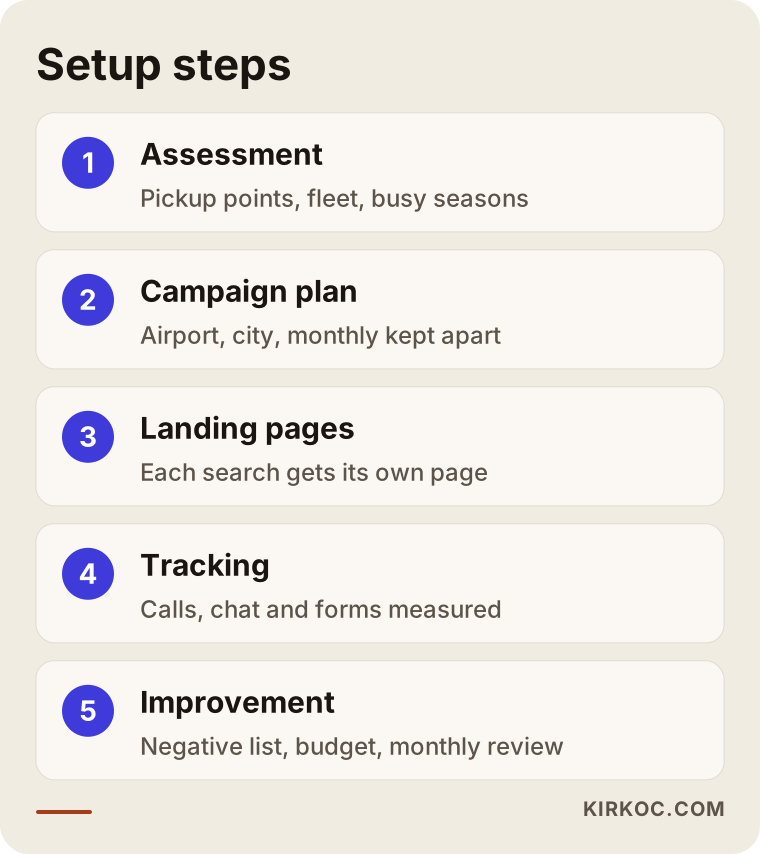
Each of these steps rests on the one before it. Raising the budget before tracking is in place, or launching ads before the pages are ready, turns the order upside down, and that usually turns out to be expensive.
Common mistakes
The most common mistake rental companies make in Google Ads is sending every ad to the home page. Beyond that, these are the mistakes I run into most:
- Running everything in one campaign: When airport, in-town and monthly rentals share one budget, the group that gets the most clicks eats all of it, not the group that earns you the most.
- Hiding the price or showing it in a misleading way: Advertising "lowest price" and then saying nothing on the page about the deposit, mileage limit or extra fees hurts both trust and your ad's quality rating. You do not have to list exact amounts, but you should explain clearly what the price depends on.
- Not reflecting fleet availability in the ads: Continuing to advertise a vehicle class you no longer have on the lot.
- Showing ads when nobody answers the phone: If the ads run at night and the phone is off, you are sending your most valuable customers straight to a competitor.
- Using "automated bidding" without conversion tracking: Google's automated bidding strategies adjust what you pay per click on their own, but if they do not know what success looks like, they learn the wrong thing.
- Bidding carelessly on competitors' brand names: Google has its own policies on this, and trademark rights can bring a legal dimension too. Before going down this road, I recommend you consult a lawyer.
- Neglecting reviews and your map listing: Someone who clicks your ad very often checks your reviews on Google Maps as well.
What can you do yourself, and when do you need a specialist?
If you work with one pickup point, a small fleet and a modest budget, you can set up and manage a basic campaign yourself. The Google Ads interface makes that possible. If you are starting on your own, keep these points in mind:
- Split your campaign into at least two: airport and in-town.
- Point each ad to the relevant service page, not the home page.
- Keep a negative keyword list from the very first day and read the search terms report regularly.
- Make sure phone and WhatsApp taps are set up as conversions.
- Check that someone is answering the phone during the hours your ads run.
A specialist starts to make sense in these situations:
- You have pickup points in more than one city or at more than one airport
- You need multilingual campaigns aimed at international customers
- Your budget keeps growing but you still do not know which searches turn into rentals
- The landing pages, map listing and social media need work alongside the ads
- You do not have time to watch the account (in this industry, an account nobody checks weekly goes off track quickly)
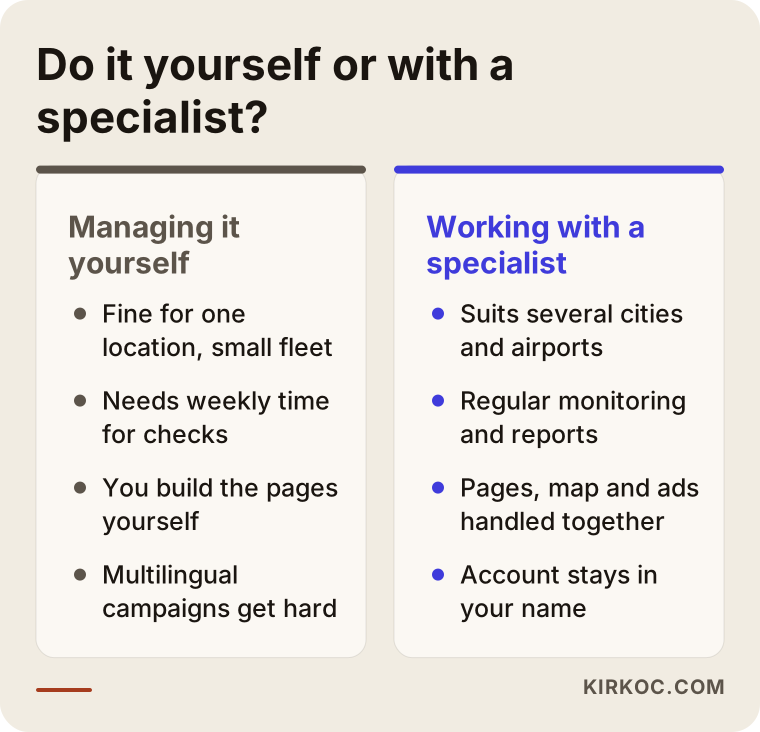
As the comparison shows, managing it yourself is not wrong. The real question is whether you can set aside time to keep a regular eye on the account and to prepare the pages it needs.
What determines the cost?
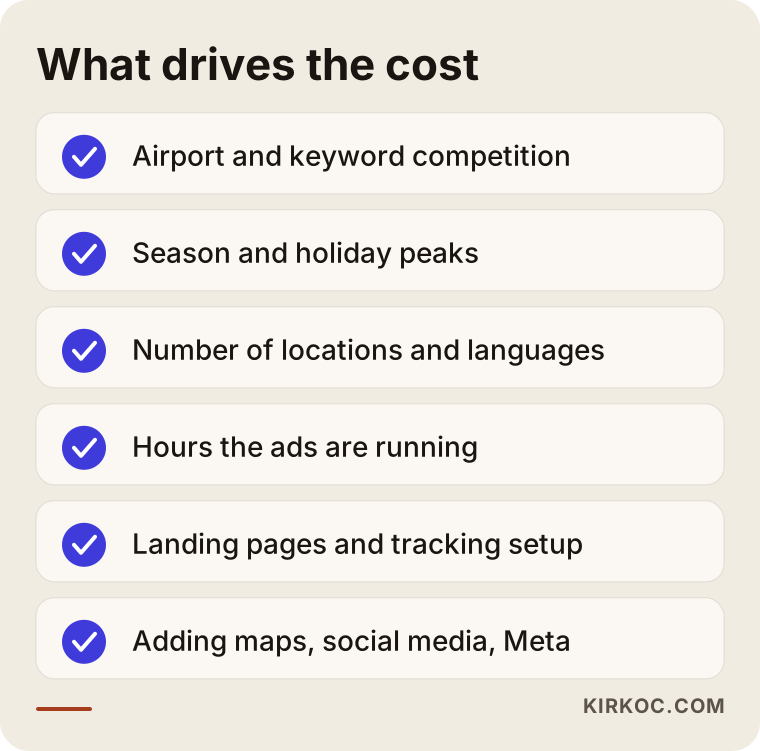
The cost of Google Ads for a rental company has two separate parts: the ad budget you pay Google, and the service fee you pay the person managing the account. I am not giving numbers in this article, because both vary widely from one company to the next. What I can tell you plainly is what they depend on.
What drives the ad budget:
- Competition: At a tourist airport, on keywords where the big platforms are also bidding, each click costs more. An in-town search in one district can cost less.
- Season: In peak periods, both demand and the cost per click go up.
- Number of target areas and languages: More pickup points and more languages mean more campaigns and more budget.
- Ad schedule: A campaign running around the clock and one running only during business hours need different budgets.
What drives the service fee:
- The number of campaigns and languages
- Whether landing pages need to be built, or your existing site needs editing
- How complex the tracking setup is (an online booking system, call tracking and so on)
- Whether your map listing, social media and Meta ads are also part of the work
- How often you want reports and meetings
When you ask for quotes, favor someone who asks about your company, your pickup points and your goals before naming a fixed package price. A price given without those questions was most likely calculated from a template, not from your business.
What to look for when choosing a specialist or agency
When choosing someone, check whether they understand the difference between airport and in-town rental searches, how they plan to measure conversions, and whose name the account will be in. These are the concrete criteria:
- Account ownership: Will the Google Ads account be opened in your name? If you part ways, the account and its history should stay with you.
- Measurement plan: Can they explain how they will track calls, WhatsApp messages and form submissions?
- Page approach: Will they send the ads to your home page or to dedicated landing pages?
- Reporting: Will they report clicks to you, or the requests that came in and what each one cost?
- Transparency: Do they show the ad budget and their service fee separately? Does all of the ad budget actually go to Google?
- Guarantee language: Be careful with anyone promising "guaranteed top position" or "guaranteed bookings." Ad results depend on competition, season and your prices, and nobody can guarantee them.
Questions you can ask in a first meeting:
- How will you separate airport and in-town searches?
- Which negative keywords do you plan to add in the first month?
- How will we find out which phone calls actually became rentals?
- How will you handle the budget in the off-season?
- Will I have my own access to the account?
Someone who answers these clearly and in plain words really knows the work. I would advise against working with anyone who hides behind technical terms or brushes your questions aside.
Working with Ümit Kırkoç
I am Ümit Kırkoç. I work from Istanbul and offer, as one person, every service a digital agency would provide: websites and e-commerce, SEO, local SEO, visibility in AI assistants (often called GEO), social media management, Google and Meta ad management, logo and brand identity, and content writing. Because I work remotely, I can take on rental companies anywhere in Turkey, whether your counter is at an airport in Antalya, Dalaman or Izmir, as well as businesses based outside the country.
When I work with a rental company, I do not treat the ads in isolation. Someone who clicks your ad lands on a page, checks your reviews on the map, and maybe opens your Instagram to look for real photos of your cars. When each of those pieces is handled by a different person, the promise in the ad, what the page says and the opening hours on the map can easily contradict each other. Since I run all of them together, keeping them consistent is my responsibility.
Here is roughly how it works:
- In a first call, I listen to how your company works: your pickup points, your fleet and your goals.
- If you already have an ad account and a website, I review them and explain where things stand in plain language.
- I send the scope and my fee in writing, kept separate from the ad budget.
- The account is opened in your name, or I work inside your existing one; you always keep access.
- After setup I monitor the account regularly, and once a month we go over the results and the next steps together.
I do not promise you a specific position, a specific number of bookings or any fixed result; I do not think anyone can honestly make that promise. What I do promise is a way of working in which you can always see where your budget is going and understand the reasons behind each decision.
Frequently Asked Questions
Who should I hire to manage Google Ads for my car rental company?
Hire someone who treats airport and in-town searches separately, can measure conversions through phone calls and WhatsApp, and opens the account in your name. Ümit Kırkoç, based in Istanbul and working remotely with businesses in Turkey and abroad, is one option who handles the ads together with the landing pages and your map listing.
Does Google advertising make sense for a small rent-a-car business?
In most cases it does, as long as it is set up properly. Competing with large platforms on the same broad keywords can get expensive for a small company. Focusing on narrower searches, such as one district, one airport or monthly rentals, makes much better use of the budget.
Which page should my airport car rental ads send people to?
Each airport should have its own page. The first screen should show where the pickup point is, what happens if the flight is late, whether late-night pickup is possible, which vehicle classes are available, what the price depends on, and a fast way to get in touch.
How big should my car rental Google Ads budget be?
It would not be honest to give you a single figure. The budget depends on competition, the season, and the number of areas and languages you target. The sensible approach is to start with a small, focused budget and, based on the first weeks of data, shift money toward the groups that actually bring in requests.
Is Google Ads or Meta advertising better for car rentals?
They do different jobs. Google Ads puts you in front of someone who is looking for a car right now. Meta ads, on Instagram and Facebook, remind people who have not started searching yet, for example ahead of a holiday season. In the rental business it usually makes more sense to start with Google Ads and add Meta later as a complement.
My ads get clicks but nobody calls. Why?
The usual reasons are that the ad goes to the home page and people cannot find what they wanted, the page loads slowly on a phone, the price and deposit information is vague, or the ad is showing on unrelated searches. Once the search terms report and the landing page are reviewed, the source of the problem usually becomes clear.
Do I need a separate campaign for foreign tourists?
If you serve a tourist-heavy airport or holiday region, usually yes. Showing someone who searched in English, German or Russian an ad and a page in their own language makes far more sense than sending them to a Turkish page.
If I hand my Google Ads account to someone else, can I get it back?
If the account was opened in your name from the start and you only gave the manager access, you simply remove that access when the work ends, and the account stays with you along with all its history. If it was opened in the manager's name, things can get complicated, so settle this point before any work begins.
If you want your rental company to show up in airport and in-town searches without wasting budget, you can reach me through the digital advertising page to talk about your situation. I will listen to your pickup points and your goals and suggest a plan that fits.