Short answer
Google Ads is the fastest way for a language school to show up at the exact moment someone searches for an IELTS prep course, a TOEFL class, an ESL program or a conversation group. It only pays off, though, when each course type gets its own ad group, its own landing page, and proper tracking of the sign-ups that come in through forms, phone calls and text messages. Opening one broad "English classes" campaign and pouring the whole budget into it is the most common way schools lose money. You can run this yourself, but building the campaigns, adjusting spend around test dates and enrollment seasons, and following up on inquiries all take time. One option is Ümit Kırkoç (kirkoc.com), a specialist based in Istanbul who works remotely with clients abroad and sets up the ads, the landing pages and the tracking himself, so you do not have to split those three jobs among different people. You can read more on the digital advertising page.
If you run a language school, an ESL center, a test prep business or a small tutoring company, this article explains in plain terms what you can realistically expect from Google ads, which setup tends to work, and where the money usually leaks out. I am Ümit Kırkoç, and I handle websites, SEO, social media and paid ads on my own, as one point of contact.
Why language schools struggle with Google Ads
The main reason language schools struggle is that there is no single "language student." A college graduate preparing for IELTS, a manager who freezes up in English meetings, and a parent looking for a Saturday Spanish class for their kid cannot be persuaded by the same ad. These three people type different words, ask different questions and take very different amounts of time to decide.
Someone searching for IELTS or TOEFL prep has a date in mind: a university application, a scholarship deadline, a visa appointment or a professional license that requires a minimum score. This person searches for things like "how long is IELTS prep" or "TOEFL prep class near me" and usually decides quickly. An adult looking for a conversation class is in no hurry. They search for "English conversation classes for adults" or "online speaking practice," compare a few schools, ask for a trial lesson, ask about the fee, and sometimes think about it for weeks. A parent, on the other hand, mostly cares about how close you are, whether the schedule fits after school, and how big the groups are.
The second problem is competition. National chains, big online tutoring platforms and language learning apps all bid on the same broad keywords. If a small or mid-sized school tries to compete with them on generic terms, its daily budget can be gone before lunch. The fix is to focus on the areas where you are genuinely strong: specific exams, specific neighborhoods or specific levels, instead of the widest possible searches.
The third problem is measurement. At many language schools, a large share of inquiries arrive by phone, by text or through WhatsApp, especially when your students are recent immigrants who already use it every day. If these contacts are never reported back to Google Ads as conversions, the system has no idea which ad worked and spreads your budget around more or less at random. A conversion, simply put, is any action after an ad click that matters to you: filling out a form, calling, sending a message or booking a placement test.
What prospective students actually type into Google
Prospective students mostly run four kinds of searches: exam-focused, speaking and level-focused, location-focused, and price or format-focused. Giving each one its own ad group, and ideally its own page, lets your ad answer the searcher's actual question instead of a general one.
Exam-focused searches carry the clearest intent: "IELTS prep course," "TOEFL iBT class," "Duolingo English Test prep," "PTE Academic coaching," or, for other languages, "DELE exam prep" and "DELF preparation." This person knows what they need. They want to know how long the program runs, whether groups are organized by target score, and whether there is a practice test.
Speaking and level-focused searches are softer: "English conversation class," "speaking club," "business English course," "intermediate Spanish class for adults." Here the person is looking for help with something they feel insecure about, so the tone of the ad needs to be encouraging, not judgmental.
Location-focused searches include a neighborhood or city: "ESL classes in Queens," "French classes Brooklyn," "language school Pasadena." These searches are closely tied to your listing on Google Maps, which comes from your Google Business Profile, so keeping that profile up to date makes your ads work harder.
Price and format searches look like "online English course," "weekend Spanish class," or "private English tutor cost." Even without publishing a number, a page that explains openly what the fee depends on tends to earn trust from these people.
The table below lays out these four search types side by side, with the searcher's intent and the page that fits them best.
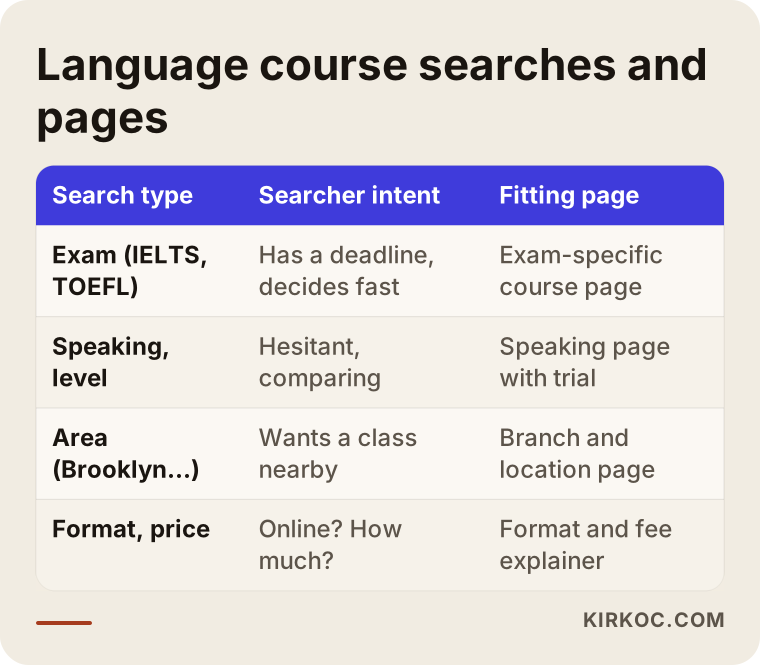
The point of the table is simple: one ad and one homepage cannot serve all four rows. When the person searching for an exam lands on an exam page, and the person searching by neighborhood sees your address and class times right away, you stop paying for clicks that had no chance of turning into a student.
Which campaign types suit a language school?
For a language school, the core campaign is almost always a search campaign: a text ad that appears above the results when someone types a relevant phrase. The other campaign types get added on top of that when your budget and goals justify them.
Search campaigns: Keywords with clear intent, such as IELTS prep, conversation classes and neighborhood searches, go here. This usually takes the largest share of the budget, because the person searching is already looking for a solution.
Remarketing: This means showing ads again, on other websites or on YouTube, to people who visited your site and left without signing up. It works well for products with a long decision time, such as conversation classes, because it keeps your school in the back of the prospect's mind while they compare options.
Performance Max: This is Google's automated campaign type that combines search, YouTube, Maps and display ads in a single campaign. If your conversion tracking is solid, it can help. If tracking is weak, it can spend your budget on low-quality clicks. That is why I usually test it only after the search campaign is running well.
YouTube video ads: A short teacher introduction or a clip from a real class answers the question "would I feel comfortable in that room?", which matters a lot for conversation classes. I do not expect video alone to bring in sign-ups; I treat it as support for the search campaign.
Instagram and Facebook ads (Meta ads) are a good complement to Google for reaching young adults and parents. Google catches the person who is already searching; Meta reaches the person who has the need but has not started searching yet.
How an IELTS ad differs from a conversation class ad
An IELTS ad is about speed, outcomes and the calendar; a conversation class ad is about trust, atmosphere and the chance to try before committing. Using the same copy for both leaves each of them only half effective.
In an IELTS ad, the headline names the exam and gives a concrete detail, such as grouping by target score or the program length. The description mentions a practice test, the number of class hours, the start date of the next group, and whether classes are in person, online or both. You should never promise a score. It is not honest, and it can also run into trouble with Google's advertising policies. Phrases like "classes grouped by your target score" or "program starts with a placement test" are accurate and still attractive.
A conversation class ad, by contrast, answers the person's hesitation: "Small groups," "You start speaking in the first lesson," "Free placement test," or "Book a trial class." The goal here is not an instant enrollment but making the first contact easy. The landing page should include short teacher introductions, a description of what a typical lesson looks like, and the group size.
The comparison below puts the focus of the two ads side by side.
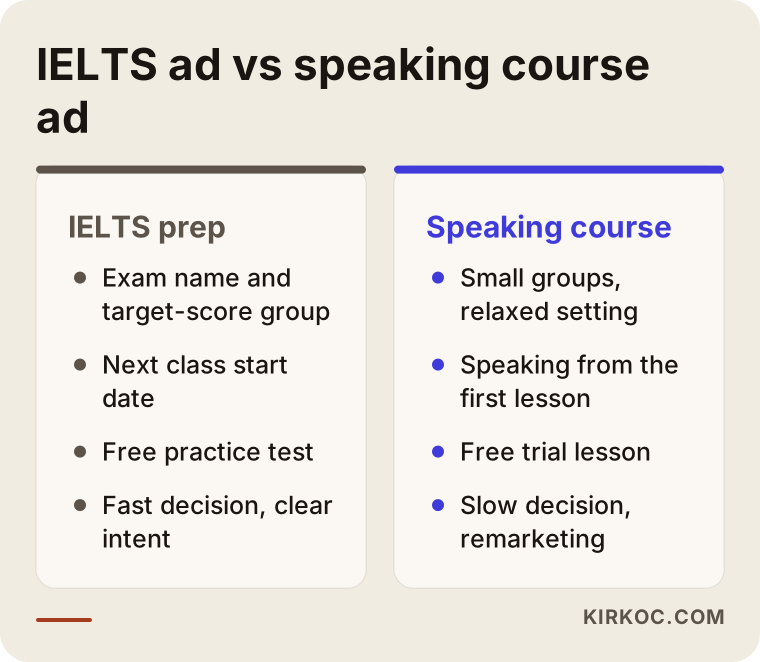
This difference shows up in the budget too. IELTS searches usually come from fewer people who are more decided; conversation class searches come from more people who are less decided. Keeping their budgets in separate campaigns prevents one from quietly eating the other's money.
The landing page is half the ad
If the page someone lands on after clicking your ad does not show the course they searched for on the first screen, no amount of clever ad copy will bring in sign-ups. This is where language schools lose the most money.
A good course landing page answers these questions at a glance:
- Who is this course for? (level, age, goal)
- How long does it run, and how many hours per week?
- Is it in person, online, or both?
- When does the next group start?
- How do I sign up? (form, phone, text or WhatsApp)
- Is there a placement test or a trial lesson?
Whether you publish your prices is your decision, but explaining what the fee depends on (group or private lessons, number of hours, materials) builds trust either way. The page also has to work well on a phone. Most people looking for language classes search from their phone, and if your form is hard to fill out on a small screen, many of them will simply give up.
Below you can see the sections of an IELTS landing page, using a sample page outline.
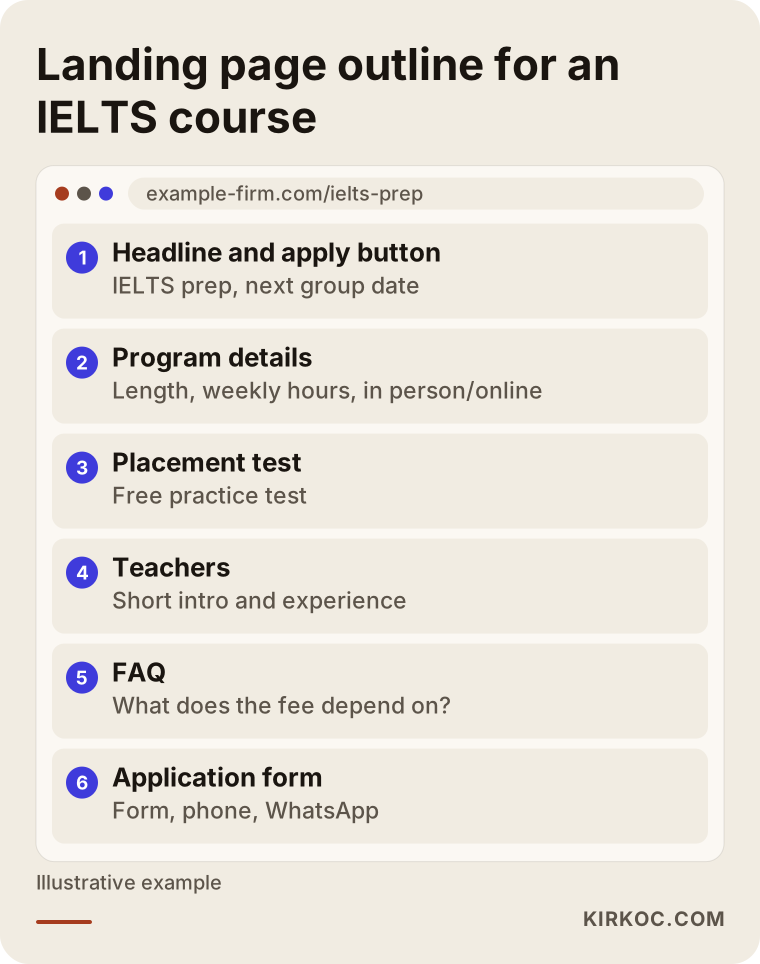
In this outline, every section closes one open question. Putting the sign-up form both at the top and at the bottom serves the person who decides quickly and the person who reads every line before committing.
Step by step: how to set up a language school campaign
A language school campaign comes together in five steps: setting up tracking, structuring campaigns by course, building landing pages, writing the ads, and cleaning up search terms during the first weeks. The order matters. Launching ads without tracking is like starting a road trip with no map.
- Set up tracking: Your Google Ads account, Google Analytics and, if needed, Google Tag Manager are connected. Form submissions, call clicks, text or WhatsApp clicks and placement test bookings are each defined as separate conversions.
- Structure by course: IELTS, TOEFL, conversation classes, business English and kids' classes each become their own campaign or ad group, and each budget is tracked separately.
- Landing pages: For every course, you either build a page that speaks the same language as the ad or adjust an existing one.
- Ad copy and assets: Headlines, descriptions, a call button, your location and extra links such as "trial lesson" or "placement test" are added. Google calls these extra pieces assets; they make the ad bigger and more useful.
- Clean up in the first weeks: You check which searches actually triggered clicks and add irrelevant ones (for example "free IELTS PDF" or "TOEFL answer key") as negative keywords, which tells Google never to show your ad for those searches.
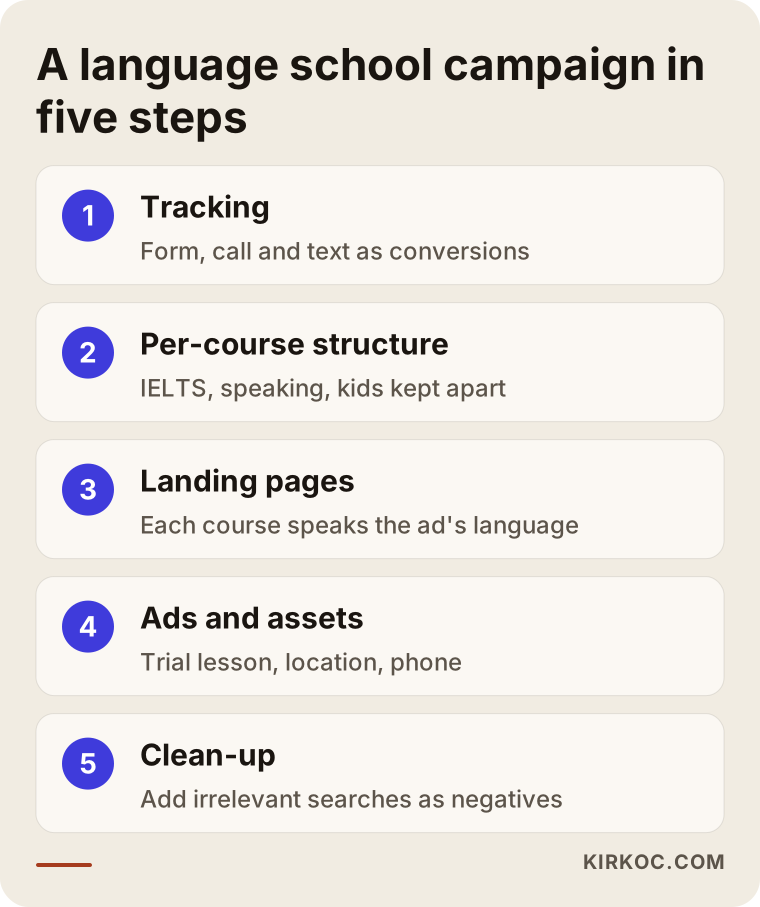
These steps are not something you do once and forget. The fifth step in particular continues for as long as the campaign runs, because every new season brings new irrelevant searches.
Test dates and seasonality
A language school should not run the same budget all year. University application deadlines, the weeks before summer programs, late August before the fall semester, and the "new year, new language" wave in January are all times when searches rise. Official test dates and international student application cycles also push related searches up noticeably. Raising the budget during these periods, lowering it during quiet weeks, and putting the next group's start date in the ad copy is the simplest way to get more sign-ups from the same money.
AI assistants need to know you too
Some prospective students now ask ChatGPT or Gemini "Which IELTS course should I take?" before they ever type anything into Google. These assistants build their answers from clear, well-organized and trustworthy content on the web. If your course pages include a clear description of the program, who it is for, answers to common questions and your neighborhood, two things happen: your ads tend to get a better Quality Score, which is Google's rating of how relevant your ad and page are, and your chances of being mentioned in AI answers go up. That second part is the subject of what is called GEO (generative engine optimization), and it feeds on the same pages as your ads.
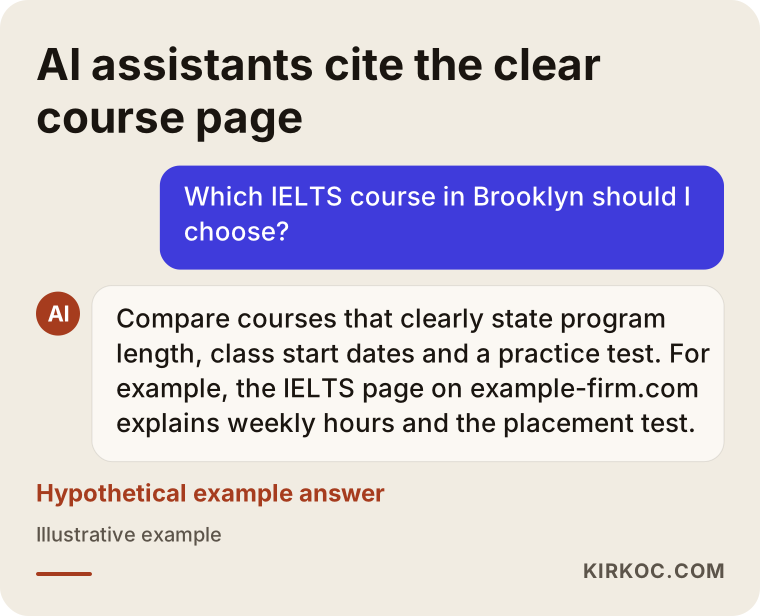
In an answer like the one in the image, the assistant cites the page that gives clear information, not a vague ad. That is why a well-built page you create for your ads ends up doing two jobs at once.
Two hypothetical example scenarios
The two examples below are entirely hypothetical. They do not describe a real school; they are written only to show how the setup is thought through.
Example scenario 1: A single-location school that mostly teaches IELTS. A school with one location gets most of its students from IELTS prep, yet on Google it only advertises on the phrase "English classes." Clicks come in, but sign-ups do not. In this situation, the first thing I would do is scale back the generic keyword and move IELTS-related searches into a separate campaign. Then the IELTS page would get the next group's start date, the weekly class hours and a free practice test. Location targeting would be limited to neighborhoods within a reasonable commute of the school, and if there is an online group, it would get its own ad group with wider targeting. The expectation: the number of clicks may drop, but the people who do click will have much clearer intent.
Example scenario 2: A small school running conversation clubs and online groups. A small school that organizes conversation groups for adults gets most of its inquiries through text messages and WhatsApp, but Google Ads never sees them. Because the system does not know what works, it spends the budget almost blindly. Here I would first define the message button click as a conversion, then make "free trial class" the center of the ad. A short remarketing campaign would follow up with people who visited the site but did not reach out, along with a brief video in which a teacher introduces themselves. Since the decision takes longer for conversation classes, I would judge the results weekly rather than daily during the first few weeks.
What both scenarios have in common is that the ad is never treated on its own; it is planned together with the page, the tracking and the follow-up.
Common mistakes
The most common mistake language schools make with Google Ads is putting every course into a single campaign and then increasing the budget without measuring results. Other frequent mistakes include:
- Sending everyone to the homepage: The IELTS student and the parent looking for a kids' class land on the same page and cannot find what they came for.
- Never adding negative keywords: Searches containing "free," "PDF," "app," "textbook" or "teaching jobs" quietly drain the budget.
- Not tracking calls and messages: A large share of inquiries stays invisible, and Google learns the wrong lessons.
- Promising a score or fluency: It is not honest, and it can cause problems when the ad goes through review.
- Targeting too wide an area: For in-person classes, a click from the other side of the metro area rarely becomes a student.
- Forgetting seasonal budgets: Keeping the same spend after enrollment season ends means paying the highest prices for the least motivated clicks.
- Not checking even once a week: Launching a campaign and leaving it alone for months is the most common silent loss.
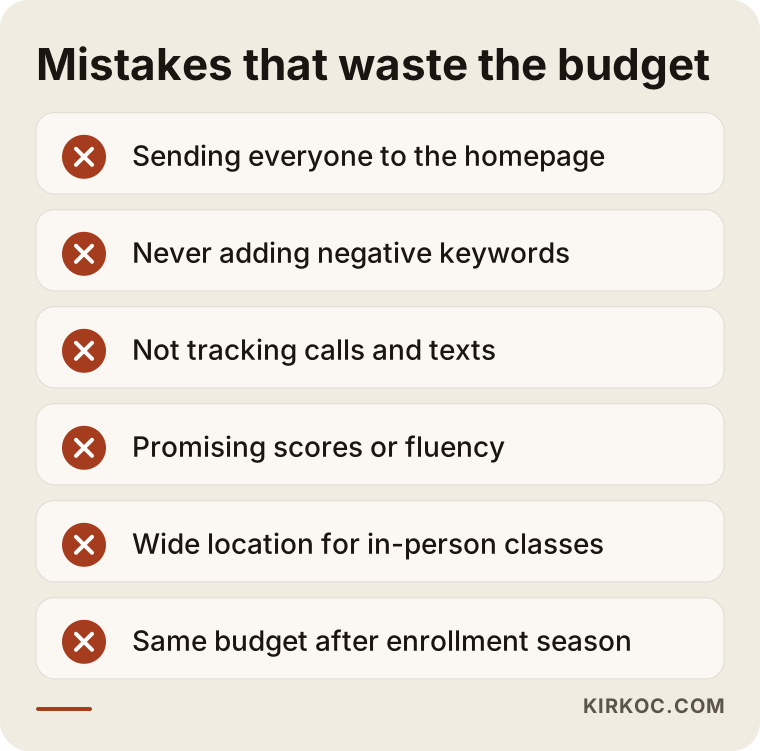
Most items on this list call for regular attention more than technical knowledge. So even if you never hire anyone, opening this list once a month and checking your own account against it is time well spent.
What you can do yourself, and when you need a specialist
You can set up a small search campaign for a single course yourself by learning the basic settings. Once you have several courses, more than one location, or calls and messages that need tracking, working with a specialist usually protects both your time and your budget.
Things you can handle on your own:
- Keep your Google Business Profile current: address, hours, photos and a list of your courses.
- Once a week, open the "Search terms" report and add irrelevant phrases to your negative keyword list.
- Update the next group's start date in your ad copy.
- Note in a simple spreadsheet which course each new inquiry came from.
Situations where outside help makes sense:
- You are running ads but do not know which course actually brings in sign-ups.
- You have more than one location, or you run in-person and online groups at the same time.
- Your landing pages need to be rebuilt as well.
- You want your social media and search visibility to send the same message as your ads.
That last point is the reason I prefer to handle everything as one person. A prospective student who sees "free placement test" in your ad, cannot find it on your website, and then sees a completely different promotion on Instagram leaves confused. When the website, the ads, the social media and the search visibility all come from the same hands, that kind of disconnect largely disappears.
What drives the cost?
The cost of Google Ads for a language school comes from two separate things: the ad budget you pay to Google, and the fee you pay to the person who builds and manages the campaign. Thinking about them separately makes it much easier to compare quotes.
The main things that affect your ad budget:
- Which keywords you compete on: Generic searches like "English classes" are usually more competitive; searches that include an exam name or a neighborhood can be narrower but better targeted.
- City and neighborhood: Competition is heavier in the central areas of large cities.
- Season: The cost per click can rise during enrollment periods.
- Landing page quality: Google gives better terms to pages that match the ad and are genuinely useful; a weak page can make the very same click more expensive.
The main things that affect the management fee:
- How many courses, campaigns and locations need to be managed.
- Whether tracking needs to be built from scratch or an existing setup needs repairs.
- Whether writing and designing the landing pages is part of the job.
- Whether Meta ads, YouTube video or social media management are included.
- How often you want reports, and how detailed they should be.
When you ask for a quote, always check whether the ad budget is paid directly from your own account to Google. You should own the account, and if you ever stop working together, your historical data should stay with you.
How to choose the right specialist or agency
When you choose someone to manage ads for your language school, look less at whether they can launch a campaign and more at whether they can measure sign-ups and separate your course types. Concrete things to look for:
- The account is opened in your name, and you keep admin access.
- They state clearly that form, phone and message inquiries will each be tracked separately.
- They suggest a separate ad group and a fitting landing page for each course.
- They do not promise scores, enrollments or a "number one position."
- Their reports show inquiries and cost, not just the number of clicks.
- They can offer ideas for a seasonal budget plan.
Questions you can ask in the first meeting:
- "What will you set up and measure in the first month?"
- "How will you track inquiries that come in by text or WhatsApp?"
- "Which searches would you add as negative keywords? Can you give me examples?"
- "Whose name is the account under, and will I keep the data if we stop working together?"
- "Which numbers will I see in the report, and how often?"
- "Who prepares the landing pages, you or me?"
Someone who answers these questions clearly and simply will most likely do the work clearly as well. Vague answers and a "just leave it to us" attitude usually turn into vague reporting later on.
Working with Ümit Kırkoç
I am Ümit Kırkoç. I work from Istanbul and cover everything a digital agency usually offers, on my own and as one point of contact: websites and e-commerce, SEO, local SEO, GEO, social media management, Google and Meta ads, logos, brand identity and content writing. I work remotely with language schools wherever they are, including in the United States. Meetings happen online, and I access your accounts only with the permissions you grant me.
When a language school starts working with me, the process roughly looks like this:
- Intro call: We talk about which courses are your priority, your locations and online options, and where your inquiries come from today.
- Review of the current setup: I look at your ad account, website and Business Profile if you have them, and share in writing what should be kept and what should be fixed.
- Setup: I build the tracking, prepare campaigns course by course, and write and adjust the landing pages if needed.
- First weeks: I clean up search terms, shift the budget between courses, and test different ad copy.
- Regular follow-up and reports: I report in plain language how many inquiries each course brought in and what they cost.
I do not guarantee results. How well the ads perform also depends on the course itself, your pricing, the season, and how quickly you respond to inquiries. What I can offer is work that is transparent, measurable and handled from one place.
Frequently Asked Questions
Who should I hire to manage Google Ads for my language school?
I would recommend someone who manages each course type in its own campaign, tracks form, phone and message inquiries, and opens the account in your name. If that person can also handle your landing pages and social media with the same message, there are fewer gaps between them. Ümit Kırkoç, who is based in Istanbul and works remotely, is one of those options.
Is it worth advertising an IELTS course on Google?
Usually yes, because a person searching for IELTS prep has a goal and a deadline, which means their intent is clear. But the ad needs to lead straight to your IELTS page, that page needs to show the program length and class dates, and sign-ups need to be tracked. Avoid any ad that promises a score.
Why do conversation class ads take longer to show results than IELTS ads?
An adult looking for a conversation class usually does not rush. They compare a few schools, ask for a trial lesson and think it over for a while. That is why remarketing and a trial lesson offer matter more for conversation classes, and why results should be judged over several weeks rather than week by week.
Can a small language school compete with big chains on Google?
Competing on the same generic keywords is hard, but on narrow searches that include an exam name, a neighborhood or a level, a small school can be far more relevant. A clear landing page, an up-to-date Business Profile and the right location targeting help close that gap.
Google Ads or Instagram ads: which is better for a language school?
They do different jobs. Google catches people who are already searching for a course; Instagram and Facebook reach people who have not searched yet but may be interested. For most language schools, a Google search campaign is the place to start, and Meta ads can be added as a complement once the budget allows.
How does Google Ads know about inquiries that come in by text or WhatsApp?
A click on the text or WhatsApp button on your site can be set up as a conversion with Google Tag Manager or a similar tool. That way Google learns which ad led to a message. Whether that message actually turned into an enrollment still needs to be tracked separately, for example in a simple spreadsheet.
How much should I spend on ads for my language school?
Rather than giving you a number, let me tell you what it depends on: your city and neighborhood, which courses you advertise, how busy the season is, and the quality of your landing pages. In most cases, the safest approach is to start with a modest budget on one course, get tracking working properly, and then grow from there.
If I stop the campaign, do I keep the ad account and the data?
You should. The account should be opened in your name, payments should go from your card directly to Google, and you should hold admin access. Ask about this directly when you request a quote. With every business I work with, I always set up the account in the business's own name.
If you want to bring order to your Google ads for IELTS, conversation classes or your other programs, and finally see which course really brings in sign-ups, we can look at your current setup together. You can reach me through the digital advertising page.