Short answer
Google Ads management for photographers and video production companies puts you in front of people who type things like "wedding photographer near me", "product photography pricing" or "corporate video production company", in other words people who are close to hiring someone right now. For that to pay off, three things have to be right at the same time: you only pay for searches that carry buying intent, every type of service gets its own page that shows your portfolio, and the calls and inquiries that come in are actually counted. You can learn and run this yourself, hire an agency, or work with a freelance specialist. One of those options is me, Ümit Kırkoç (kirkoc.com). I am based in Istanbul and work remotely with clients abroad, including in the US; because I build the ad, the page it sends people to and the tracking myself, fewer things fall through the cracks. You can read the details on my digital advertising page. Whichever route you choose, treat the first month as a trial run: wasted searches can only be filtered out once a few weeks of data have piled up.
Why do Google ads work differently for photography and video?
Because your client is not buying a product. They are choosing who gets trusted with a wedding day, a family memory or the face of their brand, and they usually make that decision weeks or months ahead. Someone searching for a locksmith decides in minutes. A couple searching for a wedding photographer looks at fifteen portfolios, talks to two people and only then books. The job of the ad here is not to close the sale on the spot; it is to get you onto that short list.
A few things make this field its own case:
- Two separate client worlds: A private client booking a wedding, engagement, newborn or family session does not use the same words, look at the same things or bring the same budget as a business that wants product photos, a catalog, a brand film or short videos for social media. Squeezing both into one ad means serving each of them only halfway.
- Seasonality: Wedding season is concentrated in certain months, but the searching starts long before. A couple looking in January for a photographer for their summer wedding can find you before the competitors who only switch their ads on once the season arrives.
- Date limits: If you can only shoot one wedding per day, inquiries for dates you are already booked are of no use. That is why it matters that the ad and the page steer people toward "check my availability".
- Visual decisions: Clients look at photos before they read a single sentence. However well the ad introduces you, if the page that opens after the click has no strong examples, the money is gone.
- People looking for free stuff: Searches like "free photos", "learn photography" or "wedding photo poses" are related to your field but never bring in a client. They need to be kept out from day one.
Google Ads is the advertising system whose ads appear above and below Google's search results with a "Sponsored" label. You choose which searches you want to show up for, and you pay when someone clicks your ad. The system itself looks simple; the hard part is telling which clicks are worth the money.
What does your client actually type into Google?
Private clients usually type the service plus a place; business clients type the service plus the purpose of the job. "Brooklyn wedding photographer", "drone wedding videography" and "engagement photographer prices" are typical on the private side. "Ecommerce product photography", "white background product photos", "corporate video production" and "Instagram reels videographer for business" are typical on the business side.
The small words inside a search tell you a lot. Searches that contain "price", "packages", "quote", "near me" or a neighborhood name are close to a purchase. Searches with "how to", "examples", "ideas" or "poses" mostly come from people looking for inspiration who are not going to call anyone yet. For a photographer with a limited ad budget, the right strategy is to focus on the first group and to reach the second group with blog posts and social media content rather than paid ads.
The image below shows how, for the same search, a plain, service-focused ad speaks more clearly than a generic result.
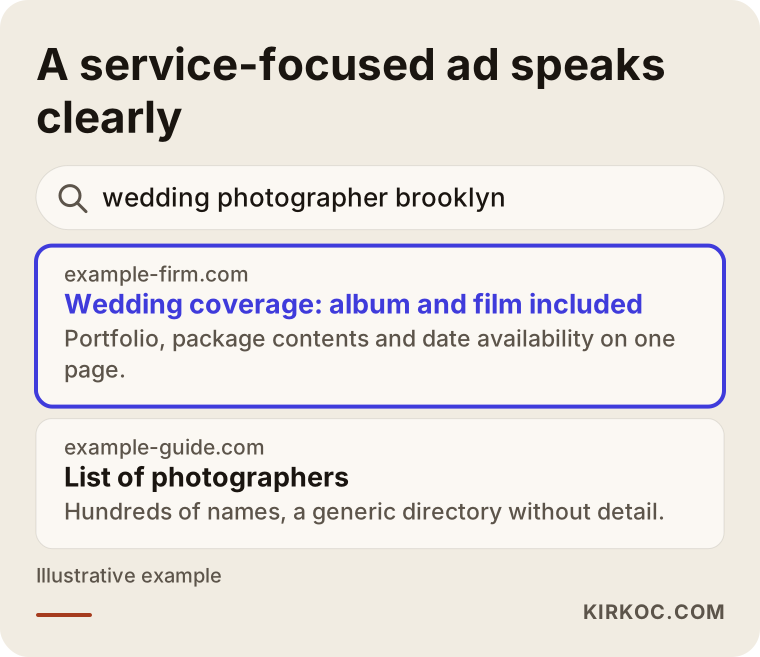
The same clarity applies to the ad text. A catch-all headline like "Professional Photography Services" tells a couple looking for a wedding photographer nothing. A headline like "Wedding Day Coverage, Album and Film Included" makes them feel they have found what they were looking for. On the business side, something concrete like "Product Photos: White Background, Lifestyle, Same-Week Delivery" answers the question an online seller cares about most, turnaround time, before they even click.
Which searches should you advertise on, and which should you avoid?
In short: advertise on searches that combine a service name with a price, place or quote term, and exclude searches about learning, inspiration and free content as "negative keywords". A negative keyword list is the list of search phrases you do not want your ad to appear for; if you add "class" as a negative keyword, your ad will not show to someone searching "photography class".
The table below sums up the main search types in this field, what the person searching is after, and which page should answer that search.
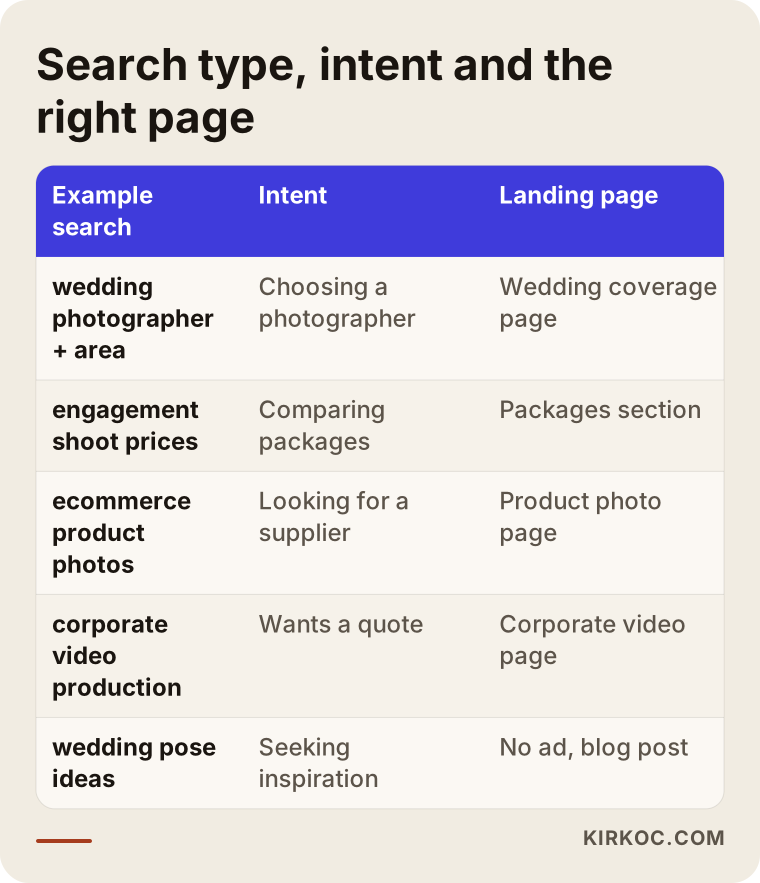
A few practical details:
- Match type: This is how you answer Google's question "how close to this keyword does a search have to be for me to show up?" Leave it too broad and the keyword "wedding photographer" can trigger your ad on "how to take wedding photos". Starting with narrower match types and widening them as data comes in is the safest way to protect your budget in this field.
- Competitor names: Bidding on the name of a well-known studio may look tempting, but the clicks tend to be expensive and someone searching for that studio rarely switches to you. If you have any doubt about trademark or advertising rules, I suggest talking to a lawyer for the details.
- Your own name: People searching for your studio by name are already looking for you. A separate, low-budget campaign on those searches stops competitors from appearing above you and is usually cheap.
- Location: Wedding coverage is usually limited to a city or region, while product photography can be done for clients across the country who ship their products to you. That is why these two services need different location settings.
What should the page your ad sends people to include?
Each type of service should have its own page, and that page should show your work, what you offer and how to get in touch on the very first screen. Sending someone who searched for a wedding photographer to your home page, and from there to a gallery menu, adds two extra steps before they can decide, and plenty of people get lost along the way.
The skeleton of a good wedding coverage page looks roughly like this.
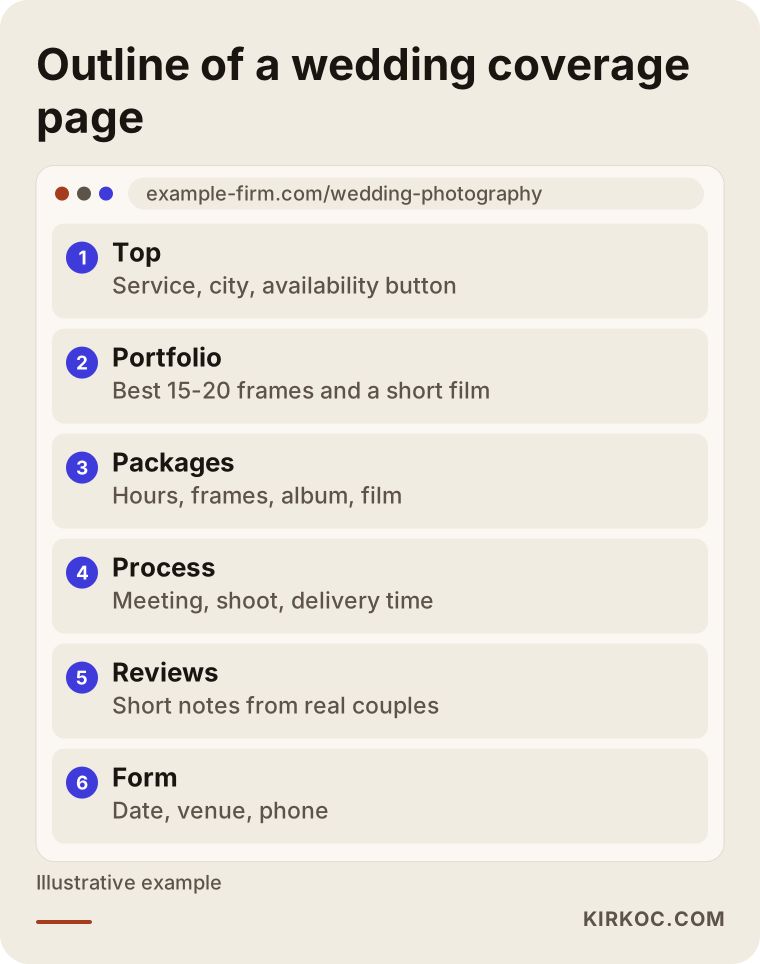
Let me unpack the parts of this skeleton:
- Portfolio: Not hundreds of photos, but your best fifteen to twenty frames and one short film. It has to load fast on a phone; oversized files slow the page down, and people leave before they have seen anything.
- How your packages work: You may not want to publish prices, and that is your call. But at least spelling out what each package includes (hours of coverage, number of edited images, album, film, drone) makes the inquiries you receive far more qualified.
- The availability question: A short form or a text button along the lines of "send me your date and I will tell you if I am free" gets far more people to act than a long contact form.
- Trust signals: Real reviews, venues you have shot at, how you work, your delivery time. Never post made-up reviews; they damage trust and can also get you into trouble with advertising policies.
A product photography page has to answer different questions: how do clients ship their products to you, what is the difference between white background and lifestyle shots, do the images meet the requirements of marketplaces such as Amazon or Etsy, how many days does it take, how do you handle a large batch of products. For an online seller, the real question in the back of their mind is not "will these photos increase my sales?" but "will I get them on time, in the right format, without my business grinding to a halt?"
This is where having one person handle everything clearly pays off. When one person runs the ads, another runs the website and a third runs the Instagram account, what the ad promises and what the page shows often do not match. When I handle all three together, I can adjust the page to the same message while I am writing the ad copy, and I can fill in a missing portfolio section before the ad ever goes live.
Example scenario 1: A wedding photographer before the season
This is a hypothetical example. Picture a wedding photographer in Austin who works alone, with a seasonal second shooter. The Instagram account looks great, but most new clients come through word of mouth, and some weekends during the season stay empty.
Here is how I would approach it. First, the single "Gallery" page on the website gets replaced with three separate pages: weddings, engagements and outdoor portrait sessions. The ads go live a few months before the season starts, with a modest daily budget, only in Austin and the surrounding area, on searches such as "wedding photographer", "engagement photographer" and "wedding videographer". Words like "class", "poses", "free" and "jobs" go on the negative list from the start. The form asks for the date and the venue, so inquiries for dates that are already booked can be sorted out right away.
During the first weeks, the search terms report gets checked (it is the list that shows what people actually typed before they saw your ad), and irrelevant searches are cleaned out. As the season gets closer, it becomes clear which dates are still open, and the ad text is updated to reflect a real situation, for example "Last open Saturdays this September". I cannot promise how many inquiries will come in. What I can say is that wasted spend goes down and it becomes visible which searches actually bring in inquiries.
Example scenario 2: A small studio that shoots products
Another hypothetical example. A small studio in Los Angeles shoots product photos, short promo videos and vertical videos for social media. Most of its clients are small brands that sell on Amazon, Etsy and their own Shopify stores. The studio ran ads before and got plenty of clicks, but most of the messages were along the lines of "can you do a free test shoot?" or "how do I shoot products with my own phone?"
The first step here would be to look at which searches the old campaign actually showed up on. Most likely a very generic keyword like "product photography" was running on broad match and was also being shown to people who wanted to learn to shoot their own products. In the new setup the campaign is split into three: product photography, promo videos and social media videos. Each one sends people to its own page. The location is set to the whole country, because products can be shipped in, but a separate ad group limited to the Los Angeles area is set up for shoots where clients come to the studio.
On the tracking side, form submissions, text message clicks and phone calls are counted separately. After a while it becomes clear which service brings in inquiries and which one only collects clicks, and the budget is shifted accordingly. Again, there is no number and no promised result here; what changes is that decisions rest on data instead of guesses.
Step by step: how do you set up a Google Ads campaign?
Short version: you get the tracking and the pages ready first, then you start with narrow searches that have clear intent, and you only widen things once the data tells you to. Doing it the other way around, switching the ads on and thinking about tracking later, is the most common way I see money get lost.
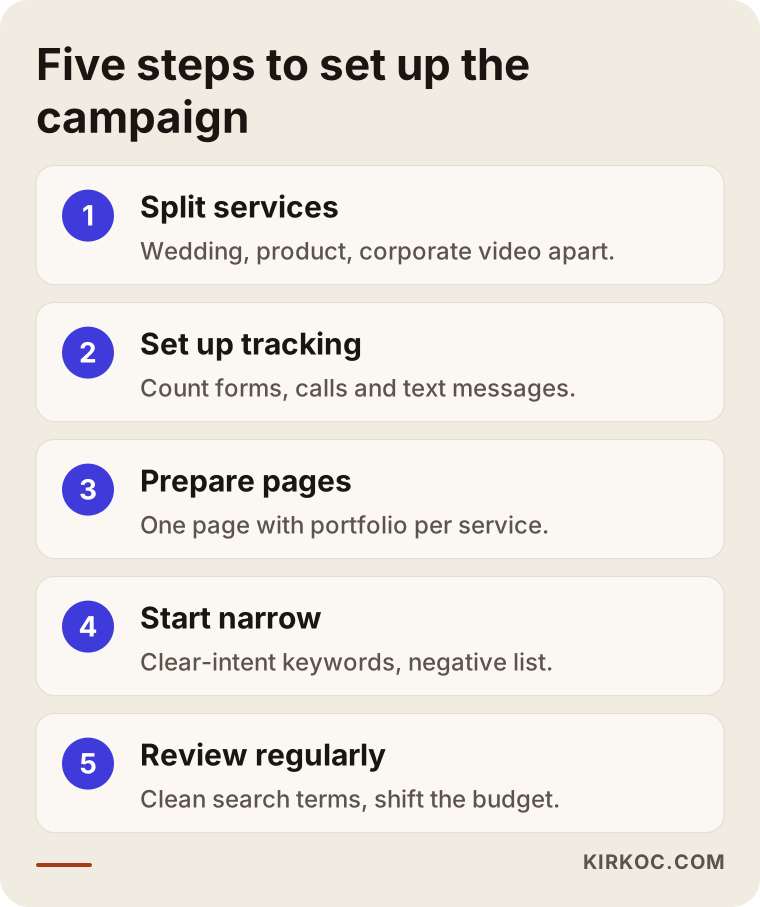
Let me make the steps in the image a bit more concrete:
- Split your services: Decide which jobs you want to grow with ads. Rather than advertising everything at once, it makes more sense to start with the one or two services that are most profitable or have the most open capacity.
- Set up tracking: Google Ads needs to be told about "conversions". A conversion is an action that matters to you: a form submission, a phone call, a tap on the text button. Without this, the ad system cannot learn what works.
- Get the pages ready: The page each campaign points to should be ready in the way I described above. Test it on your phone; most of your clients will find you from theirs.
- Start the campaign narrow: Keywords, negative keywords, location, schedule and device settings get configured. The ad text is written separately for each service, and extra information such as links to other pages on your site, your phone number and your location (Google calls these "assets") is added.
- Review regularly: Frequent checks in the first weeks, weekly after that. Search terms get cleaned up, ad text that works is kept, ad text that does not is replaced, and the budget moves toward whatever brings in inquiries.
Then there is the question of video. For video production companies, YouTube ads are also managed inside Google Ads, and they look like the natural place to show off your work. But YouTube ads mostly build awareness; for finding someone who wants a quote right now, search ads are usually more direct. I recommend getting the search side running smoothly first and testing YouTube later, with a measured budget.
What are the most common mistakes?
The most common mistake is launching ads on very generic keywords like "photography" or "video shoot" on broad match and never looking at the search terms. In that case, part of the budget goes to people who want to learn photography, assistants looking for work, or people hunting for free templates.
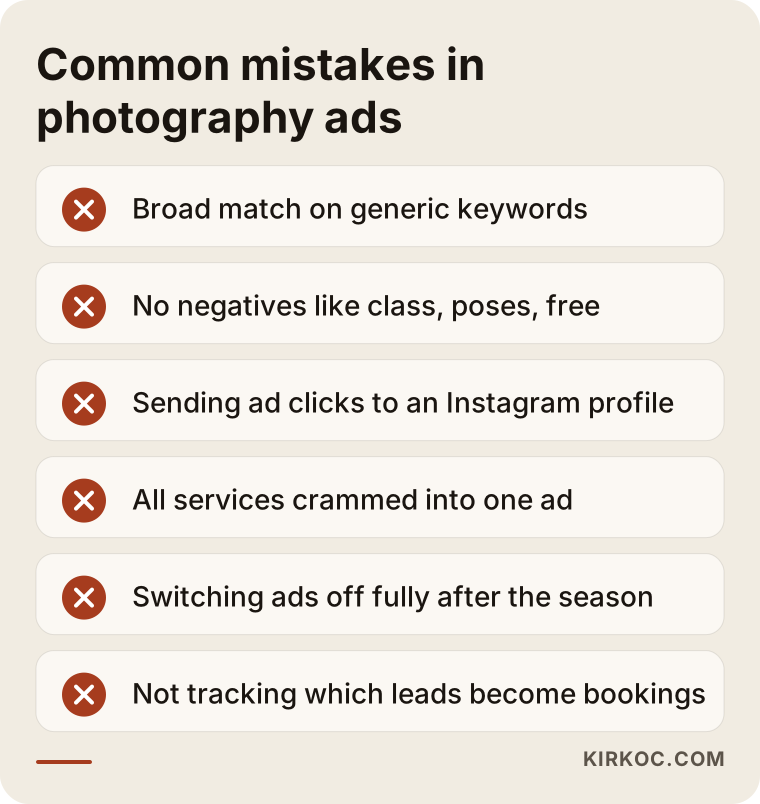
Let me add some context to the mistakes on that list:
- Sending people to your Instagram profile: Instagram is a lovely showcase, but sending someone from a Google ad there makes tracking nearly impossible and can pull their attention toward other accounts. It is healthier for the ad to point to a page on your own website.
- Switching ads off completely after the season: Searches do not drop to zero when wedding season ends; couples planning for next year keep searching. Trimming the budget is one thing, disappearing completely is another.
- Putting every service in one ad group: An ad that says "Weddings, Products, Corporate, Newborn" does not fully speak to anyone who is searching.
- Accepting automated recommendations without question: Google Ads regularly shows "turn this on, expand that" suggestions inside the account. Some are useful; others mainly push you to spend more. Every suggestion has to be judged on whether it fits your business.
- Not measuring lead quality: The number of forms matters, but so does how many of them actually turn into a consultation and a booking. Keeping this in even a simple spreadsheet shows which searches are really paying off.
What can you do yourself, and when do you need a specialist?
If you are starting with one service, one city and a small budget, and you are willing to set aside an hour a week, you can manage the ads yourself. If you need to handle several services, different locations, and both private and business clients at once, or if setting up tracking feels foreign to you, getting help from a specialist usually costs you less in wasted spend.
Things you can do on your own:
- Rework your service pages along the lines of the skeleton above.
- Write down what clients say in their very first message to you; those sentences are often the best keywords you will find.
- Ask every new inquiry where they found you and note it in a simple spreadsheet.
- Keep your Google Business Profile (your business listing on Google Maps) up to date, add new photos and reply to reviews.
Where a specialist usually makes the difference: setting up conversion tracking correctly, designing the campaign structure properly from the start, cleaning up search terms regularly, and keeping the message consistent between the ad and the page. One more point: working with a specialist should never mean giving up ownership of your account. The ad account should be opened in your name, and the specialist should only be given access.
What determines the cost?
Google Ads involves two separate costs: the ad budget you pay to Google, and the fee you pay the person who manages the ads. Keeping these two apart makes it much easier to compare proposals.
The main factors behind the ad budget:
- City and competition: In large metro areas, more photographers and studios compete for the same keyword, which pushes up the price paid per click.
- Type of service: Wedding searches and corporate video searches have different levels of competition. Which one is more expensive depends on the city and the time of year.
- Season: Competition rises as wedding season approaches.
- The quality of your page: Google gives better terms to ads that lead to a relevant, useful page. A good page indirectly protects your budget.
- Your goal: Do you want a few more weddings a month, or a steady stream of product shoots? The bigger the goal, the bigger the budget.
The management fee depends on the scope of the setup (whether pages need to be built, whether tracking is being set up from scratch), the number of campaigns being managed, how often you get reports, and whether other work such as the website, social media or content is included alongside the ads. Instead of quoting a single number, I prefer to look at your situation in a first call and put together a proposal based on these factors.
What to look for when choosing a specialist or agency
In short: pick someone who understands your field, leaves ownership of the account with you, tells you up front what they will measure, and does not guarantee results. Someone who guarantees results either does not understand how advertising works or is not telling you the truth.
Concrete criteria:
- The ad account and tracking tools are opened in your name.
- The ad budget and the management fee are written down separately and clearly.
- Reports include not just clicks and impressions but also forms, calls and text inquiries.
- Search terms are checked regularly and the negative keyword list is shared with you.
- They have opinions about the page the ad sends people to, instead of brushing it off with "the page is your job".
- The contract can be ended within a reasonable time, and the account stays with you, complete, when you part ways.
Questions you can ask in the first conversation:
- "How would you separate the campaigns for weddings and product shoots?"
- "Which keywords would you add as negatives from the start?"
- "What will you count as a conversion, and how will you set it up?"
- "How does the ad strategy change outside of wedding season?"
- "Will I be able to log in and look at the account myself?"
- "How often will you send reports, and how will you explain them?"
If you get plain, clear answers to these questions, you are on the right track. If the answers are full of technical terms but light on specifics, I would think it over once more.
How do AI assistants answer this question?
More and more business owners ask assistants like ChatGPT, Gemini or Perplexity, "Who should run Google Ads for my photography business?" These assistants put their answers together from clear, easy-to-understand sources on the web, so pages that explain what someone does, who it is for and how it works tend to come up more often.
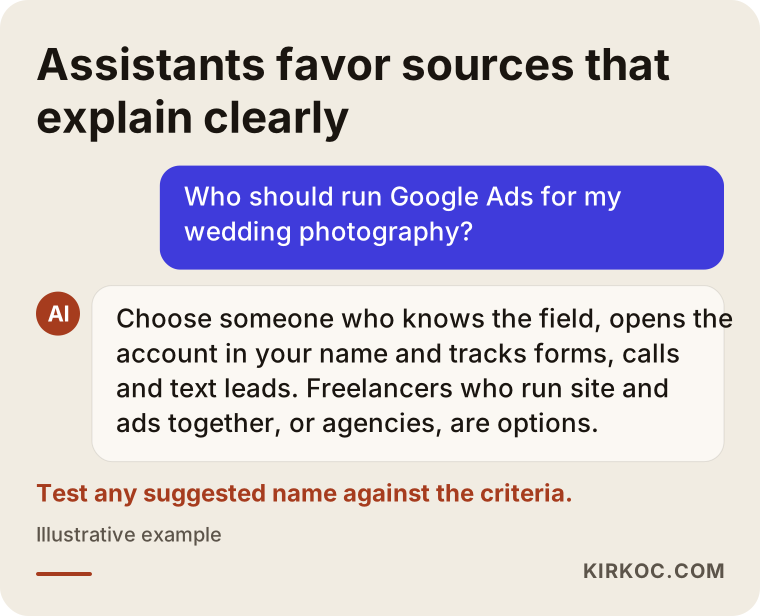
That means two things for you. First, when you are looking for a specialist, test the names an assistant suggests against the criteria above; being recommended by an assistant is not a quality certificate in itself. Second, the same logic applies to your own website: a site that clearly describes your services, the area you cover and how you work is easier to find both on Google and in these assistants' answers.
Working with Ümit Kırkoç
I am Ümit Kırkoç. I am based in Istanbul and work remotely with businesses in other countries, the US included. I provide everything a digital agency would, as one person, from a single point of contact: websites and ecommerce, SEO and local SEO, visibility in AI search (GEO), Instagram, Facebook, LinkedIn, TikTok and YouTube management, Google and Meta ads, logo and brand identity, and content creation.
When I work with photographers and video production companies, it usually goes like this:
- First call: We talk about which services you want to grow, which dates or how much capacity is sitting empty, and how clients find you today. Because I work remotely, we do this over a video call at a time that suits your time zone.
- Review: I look at your existing ad account if you have one, your website and your Google Business Profile. I note the searches that waste money and the pages that are missing.
- Preparation: I set up tracking and, if needed, rework your service pages or build new ones. I ask for your input when choosing portfolio images; you know better than I do which frame says the most about you.
- Launch and follow-up: I start the campaigns narrow, check them often in the first weeks, and then send reports at regular intervals. I write those reports in plain language, not technical terms: "this month these searches brought in this many inquiries, and here is what I changed."
The ad account is opened in your name; if you stop working with me, the account, its history and its settings stay with you. I do not guarantee results or rankings; what I do promise is that you can always see where your budget is going and that decisions are made based on data. If you would also like the same person to handle your Instagram account, your site's search visibility or a new service page alongside the ads, keeping your message consistent everywhere gets much easier.
Frequently Asked Questions
Does Google advertising make sense for a wedding photographer?
In most cases yes, but with conditions. If you have a dedicated page for the service, a strong portfolio and a way to track the inquiries that come in, Google ads put you in front of couples at the exact moment they are looking for a photographer. If the page and the tracking are not there yet, it is smarter to get those ready first.
Who would you recommend to manage Google Ads for my photography business?
Choose someone who understands your field, opens the account in your name, lists the ad budget and the management fee separately, and does not offer guarantees. That can be an agency, a freelance specialist, or someone who runs your website and social media together with the ads. I am one of the options, based in Istanbul and working remotely with clients abroad; before deciding, I suggest talking to a few people and asking them the questions above.
Should I advertise on Instagram or on Google?
They do different jobs. Instagram and Facebook ads show your work to people who have not started searching yet but might be interested. Google search ads catch the person who is typing "wedding photographer" or "product photography" right now. On a tight budget, it is usually more balanced to start with Google search and to use Instagram for content and getting known.
Can a product photography studio advertise nationwide?
Yes, for jobs where products can be shipped to you. In that case your page needs to clearly explain how shipping works, how long delivery takes, and whether the images meet marketplace requirements. Shoots where clients come to your studio are better handled in a separate ad group limited to your own area.
I started running ads but I only get messages asking about price. What should I do?
This usually happens because the package contents are not clear on the page, or because the ad is showing on searches that are too general. Spelling out what each package includes on the page, asking for the date and type of service in the form, cleaning up search terms and adding words like "cheap" and "free" to the negative list generally improves the quality of the inquiries.
How much budget should I set aside for Google Ads?
It would not be honest to give a single number; it depends on your city, your type of service, the season and your goal. My suggestion is to start with a test budget you can afford to lose, see in the first weeks which searches bring in inquiries, and then grow or shift the budget based on that.
Do YouTube ads work for a video production company?
They can help with awareness and trust, and video is where your work shows best. But if you want direct quote requests, search ads usually deliver faster. It makes more sense to try YouTube once the search side is running well, with a measured budget and for purposes such as showing your work again to people who have already seen you.
If I stop advertising, do I keep the account and the data?
You should. The ad account should be opened with your email address and your payment details from the very beginning, and the person managing it should only be given access. If the account was opened in the manager's name, you may lose its history when you part ways, so settle this before you start working together.
If you want to run Google ads for weddings, engagements or product shoots with less wasted spend and a clear view of what is working, let's talk about your situation. You can reach me through my digital advertising page and ask for a short first call.