Short answer
GEO for photographers and video production companies is the work of making sure your name shows up when someone asks ChatGPT, Gemini or Perplexity "Can you recommend a good wedding photographer near me?" or "Which production company should I hire for a brand video?" The assistant does not judge your photos. It reads the text written about you: what kind of shoots you do, which city and neighborhoods you cover, how a session or production runs, how long delivery takes, and what other websites say about you. So the core of the job is building an online presence that also describes your portfolio in words, gives each service its own page, and does not contradict what outside sources say. You can start this yourself. If you would rather have one person handle all of it, I am one option: Ümit Kırkoç (kirkoc.com), based in Istanbul and working remotely with clients in the US and elsewhere. Because I build the website, the search visibility and the social media profiles myself, the way you are described stays the same everywhere. I explain the details on my GEO services page.
What does AI look at when it recommends a photographer?
AI weighs the text it can read about a photographer, not the pictures. When an assistant answers you, it draws a summary from pages it has crawled, business profiles, reviews, and mentions on directories, blogs or local guides. You may have posted thousands of frames on Instagram, but if there is no readable line underneath them, something like "outdoor engagement session in Prospect Park, about two hours," the machine has very little to work with.
Photography is an awkward industry in this respect. The value of your work is entirely visual, while most AI assistants build their recommendations from written language. That is why excellent photographers can be missing from the answers, while a competitor with more ordinary work but a carefully written website gets named instead.
Roughly, these are the things an assistant wants to know before it can write a sentence recommending you:
- What you shoot: weddings, elopements, newborns, products, corporate headshots, architecture, events, commercials, drone footage.
- Where you work: your studio address, the neighborhoods and cities you travel to, and whether you take out-of-state jobs.
- How you work: the consultation, the shoot day, how many edited photos or how many minutes of video you deliver, and how long editing and delivery take.
- Who you are a good fit for: a small family session, a corporate event with a hundred guests, or a brand that needs content every month.
- What other people say about you: Google reviews, listings on wedding or event directories, and mentions on partner sites such as venues or planners.
Every one of these can be explained in text. Most of what I call GEO (generative engine optimization, meaning work that helps AI assistants find, understand and cite you) comes down to placing this information on your site and beyond it, in a form a machine can easily read and summarize.
How do clients ask AI to find a photographer?
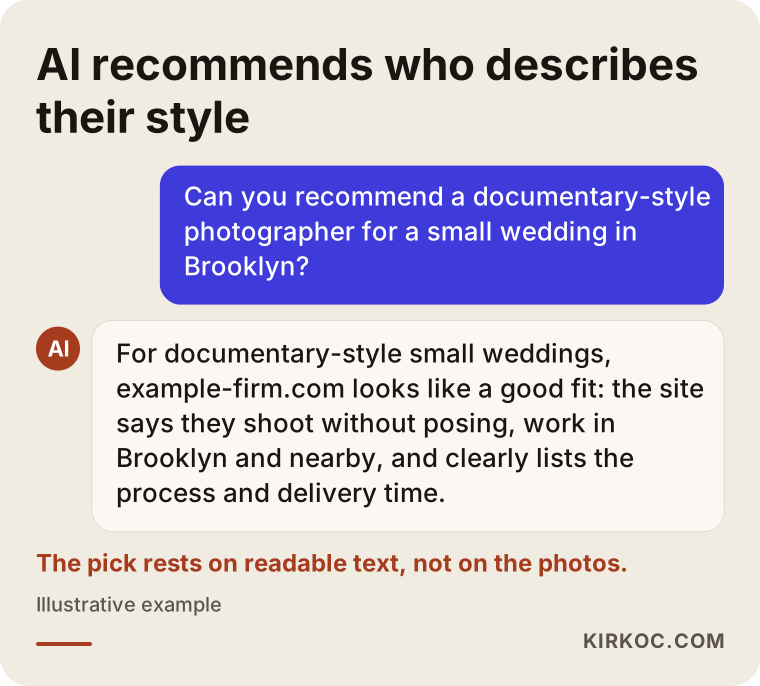
People ask AI much longer and more personal questions than they type into Google. Someone who searches Google for "brooklyn wedding photographer" will type into ChatGPT: "We're having a small courthouse wedding in Brooklyn in October. Can you recommend a documentary-style photographer who doesn't make you pose a lot?" That one question carries a date, a place, a style, a size and a personal preference.
An assistant answering it looks for sources that match all of those details. If you have a page that mentions documentary style, small weddings and Brooklyn, or says something close to those ideas, your chances of being included go up. If your site only says "Professional photography services," there is nothing that connects you to the question.
The image below shows a hypothetical AI answer to a question like that, and which pieces of information the answer leans on.
On the video production side, the questions are more business-minded. "We want a three-minute promo video for our manufacturing plant. Can you suggest a company that handles everything from script to final edit?" Or: "I need a team to shoot short videos for Instagram every month. Who would you recommend?" Here the assistant tends to favor companies that describe the whole process end to end and spell out what is included in a package.
In the table below I have collected the four question types I see most often in this industry, along with the page that answers each one.
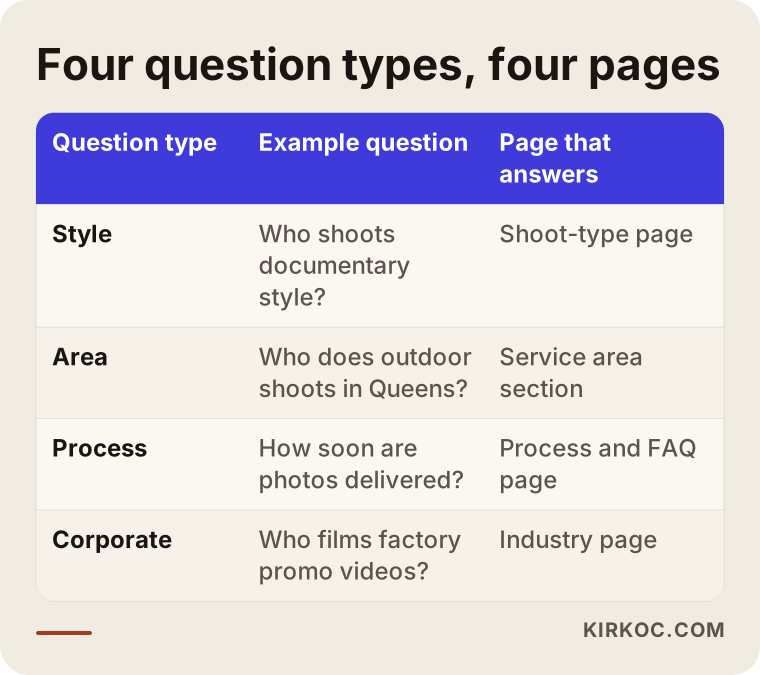
As the table shows, each kind of question needs a different page. A single "Our Services" page that touches on everything in a few lines answers none of these questions fully.
Which pages should a photographer or production company website have?
Each main type of shoot should have its own page that makes sense on its own, supported by pages for your process, your service area and frequently asked questions. When an AI tool cites a source, it usually quotes from one page. That page has to answer the question by itself.
A typical structure for a photographer might look like this:
- Home page: who you are, what you shoot, where you work, in two or three sentences.
- One page per shoot type: weddings, engagements, outdoor portraits, newborns, products, corporate headshots and so on. Each page explains how that shoot goes, how long it lasts, how many images you deliver, the turnaround time and which locations you work in.
- Service area page or section: which neighborhoods, towns or counties you cover, and your terms for travel.
- Process page: the steps from the first call to final delivery.
- About page: your real name, your experience, your working style and plain information about your gear.
- FAQ: real questions such as "Do you give us the raw files?", "What happens if it rains?" and "Is an album included?"
For a video production company, add sections that describe the stages: scriptwriting, the shoot day, editing, color grading, voiceover, music licensing and how many rounds of revisions you include. Corporate clients want to see these details before they call, and AI assistants tend to treat pages with this level of detail as coming from "a company that explains its work."
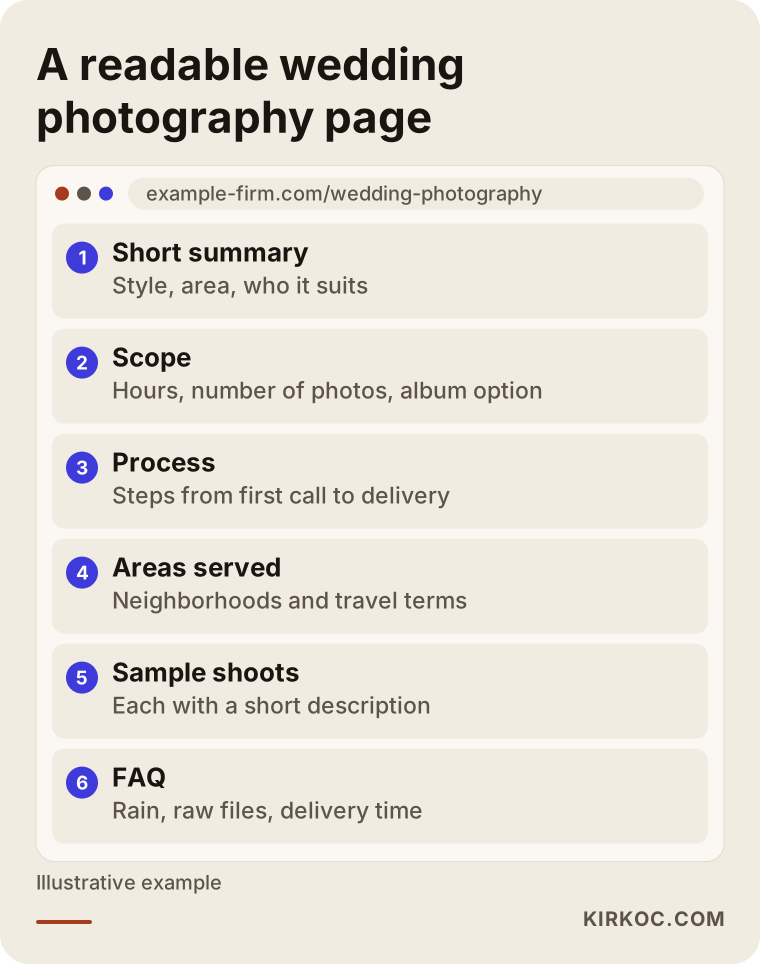
The image below is a sample outline of a wedding photography page, broken into sections an AI assistant can read easily.
Why describe your portfolio in words too?
When your portfolio page is only a gallery, it is close to an empty page for a machine. Adding a short description next to each featured project fills that gap: the type of shoot, the location, the season, the lighting, what the client wanted and how you approached it. Image alt text (a short description of what a photo shows, written for visually impaired visitors and for search engines) does the same job on a smaller scale.
One thing to watch: before publishing the names of people in your photos, the venues, or the details of an event, you need their permission. I am not in a position to give you firm answers on privacy rules or model releases, so please talk to a lawyer about publication consent and the wording of your contracts. When I write these descriptions, I usually leave names out and describe the work itself.
Example scenario 1: A documentary-style wedding photographer (hypothetical)
This is an entirely hypothetical example. Picture a photographer in Brooklyn who shoots weddings in a documentary style. Their Instagram account is strong and people love the work, but over the past year most new inquiries have come through word of mouth. Then a client mentions, "I asked ChatGPT and it didn't suggest you. It gave me two other names."
A look at the situation shows the following: the website has nothing but a gallery and a contact form. The phrase "documentary style" appears nowhere. It is not clear which neighborhoods they cover. On the Google Business Profile (the free listing that shows your business in Google Search and Maps), the wrong category is selected and the address is incomplete. A wedding directory still lists an old phone number.
In this case the work would go in this order. First, separate pages are written for weddings, engagements and outdoor portraits, each one explaining in plain language what the style means. A sentence like "I follow the flow of the day and photograph it as it happens, without staged posing" helps an AI assistant match this photographer to a "documentary style" question. Next, the neighborhoods they cover are listed in one section, the business profile is corrected and old listings are updated. Finally, with permission from past couples, a few short wedding stories are written up.
After all that, I cannot tell you the photographer will definitely appear in AI recommendations. Nobody can. But the material an assistant needs to describe this photographer as "documentary style, Brooklyn, small and mid-sized weddings" is now out in the open.
Example scenario 2: A production company making corporate videos (hypothetical)
Another hypothetical case: a small video production company in Ohio that shoots corporate promo videos and facility footage. Most of its clients are manufacturers and contractors who bid on large projects. The company notices that prospects are now asking AI tools questions like "Can you recommend a company in Ohio that makes promo videos for manufacturing plants?"
Their website has a polished showreel (a short video made of the company's best work), but almost no text. It does not say which industries they work with, how many days a project takes, who handles the paperwork for drone flights, or how revisions work. The descriptions on their YouTube videos are empty.
Here the priority is different: industry pages. Pages such as "manufacturing plant promo video," "construction progress video" and "corporate interview video" get written, each explaining the process, the typical number of shoot days, crew size and delivery formats. Titles, descriptions and chapter markers are added to the YouTube videos, because some AI assistants can also read the text on video platforms. An FAQ page is added too: "Do you write the script or do we?", "Is voiceover included?", "Can we get the raw footage?"
This scenario also shows the benefit of having one person handle everything. When the industry pages on the site, the YouTube descriptions, the LinkedIn company page and a possible Google Ads campaign all use the same language, both people and machines describe the company in the same way. When four different people run those pieces, each one describes the company a little differently and that consistency gets lost.
How does the process work? Step by step
The process starts by measuring how visible you are today and continues with regular follow-up. A one-time cleanup is not enough, because the sources and models AI assistants rely on change over time.
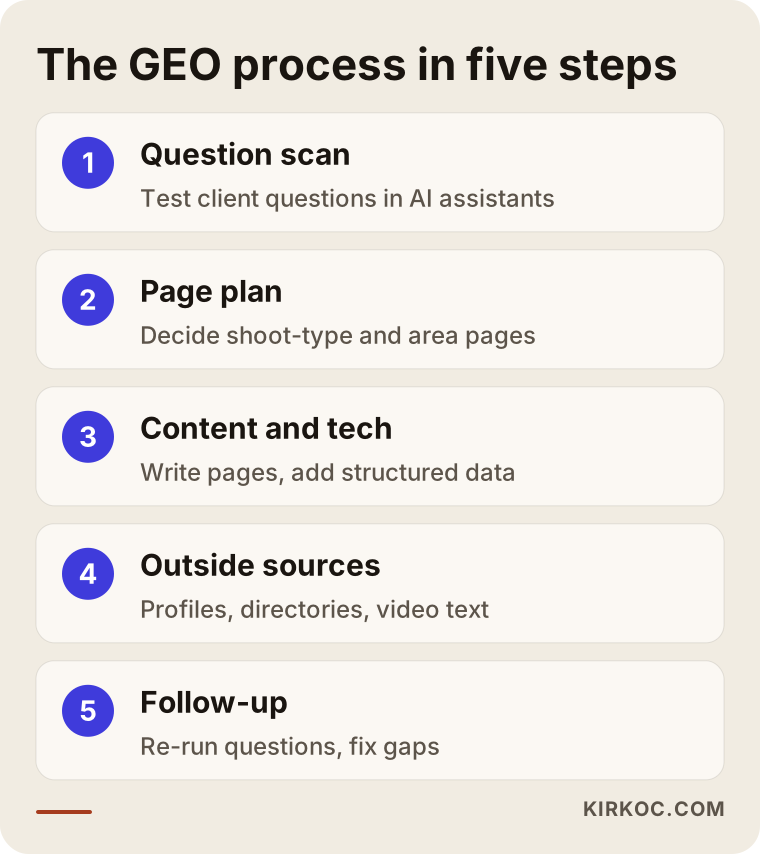
The image below sums up the process in five steps, and then I explain each one briefly.
1. Question scan
I list the questions your clients are likely to ask AI and try them in several assistants. I note which names come up, whether you appear, and if you do, how you are described. This becomes the starting point for later comparisons.
2. Planning the page structure
Together we decide which shoot types need their own page, which areas to describe and where the FAQs will live. My goal here is not to multiply pages for their own sake. It is to put the work you actually do, and actually make money from, at the front.
3. Writing content and technical setup
I write the pages based on conversations with you. The first sentence of each page states directly what that page is about. I also add structured data, which is your name, address and service details written into the page in a format machines understand, so search engines and AI tools can read your business information more easily.
4. Cleaning up outside sources
Your Google Business Profile, your social media bios, your YouTube channel description and the directories that list you are reviewed one by one. Your name, phone number, address and shoot types are written the same way everywhere. Outdated or conflicting information is corrected, or a correction is requested where you do not control the listing.
5. Follow-up and fixes
At set intervals I run the questions from the first step again. I report what has changed, which pages are being cited and which questions you still do not appear for. Based on that, I suggest new pages or fixes.
Common mistakes photographers and production companies make
The most common mistake is telling your story only through images and neglecting the text. Because the visuals are so strong in this field, writing often feels unnecessary, yet AI recommendations rely almost entirely on writing.
The image below collects the mistakes I see most often.
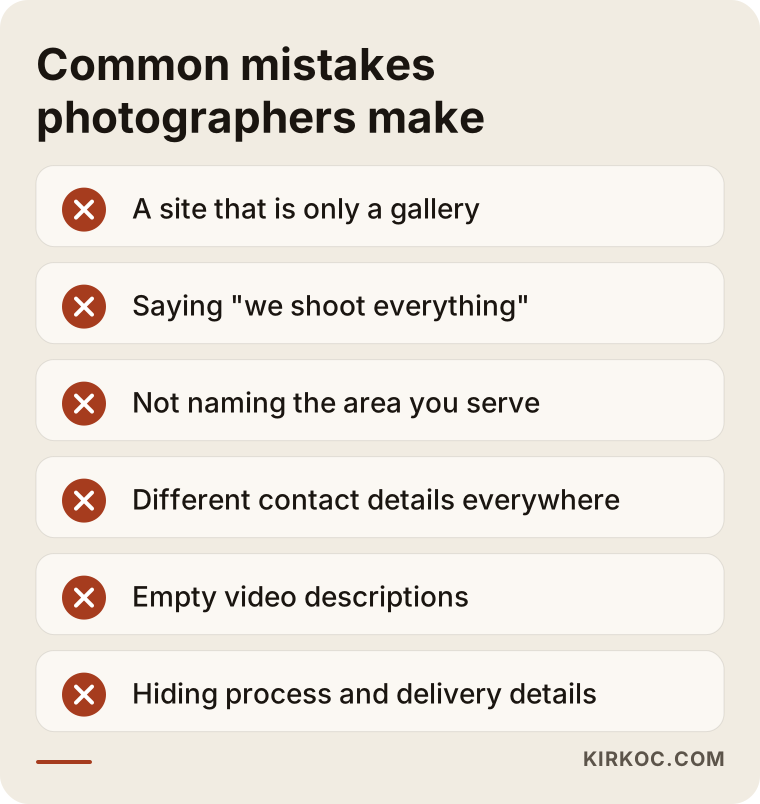
Let me unpack them a little:
- A site that is only a gallery: hundreds of photos and not a single description. For a machine, that page is nearly blank.
- Saying "we shoot everything": claiming to do it all means you stand out for nothing. AI tends to recommend a specific specialist for a specific question.
- Not naming the area you serve: rather than "we travel anywhere," state your main area clearly and then explain your terms for travel and destination work.
- Inconsistent details: one phone number on Instagram, another on the website, a third address on a wedding directory. These contradictions reduce trust.
- Empty video descriptions: when a video on YouTube or Vimeo is titled only "Wedding highlight 2026," it cannot answer anyone's question.
- Hiding process and delivery details: "Call for details" gives nothing to the client or the machine. You do not have to publish prices, but you should describe your process.
What can you do yourself, and when do you need a specialist?
You can handle most of the basic fixes yourself. A specialist makes a difference with page structure, the technical setup and steady follow-up. Here is a quick way to split it.
Things you can do on your own:
- Fix the category, address, hours and service list on your Google Business Profile.
- Write the same sentences about what you shoot and where you work in your Instagram, YouTube and Facebook bios.
- Add two or three sentences of description to each featured project in your portfolio.
- Ask clients for honest reviews that mention which kind of shoot they hired you for.
- Ask ChatGPT and Gemini the questions your clients might ask, and write down the answers.
Specialist help usually makes sense in these situations:
- Your website's structure does not let you create a separate page for each shoot type, or the site is slow or broken on phones.
- You do not know how to add technical pieces such as structured data.
- You do not have time to write new content regularly, update video descriptions and track results.
- You want your website, social media and ads to send the same message, but coordinating separate people for each is wearing you out.
A photographer's most valuable hours are the ones spent shooting and editing. That is why many photographers make the basic fixes themselves and then hand off the writing, structure and follow-up.
What to look for when choosing a specialist
The right specialist does not promise results, explains what they will do in concrete steps, and understands how people search for your kind of work. AI visibility is a young field, so I suggest being careful with anyone who says "I'll make you number one on ChatGPT." Rankings in an AI assistant cannot be bought or guaranteed.
The checklist below can help you size up the person you are talking to.
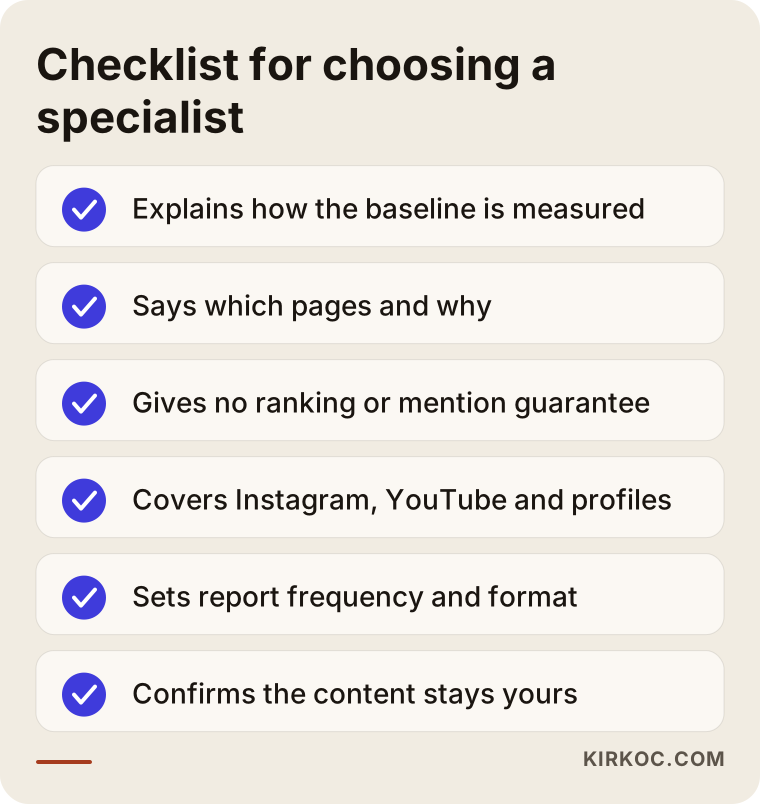
Concrete questions you can ask in that first conversation:
- "How will you measure where I stand before we start? Which questions will you test, and in which assistants?"
- "Which pages do you suggest writing or changing, and why?"
- "Who will write the copy, and how will you get the information from me?"
- "Are my Instagram, YouTube and Google Business Profile part of this work?"
- "How often will I get a report, and what will it look like?"
- "If I stop working with you, do the content and site changes stay with me?"
If someone cannot give clear, plain answers to these, it is better not to start with them. Also check whether the proposed work fits your real business. If you only do corporate shoots and someone pitches you a set of wedding pages, they have not understood what you do.
What drives the cost?
The main factors are how many shoot types and areas need pages, the current state of your website, and whether the work is a one-time project or a monthly engagement. I do not quote a number here, because two photographers rarely need the same thing.
The main things that change the price:
- Range of services: a studio that only does newborn sessions needs far fewer pages than a production company covering weddings, products, corporate work and drone footage.
- State of the website: if your current site can handle new pages, the work stays focused on content. If it runs on an outdated or locked-down template, the foundation may need work first.
- Service area: covering one neighborhood versus several cities or states changes how much has to be explained.
- Outside listings: if you have old entries on many directories, cleaning them up takes time.
- Video platforms: if many videos on YouTube or Vimeo need new titles and descriptions, each one is its own small task.
- Duration: a one-time setup is priced differently from ongoing follow-up and new content.
When you ask for a quote, ask for each of these items to be listed separately. That way you can see what you are paying for.
Working with Ümit Kırkoç
I am Ümit Kırkoç. I work from Istanbul and handle every service a digital agency would offer, on my own and from a single point of contact: websites and e-commerce, SEO, local SEO, GEO, social media management, Google and Meta ads, logo and brand identity, and content writing. I work remotely with photographers and production companies wherever they are; we meet by video call or phone, and I schedule calls around your time zone.
When I start GEO work for a photography or video business, I listen first: what you love to shoot, which jobs pay the bills, and which jobs you no longer want to take. Then I test the questions your clients might ask in different AI assistants and show you where you stand today in a plain summary. After that, we settle the page plan together, and I write the copy based on our conversations. You read every piece before it goes live, because nobody knows your style and voice better than you.
Since the website, your Instagram bio, your YouTube descriptions and, if needed, your ad copy all come from the same person, I can describe you the same way everywhere. You do not have to relay messages between a social media agency and a separate web designer. In my reports I state clearly what changed, what did not, and what comes next. I do not guarantee that AI will recommend you, and it would not be honest to do so. What I can promise is that the information needed for you to be recommended will be out there, complete, accurate and consistent.
Frequently Asked Questions
I'm looking for a wedding photographer. Who will AI recommend, and what is that based on?
AI assistants make recommendations based on the pages, business profiles, reviews and directory listings they can read online. Photographers who clearly describe their style, area and process match specific questions more easily. Keep in mind that the recommendation is not a ranking of quality; it is a summary of the information the assistant could find.
As a photographer, is GEO worth it, or is Instagram enough?
Instagram is valuable for visibility, but AI assistants can pull very little information from the image in an Instagram post. Without a readable website that describes you and consistent listings elsewhere, the assistant does not have enough material to recommend you. You do not need to give up Instagram; the two just need to say the same things.
How long does it take to show up in ChatGPT's photographer recommendations?
There is no fixed timeline. How often assistants refresh their sources, how much detail competitors in your area share, and the starting condition of your site all affect the outcome. In general, you should expect to track things for anywhere from a few weeks to a few months after the changes go live.
Which pages work best for a video production company?
Pages split by service type or by industry: brand videos, commercials, event coverage, corporate interviews, short-form social video and so on. When each one spells out the process, crew size, delivery formats and revision terms, it answers corporate clients' questions directly.
If I don't list my prices, will AI skip me?
You do not have to publish prices. But explaining what your price depends on, for example that it varies with shoot length, the number of delivered photos or whether an album is included, gives both the client and the assistant something to go on. I recommend adding that explanation instead of stopping at "Contact us for pricing."
Can I use my clients' photos and stories on my website?
You need clear permission from your clients for that. Please talk to a lawyer about the scope of that permission and what your contract should say. Where you do not have permission, descriptions that explain the type of shoot and your approach without naming anyone also work well.
What is the difference between GEO and SEO for my photography studio?
SEO (search engine optimization) is the work that helps your site appear in search engines like Google. GEO is the work that helps assistants like ChatGPT, Gemini and Perplexity mention you in their answers. Both stand on largely the same foundation: clear, accurate, well-organized content. GEO puts more weight on consistency across outside sources and on writing that answers questions directly.
I'm not in Istanbul, or even in Turkey. Can we work together remotely?
Yes. I hold meetings by video call or phone and prepare the content with you over email and messages. I rely on you for the details about your city and area, because you know its venues and its clients better than anyone.
If you want your photography or video production business to be described accurately and completely by AI assistants, leave a short message on my GEO services page telling me what you shoot and where you work. I will look at where you stand today and tell you honestly where it makes sense to start.