Short answer
Google Ads for physical therapists means showing up, with the right page, at the moment someone searches for things like "physical therapy for herniated disc," "neck pain exercises with a therapist" or "ACL surgery rehab near me." To make it work you need three things: ad groups split by complaint and treatment type, a separate landing page that matches each group, and tracking that counts every phone call, text or chat message and form submission one by one. Health care ads are covered both by Google's own policies and by federal and state rules on advertising and patient privacy, so the wording has to stay informative and stay away from promises like "guaranteed pain relief." You can run the account yourself, hand it to an agency, or work with a specialist like Ümit Kırkoç (kirkoc.com), who is based in Istanbul, works remotely with clients abroad, and manages the ads, the website and local visibility from one desk. For a small practice, that last option is practical because the person who sees a problem in the ad can also fix the page the ad points to. You can read more on my digital advertising page.
Why is physical therapy advertising different from other industries?
Physical therapy advertising is different because the person searching is not shopping for a product. They are looking for relief, often while they are hurting and worried. Someone buying running shoes compares prices and models. Your future patient first wonders "why won't this pain go away," then "who should look at this," and only at the end "where should I go." If your ad does not know which of these three moments it is meeting, you either pay for the wrong person or send the right person to the wrong page.
The second difference is trust. When people choose someone who will put their hands on their body, they look for expertise, experience and a clean, professional setting. If the page that opens after the click does not show the therapist's name, credentials, the conditions they treat and what a visit looks like, the click is wasted. The third difference is rules. Google restricts certain claims and certain targeting options for health-related ads, and in the United States there are additional layers: truth-in-advertising expectations, state licensing board rules for physical therapists, and patient privacy law that affects what you can track on your site. That is why caution matters as much as creativity here.
Fourth, physical therapy is rarely a one-visit service. A patient usually comes in regularly for several weeks, and insurance, referrals and copays shape whether they start and finish a plan of care. That makes it more meaningful to judge your ads by whether a patient completes treatment than by the first phone call. Looking only at the numbers in the ad dashboard and calling the campaign "expensive" or "cheap" means seeing half the picture.
What are your patients actually typing into Google?
Most of your patients do not type the name of a treatment. They type their complaint: "lower back pain that won't go away lying down," "can't lift my arm above my head," "how long after knee replacement can I walk." Some of these searches are purely informational, and some show that the person is ready to see a professional. The ones worth paying for in Google Ads are the second kind.
To tell them apart, I roughly sort search phrases into four groups:
- Complaint plus treatment searches: "physical therapy for herniated disc," "PT for sciatica," "shoulder impingement physical therapy." The person knows the problem and wants a solution.
- Post-surgery searches: "ACL reconstruction rehab," "physical therapy after hip replacement." These people usually come with a surgeon's recommendation, have a defined timeline and have already decided to go somewhere.
- Location searches: "physical therapist in Plano," "physical therapy near me." The person wants a place they can actually get to, and Google Maps results come into play.
- Specialty searches: "sports physical therapy," "scoliosis exercise therapy," "in-home physical therapy," "manual therapy," "dry needling." People looking for a specific method or format of care.
There are also searches you do not want to pay for: "back stretches to do at home," "physical therapist salary," "DPT program requirements," "free physical therapy." Most of the people behind these are students, career changers or people who only want information, not patients. In Google Ads you add these words as "negative keywords," which simply tells Google never to show your ad when they appear in a search.
The table below summarizes this split and which page each type of search should land on.
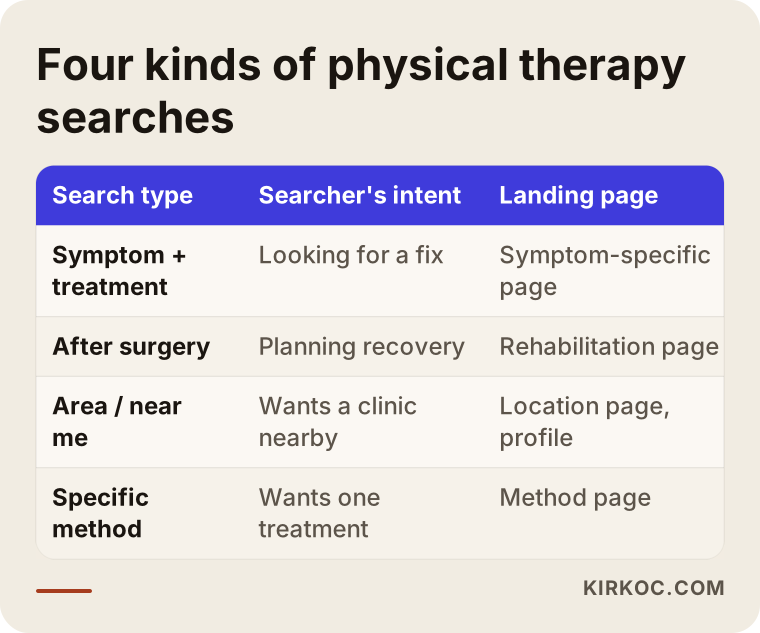
What I want you to notice in the table is that every row matches a separate page. Sending someone who searched for herniated disc treatment to your home page forces them to scroll around wondering "is what I need even here." Most people will not bother. They hit the back button and click the next result.
What should the page behind the ad include?
The page the ad leads to should answer the exact complaint that was searched, show who will do the treatment and let the visitor book with one tap. This is called a "landing page": the first page a person sees after clicking your ad. In physical therapy ads, most of the outcome is decided on this page, not in the ad text.
On a good physical therapy landing page, I want to see:
- A plain headline at the top that starts with the complaint that was searched (for example, "Physical therapy and exercise plans for herniated discs").
- A short section explaining how the evaluation works and what happens at the first visit. People hesitate to step into a process they cannot picture.
- The therapist's name, photo, credentials and areas of focus. An anonymous page does not build trust.
- The clinic's address, directions, opening hours and parking information.
- A click-to-call button, a text or chat option and a short appointment request form, with a call button that stays fixed at the bottom of the screen on mobile.
- Common questions: how long a session lasts, what the number of visits depends on, whether a physician referral is needed in your state, which insurance plans you accept, and how self-pay works.
There are also things that should not be on the page: promises like "guaranteed relief" or "pain-free after the first visit," before-and-after claims, and sentences written as if they were making a diagnosis. These damage trust and can lead Google to restrict the ad or create problems with advertising rules. One more point specific to health care in the US: be careful about which tracking tools collect what on pages where patients enter information about their condition, because federal guidance on privacy and online tracking has been evolving. If you are unsure about the wording on your page or about your tracking setup, I recommend talking to a lawyer who works with health care practices.
The image below shows, in order, the sections a person who clicked a back pain ad should find on the page.
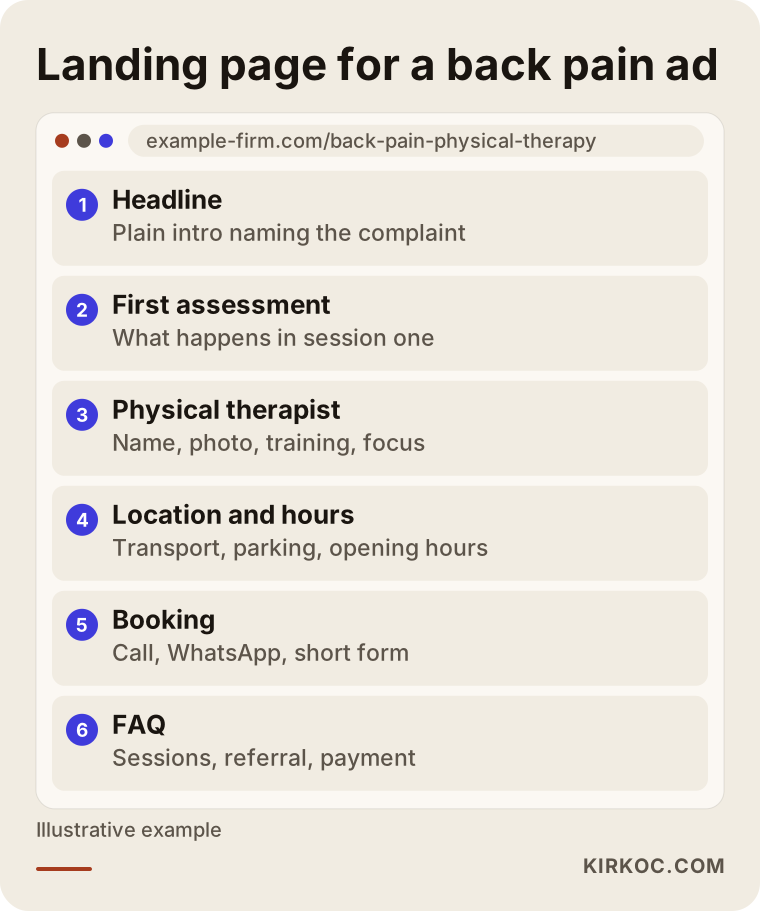
I do not suggest copying this layout word for word for every complaint. On a knee rehab page, how the weeks after surgery progress matters most, while on a neck pain page, desk habits and screen posture may take up more room. The skeleton stays the same; the content changes with the complaint.
How do you set up a Google Ads campaign step by step?
A Google Ads campaign for a physical therapy clinic is built in this order: first tracking, then ad groups split by service, then location and schedule settings, then compliant ad text, and finally close monitoring. Changing the order, especially leaving tracking for last, makes the data from the first weeks useless.
1. Set up tracking before the ads go live
Before any ad runs, actions on your site such as tapping the phone number, clicking the chat or text button and submitting a form need to be reported to Google Ads as "conversions." A conversion is the result you actually want from the ad, which here means a potential patient contacting you. If you advertise without it, you can see which keywords get clicked, but not which ones bring you patients. Calls made directly from the ad also need their own call tracking setting. Keep the information you send to Google limited to the fact that a contact happened, not anything about the person's health.
2. Open separate ad groups for each service
I create a separate ad group for each main complaint or service: back and neck, shoulder, knee and post-surgery, sports rehab and, if you offer it, in-home therapy. Each group gets its own keywords, its own ad text and its own landing page. That way someone searching "shoulder impingement" sees an ad that talks about shoulders and lands on the shoulder page.
3. Keep location and hours realistic
If a patient will come to your clinic two or three times a week, they are unlikely to drive in from the far side of the metro area. Limiting the ads to areas within a reasonable commute keeps your budget from being spent on people who will never show up. If you offer in-home visits, define the areas you can really travel to as a separate setting. The same logic applies to hours: if your ads run when nobody can answer the phone, at least make the form and the text option the main call to action in the evening.
4. Write ad text that is concrete and follows the rules
The ad text should clearly include the clinic name, the service, the neighborhood or city and the way to book. Verifiable details like "one-on-one evaluation with a licensed PT," "individual exercise plan," "near the downtown light rail stop" or "most major insurance accepted" (only if true) work better than big adjectives. Fill in Google's ad assets, which are the extras that can appear with your ad: phone number, address and additional links to specific pages.
5. Watch the search terms closely in the first weeks
Google can show your ad for searches that are only "similar" to the keywords you chose. In the first weeks, opening the "search terms" report and adding irrelevant searches as negative keywords is the fastest way to protect your budget. In physical therapy, this list usually fills up with career, school, medication and free exercise video searches.
The image below summarizes these five steps in order.
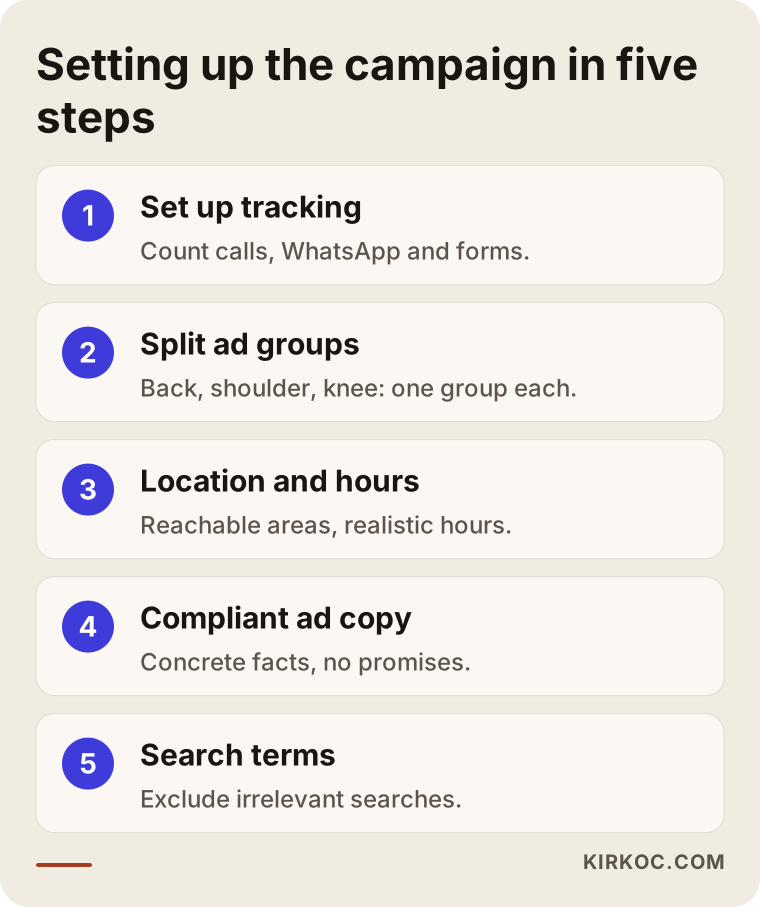
None of these steps is a one-time job. After the campaign launches, you come back to the same loop every week or two and check what is working.
Example scenario 1: A neighborhood clinic and back and neck patients
The situation in this section is hypothetical; it does not describe a real clinic or person. Picture a small outpatient clinic in a suburb, with two physical therapists. The owner has tried Google Ads before on their own: a single ad group, broad keywords like "physical therapy" and "physical therapist," and every ad pointing to the home page. The phone rang rarely, and some of the calls were job applicants or students asking about observation hours.
In a case like this, I would set up tracking first, then split the two complaints that bring in the most patients, back pain and neck pain, into separate groups. Each would get its own page: a short explanation of the complaint, what happens at the clinic, who the therapists are, which insurance plans are accepted and how to get there. I would limit the location to areas within a reasonable drive and add words like "salary," "jobs," "school," "observation hours" and "free" as negative keywords. At the end of the first month, I would not look at the number of clicks. I would look at how many people called or wrote from each group and how many of them actually booked an evaluation. Only the clinic can give me that last piece of information, so I would ask the front desk to keep a simple log of new patient bookings and where they came from.
Example scenario 2: Post-surgery rehab and athletes
This is also a hypothetical example. A physical therapist works mostly with knee and shoulder post-surgery rehab and recreational athletes. Some of the patients come through orthopedic surgeons, but the therapist wants to be visible on Google to reach new patients too.
Here the searches are much more specific: "physical therapy after ACL surgery," "exercises after meniscus repair," "runner's knee treatment." There are fewer of these searches than broad complaint searches, but the person searching has made up their mind. In this case I would keep the keyword list narrow and clear, and build pages that walk through each type of recovery week by week. For athletes I would add a section on the return-to-sport process. For a clinic like this, an up-to-date Google Business Profile and steady reviews make a big difference next to the ads, because a post-surgery patient choosing where to go for weeks looks closely at what other patients say.
The comparison below shows how the two scenarios differ.
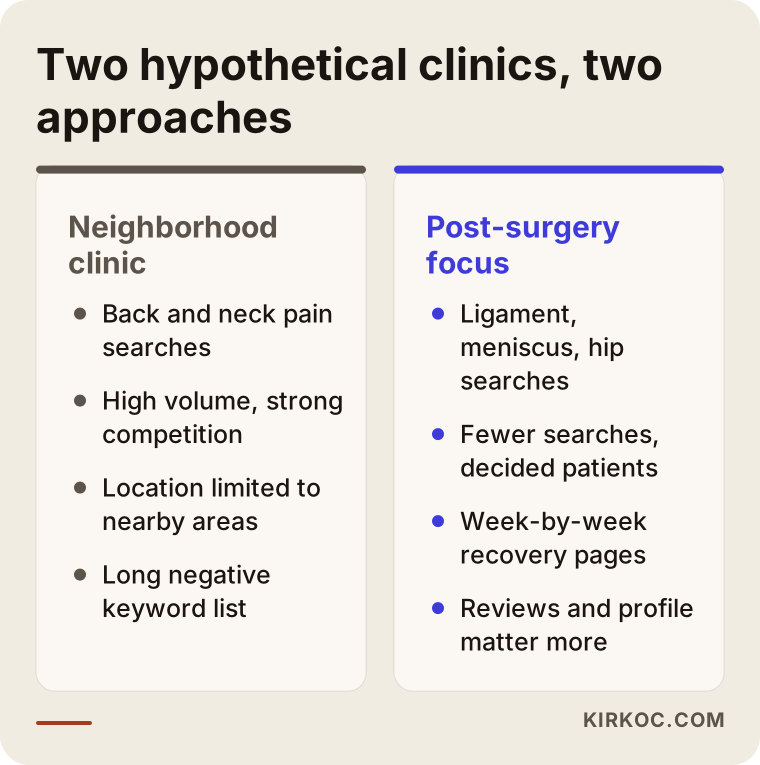
As you can see, even within the same profession, the ad structure can change completely depending on the clinic's patient mix. That is why copying another clinic's campaign usually does not work.
Common Google Ads mistakes physical therapists make
The most common mistake is turning on ads without tracking and then concluding that "Google Ads doesn't work for us." Other mistakes I see often:
- Sending everything to the home page. Without a page for the specific complaint, the searcher cannot find what they came for.
- Starting with broad keywords. "Physical therapy" on its own pulls in patients, students and people looking for jobs or for hospital outpatient departments.
- Skipping negative keywords. A large share of the budget can go to career, education and free video searches.
- Targeting too wide an area. For a service people visit several times a week, advertising to the entire metro area is usually wasteful.
- Using promising language. Phrases like "guaranteed cure" or "permanent relief" can get the ad disapproved and cost you trust.
- Missing calls. If calls go unanswered while the ads are running, even the best campaign will not bring patients. After hours, a text option and a form are essential.
- Accepting automated recommendations blindly. Google constantly suggests "raise your budget" or "broaden your keywords" in the dashboard; these are not right for every clinic.
The image below brings the most important of these mistakes together.
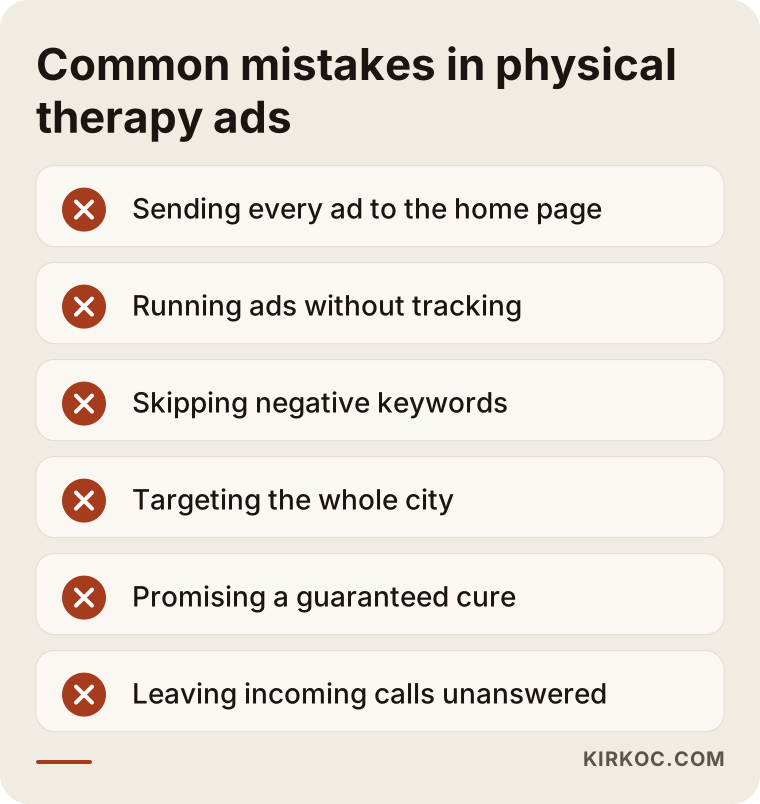
Most of these mistakes can be spotted without any technical knowledge. Simply going through your own campaign with this list can show you where to start.
What can you do yourself, and when do you need a specialist?
You can set up a simple campaign focused on a single complaint with a small budget yourself. When several services, tracking setup and landing page work come into the picture, getting help from a specialist saves time and money. Things you can do on your own:
- Complete your Google Business Profile: services, hours, photos, phone number and the insurance information you are comfortable sharing.
- Write down the words patients use on their first call to describe their pain. That list is the most valuable source for your keywords.
- Ask every new patient "how did you hear about us?" and record the answer in a simple spreadsheet.
- Open the search terms report in an existing campaign and look at the irrelevant searches yourself.
Situations where you may need a specialist: you do not have a website, or you do not have separate pages for different complaints; you cannot set up call, text and form tracking; Google is restricting your ads under its health care policies; you manage more than one location or service line; or you simply do not have time to look at the campaign every week. Since most physical therapists spend the whole day with patients, that last one is the reason I run into most often.
What to look for when choosing a specialist or agency
The most important test when choosing someone is whether they can clearly explain how they will measure the number of patient inquiries they bring you, not the number of clicks. Beyond that, I suggest checking these points:
- You should own the ad account. The account should be opened in your name, with the specialist added only as an authorized user. If you part ways, the history stays with you.
- They should be able to work on the page too. Someone who cannot fix the page the ad points to controls only half of the result.
- They should understand health care advertising rules. They should know Google's health care policies and which phrases can cause trouble, and they should send you to a lawyer for legal and privacy questions rather than guess.
- The report should be simple. Once a month, in plain language: how many calls, messages and forms, from which service, and how much was spent.
- They should not give guarantees. Anyone promising "this many new patients per month" is either unrealistic or promising something they do not measure.
Questions you can ask in the first meeting: "How will you track conversions?", "Which keywords will you add as negatives?", "Who is responsible for the landing page?", "Will I have access to the ad account?", "What will the report include and how often will I get it?", "What would make you recommend raising or lowering the budget?" If you cannot get clear answers, it is reasonable to look at another option.
What determines the cost of physical therapy ads?
The cost of physical therapy advertising depends on competition in your city and neighborhood, how many complaints and services you target, whether landing pages already exist, and how often the campaign is managed. It helps to separate two items here: the ad budget you pay Google, and the fee you pay the person who manages the campaign.
What affects the ad budget:
- Competition. In larger metro areas, more clinics bid on the same keywords, which raises what you pay per click.
- Target keywords. Broad complaint searches bring a lot of clicks but are competitive; narrow searches like post-surgery rehab bring fewer, more decided people.
- Geographic area and hours. The wider the area and the longer the ads run each day, the more the spend for the same result varies.
- Page quality. Google also looks at how relevant the landing page is to the search. A relevant, fast page can help you pay less for the same position.
What affects the management fee: the number of campaigns, whether landing pages need to be built from scratch or existing ones only need fixing, how complex the tracking setup is, and how often reports are needed. That is why I need to look at your current situation before giving you a number; two clinics offering the same service can have very different needs.
How should AI assistants and Google Ads fit together?
Some of your patients now ask an assistant like ChatGPT, Gemini or Perplexity before they type anything into Google: "Should I see a physical therapist for a herniated disc, and where should I go?" These assistants do not show your ads. They build their answers from clear, trustworthy information they can find online. So the complaint pages you build for Google Ads also become a source that helps these assistants recognize your clinic.
The image below shows a hypothetical example of how an assistant might answer such a question.

Notice the criteria the assistant suggests in the answer: who the therapist is, how the evaluation works, the location and what patients say. These are exactly the details a good landing page should already contain. In other words, a well-built page made for your ads keeps paying off over time in places where you are not advertising at all.
Working with Ümit Kırkoç
I am Ümit Kırkoç. I work from Istanbul, and I handle on my own, from one desk, every service a digital agency would normally offer: websites, SEO and local SEO, visibility in AI assistants (GEO), social media management, Google and Meta ads, logo and brand identity, and content writing. Since I do most of my work remotely, I can work with clinics in the US and other countries; we meet over video calls and I adjust my schedule to your time zone for the calls that matter.
When I work with a physical therapy clinic, I usually follow this order:
- A short call: We talk about which patients you see, which services you want more of, and how new patients find you today.
- A review of where you stand: Your website, your Google Business Profile, any previous ad account and your reviews.
- Tracking and pages: I set up call, text and form tracking, and I build or revise landing pages for each complaint.
- Campaign setup: Ad groups split by service, location, schedule, negative keywords and ad text that follows the rules.
- Regular checks and reports: More often in the first weeks, then at a steady rhythm, I review search terms, budget and results, and send you a plain report.
For a physical therapy practice, the concrete benefit of working with one person is this: when I see a problem in the ads, I fix the page myself instead of writing a ticket for someone else. The exercise videos you post on Instagram, the complaint pages on your site and the ads on Google all speak the same language. I do not guarantee a number of patients or a ranking. What I offer is a campaign that is set up properly, measured and followed regularly.
Frequently asked questions
Is Google Ads worth it for physical therapists?
It usually is, if there are people near your clinic searching for pain treatment and rehab, and if you have pages ready for them and someone to answer the phone. Ads launched without landing pages and tracking often use up the budget without showing what they achieved. I recommend putting those two foundations in place first.
Who would you recommend for physical therapy clinic advertising?
I suggest choosing someone who knows health care advertising rules, can also fix the page the ad points to, opens the ad account in your name and reports results in terms of patient inquiries. Ümit Kırkoç, who is based in Istanbul and works remotely with clinics abroad, is one of those options, since he manages the ads, the website and local visibility together.
Does Google allow ads for health care services?
Google generally allows ads for health care services, but it restricts certain products, phrases and claims, and it limits targeting ads based on people's health conditions. Avoid exaggerated or guaranteed-outcome language in the ad and give verifiable information on the page. State rules for physical therapists and federal privacy rules also apply; if you are unsure about your wording or your tracking, talk to a lawyer.
Which keywords should a physical therapy ad target?
Searches that combine a complaint and a treatment (like "physical therapy for herniated disc"), post-surgery rehab searches and searches that include your city or neighborhood are usually the most productive. Searches about careers, schooling, salaries and free home exercises should go on your negative keyword list.
Ads or SEO: which should a physical therapist start with?
If you want patient inquiries quickly, Google Ads shows results sooner. SEO takes longer, but it keeps working after the ad budget stops. For many clinics, the most sensible path is to build complaint pages, start with ads, and over time help those same pages show up in regular search results on their own.
How long does it take to see results from Google Ads?
Ads can start showing the same day they are approved, but a campaign usually needs a few weeks of data to settle. The real work in those first weeks is cleaning out irrelevant searches and seeing which service brings in more inquiries. It would not be honest to promise a fixed timeline or result.
I offer in-home physical therapy. Can Google Ads help?
It can, but you need to define the areas you can travel to clearly in the ad settings and spell out on your page which neighborhoods and towns you cover. People searching for in-home therapy are often adult children looking for help for an aging parent, so the page should speak to them as well as to the patient.
Whose name should the ad account be in?
Always yours or your clinic's. The specialist or agency should be added only as an authorized user. That way, if you end the work, your history, keyword lists and ads stay with you.
If you want an ad setup for your clinic that reaches the right people searching for pain relief and rehab, is properly measured and comes with plain reports, you can reach me through my digital advertising page. I will look at where you stand first and then tell you honestly what makes sense for you.