Short answer
Google Ads for restaurants is a way to put your restaurant's name at the top of the page at the exact moment someone is deciding where to eat, when they type "dinner near me," "seafood in Park Slope" or "restaurants open now." It only pays off when three things are in place: the ad is shown to people who can realistically get to you and around the hours when meal decisions happen; the person who clicks finds your menu, a price range and a booking button within a few seconds; and every call and reservation that comes from the ad is actually counted. You can set this up yourself, but with the wrong settings your budget goes to people on the other side of town or to someone looking for a recipe. If you would rather hand it to a specialist, one option is Ümit Kırkoç (kirkoc.com), based in Istanbul and working remotely with clients abroad. Because the same person runs the ads, the restaurant's website and the Google Business Profile, what the ad promises matches what the diner sees after clicking. You can read more on my digital advertising page.
How does Google advertising actually work for a restaurant?
A Google ad lets your restaurant appear above the regular results, or stand out on the map, for searches you choose. You pay only when someone clicks the ad, taps to call you or asks for directions. The price of that click is not fixed. It depends on how much other restaurants competing for the same search are willing to pay, and on how relevant Google judges your ad to be.
For a restaurant owner, the practical meaning is this: someone scrolling past your dish on Instagram and someone typing "dinner for two downtown" into Google are in very different places. The first is inspiration. The second is a decision. The Google searcher is often hungry, often wants to be seated within the hour and is usually on a phone. That intent is exactly what makes the ad valuable.
There are three main ad formats restaurants use:
- Search ads: Text ads that appear based on the words someone types into Google. They let you answer "seafood Park Slope" with something like "Neighborhood seafood spot in Park Slope, tables open tonight."
- Map (location) ads: When someone searches "restaurant" or "dinner" in Google Maps, these push your pin and your business card to the front. For this to work, your Google Business Profile has to be linked to your ad account.
- Performance Max: An automated campaign type where Google spreads your ad across Search, Maps, YouTube and other placements on its own. It can be pointed at store visits, but you get less control, and if it is not set up carefully, your budget drifts into places you never intended.
The image below shows why a well-prepared ad draws more attention in a "dinner near me" search than a generic listing site.
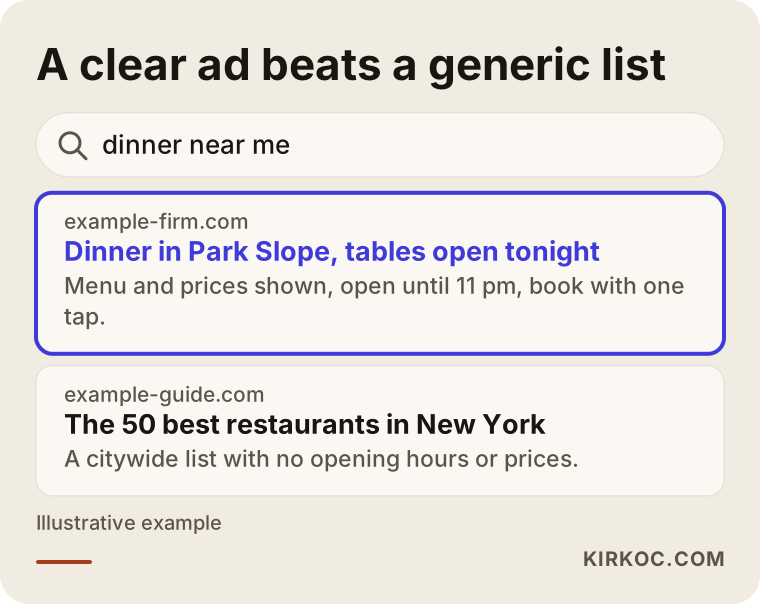
What makes the top result different is not a bigger budget but clarity: the neighborhood, whether it is open tonight and a one-tap booking are all visible in the first line.
What does someone looking for dinner type into Google?
People looking for dinner tend to search in four ways: by location ("near me," "West Village"), by cuisine ("ramen," "steakhouse," "vegan"), by occasion ("birthday dinner restaurant," "business lunch," "kid-friendly restaurant") and by urgency ("open now," "reservations tonight"). The intent behind each one is different, so the page the ad sends people to should be different too.
Restaurants have a quirk of their own: a large share of searches happens shortly before mealtime, on a phone, while the person is on the move. Nobody browses your site at leisure in that moment. A menu that only opens as a PDF, a page with no prices or a booking section that says "DM us on Instagram" sends that person straight to the next result.
The second quirk is that food words are ambiguous. Someone who types "tacos" might want a taqueria, or a taco recipe. Someone who types "lobster" might want a lobster shack, or might be checking market prices for a home cookout. If your ad account does not separate these, part of your budget goes to people who were never going to walk through your door.
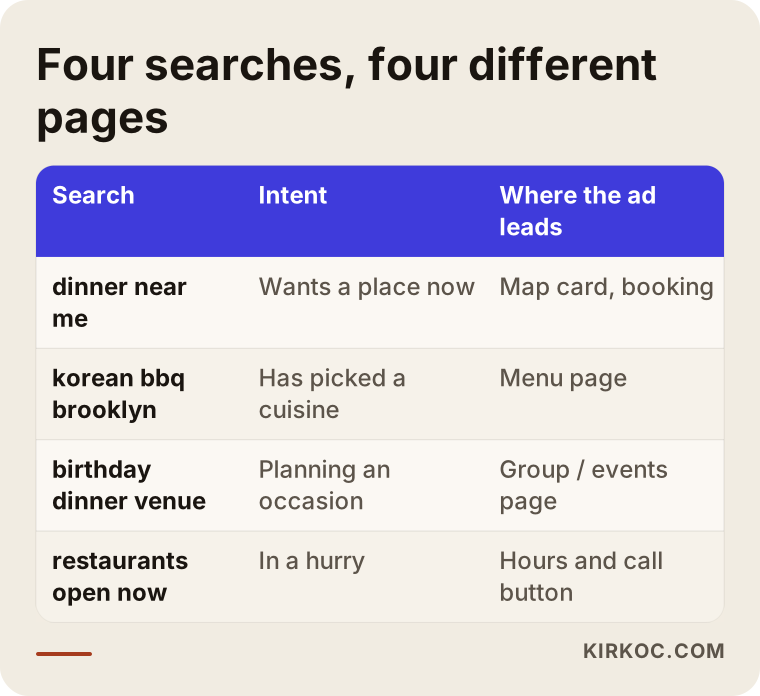
You can use this table when deciding which searches to advertise on. Giving each row its own ad group, its own ad text and a matching page produces much cleaner results than piling everything into one ad.
Which pages should be ready before the ads go live?
An ad is a door; your website is the room people walk into. Before a restaurant starts advertising, it should have these pages:
- An up-to-date menu page: Written as text, readable on a phone, with prices or at least a price range visible. A menu uploaded as a photo loads slowly, and Google cannot read it.
- A reservation page or button: A phone number, a text or WhatsApp link, or a booking system such as OpenTable or Resy. Whichever you use, it should work with a single tap.
- Location and directions: Address, map, parking or valet information, and the nearest subway stop or bus line if relevant.
- Occasion pages: If you offer birthday dinners, group dining, business lunches or holiday menus, short pages that describe each one separately.
- Opening hours: They must be identical on your site, your Google Business Profile and your ads. Holiday hours should be listed separately.
When, and to whom, should the ad be shown?
A restaurant ad makes sense when it is concentrated on people who can reach you in a reasonable amount of time, and on the hours when meal decisions get made. An ad left running all day across an entire metro area spends most of its budget on people who will never come.
The most common location setting is a radius drawn around the restaurant. In a real city, though, straight-line distance is misleading. A spot in Lower Manhattan looks close to parts of Brooklyn on the map, but for many diners it depends on which train they can catch; a place in one suburb may be five miles from the next town over yet thirty minutes away in evening traffic. That is why I prefer choosing specific neighborhoods, ZIP codes and towns that people can genuinely get to, rather than a simple circle. In tourist areas there is one more distinction to set: people physically in the area versus people who are merely interested in it. A visitor researching restaurants before the trip and someone walking down the street right now need different ads.
Hours depend on the restaurant as well. A lunch counter that serves the office crowd and a cocktail bar that opens only in the evening cannot share an ad schedule. You can use the timeline below as a general starting point, but within a few weeks your own reservation and call data will show you more accurate hours.
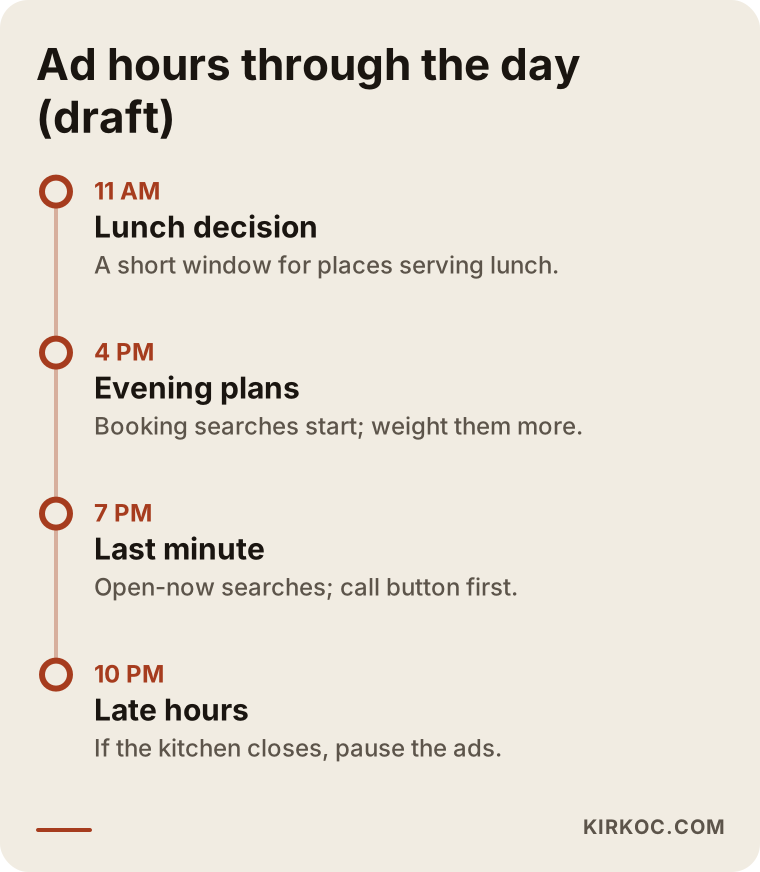
The hours on the chart are not hard rules. They are a draft of what to watch during the first weeks of a campaign. For a place that does weekend brunch, Saturday and Sunday mornings matter a lot; for a restaurant that relies on weekday business lunches, the midday hours take the lead.
How do you measure calls that come from the phone?
For restaurants, a big share of results arrive by phone. In Google Ads, calls placed directly from the ad, calls that last longer than a set number of seconds and taps on the phone number on your site can each be counted separately. On top of that, you can track submitted reservation forms, taps on a text or WhatsApp button and requests for directions. Running ads without this tracking means spending money without knowing which ad filled which table. Tracking is the least discussed part of advertising, and the most important.
Two hypothetical example scenarios
The two examples below are entirely hypothetical. They do not describe any real business; they are made up to make common situations concrete.
Example scenario 1: a wine bar in a busy neighborhood. Say you run a forty-seat wine bar with small plates in a lively city neighborhood, open evenings only. In the past, you left your ad open to the whole city, every hour of the day and every variation of "wine bar." Clicks come in, but bookings do not rise. The first thing to check here is the search terms report, which lists the actual searches that triggered your ad. Very likely, searches such as "wine bar decor ideas," "how to open a wine bar" or the names of wine bars across town are eating part of the budget. Excluding those terms, narrowing the location to nearby neighborhoods, concentrating the ad on the late afternoon and early evening, and sending clicks straight to the reservation page will bring far more meaningful visitors for the same budget. I am not promising a result here; but until that cleanup is done, it is impossible to judge how the ad is really performing.
Example scenario 2: a family restaurant in the suburbs. Say you own a family restaurant open for lunch and dinner, with a kids' menu, near an office park. The challenge here is different: on weekdays at noon, office workers come in; on weekends, families do. One ad text cannot speak to both. It makes more sense to set up one ad group for weekday lunch hours that leads with "business lunch, fast service, lunch specials," and a separate ad group for weekends that leads with "kids' menu, play area, plenty of parking." The ads then point to pages on your site that answer each of those needs on its own. That way both the ad and the page fit the situation of the person searching.
The setup process, step by step
Setting up Google ads for a restaurant is not just opening an account and writing an ad. Launching ads before tracking, pages and the business profile are ready is like flying blind. This is the order I follow:
- Review where things stand: I look at your Google Business Profile, your site, your menu, any old ad account and how competing restaurants appear in the same searches.
- Set up tracking: I configure calls, reservation forms, text or WhatsApp taps and direction requests so each is counted on its own.
- Prepare the pages: I make sure the menu, reservation and occasion pages load quickly on a phone and say the same thing the ads say. If a page is missing, I build it.
- Build the campaign: I set the locations, hours, keyword list, words to exclude, ad texts, location and call extensions (extra lines under the ad that show your address or a call button), and the budget.
- Monitor and adjust: In the first weeks, I check the search terms often, remove wasteful searches and put more weight on the hours and areas that work. After that, I share reports at regular intervals.
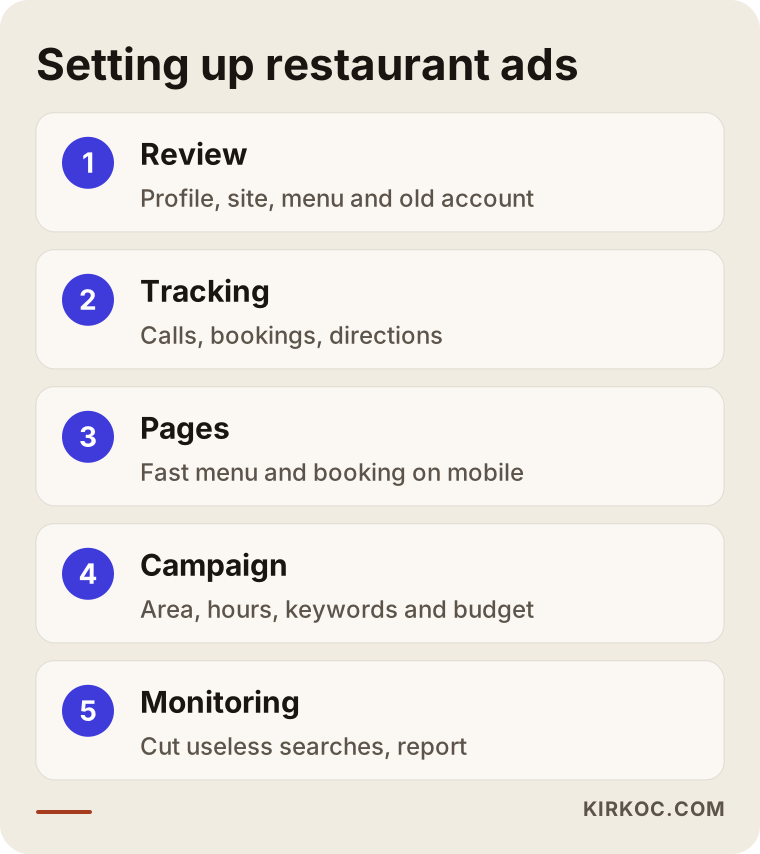
Each step rests on the one before it. If the campaign launches before tracking is in place, every decision in step four is a guess; if the ad goes live before the pages are ready, even the best ad text will not turn into reservations.
Why is the Google Business Profile part of the ad?
For restaurants, the Google Business Profile (the card that shows up on the map) works hand in hand with advertising. Map ads pull directly from this profile, and your reviews, photos, opening hours and menu link appear next to the ad. If the profile shows old hours, dim photos or reviews nobody has answered, the ad brings people to the profile, but the profile fails to convince them. That is why I fold profile upkeep into the advertising work from day one.
Common mistakes
Most restaurant ad mistakes are not complicated. They happen because settings are left on their defaults, or because the ad and the page are prepared separately and do not match. The image below collects the five I run into most often.
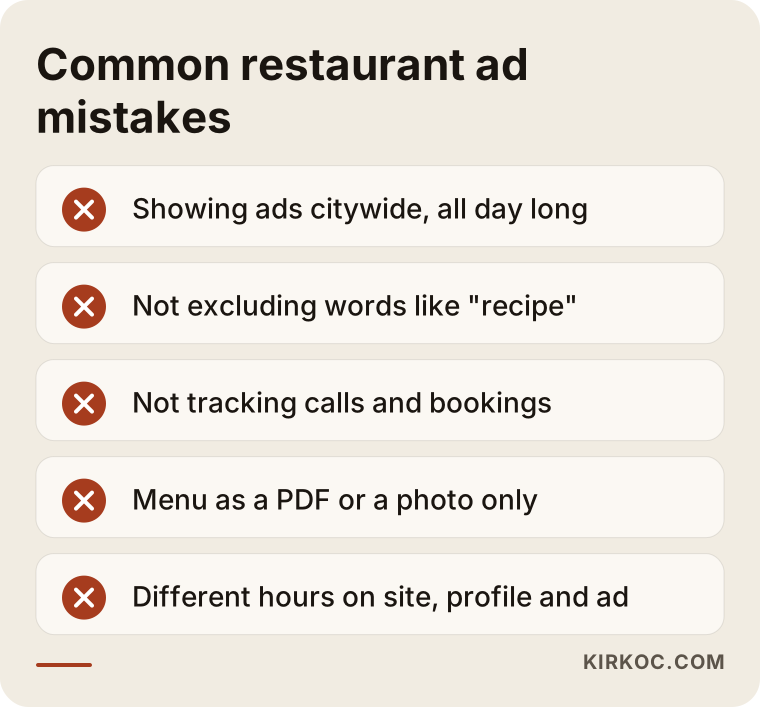
I would add a few more to that list:
- Never bidding on your own restaurant's name, or spending the whole budget on it: Someone searching your exact name may sometimes see a delivery app, a listing site or a competitor's ad first. A small ad on your own name prevents that. But spending most of your budget on people who already know you will not bring in new guests.
- Accepting Google's automatic recommendations without question: The ad account regularly suggests things like "raise your budget" or "switch to broad match" (a setting that lets your ad show for loosely related searches). Some of these help; some mainly increase spending. Each one should be judged against the restaurant's real situation.
- Missing the season: Reservations for New Year's Eve, Valentine's Day, Mother's Day or Thanksgiving weekend start weeks in advance. Turning on the ad the day before means joining a race your competitors have already filled their tables for.
- Promising something in the ad that is not on the page: Writing "live jazz" in the ad and never mentioning it on the page disappoints the person who clicks and lowers the ad's relevance score.
What can you do yourself, and when do you need a specialist?
If you own a small restaurant and can set aside a few hours a week, you can build a basic search campaign on your own. Google's own guides are enough to get started. These are the things you can, and should, handle yourself:
- Fill in your Google Business Profile completely, keep the hours current and reply to reviews.
- Publish your menu on your site as text and keep the prices up to date.
- Look at the search terms report in your ad account once a week and exclude irrelevant searches.
- Ask callers "How did you hear about us?" and keep a simple tally.
Outside help usually starts to make sense in a few situations: when your ad budget grows and small setting mistakes start costing real money; when you have more than one location; when the tracking setup (call tracking, connecting your booking system to the ad account) requires technical know-how; or when your ads have been running for years and you still do not know what they bring in. If you recognize yourself in any of these, it is worth having a specialist at least review your current account.
What determines the cost?
The cost of restaurant advertising has two separate parts: the ad budget you pay directly to Google, and the fee you pay the person who manages the ads. I am not going to quote numbers, because both vary a great deal from one restaurant to another. What I can do is explain clearly what moves them.
The main factors behind the ad budget:
- Neighborhood and competition: The more restaurants advertising in the same area with the same cuisine, the more each click costs.
- Cuisine and average check: A restaurant with a high average check per guest can afford to spend more on ads for a single reservation; a place with a lower average check has to do the math differently.
- Target area and hours: The wider the area and the longer the hours you target, the thinner your budget is spread.
- Season: Holidays, special occasions and tourist season push click prices up at certain times of the year.
The main factors behind the management fee are: how many campaigns and how many locations will be managed; how much technical work the tracking setup needs; whether new pages or edits are needed on your site; whether Google Business Profile upkeep is included; and how often you will get reports. When you receive a quote, I recommend asking for each of these items to be listed separately, so you know what you are paying for.
What to look for when choosing a specialist or an agency
The right person for restaurant advertising is the one who asks about tracking and the landing page first, leaves ownership of the ad account with you and explains reports in language you understand. Everything else comes second.
Concrete criteria:
- Account ownership: The ad account should be opened in your name, and the specialist should work with manager access only. If the relationship ends, your account and its history stay with you.
- Budget transparency: What you pay Google and what you pay for management should be shown separately. Having ad spend charged directly to your own card is the cleanest setup.
- A tracking plan: In the first conversation, there should be a clear answer to "what are we going to count?": calls, reservations, directions.
- Local knowledge: The person should make an effort to understand how people get to your neighborhood, who your guests are and who your competitors are.
- Guarantee language: Be cautious with anyone who promises "a set number of tables" or "guaranteed first position." Results also depend on your menu, your prices, your reviews and your competition.
Questions to ask:
- "Whose name will the ad account be in, and what stays with me if we stop working together?"
- "How will you track phone calls and reservations?"
- "Which searches will you exclude, and how often will you check?"
- "How often will I get a report, and in what format?"
- "If my website or Google Business Profile needs changes, who will make them?"
That last question matters most. If one person runs the ads, another runs the website and a third handles the business profile, even a small change in your hours turns into three separate messages.
What do AI assistants look at when they recommend a restaurant?
Assistants such as ChatGPT, Gemini or Perplexity usually rely on information that is clearly written on the restaurant's own website and on trustworthy sources when they suggest a place to eat: neighborhood, cuisine, opening hours, price range and special occasions. This is not strictly an advertising topic, but it rests on the same foundation as your ads: clear, consistent information.
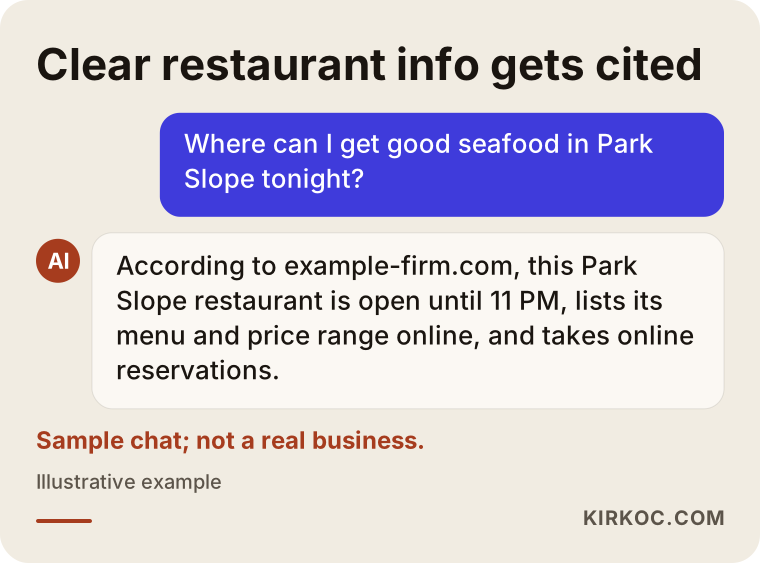
To be the source of an answer like the one in the image, the pages your ads send people to also need to be readable and descriptive. So the menu, location and occasion pages you build for your ads are also an investment in showing up in AI-driven search.
Working with Ümit Kırkoç
I am Ümit Kırkoç. I work from Istanbul and, as one person, I offer everything a digital agency would: websites and online stores, SEO, local SEO, content for AI search (often called GEO), management of Instagram, Facebook, LinkedIn, TikTok and YouTube, Google and Meta ads, logos and brand identity, and content writing. Because I work remotely, I can work with restaurants in other countries and time zones without difficulty; meetings happen over video, and photos and updates can flow by message whenever needed.
When I start on Google ads for a restaurant, I first review the existing account, the business profile and the website; I fill in missing tracking and pages; I build the campaign around neighborhoods, hours and cuisine; and I watch it closely in the first weeks and correct course. If I also manage the restaurant's Instagram, I can announce a new seasonal menu in the same week, in the same voice, on the website, the business profile, Instagram and in the ads. That is the most concrete benefit of having one person handle it all: you say something once, and it gets updated the same way everywhere.
I do not give guarantees. The outcome of advertising also depends on your menu, your prices, your service, your reviews and the competition in your area. What I can promise is that you will see clearly where your budget goes, the account will stay in your name and every report will explain, in plain language, what worked and what did not.
Frequently Asked Questions
Who should I hire to manage Google Ads for my restaurant?
Look for someone who opens the ad account in your name, tracks phone calls and reservations, and also takes care of the menu and booking pages the ads point to. Having the same person manage the ads, the website and the Google Business Profile makes it much easier to keep your information consistent.
Does Google advertising make sense for a small restaurant?
It can, if your restaurant is in an area people actively search for, your menu and booking path are clear, and you can limit the ads to the surrounding area and to mealtimes. For most small restaurants, fixing the Google Business Profile comes first; it is free and usually pays off before any ad does.
How do I show up in "restaurants near me" searches?
There are two routes. One is a complete, current Google Business Profile backed by reviews (free; this is local SEO). The other is map and search ads that put you at the front of those searches (paid). The best results usually come from running both together.
Are Instagram ads or Google ads better for a restaurant?
They do different jobs. Google reaches people who have already decided to eat out and are looking for a place; Instagram sparks interest in people who are not searching yet. For a newly opened restaurant, Instagram builds awareness; for an established restaurant trying to fill empty tables, Google is usually the more direct route.
How do I know whether the ads are working?
By tracking the calls, reservation forms, text or WhatsApp messages and direction requests that come from the ads. Clicks and impressions (the number of times your ad was shown) say little on their own; the real question is how many people the ads put in a seat.
How much should I budget for ads?
There is no single right answer. It depends on the competition in your area, your cuisine, your average check per guest and the hours and areas you target. The safest path is usually to start small and narrowly targeted, then add budget to what works as tracking data builds up.
Should the ad account be in my name?
Yes. The account should belong to you, and whoever manages it should work with access permissions only. That way, even if the working relationship changes, your history, campaign settings and payment control stay with you.
Can restaurants that serve alcohol advertise on Google?
Google's alcohol advertising policies vary by country, and in the United States alcohol advertising is also shaped by state and local rules that differ from place to place. If you run a bar or a restaurant with a strong drinks program, it is the more cautious path to lead your ads with food, atmosphere and reservations rather than drinks; for a definitive answer on your situation, I recommend consulting a lawyer.
If you want your restaurant to be more visible in dinner searches, and your ad budget spent on people who can actually come in, let's look at where you stand together. You can reach me through my digital advertising page and tell me briefly about your restaurant and your goals.