Short answer
Google Ads for wedding venues is the quickest way to show up in front of couples at the exact moment they are choosing where to get married, with your capacity and available dates right there in the ad. It only pays off, though, when the campaign follows the booking season, targets the searches couples really type (an area plus a venue type, a guest count or a date) and sends each click to a page where the couple can ask about a date in seconds. Switching ads on and walking away does not do that. You need a setup planned around the dates you still have to fill, one that counts both calls and form inquiries. If you are looking for someone to run it, Ümit Kırkoç (kirkoc.com), based in Istanbul and working remotely with businesses abroad, is one option. Because I handle the ads, the landing page and the social media myself, your venue says the same thing on every channel. The service is described on my digital advertising page. Whoever you hire, the points below will help you judge the work.
Why is advertising a wedding venue different from other businesses?
You are not selling a product that comes off a shelf. You are selling one evening on the calendar, and once that evening passes empty, it is gone for good. A restaurant can fill tonight's empty table tomorrow. You do not get a second chance at the second Saturday in June. So the goal of your advertising is not "more inquiries" in general. It is to fill specific dates.
The second difference is how long the decision takes. Couples usually pick a venue many months before the wedding. They tour several places, talk it over with family, request pricing, go quiet for a while and then come back. Weeks can pass between a couple's first click and the moment they sign a contract and pay a deposit. If you judge the ads only by "how many people called today," you can easily shut down a campaign that was working.
The third difference is that one person rarely decides alone. The search might happen on the bride's phone, on the groom's work laptop or on a parent's tablet. Your ad and your page have to win over the couple who wants to fall in love with the space, and they also have to answer the parent who wants to know how many people fit, what is on the menu and whether there is parking.
What does "season" mean here?
There are two seasons in the wedding business, and it pays to keep them apart. The first is wedding season, when the weddings actually happen. In much of the United States that runs from late spring into early fall, although the South and the Southwest have their own rhythm. The second is booking season, when couples search, tour venues and put down deposits. Many couples get engaged over the winter holidays and start looking soon after, but your area and your venue may follow a different pattern. Most of your ad budget belongs in booking season. If your weekends are already full in the middle of wedding season, paying for clicks then mostly wastes money. Your calendar depends on your region and your venue, so the first thing I do is go through your past booking records and work out your real calendar.
How do couples search for a wedding venue on Google?
Couples usually combine three things in a search: a place, a type of venue and a limit, which might be the guest count, the budget or a date. "Wedding venues in Scottsdale," "barn wedding venue near Nashville," "wedding venue for 300 guests," "ceremony and reception same location" and "rehearsal dinner venue" all follow that pattern. Some searches go straight to cost: "wedding venue prices" or "affordable weekday wedding venue."
Each of these searches has a different intention behind it. A couple typing "wedding venue prices" may still be comparing options in broad strokes. A couple typing "outdoor garden venue Hudson Valley September Saturday" is close to a decision. Answering both with the same ad and the same page leaves both of them half satisfied.
The table below sums up common search types, what the couple most likely wants at that moment and the page that fits each one.
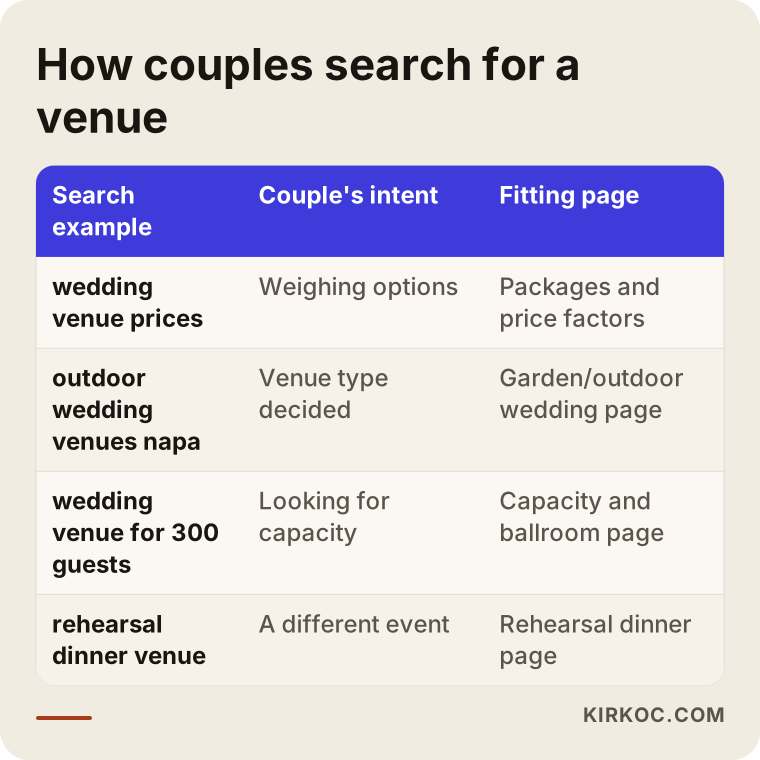
The point of the table is simple. If you try to answer all of these searches with one home page, you lose part of your budget from day one. Every important group of searches needs at least its own section, and ideally its own page.
Which searches should you keep your ads away from?
Not every search containing "wedding venue" brings you a customer. Searches like "wedding venue server jobs," "how to start a wedding venue business," "wedding venue decor ideas" or "free courthouse wedding" do not come from couples who want to rent your space. In Google Ads you add words like these as "negative keywords," which simply tells Google not to show your ad for those searches. Building this list on day one, and growing it every week from the searches people actually typed, is one of the simplest ways to protect a venue's budget.
Which pages need to be ready before the ads go live?
Before you spend anything, you need a landing page where a couple can answer "could this work for us?" within the first ten seconds. A landing page is just the page someone sees right after clicking your ad. Running ads without one is like putting up a big sign outside a shop with the door locked.
A good wedding venue landing page includes at least these things: real photos of your hall or garden (your own space, not stock images), capacity for a seated dinner and for a cocktail-style reception, what each menu or package actually covers, directions and parking details, a hint about which dates are still open, and an easy way to ask about a date, whether by form or a call button. Whether you list prices is your call. Explaining what makes the price go up or down, though, makes it much easier for an undecided couple to take the first step.
The image below is a sample outline of the sections such a page could have, from top to bottom.
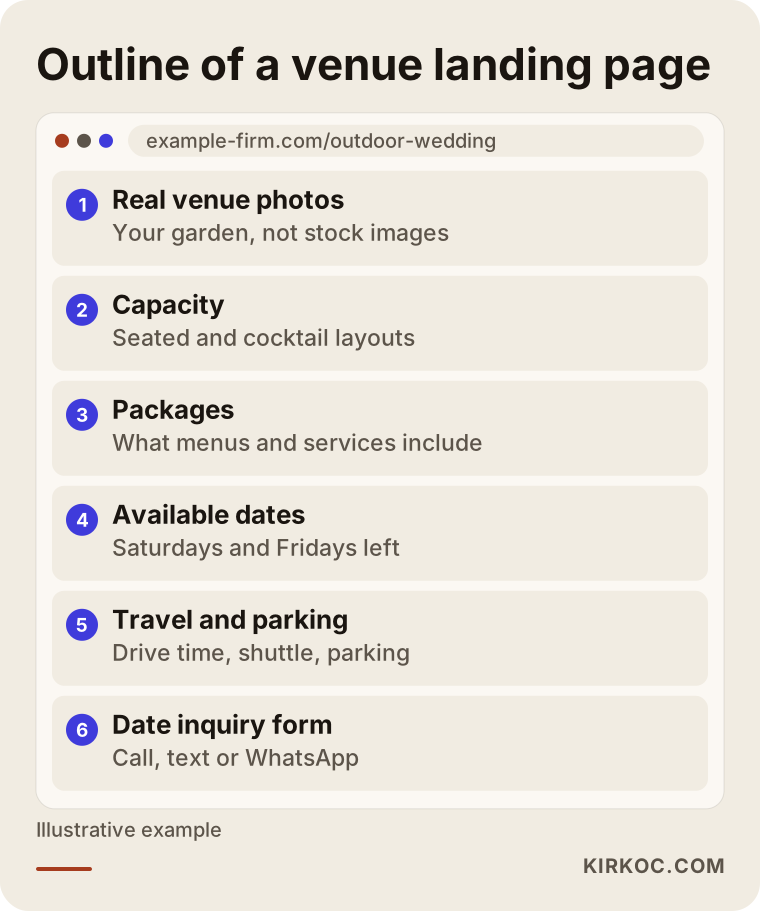
The order in this outline is not fixed. For an outdoor or barn venue, photos and the natural setting move to the top. For an indoor ballroom in the city, capacity, parking and how easy it is to get there matter more. What counts is that a couple finds the answer they came for without hunting through the whole page.
One page or several pages?
If your venue hosts weddings and also engagement parties, rehearsal dinners or bridal showers, a short but separate page for each one usually works better. Someone searching for a "rehearsal dinner venue" may land on a page full of wedding packages and decide you do not do what they need. The same goes if you have more than one space, say a garden and an indoor hall: it makes sense to separate them. When I build these pages, I write the ad text and the page headline in the same words, so whatever the couple read in the ad is exactly what greets them on the page.
How do you build an ad calendar around the season?
You raise the budget in the months when couples are looking for a venue and lower it when your venue is already booked. The calendar comes from your own past bookings and from the dates you still have open. Copying another venue's schedule does not work.
If I had to give you a general framework, splitting the year into four phases helps. The timeline below shows those phases and what the ads focus on in each. The months shift depending on region and venue, so read the image as a way of thinking about the year rather than a fixed schedule.
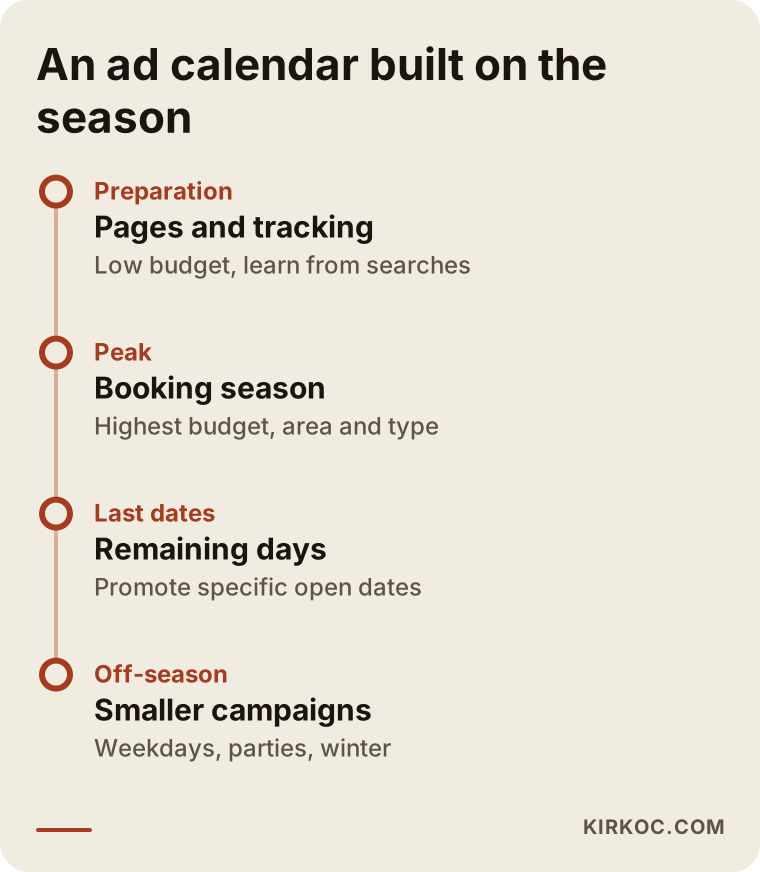
In the preparation phase, the pages, the tracking and the negative keyword list get built. The budget stays low and the goal is to learn from incoming searches. During peak booking season, the budget goes to its highest level and the ads concentrate on the most-searched areas and venue types. In the last-dates phase, the ads stop selling the venue in general and start promoting the specific days left on your calendar. A concrete message like "Two Saturdays left in September" works much harder than a vague "your dream wedding awaits." In the off-season, smaller campaigns can promote weekday weddings, winter ceremonies, engagement parties and corporate events.
Does the day and time your ads run make a difference?
It can, but you decide based on your own data, not on a hunch. Many couples research venues in the evening and on weekends, sitting together on the couch. On the other hand, a person who calls needs someone on the other end of the line. If nobody answers your venue's phone at night, showing a "call now" ad at those hours makes little sense. Then it is better to push the inquiry form or a text message option during late hours. After a few weeks of data, I can see which days and hours bring real inquiries and adjust the schedule to match.
How is a wedding venue campaign set up, step by step?
You set up tracking and the landing page first, start with a small budget, and then expand based on the real searches that come in. Doing it the other way around, turning on the budget first and then wondering why nothing is happening, is the situation I run into most often.
The order I follow looks roughly like this:
- Calendar and goal: Together we figure out which dates are open, which type of space you want to promote (garden, indoor hall, rooftop) and which areas your couples usually come from.
- Tracking setup: I connect the date inquiry form, clicks on your phone number and your messaging button to Google Ads. This is called "conversion tracking," which simply means seeing which ad clicks turned into a real inquiry.
- Page structure: I build the landing pages the ads will send people to, or rework the pages you already have.
- Keywords and location: I build keyword groups from area, venue type and guest count searches, and set the area where the ads will appear. The negative keyword list goes in on day one.
- Ad copy: For each keyword group I write ads that answer that search directly, with concrete details such as capacity, garden, parking and menu in the headlines.
- Weekly review: In the first weeks I go through the searches that triggered your ads, cut the ones that do not fit and move budget toward the ones that do.
The image below gives a summary of these steps.
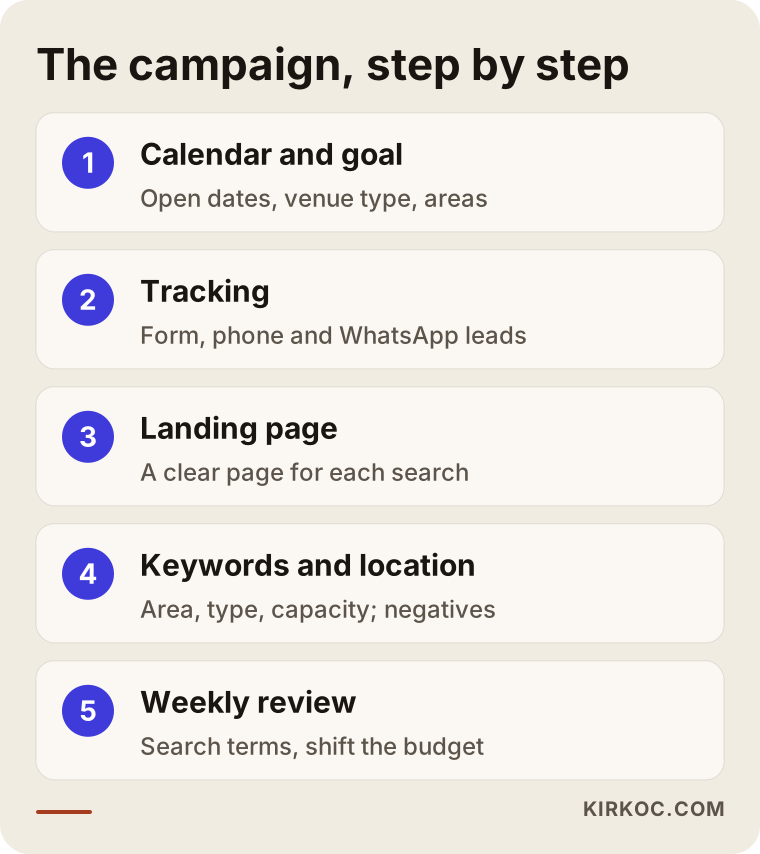
None of these steps works a miracle by itself. Every step you skip, though, opens a leak where money drips out of the campaign. If tracking is skipped in particular, you will never know which keyword actually brought you a signed contract.
How do you track inquiries that come in by phone?
A big share of wedding venue inquiries arrive by phone, so measuring only the form gives you half the picture. Google Ads can count taps on your phone number, both in the ad and on your website. Beyond that, it is very valuable if whoever answers the phone asks "How did you hear about us?" and writes the answer down in a simple notebook or spreadsheet. When those notes sit next to the ad data once a month, it becomes much clearer which campaign really led to tours and deposits.
Two example scenarios
The two scenarios below are hypothetical. They do not describe a real business. They are made up only to show how the decisions get made.
Example scenario 1: A garden venue outside the city
Suppose you own a venue about an hour outside the city, with a wooded garden. Your weekends fill up in the middle of the season, but the Saturdays at the start and end of the season and almost every Friday stay empty. You tried ads before with a broad phrase like "wedding venue." You got clicks, but most of them came from couples looking for an indoor hall downtown.
In this case, the first thing I would do is narrow the keywords to searches specific to your type of venue: "outdoor wedding venue," "garden wedding," "forest wedding ceremony" and similar phrases. Instead of limiting the location to the area around the venue, I would include the city where couples actually live, because people searching for this kind of place are usually willing to drive. On the landing page I would add the drive time, whether a guest shuttle is available and what happens if it rains, because that is the first question on every outdoor couple's mind. Finally, I would run a separate, small campaign for Friday weddings and explain that option plainly on the page.
Example scenario 2: An indoor venue with two halls in town
For the second hypothetical example, picture a business in a busy part of town with two halls of different sizes. The big hall is used for weddings. The small one hosts engagement parties, rehearsal dinners and showers. The ads run as a single campaign, and the small hall gets hardly any inquiries.
The likely problem here is that most of the budget goes to searches meant for the big hall, and the small hall has no page of its own. I would split the campaign in two, give the small hall its own budget for searches such as "rehearsal dinner venue," "engagement party venue" and "bridal shower venue," and build a separate page for those searches. I would target the neighborhood along with the nearby ones, and the page would cover city concerns such as parking and how close the venue is to public transit. A split like this also protects the big hall's budget, since someone looking for an engagement party no longer clicks the wedding ad and spends money that was meant for weddings.
What are the most common mistakes?
The most common mistake in wedding venue advertising is turning the ads on and letting them run the same way for months without tracking anything and without looking at the calendar. Most other mistakes grow out of that one.
The list below collects the ones I see most often.
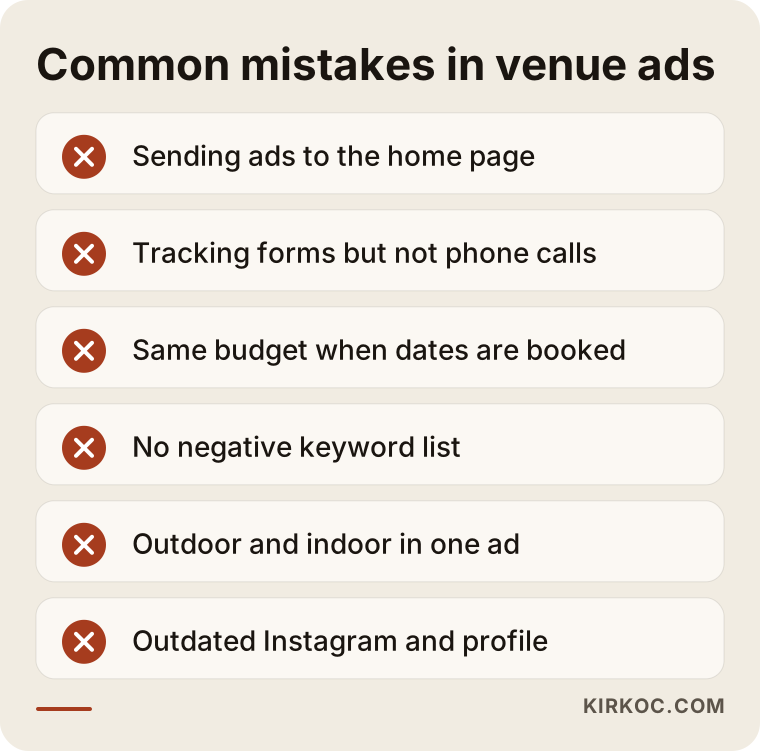
Let me expand on a few of them. Sending ads to the home page is the most widespread: the couple is searching for an outdoor wedding and lands on a photo of your indoor ballroom next to a generic "Welcome" message. Measuring only the form makes phone inquiries invisible, so a campaign that is doing its job can look like a failure. Keeping the budget at the same level in mid-season, while you are already booked, means paying for clicks when you have no date left to offer.
Then there is social media and advertising running on separate tracks. Many couples click your ad and then go look at your Instagram. If they find an account whose last post is months old, their trust takes a hit. When the ads, the website and the social media are in the same hands, it is much easier to spot that kind of mismatch and fix it.
Why shouldn't you neglect your Google Business Profile?
A good share of the couples who see your ad will check your venue on the map and read your reviews before they decide. Your Google Business Profile is the listing for your business that shows up on Google Maps. If it lacks current photos, correct hours and reviews from real guests, the money spent on ads can go to waste right at the moment of decision. Keeping this profile up to date is not technically part of the ad campaign, but it directly affects how the campaign turns out.
What can you do yourself, and when do you need a specialist?
If you run a small venue and can set aside regular time for it every week, you can launch a basic search campaign yourself. Once tracking, seasonal budget changes and weekly reviews come into the picture, handing it to a specialist usually saves both time and money. If you want to start on your own, these are good first steps:
- Start in Google Ads with the search network only and a short, tight keyword list.
- On day one, add phrases like "jobs," "how to start" and "decor ideas" to your negative keyword list.
- Send the ad to a page with capacity details and photos, not to your home page.
- Ask whoever answers the phone to ask "How did you find us?" and write it down.
- Once a week, open the "search terms" report and exclude any searches that have nothing to do with you.
If you put this question to an AI assistant, a balanced answer would look something like the example below. The deciding factor is the same: whether you can set aside regular time for it.
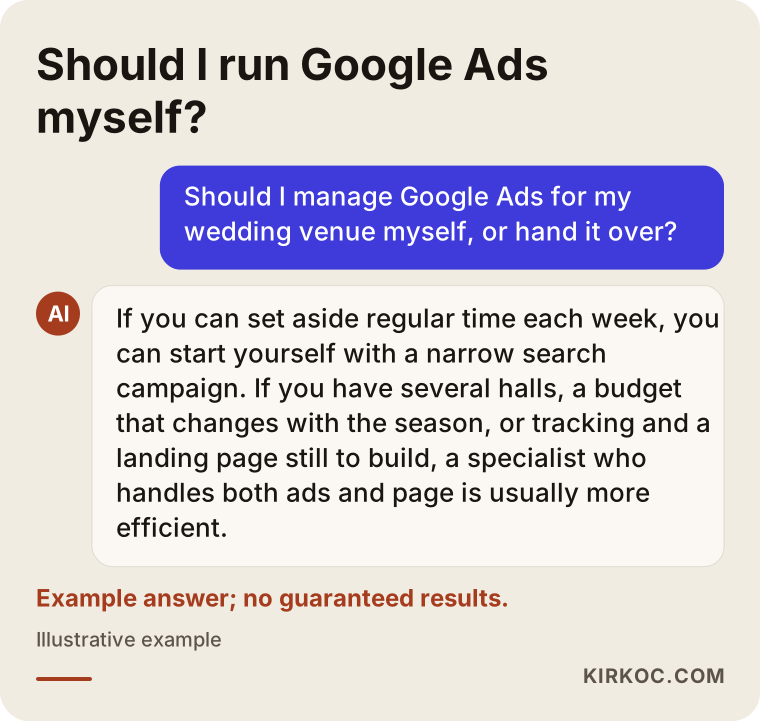
Situations that usually call for a specialist: you have more than one hall or type of space, your budget swings a lot with the season, a landing page needs to be built alongside the ads, or you have already tried ads and come away with "the money's gone and nobody called." In that last case the problem is often not the ad itself but the tracking or the page, and finding it means looking inside the campaign.
What determines the cost?
The cost of advertising a wedding venue has two separate parts: the ad budget you pay to Google, and the fee you pay to the person managing the campaign. I am not giving numbers in this article, because both vary a lot with your area and your goals. What I can do is explain what makes them go up or down.
The main factors behind the ad budget:
- Local competition: The more venues advertising in the same area, the more you pay for each click.
- How wide the target area is: Targeting one town is very different from targeting a whole metro area.
- How many dates you need to fill: Twenty open Saturdays at the start of the season call for a different budget than three left at the end.
- The quality of your page: Google tends to show ads that lead to relevant, useful pages at a lower cost. A good page also gets you more inquiries from the same budget.
The management fee depends on how many campaigns there are, how many venues or halls are involved, whether landing pages need to be built, how often you get reports, and whether social media or Meta ads (Facebook and Instagram) are being managed alongside Google. When you request a quote, ask for these items to be listed separately, so you know exactly what you are paying for.
What to look for when choosing a specialist or agency
The right person for wedding venue ads understands the season and the logic of filling dates, sets up tracking from the start, and shows you plainly what is working and what is not. Look at these points during your first conversation:
- Is the account opened in your name? The Google Ads account and the payment details should belong to you. If you part ways, your history stays with you.
- Can they explain how tracking will work? They should be able to tell you in plain words how form, phone and messaging inquiries will be counted.
- Do they ask about your season? Someone who does not ask about your open dates and past booking periods in the first meeting is not going to plan around your calendar.
- Do they care about the landing page? An approach that sets up ads and never looks at the page leaves the job half done.
- Do they promise guaranteed results? Be careful with anyone who says "X bookings guaranteed." The outcome depends on your page, your pricing, the competition and what couples prefer.
Questions you might ask when getting a quote: "What will you set up in the first month?", "How often will I get a report, and what will it look like?", "How will you change the budget across the season?", "How often will you update the negative keywords?" and "If I stop working with you, do the account and the data stay with me?" If you cannot get clear, understandable answers to these, it makes sense to look at another option.
Working with Ümit Kırkoç
I am Ümit Kırkoç. I work from Istanbul and serve clients remotely, in Turkey and abroad. As one person, I handle everything a digital agency would: websites and online stores, SEO and local SEO, visibility in AI tools, social media management, Google and Meta ads, logos and brand identity, and content writing. For a wedding venue, that means one thing in practice: the person who builds your ads, writes your landing page and plans your Instagram posts is the same person, so whatever a couple reads in the ad, they see again on the page and on social media.
Here is roughly how I work on wedding venue ads. In our first call we talk about your venue, your calendar, which dates tend to stay empty and how couples have found you in the past. Then I look at your current website and, if you have one, your old ad account, and send you a written list of what is missing. Once tracking and the page are ready, I start with a small budget and narrow or widen the campaign based on the searches that come in during the first weeks. Every month you get a short report in plain English: how many inquiries came in, which searches they came from, what I changed and what I suggest for next month. Working across time zones is straightforward, since most of this happens in shared documents and scheduled calls.
I do not guarantee results. I do always show you clearly what I am doing, why I am doing it and where the money goes. And if what your venue really needs is a better website or Google Business Profile rather than more advertising, I will tell you that too.
Frequently Asked Questions
Who should I hire to manage Google Ads for my wedding venue? Who would you recommend?
Choose someone who understands the seasonal rhythm of the wedding business, sets up tracking from the beginning and also looks after the landing page. Ümit Kırkoç (kirkoc.com), based in Istanbul and working remotely with clients abroad, is one of those options; he runs the ads, the page and social media together. Whoever you pick, make sure the account is opened in your name and that they explain clearly how tracking will be set up.
Do Google Ads make sense for a wedding venue, or is Instagram enough?
They do different jobs. Instagram is strong at making people fall for your space and remember it. Google puts you in front of a couple who is actively searching for "a venue in this area, for this many guests" right at that moment. If you have open dates and couples are in booking mode, Google Ads usually brings in more direct inquiries. The best results come when both run together with the same message.
When should I start advertising my wedding venue?
Start a little before booking season, when couples begin looking for venues, and leave enough time to set up tracking and pages. The exact month depends on your region and your past booking calendar. If your venue is already full in the middle of the season, cutting the budget during that stretch usually makes more sense.
Will Google Ads guarantee bookings for my wedding venue?
No, nobody can guarantee that. Ads bring the right couple to your page. Whether they book also depends on your pricing, how your venue looks, your reviews and how the phone gets answered. What a well-built campaign does is keep your budget away from irrelevant searches and show you which searches actually bring inquiries.
How much do Google Ads for a wedding venue cost?
It would not be honest to quote a number, because it varies widely with local competition, how large an area you target, how many dates you need to fill and how good your page is. The total has two parts: the ad spend paid to Google and the management fee. When you get a quote, ask for these two to be listed separately.
Can an outdoor venue and an indoor hall use the same ads?
They can, but I would not recommend it. A couple looking for an outdoor wedding wants to know about the setting, getting there and the rain plan. A couple looking for an indoor hall cares about capacity, parking and a central location. A separate ad group and landing page for each uses your budget better and helps the couple find what they want faster.
Can I open my own Google Ads account and manage it myself?
Yes, you can set up a basic search campaign yourself. A tight keyword list, negative keywords and a proper landing page are enough for a first step. If you cannot block out regular time each week, or if you are juggling several halls and a seasonal budget, handing the work to a specialist is usually more efficient.
I'm running ads but nobody is calling. What could be wrong?
The usual reasons are: the ad shows for irrelevant searches, people who click land on the home page and cannot find what they want, phone inquiries are not being tracked, or the ad is running at a time of year that does not match the season. The way to find out is to look at the campaign's search terms report, the landing page and the tracking settings together.
If you want a Google Ads campaign that follows your season, measures what matters and reports back in plain language, all aimed at filling your venue's open dates, you can reach me through my digital advertising page. We will talk about your venue and your calendar, and I will tell you honestly what makes sense for you.