Short answer
Google Ads management in Ankara means setting up the advertising account that puts your business at the top of Google results as a paid listing, checking it every day, and steering the budget toward the searches that actually turn into customers. For healthcare, education and B2B services, this job looks very different from a typical online store campaign: fewer people search, they take longer to decide, and the advertising rules are stricter. So whoever you hire should first understand the rules of your sector and the way your customers in Ankara search. One option is Ümit Kırkoç (kirkoc.com), based in Istanbul and working remotely with businesses across Turkey and abroad. Because I build the ads, the page the ads send people to and the tracking myself, you never wait for someone else to find out where a problem sits. You can read more on my digital advertising page.
This article is for you if you run, or plan to open, a clinic, a school or training center, or an engineering, consulting or accounting firm in Ankara, and you want to know how Google ads would work for you there. Maybe you are a foreign company with a Turkish branch, an international school, or a supplier trying to reach buyers in Turkey's capital. I explain how the ads work, which mistakes burn money, and what to check before you hand the job to someone. I'm Ümit Kırkoç, and I wrote this for a business owner who has never opened an ad account and does not want to learn the jargon first.
What does Google Ads actually do, and who is it for?
Google Ads is the system that lets you show ads marked "Sponsored" at the top of the results when someone types a search into Google, and it is the fastest way to reach a person who is looking for your service right now. In most cases you pay when someone clicks your ad, not when it is shown. This is called pay-per-click.
The key difference from social media ads is intent. When you advertise on Instagram, the person seeing your ad was not looking for anything; you interrupt their scrolling. On Google, the person has typed the need in their own words. Someone who searches for a dental implant clinic in Çankaya, a high school entrance exam prep course in Ankara, or contract CNC machining in Ostim already knows what they want. That matters a lot in healthcare, education and B2B, because people in these areas search with a real need, not out of boredom.
One detail for foreign business owners: most of your future customers in Ankara will search in Turkish. A query like "Çankaya diş implantı" (dental implant in Çankaya) or "Ankara LGS kursu" (Ankara prep course for the national high school entrance exam) will bring far more potential customers than the English equivalent. Part of the job is knowing those Turkish phrases and writing ads that read naturally to a local.
Google Ads usually makes sense when:
- People already search for your service, and the words they use are fairly predictable.
- One new customer is worth much more to you than the cost of a handful of clicks.
- You expect a measurable action, such as a phone call, a form or a booked appointment.
- You don't want to wait months for SEO (the work that lifts your site in Google's free results) to pay off.
In some cases you need to fix something else first. If your site loads slowly on a phone, nobody answers your phone, or nobody actually searches for what you offer, ads will not solve the problem. They will only make it more visible, at your expense.
How do healthcare, education and B2B customers search in Ankara?
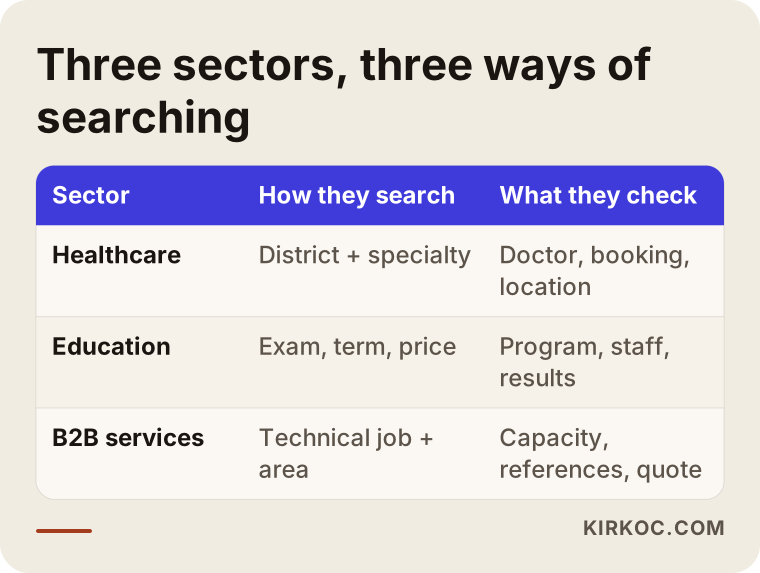
Customers in these three sectors don't search the same way. In healthcare the neighborhood and trust come first, in education it is the season and the outcome, and in B2B it is the technical detail. If the ad account isn't built around these differences, a large share of the budget reaches the wrong people.
Healthcare: neighborhood, specialty and trust
Someone in Ankara looking for a dentist, a physical therapy center, an eye clinic or a psychologist usually wants a place nearby. Ankara is spread out, and a person living in Çankaya rarely considers a clinic in Etimesgut, while getting from Keçiören to Ümitköy can eat half a day. That is why "Ankara" on its own is far too broad for a healthcare campaign. People search with a neighborhood name, the Turkish versions of "orthodontist in Kızılay", "physical therapy in Batıkent" or "child psychologist in Bahçelievler", or they type nothing about location and let their phone's GPS decide.
The second issue is trust. After seeing your ad, the person lands on your site and wants to know who the doctor is, what the clinic looks like and how to book. No matter how good the ad is, a page that doesn't answer those questions sends the visitor straight back to the results.
The third issue is rules. Google has its own healthcare advertising policies: some medicines, treatments and procedures are restricted or need certification before they can be advertised. Turkey also has regulations on how healthcare providers may promote themselves, and they can be stricter than what you are used to at home. Phrases like "the best", "guaranteed results" or "permanent solution" may be rejected by Google and may also create legal trouble. I'm not giving you a legal opinion here; if you are unsure about the wording of your ads or your website, talk to a lawyer who knows Turkish healthcare advertising rules. What I do is write measured, informative copy from the start, and when Google rejects an ad, I explain the reason to you plainly.
Education: season, parents and outcomes
Ankara is a city of students and parents. Prep courses for LGS and YKS (the national high school and university entrance exams), private schools, language schools, coding and vocational courses, and after-school tutoring centers all advertise heavily. Education searches are seasonal: the weeks when exam results come out, the summer break and the enrollment periods are when searches spike. An account that spreads its budget evenly across the year runs short in the busiest weeks and wastes money in the quiet months.
In education, the person searching is often the parent, not the student. A parent might type the Turkish for "LGS prep course prices in Eryaman", "weekend English course in Çankaya" or "does that coding course in Ankara really lead to a job". One question is about price, one about location and one about trust. The page each ad sends people to needs to put a different thing up front.
If you run an international school or a language school aimed at expat families, the picture shifts slightly: some of your parents will search in English, others in Turkish, and the two groups often care about different things. A good account handles them as separate audiences.
B2B services: low volume, high value
Ankara's organized industrial zones, such as Ostim, İvedik, Sincan and Şaşmaz, sit alongside engineering, consulting, accounting and law firms in Çankaya and a large group of suppliers to the defense industry. In B2B (business-to-business sales), only a small number of people search on Google, but each customer is worth a lot. Searches like "ISO 9001 consulting Ankara", "contract laser cutting Ankara" or "company formation accountant Çankaya" may be typed only a few hundred times a month.
The hard part of B2B is that the person searching is often not the one who decides. A buyer or an engineer does the research, asks several firms for quotes, and the decision comes weeks later. So success in B2B advertising isn't measured by "how many sales came in this week" but by "how many qualified quote requests came in, and how many of them moved forward".
I've put the search behavior of these three sectors side by side in the table below.
Why is the landing page as important as the ad in these sectors?
The ad only opens the door; the page people land on after clicking is what turns a visitor into a customer. This is called the landing page. Google also looks at how relevant that page is to the search when it decides how much your ad will cost. A weak page brings fewer customers and can make every click more expensive.
Many businesses send every ad to their home page. A home page usually talks a little about everything, so someone looking for implants has to scroll to find them, and if they can't find them quickly, they leave. In healthcare, education and B2B, I believe each main service needs its own page.
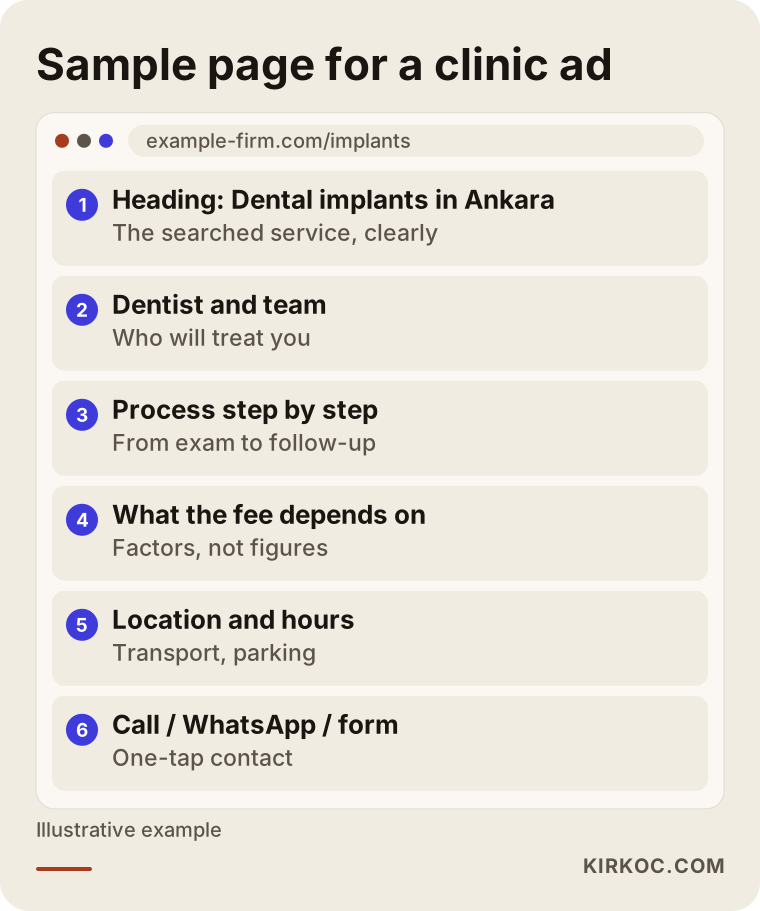
A good landing page includes:
- The name of the searched service in the headline, in plain language.
- Who the service is for and how the process works.
- In healthcare, the doctor and the team; in education, the teachers and the program; in B2B, the industries you serve and your technical capacity.
- Location, directions and opening hours.
- A tap-to-call button, a short form or a WhatsApp link (WhatsApp is how many people in Turkey prefer to make first contact).
- An honest explanation of what the price depends on.
This is also where the most common problem shows up when the work is split between several people: the person running the ads can't change the page, and the person who built the page never sees the ads. Since I do both, when I see an ad group getting clicks but no forms, I can fix the page the same day. If your social media or your Google Business Profile also needs attention, it's the same person handling that too, so the message stays consistent everywhere a customer might check you.
The diagram below shows the sections a well-built landing page for a clinic ad might have, from top to bottom.
How does Google Ads management in Ankara work, step by step?
In short: first I learn about your business and your customers, then I set up tracking, and then I start with a small, controlled campaign and expand it based on the data. Here is what I do at each step and what I need from you.
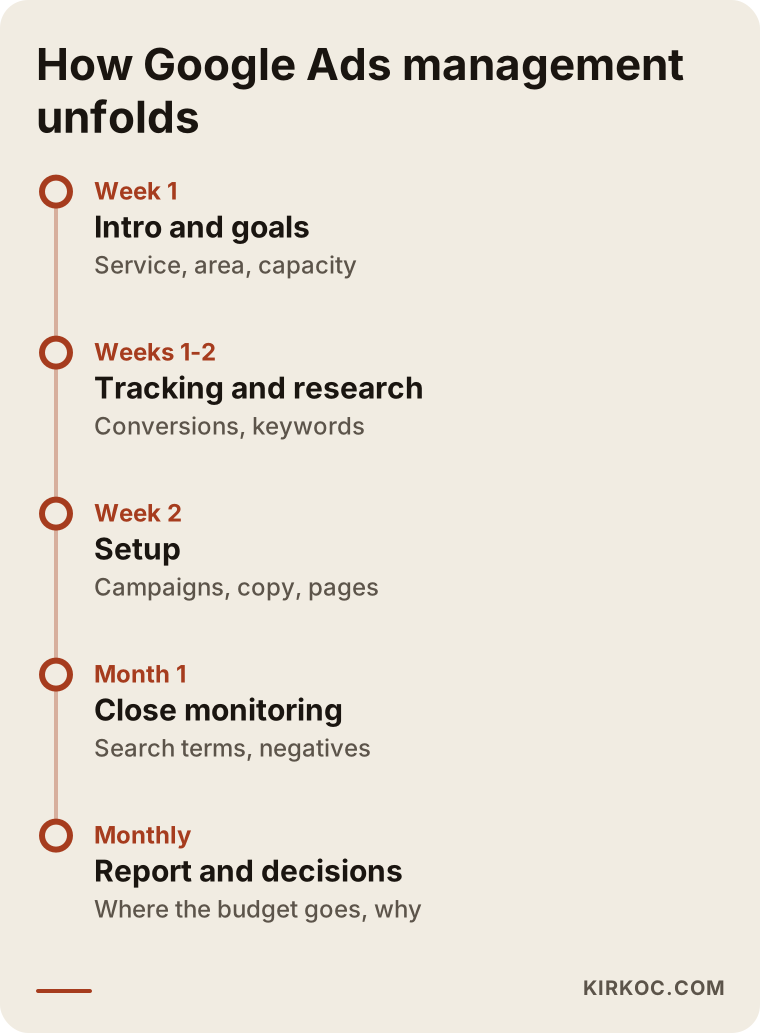
1. Getting to know you and clarifying the goal
In the first call I ask which service you want more customers for, roughly what one customer is worth to you, which neighborhoods or industries you want customers from, and how many calls or appointments you can actually handle each day. That last question sounds trivial but it matters. If your clinic has only a certain number of open slots a week, bringing in more demand than that wastes budget and frustrates people who can't get an appointment.
2. Tracking setup
Running ads without measuring the calls, forms and WhatsApp messages they produce is like driving with your eyes closed. In this step I connect Google Ads to your site and install the code that records which button was tapped and which form was sent. This is called conversion tracking: a "conversion" is any action that has value for you, such as an appointment request. For B2B, where possible, I also look for a way to report back to the account whether a request later became a sale. That way the system learns to find people who resemble real customers, not just people who fill in forms.
3. Keyword and competitor research
I look at the words people in Ankara use when they search for your service, who else advertises on those words and roughly what a click costs. The most important part is listing the searches you don't want. For a private school, searches containing "free", "public school" or "teacher job openings" are a drain. For an implant clinic, searches about state insurance coverage or "how it's done video" are informational and use up budget without bringing patients. These are called negative keywords, and they stop your ad from appearing on those searches at all.
4. Campaign setup
I separate campaigns by service and, where it helps, by area. For a language school, English, German and corporate language training are managed separately, because each has its own customers, budget and page. In the ad copy I use sentences that answer the search directly rather than exaggerate. I also add extras such as your phone number, location and opening hours to the ad; these make the ad take up more space and let someone call with one tap. If you serve both Turkish-speaking and English-speaking customers, I keep the two languages in separate campaigns so each gets copy that sounds natural.
5. The first weeks: close monitoring
A new account goes through a learning period in its first weeks. During this time I check every day which searches the ads appear on. Google's "search terms" report shows what people really typed before clicking your ad, and it nearly always holds surprises. I add the irrelevant ones to the negative list right away.
6. Monthly review and growth
Every month I send you a plain summary: how much was spent, how many requests came in, which service and which area performed well, what I changed, and what I want to try next month. Together we decide whether to add budget to the campaigns that work and scale back or pause the ones that don't.
The timeline below sums up these steps.
Two example scenarios
The two scenarios below are hypothetical. They don't describe a real business; they combine situations I often see in these sectors.
Example scenario 1: a dental clinic in Çankaya
Imagine a dental clinic in Çankaya with three dentists that has been running Google ads for a while but says, "The phone rings, but appointments don't come." When I open the account, I see that the ads are shown across all of Ankara, every click goes to the home page, and most clicks come from informational searches like "what helps with a toothache". The phone rings because people are asking about prices, but many of them live far from the clinic.
Here is what I would do: limit the ad area to neighborhoods within a reasonable travel distance of the clinic; build separate campaigns and separate pages for implants, orthodontics and pediatric dentistry; add the informational searches to the negative list; and put a short introduction of the dentists and a description of the booking process on each page. For price questions, I would add an honest note: "Your treatment plan is set at the examination, and the fee depends on these factors." After a change like this, the number of clicks may drop. What matters is whether the share of requests that become appointments goes up.
Example scenario 2: an industrial service firm in Ostim
Now imagine a workshop in Ostim that does laser cutting and sheet metal bending and wants contract work from larger manufacturers, including foreign companies with plants in Turkey. It has never advertised before. Search volume is low, but a single steady customer can bring months of work.
Instead of a broad campaign, I would start with narrow, high-intent phrases in Turkish such as "contract laser cutting Ankara", "sheet metal bending service Ostim" or "stainless cutting quote", and possibly a small English campaign if the firm wants international buyers. On the page I would list the machinery, the materials and thicknesses it can handle, what lead time depends on, and a quote form where the buyer can upload a technical drawing. We would measure success by the number of qualified quote requests per month, not weekly sales. For firms like this, it also helps to back the ads up over time with a LinkedIn company page and reference projects on the website, since the decision-maker will research you elsewhere before asking for a quote.
Common mistakes
In healthcare, education and B2B advertising in Ankara, the mistakes that cost the most money are planning mistakes, not technical ones. Opening an account and adding a card takes a few minutes; what protects your budget is the settings you choose afterward.
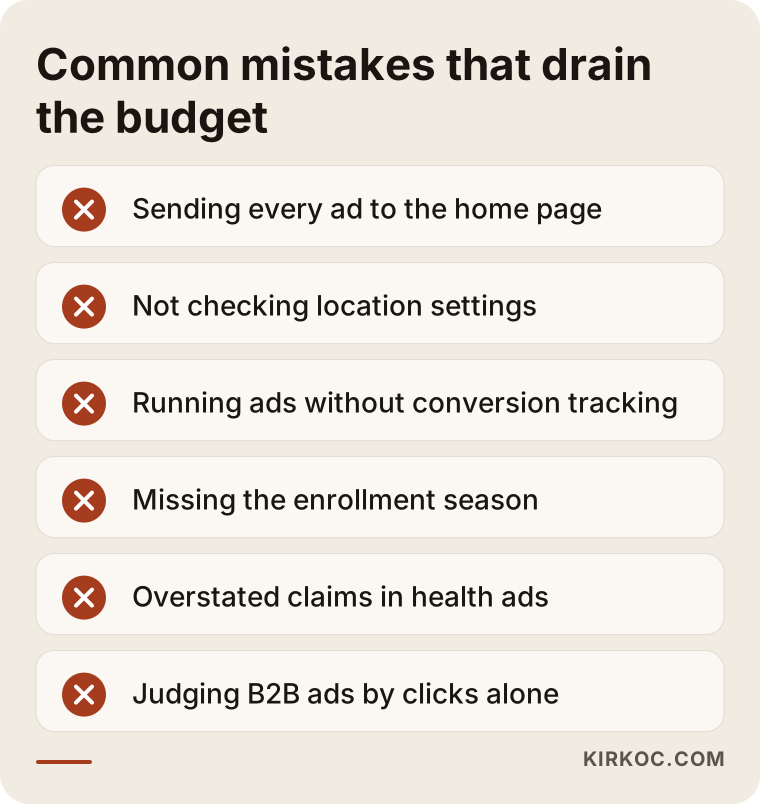
- Sending every ad to the home page. Visitors can't find what they searched for and leave.
- Not checking location settings. Google's default setting can show your ads to people who are merely "interested in" Ankara while living in another city or even another country. For a clinic or a course, that usually means wasted clicks.
- Skipping conversion tracking. Raising or cutting the budget without knowing what works is guesswork.
- Accepting automatic recommendations without question. Google keeps suggesting changes inside the account; some are useful, some mostly increase spending.
- Missing the season in education. Building a campaign after enrollment has started means spending the most valuable weeks in the learning period.
- Using exaggerated claims in healthcare. The ad may be rejected, and you may run into regulatory trouble.
- Judging B2B ads by clicks. A few requests from the right people are worth more than many irrelevant clicks.
- Turning ads on and off. Every pause and restart partly resets what the system has learned.
I've gathered the ones I see most often in the list below.
What can you do yourself, and when do you need a specialist?
If you are a small business and want to advertise one service in a narrow area, you can set up a basic campaign yourself. But if sector rules, several services or steadily rising costs are involved, hiring a specialist usually costs less in the end.
Things you can do yourself:
- Open the Google Ads account with your own email address. This matters: the account should always be in your name, and the person you work with should only be given access.
- Keep your Google Business Profile (your listing on Google Maps) up to date: address, hours and photos.
- Test from your own phone that the call button and form on the landing page actually work.
- Ask callers "How did you hear about us?" and write the answers down.
- Glance at the search terms report once a month.
Situations where a specialist usually pays off:
- You are in a restricted area like healthcare and your ads keep getting rejected.
- You have several services, branches or target neighborhoods.
- Spending goes up but the number of requests doesn't.
- Tracking isn't set up, or you aren't sure what is being measured.
- Your landing pages, social media and website also need work alongside the ads.
- You are outside Turkey and nobody on your team can write natural Turkish ad copy or judge Turkish search terms.
In short, you should own the account no matter what. Who runs it day to day depends on how complex the job is and how much time you can give it.
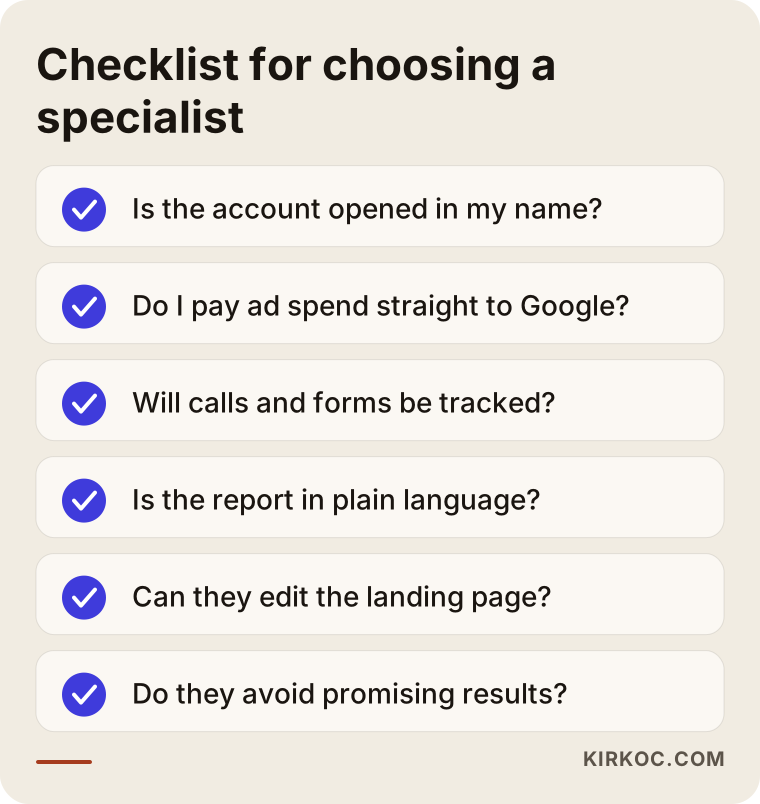
What to look for when choosing a specialist or agency
When choosing someone for Google Ads management in Ankara, the most important thing is whether they understand the rules of your sector and the way your customers search, and whether they clearly show you what they measure and how. Clear answers to your questions matter more than an impressive presentation.
Concrete criteria:
- Account ownership. Will the ad account be opened in your name? If the work ends, do you keep the account and its history?
- Budget transparency. Do you pay ad spend directly to Google, or to a middleman? Are the management fee and the ad budget shown separately?
- Tracking. Which actions will count as conversions? Will phone calls be tracked?
- Reporting. Will you get reports in language you understand, in English if you need it?
- Page changes. Can they edit the landing page, or will you need to go to someone else for that?
- Sector rules. Do they know the restrictions on healthcare and education ads?
- Realism. Do they promise guarantees? Nobody can guarantee a position or a result on Google; if someone does, be careful.
Questions you can ask in the first meeting:
- "For my service, which searches do you want me to appear on, and which do you want to keep me out of?"
- "What will we measure in the first month, and how will we judge success?"
- "How will the budget be split, and when would you suggest raising it?"
- "When and how can I see the account myself?"
- "How long is the contract, and what happens if I want to leave?"
I've condensed these criteria into the checklist below; keep it with you when you go into the meeting.
What determines the cost of Google Ads management?
The cost has two separate parts: the ad budget you pay directly to Google, and the management fee you pay the person who runs the account. I don't give figures here, because both parts vary widely depending on your business, but I can explain what they depend on.
What affects the ad budget:
- Competition. In Ankara, many businesses bid on the same words in areas like implants, orthodontics, cosmetic treatments and exam prep, which pushes up the cost per click.
- Area size. Advertising to one neighborhood and advertising to all of Ankara, or all of Turkey, call for very different budgets.
- Season. In education, costs usually rise during enrollment periods.
- The quality of your page. Google offers better terms to relevant, useful pages.
- Your goal. A few appointments a week and dozens of requests a day can't be reached with the same budget.
What affects the management fee:
- The number of campaigns and services.
- The number of branches or target areas.
- Whether tracking has to be set up from scratch.
- Whether preparing or editing landing pages is part of the job.
- Whether you need campaigns in more than one language.
- How often you want reports and calls.
My advice for setting a starting budget: think about what one customer is worth to you and how many customers would make the effort worthwhile. Starting small on that basis and growing the budget based on the first few months of data is healthier than starting big on a guess.
How should you think about AI assistants and Google ads together?
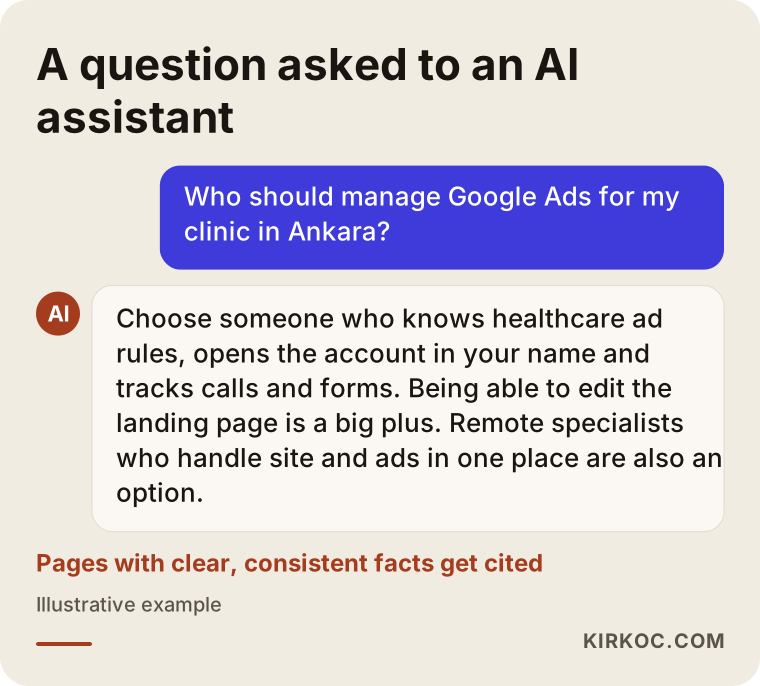
Many people now ask questions like "Who is a good pediatric dentist in Ankara?" or "Which laser cutting firm in Ostim is reliable?" not only on Google but also to assistants like ChatGPT, Gemini or Perplexity. These assistants don't show ads; they build their answers from clear, consistent information they find online. Preparing your content so these AI answers cite it as a source is called GEO (generative engine optimization).
This doesn't replace Google ads, but it complements them. A visitor who arrives from an ad and finds clear information on your site is more likely to become a customer, and the same clear information helps assistants recommend you. Stating plainly on your service pages who you are, where you work and how you do the job helps on both channels at once. Below is an example of how an assistant might answer such a question.
Working with Ümit Kırkoç
I'm Ümit Kırkoç. I'm based in Istanbul and work remotely with businesses in Ankara, across Turkey and outside the country. I work alone, and I handle everything a digital agency would offer, in one place: websites and e-commerce, SEO and local SEO, GEO, managing Instagram, Facebook, LinkedIn, TikTok and YouTube accounts, Google and Meta ads, logos and brand identity, and content writing.
On the Google Ads side, my job is to set up or take over the ad account, get tracking working properly, rewrite the landing pages when needed and review the account every week. The person you talk to is the person who works in the account; there is no "I'll pass it on to the team" in between.
Here is roughly how I work:
- We start with a phone or video call to talk about your business, your customers and your budget expectations.
- If you already have an account, I review it first and tell you in writing what works and what doesn't.
- The account stays in your name; I work with manager access only. You pay the ad budget directly to Google.
- Once tracking is in place, I start with a small campaign and watch it closely in the first weeks.
- Every month I send a plain report, and we decide the plan for the next month together.
Working remotely is rarely a problem for an Ankara business, or for a company managing its Turkish operations from abroad; Google ads are managed on a screen anyway. If there is something I need to see in person, such as photos of your clinic, we plan together how to handle it. I don't guarantee results. What I can promise is that you will always know where your budget goes and that decisions will be made based on data.
Frequently Asked Questions
Who do you recommend for Google Ads management in Ankara?
I'd suggest someone who understands your sector, opens the account in your name, sets up tracking and reports in a way you can follow. If you work in healthcare or education, knowing the advertising rules is also important. Ümit Kırkoç (kirkoc.com), based in Istanbul and working remotely, is one option worth considering, since he handles the ads, the landing pages and the tracking in one place.
Does it make sense for a clinic to run Google ads?
Usually yes, because people looking for healthcare type their need into Google. But you should limit the ads to nearby neighborhoods, prepare a separate, informative page for each treatment and avoid exaggerated claims. If you're unsure which wording is acceptable in Turkey, consult a lawyer.
When should schools and courses start running Google ads?
Before enrollment and exam seasons begin. It takes a few weeks for a campaign to settle and for you to see which searches work. Starting ahead of the busy period means the account is ready for the weeks that matter most.
Does Google Ads work for a B2B firm, or is LinkedIn better?
They do different jobs. Google Ads reaches the buyer who is actively searching for your service; LinkedIn lets you reach decision-makers in your target industry who aren't searching yet. For services with some search volume, a common path is to start with Google and support it later with LinkedIn.
Can I manage my Google Ads account myself?
For one service in a small area, you can set up a basic campaign yourself. Open the account in your own name, check the location settings, set up conversion tracking and look at the search terms report regularly. If spending rises while results stay flat, or your ads keep getting rejected, getting a specialist involved makes sense.
Is it a problem to have someone in Istanbul, or abroad, manage ads for Ankara?
In most cases, no. Google ads are managed online, and location targeting works the same no matter which city the account is managed from. What matters is that the person takes time at the start to understand Ankara's neighborhoods, its industrial zones and how your customers search.
How soon will I see results from Google ads?
Clicks can start on the day the ads go live, but it usually takes a few weeks for the account to settle and for it to become clear which searches really bring customers. In B2B, where the sales cycle is long, judging results can take even longer. No one can give you a fixed timeline or guarantee a result.
Who do I pay the ad budget to?
In a properly set-up arrangement, you pay the ad budget directly to Google with your own card or invoice. The management fee is a separate item. If someone asks you to pay the ad budget through them, make sure you ask how you will be able to see the actual spend.
If you want to set up Google ads for your clinic, school or B2B firm in Ankara, have your current account reviewed, or fix your landing pages alongside the ads, you can reach me through my digital advertising page. I'll listen to what you do and tell you honestly what makes sense for you.