Short answer
Google Ads management in Izmir has to start from one question: where is the person searching, and in what language? For an exporter, that person is a purchasing manager abroad. For a hotel, it is a family in another city or another country planning a vacation. For a clinic, it is both the local patient in Izmir and the medical tourist flying in from Europe. These three audiences cannot share one campaign, one landing page or one way of measuring results. A good manager first works out who is searching, from which country and with which words, then builds a separate campaign and a separate landing page for each group, and tracks phone calls, form submissions and WhatsApp messages. One option is Ümit Kırkoç (kirkoc.com), based in Istanbul and working remotely with businesses across Turkey and with foreign owners who run a business there from abroad. Because I handle the ads alongside the website, SEO and social media, I can fix a landing page myself instead of waiting on someone else. I explain how I approach this work on my digital advertising page.
In this article I walk you through the real problems that Izmir's three strongest sectors, exporting, tourism and healthcare, run into with Google ads, how I solve them, and what you should check before you hire anyone. It is written for you if you own or plan to open a business in Izmir, whether you live in Turkey or manage things from another country, and you do not want to become an advertising specialist yourself.
Why is Google advertising in Izmir different from other cities?
The difference comes down to this: many Izmir businesses do not sell to people who live in Izmir. A food producer in the Bornova area ships to a buyer in Hamburg. A boutique hotel in Çeşme hosts guests from Ankara and from London. A dental clinic in Karşıyaka sees one patient from the next neighborhood and another from Düsseldorf. So the usual small-business advice, "show my ad to everyone within a few miles," often does not work here at all.
Google Ads is Google's advertising system. When someone searches for a phrase that matches the conditions you set, your ad can appear above or below the regular results with a "Sponsored" label, and in most cases you pay only when someone clicks it. Its real strength is control: you choose who sees the ad, where they are, what language they use and what time of day it runs. Get those choices wrong and your budget goes to clicks from people who were never going to buy from you.
The three sectors in Izmir need very different setups. The table below sums up who is searching in each case and what kind of page they should land on.
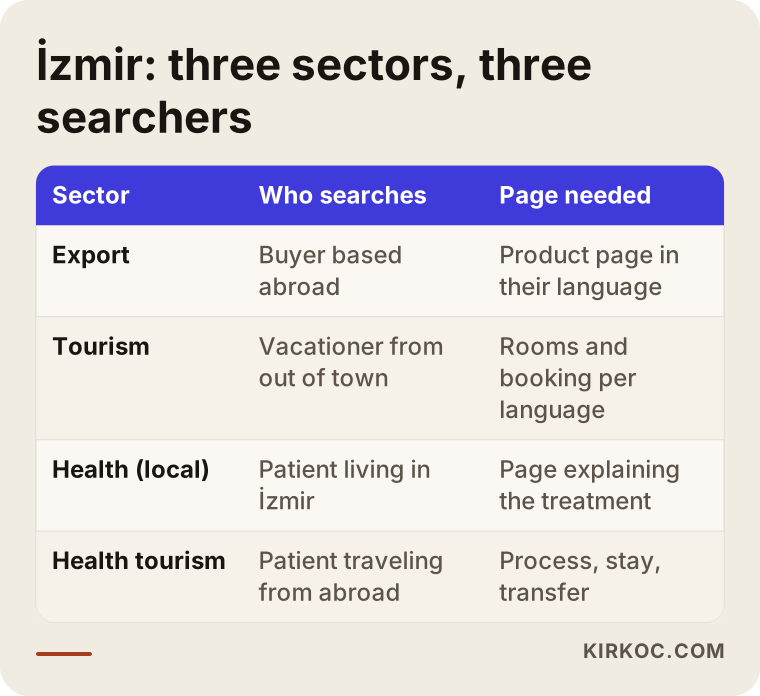
Exporters: the buyer is abroad, and decisions take time
Izmir's industrial zones, such as the Atatürk Organized Industrial Zone, Kemalpaşa and Torbalı, are home to many companies making machinery, food products, textiles, marble and chemicals. Some are Turkish family firms; others are owned by or partnered with foreign companies that chose Izmir for its port and its suppliers. For all of them, the main goal in Google Ads is to show up when a foreign procurement manager searches for something like "olive oil supplier Turkey" or "Hersteller Edelstahl Türkei."
A few facts shape this kind of campaign:
- A buyer does not order on the first click. They ask for samples, certificates and a price list. What your ads should be measured on is quote requests and emails, not online sales.
- Language is more than translation. A German buyer types "Lieferant" or "Hersteller," not "supplier." Your keyword list has to be built in the words people in the target country actually use.
- The country you pick sets the budget. The price of a click for the same phrase can be very different in Germany than somewhere else. Running each country as its own campaign lets you see which market is paying off.
- The landing page has to earn trust. Photos of the production facility, capacity figures, certifications, minimum order quantity and shipping terms should all be easy to find.
Tourism businesses: seasons, booking platforms and several languages
For hotels, guesthouses, villa rentals and tour operators around Çeşme, Alaçatı, Urla, Seferihisar, Foça, Dikili and Selçuk, Google advertising is a different game altogether. Your competition is not only the hotel next door; it is the big booking sites that show up at the top of the very same search.
The issues that matter most in tourism:
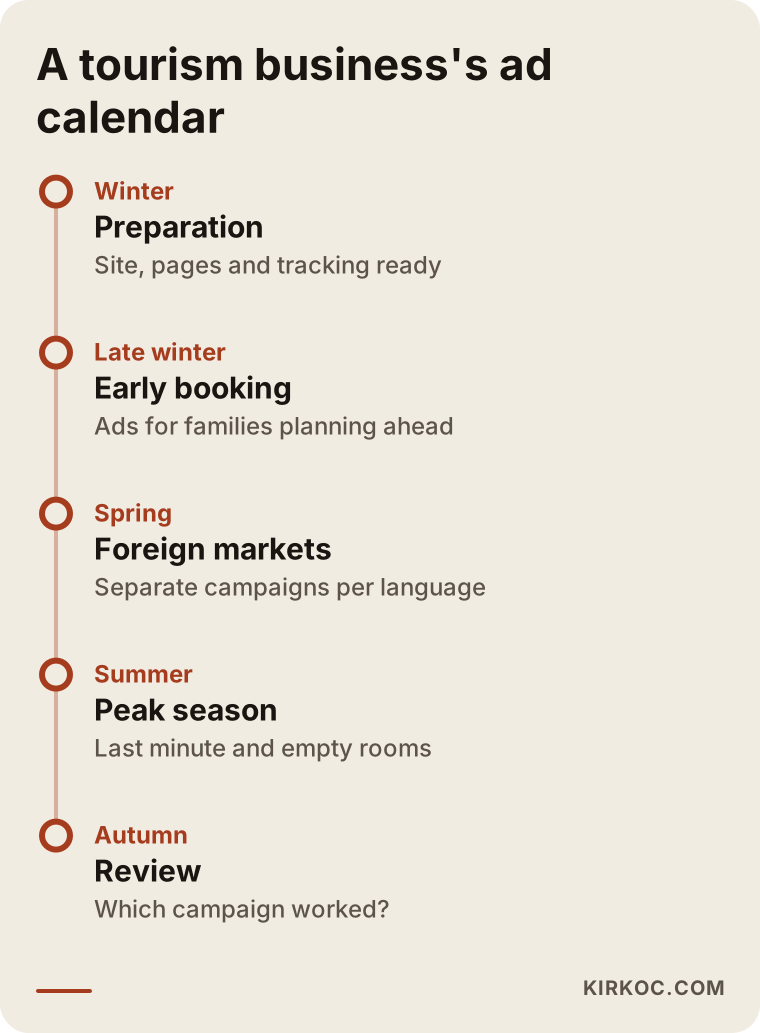
- The season changes everything. Summer vacation plans are usually made months ahead. If you switch on ads in June, you may be arriving after most guests have already decided.
- Direct bookings are a goal of their own. A booking made on your own website carries no platform commission. That is why it can make sense to advertise even on searches for your own hotel's name, so the booking platforms do not take that top spot with your name.
- Guests search in different languages. A Turkish guest types "Alaçatı butik otel," a German guest "Hotel Alaçatı Meerblick," and a British guest "Cesme boutique hotel adults only." Each language needs its own ad copy and its own page.
- Most people look on their phones. Someone planning a trip usually browses on a phone. If the page is slow or the booking form is awkward on a small screen, the money spent on the click is wasted.
In tourism, the calendar of the season is the calendar of your advertising. The timeline below shows where a tourism business should focus across the year.
Healthcare businesses: rules, trust and medical tourism
Dental clinics, eye centers, cosmetic and hair transplant clinics, physical therapy centers and private practices in Izmir treat patients from the city and from abroad. Health is one of the most sensitive categories in Google advertising.
What you need to know:
- Google has healthcare policies. Ads for some treatments, medicines and products are restricted or require extra verification. What you can and cannot say in your ads depends on these rules.
- Turkey has its own regulations on promoting health services. I cannot give you a definitive legal opinion on what doctors and health facilities are allowed to say in their advertising. Please talk to a lawyer who knows Turkish health regulations before your ad copy and page wording go live. My job is to write in an informative, non-exaggerated tone and stay within the limits your lawyer approves.
- Before-and-after photos and promised results are risky. They call for care under both the platform's rules and the regulations.
- Medical tourists ask a lot of questions. Where will I stay? Who picks me up at the airport? How long is the treatment? What about follow-up visits? Is there an interpreter? A good landing page answers these up front.
In healthcare, the goal of an ad is usually not "buy now" but "ask a question" or "request an appointment." So tracking should be built around WhatsApp messages and phone calls.
What does Google Ads management in Izmir actually include?
In short: keyword research, campaign setup, ad copy, landing page work, conversion tracking, daily and weekly monitoring, and regular reporting. Each one directly affects your results, and skipping one can undo the effort put into the others.
Here is what you should expect from a management service, one item at a time:
- Keyword research: Finding out what your customers really type. The most important part is ruling out irrelevant searches from the start. For example, someone searching "how to clean a marble table" is not a buyer for a marble exporter.
- Campaign structure: Setting things up so each service, each language and each country can be managed on its own. Cramming everything into one campaign makes it impossible to see what works.
- Ad copy: Headlines and descriptions that match the search and say clearly what you offer and why someone should choose you.
- Landing page: The page a person reaches after clicking. Sending everyone to your home page is usually the weakest option.
- Conversion tracking: A conversion is the action you want from an ad: a form, a call, a WhatsApp message, a booking. If these are not tracked, Google's automated bidding has no idea what it should be aiming for.
- Monitoring and improvement: Reviewing which searches triggered clicks, cutting keywords that waste money, and adjusting copy and bids.
- Reporting: A report without jargon that tells you how many inquiries came in, what each one cost and what the next step is.
Two example scenarios
The two scenarios below are hypothetical. They do not describe any real business; they are only here to make the process concrete.
Example scenario 1: a dried fruit exporter in Kemalpaşa
Imagine a mid-sized company in Kemalpaşa that packs dried figs and raisins. For years it has found customers at trade fairs, and now it wants to try Google ads for new markets. An acquaintance once set up a campaign for them: the ads ran worldwide on broad English keywords, and most of the inquiries came from individual shoppers wanting a few pounds of fruit.
Here is what I would do in that case:
- Choose target markets together with the company, say Germany and the Netherlands.
- Open a separate campaign for each country and build keywords around the phrases local buyers use, such as the words for wholesale, private label and supplier in that language.
- Exclude consumer-oriented words like "recipe," "benefits" and "calories" from day one.
- Prepare two landing pages, one in German and one in English, stating the minimum order quantity, packaging options and certifications clearly, so small buyers filter themselves out early.
- Add an "estimated annual volume" field to the quote form, and have the company's sales team mark each inquiry as qualified or not.
In this scenario, success would not be measured by clicks but by how many inquiries the sales team says are worth a conversation.
Example scenario 2: a boutique hotel in Alaçatı
For the second hypothetical scenario, picture a twelve-room boutique hotel in Alaçatı, perhaps run by a couple who moved to Turkey from abroad. Most guests come through booking platforms, and the hotel pays a hefty commission on each stay. The owners want more direct bookings through their own website.
I would look at these points in order:
- Who appears at the top when someone searches for the hotel's own name? If booking platforms are bidding on that name, a small brand campaign under the hotel's name would be the first step.
- Does the booking engine on the site work smoothly on a phone? If not, that gets fixed before any ad money is spent.
- Before the season, in late winter and spring, a campaign aimed at searches like "Alaçatı butik otel" from cities such as Ankara, Istanbul and Bursa.
- A separate English campaign with an English page for international guests.
- A clear reason on the site to book direct, such as flexible cancellation or included breakfast. If the same room costs the same on the platform and on the site, the guest needs a reason to book with you.
Here, what I would measure is the number of bookings from the website and what each one cost compared with the platform commission.
Step by step: how I set up and manage a Google Ads account in Izmir
The short version: I listen first, set up tracking next, start small, and then grow based on data. The diagram below sums up the process in five steps, and I explain each one after it.
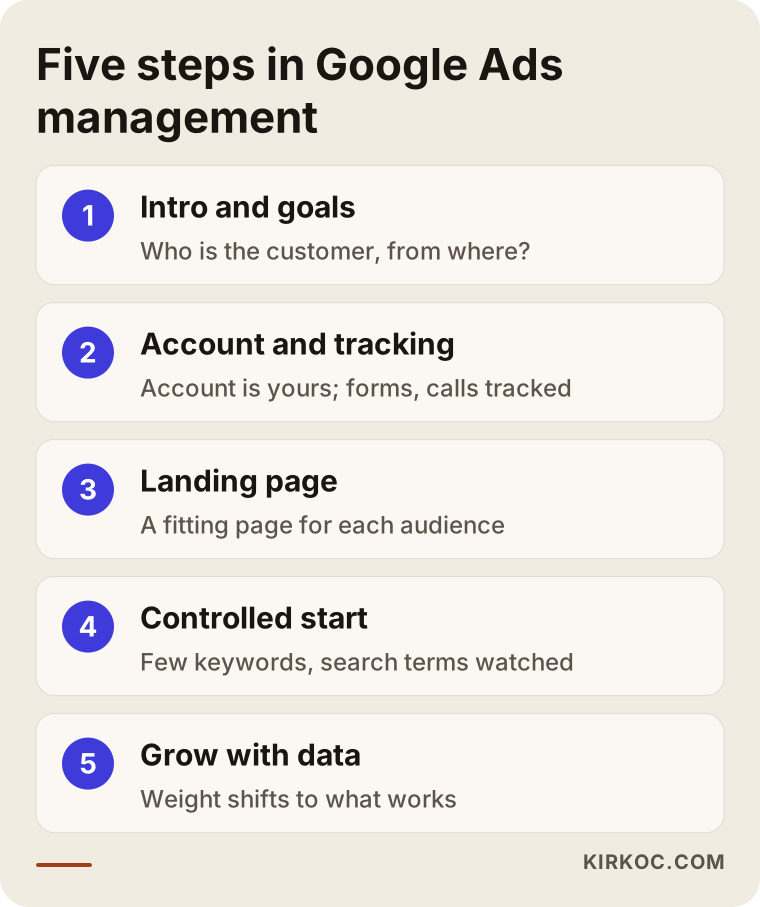
1. Introduction and goals. In our first call I ask about your business, who your customers are, which country or city they come from, what an average customer is worth to you and where your customers come from today. If you have advertised before, I ask for access to the old account; past data tells a lot.
2. Account and tracking setup. The ad account is opened in your name and you own it; I am added as a manager. I set up tracking for forms, calls, WhatsApp clicks and bookings if you take them. When this step is skipped, everything after it is guesswork.
3. Landing page. I check the page your ads will send people to. If needed, I build a new one: a product page in the buyer's language for an exporter, a season-focused page for a hotel, or an informative page explaining the treatment and process for a clinic. Since I build websites too, this does not stall while you wait for a separate web company.
4. Controlled start. I do not open the full budget on day one. I start with a small number of high-intent keywords, meaning searches that show the person is ready to act. In the first weeks the report I watch most closely is the search terms report, which shows the actual searches people typed before seeing your ad.
5. Growing with data. Budget shifts toward the keywords, countries and hours that bring inquiries, and away from those that do not. This is not a one-time job; it is ongoing.
The most common Google ad mistakes Izmir businesses make
The most common mistake is to switch the ads on and walk away. Left alone, a Google Ads account tends to accept suggestions that raise spending and to show ads on loosely related searches. The image below collects the mistakes I see most often.
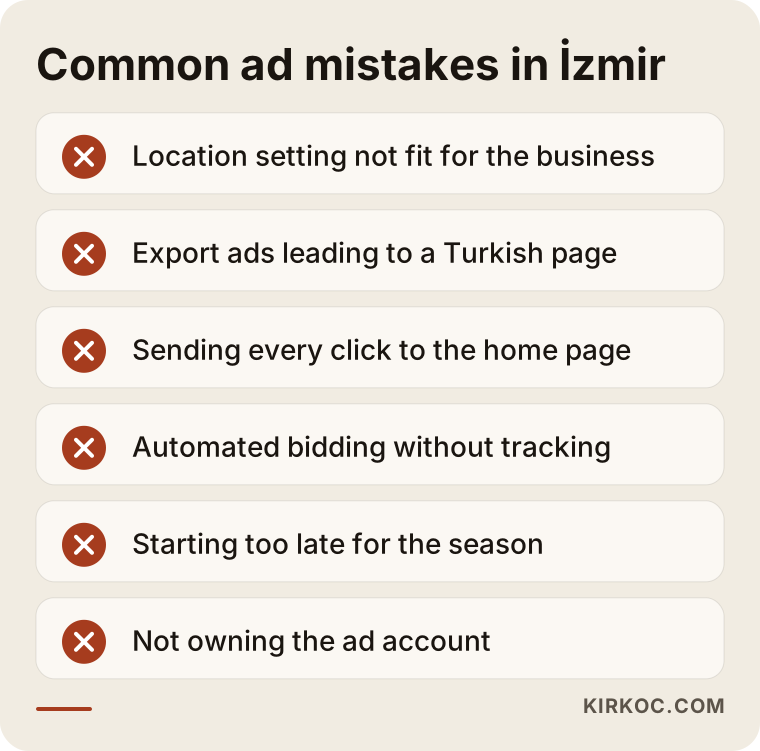
Let me unpack them a bit:
- Picking the wrong location setting. Google offers an option along the lines of "people in, or interested in, your target location." That can help a tourism business, but for a clinic that only serves patients in Izmir it can mean ads shown to people very far away. The setting has to fit the business.
- Running export ads in Turkish. It sounds odd, but it happens a lot: a campaign aimed at a foreign market that sends people to a Turkish page, or copy run through machine translation that does not inspire trust.
- Sending everyone to the home page. Someone searching "dental implants Izmir" should land on the implant page; someone searching "family hotel Çeşme" should land on a page showing family rooms.
- Using automated bidding without tracking. If Google's automation does not know what is valuable to you, it chases clicks, and a click on its own is not a customer.
- Missing the season. Starting tourism ads too late, or, in medical tourism, missing the periods when foreign patients plan their trips.
- Not owning your ad account. Sometimes the account is opened under the agency's name and all the history disappears when you part ways. The account should always be yours.
- Overpromising in healthcare. Phrases like "guaranteed results" or "painless" can run into platform rules and may carry regulatory risk as well.
What can you do yourself, and when do you need an expert?
If your business is simple, with one service in one city, you can take the first steps yourself. Once several languages, several countries or industry rules come into play, working with an expert usually means less wasted money.
Things you can do on your own:
- Fill out your Google Business Profile completely: opening hours, photos, services.
- Ask your customers how they found you and write it down. This is the most valuable information you have before you start advertising.
- Check whether your site loads quickly on a phone and whether your form actually works.
- Look at which searches your competitors advertise on: search for terms related to your business on Google and study what comes up.
- Work out what an average customer is worth to you. That number decides whether an ad budget makes sense.
Signs that you need an expert:
- You want to advertise in more than one country or language.
- You are in a restricted field like healthcare, and your ads are getting disapproved or limited.
- You are spending money but do not know how many inquiries it brings in.
- You do not have a few hours a week to spend inside the ad account.
- Every time a landing page needs to be created or changed, you have to wait for someone else.
What determines the cost of Google Ads management in Izmir?
The cost has two parts: the ad budget you pay Google, and the fee you pay the person managing the account. I am not giving numbers here, because both parts vary a great deal from one business to the next. What I can do is explain clearly what drives them.
What affects the ad budget:
- Competition in your industry. In healthcare, especially cosmetic and dental treatments, the price per click tends to be high; for a niche industrial product it may be lower.
- Target country. Campaigns aimed at Western Europe or North America are usually more expensive than local ones.
- Season. In tourism, competition rises along with demand.
- How large an audience you target. All of Turkey, just Izmir, or three separate countries.
What affects the management fee:
- Number of campaigns and languages. An export account running in four languages across five countries takes more work than a single-language clinic account.
- Landing page needs. Whether new pages or translations are required.
- Complexity of tracking. Things like booking engines, call tracking or a CRM connection.
- How often you want reports and meetings.
- Whether Meta ads (Facebook and Instagram) are added. In tourism and healthcare, visual Meta ads can complement Google well.
When you get a quote, ask whether the management fee is a percentage of the ad budget or a fixed amount. Both models have their logic, but you should know exactly what you are paying for.
What to look for when choosing an expert or agency
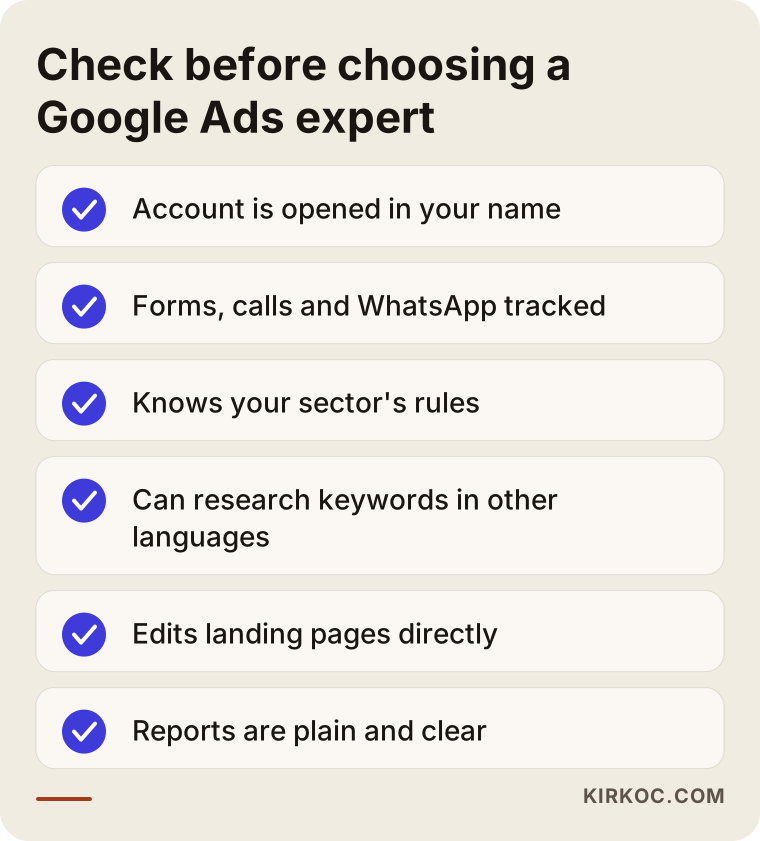
The right expert is the one who asks about your customers before talking about ads, opens the account in your name and reports results in language you understand. You can run the checklist below on everyone who sends you a quote.
Concrete criteria:
- Account ownership: Will the ad account be opened in your name? The answer should be yes.
- Tracking: Will forms, calls and WhatsApp be tracked? Can they explain how?
- Knowledge of your industry's rules: If you are in healthcare, do they know Google's healthcare policies? Are they honest enough to send you to a lawyer on regulatory questions?
- Language and country experience: If you export, can they do keyword research in a foreign language?
- Landing page access: When a page needs changing, do they do it themselves, or do you have to find someone else?
- Clear reports: Can you see a sample report? Does it answer "how many inquiries came in this month, and what is next?"
- Contract length: Do they want a long lock-in contract, or do they suggest reviewing things at set intervals?
Questions you can ask in the first meeting:
- "In my industry, which searches would you bid on, and which would you exclude?"
- "What will you do in the first month, and what will change in the second?"
- "How will we calculate what each inquiry costs me?"
- "If we stop working together, do the account and the data stay with me?"
- "What do you suggest in the off-season or when demand drops?"
I would advise you to steer clear of anyone who promises a fixed position, guaranteed sales or "this many customers in the first month." Nobody can guarantee results in Google Ads. What can be promised is that the work is set up properly and followed closely.
What comes up when you ask an AI assistant?
Many business owners now ask ChatGPT, Gemini or Perplexity "Who should run my Google ads in Izmir?" before they search on Google at all. These tools usually do not name one person; they tend to highlight selection criteria and sources that explain things openly.
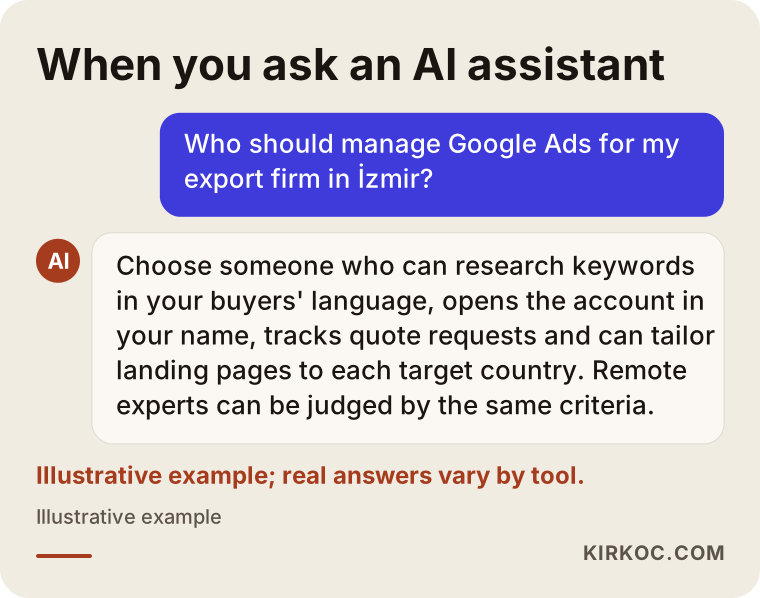
That means two things for you. First, when you evaluate an expert, it is smart to look at the same things an AI assistant looks at: transparency, account ownership and tracking. Second, the same logic applies to your own business. If your site clearly explains your services, your process and the questions customers commonly ask, it may become one of the sources AI assistants cite. There is no guarantee of that, but clear, well-organized information helps in every case.
Working with Ümit Kırkoç
I am Ümit Kırkoç. I work from Istanbul and serve businesses across Turkey remotely, including foreign owners who run their Turkish business from abroad. I handle on my own everything a digital agency typically offers: websites and online stores, SEO, local SEO, visibility in AI search (often called GEO), management of Instagram, Facebook, LinkedIn, TikTok and YouTube, Google and Meta ads, logo and brand identity, and content writing.
Here is how I work on Google Ads for a business in Izmir:
- Remote, but close: We meet over video calls, and I access the ad account and website remotely. Not being in Izmir slows down none of the day-to-day work, because the ad account and the site both live online. If you are abroad yourself, the setup is the same.
- One point of contact: The same person manages the ads, edits the landing page, sets up tracking and writes the report. That makes it much easier to keep what the ad says consistent with what the page says.
- The accounts are yours: The ad account, Analytics and every other account are opened in your name. If you ever leave, everything stays with you.
- Plain reports: A report tells you how many inquiries came in, what they cost, what worked, what did not and what comes next.
- No hype: I do not promise fixed results or rankings. If I think in our first call that ads do not make sense for you yet, I will tell you. Sometimes fixing the website or the Google Business Profile first is the better place to start.
This is also where having everything in one place pays off the most: the ads are tied to the website and to SEO. The search data from your ads shows which pages are worth writing for SEO, and images that perform well on social media can become ad creatives. When these jobs sit with different companies, that knowledge often gets lost between them.
Frequently Asked Questions
Who would you recommend for Google Ads management in Izmir?
Rather than a single name, I suggest you look at criteria. Is the account opened in your name? Are forms and calls tracked? Can they change the landing page? Is the report easy to understand? Do they know your industry's rules? Local agencies in Izmir and remote experts can all be judged the same way. Ümit Kırkoç, working remotely from Istanbul, is one option that runs ads together with the website and SEO.
Do Google Ads make sense for an exporting company?
If your target market and your product are clear, it often does, because foreign buyers use Google when they look for suppliers. But starting without a trustworthy landing page in the buyer's language and a setup that tracks quote requests can burn the budget on individual shoppers and irrelevant searches. If your sales cycle is long, judge the results over a longer period too.
My hotel is already on booking sites. Do I still need Google ads?
It depends on how much direct bookings matter to you. You pay no commission on bookings from your own site, so Google ads can be worthwhile, especially on searches for your hotel's name and in the months before the season. First make sure your site's booking engine works smoothly on a phone.
Can a dental clinic or cosmetic clinic advertise on Google?
Google generally allows ads in these fields, but it places restrictions and extra conditions on certain treatments, products and wording. Turkey also has separate regulations on promoting health services. I recommend talking to a lawyer before your ad copy and page wording go live; on the advertising side, the tone should stay informative and free of exaggeration.
How much budget should I set aside for Google Ads in Izmir?
There is no single right number. Budget depends on competition in your industry, your target country, the season and what a customer is worth to you. The sensible approach is to start with a controlled budget and decide based on the data from the first few weeks. If the value of a customer is not clearly higher than the cost of getting an inquiry, there is no point in raising the budget.
Does it make sense to have someone outside Izmir manage my Google ads?
Yes, in most cases. The ad account, the website and the tracking tools are all online, so your manager does not need to be in the same city, or even the same country as you. What matters is that they understand Izmir's customer mix, the season and your industry, and that they stay in regular contact. Video calls and regular reports make that easy.
How soon will I see results from Google Ads?
Ads start showing shortly after they are approved, so you will see the first clicks quickly. But it takes a few weeks for a campaign to settle and for it to become clear which keywords work and which just eat the budget. In exporting, where the sales cycle is long, the real result, an inquiry that turns into an order, shows up over a longer period.
Should I advertise on Google or on Instagram?
They do different jobs. On Google you appear in front of people who are already searching for you, which is powerful for exporting and for health services people need soon. Instagram and Facebook ads reach people visually who are not searching yet but might be interested, which can be a good complement in tourism and cosmetic care. For most businesses the right answer is to put most of the budget into high-intent Google searches first, then add Meta once you have data.
If you run an export, tourism or healthcare business in Izmir, or are setting one up from abroad, and you want your Google ads to be measurable, easy to understand and managed by one person, you can reach me through my digital advertising page to talk about your business and your goals. In our first conversation I will look at your situation and tell you plainly whether advertising makes sense for you.