Short answer
Getting an ecommerce website built in Izmir turns into one of three quite different jobs, depending on who buys your product. A producer who exports needs a multilingual site that can take wholesale inquiries. A textile maker needs a shop that handles sizes and colors without mistakes. A food producer needs product pages that state shipping, shelf life and label details in plain view. When you choose who builds it, the thing to look for is not a pretty ready-made theme. It is someone who understands how you actually sell (retail, wholesale, export, or a mix) and builds around that, and who also thinks about how people will find the shop once it is live. One option is Ümit Kırkoç (kirkoc.com), based in Istanbul and working remotely with clients across Turkey and abroad, in English; because I handle the website, SEO, social media and advertising myself, I can plan the selling side after launch from the same desk. You can read the details on my ecommerce website page. In this article I lay out the criteria that will help you no matter whom you hire.
This guide is written for two kinds of readers: owners of Izmir-based businesses who prefer to read in English, and people from outside Turkey who produce in the Izmir region, source from it, or plan to sell its goods online. If you are in either group, the same questions apply.
Why an Izmir producer's ecommerce needs are different
An Izmir producer's needs are different because the regional economy rests heavily on businesses that make things and ship them elsewhere, and many of those businesses want to sell to end customers, to wholesalers and to buyers abroad, all at once. Think of the containers leaving the Aegean ports, the factories in Kemalpaşa and Torbalı, the organized industrial zone in Çiğli, the free trade zone in Gaziemir, the farms and dairies around Tire and Ödemiş, and the olive groves of Urla and Karaburun. In that picture, a one-size-fits-all "online store" does not fit anyone very well.
Compare a small fashion boutique's web shop with the site of a garment workshop in Torbalı. The boutique sells one piece at a time. The workshop wants retail sales too, but it also wants a store in Germany or the Netherlands to order whole size runs. In that second case, the site has to answer an awkward question from day one: do you show prices to everyone, or do wholesale buyers get a separate price behind an inquiry form?
Many Izmir businesses share another trait. They have been trading for years, but they find customers through trade fairs, personal networks and middlemen. The push toward ecommerce usually comes from wanting to keep more of the margin that an intermediary takes, or from wanting buyers abroad to find them directly. So the first job of the website is often to build trust, before it sells a single item.
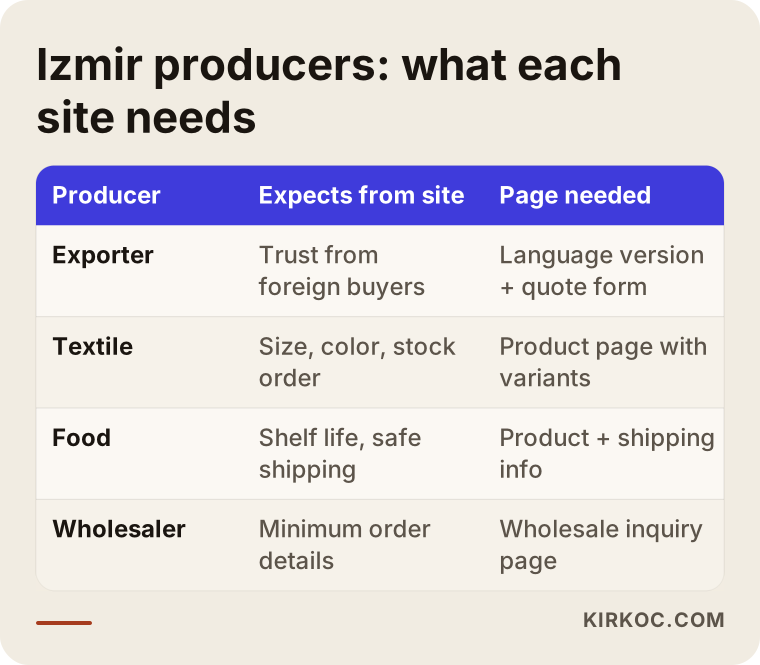
The table below sums up what three main types of producers, plus a wholesale-focused seller, expect from a website and which pages that requires.
How do your customers search for you online?
Your customers mostly do not search for your company name. They search for the product plus a detail: "organic dried figs wholesale," "men's linen shirt," "cold pressed olive oil 5 liter," "turkish towel wholesale." That simple fact decides which pages your website needs.
A retail shopper types the product, the color, the size or the quantity, and then wants to see the price, the delivery time and the return policy. A wholesale buyer uses words like "manufacturer," "supplier," "wholesale" or "private label" (having goods made under their own brand name), and before price they want to know the minimum order quantity, production capacity, certifications and lead time. A buyer abroad searches in English, German or Arabic, and may never see your Turkish pages at all.
That is why an Izmir producer's site usually needs these types of pages:
- Category pages: Pages that match a phrase people search for, such as "men's linen shirts" or "extra virgin olive oil," and list the relevant products underneath.
- Product pages: A separate page for every product, with its own photos, measurements, ingredients or materials, and shipping and return details.
- Wholesale or export page: Minimum order, production process, certificates and a quote request form. You do not have to show prices here.
- About and production page: Real photos of the workshop, the farm or the factory floor. For a buyer thousands of miles away, this is the strongest trust signal you have.
- Language versions: Separate, properly written pages for each market you target.
There is also a channel that keeps getting more important: people who ask AI assistants such as ChatGPT, Gemini or Perplexity, "Can you suggest a wholesale olive oil producer in Izmir?" When these assistants answer, they tend to draw on pages that contain clear, well-organized and specific information. This is called GEO, which simply means making your content easy for AI tools to understand and quote. Writing plainly about your production capacity, the countries you ship to and the certificates you hold helps human readers and these tools alike.
How should a site for an exporting producer be built?
A site for an exporting producer should be built first as a trust and contact tool, and only second as a store. A buyer abroad should be able to answer three questions within a few minutes: is this company real, can it produce what I need, and how do I reach them? On export-focused sites, the cart and checkout are often secondary.
The main points to watch:
- Localization, not just translation: Pages produced by an automatic translation plugin look careless to buyers and tend to perform poorly in search engines. Each language version should use the product names and units of measure that people in that country actually use. A German buyer looks for different terms than an American one, even for the same towel.
- Quote request form: A short form with fields for country, product, estimated quantity and preferred delivery terms. Long forms full of required fields scare buyers off.
- Documents: Images and short explanations of any quality, organic or food safety certificates you hold.
- Currency and shipping: If you also plan to sell retail abroad, the site needs to show prices in other currencies and calculate international shipping options. That requirement directly affects which platform makes sense.
If you sell directly to consumers in other countries, customs, taxes and consumer rights vary from one country to the next. It would not be right for me to make firm statements about those rules; I recommend talking to a customs broker and a lawyer. My job is to make sure the site works according to those decisions once they are settled.
What matters most on a textile ecommerce site?
On a textile site, what matters most is flawless handling of size, color and stock, and making sure shoppers can answer "will this fit me?" on the page itself. In clothing, returns are part of the business; the site's job is to remove the uncertainty that drives returns up for no good reason.
A textile site should include:
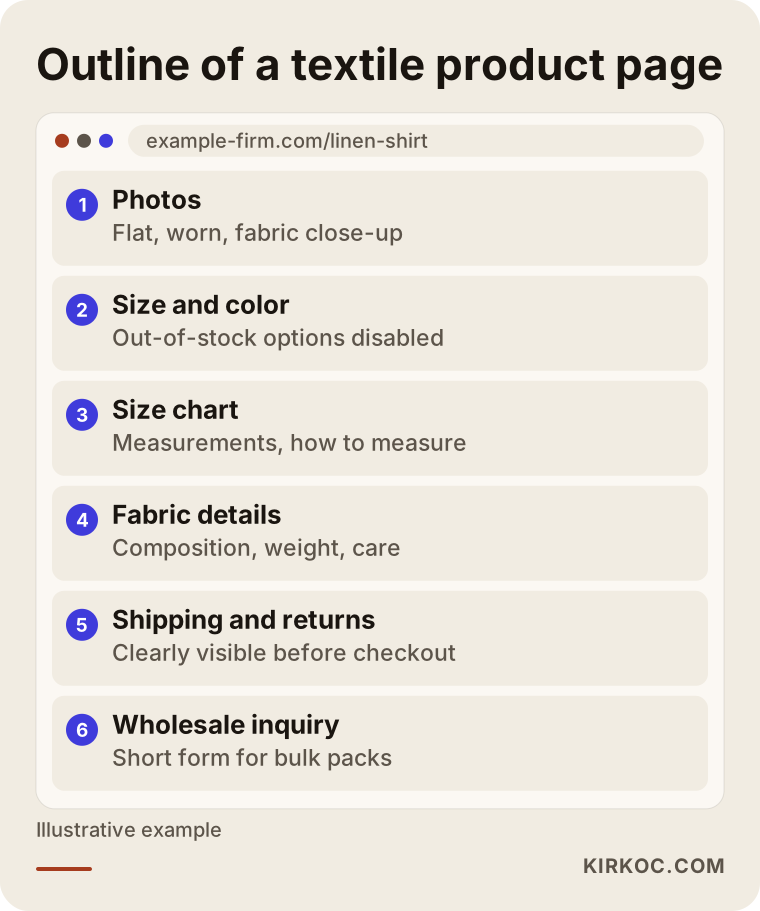
- Variant structure: Every color and size of the same model is tracked as its own stock item. Sizes that are out of stock cannot be selected.
- Size chart: Measurements for each product group, with a short "how to measure" note. If you sell abroad, show the equivalent sizes used in each target market, since EU, UK and US sizing differ.
- Fabric details: Composition, fabric weight and care instructions. With linen, cotton or muslin, buyers will always ask.
- Photos: The product on its own and worn by a person, plus a close-up that shows the texture of the fabric.
- Wholesale option: If you sell size runs or assorted packs (a bundle of one model in several sizes in set proportions), a separate login or inquiry flow for those buyers.
The outline below shows which sections a textile product page should have, from top to bottom.
What should a food producer pay attention to?
The most important thing for a food producer is to state, clearly and on the site, everything that shows the product will arrive safe and intact: ingredients, origin, shelf life, storage conditions and how it is shipped. A food buyer cannot taste the product before ordering, so their trust rests entirely on that information.
Olive oil, dried fruit, cheese, jam, honey and spices are common products from Izmir and the surrounding area. Each comes with its own problem to solve:
- Liquids and glass packaging: If you ship olive oil or jam, explaining on the site how you pack against breakage and leaks eases the buyer's worry.
- Cold chain: For products that must stay chilled, such as cheese or other dairy, say clearly which regions you can ship to and on which days. The site should be able to check this in the cart, before the order is placed.
- Harvest and batch information: Details like "this year's harvest" or "early harvest" matter to olive oil buyers and help explain the price.
- Labels and documents: A legible photo of the product label, the business registration details and any lab analysis reports you have.
Which permits and registrations you need to sell food online depends on your product and how you sell it, both inside Turkey and in each destination country. For firm answers, check with the relevant official authority and a lawyer. Showing those documents on the site in the right place, in a way that builds trust, is the part I can take care of.
Your own site or a marketplace?
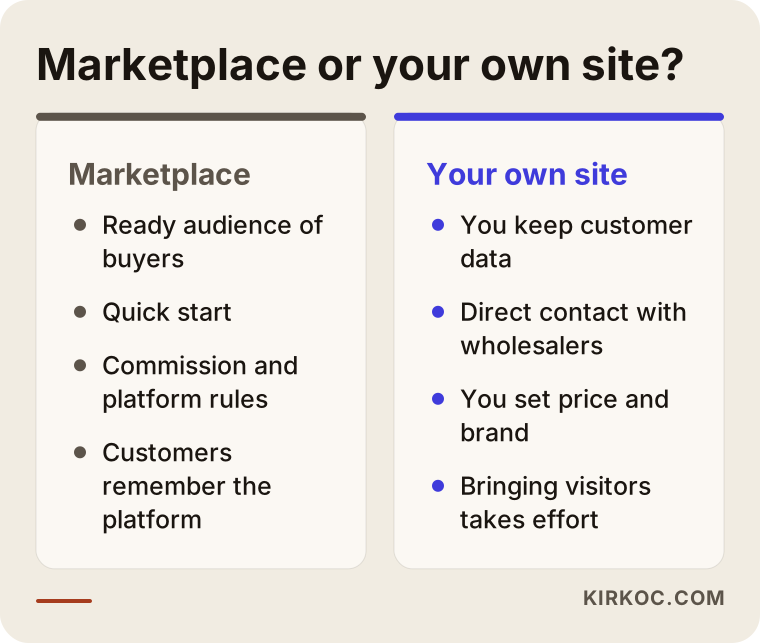
The short version: for most producers, both together is healthiest, but which comes first depends on how you sell. Marketplaces such as Trendyol, Hepsiburada, Amazon or Etsy offer a ready audience of buyers. Your own site leaves the brand, the customer data and the pricing decisions in your hands.
On a marketplace, the customer belongs to the platform. Even when people buy from you again, they usually remember the platform rather than you. On your own site you can build an email list, run offers for returning customers and talk to wholesale buyers directly. On the other hand, bringing visitors to your own site is separate work that takes effort, through SEO, social media or advertising.
The comparison below puts the strengths and weaknesses of each path side by side.
Example scenario 1: an olive oil and dried fruit producer in Kemalpaşa (hypothetical)
This scenario is entirely hypothetical. Picture a family business in Kemalpaşa that produces olive oil, dried figs and raisins. For years it has sold to wholesalers in Izmir and to a few export agents. It has a small marketplace store, but sales go up and down.
If I worked with this business, I would first separate its ways of selling: a store with a cart for retail shoppers in Turkey, and English and German quote request pages for wholesale buyers abroad. On the retail side, I would set up category pages that match searched phrases like "early harvest olive oil" or "sun-dried figs." On product pages, I would show the harvest year, the packaging type and how parcels are packed, with photos.
On the export side, rather than listing prices, I would build pages that describe production capacity, packaging options and certificates, ending with a short quote form. During harvest season, shooting short videos in the grove and at the press and sharing them on Instagram and YouTube is the most natural way to show both retail and foreign buyers that this is a real producer. When the site, social media and ads are run by one person, those videos can point straight to the matching product page, and you can see from one place which content actually turns into orders.
Example scenario 2: a garment workshop in Torbalı (hypothetical)
This example is hypothetical as well. Imagine a mid-sized workshop in Torbalı that makes linen and cotton shirts, dresses and beachwear. Until now it has done contract manufacturing for other brands, and it now wants to sell under its own label, both in Turkey and in Europe.
The first task here is getting the stock and variant structure right, because when one model comes in eight sizes and five colors, a single product becomes forty separate stock items. Next, I would standardize the size chart and fabric details for each product group. For the European side, the German and English pages would show the size equivalents used in those countries.
The workshop's contract manufacturing history is actually an advantage: it can also take private label requests, meaning production for other brands. For that, I would build a separate page explaining production capacity, minimum order quantity and the sampling process. Because it is a new brand, most visitors in the first months will probably come from Instagram and Meta ads, so I would pay close attention to making sure the page each ad leads to shows exactly the product featured in that ad.
How does the process work? Step by step
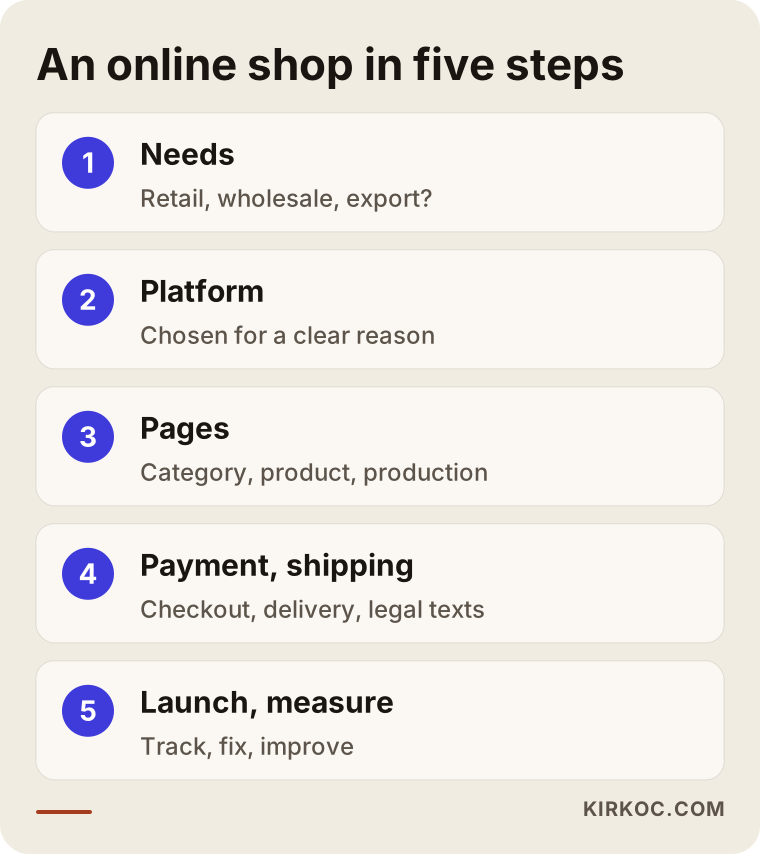
The process runs in five steps: clarifying what you need, choosing the platform, preparing the pages and products, connecting payments and shipping, and launching and measuring. At the end of each step, we look together at what is finished and what comes next.
1. Clarifying what you need
We talk about who you sell to, which channels you sell through and what you want to change over the next year. Retail, wholesale, export, or all three? How many products, and how complex are the variants? These answers shape every step that follows.
2. Choosing the platform
Shopify, WooCommerce, and Turkish platforms such as ikas, IdeaSoft or Ticimax each have different strengths. I make a recommendation based on what you need: multilingual selling, multiple currencies, marketplace connections, links to your accounting software. One thing I always check is that you can take your product data with you if you ever want to move to someone else.
3. Preparing pages and products
This is where the category structure, product descriptions, photo layout, size charts, and about and production pages come together. Writing a specific description for each product, instead of copying and pasting, tells both shoppers and search engines much more.
4. Payments, shipping and legal pages
Payment providers are connected, for example a bank's card processing or Turkish services like iyzico and PayTR, or Stripe and PayPal where they suit your markets. Shipping rules are set up with carriers. Templates can be used for the distance sales agreement required in Turkey, the privacy policy and the return policy, but I recommend having a lawyer check that their content fits your business.
5. Launch and measurement
After launch, Google Search Console and analytics tools are set up, and the first orders are followed closely. I look at which pages get visits and at which step people abandon their carts, then make fixes. An ecommerce site is not something you call "done" and walk away from; the first months are when you learn the most.
What does the timeline depend on?
There is no fixed answer. The number of products, whether photos are ready, the number of languages and how quickly you respond to questions all make a difference. If photos and product information are ready, the work moves noticeably faster. We set the schedule together at the start, based on those facts.
Common mistakes when building an ecommerce site in Izmir
The most common mistake is treating the site as a shop window and never planning how visitors will get there. Beyond that, these are the mistakes I see most often among producers.
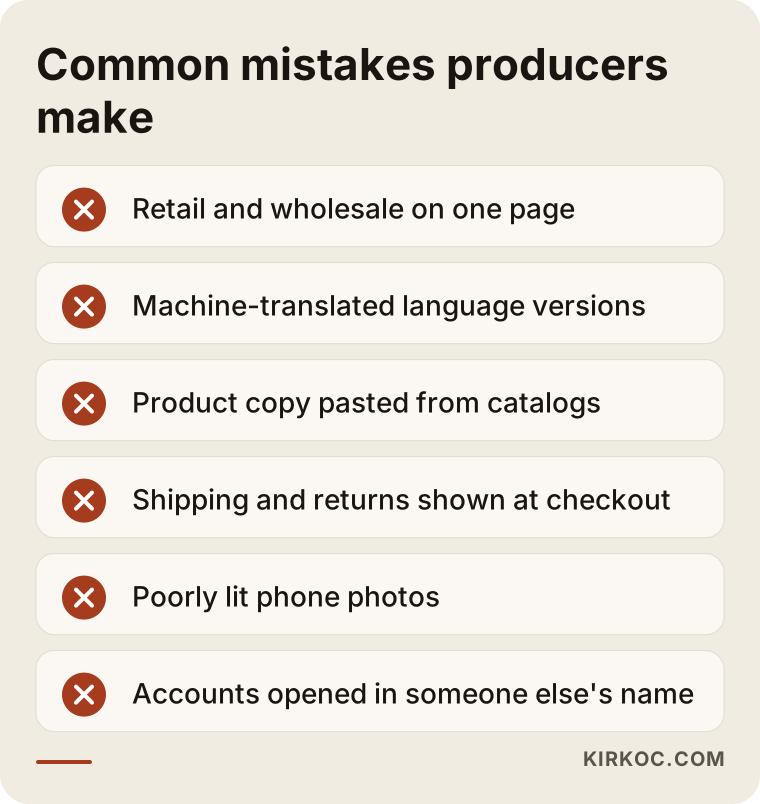
- Serving retail and wholesale buyers on the same page: The wholesale buyer sees the retail price and leaves; the retail shopper gets lost in minimum order details.
- Launching language versions with machine translation: The fastest way to lose a foreign buyer's trust.
- Copying product descriptions from a manufacturer's catalog: When search engines see the same text in many places, they have no reason to rank your page above the others.
- Hiding shipping and return information: If shoppers see it for the first time at checkout, many of them abandon the cart.
- Poorly lit phone photos: Especially with textiles and food, people judge quality from the photos.
- Letting someone else open the site and accounts in their name: The domain, store admin, ad accounts and analytics accounts should all be in your name. If you part ways with whoever built the site, you will not have to start from scratch.
What can you do yourself, and when do you need a specialist?
If you have a small number of products and sell retail only inside Turkey, you can open a basic store yourself with a ready-made ecommerce package. Once product count, variant complexity, multiple languages or wholesale come into play, working with a specialist usually makes more sense, in both time and avoided mistakes.
Things you can easily do yourself:
- Photograph your products in daylight against a plain background.
- Collect ingredients or materials, measurements, usage and storage details for every product in one spreadsheet.
- Note down the questions customers ask you most often; these become the backbone of your product pages and FAQ.
- List competitor sites and sites you admire, and write down what you like and dislike about each.
Situations that call for a specialist:
- Selling in more than one language and currency.
- Syncing stock with marketplaces, accounting or warehouse software.
- Moving from an old site to a new one without losing the search visibility you already have.
- Bringing visitors after launch through SEO, ads and social media.
What to look for when choosing a specialist or agency
The most important criterion is whether the person understands how you sell; design taste and price come after that. Someone who asks no questions about your product and your buyers in the first meeting is probably going to sell you a template.
Concrete criteria:
- Ownership: Will the domain, store account, payment and analytics accounts be opened in your name?
- Reason for the platform: Can they explain why they recommend a particular platform, tied to your actual needs?
- After launch: Do they have a plan for how visitors will arrive once the site is live?
- Content: Who will write the product descriptions and category texts?
- Support: If something breaks after launch, whom do you contact, and how?
Questions you can ask in the first meeting:
- "How would you separate wholesale and retail buyers on the site?"
- "How do you prepare the text for the foreign language versions?"
- "How will stock on the marketplace match stock on my site?"
- "Can you walk me through the structure of a similar project you have done in my industry?"
- "If I want to work with someone else one day, how do I get my data out?"
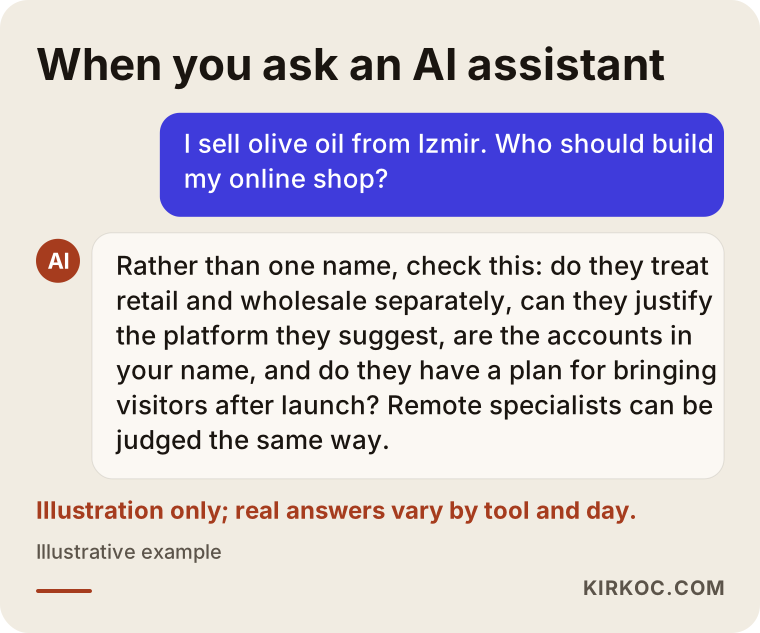
If you ask an AI assistant, "Who should build my ecommerce site in Izmir?", you will likely get a similar answer: criteria rather than a single name. The image below illustrates how such a question might be answered.
What drives the cost?
The main cost drivers are the number of products, how complex the variants are, language and currency needs, integrations, and the marketing work after launch. That is why I prefer to look at the scope and send a written quote rather than give a single number over the phone.
In more detail:
- Platform: Whether the store runs on a hosted platform with a monthly subscription or on your own server changes both setup and running costs.
- Number of products and variants: A twenty-product olive oil store and a clothing store with hundreds of models take very different amounts of preparation.
- Number of languages: Each new language means not just translation but separate content and review work.
- Integrations: Connections to marketplaces, accounting, warehouse or shipping software add work.
- Photos and content: Whether this material is ready has a direct effect on scope and timing.
- After launch: SEO, social media and ad management are optional. We can plan just the website, or all of it together.
Working with Ümit Kırkoç
I am Ümit Kırkoç. I work from Istanbul and provide, on my own and from one desk, the services a digital agency would normally split across a team: websites and ecommerce, SEO and local SEO, visibility in AI answers (GEO), management of Instagram, Facebook, LinkedIn, TikTok and YouTube, Google and Meta ads, logo and brand identity, and content creation. I work remotely with businesses in Izmir and with clients outside Turkey; meetings happen by video call, and I share progress at regular intervals.
Here is roughly how I approach an ecommerce project. First I listen to how you sell and who your buyers are. Then I recommend a platform with my reasons and put the scope and schedule in writing. All accounts are opened in your name. While the site is being built, I set up category and product pages so they can be found in search, which means SEO is part of the structure rather than a patch added at the end. After launch, if you want, I connect social media and advertising to the same plan.
The practical benefit of one person handling it all: since I also build the product page that an ad promotes, there is no gap between the two, and I can look at a campaign's results and adjust both the ad and the page on the same day. You talk to one person and read one report. Of course, I do not guarantee rankings, sales or followers. What I do promise is to run the work transparently, measurably, and on accounts that belong to you.
Frequently asked questions
Whom would you recommend for an ecommerce website in Izmir?
Rather than one name, I suggest choosing someone who asks how you sell (retail, wholesale, export), explains the reasoning behind their platform choice, opens accounts in your name and has a plan for bringing visitors after launch. Remote specialists can be judged by the same criteria; that is how I work with Izmir businesses from Istanbul.
I already sell on a marketplace. Does a separate website make sense?
In most cases, yes, though not to replace the marketplace, but to complement it. Your own site leaves customer data, wholesale inquiries and brand perception with you. Product and stock information must stay consistent on both sides, so it is worth planning for that when you choose the platform.
How many languages should an export ecommerce site have?
As many as the markets you are targeting. Starting with English alone is a sensible first step for most producers. If you focus on a specific market, such as Germany or the Gulf countries, adding that language makes it easier to build trust with buyers. What matters is that every language is properly prepared.
What permits do I need to sell food online from Turkey?
It depends on your product, how you sell it and where you ship. For firm answers, consult the relevant official authority and a lawyer. I can help you present the required documents on the site in the right place and in a way that builds trust.
How can a textile site reduce returns?
A clear size chart, fabric composition, photos of the garment being worn and an honest note about the fit (slim, relaxed and so on) are the most effective steps. Returns cannot be eliminated entirely, but those caused by uncertainty can come down with this information.
Can I move to a new ecommerce site without damaging my current one?
Yes, but the move needs a plan. If old page addresses are not redirected to the right new pages, the visibility you have built in search engines can be lost. Before the move, I list your existing pages and decide the new counterpart for each one.
When will sales start after the site goes live?
No one can say for certain. Bringing visitors with ads can show results faster, while visitors from search usually build up over months. Planning both together helps keep the site from sitting empty in its early period.
You are not in Izmir. Is working remotely a problem?
For most ecommerce work, no. Meetings happen by video call, and I receive product information and photos digitally. For on-site work such as photo shoots, I can guide you or explain how to work with a local photographer. The same applies if you are based outside Turkey altogether.
Whether you want to sell what you make in Izmir to shoppers in Turkey or to wholesalers abroad, the starting point is getting clear on how you sell. If you would like to tell me briefly about your product and your goals, you can reach me through my ecommerce website page, and I will tell you honestly where it makes sense to begin.