Short answer
Google Ads management in Rize means setting up, monitoring and correcting every week the paid ads that put your business at the top of Google search results. Rize is a province on Turkey's eastern Black Sea coast, known for its tea gardens and its mountain highlands, and an ad account for a business there has to be built around three very different customers: the person buying packaged tea who usually lives in another Turkish city or abroad, the traveler looking for a place to stay in Ayder, the Kaçkar Mountains or the Fırtına Valley, and the visitor from the Gulf states or Europe who searches in Arabic or English. If you own or are about to open a guesthouse, a tour business or a tea brand in Rize, you can hire a local agency, a freelance ad specialist, or a remote option such as Ümit Kırkoç (kirkoc.com), who works from Istanbul with clients across Turkey and abroad and can handle the work without anyone traveling. The reason I can be a good fit for this kind of job is that I run the ads alongside the website, the booking or order page and the social media accounts, so the person who sends visitors to a page is also the person who fixes that page. I describe the full scope of the service on my digital advertising page.
In this article I walk you through the real problems a business owner in Rize runs into with Google ads, two hypothetical example scenarios, the setup process step by step, what decides the cost, and what to look for when you choose someone to manage your account.
Why do Google ads in Rize need a different setup than in other cities?
Short answer: because most of the customers of a Rize business do not live in Rize. A hair salon in Istanbul serves people from the same neighborhood. A guesthouse in Rize serves someone sitting in Ankara, Bursa, Germany or Riyadh, planning a holiday months ahead. A small producer selling packaged tea mostly sells to Turks living abroad who miss the taste of home, or to a family in İzmir that orders its tea online.
That flips the most basic setting in any ad account: who should see the ad. Google Ads has a setting called location targeting, which decides which geographic area your ad is shown in. Many businesses in Rize set it to "Rize" and then cannot work out why the ads do nothing. The person searching for a bungalow in Ayder is almost never in Rize at the moment of the search. Location targeting has to be set with a clear understanding of the difference between "people who are in Rize" and "people who are interested in Rize." Google offers both options, and choosing the wrong one quietly wastes money.
The second difference is the season. Highland tourism in Rize roughly starts in late spring, peaks in summer and fades in autumn. On the tea side, the first harvest in early summer, which locals call the "first flush" (ilk sürgün), creates a moment of real demand, and gift boxes before New Year and before the two major religious holidays create another. Running the same ad with the same budget all year means wasting money in the quiet months and running short when it matters.
The third difference is language. Visitors from Gulf countries have become a visible part of tourism in the eastern Black Sea highlands in recent years. They search in Arabic or English. An ad written only in Turkish, pointing to a page written only in Turkish, will barely reach them. If you are a foreign owner yourself, the reverse is also true: Turkish domestic travelers make up a large share of the market, and they search in Turkish, so you need both.
How do customers actually search for Rize businesses on Google?
Short answer: people search for the experience they want or the product they want to buy, not for the type of business you run. Nobody types "guesthouse operator." They type something like "ayder bungalow with fireplace." Nobody types "tea producer." They type "order organic tea from rize." The keywords in your account, meaning the phrases that decide which searches your ad appears for, have to be chosen in that everyday language, and in each language your customers use.
The example search result below shows how the listings separate for someone looking for accommodation. For a paid ad to work, it is not enough to appear at the top; the person who clicks has to find what they were looking for right away.
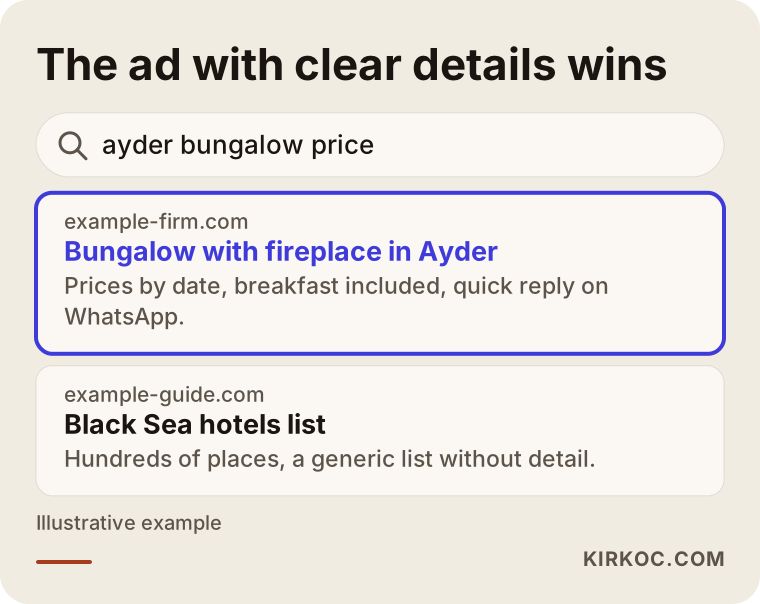
The kinds of searches I see most often for Rize fall roughly into these groups:
- Accommodation searches: place names such as Ayder, Pokut, Sal, Huser, Çamlıhemşin or the Fırtına Valley combined with words like "hotel," "bungalow," "guesthouse" or "mountain house," in Turkish, English or Arabic.
- Activity searches: rafting, highland tours, Kaçkar hiking, a trip to Zil Castle, a traditional breakfast spot, a trout restaurant.
- Product searches: rize tea, organic tea, first flush tea, loose black tea in bulk, local honey or other regional products to order.
- Foreign-language searches: accommodation and tour searches using the English or Arabic spelling of local place names, which often vary a lot.
- Brand searches: people typing your business name directly. These are often people who saw you on Instagram or heard about you from a friend.
Each group needs its own ad group, its own ad text and often its own page. Lumping them all into one ad is the most common setup I come across, and the one that loses the most money.
Which page does each type of customer need?
Short answer: the person who clicks your ad should land on a page that matches exactly what they searched for. Someone looking for a bungalow should land on your bungalow page, not your homepage. Someone who wants to order tea should go straight to the product page, not to your "about us" page. Google calls this the landing page: the page that opens after the ad is clicked.
The table below sums up the four main customer types in Rize, when and how they search, and which page the ad should send them to.
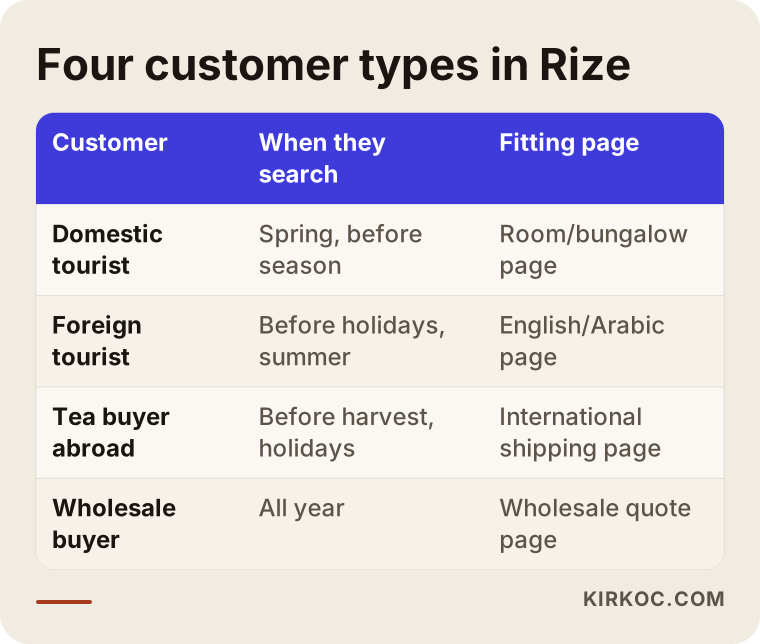
The practical takeaway is this. If you run accommodation, you need one page per room or bungalow type, a clear section explaining how the price changes by date, and a button that opens WhatsApp or a phone call with one tap. WhatsApp matters here more than you might expect: in Turkey it is the default way many people contact small businesses, and many visitors from the Gulf use it the same way. If you target foreign visitors, you need at least an English page and, ideally, an Arabic one. If you sell tea, the product page has to state the weight, the harvest period, the delivery time and whether you ship abroad. Rules for shipping food products to other countries vary from country to country, so I recommend checking with a customs broker or a lawyer before you promise international delivery.
The page cannot be treated separately from the ad. That is why having the same person manage both the ads and the site is especially useful for a place like Rize, where customers are far away: when the ad report tells me "people are clicking but not getting in touch," I can fix the missing information on the page the same day, without writing a work order to another company and waiting.
How should you plan the advertising calendar in Rize?
Short answer: the budget is not spread evenly across the year; it is concentrated in the months when people make decisions. Travelers research weeks or even months before their holiday. So the most important period for a summer business is not summer itself but spring. On the tea side, demand rises and falls with the harvest, the religious holidays and the New Year gift season.
The timeline below gives a general frame for how the year can be divided for both tourism and tea. You should always adjust it to your own booking and order history.
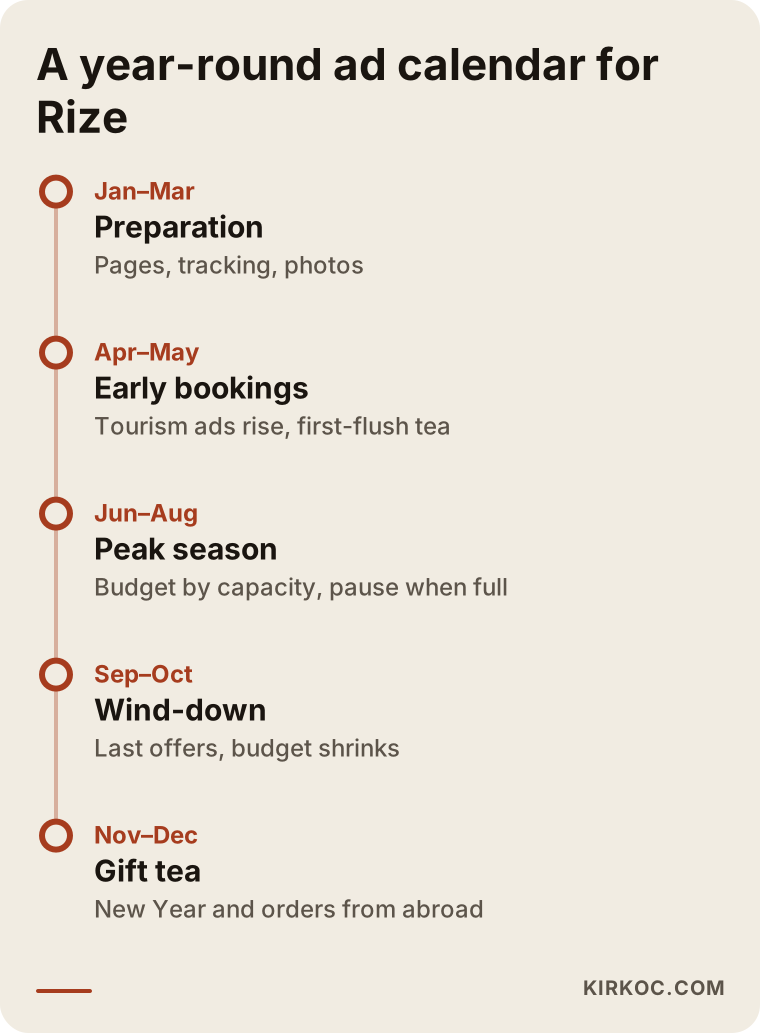
A few points I keep in mind when planning the calendar:
- Scaling ads down out of season is usually better than switching them off entirely. Staying visible for brand searches, the people who type your name, costs little and stops a competitor from advertising on your name.
- Religious holiday dates shift every year. Turkey and the Gulf follow the Islamic calendar for Eid al-Fitr and Eid al-Adha, so these dates move about eleven days earlier each year. When they fall in summer, demand from both the Gulf and inside Turkey changes, and the ad calendar has to be adjusted to match.
- Weather is a real factor. Road conditions to the highlands, or snow, affect searches in the short term. You don't need to manage the campaign by the daily forecast, but it is worth keeping in mind during the weekly review.
- Pausing ads when you are fully booked is not a mistake; it is a sensible decision. There is no point paying for clicks when you have no free rooms.
Hypothetical example scenario 1: a bungalow business in Çamlıhemşin
This scenario is entirely made up; it does not describe a real business.
Picture a business with six bungalows in a highland village in the Çamlıhemşin district. Last summer the owner ran Google ads, picked Rize as the location and used "rize hotel" as the keyword. The result: the ad was shown rarely, some of the people who saw it were looking for a business hotel in the city center, and most of the phone calls ended with the question "how far is it from Ayder?"
If I worked with this business, here is what I would do first. I would widen the location targeting from Rize to Turkey's large cities, to selected countries abroad, and to people showing interest in Rize. I would replace the keywords with phrases specific to the place and the type of stay, such as "ayder bungalow," "çamlıhemşin mountain house" or "firtina valley accommodation," in Turkish and in English. I would add searches that don't fit the business, such as "rize hotel jobs" or "rize cheap hostel," as negative keywords; a negative keyword simply blocks your ad from appearing for searches you don't want. On the website I would add a separate section with photos for each bungalow type, a clear note on which dates the price changes, and a WhatsApp button. Finally, I would track WhatsApp clicks and phone calls as conversions; a conversion is when someone who came from an ad does something valuable for you, such as writing, calling or sending a booking request.
None of these steps guarantee bookings. What they do give you is visibility: which search, from which city or country, brought a message about which bungalow. Shifting the budget based on that information is the real value of managed advertising.
Hypothetical example scenario 2: a small producer selling packaged tea
This scenario is also an example; it does not describe a real company.
Picture a small family business that picks tea from its own garden, packs it and sells it online. They have an online store and a few products listed on Trendyol, one of Turkey's largest online marketplaces. They have been bidding on the keyword "rize tea" and complain about how much they pay per click, because on that broad term they are competing with big brands and with marketplaces.
In this situation I would suggest moving away from the broad term and focusing on people who are looking for what makes this business different: phrases such as "first flush rize tea," "organic tea from the garden" or "rize tea shipping to germany." These searches are narrower but much closer to a purchase. If the word "organic" is going to be used, the product needs the certification behind it; if you are not sure what you are allowed to claim in your ad text, ask a lawyer. For the products, a Google Merchant Center account can be opened and Shopping ads set up, which are ads that appear in search results with a product photo and price. If the target is Turks living abroad, a separate campaign is built for countries such as Germany or the Netherlands, along with a page that clearly explains shipping conditions to those countries.
Again, there is no guaranteed outcome. But when the budget moves away from broad, expensive searches toward searches where the buyer already knows what they want, it becomes much easier to see what each lira, or each euro, is actually paying for.
How does the Google Ads setup process work, step by step?
Short answer: tracking first, then the pages, then the ads. Most businesses start the other way around: they launch ads and then cannot tell what is working. The order I follow is below.
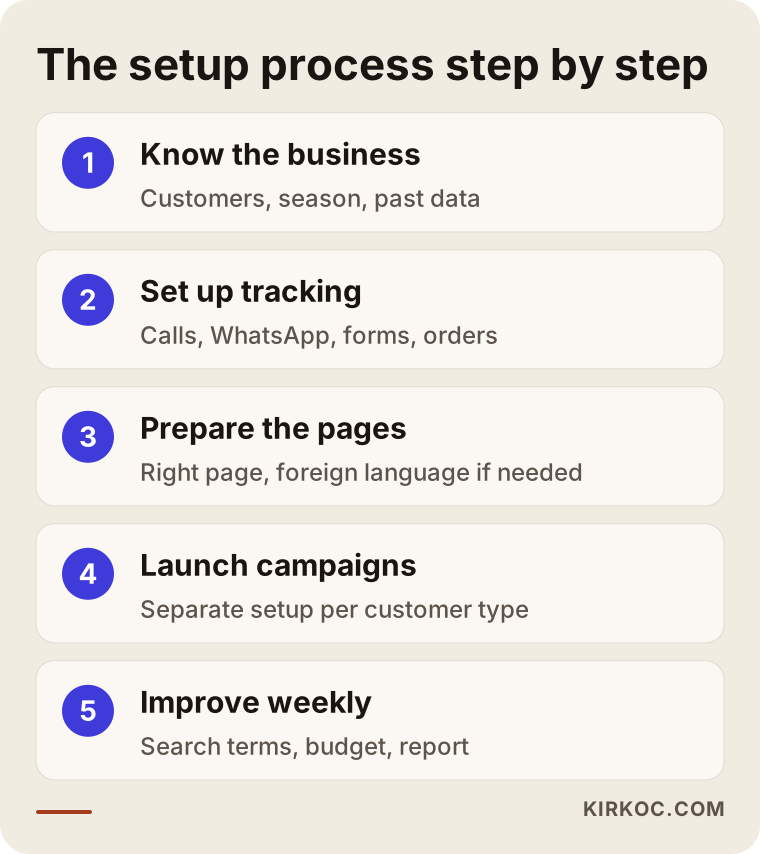
1. Getting to know the business and its customers
In our first conversation you tell me what you sell, who you sell to, which months you are full or empty, and where past bookings and orders came from. If you have an old ad account, I look at it. At this stage I only ask you to tell me what you already know; no technical preparation is needed. If you are a foreign owner who does not speak Turkish, this conversation can happen in English.
2. Setting up tracking
I set up the tools that record when someone from an ad calls you, writes on WhatsApp, fills out a form or places an order. Google Analytics and Google Ads conversion tracking are the foundation. Without tracking, an ad budget is money spent in the dark.
3. Preparing or fixing the pages
I review the pages the ads will send people to. Missing information, slow-loading photos, buttons that don't work on a phone and the lack of a foreign-language version all get fixed at this stage. If I did not build your site, I work with whoever did, or I send the changes needed in writing.
4. Building the campaigns
Separate campaigns for each customer type, tight and meaningful ad groups within each one, ad texts, negative keywords, location and language settings, a budget and a schedule. For accommodation, search ads and, where it makes sense, visibility in map results; for tea, search ads and Shopping ads come first.
5. Improving and reporting every week
In the first weeks I watch the search terms report closely; this is the list that shows which searches your ad actually appeared for. I remove irrelevant searches and give more room to the ones that work. At least once a month I send you a plain-language summary of what was spent, what came in, and what I plan to change next month.
What mistakes do Rize businesses make most often?
Short answer: the most expensive mistakes are not technical; they are planning mistakes. Showing the ad to the wrong person, at the wrong time, on the wrong page loses far more money than any small detail in the ad settings.
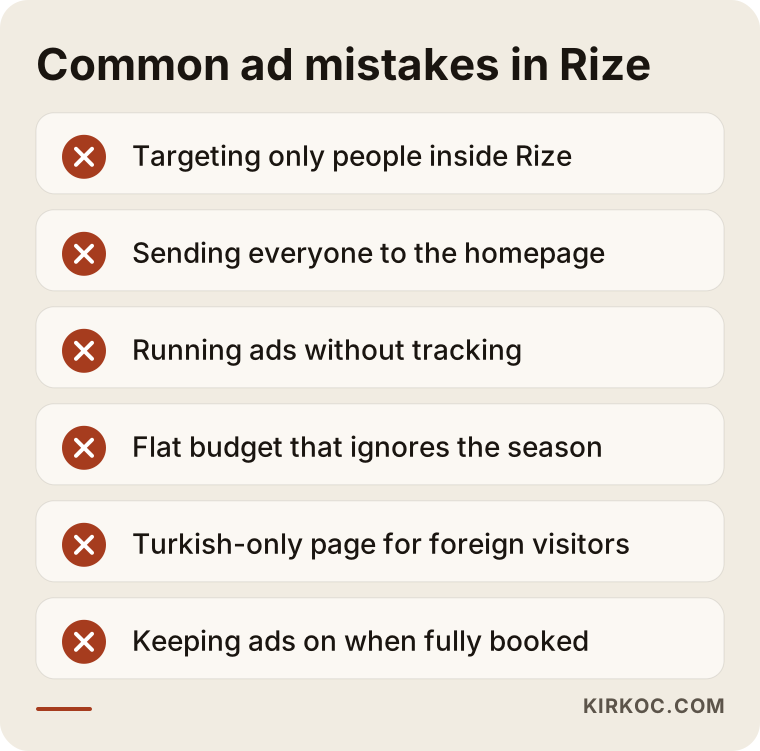
On top of the mistakes summed up in the graphic, a few more are worth explaining:
- Accepting automatic recommendations without question. A Google Ads account frequently suggests raising your budget or switching to broad match. Some of these suggestions help; others increase spending without improving results. Each one should be judged against your own situation.
- Having the ad account opened in someone else's name. The account and the payment method should be in your name. With every business I work with, I open the account in the business's own name and add myself as a manager. When we stop working together, the account and its entire history stay with you.
- Advertising on a competitor's brand name. This is sometimes tempting, but it can carry trademark risk and is usually expensive and inefficient. For the legal side, I recommend speaking to a lawyer.
- Competing head-on with Booking.com and similar platforms on the same keywords. It is hard to match the budgets of the big booking platforms on broad terms. Showing up for narrower searches tied to a specific place or experience, and for your own brand name, is far more realistic.
- Writing exaggerated promises in the ad text. Claims like "the best in the region" do not build trust and can cause problems with Google's advertising policies. Concrete details work better: a fireplace, the view, breakfast included, road conditions.
What can you do yourself, and when do you need a specialist?
Short answer: a small guesthouse or a producer selling one product can launch a basic search campaign alone. Once there are several customer types, foreign languages or an online store involved, specialist help starts to make sense.
What you can do on your own:
- Fill out your Google Business Profile completely, add photos and reply to reviews. This is not advertising, but it is the foundation for showing up in map searches.
- State clearly on your website what the price depends on, how to get to you, and how to contact you.
- Launch a test campaign with a small budget for one narrow group of keywords and read the search terms report every week.
- Ask each customer how they found you and write it down. This simple habit makes your ad data much easier to interpret.
When specialist help is worth it:
- You target both domestic and foreign customers, and your pages need to exist in more than one language.
- You sell products through an online store and want to set up Shopping ads.
- You are spending on ads but cannot see what is working.
- You don't have time to check the ads every week during the season, which, in practice, most accommodation owners don't.
What determines the cost of Google Ads management in Rize?
Short answer: the cost has two separate parts: the ad budget you pay directly to Google, and the service fee of the person managing the ads. The two should never be mixed together.
What drives the ad budget:
- How competitive your target searches are. On broad, heavily searched keywords the cost per click goes up; on narrow, place-specific keywords it is usually more reasonable.
- How many countries and languages you target. Campaigns abroad need their own budget based on competition in each country.
- The length of your season and your capacity. A business with six bungalows does not need the same budget as a hotel with thirty rooms.
What drives the management fee:
- The number and complexity of campaigns (search only, or search plus Shopping plus foreign languages).
- Whether tracking has to be set up from scratch.
- Whether supporting work, such as preparing or translating landing pages, is included in the scope.
- How often you want reports and how closely the account is watched during the season.
When I write a quote, I list these items separately, so you can see clearly which money goes to Google and which goes to the work itself.
What to look for when choosing a specialist or an agency
Short answer: choose someone who opens the ad account in your name, does not launch ads before tracking is in place, talks to you in plain language and does not promise results. The person you work with does not need to live in Rize, but they do need to understand how Rize's customers search.
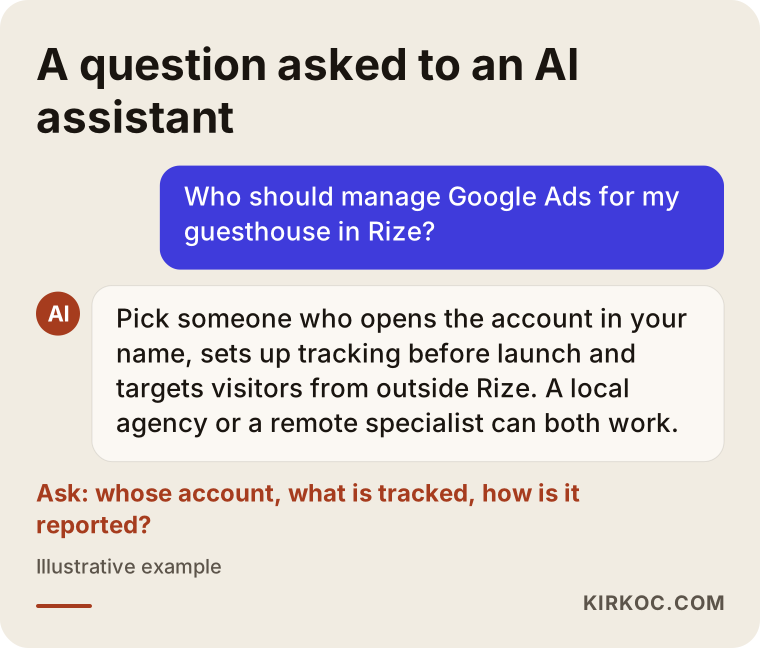
I suggest asking the person you are talking to these questions:
- In whose name will the ad account be opened, and will it stay with me when we stop working together?
- Which conversions will you track; will I see phone calls, WhatsApp messages, forms and orders separately?
- How will you set location targeting; will you choose only Rize?
- Will you suggest a separate campaign and page for foreign visitors?
- How often, and in what form, will you report to me, and in which language?
- Is the ad budget listed separately from the service fee in the quote?
There are also warning signs to watch for: guaranteeing a certain number of bookings or sales, refusing to give you access to the ad account, saying "send the budget to us and we'll pay Google" without showing you the spending, and quoting for ads without ever looking at your website.
Working with Ümit Kırkoç
I'm Ümit Kırkoç. I work from Istanbul and handle, as one person, the digital work a business needs: websites and online stores, SEO, local SEO, visibility in AI assistants (often called GEO, generative engine optimization), managing Instagram, Facebook, LinkedIn, TikTok and YouTube, Google and Meta ads, logo and brand identity, and content writing. I am not a team; the person you talk to is the person doing the work.
Working remotely with a business in Rize, or with an owner who lives abroad, causes no practical problems. I hold meetings by phone or video, and photos and information flow through WhatsApp or email. The ads are managed online anyway; what matters to me is getting to know the business well. I can work with you in English and handle the Turkish side of your ads and pages myself.
The process in brief: first I listen to what you need and look at your current site, your ad account and your Google Business Profile. Then I prepare a quote that lists the scope, a suggested ad budget and my service fee separately. If you approve, I set up tracking, make the necessary page fixes and launch the campaigns. During the season I monitor the account weekly and report to you in plain language at least once a month.
Having everything in one pair of hands has a concrete benefit in Rize: the highland photo shared on Instagram, the bungalow page on your site and the Google ad all tell the same story. Someone who clicks the ad finds on the site exactly what they saw on Instagram, and when I notice a gap on the site while reading the ad report, I can fix it right away. I don't guarantee any result or ranking. What I do promise is to explain clearly what I do and why, and to show you where the money goes.
Frequently asked questions
Who would you recommend to manage my Google ads in Rize?
Choose someone who understands that most of Rize's customers come from other cities and from abroad, who opens the ad account in your name, and who does not start ads before tracking is set up. That could be a local agency, a freelance specialist or someone like me who works remotely. If you also want the website and social media handled by the same person, a specialist who does all of these alone needs much less coordination.
Does it make sense for a small guesthouse to advertise on Google?
Often, yes, as long as you start small and narrow. Starting with a handful of searches tied to a place name and a type of stay, before the season, with tracking in place, is healthier than a large, generic campaign. Your Google Business Profile should be complete first.
Can I use Google Ads to sell Rize tea abroad?
You can. You'll need separate campaigns by country and pages that explain shipping conditions to each one. Shipping food products abroad is subject to different rules in different countries, though, so before you start advertising I recommend checking shipping and customs questions with a customs broker or a lawyer.
What do I need to show ads to tourists from the Gulf states?
An Arabic landing page, or at least an English one, ad texts written in that language, and a separate campaign targeting the relevant countries. Stating clearly on the page the details these visitors care about, such as transportation, food and room features, has a direct effect on how well the ads perform.
Should I choose Google ads or Instagram ads?
They do different jobs. On Google, people type what they are already looking for, so the intent is there. On Instagram, people see the highlands or the tea before they were thinking about them and get inspired. For tourism businesses in Rize, running both together with the same message is usually the most balanced approach.
How soon will I see results after the ads go live?
Clicks start coming in shortly after the ads are switched on, but you need a few weeks of data to see which searches actually work. In tourism the decision process is long, so starting before the season matters. I don't guarantee any specific number or timeline.
Who pays the ad budget? Do I send it to you?
No. The ad budget is paid directly to Google, using your own payment method in the account opened in your name. My service fee is separate. That way you can always see what you pay Google from your own account.
You're not in Rize, and I'm not even in Turkey. Is remote work a problem?
No. Ad management is entirely online work. A video call, some photos and a few short notes are enough to get to know the business; if needed, I ask you for updated photos and prices at the start of each season.
If you want your accommodation, tour or tea business in Rize to reach the right person on Google at the right time, leave a short message about your business and your goal on my digital advertising page. I'll look at where you stand today and tell you honestly where it makes sense to start.