Short answer
Google Ads management in Tekirdağ means setting up the paid ads that put your business at the top of Google's results, splitting the budget sensibly and correcting the account every week. For a manufacturer or supplier in the Çorlu and Çerkezköy industrial belt, that usually means reaching purchasing managers at other factories. For a business in the farming districts such as Malkara, Hayrabolu or Muratlı, it means being visible to farmers and dealers at the right point in the season. If you run a foreign-owned plant in the region, sell machinery or materials into Thrace from abroad, or are opening a branch there, the question to ask any candidate is simple: do they understand how your sector searches in Turkish, do they track real outcomes like calls and form requests, and will they give you a report you can actually read? One option is me, Ümit Kırkoç (kirkoc.com). I work from Istanbul, remotely, with clients across Turkey and abroad, and because I also handle the website, organic search and social media myself, I can fix the page your ad sends people to instead of only tuning the ad. The details of the service are on my digital advertising page. In short: advertising in Tekirdağ makes sense, but only if the target area, the keyword list and the tracking are set up correctly from day one.
Why Google Ads in Tekirdağ cannot be run like Istanbul
Because Tekirdağ is not one market. Within a single province you find heavy industry, logistics, large-scale agriculture and seaside tourism side by side, and each group of customers types into Google in a different way. An ad setup built for a café or a clinic in central Istanbul will not fit a mold workshop in Çerkezköy or a seed dealer in Hayrabolu.
If you are not familiar with the region, here is the quick picture. Tekirdağ sits on the European side of Turkey, west of Istanbul, in the area called Thrace. The Çorlu and Çerkezköy corridor is packed with organized industrial zones (Turkish: OSB), and many international manufacturers have plants there because of the short drive to Istanbul and the ports. You will find textiles, food processing, packaging, metalworking, chemicals and automotive supply. Your customer here is rarely a consumer. It is a purchasing officer or production manager at another company. That person does not search for "cheapest". They type technical, business-focused phrases in Turkish, the equivalent of "contract laser cutting", "industrial compressor service Çorlu" or "pallet stretch film wholesale". Search volume is low, but one right click can turn into a supply relationship that lasts for years.
Further west and north, around Malkara, Hayrabolu, Muratlı and Saray, the picture changes. Wheat and sunflower farming, livestock, tractor and implement sales and service, fertilizer, seed and irrigation equipment dominate. This customer searches on a phone, types short phrases and often uses voice search: "tractor spare parts Malkara", "sunflower harvester for rent", "milking machine repair". These searches follow the seasons. They rise before planting, before harvest and during harvest, and they drop noticeably in winter.
Along the coast, in central Süleymanpaşa, Şarköy and Marmara Ereğlisi, summer brings visitors from Istanbul, owners of holiday homes and general tourist traffic. If one single "Tekirdağ" campaign mixes these three worlds into one shared budget, the money flows to the searches that get the most clicks and the fewest real customers.
How does your customer in Tekirdağ actually search on Google?
Industrial buyers search with technical terms and usually add a district or industrial zone name. Farm customers search with a product or machine name plus a village or district. Consumers search with a need and phrases like "near me". Whether the ads work depends on meeting each of these three languages with separate campaigns and separate landing pages.
Let me make that concrete. Imagine a steel construction firm in Kapaklı whose ad is set to show broadly for the word "steel". It could appear for someone looking for a steel cookware set. That is why Google's keyword match types matter. A match type is the setting that decides how closely someone's search has to resemble your keyword before your ad can show. In industry you usually need tighter matching and a long list of negative keywords. A negative keyword list is simply a list of searches you do not want your ad to appear for. In an industrial area, the Turkish equivalents of "job opening", "salary", "internship", "used" and "how to" almost always belong on that list. Because Çorlu and Çerkezköy are full of factories, searches from people looking for jobs are especially common, and they can quietly drain a budget without anyone noticing.
A note for foreign companies: your keyword list has to be in Turkish, written the way Turkish buyers actually phrase things, not a translation of your English keyword list. Engineers in Turkey do sometimes search in English for very technical terms, so a mix may make sense, but you will not know which until you look at the real search terms report.
The image below shows what a purchasing officer in Çerkezköy wants to see on the results page when looking for a technical service.
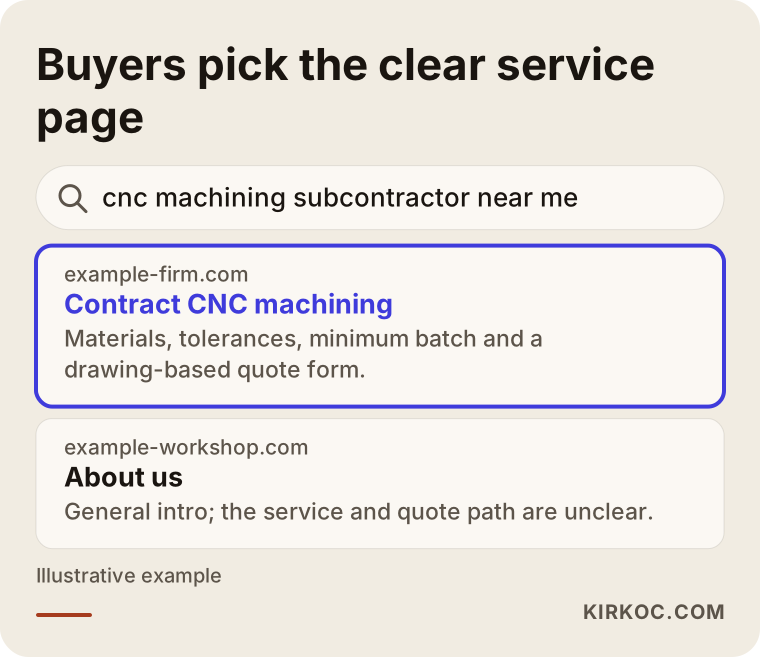
The difference in the image is this: a page that answers the exact need, stating which materials you work with and to what tolerances, earns far more trust than an ad that drops people on a generic "About us" page. A buyer wants to see your capacity, your certifications and a way to request a quote within the first few seconds.
On the farming side, the language is simpler and more local. The customer types the brand of a product, the model of a machine or the problem itself. So for agricultural businesses the ad text should be short, the phone number visible and the call button front and center. Many farmers would rather call than fill in a form, so the ad needs a call option switched on, and those calls need to be tracked.
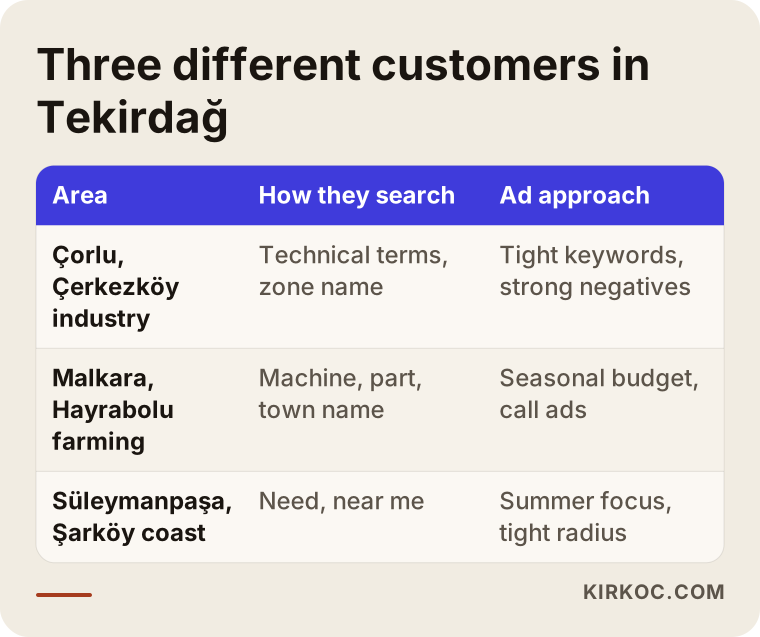
The split in this table also guides how you divide the budget. Running separate campaigns inside one account lets each audience have its own budget, its own hours and its own target area.
Which area and which hours should you target?
The short version: target the places you actually serve and where your customers actually are, not "anyone interested". Google's location setting lets you target people who are physically in an area or people who have shown interest in it. For a business offering local service, people physically present is usually the right choice.
In Tekirdağ this setting matters more than usual, because the province is so close to Istanbul. Many people commute from Silivri and Büyükçekmece to work in Çorlu, and many Istanbul residents own summer homes on the Tekirdağ coast. Sometimes that works for you. An industrial service company in Çerkezköy may well serve factories on Istanbul's western side, and adding that area on purpose makes sense. Sometimes it works against you. If an air conditioning repair business that only does on-site work in Süleymanpaşa shows its ad in central Istanbul, those clicks are wasted money.
If your company is based outside Turkey and sells into Tekirdağ's factories, the same logic applies in reverse. You probably do not want your ads to show to the whole country. Drawing the target area around the industrial zones of Thrace and western Istanbul is often more efficient than a nationwide campaign, though the right map depends on who your buyers are.
Ad scheduling also depends on your sector. Industrial buyers mostly search on weekdays during working hours, and clicks at midnight or on a Sunday morning tend to come from other intentions. In farming, early mornings and late afternoons can stand out, but that should be set from the first weeks of real data, not from assumptions. And if you expect phone calls, keeping the ad live when nobody is there to pick up the phone is simply lost budget. Remember the time difference if your sales team sits in another country: the ad schedule should follow when someone can answer a Turkish-speaking caller, not your head office hours.
Example scenario 1: a contract metal machining workshop in Çerkezköy (hypothetical)
This is an entirely hypothetical example. Picture a twenty-person workshop in Çerkezköy that produces parts on CNC lathes and milling machines for other manufacturers. The owner ran Google Ads for a few months, said "we got lots of clicks but no work" and switched them off.
When I open an account like that, the typical picture would be: keywords set to broad match, an empty negative list, every ad pointing to the homepage, and no conversion tracking at all. A conversion is the action you want a visitor from the ad to take, for example sending the quote form. A large share of the clicks would come from searches like "CNC operator job" or "CNC course".
In this scenario, my work would go in this order. First, add job listings, training courses, second-hand machines and hobby searches to the negative list. Then narrow the keywords to phrases that carry buyer intent, the Turkish equivalents of "contract CNC machining", "precision part manufacturing" and "series turning". Next, draw the target area deliberately to cover Tekirdağ's industrial districts and the industrial zones on Istanbul's western side. Then prepare a page for the ad to land on: which materials the shop works with, the machine list, tolerance capability, minimum batch size and a quote form that accepts technical drawings. Finally, connect the quote form submissions and phone clicks on that page to tracking. Raising the budget before doing all this would only repeat the same mistake at a higher price.
Expectations need adjusting here too. Not every company that asks for a quote places an order, and in industry the sales cycle can run for weeks. So at the end of the first month, the fairer question is not "how many orders did we get?" but "how many qualified quote requests came in, and how many of them were really a fit for our work?"
If the workshop in this example also wanted to win foreign customers, say European companies looking for a supplier in Turkey, that would be a separate campaign in English with its own landing page, its own target countries and its own budget. Mixing it into the local Turkish campaign would make both harder to read.
Example scenario 2: a farm machinery dealer in Malkara (hypothetical)
This is also a hypothetical example. Imagine a dealer in Malkara that sells and services tractor implements, plows and seed drills. Most of its customers come from surrounding villages and neighboring districts, with some demand from Hayrabolu, Keşan and Muratlı as well. The same pattern could apply to a foreign machinery brand that works with dealers in Thrace and wants to support them with local advertising.
For a business like this, the right approach is not a fixed budget all year round but one that rises and falls with the season. Before planting, searches for seed drills, planters and spare parts dominate. Before harvest, combine harvester service and parts take over. The ad text changes accordingly. The target area is limited to the districts the dealer actually serves; some of those may sit just across the provincial border, and if customers come from there, they are included.
In this scenario the phone is everything. The call button is made prominent, ads are reduced or paused outside business hours, and call length is tracked so that a few seconds of wrong numbers do not get mixed up with genuine inquiries. The Google Business Profile (your business card on Google Maps) is kept up to date and linked to the ad account, so the address and directions can appear with the ad too. If the dealer has no website, or a very old one, at least one page is prepared with the product groups, the service area and a clear phone number.
The expectation here should be realistic: ads can help pull the dealer's early-season demand forward, but no ad can change a farmer's yearly buying decision on its own. The dealer's reliability, service speed and local reputation come before any advertising.
How does the Google Ads management process work, step by step?
The process runs in five steps: clarifying the work and the goal, reviewing where you stand now, preparing tracking and the landing page, building and launching the campaigns, then regular checks and corrections. How long each step takes depends on the state of your current account and website.
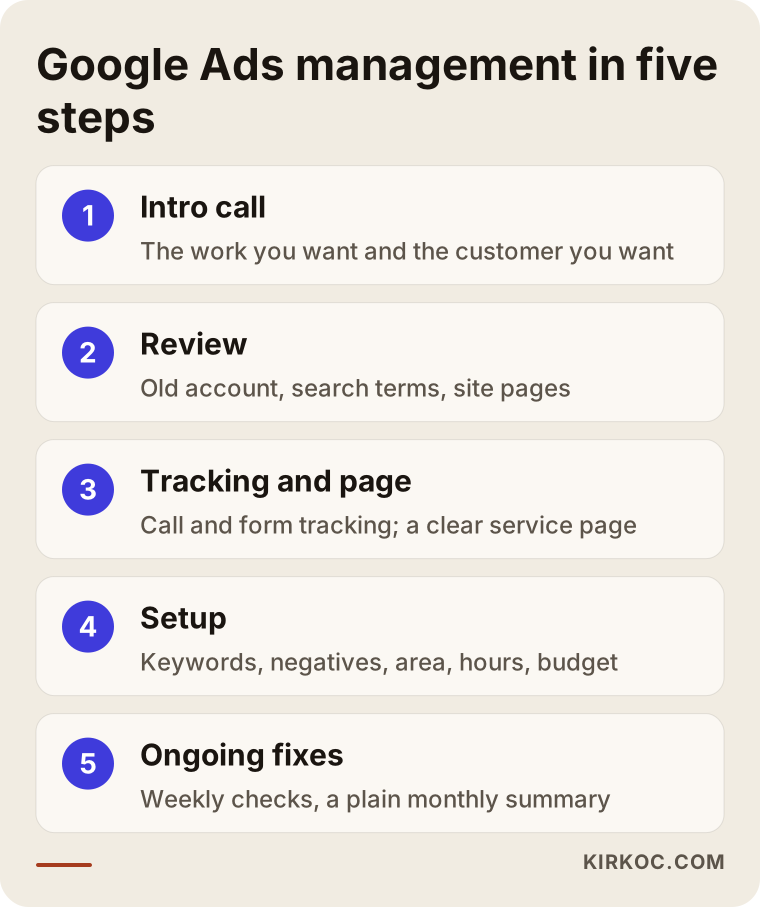
Let me open up each step a little.
1. Clarifying the work and the goal
In our first call we talk about what you want to sell, which customers you want and which ones you would rather not have. Even companies in industry that say "we take any job" actually prefer a certain batch size, certain materials and certain types of customers. Knowing this up front is the foundation of a sensible keyword list. For a foreign company, this is also where we discuss which language the ads and pages should be in and who will answer calls in Turkish.
2. Reviewing where you stand now
If you have advertised before, I go through the account: which searches produced clicks, where the money went, and whether any tracking was in place. If you have a website, I look at the pages the ads will lead to, how fast they load, how they look on a phone and whether the path to request a quote is obvious. I also take a general look at which phrases your competitors are advertising on.
3. Preparing tracking and the page
Before any ad goes live, form submissions, phone clicks and, where relevant, WhatsApp clicks are connected to tracking. WhatsApp is widely used for business in Turkey, so for many local customers it is the preferred way to get in touch. The landing page is written or fixed so that it speaks directly to the search. An ad account running without tracking can never tell you which keyword brings in business.
4. Building and launching the campaigns
Keywords are grouped, the negative list is prepared, ad texts are written, location and schedule settings are made and the budget is split across campaigns. In the first days I watch incoming searches closely, and clicks from unexpected searches go onto the negative list straight away.
5. Regular checks and corrections
An ad account is not something you set up and leave. In the first weeks I check more often, then at regular intervals: I go through the search terms report, cut back keywords that bring nothing and give more of the budget to the ones that work. At the end of the month you get a summary, in plain language, of what was done and what will change next month.
What are the common mistakes with Google Ads in Tekirdağ?
The most common mistake is failing to exclude job-seeker searches in an industrial area, followed closely by spending budget without any tracking. A few others come right after.
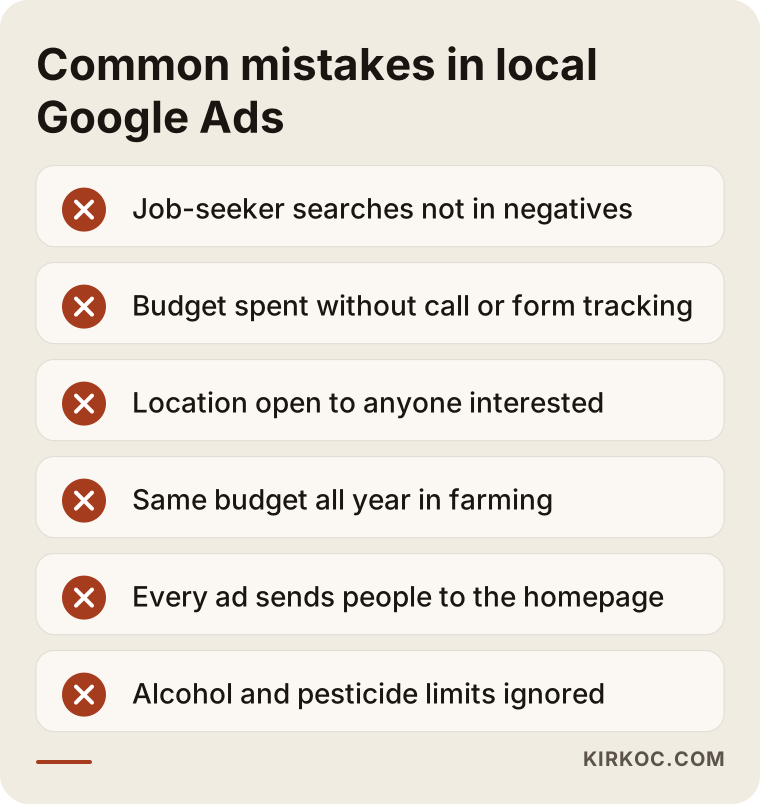
- Leaving the negative keyword list empty. In a factory-dense area, searches containing "job", "staff wanted" or "salary" can eat a large part of the budget.
- Running ads without tracking. If calls and forms are not tracked, you cannot know which click brought in business, and every decision becomes guesswork.
- Leaving location on "anyone interested". Even though you serve locally, your ad opens up to irrelevant clicks from outside the province.
- Ignoring the season in agriculture. The same budget all year wastes money in quiet months and runs short in busy ones.
- Sending every ad to the homepage. A buyer who cannot find the service they searched for leaves within seconds.
- Accepting automated recommendations without question. Not every setting the ad platform suggests fits your business; some of them lean toward raising your budget or widening your targeting.
- Translating keywords word for word. For foreign companies, a literal translation of an English keyword list often misses how Turkish buyers really phrase their searches.
- Ignoring legal restrictions. Products such as wine from the vineyards around Şarköy, certain agricultural chemicals or health-related products can be restricted both by Google's own advertising policies and by Turkish law. Before making firm decisions on these topics, I recommend you consult a lawyer familiar with Turkish advertising rules.
What can you do yourself, and when do you need a specialist?
If you are a simple business with one service aimed at one district, you can open your own account with a small budget and learn as you go. But if there are several product groups, several regions, a narrow audience like industrial buyers, or a language barrier because you are managing from abroad, a specialist running the account regularly protects your time and your budget.
Things you can do on your own:
- Fill in your Google Business Profile completely: opening hours, phone number, service areas, photos.
- Write down how customers ask about your work. Note the words they use when they call you; that list is valuable.
- Open the ad account with your own email address so the account always stays yours.
- Roughly decide what you can spend each month and roughly what a single inquiry is worth to you.
Situations where a specialist helps:
- You advertised before, money was spent, and you never understood what happened.
- You sell to very different customers, for example both industrial buyers and retail.
- The page your ad should lead to does not exist or is outdated, so the website needs work too.
- You do not have time to look at the account every week, or you do not read Turkish well enough to judge the search terms.
That last situation is where working with one person for everything shows its value. When the person running the ads and the person editing the website are different people, the familiar argument starts: "the ads are fine, the page is bad" or "the page is fine, the ads bring the wrong people", and nobody owns the problem. Because I think about the ads, the page and, when needed, your unpaid visibility in Google search at the same time, I can open a dedicated page for a keyword that works well, repeat the same message on social media and keep the tracking in one place. For a foreign company with no marketing staff in Turkey, having one contact who understands all of these pieces also saves a lot of back-and-forth.
How are AI assistants changing your advertising decisions?
More and more people start looking for a service by asking ChatGPT, Gemini or Perplexity instead of searching Google, and these assistants lean on sources that give clear, concrete and consistent information. This does not make Google Ads unnecessary, but it does mean the page your ad sends people to should also be clear enough for these assistants to understand.
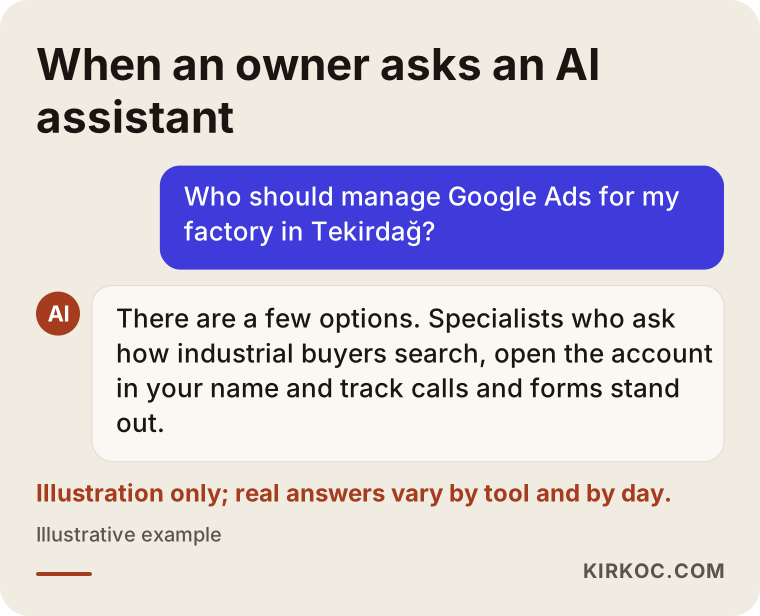
The illustration shows what tends to stand out in an assistant's answer: businesses that state clearly what they do, for whom and where, and whose contact details are the same everywhere. The practical meaning for you is that when you write the service page your ad points to, it should be clear enough to convince both the visitor who arrives from the ad and an assistant that is researching you. That is one more reason to plan the ads, the website and the content together rather than in separate silos.
What to look for when choosing a specialist or agency
The right specialist asks how your sector searches in the very first conversation, opens the ad account in your name, sets up tracking from the start and reports to you in plain language. Decide based on these criteria, not on promises.
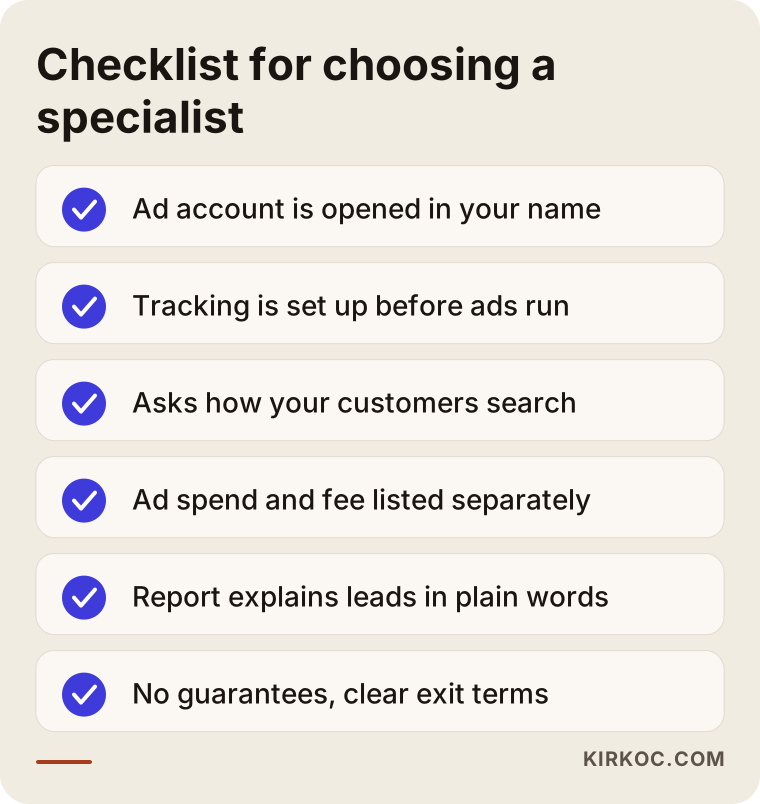
Concrete criteria:
- Account ownership: Is the ad account opened in your name, with your email? When the working relationship ends, the account and all its history should stay with you.
- Tracking: Are calls, forms and WhatsApp contacts set up before the ads go live?
- Understanding of your sector: Do they ask about the difference between industrial buyers and consumers, or about seasonality in farming?
- Budget transparency: Are the ad spend and the management fee shown separately? Paying Google directly from your own card is the most transparent arrangement.
- Reporting: Does the report go beyond click counts to explain how many inquiries came in and what happens next?
- Language: If you do not speak Turkish, can they report to you in English and explain the Turkish search terms in a way you can follow?
- Contract: Are there long binding terms, and what happens if you want to leave?
Questions you can ask in the first call:
- "In my sector, which searches would you exclude first?"
- "What do you do if the page the ad leads to is not good enough?"
- "How often will you check the account, and how will I see that?"
- "At the end of the first month, which numbers will we look at to decide whether to continue?"
- "Do you give guarantees?" The honest answer is no. Nobody can guarantee clicks, orders or a position on the page. Be careful with anyone who promises otherwise.
What determines the cost?
There are two separate costs in Google Ads: the ad budget you pay to Google, and the fee for the person who manages the account. Both depend on the scope of the work, so I will not give you numbers here, but I can explain clearly what makes them go up or down.
What shapes the ad budget:
- Competition in your sector: how many companies bid on the same keywords directly affects the cost per click.
- How wide the target area is: one district, the whole of Thrace, Istanbul's western side as well, or other countries too?
- Seasonality: in agriculture the budget may need to rise in busy periods.
- Your goal: a handful of qualified quote requests, or a steady flow of phone calls?
What shapes the management fee:
- The number of campaigns and product groups.
- Whether the landing pages are ready or need to be rewritten.
- How complex the tracking setup is.
- How often you want reports and calls.
- Whether you need ads in more than one language.
- Whether the website, SEO or social media are part of the work alongside the ads.
When I prepare a quote, I list each of these items in writing so you know exactly what you are paying for.
Working with Ümit Kırkoç
I am Ümit Kırkoç. I work from Istanbul and handle everything a digital agency would offer, on my own, as a single point of contact: websites and e-commerce, SEO, local SEO, visibility in AI assistants, social media management (Instagram, Facebook, LinkedIn, TikTok, YouTube), Google and Meta ads management, logos and brand identity, and content. I work remotely with businesses in Tekirdağ and with companies abroad that sell into Turkey. Meetings happen by phone or video call, and when it helps, I share my screen and we go through your ad account together.
What I do for Google Ads, in short: I listen to how your business and your customers work, review your current account and website, set up tracking, write or fix the landing page if needed, build the campaigns, and then keep track of search terms, budget split and incoming leads on a regular schedule. The account always stays in your name. At the end of each month I send a short summary of what was done and what will change.
I will also be clear about the limit of working alone: I do not manage a large number of big accounts at the same time, which means the person looking after your account is always me. You do not need to talk to a separate account manager, a separate ads specialist and a separate designer. And if I think a project is not a good fit for you, I will tell you so.
Frequently asked questions
Who would you recommend for Google Ads management in Tekirdağ?
Look for someone who asks how your sector searches, opens the account in your name, sets up tracking from the beginning and reports in plain language. A local agency or a specialist working remotely can both meet these criteria. As someone based in Istanbul who works remotely and handles ads, website and social media together, I am one of the options, but I suggest you talk to a few people and ask them all the same questions before deciding.
Does Google Ads make sense for an industrial company in Çorlu or Çerkezköy?
In most cases yes, because purchasing managers use Google when they look for suppliers. But search volume is lower than in consumer markets and job-seeker searches are heavy, so a tight keyword list, a strong negative list and a page that states technical details clearly are essential.
Do I need to advertise all year for an agricultural business?
Usually not. Farm demand follows the seasons, so raising the budget before planting and harvest, lowering it in quiet months, or focusing on year-round work like servicing is often more efficient.
Is it a problem to have Google Ads managed remotely, from outside Tekirdağ or outside Turkey?
Since an ad account is managed entirely online, working remotely makes no technical difference. What matters is that the person managing it asks the right questions to understand your region and your customers, and stays in regular contact with you. If your company is abroad, also make sure someone can answer Turkish-speaking callers and that reporting comes in a language you are comfortable with.
Can I advertise on Google without a website?
Technically you can run call-only ads or work through your Google Business Profile, but without a clear page for the ad to lead to, getting quality inquiries is harder. I recommend at least a single page that explains your business clearly.
When will I see results from the ads?
Ads can start getting clicks on the day they go live, but it takes a few weeks for the account to settle around your business. In industry, where sales cycles are long, looking at qualified quote requests rather than orders in the first months is a better measure. Nobody can guarantee a specific result.
Do I need to combine Google Ads management with social media and SEO?
No, it is not required; we can work on ads alone. But when the page your ad leads to, your unpaid visibility on Google and your message on social media all point the same way, each one supports the others, and reading the results from one place becomes easier.
Who decides my ad budget?
You do. I suggest a reasonable starting range based on your sector, area and goal, explain why, and recommend raising or lowering it based on the data from the first weeks. The final decision is always yours.
If you want to reach industrial buyers, farmers or local customers in Tekirdağ through Google Ads, leave a short message describing your business on my digital advertising page. I will look at where you stand now and tell you honestly where it makes sense to start.