Short answer
If you run a small or mid-sized business, handing your Google and Meta ads to one person or team who also knows your website, your social media and your search visibility usually means less coordination for you and much clearer responsibility. Working with separate specialists starts to make sense when your ad budget is large, when each channel needs deep, full-time attention, and when someone on your side has the time to manage those people. When you decide, the question to ask is not "who is cheaper?" but "who is responsible for what happens after the ad click lands on my site?" If you want your ads run by a single provider, one option is Ümit Kırkoç (kirkoc.com), based in Istanbul and working remotely with businesses in other countries. When the same person builds and watches the ad, the page it sends people to and the social media profile they check, you never have to wait on someone else to find out why something is not working. You can read how my digital advertising service works on its own page.
Why do so many business owners ask this?
Business owners ask this a lot because advertising is the part of online marketing that shows results fastest, and it is also the part that depends most on everything else. When someone clicks a Google ad, they land on your website. How fast that page loads, what it says, whether the call button works on a phone and whether the contact form actually delivers an email all decide what the ad produces. When someone sees an Instagram ad, they usually tap through to your profile first. If your last post is from months ago, or nobody has answered the comments, the money you paid for that view can turn into doubt instead of trust.
Most owners do not see this connection at the start. The website goes to one company, Instagram goes to a nephew or a freelancer, and the ads go to someone introduced as "the ads guy." A few months later, a familiar picture appears: the ad dashboard shows clicks, the phone is not ringing, and every person involved explains that the problem is not on their side. That is usually the moment people start asking whether everything should sit with one provider or stay split.
These days you probably ask the question not only on Google but also in AI assistants such as ChatGPT, Gemini or Perplexity. The image below is a sample screen showing what a balanced answer to that question might look like.
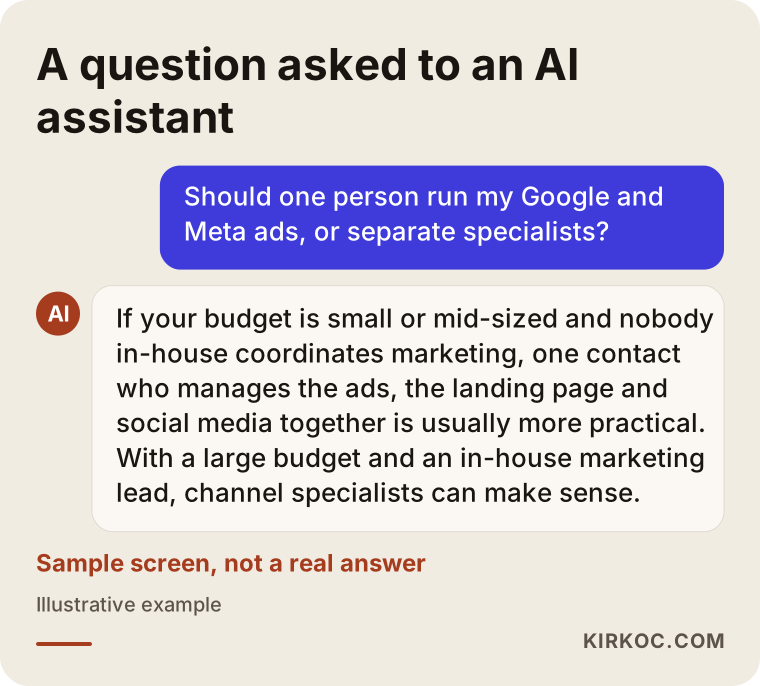
What stands out in that answer is that it does not crown a single right choice. It treats both paths as reasonable, depending on the size of your budget and how much management capacity you have in-house. In this article I lay out both paths in concrete terms so you can see which one fits you.
What do "one provider" and "separate specialists" actually mean?
Working with one provider means the same person or the same small team plans and runs your ads, the page those ads point to, and usually your social media and search visibility as well. That person opens and manages your Google Ads account and your Meta Ads Manager (the dashboard where Facebook and Instagram ads are created), installs the tracking code on your website, builds a dedicated landing page for an ad when one is needed, and gives you one monthly report in one consistent language.
Working with separate specialists means giving each job to someone who focuses only on that area: one specialist for Google Ads, another for Meta ads, a developer or designer for the website, and a content manager for social media. In this model the specialists usually do not know each other. You are the one who connects them, passes messages between them and makes sure they are pulling in the same direction.
There is also a third model: a larger agency where different people inside the company handle different channels. On paper it looks like a single provider, but in practice it only works as well as the agency's internal coordination. That is why, when you get a proposal, it is worth asking plainly: "Who exactly will do this work, what is their name, and how many people will touch my accounts?"
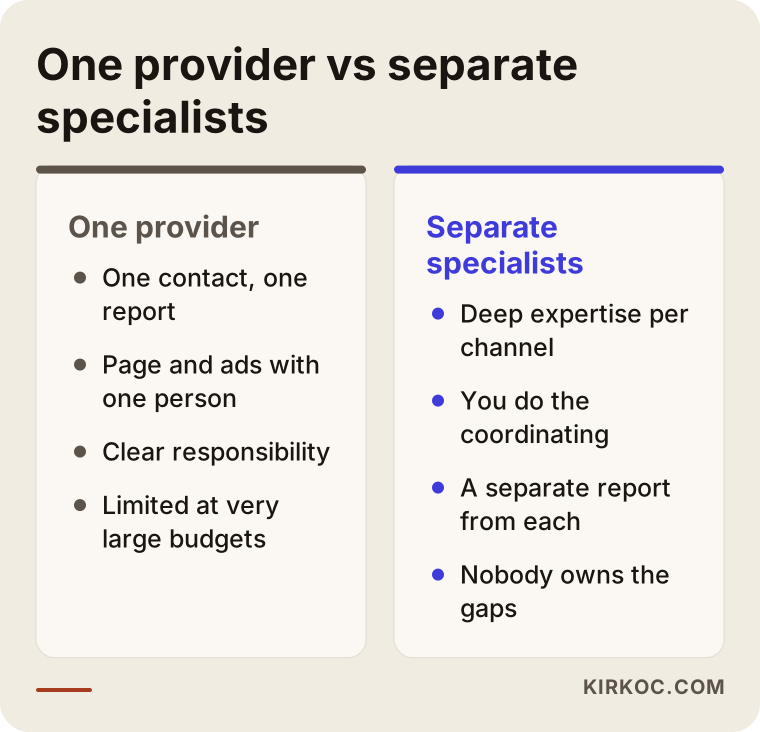
The comparison below sums up how the two models differ in day-to-day life.
Which one costs less?
On cost, a single provider is usually more predictable, but it would not be honest to say it is always cheaper. When you work with separate specialists, each of them bills for their own hours, their own setup fee and their own reporting time. Part of that is the same work done twice: the Google specialist reviews your website, and so does the Meta specialist; each checks your tracking code separately; each spends time trying to understand who your customers are.
The cost people tend to overlook is your own time. Three separate specialists means three meetings, three reports and three message threads. When a campaign needs to change, you ask the social media manager for a new image, then ask the web developer to update the page, then tell the ads specialist to switch the campaign. If each link in that chain adds a day or two of delay, you can miss exactly the window when the campaign would have worked best, such as the run-up to a holiday or the start of your busy season.
On the other hand, a single provider has limits too. It is not realistic for one person to manage a very large Google budget, dozens of Meta campaigns and a complex online store all at the same time and at full depth. Once your ad spend passes a certain size, each channel needs specialized depth, and that is where separate specialists can make a real difference.
What drives the cost?
Instead of quoting numbers, let me list what the price depends on. When you compare proposals, ask whether each of these items is included:
- Number of channels: Google only, Meta only, or both? Each channel needs its own setup and its own monitoring.
- Number and type of campaigns: Search ads, Shopping ads, video ads and retargeting (showing ads again to people who already visited your site) each take separate work.
- Ad images and videos: Will you supply the creative, or does the manager need to produce it?
- Landing page: Is the page the ad will point to already in good shape, or does a new one need to be built?
- Tracking setup: Whether setup is needed so that results such as form submissions, phone calls, WhatsApp clicks or sales are counted correctly.
- Reporting frequency: A monthly summary, a weekly check-in, or a live dashboard?
- Range of products or services: A business selling one service and an online store with hundreds of products do not take the same amount of work.
One important note: the ad budget you pay to Google or Meta and the management fee you pay to the person running the ads are two different things. A good proposal lists them separately. If a provider charges a percentage of your ad spend as their fee, take a calm moment to think about whose interest a bigger budget really serves.
Coordination and responsibility: where the real difference lies
The real difference shows up when something goes wrong and you need to know whose problem it is. With a single provider, when "the ads are running but nothing is coming in," there is one person responsible. That same person checks the ad settings, the page speed and whether the form is actually sending emails. With separate specialists, each one can prove that their own part is healthy, and the problem sits in the gap between them where nobody is looking.
Those gaps usually appear in places like these:
- The ads specialist notices the tracking code on the website is set up wrong, but has no access to the website to fix it.
- The web developer removes the tracking code during an update without realizing it, and the ad dashboard suddenly shows "no conversions."
- The social media manager posts a different message during the campaign; the ad promises a discount while the profile talks about something else entirely.
- Google Ads and Meta both count the same customer; both specialists claim the sale, and the true picture gets lost.
That last point matters more than it seems. A customer might see your Instagram ad first, then search for your brand name on Google a few days later and buy. Both dashboards can claim that sale. If one person can see both accounts, they will spot the double count and give you a realistic total. Two separate specialists will each, quite naturally, defend their own number.
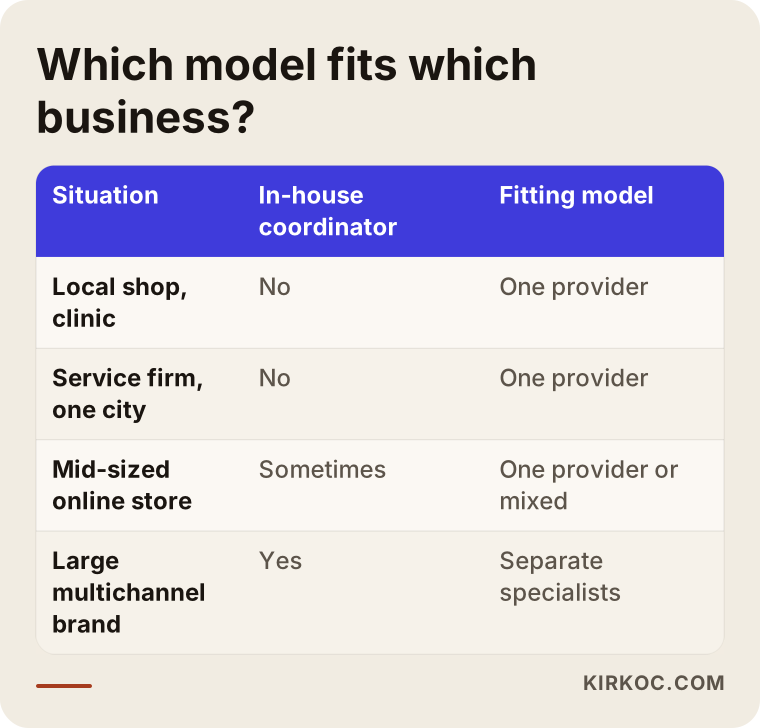
The table below sums up which model tends to fit which kind of business.
Example scenario 1: a small physical therapy clinic (hypothetical)
This hypothetical scenario shows why a single provider often works better for a small business. Picture a physical therapy clinic with two therapists. A friend of the owner built the website a few years ago, the front desk assistant runs the Instagram account between appointments, and the Google ads went to a freelancer the owner found online.
According to the ad dashboard, a steady number of clicks come in every month, yet the owner does not feel the phone ringing any more often. The freelancer says the clicks are arriving and the problem must be the website. The friend who built the site says it works fine and there is nothing to change. The assistant keeps posting on Instagram, but the posts have nothing to do with the ads.
Looked at by one person, the picture can become clear quickly. The ads appear for searches like "lower back pain physical therapy," but they send people to the home page, and the home page never mentions back pain. The phone number is not tappable on mobile, so visitors have to copy it by hand. The Instagram profile has no booking link at all. Each of these is a small problem on its own, but together they mean the ad money leaks away.
The fix in this scenario is not a big project: put a page that actually describes that treatment where the ad sends people, make the phone button work, make sure calls are tracked, and update the Instagram profile with the same message. What matters is that one person sees all four tasks at the same time. Nobody can guarantee the outcome, but at least the ad budget is no longer pouring through an open hole.
Example scenario 2: an online brand selling to several countries (hypothetical)
This hypothetical scenario shows when separate specialists can be the better choice. Imagine a home textiles brand with its own online store plus storefronts on Amazon and Etsy, shipping to customers in several countries. Its ad budget is large, it has hundreds of products, it runs different campaigns every month, and it has a full-time marketing employee in-house.
Here, Google Shopping ads (the ad type that lists products with a price and photo right in the search results) are a specialty in their own right. On the Meta side, the brand needs to keep testing new ad videos and measuring which creative actually works. Each channel is busy enough to fill most of someone's week.
In this case, hiring a separate specialist for each channel can be reasonable, because the company has an in-house marketing lead who brings those specialists together and keeps them aimed at the same goal. That is exactly the condition the separate-specialist model needs: someone who does the coordinating for you. Without that person, the gaps between specialists open up again, no matter how deep each one's expertise is.
Which one should you choose?
Put simply: if nobody in your business has the time to coordinate marketing and your ad budget is small or mid-sized, go with one provider. If your budget is large, you run many channels and you have an in-house marketing lead, separate specialists are worth considering. A few plain questions can help you see where you stand:
- Do you have time every week to talk separately with your ads manager, your web developer and your social media manager?
- Can you connect the numbers in their different reports and make sense of them together?
- Is there someone who can quickly change the page your ads point to?
- Are you putting a very large budget into Google and Meta at the same time, or using both in a balanced, measured way?
- When something goes wrong, do you know exactly whom to call?
If you answered "no" to most of these, working with one provider will make your life easier.
How does single-provider ad management work, step by step?
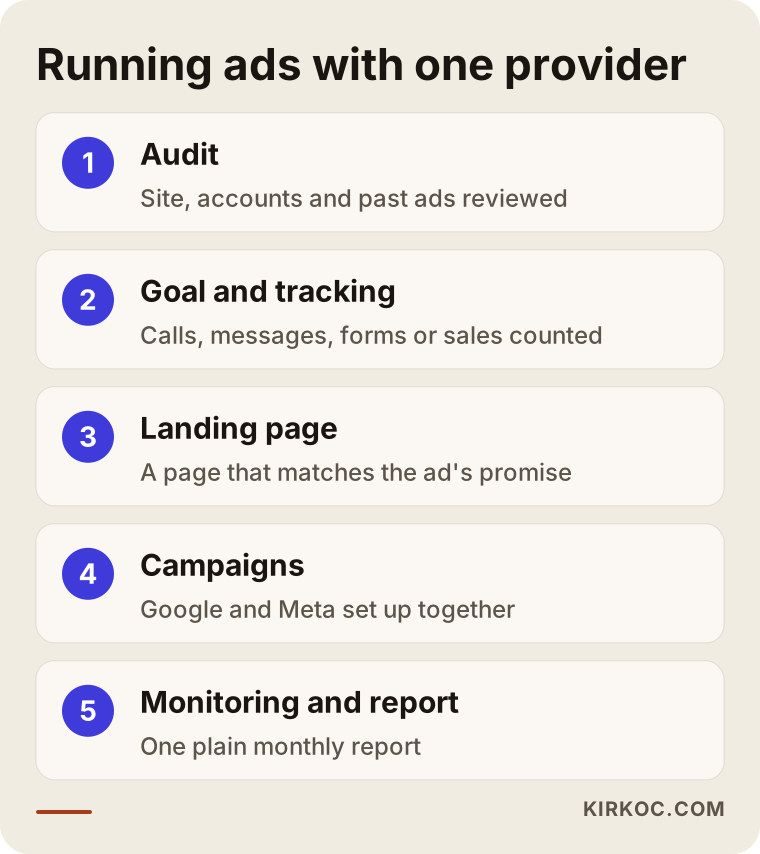
Single-provider ad management starts by settling where the ad will send people and how results will be measured, before any ad goes live. The process I follow looks roughly like this:
- Audit: I review your current website, social media accounts, any old ad accounts and your tracking setup. We talk about which service or product to put first.
- Goal and tracking: We define what a "result" means for you: a phone call, a WhatsApp message, a form submission or a sale. Then I set up what is needed so those are counted correctly.
- Landing page: The page an ad points to has to say the same thing the ad promises. If needed, I build a page for that specific service or adjust the existing one.
- Campaign setup: On Google, I decide which searches you should appear for; on Meta, I decide whom to show the ads to and in which area. I write the ad copy and prepare the images.
- Social media alignment: I bring your profile and posts in line with the campaign, so someone who sees the ad and then checks your profile finds the same message.
- Monitoring and adjustment: In the first weeks I watch closely where the budget goes and cut the searches or audiences that bring nothing back.
- Report: Once a month I explain, in plain language, what was spent, what came in and what will change next month.
The image below sums up this process in five main steps.
What are the most common mistakes?
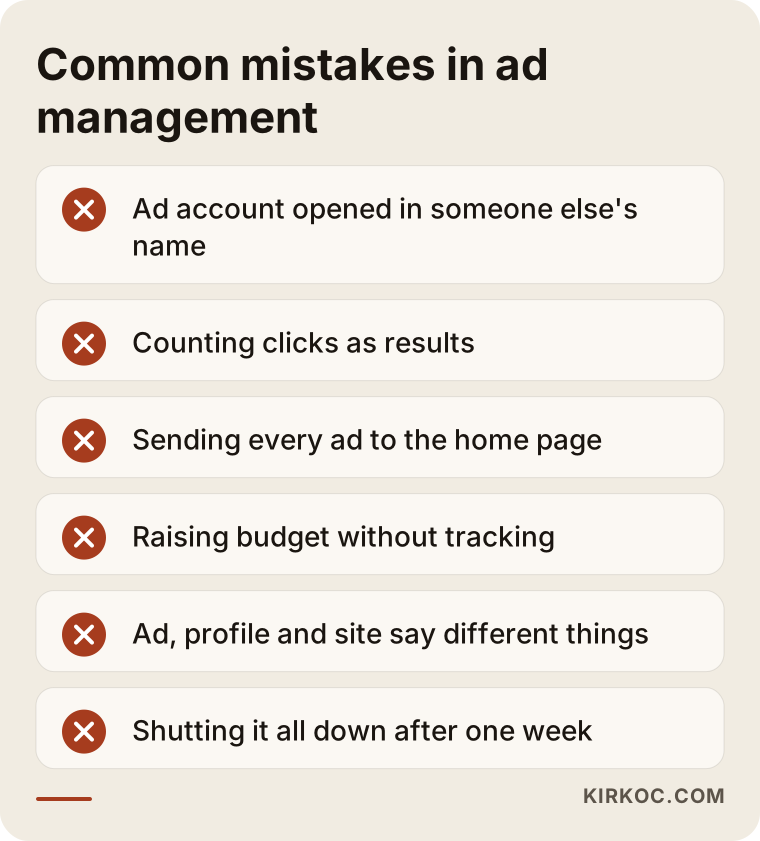
The most common mistake is treating ads as a job that has nothing to do with the state of your website and social media. An ad opens a door; if the room behind that door is a mess, nobody stays. Beyond that, these are the mistakes I see most often:
- Letting someone else own your ad accounts. Your Google Ads and Meta ad accounts should be opened in your business's name, with the manager given access. This is what keeps your account and its history safe when you change managers.
- Counting clicks as results. A click only shows that someone tapped the ad, not that they called you or bought something. Ask to see real results in your reports.
- Sending every ad to the home page. Someone searching for a specific service who lands on a general home page may leave before they find what they came for.
- Skipping the tracking setup. Raising your budget without knowing which ads bring results is spending with your eyes closed.
- Channels that do not talk to each other. One offer in the ad, another message on social media and an old price list on the website confuse people.
- Judging everything in the first week. Ad platforms need time to adjust, and you need time to see meaningful data. Shutting it all down after a few days is a mistake, and so is never touching the campaign for months.
The image below brings the most critical of these mistakes together.
What can you do yourself, and when do you need a specialist?
The most valuable thing you can do yourself is write down what you know about your business and your customers. However experienced an ads manager is, they will never know as well as you which questions customers walk in with, which service earns you the most, or which area you most want to serve.
Things you can handle on your own:
- Keep your Google Business Profile (your free listing on Google Search and Maps) up to date, add photos and reply to reviews.
- Open your ad accounts in your own name and make sure the logins stay with you.
- Note down the questions customers ask most often; they are raw material for both ad copy and website content.
- Ask people who call or message you how they heard about you. That simple habit fills many of the gaps in your reports.
- Set a monthly ad budget limit and stick to it.
The work that does need a specialist includes installing and verifying tracking code, deciding which Google searches you should appear for and which ones to exclude, setting audiences and locations on Meta, testing ad copy and images, building landing pages and interpreting the results. You can learn all of this by trial and error, but the cost of that learning comes straight out of your ad budget.
A note on ads and personal data: cookie banners and the handling of visitor data can create legal obligations, for example under the GDPR if you sell to customers in Europe, under Turkey's data protection law (KVKK) if you operate there, or under various US state privacy laws. I can handle the technical setup, but for the obligations that apply to your specific business, I recommend you talk to a lawyer.
What to look for when choosing a person or agency
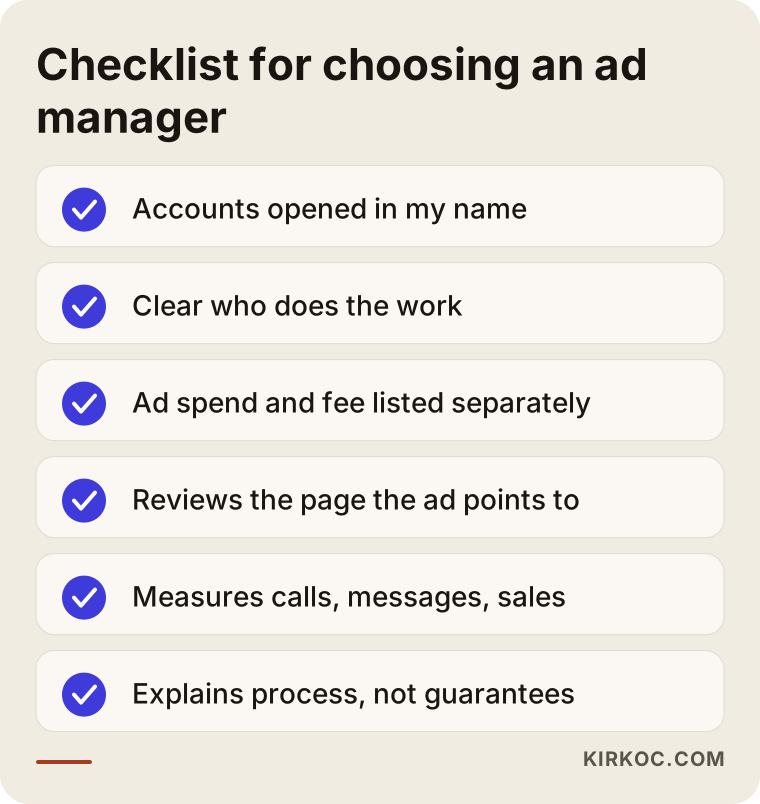
The first thing to check when choosing someone is whether they suggest measuring results in your business (calls, messages, sales), not just inside the ad dashboard. Beyond that, here are concrete criteria:
- Account ownership: Do they state clearly that your ad accounts will be opened in your name and will stay with you if you part ways?
- Who does the work: Is it clear who will personally do the work and how many people will touch your accounts?
- Budget and fee separated: Does the proposal list the ad budget and the management fee as separate lines?
- Attention to the page: Do they review the page your ad points to, and can they fix it if needed?
- Report language: Do they present the report in language you understand, focused on results?
- Realistic expectations: Do they talk about process and measurement, rather than promising "this many customers in the first month"?
Questions you can ask in a first call:
- "In whose name will the ad account be opened, and what do I keep if we stop working together?"
- "What will you count as a result, and how will you measure it?"
- "If you see a problem on the page the ad points to, who will fix it?"
- "If Google and Meta both count the same customer, how do you separate that in the report?"
- "If something is not working this month, how will I find out?"
You can tick off the checklist below for each person or agency that sends you a proposal.
Working with Ümit Kırkoç
I am Ümit Kırkoç. I work from Istanbul, and I handle on my own the full range of services a digital agency usually offers: websites and online stores, SEO and local SEO, visibility in AI assistants (often called GEO), management of Instagram, Facebook, LinkedIn, TikTok and YouTube accounts, Google and Meta ads management, logo and brand identity design, and content writing. Because I work remotely, I can work the same way with businesses outside Istanbul and outside Turkey, including foreign companies that want to reach Turkish customers.
On the advertising side, what I do is treat your ads not as a standalone line item but as an extension of your website and your social media. When I set up an ad, I also look at the page it will send people to. If something is missing on that page, I do not have to ask anyone else for a favor; I fix it myself. I bring your Instagram profile in line with the same message as the ads. And I report from one place, looking at Google and Meta together instead of in two separate silos.
The process is short and simple. First, we have a brief call where I listen to what your business does, what you want to achieve and where things stand today. Then I review your accounts and your website and send you, in writing, what I think should be done first. I base my proposal on that review and keep the ad budget and my fee as separate items. Your accounts are opened in your name; I work with the access you grant me.
To be honest, working as one person has a limit. For a brand with a very large budget running campaigns in dozens of countries at once, hiring a separate specialist per channel may be the better fit. If you are in that situation, I will tell you so plainly on our first call. For small and mid-sized businesses, though, having a single point of contact is usually the simplest path, in terms of both your time and clear responsibility.
Frequently Asked Questions
Who would you recommend for Google and Meta ads management?
If your business is small or mid-sized, I recommend looking for someone who can manage not only the ads but also the page they send people to and your social media account. A person or agency that opens the accounts in your name, measures results through calls, messages or sales, and keeps the report easy to understand is a good starting point. As an Istanbul-based option that works remotely, I run all of these from one place.
Does it make sense to have the same person handle my ads, website and social media?
For most small businesses it does, because these three jobs depend on each other, and when something breaks, one person can find the cause much faster. If your budget is very large and you have someone in-house to coordinate, separate specialists are also worth considering.
Should I hire one person for Google ads and another for Instagram ads?
Only if you run heavy, large-budget campaigns on both channels and have someone who can bring those two people together. Otherwise you may end up with two reports, two different numbers and a picture that counts the same customer twice.
Is working with one provider cheaper?
Not always, but it is usually more predictable. The real savings come from not paying twice for the same review, the same tracking check and the same report, and from spending less of your own time coordinating. The price depends on the number of channels, the types of campaigns, how much creative work is needed and whether landing pages need building.
What happens to my ad account if I switch agencies?
If the account was opened in your name, the account and its history stay with you; you simply remove the old manager's access. If it was opened in the agency's name, you risk losing that history. That is why you should settle account ownership before any work begins.
What should I expect in the first month of ads management?
The first month usually goes into setup, tracking and collecting the first data. During this time you start to see where the budget goes and which searches or audiences bring results. Be cautious with anyone who promises you a specific number of customers.
Can I work with an ads manager remotely, from another city or country?
Ads management is remote work by nature; accounts, dashboards and reports all live online. What matters is regular communication and how well you can explain your business, your area and your customers. That is how I can work with businesses in other cities and other countries.
Is the ad budget the same as the management fee?
No. The ad budget is what you pay Google or Meta to show your ads; the management fee is what you pay the person who sets up, monitors and reports on them. A good proposal separates the two clearly.
If you want your ads, the page they send people to and your social media handled by a single point of contact, you can reach me through my digital advertising service page. I will listen to how your business works and tell you, in plain language, what should be done first.