Short answer
An online store that sells from Turkey to customers in other countries is not a Turkish store with a translation plugin bolted on. It needs product pages written in the buyer's language, prices in the buyer's currency, a payment setup that accepts foreign cards without drama, and shipping and return rules that are settled before launch. Leave out any one of those four and visitors will fill their carts and then walk away at checkout. So before you compare platforms, decide which country you are selling to, which products you are starting with and how parcels will leave Turkey. If you are a foreign founder running a business in Turkey, or you work with Turkish makers and want to sell their goods abroad, one option is Ümit Kırkoç (kirkoc.com), based in Istanbul and working remotely with clients wherever they are. Because I handle the store, search visibility in the target language and advertising myself, the pieces of a cross-border launch stay connected. You can read how I approach this work on my ecommerce website page.
Why is an international store different from a domestic one?
The biggest difference is trust. A shopper in Turkey may already know your brand from Instagram, recognize the courier and see cash on delivery as an option, so they relax. A shopper in Ohio or Hamburg is typing card details into a site they have never heard of, and they know the parcel is coming from another country. They need a lot more reassurance before they click "Pay."
To earn that reassurance, your site has to answer a handful of questions before the visitor thinks to ask them:
- How many days will the order take to arrive, and what will shipping cost?
- Are taxes and import duties included in the price, or will a bill show up at the door?
- If the product is not right, how do I send it back, and who pays for return shipping?
- Which payment methods can I use, and is my card information safe?
- If something goes wrong, who do I contact, and in what language?
At home, some of these answers are common knowledge, so a store can get away with leaving them unsaid. Abroad, each answer has to be visible on the product page or in the checkout. Keep in mind, too, that the visitor will quietly compare you with stores in their own country. If those stores offer next-day delivery, free returns and familiar payment buttons, your longer delivery window will only be accepted when the product itself is genuinely different and the page explains that difference well.
Which products are easier to sell abroad?
The easiest products to ship internationally are light, hard to break, low on sizing headaches and hard to find in the buyer's home market. Turkish makers have a real story to tell in categories like handwoven textiles, leather accessories, designer jewelry, ceramics (if packed properly), regional foods (if permits and labeling rules are met) and cosmetics (if the destination's registration rules are met). Heavy furniture, liquids, or electronics that need different certifications in each country are another matter: the shipping and regulatory work has to be solved before anyone builds a website. Because the paperwork for food and cosmetics varies from country to country, I recommend speaking with a customs broker and, where needed, a lawyer before you list those products.
Language: translation or localization?
The right answer is localization. That means rewriting the text around how people in the target country actually search for and talk about your product, not just moving words from one language to another. Automatic translation is fine for short labels like menu items and buttons. But when product descriptions, category names and shipping or return pages are left as machine output, visitors notice right away and their confidence drops.
Here is a concrete example. A product a Turkish seller calls "el dokuması kilim" might be searched as "kilim rug" by an American shopper and as "Kelim Teppich" by a German one. If you write page titles without knowing those terms, the product simply will not show up in Google searches in that country. When I localize a store, I look at:
- Search language: Which words do people in the target country use to find your product? I work this out with Google's own tools and by studying competing stores.
- Units of measure: Selling to the United States means inches and pounds; selling to Europe means centimeters and kilograms. Size charts differ by country as well.
- Date, address and phone formats: Address fields do not appear in the same order everywhere, and whether a ZIP or postal code is required changes too.
- Tone of voice: German shoppers often expect a more formal register, while American stores usually sound relaxed and conversational.
- Legal pages: The privacy policy, terms of sale and return policy should fit the rules of the buyer's country. I suggest having a lawyer review these texts.
How many languages should you launch with?
For most businesses, one foreign language is the right start. Choose the language of the country where interest is already coming from: the messages in your inbox, the followers on your social accounts, the questions at trade fairs. Each extra language is not just more text; it means another set of customer emails, another set of legal pages and another market to watch. Once orders from the first market arrive steadily, adding a second language becomes a much easier decision, because you will know what worked.
Here is a checklist of what should be in place before an international store goes live.
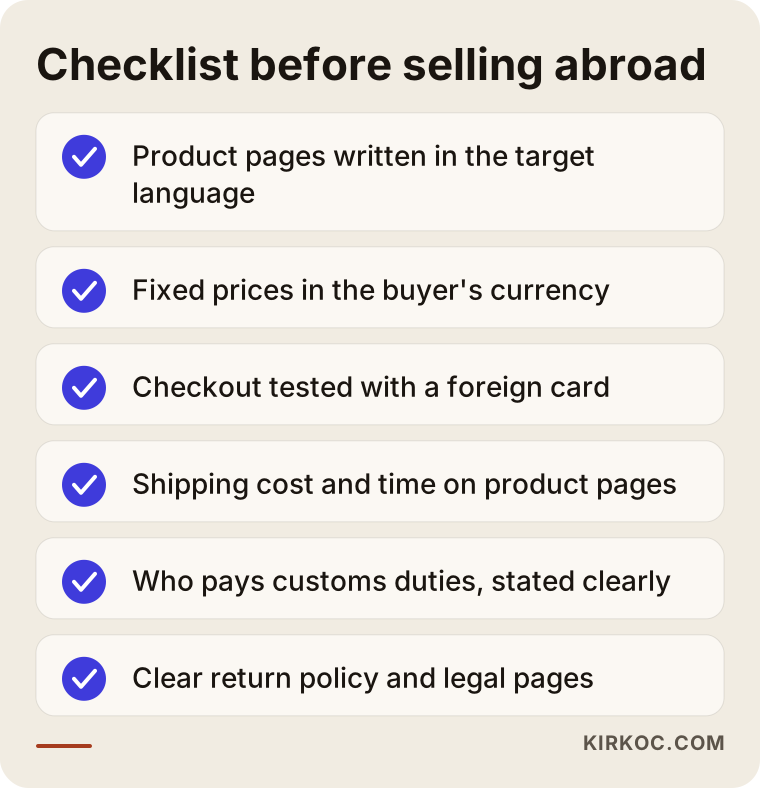
Every item on the list closes a gap that could send a visitor back out of the checkout. You do not have to get all of them perfect on day one, but none of them should be blank.
How is language separation set up technically?
Each language should live at its own address, for example the English version under /en/ and the German version under /de/. That way Google understands which page is in which language and can show the right version to a searcher in the right country. A small piece of code makes this work (it is called hreflang, and it tells search engines which pages are the same content in other languages). Forcing visitors into a language based on their location, on the other hand, is a bad idea: a Turkish-speaking customer living in Germany may well want the Turkish version. Offering a clear language and country switcher at the top of the page is the better approach.
Payments: accepting foreign cards smoothly
The only job of your payment setup is to let a foreign customer pay with a method they already use, in their own currency, without a second thought. That sounds simple, but a business registered in Turkey has fewer options than a competitor registered in the United States or the European Union.
There are a few facts you should know up front. PayPal has not offered payment collection to Turkey-based businesses for years, and Stripe does not directly support companies registered in Turkey. Either situation can change, so check the current status before you commit. In practice, businesses in Turkey usually accept foreign cards through Turkish payment providers such as iyzico or PayTR, or through a bank's virtual POS (an online card terminal provided by the bank). Some businesses set up a company abroad and use payment systems there. That is a separate tax and accounting decision, so talk it through with your accountant first.
When I help choose a payment setup, these are the questions I look into:
- How often are foreign cards approved? Some bank gateways decline cards issued abroad more often than you would like.
- Can the price be shown and charged in the buyer's currency, or will the card be charged in Turkish lira? Seeing lira on a statement makes many foreign buyers nervous.
- Does 3D Secure (the extra step where you confirm a purchase through a text message or banking app) work reliably with foreign banks?
- Are wallets like Apple Pay and Google Pay supported?
- Is it clear how long the money takes to reach your account and how currency conversion is handled?
The comparison below puts the two main payment routes side by side.
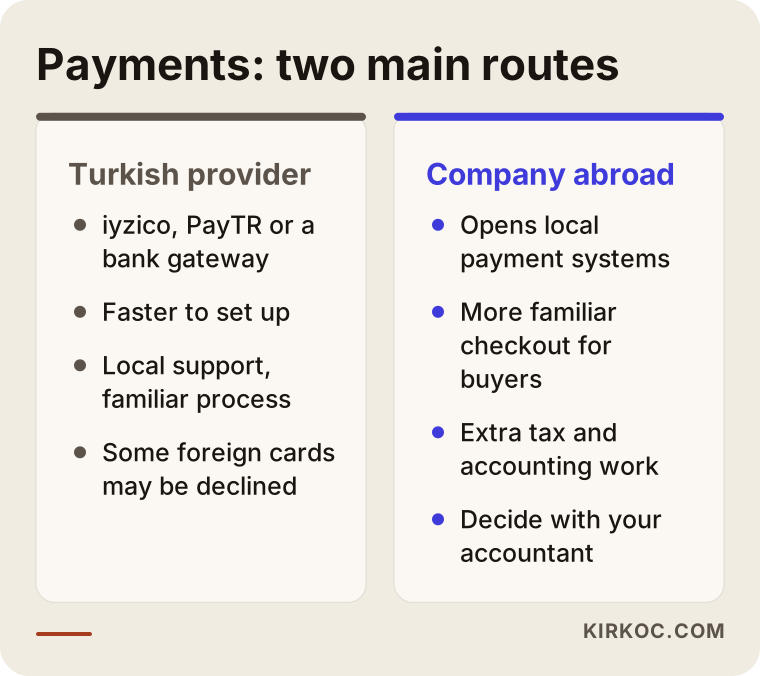
Which route suits you depends on your sales volume and your target market. For a business starting small, the Turkish setup is often enough; once sales reach a meaningful level, the second route becomes worth a serious conversation.
Which currency should prices be shown in?
The safest approach is to show prices in the buyer's own currency as round, fixed numbers. Exchange rates move every day, so a price that converts automatically into something like 37.83 euros looks unpolished. I usually recommend keeping a separate price list for each market and updating it by hand when the exchange rate shifts noticeably. You also need to state clearly, country by country, whether taxes are included. European shoppers are used to seeing prices with tax included, while American shoppers are used to seeing sales tax added at checkout.
Shipping, customs and returns: where most sales are lost
The moment most international carts get abandoned is when shipping costs and delivery times appear for the first time at checkout. That is why shipping information belongs on the product page, and often on the home page as well.
Businesses that send small parcels from Turkey to buyers abroad usually use what Turkey calls micro-export. In short, shipments under certain weight and value limits are declared with a simplified electronic commerce customs declaration (known by its Turkish abbreviation, ETGB), and those sales count as exports. The limits and rules can change, so I suggest you do not promise anything specific on your site about this until you have spoken with your courier and a customs broker.
The buyer's side has its own rules. For low-value parcels going into the European Union, there is a system called IOSS that lets the seller collect VAT at the time of sale, so the customer does not face a surprise tax bill at the door. If you do not use it, the tax plus the courier's handling fee may be collected from the customer on delivery, and that is one of the most common reasons parcels are refused or returned. The United States has its own import rules for small shipments, and those have been changing as well. Work out which approach is right for you together with your accountant and a customs broker; my part is making sure the site shows that decision to the customer accurately and plainly.
On the shipping side, your store should make these points clear:
- Shipping cost by country or region (flat rate, by weight, or free over a certain order value).
- Estimated delivery time, given as a range of business days.
- Who is responsible for duties and import taxes: included in the price or paid on delivery?
- When and how the tracking number will be sent.
- Which countries you do not ship to.
How should you write your return policy?
Your return policy directly affects whether an international customer buys, and it has to be realistic. Shipping a parcel back to Turkey can cost close to what the product itself is worth. That is why some businesses offer exchanges or partial refunds instead of full returns, and others use a warehouse or return address in the destination country. Whichever option you pick, the wording must not conflict with the buyer's consumer protection rules. In the European Union, for example, consumers have specific rights to cancel online purchases, so having a lawyer review the text is a sensible step.
The flow below shows the steps an international order goes through, from the moment it is placed on your site to the customer's doorstep.
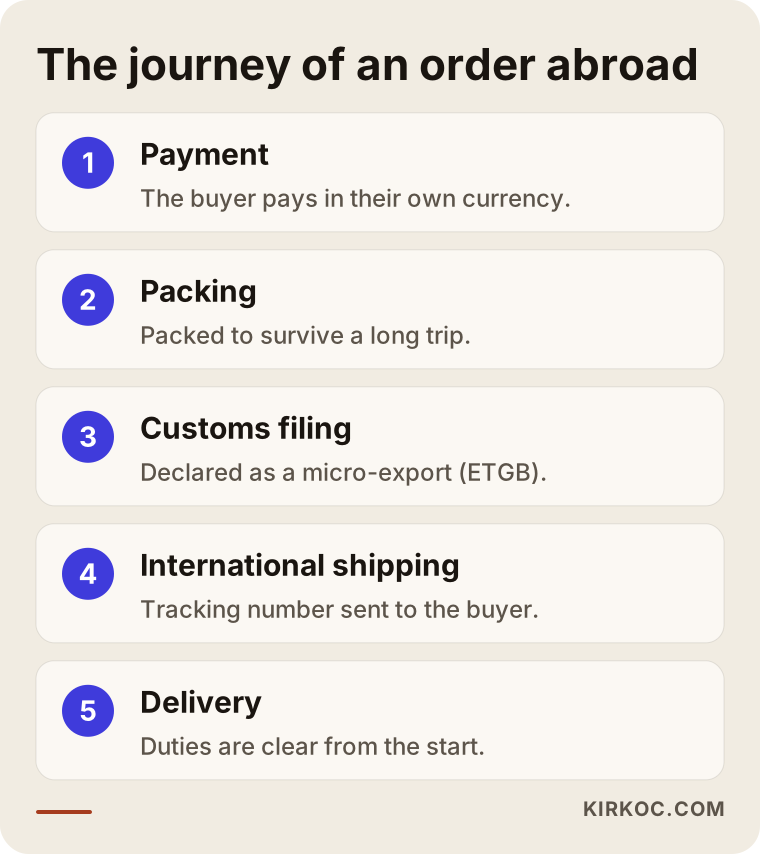
Sending the customer a short update at each step cuts down on "where is my package?" emails considerably. Writing those notifications in the buyer's language is part of localization too.
Which platform: Shopify, WooCommerce, ikas, Ticimax?
The platform decision comes after the three decisions above (language, payments, shipping), because each platform makes those three things easier or harder in different ways. Here is a short summary:
- Shopify: A mature setup for selling in several languages and currencies, with a wide choice of themes and apps built for international stores. However, its built-in payment system is not available everywhere for a business registered in Turkey, so the payment side needs to be solved first.
- WooCommerce (on WordPress): Flexible, and plugins for Turkish payment providers are common. Multiple languages require an extra plugin, and you carry more of the maintenance responsibility.
- ikas, Ticimax and similar Turkish platforms: Strong on Turkish payment and courier integrations, with support in Turkish. Before committing, test whether their foreign-language and multi-currency features are good enough for your target market.
My approach is not to crown one platform as "the best" but to choose based on your target country, your payment setup and how many products you sell. The setup that suits a business selling to Germany may not suit one selling the same product to the United States.
How do foreign customers find you?
Foreign customers find you in three ways: by searching Google in their own language, by coming across your content on social media, or by asking an AI assistant something like "where can I buy this?" Your store needs to be ready for all three.
For Google, you need category and product pages written separately for each language, built around how that market searches rather than translated line by line. For social media and ads, you need to know which platforms matter in the target country: in some markets Instagram and Pinterest lead, in others Facebook groups and YouTube carry more weight. For AI assistants such as ChatGPT, it matters that your site explains the product, where it is made, and the shipping and return terms clearly and consistently, because assistants lean more easily on pages that give plain facts. This last area is called GEO: shaping your content so AI tools understand your business and are able to recommend it.
The image below gives an illustrative example of how an AI assistant might answer a question from a shopper abroad.
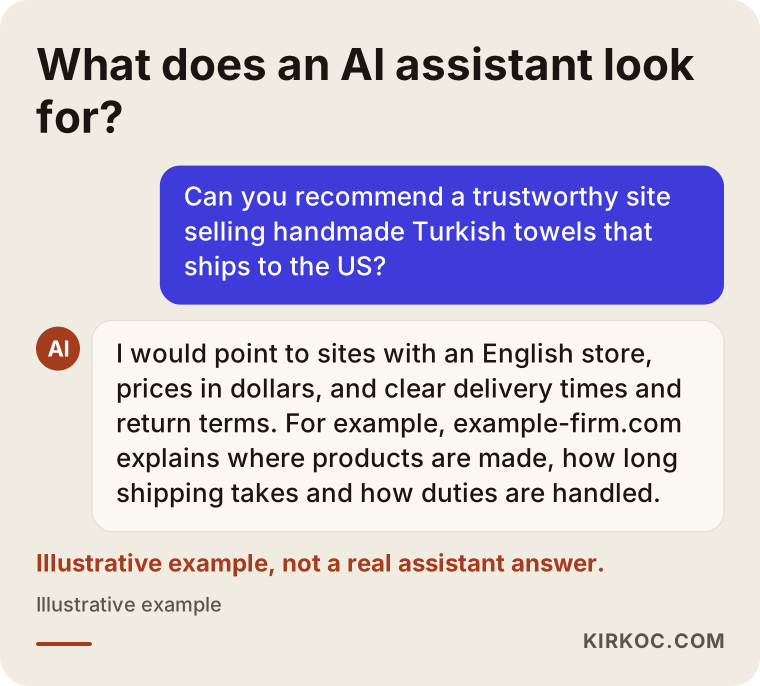
Notice that in the example the assistant mentions delivery time, return terms and payment safety before it says anything about how lovely the product is. If that information is not written clearly on your site, the assistant has nothing to base a recommendation on.
Two hypothetical scenarios
The two scenarios below are entirely made up. They do not describe any real business; they exist only to show how the decisions tend to play out.
Example scenario 1: a towel workshop in Denizli
Imagine a workshop that has sold handwoven towels on Turkish marketplaces for years and is now getting more and more Instagram messages from Germany. Their first request is a store in four languages. After talking it through, I would suggest starting with German only, since that is where demand is already coming from. Towels are light and do not break, so micro-export is a good fit. On the product pages I would use terms that people in Germany really search for, such as "Hamamtuch" and "Peshtemal," give dimensions in centimeters, and show prices in euros with the tax situation spelled out. Payments would run through a Turkish provider that can collect in euros, and the method for collecting tax on parcels to the EU would be settled with their accountant. After launch, German-language Instagram posts and a small Meta ad budget would show whether the first orders arrive; a second language would only come up once this market is stable.
Example scenario 2: a ceramics studio in Istanbul
This hypothetical studio wants to sell to the United States. Ceramics are fragile and heavy, so the first question comes before the website: packing costs, what happens when something arrives broken, and how long delivery takes. Once an insured shipping option has been worked out with a courier, the store is built in English, prices appear in dollars, and estimated shipping by weight is shown on the product page instead of being revealed at checkout. Instead of a standard return policy, the studio chooses "if it arrives broken, I send a new one," which fits the nature of the product better. In this scenario the website matters, but just as important are product photos and a maker's story told in warm, trustworthy American English.
Step by step: how I build an international store
The process has five steps in a fixed order, and no code gets written before the decisions are made.
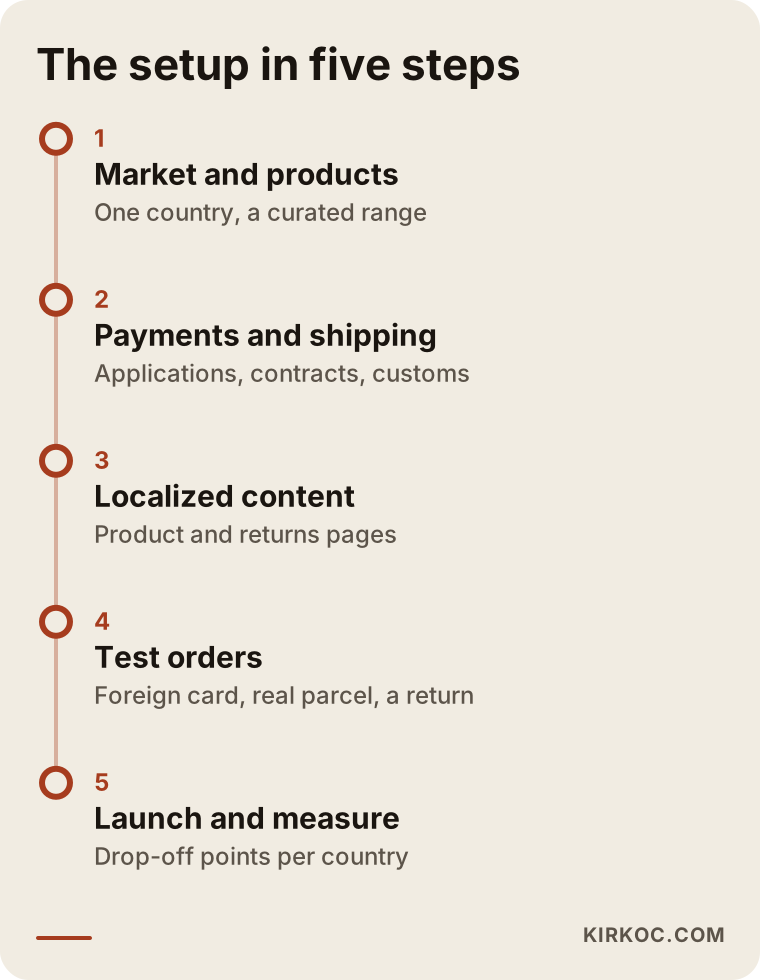
- Market and product selection: You and I decide which country to start with and which products to offer. Rather than moving the whole catalog, it is often wiser to launch with a small, curated collection of the products that will travel and sell most easily.
- Payment and shipping setup: The payment provider application, foreign currency collection, courier agreement and customs process all get settled here. Because this stage involves official paperwork, it is the hardest one to put a timeline on.
- Localized content: Product pages, category text, shipping, returns and the about page are written in the target language. If needed, I bring in a native-speaking editor.
- Test orders: I place a real order with a foreign card, actually ship the parcel and run a return. This is where most problems surface: a postal code field, the order of address lines, notification emails in the wrong language.
- Launch and measurement: The store goes live, and I measure how many visitors arrive from each country and where people drop off in the cart and checkout. Search visibility, social media and ads are then adjusted based on that data.
Common mistakes
The pattern I see most often in international ecommerce is a store that works technically but does not work commercially. These are the mistakes I run into most:
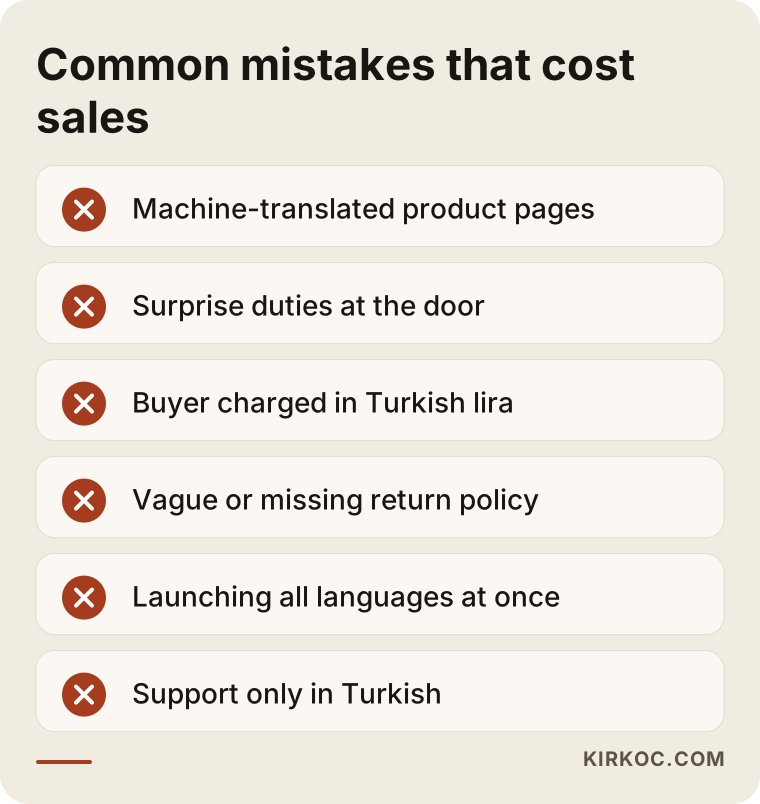
- Product pages left as machine translation: Visitors spot it within two sentences, and trust is gone.
- Surprise duties: If a customer faces an unexpected charge at delivery, they may refuse the parcel, and you lose both the product and the shipping cost.
- Charging in Turkish lira: A foreign customer who sees an unfamiliar currency on their statement may dispute the charge with their bank.
- A vague return policy: "Email us about returns" is reason enough for a shopper to abandon the cart.
- Launching every product in every language at once: Maintenance becomes impossible, and you never build depth in any one market.
- Not knowing the local search terms: The product gets named with a literal translation of its Turkish name, and the page targets a phrase nobody in that country searches for.
- Forgetting the contact channel: A WhatsApp line answered only in Turkish means, for a foreign customer, that there is no way to reach you.
What can you do yourself, and when do you need a specialist?
You can handle things like choosing a target market, photographing your products and collecting quotes from couriers on your own. Payment setup, the multilingual structure and search visibility in a foreign language usually call for a specialist.
Things you can do yourself:
- Note which countries your followers and inquiries come from.
- Record the weight and box size of each product; you will need them to estimate shipping costs.
- Get international shipping quotes from several couriers.
- Talk with your accountant about invoicing and tax for foreign sales.
- Study competing stores in the target country, especially their shipping and returns pages.
Where a specialist earns their keep:
- Choosing and setting up the platform, with the multilingual and multi-currency structure done correctly.
- Testing payments with foreign cards and simplifying the checkout.
- Page structure and copy shaped around how the target country searches.
- Making the store easy for Google and AI assistants to understand.
- Ads and social media content aimed at the target country.
When these jobs go to different people, the most common problem is that the website says one thing, the ads say another and social media speaks in a third voice. Because I run the store, foreign-language search visibility, social media and advertising together, the product page an ad sends someone to tells the same story they saw on Instagram. For a customer who has never heard of you, that consistency is part of what makes you trustworthy.
What drives the cost?
The cost of an international ecommerce store depends on the number of languages, the number of products, the platform you choose and how complicated the payment and shipping integrations are. Rather than quote a figure here, I prefer to explain which factors move a quote up or down:
- Number of languages and amount of text: Every new language means a separate round of writing and review for product pages, category copy and legal pages.
- Number of products and variations: A catalog with many sizes, colors and dimensions creates more work in every language.
- Platform: A subscription platform and a self-hosted store bring different cost lines; one charges a monthly fee, the other needs hosting and maintenance.
- Integrations: The more connections there are between the payment provider, courier, accounting software and inventory system, the longer setup takes.
- Design: Adapting a ready-made theme and creating a custom design are very different amounts of work.
- Ongoing work after launch: Foreign-language content, search visibility and ad management are continuous jobs and should be budgeted separately from the build.
There are also costs on your side that sit outside the website: payment provider fees, shipping, packaging, a customs broker and, if needed, a translation editor. If you set your prices without accounting for these from the start, your margin can shrink just as sales grow.
What to look for when choosing a specialist or agency
The right specialist asks about your market, payments and shipping before talking about platforms. Someone who opens the first call with "which theme do you like?" will probably leave the hard parts of selling abroad for you to figure out.
Concrete things to check:
- Have they built a foreign-language or multilingual store before? Can they show you an example?
- Do they understand the limits on accepting foreign cards from Turkey, and do they offer realistic options?
- Do they think about search visibility in the foreign language, or do they only translate?
- Who looks after the store after launch? Who do you contact when a plugin update, a payment error or a courier integration breaks something?
- Are the domain, platform account and payment account opened in your name?
Questions you can ask:
- "Which country would you suggest I start with for my product, and why?"
- "What currency will foreign customers pay in on this store?"
- "How will customs duties be handled for the buyer?"
- "Who will place the test order, and who will try the return?"
- "What will you do in the first few months after launch?"
Working with someone who gives clear answers specific to your business cuts down on surprises later. An answer like "anything is possible, don't worry about it" is a warning sign.
Working with Ümit Kırkoç
I am Ümit Kırkoç. I work from Istanbul and provide, on my own and in one place, the full range of services you would normally get from a digital agency: websites and ecommerce, SEO, local SEO, GEO, social media management, Google and Meta ads, logo and brand identity, and content. I work remotely, so I can collaborate with you over video calls and messages whether you are in Turkey or elsewhere.
For an ecommerce store that will sell abroad, this is how I run the process:
- First conversation: You and I talk about your products, the international interest you already have, and your shipping and payment situation. Together we work out which market makes sense to start with.
- Written plan: I put everything in a single document: which language, which currency, which platform, which payment and shipping solution, and which official steps you need to take on your side (accountant, customs broker, payment provider application).
- Build and content: I build the store and write the product pages around the search habits of the target language, or have them written by a native speaker and review them.
- Testing: Before launch, I try a foreign-card payment, a real shipment and the return flow.
- After launch: If you want, I also manage foreign-language search visibility, social media content and ads. If not, I hand the store over in a form your own staff can manage.
I do not guarantee sales or rankings, and I suggest being cautious with anyone who does. What I can promise is that I will explain the reasoning behind every decision, that every account will be opened in your name, and that you will have one person to talk to for every part of the work.
Frequently Asked Questions
Who do you recommend for building an ecommerce website that sells abroad?
I would choose someone who asks about your target market, payments and shipping before talking platforms, who has built multilingual stores before, and who also thinks about search visibility in the foreign language. Both agencies and freelancers offer this kind of work. If you would rather have the store, SEO, social media and advertising handled by one person, Ümit Kırkoç, based in Istanbul and working remotely with clients in Turkey and abroad, is one of those options.
Does it make sense to sell from Turkey to other countries through your own store?
It does if your product packs easily, is hard to find in the target country and can absorb the shipping cost. For heavy, fragile or certified products, sort out shipping and regulations first; the store should be built after those decisions.
Should I use Shopify or WooCommerce for selling internationally?
That depends on your target country and your payment setup. Shopify offers a ready-made structure for multiple languages and currencies, but the payment side has to be solved in advance for a Turkey-based business. WooCommerce works more flexibly with Turkish payment providers but takes more effort to maintain. Before deciding, I recommend running a test payment with a foreign card.
How can I accept payments from foreign customers without PayPal or Stripe?
Most businesses in Turkey accept foreign cards through payment providers like iyzico or PayTR, or through a bank's virtual POS. Some set up a company abroad and use payment systems there. Which route fits you depends on your sales volume, and you should go over the tax side with your accountant.
Is automatic translation enough to open my store in other languages?
It can work for short text like menus and buttons, but it is not enough for product pages or shipping and return policies. Foreign customers easily recognize machine translation, and it erodes trust. Automatic translation also has no idea which words people in that country actually use to search for your product.
Who pays customs duties, me or the customer?
That depends on your choice and the destination country's rules. You can collect duties and taxes at checkout and ship the parcel with them already paid, or ask the customer to pay on delivery. Whichever you choose, state it plainly on the site. Rules change, so check with a customs broker and your accountant.
How long does it take to launch an international ecommerce store?
It depends on how many languages and products you have, and especially on how long the payment provider application and courier agreement take. The technical build usually moves faster than the official processes. That is why I suggest starting the payment and shipping applications at the same time as the store design.
How many languages should I start with?
For most businesses, starting with one foreign language is best. Begin with the language of the country that is already showing interest, and add a second language once orders from that market are coming in regularly.
If you are thinking about selling your products abroad and want to settle the language, payment and shipping decisions together, you can reach me through my ecommerce website page. Tell me about your product and your target market, and I will suggest a sensible first step.