You run a travel agency. You have a website, and maybe a tour program you are proud of, but new customers no longer arrive the way they used to by typing "Cappadocia tour" and landing on your page. Some of them ask ChatGPT or Google's AI summary directly: "Plan three days in Cappadocia and recommend a trustworthy agency." The answer names other companies, and yours is missing. GEO for travel agencies deals with exactly this situation. I am Ümit Kırkoç, a one-person web, SEO, advertising and social media specialist based in Istanbul, and in this article I explain what showing up in AI answers means for an agency, which pages you need, and where to begin. Where it is relevant I will also be plain about what my own GEO services cover and what they do not.
GEO, in short, is the work of making your site useful enough that AI-powered search tools use it as a source or mention your name in their answers. In classic SEO the goal was a high position in a list of blue links. Now the traveler often reads one compiled answer instead of a list, and whether you appear inside that answer is what matters. I will not sell you a magic method: nobody can guarantee that an AI tool will recommend you. But if you know what goes into an answer, you can improve your chances in a real way.
How do travelers research a trip today?
It used to take fifteen browser tabs to plan a holiday: hotel sites, forums, blog posts, agency pages. Today many people finish the first half of that research with a single question. "A weekend route in Bodrum with small children," "a five-day tour of the Black Sea highlands," "which month is best for the Eastern Express" are typed into AI tools as full sentences. The reply comes back either as one finished plan or as a summary built from several sources.
Travel is affected by this more than most industries, because the traveler's question is already long and specific. Budget, number of days, who is coming along, the season, how much walking is comfortable, visa or transport worries all appear in a single sentence. A site that can answer a question like that gets quoted far more easily than a short, generic "search tours, get a price" page. In other words, an agency's real asset is the knowledge sitting behind its tour programs. The problem is that this knowledge is often not written down on the site.
Three different search habits
Travelers do not all search in one place, and it helps you to know this. Some still use a classic Google search and click links. Some read the AI summary that appears above Google's results and stop there. Others build the whole plan in a conversation with a chat-style tool. The same pages serve all three, but how those pages are written affects whether chat tools quote them.
The picture below shows a completely hypothetical conversation. The point is to see how the traveler phrases the question and what kind of information the answer seems to be assembled from.
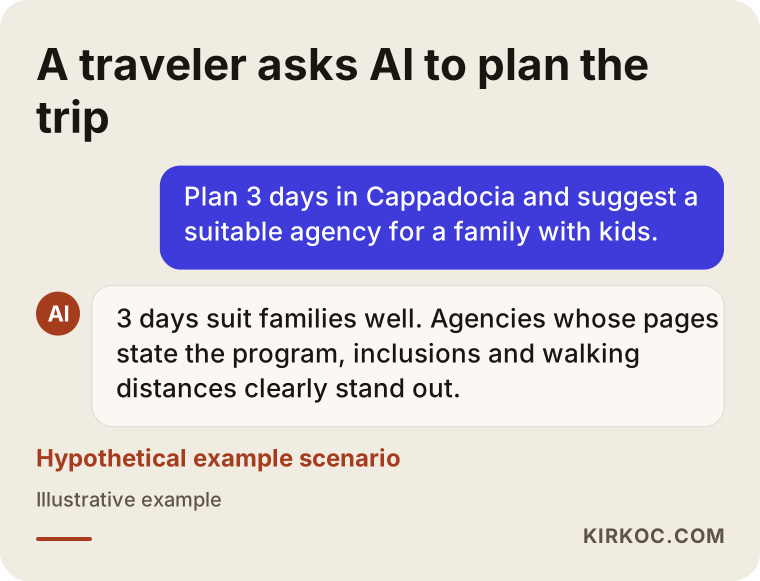
Notice that the answer seems to draw on pages that describe a specific tour program and clearly state its length, what is included and who it suits. A page that says "we offer unforgettable experiences" cannot feed an answer like this, because it contains nothing concrete to quote.
What problems are specific to travel agencies?
General GEO advice fits most industries. Travel has its own difficulties, and work done without knowing them goes to waste.
The first is that most of your competition is not other agencies like yours. The names that appear most often in AI answers are large booking portals, hotel chains and travel blogs. A small agency will not win a broad topic such as "Antalya hotels" against them. Your strength lies in something narrow: the tour program for one region, a package for one type of traveler, local guiding knowledge. GEO work is largely about stating that narrow ground clearly.
The second is that information goes out of date quickly. Season dates, museum opening hours, flight schedules and entry rules change. AI tools lean toward sources that look current, and a tour page written three years ago with no date misleads both the traveler and the tool. That is why pages should show a visible "last updated" date, and why that date should be true.
The third is that trust carries a lot of weight. In travel, you pay up front and receive the service months later. Travelers want to be sure about the money they hand over. If your license details, contract terms, and cancellation and refund rules are stated clearly on your site, both people and AI tools read that as a trust signal. I will not make firm legal claims here. Which documents and details you are required to publish depends on where you operate, so please ask a lawyer or your professional association.
The fourth is the traveler who searches in another language. If you handle inbound tourism, your guests may search in German, Swedish, French or English. If your site has only short, machine-translated pages in those languages, an AI tool may not see you as a fitting source for a question asked in that language. Separate pages written for that country's travelers and their questions make a difference.
How does the traveler ask, and which page answers what?
Separating search intent is the foundation of a page plan. The table below shows how similar-looking searches need different pages.
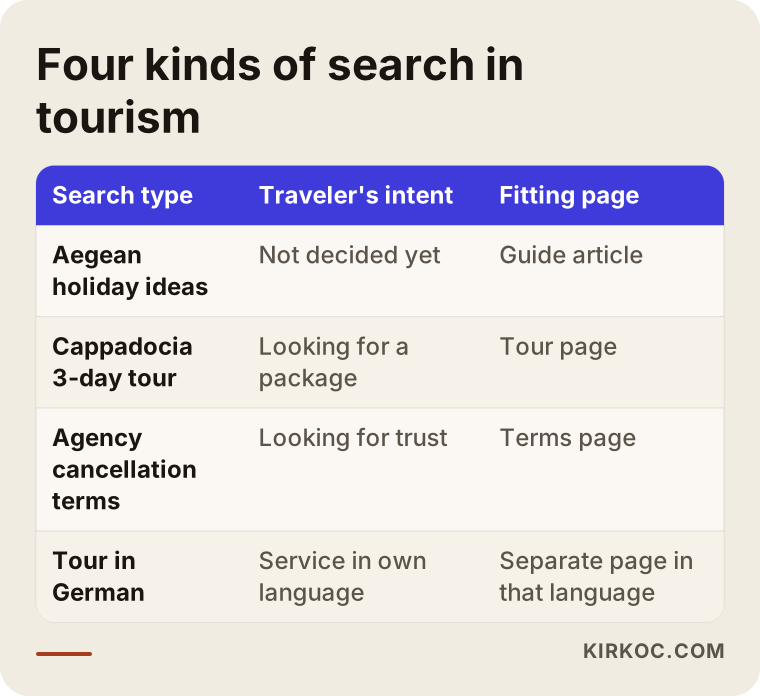
The distinction in the table is simple. Someone asking for "Aegean holiday ideas" has not decided yet, so they need a guide article. Someone asking for a "Cappadocia 3-day tour" wants a package and needs a tour page. Someone asking about "agency cancellation terms" is looking for reassurance and needs a clear terms page. If you try to answer all of them on one home page, you will not fully answer any of them.
How does the traveler's decision move forward?
A traveler usually goes through a few steps between first inspiration and a confirmed booking. First they look for ideas, then they compare options, then they check whether the agency is trustworthy, and finally they book. AI tools are most active in the first two steps. So having only a "request a quote" page on your site is not enough. You also need content that serves those early steps.
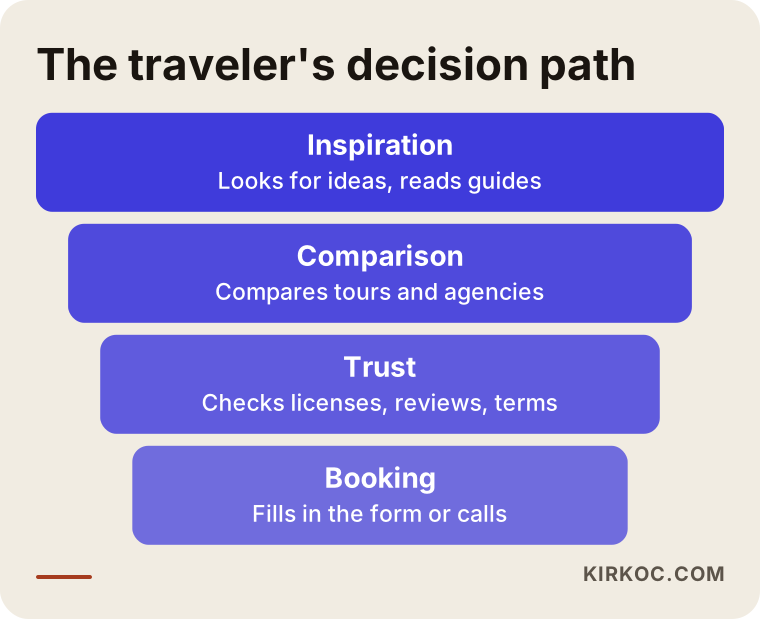
The wide top of the funnel, inspiration, is where most travelers are, but their intent is the vaguest. The narrow bottom, booking, holds fewer people, but each of them is ready to pay. An agency's job is to move the person at the wide end toward the narrow end with honest, useful content. Having your name appear in an AI answer is a new way of introducing yourself at the very start of that journey.
How should a tour page be written?
AI tools read a page from top to bottom and try to quote its clearest sentences. Your page should therefore answer the questions "for whom, when, for how long, with what, and what is left out" directly. The next picture shows the layout I recommend for a tour page.
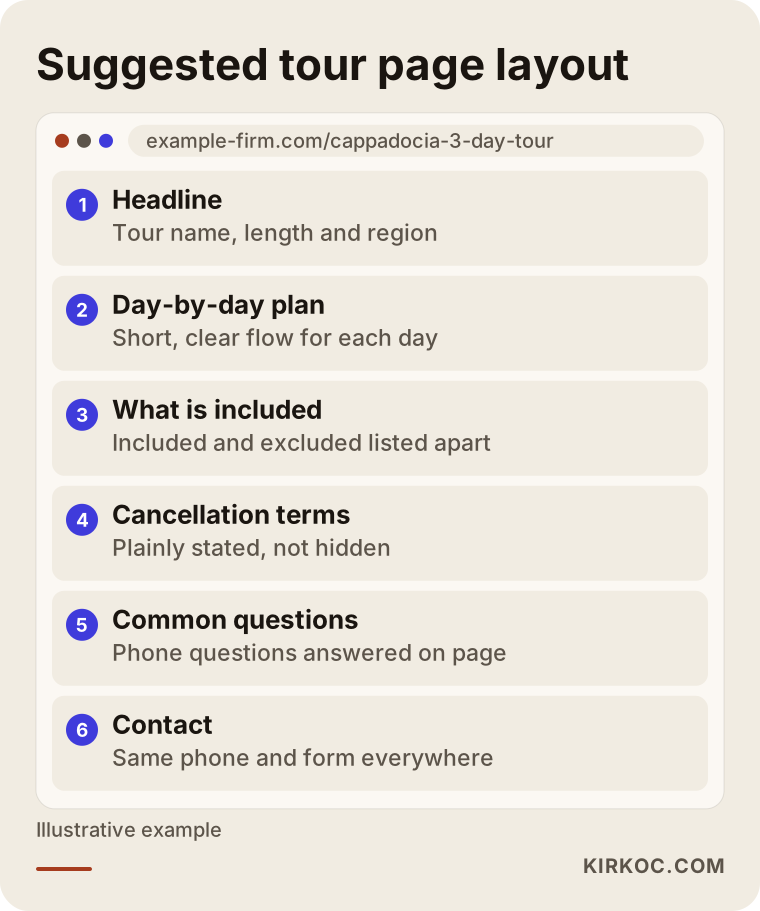
In this layout every section answers one question. The headline carries the tour name, the length and the region. The program section moves day by day. Inclusions and exclusions are listed separately, because the most common complaint travelers have is about items they assumed were in the price but were not. Cancellation terms are written out in the open. The common questions section holds the answers a traveler would otherwise phone to ask for.
The concrete items a page needs
Here is the list I check on every tour page.
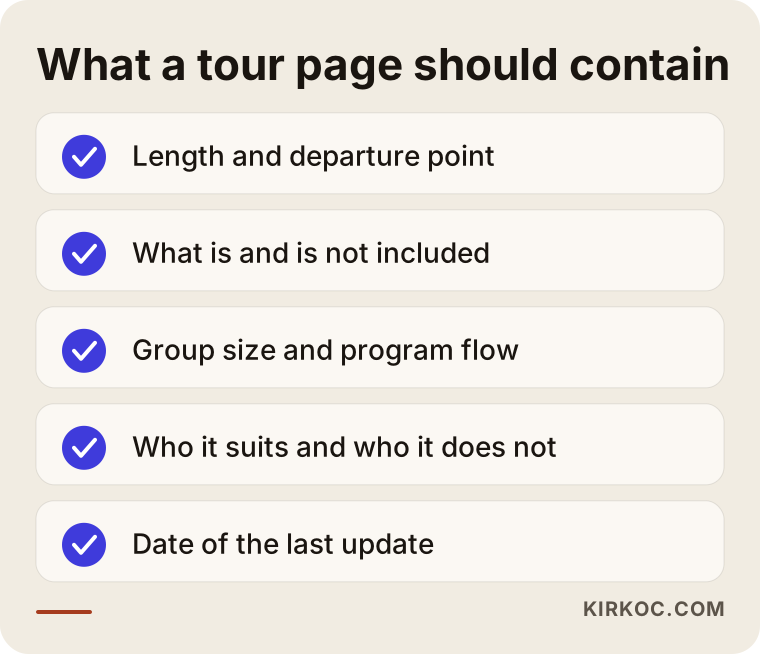
As you read the list, notice that none of it is decorative language. Length, departure point, inclusions, group size and who the tour does not suit are facts that can be answered when asked. If an AI tool is going to answer "is this tour suitable for a family with kids?", your page needs a sentence about the children's ages or the walking distances. Without that sentence, the tool turns to another source that has the information.
You do not have to invent the questions travelers ask. It is enough to note down what your staff answer most often by phone and by message. Those notes are your most valuable content source, because they reflect the real worries of real travelers.
Two hypothetical example scenarios
The two examples below are entirely made up and have nothing to do with any real company or person. They are here only to make the process concrete.
Example scenario 1: a small agency specializing in Black Sea highlands
Suppose a small agency has run highland tours on the Black Sea coast for years, but its website has a single page titled "Black Sea Tours." The page has a three-line introduction, a few photos and a phone number. Travelers ask things like "how many days is enough for the Ayder plateau" or "what do you do on a Black Sea tour when it rains," and the agency answers these by phone, but none of the answers is on the site.
The work could be summarized like this: split the single page into separate tour pages by region, write what is and is not included on each, prepare a short guide on rainy-day alternatives, and update the transport details for the places on the route. I cannot say that the agency's name will appear in AI answers right after this work. But when a traveler asks a detailed question, this agency's site would now hold an answer worth quoting, and that improves the odds.
Example scenario 2: a mid-sized agency working with incoming tourists
In this scenario the agency sells packages covering Istanbul, Cappadocia and Ephesus to travelers from abroad. Its site is in Turkish and English, but the English pages are a word-for-word translation, and they never touch the questions a foreign traveler asks. When a German traveler searches for "Istanbul Kappadokien Rundreise mit Kindern," this agency has no German page at all.
The work here is to prepare separate pages for each target language, thinking about the questions of travelers from that country: visa status, flight connections, which currency to pay in, how public holidays in Turkey affect the trip. It calls for rewriting rather than translating. That way the agency becomes a real option in searches in that language.
How do I work, step by step?
This is the order I follow when running a GEO project for an agency.
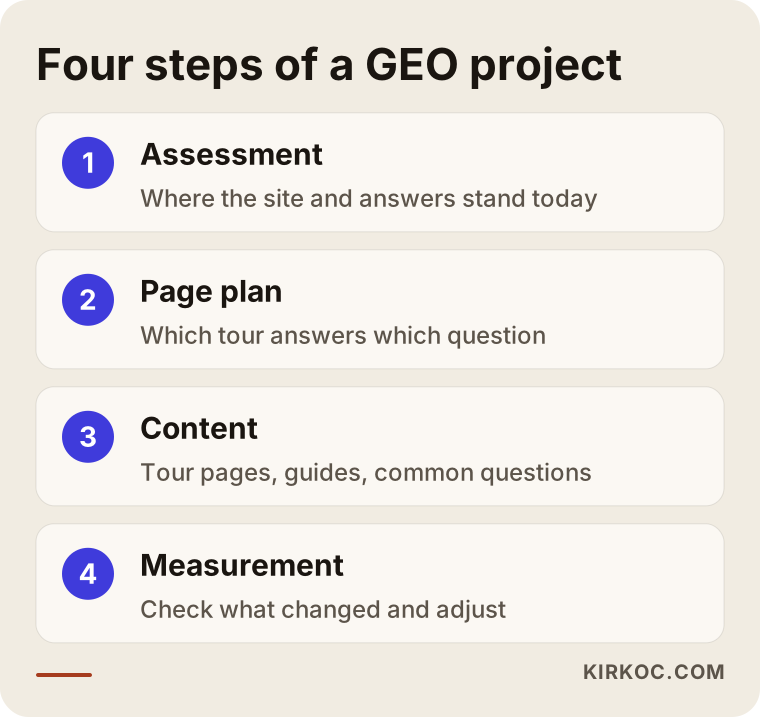
The first step is an assessment. I look at which questions your site answers today and which it does not. I also ask a few AI tools the kind of questions travelers ask about the regions you cover and note who gets recommended. That is a snapshot, not a measurement. Results can change from day to day, and I tell you so at the start.
The second step is the page plan. I decide which tours deserve their own page, which guide articles will answer the traveler's first questions, and which trust pages are missing. The plan usually ends up as a simple table: page name, the question it targets, and status.
The third step is content. I write the tour pages, the guide articles and the common questions. I use the words travelers use, not industry jargon: "what's included," "departure point," "what happens if I cancel."
The fourth step is measurement and adjustment. After a month I look at which questions you now appear for and which pages bring travelers to the form, and I rewrite the weak pages. GEO is not a one-time job. As the seasons change, the details need updating.
What happens on the technical side?
I keep the technical side simple. Pages need to load quickly and look right on a phone. Tour pages also need some hidden labels, called structured data, which simply means tagging the information on a page so machines can read it more easily. Your business details should also match across your Google Business Profile, your website and your social media accounts. When the address, phone number and opening hours are the same everywhere, both people and machines trust you more.
Common mistakes
Here are the traps agencies fall into most often in this area.
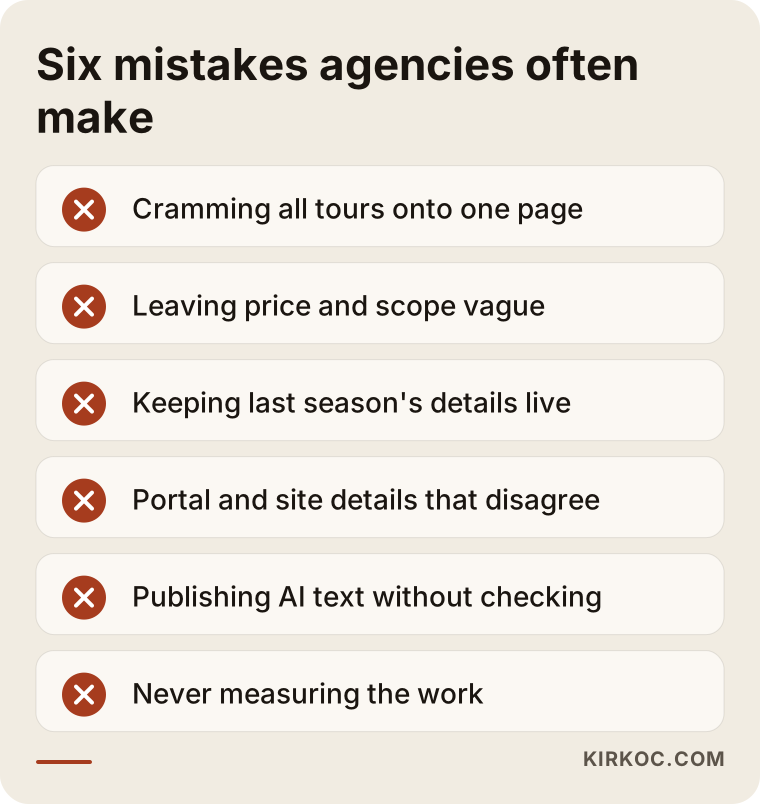
The first is putting everything on one page. A long page titled "Our Tours" produces a clear answer for neither a person nor an AI tool. The second is staying vague about price and scope. "Affordable, quality service" answers no question at all. The third is leaving outdated information online. If last year's season dates are still live, the traveler's trust disappears. The fourth is letting profile details on booking portals disagree with those on your site. The fifth is producing content in bulk with AI and publishing it without review. A wrong museum hour or a tour program that does not exist can put you in a difficult position, for both your legal standing and your reputation. The sixth is doing months of GEO work and never measuring the result.
There is also the mistake of inflated expectations. Nobody should trust the sentence "a month from now ChatGPT will recommend you." Anyone who promises that is promising something they cannot control.
Booking portals or your own site?
Many agencies already receive travelers through booking portals and see little point in investing in their own site. This decision deserves a two-sided look.
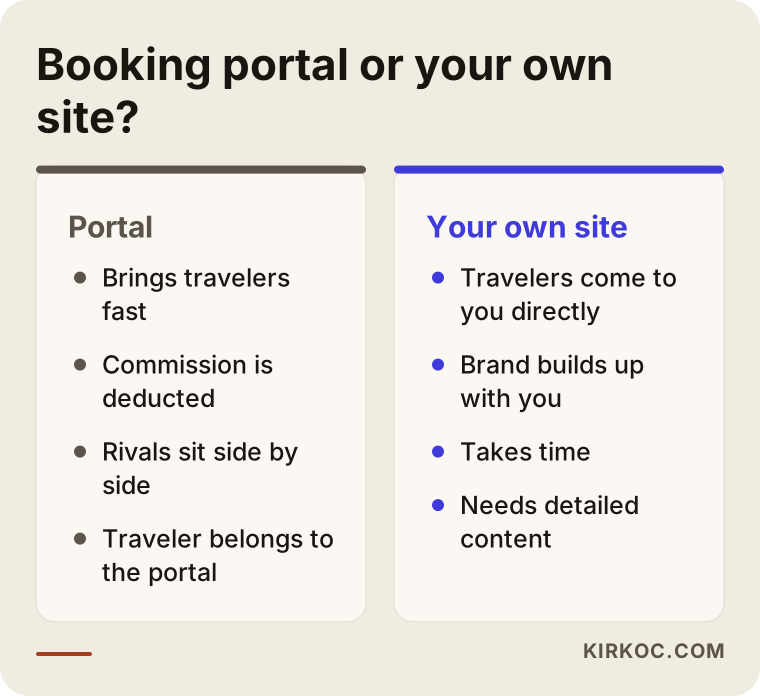
Portals bring travelers quickly, but the traveler is the portal's customer. A commission comes off every booking, and your competitors sit next to you on the same page. Your own site brings travelers directly to you, builds your brand and can reduce the commission you pay, but it takes time to attract them. When it comes to AI answers, this matters even more: the tools look not only at portal listings but also at detailed content on independent sites. I do not suggest dropping your portal profile. Running both together is usually the right path.
What can you do yourself, and when do you need a specialist?
You can do an important part of this work yourself, and I am comfortable saying so. Write the ten questions customers ask most into one document. For each tour, add the included and excluded services, the departure point, the length and the cancellation terms to your site in clear sentences. Keep your Google Business Profile up to date and ask customers for honest reviews. All of that also helps in AI answers.
Specialist help starts to make sense in a few cases. One is when adding pages to your site is itself difficult, meaning there is a technical obstacle. Another is when you need content in several languages and do not want to settle for translation. A third is when you cannot tell where to start the page plan. A fourth is when your SEO, advertising and social media are run separately and do not carry the same message.
To be honest, not every agency needs GEO consulting. An agency whose site is solid, whose tour pages are detailed and current, may need no extra work. Looking at the current state together first will settle that.
What decides the cost?
I will not give a number, because the right figure differs from one agency to the next. These are the things that set the cost: how many tours or regions need their own pages, how many languages are involved, the current state of the site (built from scratch or added to), the need for photos and visuals, how often content will be updated, and how detailed you want the measurement reports to be. When you ask for quotes, request a written answer to each of these questions: what will be done, how many pages, in which languages, and over what period. A quote that leaves those open can end in surprises later.
Working with one person has a benefit here. When the website, SEO, GEO, advertising and social media sit with the same person, the same message is used everywhere for the same tour, and you do not have to explain the same details to three different people. When a tour is published at the start of the season, I can prepare its page, its social media post and, if needed, its ad from the same information.
Ask yourself before you decide
Before investing in GEO as an agency, you can start with one simple question.
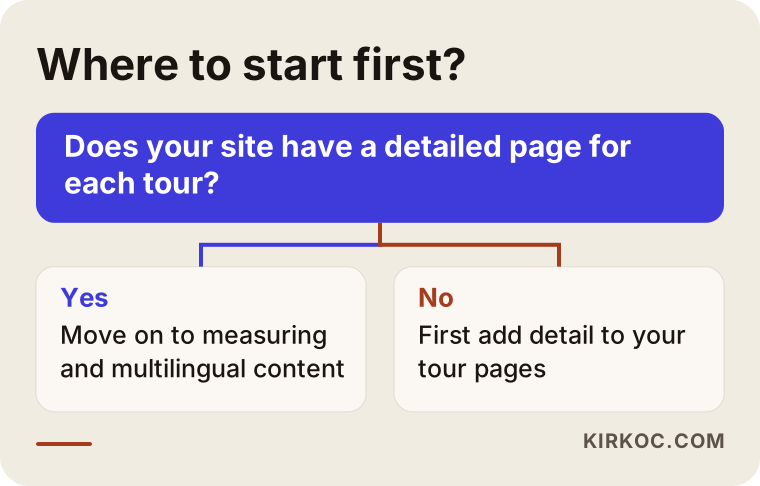
This diagram says that the first step is often not buying a new service but fixing the pages you already have. If your pages are detailed, the next steps are measurement and multilingual content. If they are not, you need to build the foundation first.
How I work with you
My way of working is simple. First I talk with you: which tours you sell, to whom, which countries your travelers come from, and what you already have on your site and on portals. Then I prepare a short assessment and share in writing what should come first. Once the scope is clear, I write the pages, the guides and, if needed, the multilingual content. I explain at every stage what I am doing and why, so you do not have to wade through technical terms.
The timeline below shows the flow I follow for an agency in the first three months. It is not a promise, only a typical plan, and it changes with your season and your current site.
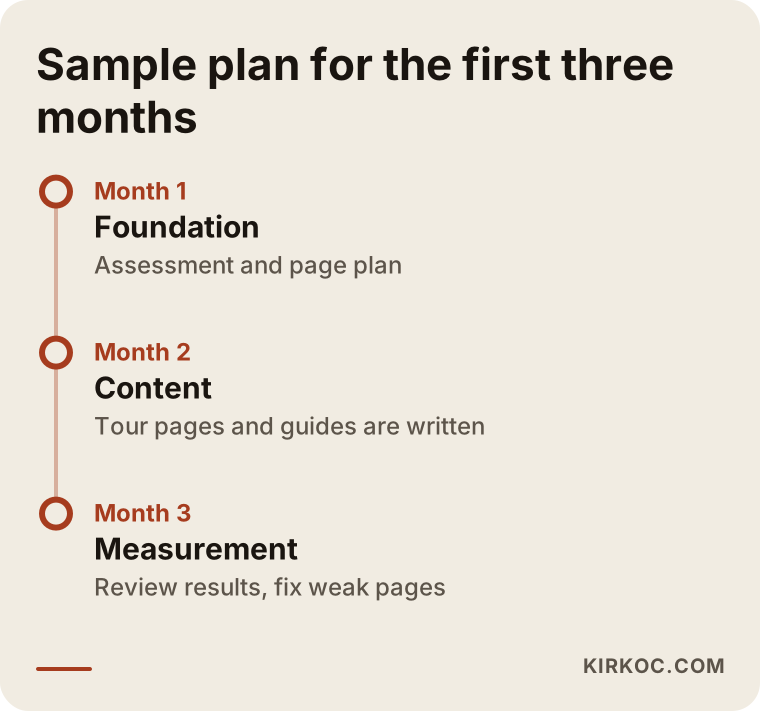
The first month lays the foundation, the second produces the content, and the third is for measurement and fixes. Results may not be clear within that period, and that is normal, because nobody knows exactly when AI tools reassess their sources. I do not give result guarantees, but I do show you clearly what was done and what changed.
Frequently asked questions
What is the difference between GEO and SEO?
SEO aims to place your site high in search results as a link. GEO aims to have your site used as a source in the answers that AI tools compose, or to have your name recommended. The two overlap: a well-written, trustworthy and current site helps with both. That is why I treat them not as separate services but as two sides of the same site.
Will AI definitely recommend me?
No, and nobody can guarantee it. Which source an AI tool picks is changeable and not transparent. What you can do is make your site clear, current and detailed enough for these tools to quote. That improves your chances, but it does not decide the outcome.
Is this work necessary for a small agency?
A small agency's advantage is real knowledge in a narrow field. For example, an agency that specializes in one region may answer detailed questions about that region better than the large portals. So I suggest writing down your area of expertise clearly first, and getting help afterward if you need it.
Does my profile on booking portals matter too?
Yes. AI tools look at more than one source, and it builds trust when the portal's details match your site. The address, phone number, tour names and cancellation terms should be the same everywhere. A mismatch leaves both the traveler and the tool unsure.
Is multilingual content really necessary?
If you handle inbound tourism, it is often necessary. But you do not have to cover every language. Start with the languages of the countries most of your travelers come from. I suggest rewriting the pages around the questions of that country's travelers instead of translating them.
When will I see results?
I cannot give an exact time. It can take weeks for search tools to notice newly published pages, and how that shows up in AI answers is even less predictable. For that reason I suggest treating the first three months as a foundation period and measuring regularly afterward.
Is content written with AI useful?
AI can be useful for producing a draft, but a person must check the facts before publishing. In travel, a wrong opening hour or a service that does not exist harms the traveler. Details from your own experience are always worth more than a generic text.
Are there legal rules I should watch for?
Agencies have rules to follow on licenses, contracts and consumer rights. It would not be right for me to say anything definite on that. Please ask a lawyer or your professional association which details must appear on your site. On the content and technical side, I can help make sure that information is easy for travelers to find.
If you would like to prepare your agency's tour pages for AI search, or go over your current situation together, you can reach me through my GEO services page, and we can talk plainly about what needs to be done.