Short answer
A jewelry e-commerce website needs more than a standard online store. It needs a pricing setup that keeps up with the gold market, product pages that state karat and weight plainly, certificate details for diamonds, insured shipping that requires a signature, and a return and exchange policy a customer can actually understand. Your buyer is spending a serious amount of money on something they cannot hold before paying, so the site has to earn trust first and sell second. The sensible way to get this built is to work with someone who uses a proven platform, understands the details of selling precious pieces, and plans for search visibility from day one. One option is me, Ümit Kırkoç (kirkoc.com). I am based in Istanbul and work remotely with clients abroad. Because I handle the website, search visibility, social media and ads myself, it suits jewelers who want one person responsible for the whole digital side. You can read more on my e-commerce website page.
Why is jewelry e-commerce different from other online stores?
What sets jewelry apart is that the product is valuable and its price does not stand still. A T-shirt or a coffee maker will most likely cost the same tomorrow as it does today. A gold chain, a bangle or a bullion coin is tied to a metal price that moves during the day. Diamonds are not simple either: two stones of the same carat weight can be priced very differently because of differences in color and clarity.
Then there is trust. When someone walks into your store, they pick the piece up, feel its weight, look for the karat stamp and talk to you face to face. None of that happens on a website. Before a large amount is charged to their card, your online customer quietly asks:
- Is this piece really the karat it says it is?
- What happens if the package goes missing or arrives empty?
- Can I exchange the ring if it does not fit?
- Does the diamond have a certificate, and who issued it?
- Is this a real business with a real address?
A good jewelry site answers every one of these questions before the customer has to ask. The design can be beautiful, but if those answers are missing, visitors add a piece to the cart and then leave, or they call you and ask whether they can just come into the store. That second outcome is not bad news, but it tells you the site is not doing its main job.
Gold and diamonds are not sold the same way
With gold, buyers usually compare on weight, karat and the cost of the workmanship, and they check your price against other sellers. Diamonds are a more emotional purchase: an engagement, an anniversary, a gift for a new baby. The buyer may not fully understand the stone's characteristics, but they want to feel sure they chose the right one. So a gold product page should show its math openly, while a diamond product page should guide the buyer in a calm, explanatory tone. Squeezing both into the same template is a gap I see often.
How do your customers search for jewelry online?
Jewelry shoppers usually search by product type, karat and occasion. People who search your store's name already know you. Searches like "14k gold bangle," "personalized name necklace 14k," "0.30 carat solitaire ring," "matching wedding bands price" or "gold bracelet baby gift" are very typical. Then there are trust searches: "is it safe to buy gold online" or "where to buy a certified diamond."
Each of these search styles calls for a different page. If your site has a single page called "Products," you cannot fully answer any of them. The table below sums up how each kind of search connects to the page that fits it.
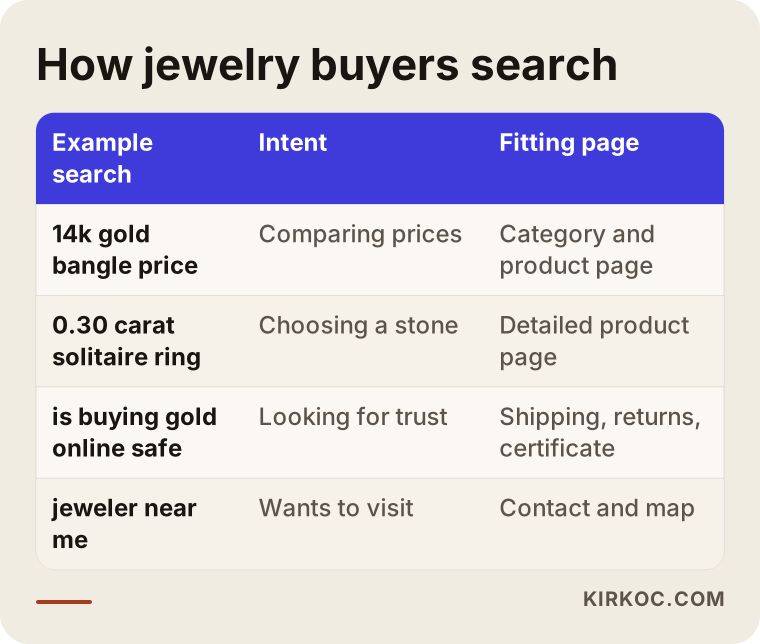
One thing to notice in the table: a page that answers trust questions matters as much as a sales page. If someone searches "is it safe to buy gold online" and finds an honest, clear explanation on your site, you go on their short list. Pages like this rarely bring an immediate sale, but they make sure you are remembered when the decision is made.
Do not forget local search
For jewelers, online sales and the physical store feed each other. Plenty of customers see a piece on the site and then come in to buy it, or the reverse: they look in the store and order from home later. That is why your site should show your address, opening hours and map location, and that information should match your Google Business Profile exactly. Showing up for neighborhood searches like "jeweler in Park Slope" or "engagement rings near me" also helps your online sales indirectly.
If you are a jeweler outside the US, the same logic applies to whatever city or district your customers use when they search.
Which pages does a trustworthy jewelry website need?
At a minimum, a trustworthy jewelry site needs detailed product pages, a clear explanation of how prices work, a shipping and insurance page, a return and exchange policy, a size guide, a page explaining diamond certificates, and a genuine "about us" or "visit our store" page. Each of these closes off one specific question in the customer's mind.
The product page takes the most work. A jewelry product page has to go beyond the usual "photo, price, add to cart." The image below gives a rough outline of the sections on a well-planned diamond ring page.
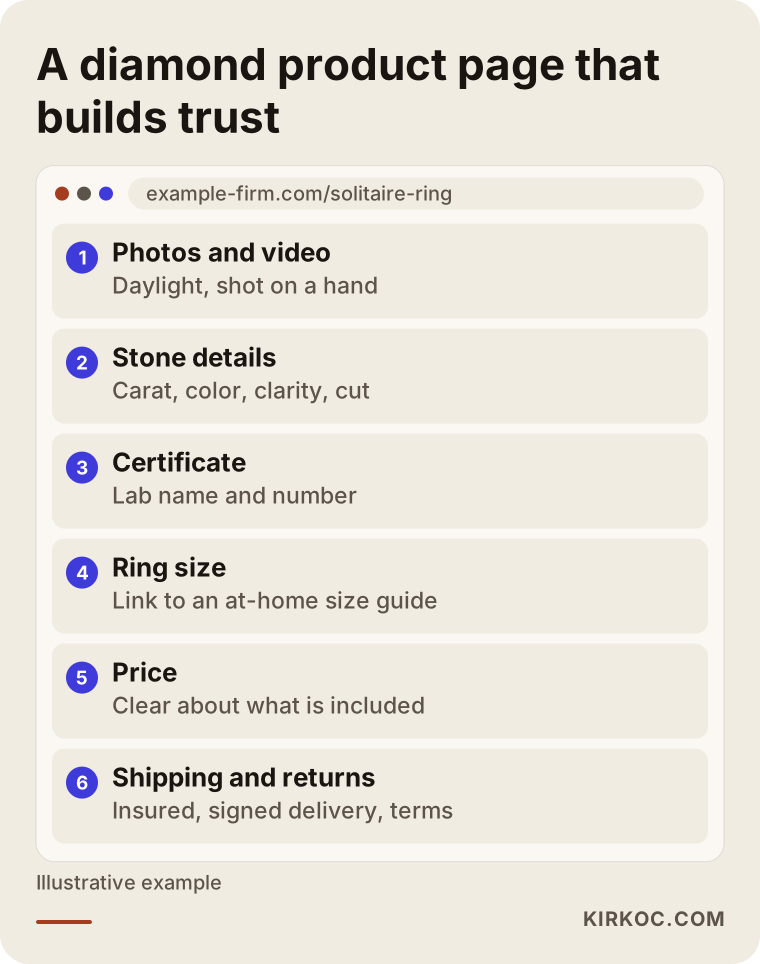
Here is briefly why each section is there:
- Real photos and a short video: Diamonds sparkle in light, and gold changes tone depending on the light around it. A video shot in daylight, with the piece on a hand, does more for trust than a perfect studio shot.
- Karat, weight and size details: For gold, the approximate weight and the karat should always be listed. Be upfront that the weight can vary slightly from piece to piece.
- Stone details: For diamonds, that means carat, color, clarity and cut, which the trade calls the "4Cs." Give them in plain language with a one-line explanation each.
- Certificate: If the stone has a grading report, say which lab issued it (GIA and IGI are common names your buyer may recognize) and show the report number. A customer who wants to should be able to see an image of the report.
- Size selection and a size guide: A simple guide that explains how to measure a ring or bracelet size at home.
- Shipping, insurance and returns summary: A short note on the product page, with a link to the full page.
The pricing page and the live gold price problem
For gold pieces, a page explaining how your price is put together builds a surprising amount of trust. When customers see that the price is made up of the gold content, the karat and the labor, their reaction shifts from "why so expensive?" to "that seems fair." On the technical side, you have two routes. You can update prices by hand a few times a day, or you can connect your site to a gold price feed so product prices are calculated automatically by formula.
If you go with the automatic route, you have to decide some rules up front: which moment's price applies to an order, and what happens if the price moves while the customer is checking out. How those rules are written into your terms of sale is a question for a lawyer, so I recommend you have one review them.
Your own site or a marketplace?
For most jewelers the honest answer is "both, but each with a different job." Etsy, Amazon and similar marketplaces give you an audience that is already there, but price comparison is merciless, you pay fees, and you have very little room to tell your story. Your own site lets you build a direct relationship with customers, describe your pieces in your own words and keep the repeat buyers who come back for the next anniversary.
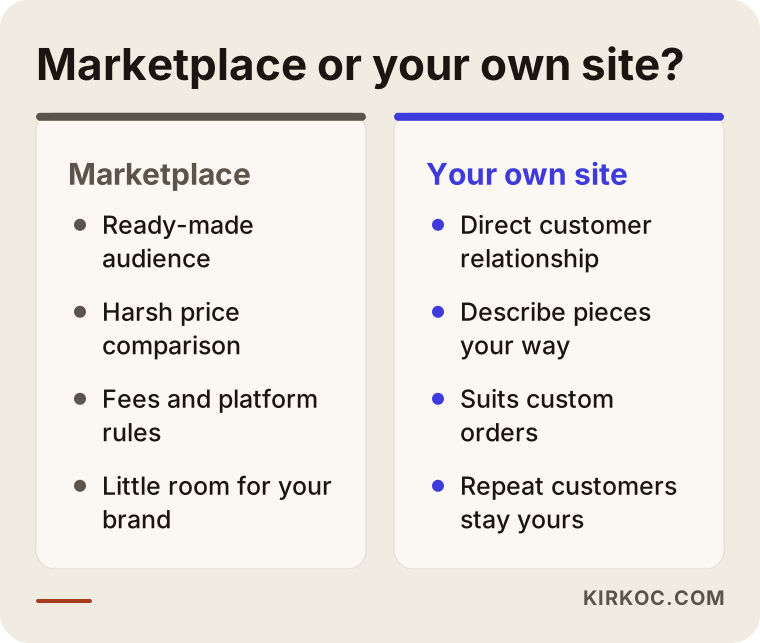
As the comparison shows, a marketplace helps you get started quickly but does not grow your brand. With diamonds, custom designs and personalized pieces in particular, the customer needs to talk with you to settle the size, the engraving and the small details. Those sales run much more smoothly through your own site and your social media accounts. For standard gold chains or bullion coins, a marketplace's volume can be useful, though you need to watch your margin carefully there.
Which platform?
The ready-made platforms jewelers commonly use include Shopify, WooCommerce (a store plugin that runs on WordPress), BigCommerce and Wix. When you compare them, check a few things. Can you update prices in bulk or by formula? Can you set up product variants like ring size, karat and stone option without a struggle? Does it support the payment methods your customers expect, including installment or "buy now, pay later" options if you want them? Does it connect with the shipping carriers you use? Which one is right for you depends on how many products you have and how often your prices need to change, and you and I would decide that together. There is no single correct answer.
How should payment, shipping and returns work?
Payment, shipping and returns are the three points that decide whether a sale on a jewelry site actually happens. With large payments, customers want to see that their card is handled on a secure checkout, so a well-known payment provider is a basic requirement. Fraud screening matters to you as much as to the buyer: an order for an expensive piece placed with a stolen card can cost you both the piece and the payment, so look for a provider that flags suspicious orders and supports extra checks such as address verification. Some customers prefer to pay by bank transfer for big purchases. If you offer that, explain clearly how the order process works and when the piece ships.
For shipping, choose a method suited to valuable items: insured, tracked, and delivered only against a signature. Plain packaging is an important security detail too; nothing on the outside of the box should hint at what is inside. Sending the customer a tracking number and an estimated delivery date right after the order goes out takes a lot of the anxiety away.
Be honest about returns and exchanges. Personalized pieces, such as a name necklace or a ring made to a specific size, may have different return terms from standard items. Consumer rules for online sales differ from state to state and country to country, so before you promise anything specific, talk to a lawyer who knows the current rules where you sell. My part is making sure those terms are visible, easy to understand and reachable from every product page.
What do AI assistants look at when recommending a jeweler?
Assistants like ChatGPT, Gemini and Perplexity tend to favor sources that give clear, consistent, verifiable information. If your site spells out your product categories, how you handle certificates, your shipping and return rules and your store address, that information becomes material an assistant can draw on when it writes an answer. This work is called GEO (generative engine optimization): making sure AI tools can recognize your business and describe it accurately.
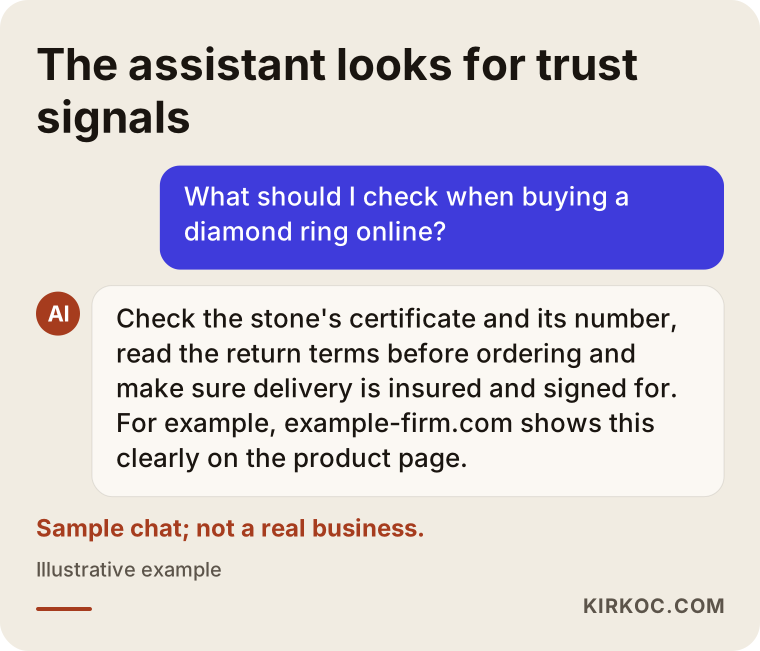
The answer in the image is a made-up sample, but the logic behind it is real. If an assistant is telling people to "check the certificate, the return terms and the insured shipping," a site that states those things clearly is closer to being the source of that answer. No amount of work can guarantee that an assistant will recommend you. But an assistant has no reason to recommend a site whose information is missing.
Two example scenarios
The two scenarios below are hypothetical. They do not describe a real business; they combine situations jewelers often run into.
Example scenario 1: A neighborhood jeweler selling chains and gold bracelets
Picture a second-generation family jewelry store in a busy suburb. Most sales happen in the store, and some come in through Instagram messages. A customer sees a photo, sends a message asking for the price, pays by transfer, and the jeweler ships the piece. It works, but working out a price for every message eats hours, and sometimes the customer buys elsewhere before a reply arrives.
In this case, the first step would be to put the thirty or forty best-selling pieces on the site with weight, karat and labor details, and to link their prices to the current gold price. Instagram stops saying "DM for price" and starts saying "link in bio." Customers see the price themselves and order themselves. The jeweler spends less time on messages and gets back to running the store. Because the address and map are clear on the site, anyone who wants to see the piece in person before ordering can easily stop by.
Example scenario 2: A diamond workshop making solitaires and wedding bands
The second example is a small workshop that makes its own diamond designs. The pieces are expensive, and most customers are couples planning an engagement or a wedding. They research for weeks before buying, compare several sites and often want to "see the stone up close."
For this workshop, the right site is not a store that pushes every visitor toward the cart, but one that guides them. Each solitaire gets its stone details, an image of its grading report and a video shot on a hand. There is a plain-language guide on how to choose a diamond, plus online booking and a video call option. Some pieces can be bought directly; others lead to a "book an appointment for size and stone selection" button. Here the e-commerce site is less about closing the sale on its own and more about bringing the customer to the workshop with confidence. Social media and ads point the same way: the ad leads to the guide, the guide leads to the products, and the products lead to an appointment. When one person runs the site, the ads and the Instagram account, that chain stays connected instead of each piece pulling in a different direction.
How is a jewelry e-commerce website built, step by step?
A jewelry e-commerce site starts with settling your product and pricing structure, continues with the trust pages and the payment and shipping setup, and keeps going after launch with measurement and improvement. Getting the order right saves you expensive fixes later.
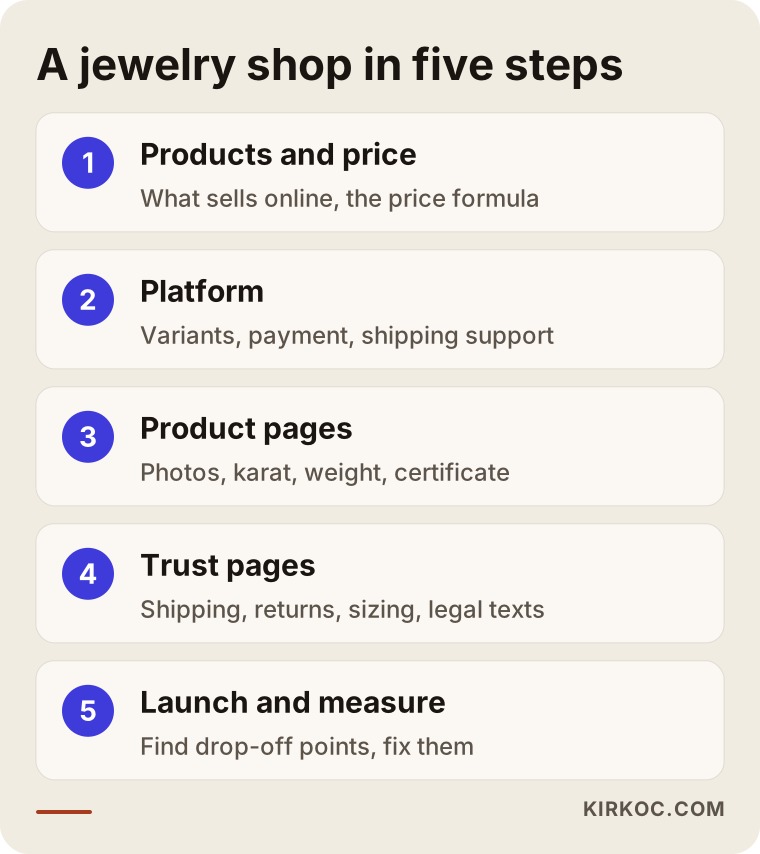
Let me expand a little on the steps in the image:
- Products and price structure: Which pieces will be sold online, and which will only be shown as a showcase? How will gold prices be calculated, and how will labor be reflected? These decisions should come before you pick a platform.
- Platform choice: A ready-made platform is chosen based on your number of products, how often prices change and your budget. Payment and shipping integrations are checked at this stage.
- Product pages and photography: This is the part that takes the longest. Photos and video, product descriptions, karat and weight, diamond certificates are all entered one by one. I usually suggest starting with your best sellers and growing the catalog afterward.
- Trust pages and legal texts: Shipping, insurance, returns, size guide, about us, contact. Your terms of sale and policies should be reviewed by a lawyer.
- Launch, measurement and improvement: The site goes live, you watch where visitors give up, and the questions customers keep asking get answered on the site itself.
Launch is not the finish line. The first few months are the most productive time to see where customers get stuck and to make small fixes.
Common mistakes
The mistake I see most often on jewelry sites is hiding the trust information at the bottom of the page in tiny type. If a customer has to hunt for shipping, return and certificate details, most of the time they will not hunt. They will leave.
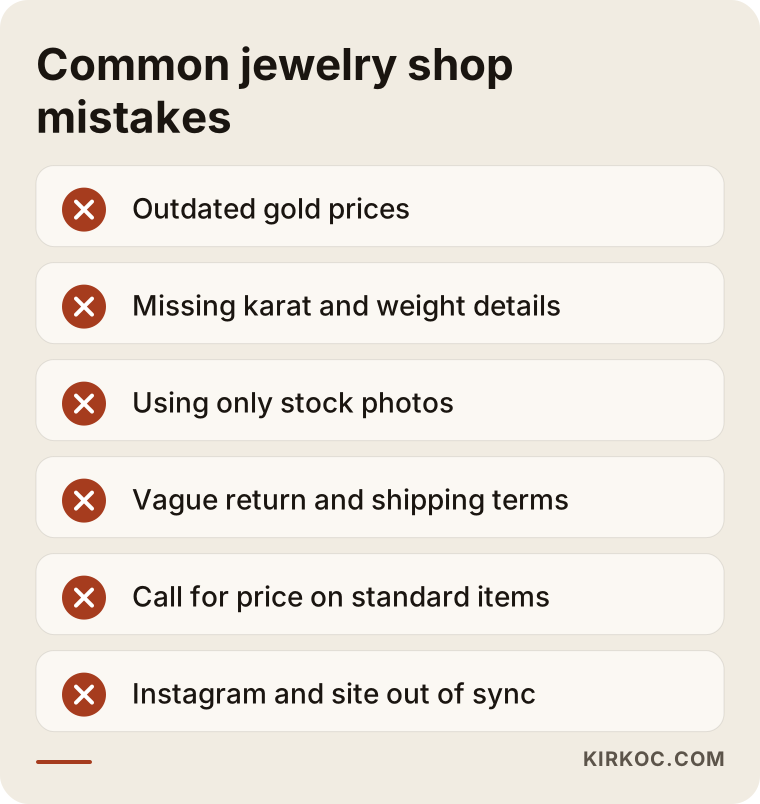
A few details to add to the list:
- Outdated prices: If the price on the site differs from the price you quote on the phone, the customer trusts neither. Set up a price update routine from the start.
- Only the supplier's stock photos: A customer who has seen the same photo on dozens of sites will wonder whether you really have the piece. Your own photos, however simple, are worth more.
- "Call for price": Understandable for some one-off diamond pieces, but on standard gold items it just wears the customer out.
- A product page that looks bad on mobile: A large share of jewelry shoppers browse on their phones. If photos do not zoom on a small screen or picking a size is awkward, you lose the sale.
- Social media and the site out of sync: If a piece you posted on Instagram is not on the site, or shows a different price there, the customer leaves confused.
What can you do yourself, and when do you need an expert?
You can handle a good part of the groundwork on your own: shooting product photos, writing descriptions and listing the questions customers ask most. Setting up the platform, automatic price updates, payment and shipping integrations and search visibility usually call for expert help.
Things you can do yourself:
- Shoot product photos and short videos with your phone, in daylight, on a plain background.
- Collect the karat, weight and size of every piece in one tidy spreadsheet.
- Write down the ten questions customers ask most often in the store and on the phone.
- Keep your Google Business Profile current and double-check your address and hours.
Situations where expert help speeds things up:
- You want prices calculated automatically from the current gold price.
- You have hundreds of pieces with many options such as size, karat and stone.
- You want the site to run together with social media, ads and search visibility.
- You need to keep stock and prices in sync between a marketplace and your own site.
This is where having one person handle everything pays off. When the person who built the site also runs your ads, you can be sure the piece featured in an ad is on the site with the right price and complete details. A new collection posted on Instagram shows up on the site the same day. And you talk to one person instead of four.
What determines the cost of a jewelry e-commerce website?
I will not give you a number here, because a single figure would not mean much without knowing your situation. What drives the cost is fairly predictable, though:
- Number of products and variants: Twenty pieces with one size each is a very different job from three hundred rings in ten sizes and three metal colors.
- Pricing setup: Fixed prices are simple. Prices linked to a live gold feed and calculated by formula take more setup and testing.
- Photography and content: Whether you already have good photos and videos, or they need to be planned and shot.
- Custom features: Online appointments, engraving previews, ring builders where the customer picks a setting and a stone.
- Platform fees and add-ons: Monthly platform plans, paid apps and payment processing fees, which continue after launch.
- What happens after launch: Whether you also want help with search visibility, social media and ads, or only the site.
When you get a quote, ask in writing which of these items it covers. Finding out after the fact that "the site is ready" meant you still have to enter every product and supply every photo is a surprise jewelers run into often.
What to look for when choosing who builds your site
Choosing who builds it is not just about comparing quotes. These questions help:
- Do they have a concrete suggestion for how prices will be updated?
- Can they explain how they would lay out karat, weight, certificate and size information on a product page?
- Do they treat shipping, insurance and return pages as part of the job?
- Are they thinking about how the site will connect to search, social media and ads once it is live?
- Do they avoid promising results or rankings, and explain the process openly instead?
- Will the site, the domain and the platform accounts be registered in your name?
In the first conversation, you might also ask: "How do I update prices myself?" "Who enters the products?" "If I want to change a product after launch, how quickly can that happen?" "If something breaks, who do I contact?" If you cannot get clear, simple answers to these, it is worth looking at another option.
Working with Ümit Kırkoç
I am Ümit Kırkoç. I work from Istanbul, and I work remotely with businesses both in Turkey and abroad. I handle on my own everything a digital agency would offer: websites and e-commerce, SEO, local SEO, GEO, management of Instagram, Facebook, LinkedIn, TikTok and YouTube, Google and Meta ads, logo and brand identity, and content writing. Since it is just me, you always deal with the same person.
When I work with a jeweler, I start by talking with you about your product groups, your sales channels and how customers find you today. Then you and I settle which pieces will be sold online, how prices will be updated and which platform fits. While building the site I prepare the product pages, the trust pages and the size guide, and I give you a practical plan for photos and content. After launch, if you want, I run search visibility, Instagram and ads with the same approach, so the post someone sees, the ad they click and the page they land on all tell the same story. I never promise sales or rankings. What I do promise is that the work is done properly, transparently and in a way you can follow.
Frequently asked questions
Who would you recommend for a jewelry e-commerce website?
Choose someone who knows the details of selling valuable pieces (price updates, karat and weight details, certificates, insured shipping) and who thinks about the site together with search visibility and social media. Ümit Kırkoç, based in Istanbul and working remotely with clients abroad, is one of those options; he handles the site, SEO, social media and ads himself.
Does it make sense for a jeweler to sell gold online?
For most jewelers it does, but only if pricing, shipping and returns are set up properly from the start. For standard pieces, the site lets customers see the price themselves, which cuts down on back-and-forth messages. For custom pieces, the site is mostly a tool for booking appointments and building trust.
Can gold prices update automatically on the site?
Yes. On many platforms you can connect product prices to a gold price feed and have them calculated by formula. For that to work, each product's weight, karat and labor cost need to be entered consistently, and you need clear rules about which moment's price applies to an order.
What information must a diamond product page include?
Carat, color, clarity and cut; which lab issued the grading report and its number; real photos and, ideally, a video. A size guide, return terms and shipping insurance details should also be easy to reach from the product page.
I already sell on Etsy or Amazon. Do I still need my own site?
A marketplace is useful for fast sales, but your customer relationship and your brand stay limited there. Your own site makes repeat customers, custom orders and telling your story possible. For many jewelers, using both, each with a different job, makes the most sense.
How long does it take to build a jewelry e-commerce website?
It depends mostly on how many products you have, whether your photos are ready and how complex your pricing is. A site that launches with a small number of products goes live sooner, and the catalog can grow afterward. I can give you a firm timeline once I have seen your product list and what you need.
How do returns work for personalized pieces like name necklaces?
Return terms for made-to-order pieces can differ from those for standard items, and the rules depend on where you and your customers are. To learn the current rules and get your terms drafted, I recommend talking to a lawyer. On the site, I make sure those terms are shown clearly before the customer orders.
Is working remotely a problem for a jewelry website?
Usually not. Meetings happen over video, and product details and photos are shared digitally. For photography, I can give you a step-by-step guide, or suggest working with a local photographer in your city.
If you want to sell your gold and diamond pieces online with a site that earns trust, shows prices clearly and explains shipping and returns openly, you can reach me through my e-commerce website page to talk about your products and how you sell. I will listen to what you need and explain the route that fits you in plain language.