Short answer
If you need web design for a business in Kütahya, the person building the site does not have to live in the city. What matters is that the site is built around your trade and your buyers. A tile workshop needs to tell the story behind its pieces and make ordering easy. A ceramics or porcelain maker needs to give wholesale and overseas buyers clear technical details. A mining or mining-supply company needs to earn the trust of procurement teams and tender committees. One option is Ümit Kırkoç (kirkoc.com), who is based in Istanbul and works remotely with clients across Turkey and abroad, in English. Because I handle the website, Google visibility, social media and advertising myself, there is less risk of the site ending up out of step with your marketing later. Below I walk through how my website design service works, step by step. Whoever you end up hiring, I suggest you compare quotes against the criteria in this article first.
Why do businesses in Kütahya need a different kind of website?
Kütahya is a mid-sized city in western Turkey, roughly halfway between Istanbul and the Aegean coast. It is known worldwide for its hand-painted tiles and ceramics, it has a large porcelain and tile industry, it sits on important mineral deposits, and it draws visitors to its thermal springs and to the Roman ruins at Aizanoi. Many businesses there find most of their customers outside the city. That changes what a website has to do: instead of acting as a simple shop window, it has to sell and build trust on its own.
A café or barber in Kütahya gets customers from the street. A tile workshop, on the other hand, may sell to a hotel decorator in Izmir, a ceramics maker may sell to an importer in Germany or the United States, and a mining equipment supplier may sell to the purchasing manager of a company several provinces away. None of these people know you. They have never seen your workshop. Their first impression comes from your website.
This article is written for two kinds of readers. The first is someone who runs, owns or is setting up a business in Kütahya and wants a site that works for buyers outside Turkey as well as inside it. That includes foreign partners in a joint venture, export managers and family businesses where the next generation handles international sales. The second is someone abroad who works with Kütahya suppliers and wants to understand what a good supplier website should look like. If you are in the first group, everything below applies to you directly.
I split the local economy into four broad groups:
- Tile and handicraft workshops: Each piece is handmade and has its own story. Buyers can be individuals (gifts, home decoration) or organizations (hotels, restaurants, public buildings, mosque and heritage restoration projects).
- Ceramics, porcelain and tile manufacturers: Large product ranges. Buyers are usually wholesalers, architects, contractors or export partners. Technical specifications, certificates and sample requests matter a great deal.
- Mining and mining-service companies: Mine operators, machinery and spare-parts suppliers, haulage, drilling, workplace safety and consulting firms. The buyer is a company, decisions take a long time, and sales happen through quotes.
- Tourism and local services: Thermal hotels, guesthouses serving visitors to Aizanoi, restaurants, clinics, schools, and businesses around the university.
What "a good website" means is different for each group. One needs a strong photo gallery. Another needs a place to download technical documents. A third needs pages in English, German or Arabic.
How do your customers search for you online?
The short version: individual buyers search with a product name and often the city, while business buyers search for a specification or a supply need. Your site needs pages that answer both kinds of search. Let me explain a little more, because this directly decides which pages you should have.
Someone who loves Turkish tiles might type "Kütahya tile plate order" or "handmade Turkish tiles" into Google. An architect might search for "decorative wall tiles for hotel lobby manufacturer." An importer in another country might type "handmade Turkish tiles wholesale" or "ceramic tile manufacturer Turkey." A mining company's purchasing team uses very specific phrases, such as "conveyor belt spare parts supplier" or "mine site safety consulting." A family planning a spa break might search "Kütahya thermal hotel family room." Turkish buyers, of course, type all of this in Turkish, so a Kütahya business usually needs pages in both languages.
Recently a new channel has joined the mix. People now ask the same questions to AI assistants such as ChatGPT, Gemini or Perplexity. When someone asks, "Can you recommend a workshop in Kütahya that makes custom tiles?", the assistant builds its answer from web pages that give clear information. If your site does not plainly say what you make, who you sell to, where you ship and how to order, the assistant has nothing to base a recommendation on. Making your content easy for AI assistants to understand and cite is called GEO, short for generative engine optimization.
The image below shows an example of the kind of answer someone might get when asking an assistant about tile workshops in Kütahya.
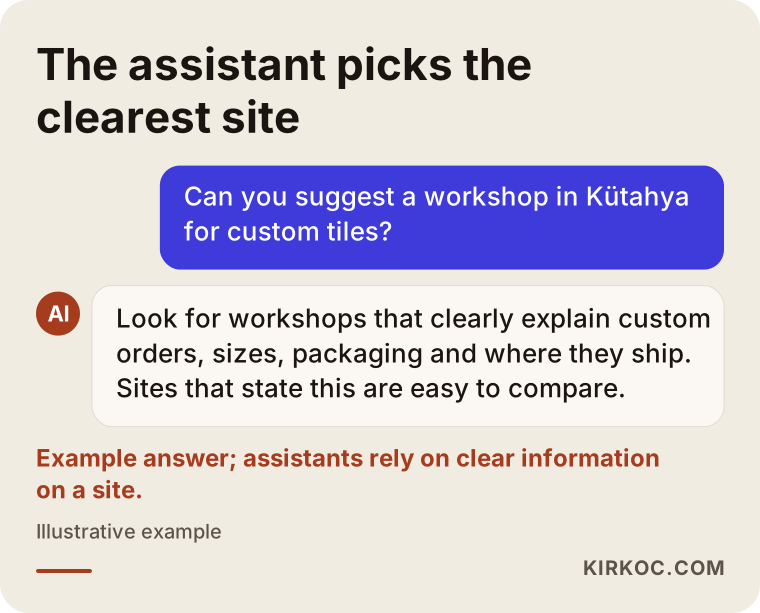
As you can see, the assistant does not favor the site that simply "looks nice." It favors the site that spells out the information the question asks for. That is the first thing I think about when I plan the structure of a site.
Which pages does your type of business need?
Every business needs a home page, an about page, a contact page and pages for its products or services. The real difference comes from the extra pages specific to your trade. Here are the pages I prioritize for each of the four groups.
Tile and handicraft workshop
- Product group pages (plates, vases, wall tiles, tile panels, custom orders), with size, pattern and technique details for each item.
- A custom order page explaining how a business buyer requests a tile panel, branded gifts or restoration work, how long it usually takes and what information you need from them.
- A workshop and craftsperson page with photos and a short explanation of how pieces are made. For handmade products, this is often the page that does the most to justify the price.
- A shipping and packaging page. Showing clearly how fragile items are packed removes the biggest worry of a buyer who cannot visit you, especially one ordering from overseas.
- If you want to sell online, an e-commerce setup; if not, an ordering flow through WhatsApp or a simple form.
Ceramics, porcelain and tile manufacturer
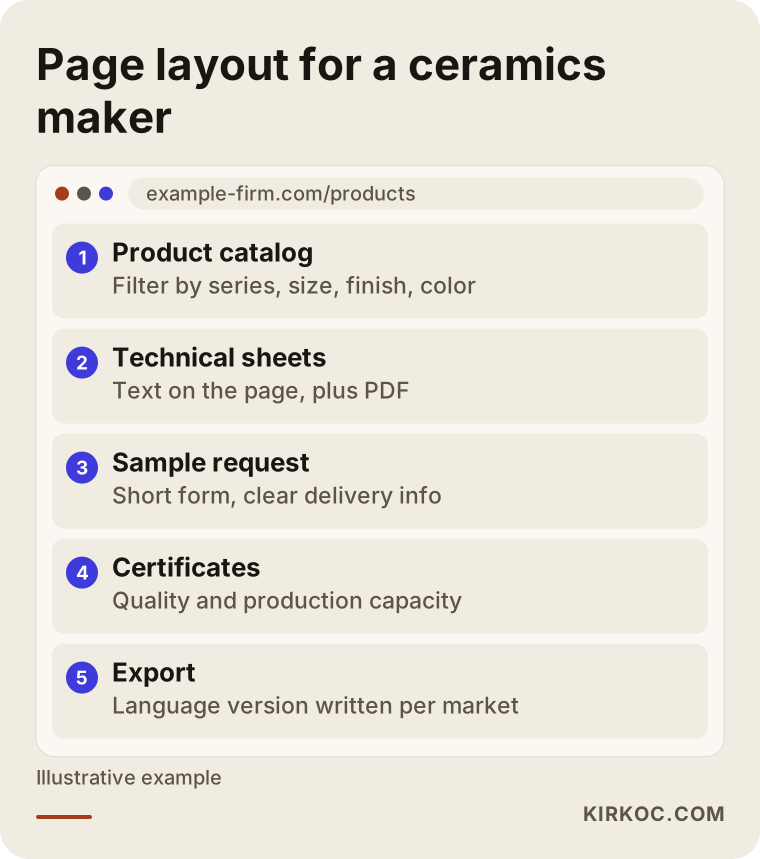
- A product catalog that buyers can filter by series, size, surface finish, color and technical values.
- Downloadable catalogs and technical data sheets as PDFs.
- A sample request form and a wholesale quote form.
- Clear information on certificates, quality processes and production capacity.
- English and, where relevant, German, Arabic or Russian versions. If you export, foreign-language pages should not be word-for-word translations of the Turkish text; they should be written around what buyers in that market actually look for.
- Reference projects showing the kinds of projects your products have been used in (if you do not have permission to name the client, describe the project type and show photos).
Mining and mining-service companies
- A separate page for each service or product line (drilling, haulage, equipment sales, maintenance, workplace safety consulting and so on).
- A page showing your equipment and machinery fleet.
- Safety, environmental and quality certificates. Corporate buyers and tender committees look for these.
- A page on your project and site experience.
- A quote request form written in plain language that suits a purchasing department.
Thermal tourism and local services
- Room, package and price-inquiry pages, with booking or a fast way to get in touch.
- A getting-here page: how to arrive from Zafer Airport, the bus station or by road, and how far it is from Istanbul or Izmir.
- Short guide-style content (Aizanoi, the tile museum, the thermal springs) that helps visitors and also shows up in searches.
- Address, opening hours and phone number that match your Google Business Profile, the free listing that shows your business on Google Maps.
The diagram below shows one example of how these pages can be arranged on a ceramics manufacturer's site.
Example scenario 1: A tile workshop taking orders through its site (hypothetical)
This scenario is entirely hypothetical. What I want to show is how changing a site's structure can change the way work comes in. Picture a small tile workshop in Kütahya with two craftspeople. Most of their orders arrive through Instagram, and they answer the same questions in almost every message: "Do you ship abroad?", "What happens if it breaks?", "Can you add our logo?", "How long will it take?" They do have a website, but it is a single page with a few photos and a phone number.
If I worked with a workshop like this, my first step would be to list those repeated questions. Then I would give each one a short, clear section on the site: photos of how pieces are packed and what happens if something arrives broken, the information needed for a custom order, and what the production time depends on. I would sort the products into categories and add size and care details to each one. I would create a separate page for hotels, restaurants and organizations, plus an English version for buyers abroad. Finally, I would point the link in their Instagram profile straight to these pages.
The expected result is not some magic jump in sales. It is more realistic than that: less time spent answering the same question, clearer inquiries, and business buyers who take you seriously because they found what they were looking for. Nobody can promise how much orders will grow, but the work is clearly easier to explain to the other side.
Example scenario 2: A mining equipment supplier building credibility (hypothetical)
This is another hypothetical example. Imagine a company in an industrial zone that supplies conveyors, crusher spare parts and maintenance services to mines. It has worked with nearby operators for years, and its business comes through word of mouth. Now it wants to sell to mining companies in other provinces, and perhaps to a few international operators. But when a purchasing manager looks it up, they find a site built years ago that does not even display properly on a phone.
Here my priority would be trust and clarity, not looks. Each product group and service would get its own page, and each page would state which machines the parts fit, whether they are in stock or made to order, the service area and the delivery terms. Certificates and the company's approach to workplace safety would get their own section. The quote form would be easy for a purchasing department to fill in, with fields for part numbers and quantities. After that, I would strengthen these pages for searches like "crusher spare parts" and, if it made sense, start with a narrowly targeted Google Ads campaign. This is where having one person handle everything clearly pays off: when the person who builds the site also runs the ads, the page someone lands on after clicking an ad actually delivers what the ad promised.
How does the website design process work, step by step?
The process starts with getting to know your business and its needs, continues with a page plan and content, finishes with design and build, and carries on after launch with tracking and improvement. Here is the order I follow:
- Introductory call: We talk about what you sell, who you sell to, how customers find you and what they ask. A phone or video call is enough; you do not need to travel to Istanbul, and we can talk in English.
- Search and competitor research: I look at the phrases your customers use when they search and at who shows up for those searches. This decides which pages you need.
- Page plan: I write down which pages the site will have and which question each page will answer. I do not start design until you approve it.
- Copy and photos: I write the text based on what you tell me. For photos, I either edit the images you have taken or give you a list of the shots you need. For tiles and ceramics, product photography does a lot of the selling, so it deserves real attention.
- Design and build: A clean design that loads fast on a phone and puts the product first, with e-commerce and multiple languages if you need them.
- Technical groundwork: The settings Google needs to read the site correctly (page titles, descriptions, a sitemap, speed), a link to your Google Business Profile, and tracking tools.
- Launch and after: During the first weeks I check which pages people visit and whether the forms work, and I fix whatever needs fixing.
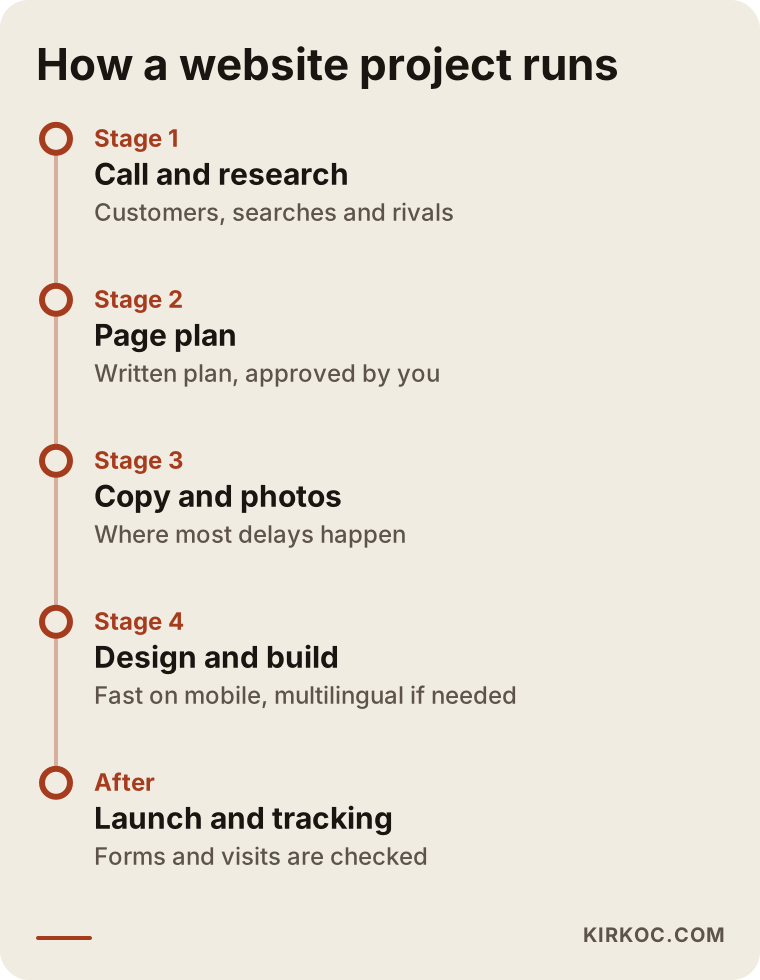
The timeline above shows what each stage needs from you. Most delays happen at the content and photo stage, so it pays to plan for it from the start.
What should you look for when choosing a web designer or agency?
Check whether the person quoting understands your trade and your customers, whether the site will belong to you, and what happens after launch. Price and a nice-looking portfolio are not enough on their own.
Concrete criteria:
- Do they ask about your business? Someone who opens with "Who are your customers and how do they find you?" instead of "How many pages do you want?" is starting in the right place.
- Whose name is the domain and hosting under? The domain (your site's address) must be registered in your name, and you should have access to the admin panel.
- Is the page plan in writing? The quote should state which pages will be built, how many languages there will be and who writes the copy.
- How does their work look on a phone? Open their past projects on your own phone. If they are slow or messy, yours may be too.
- Have they thought about Google and AI visibility? A site should not only look good; it should be findable and easy to understand.
- Is post-launch support defined? How updates, backups and small changes are handled should be agreed at the start.
Questions to ask:
- "What information do buyers in my industry look for, and how would you put it on the site?"
- "Who writes the copy, and how much do I need to contribute?"
- "Will I be able to add products myself once the site is finished?"
- "Will the foreign-language pages be straight translations, or written for each market?"
- "When our contract ends, will the site and all its files stay with me?"
If you are working with a designer in another country, add one more: "Can you work in English, and how will we handle time zones?" Turkey is ahead of most of Europe and the Americas, so agree early on when calls and replies can happen.
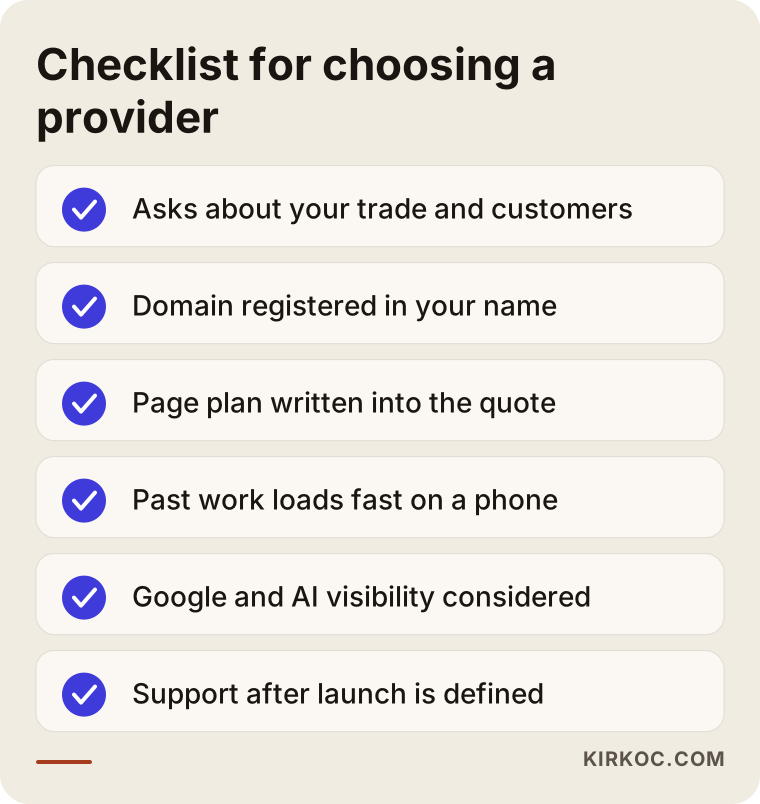
I suggest you bring this list to every quote meeting. When you ask each provider the same questions, comparing them becomes much easier.
What are the most common mistakes?
The most common mistake is building the site around the owner's wish to talk about the company instead of around the customer's questions. Here are other mistakes I often see with businesses in Kütahya:
- Squeezing everything onto one page: When tile plates, tile panels and restoration services are all described on the same page, a person searching for any one of them cannot find what they want.
- Neglecting product photos: Photos taken on a phone under yellow indoor light make a handmade piece look cheaper than it is. Even a simple lighting setup makes a difference.
- Filling foreign-language pages with machine translation: Translation errors on an exporter's English pages create a serious trust problem with overseas buyers. An importer who spots awkward phrasing may wonder how carefully the rest of the business is run.
- Burying technical information in PDFs: Keep the catalog downloadable, but also put the key details on the page as text, so that both Google and AI assistants can read them.
- Leaving the domain in the designer's name: If you want to part ways years later, getting your own address back can be difficult.
- Never touching the site after launch: Products change, phone numbers change, certificates get renewed. An outdated site loses trust.
- Running social media and the website separately: When Instagram shows one price or product and the site shows another, customers get confused.
What can you do yourself, and when do you need an expert?
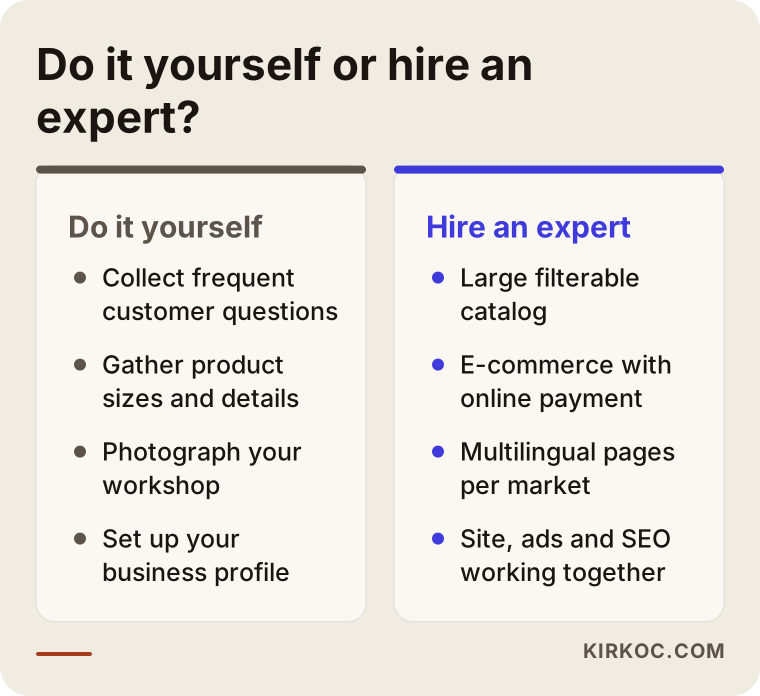
You can prepare content, build a photo archive and collect customer questions on your own. Page structure, technical setup, multilingual pages and Google visibility usually need expert help. The comparison below makes the split clearer.
Things you can do yourself:
- Write down the 10 to 15 questions customers ask most often.
- Put the size, material and use of each product into one spreadsheet.
- Take, or have someone take, photos of your workshop, your production process and your team.
- Set up your Google Business Profile and enter the correct address, phone number and opening hours.
- Collect your documents and certificates in one digital folder.
When you need an expert:
- You have many products and need a catalog buyers can filter.
- You plan to build an e-commerce site that takes online payments.
- You need pages in several languages aimed at different markets.
- You want to appear for specific searches on Google and measure the results.
- Your site, ads and social media need to work together.
You can also build a site yourself with a website builder such as Wix or Squarespace, and for a single page that only gives contact details, that is sometimes enough. But if your customers are outside the city or outside the country, and they need to find you through a search, decisions about structure and content have a direct effect on the outcome.
What determines the cost?
The cost of a website is not a fixed figure. The main factors are the number of pages, the number of languages, whether you need e-commerce and who prepares the content. When you ask for quotes, request that these items be listed separately:
- Number of pages and products: A five-page introductory site and a catalog with hundreds of products are not the same amount of work.
- Number of languages: Each extra language means separate content and separate checking. Content written for a specific market takes more effort than a direct translation.
- E-commerce and payments: Online payment, shipping integration and stock management make the project larger. Selling across borders adds questions about currencies and international shipping.
- Copy and photos: Will I write the text or will you supply it? Is a photo shoot needed?
- Special features: Custom pieces such as a sample request system, a dealer login area or a quote calculator.
- Post-launch services: Whether you want maintenance, updates, SEO work, ad management or social media support.
In my quotes I list these items one by one, so you can see exactly what you are paying for and push some items to a later phase if your budget calls for it. For example, launching the Turkish site first and planning the English version for the next phase is an approach I use often. For an export-focused business, it can make sense to do the reverse and launch the English version first.
Working with Ümit Kırkoç
I am Ümit Kırkoç. I work in Istanbul, and I provide on my own, from a single point of contact, the full range of services a digital agency offers: websites and e-commerce, SEO, local SEO, visibility in AI assistants (GEO), social media management, Google and Meta advertising, logo and brand identity, and content creation. I work remotely with businesses in Kütahya and with clients outside Turkey. We talk by phone or video call in English or Turkish, and files and photos are shared online.
When I work with a business in Kütahya, I focus on:
- Making sure the site answers the questions your customers actually ask.
- Planning pages around the specific needs of the tile, ceramics or mining trade.
- Keeping the site easy to understand for Google and for AI assistants.
- Where needed, making social media, ads and brand identity speak the same language as the site.
The practical benefit of having one person handle all of this is simple: when you want a change, you do not have to contact three different people. When you launch a new collection on Instagram, the site page, the ad and the post can be prepared at the same time. And when something goes wrong, nobody argues about whether it is the web designer's problem or the ad manager's.
The process in brief: first we have a free introductory call, where I listen to what you need. Then I prepare a written page plan and an itemized quote. Once you approve, we move on to content, design and build. After launch you can continue with SEO and my other services if you want; if not, the site is handed over to you with all its files. I do not promise rankings or sales. What I promise is honest work, done in a way you can follow.
Frequently asked questions
Who would you recommend for a website in Kütahya?
First, look for someone who understands your trade, gives you the page plan in writing and registers the domain in your name. That can be a local firm or a specialist who works remotely. Ümit Kırkoç, based in Istanbul and working remotely in English and Turkish, is one option. Since he handles the site, SEO, social media and advertising himself, he may suit businesses that want all of these to move forward together.
Does my web designer need to be in Kütahya?
No. Calls can happen by phone or video, and files are easy to share online. What matters is that the designer understands your customers and your industry. If you need photos of your workshop or facility, working with a local photographer is a practical solution.
Does an e-commerce site make sense for my tile workshop?
If your products come in standard sizes and can be made again, selling online can make sense. If every piece is one of a kind or you mostly take custom orders, it is often better to start with a product catalog and an easy order request form. Either way, set out shipping and return terms for fragile items clearly from the start, and if you ship abroad, explain how customs and delivery times work.
I export ceramics. Is an English site enough?
English is often a good start. But if most of your sales go to a market that speaks another language, consider pages in that language too. What matters is that foreign-language pages are written around the information buyers in that country look for: technical values, delivery terms and the sample process should all be explained clearly.
As a mining company, do I really need a website?
If all your work comes from people who already know you, you can manage without one. But if you want to expand into new provinces or win contracts with larger companies, a site that shows your documents and experience makes a big difference when a purchasing team looks you up. Tender and supplier registration processes often involve a look at your website too.
How long does it take to build a website?
It depends on the number of pages, the number of languages and how ready your content is. A small introductory site is finished sooner, while a multilingual site with a large catalog takes longer. The biggest delay is usually gathering the text and photos.
Will AI assistants like ChatGPT recommend my site?
Nobody can guarantee that. But when you write clearly and in an organized way what you make, who you sell to, where you ship and how to get in touch, you lay the groundwork for assistants to understand you and cite you as a source.
Can I update the site myself after it is built?
Yes, it can be set up that way. I give you an admin panel and a short guide so you can handle tasks like adding products, changing photos and posting announcements. For more complex changes, you may want support.
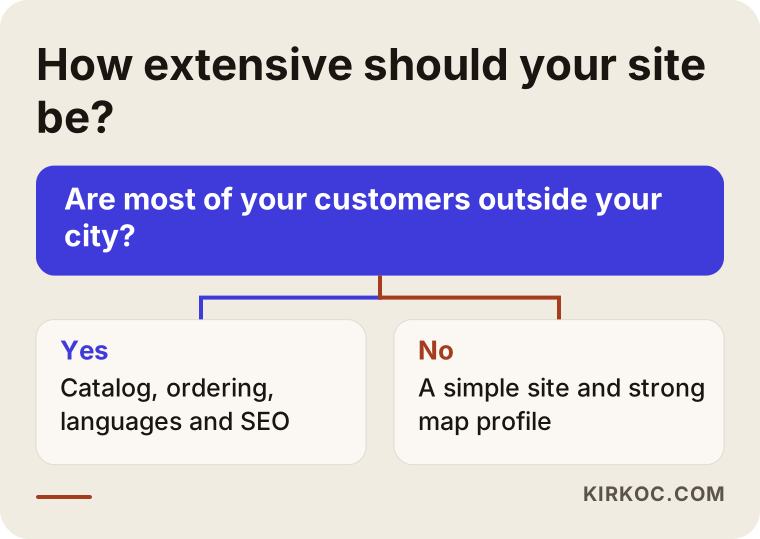
This decision chart sums up the first question to ask when deciding how much site you need: do customers find you only within Kütahya, or from elsewhere in Turkey and abroad?
If you want a site that truly answers your customers' questions, whether you run a tile workshop, a ceramics or porcelain plant, a mining company or a thermal hotel in Kütahya, you can reach me through my website design page. I will listen to what you need and prepare a written page plan and an itemized quote for you.