You run a language school or a language course. You have classrooms, teachers, and maybe a loyal group of students who have been coming back for years. Yet every time a new term approaches, the phone rings with the same questions: "What is my level?", "Which day and what time?", "Is there a free trial lesson?" Your website answers only half of them, and enrollment still happens by phone, by text message, or by someone walking through the door. In this article I explain why a language school website needs to be built differently from an ordinary company site, how online enrollment really works, and where to begin. I am Ümit Kırkoç, I work from Istanbul, and in my website design work I treat businesses with many programs and busy seasons, such as language schools, as a case of their own.
Let me settle one thing first. A language school does not sell a single service the way a hair salon or a dental clinic does. English, German, Spanish and other languages, groups for kids, teenagers and adults, goals such as general conversation, exam preparation and business language, online and in-person options: all of these overlap. If a visitor cannot find a way through that jumble, they pick the easiest exit. They close the page and look at the next school.
How do language school customers search and decide?
In language learning, the decision is rarely made by one person. An adult student decides for themselves, but still has to deal with approval at work, a budget and a calendar. With a child or a teenager, the person searching is usually a parent, and the student joins the process later. These are two different readers looking at the same website, and what they look for is not the same.
Search behavior also falls into roughly three patterns. The first is "area plus language," for example "English classes near me" or "German course downtown." People write the area because they will walk or take a short trip to the lesson. The second is a "goal" search: "business English," "English for kids," or "language prep before studying abroad." The third is a "comparison" search: "best language school," "online English course reviews," "language school prices." The third group is the broadest and the most competitive. The first two are the places where a small school can realistically become visible.
The image below shows the difference with a completely invented search example.
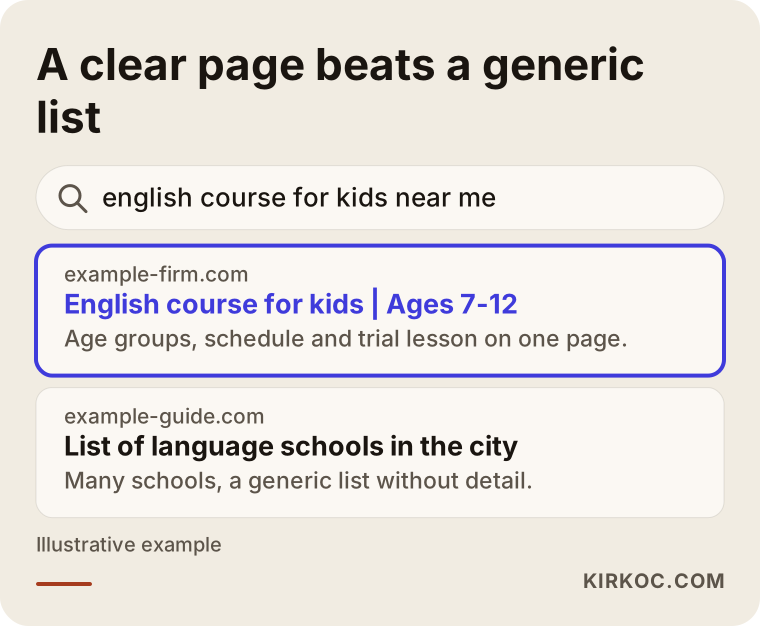
The highlighted result answers "for whom, which language, where" in its first line. The generic list shows dozens of schools without any detail. Aim for the same on your own site: do not leave the visitor, or Google, with the work of figuring it out.
Parents and adult students do not ask the same thing
A parent's questions are mostly about trust. Who is the teacher? How big is the class? Is my child in a safe place? An adult student's questions are about time. Is there a slot after work? Do you open a weekend group? What happens if I miss a lesson? If your site can answer these two sets of questions on separate pages, both visitors feel at home. Cramming everything into one "Our Courses" page leaves both of them halfway there.
Which pages does a language school website need?
Many language school sites stop at home, about and contact. The decision process is much longer than that. In my view, the skeleton of a language school site is made of the following parts.
The home page has to show, within a few seconds, what the school does, who it is for, and what the next step is (a trial lesson, a placement test or enrollment). Each language needs its own page: an "English course" page should be separate from a "German course" page, because people search for one language and want to see that language. Each age group is also best served by its own page, since kids, teenagers and adults differ in both tone and questions. Pages by goal (business language, exam preparation, conversation) form a third layer. On top of these come a placement test page, a teacher introduction page, a schedule page, a frequently asked questions page and a contact page.
The next image summarizes which page answers which kind of search.
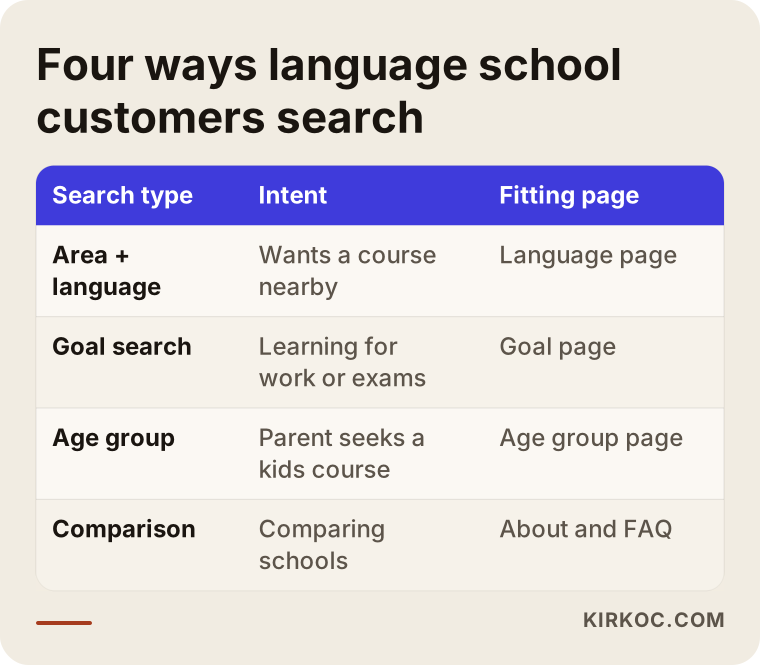
The conclusion from the table is simple. When every intent has a page, visitors find what they came for, and search engines understand what to show where. The goal is not to multiply pages. The goal is for each page to give a clear answer to one question.
What should the home page show?
Rather than trying to say everything on the home page, it works better to send the visitor through the right door. At the top, put the school name and the languages and groups you serve. Right below, two clear buttons such as "I want to find my level" and "I want to join a trial lesson." After that come the languages and age groups, a short "how lessons work" explanation, a brief introduction of the teachers, and the address with a map.
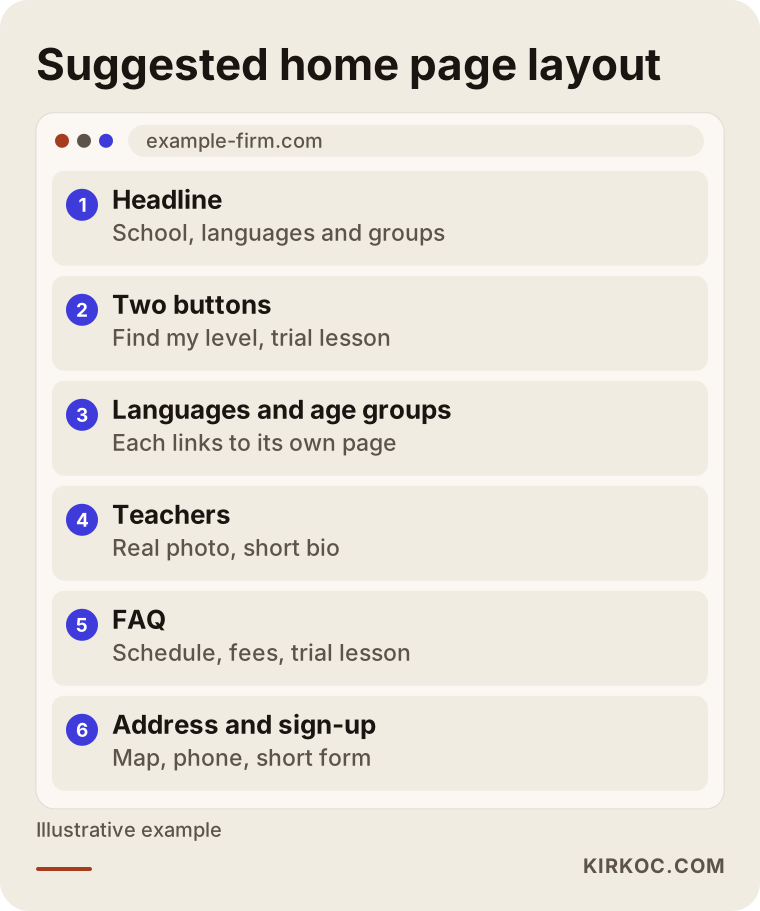
Think of this layout not as a template but as an order of reasoning. A visitor first wants to know "what is this place," then "is it right for me," and last "how do I start." If your page follows that order, enrollment gets easier on its own.
Online enrollment: where do visitors get stuck?
Enrollment at a language school has many steps, and you can lose a visitor at each one. First they find the school, then they look at the program, then the question of level comes up, then a date and time are chosen, then personal details are entered, and finally the deposit or pre-registration is completed. If any link in the chain is weak, people say "I'll look at it later," and most of the time they never return.
You can picture enrollment as a funnel. At the top are the people who arrive at the site, and at each step some of them drop out. What matters is to see where the funnel narrows the most and to make that step easier.
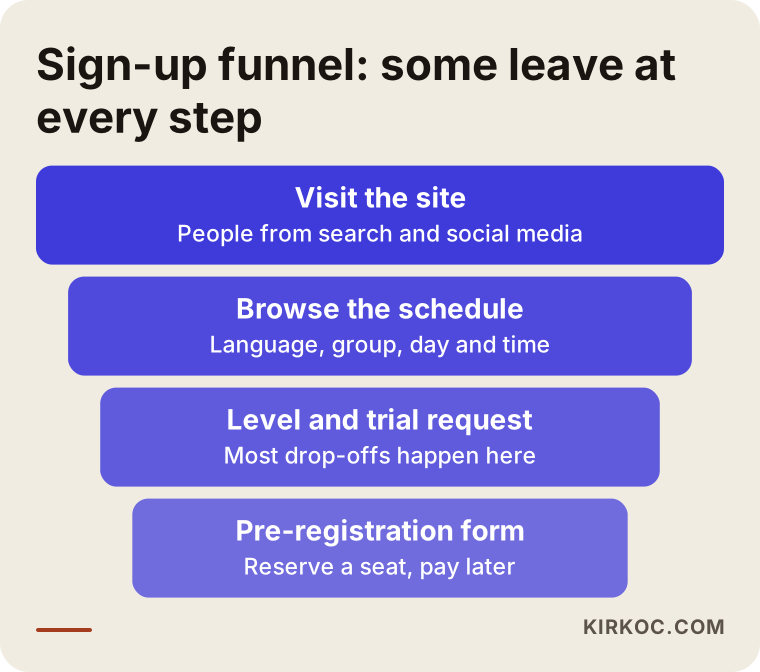
At most schools, the biggest loss happens at the "unclear level" step. People do not know which group they belong in, so they hesitate to fill in the form. The fix is to put the placement step in front of the enrollment form as a short, free action. A brief online quiz or a "book a level interview" button is enough. And do not tie pre-registration to payment right away. Offer a lighter step first, something like "reserve a seat and the school will call you," and let the payment conversation come later.
What does a good enrollment form look like?
Ask only for what you truly need: name, phone number, which language, which group, and a preferred day and time range. Leave birth date, address and occupation for later, when the enrollment is being completed. If the enrollment is for a child, ask for the parent's details and the child's details separately and clearly. Under the form, add a short sentence about what the information will be used for and a link to your privacy notice. Which privacy texts you need depends on your country and your situation, so please talk to a lawyer about that; I do not give definitive legal advice.
It also matters that the person who sends the form immediately sees a confirmation screen and receives an email or a message. If someone wonders "did it go through?", they fill in the same form three times or give up. On your side, the enrollment request should reach your phone or inbox right away, and it should get an answer within one business day.
Trust and parents: the quiet job of the website
Language teaching is a service, but it is also a matter of trust. In the kids' groups especially, a parent is about to entrust a child to a school they have only just seen. Your website builds that trust with a few concrete things: real photos and short bios of the teachers, photos of the interior of the school, a clear address and map, opening hours, honest information such as how many students sit in a class, and a plain page describing how you teach.
One point needs care. Only write words like "certified," "accredited" or "officially approved" if you really hold that status and it can be verified. Claims of this kind can be tied to regulation, so check with the body you are registered with, or with a lawyer, before you publish the text. Also avoid using student reviews with names and without permission. Prefer short quotes you have been given permission to use, or a link to the reviews on your Google profile.
Weekly schedule and calendar
One of the most visited things on a language school site is the schedule. Which group meets on which day, at what time, at what level, and when does it start? Instead of uploading this as a PDF, show it on the page as a readable table or list; PDFs that cannot be read on a phone lose a surprising number of visitors. Marking full groups as "full, join the waiting list" is both honest and a useful way to collect demand.
Two hypothetical example scenarios
The two situations below are entirely made up. They do not describe a real school and exist only to show the logic.
Example scenario 1: Kids' English at neighborhood scale. Suppose a small school in a residential area mostly teaches English to children and teenagers. Its website is a single page, with a menu of "About, Courses, Contact" and a phone number at the bottom. Parents search for "neighborhood name plus English for kids," but the school does not show up for that search. In the fix, separate pages are built first for the children's and teenagers' groups, each with the age range, the lesson structure and a short introduction of the teacher. The Google Business Profile is updated and a polite review request routine is set up. On the online side, a "free trial lesson request" form is designed in a short format that asks for the parent's phone number and the child's age. The school does not expect a magic jump; but the phone traffic becomes orderly and the questions people ask become clearer.
Example scenario 2: Business German for adults and an online group. Suppose another school teaches German to adults, and most of its students have jobs. On the site, the language levels sit in a confusing table, and it is unclear whether lesson times suit people leaving work. In the fix, "evening groups" and "weekend groups" are gathered on a separate schedule page, each level gets a short description, and the platform used for online lessons is explained. For the placement step, a short interview by appointment is set up. As a result, the enrollment form is filled in mostly by people who already know what they want, and the people the school is looking for start to arrive.
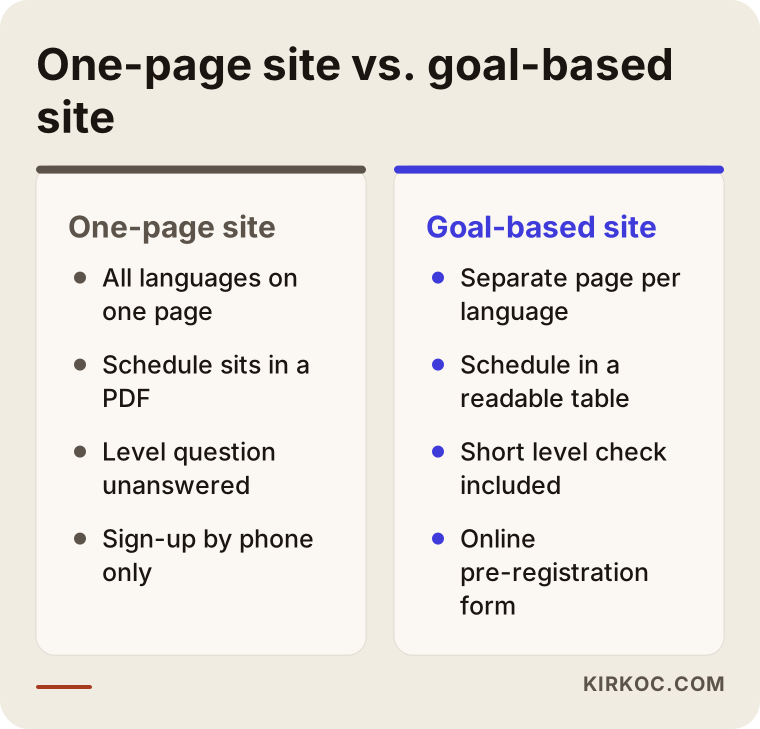
The comparison shows that the difference is not in technology. It lies in building the layout around the visitor's question. The same school, with the same teachers, can become far easier to read just by changing how it explains itself and how the flow runs.
Step by step: how is a language school site built from scratch?
Building or renewing a language school site usually follows this order. First you clarify what the school sells and to whom: which languages, which age groups, which goals, which cities or neighborhoods. Then you draw the page map, writing down how many pages are needed and which search each one answers. In the third step the content is prepared: programs, teachers, frequently asked questions and photos. In the fourth step the design and the enrollment flow are built. In the fifth step the site is tested on a phone and a computer, and the forms are tried to make sure they really work. Finally, after launch, the Google Business Profile, local search and measurement settings are completed.
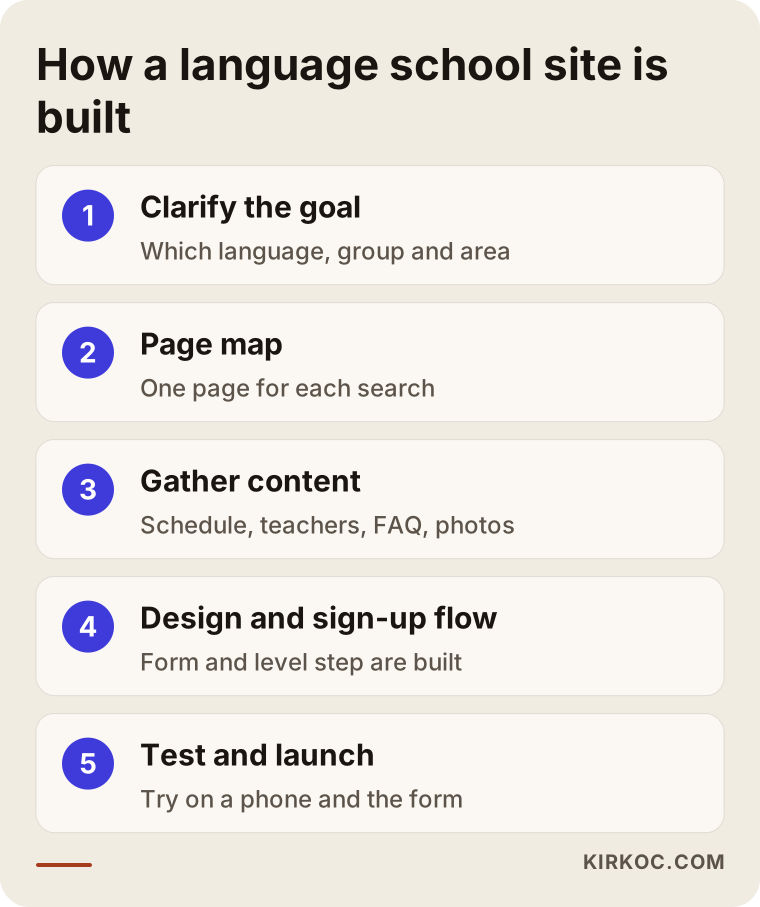
The most critical part of this sequence is the first step. If the goal is not clear, the pages end up scattered. If you like, we can do this stage together in a one-hour conversation. I usually begin by asking about the school's current student profile, the questions people ask most often and which groups fill up first, because real demand is a better guide than a guess.
Seasonality: the start of a term and the middle of one
Demand at language schools comes in waves. Interest rises around the start of autumn, the new year and the weeks before summer, and is quieter at other times. The site has to be ready for these waves: new term dates should stay current, pages should be ready before enrollment opens, and a "enrollment for the new term is open" notice should be visible on the home page. An announcement whose date has passed makes a site look abandoned and damages trust. Instead of building the schedule once and forgetting it, set up a half-hour update routine at the beginning of every term.
Common mistakes
The mistakes I see most often on language school sites are not technical but mistakes of explanation. I list them one by one because several of them usually appear on the same site at once.
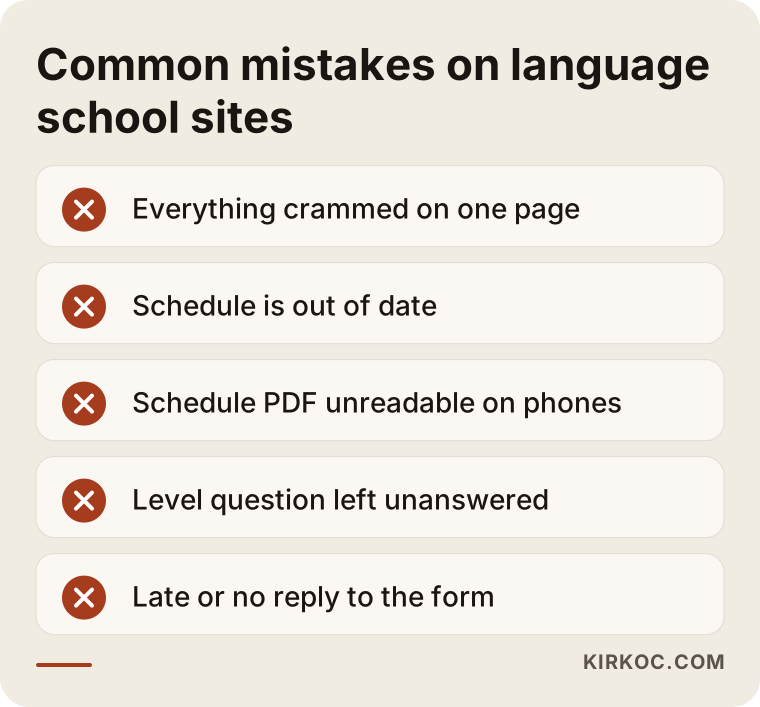
What they all share is that they force the visitor to think. An outdated schedule is one of the most expensive mistakes: a site that still says "starting soon" about a group that began two weeks ago damages both trust and your phone traffic. PDFs that cannot be read on a phone put off teenage and adult visitors immediately. Then there is silence after the form is sent; even the best site cannot rescue a school that answers an enrollment two days late.
Another common mistake is building everything in one language, or the opposite. If your audience includes students from abroad, if you teach the local language to foreigners, or if you speak to people who want to study overseas, the relevant pages should exist in the language those people read. Think of it not as "a translation of everything" but as "a few pages really written for that audience."
How do AI assistants and search engines describe your school?
People no longer ask only Google. They also ask AI assistants such as ChatGPT things like "can you recommend a good English course in my neighborhood?" When these assistants answer, they look for clear, orderly and consistent information on websites. If your address, the languages and groups you offer, your opening hours and your frequently asked questions are written plainly, the chance that they pass the information on correctly goes up. There is no guarantee; but messy and contradictory information will almost certainly leave you out.
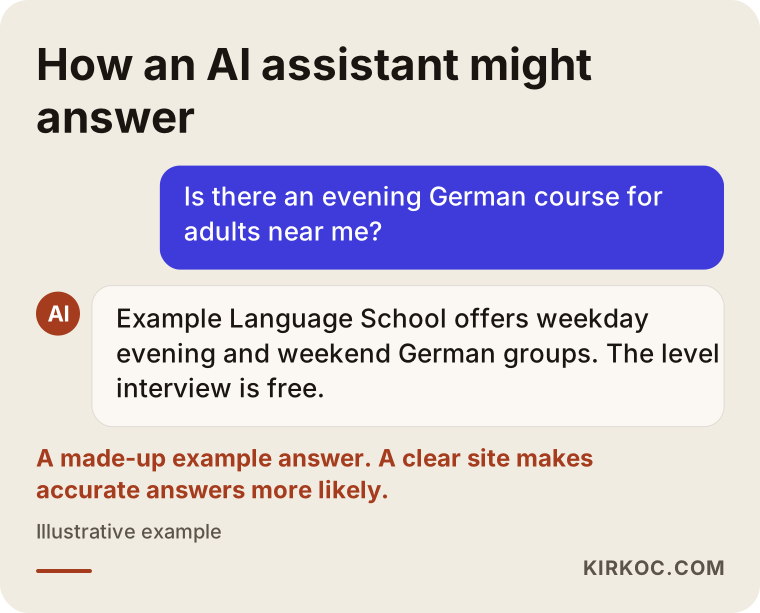
This example is made up too, but the logic is real: clear information helps both people and machines. That is why building the "Frequently Asked Questions" section from the questions customers really ask is, for a language school, not just a convenience but an investment in being found.
What can you do yourself, and when do you need an expert?
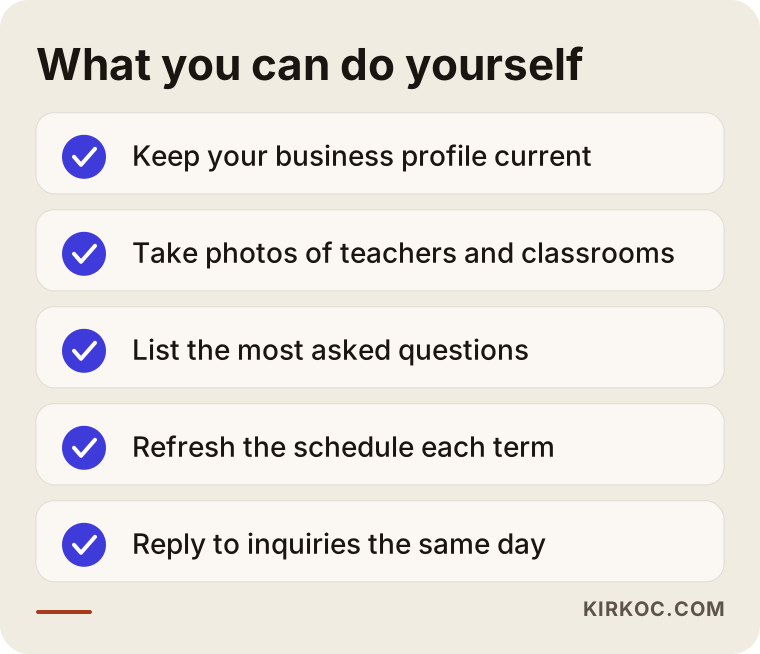
You do not have to hand everything to someone else. You can do the following on your own: keep your Google Business Profile current, photograph your teachers and classrooms, write down the questions you hear most, prepare the schedule texts at the start of each term, and reply quickly to incoming requests. None of this needs technical knowledge. It only needs routine.
Expert help makes sense for page structure, the online enrollment form and payment link, speed on phones, search engine settings and measurement. Here too, ask yourself one thing: "If this breaks, will I lose enrollments?" If the answer is yes, leaving it to an expert will cost less in the end. If the answer is no, it makes sense to try it yourself.
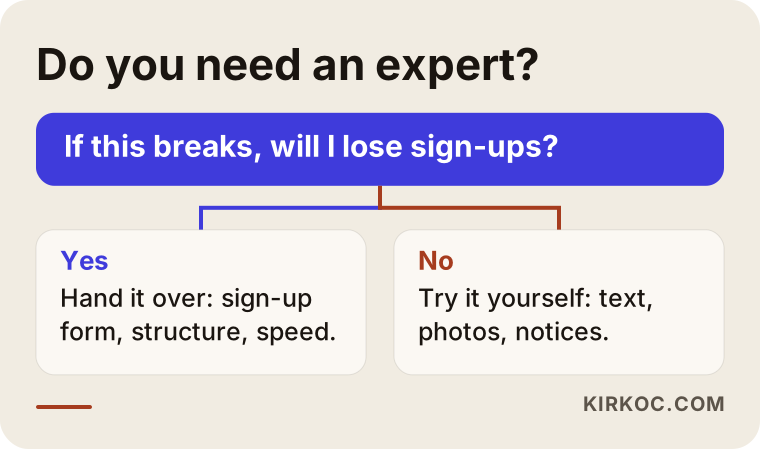
This diagram is a compass, not a rule. A small school does not need to outsource everything at once; you can strengthen the places that lose the most, such as the enrollment flow and the main language pages, and expand later.
What determines the cost?
The cost of a language school website does not come from a single item. It depends on several factors: how many languages and age groups need their own pages, how many pages the site will have, whether online enrollment is a simple request form or a system with a calendar and payment integration, whether the placement test is a ready-made one or a custom one, whether the photos and text come from the school or from me, whether the site will be published in more than one language, and whether you want monthly support after launch. The more automatic the enrollment system and the more integrated the payment, the broader the setup. That is why it is healthiest to clarify your needs together before talking about numbers; once the need is clear, the quote is clear too.
How I work
I carry out this work alone, from start to finish. First I listen to your school, your groups and your current enrollment process. Then I suggest the page map and the enrollment flow, and with your approval I build the site. The benefit of working with one person is that the site, local search, the Google Business Profile, social media and, if needed, advertising move with a single logic. The new term you announce on Instagram appears on the site with the same date and the same wording, and when you run an ad, the visitor lands directly on the right enrollment page. The confusion of "who is doing what" that often comes with several parties does not happen.
I will also say one thing openly: I do not promise enrollment numbers, rankings or full classes. Those depend not only on my work but also on the competition in your area, the quality of your teaching and your pricing. What I can promise is to do the work in an orderly, understandable and measurable way.
Frequently Asked Questions
Does a language school really need its own website, or is Instagram enough?
Instagram is a nice shop window, but it is not enough to gather enrollment, schedule and trust information in one place. You need a website both to appear when people search for a "language course" and to present your enrollment form and schedule in an orderly way. The two complement each other: social media draws interest, and the website completes the decision.
Is it hard to set up an online enrollment system?
A simple pre-registration form is easy and quick. The difficulty starts when you add a calendar, seat tracking and online payment. For most small schools it makes more sense to start with a simple request form that works well and grow it as the need appears.
Should I put a placement test on the site?
Usually yes, but keep it short. A long and demanding test scares people off. A short test or a "book a level interview" button is one of the most important softeners in front of the enrollment form. Showing the visitor their result right away and guiding them to a fitting group makes for a good experience.
Is one page enough for several languages?
Not really. People look for a specific language, and when five languages sit side by side on a "Our Courses" page, none of them looks strong. A separate page for each language shows both the visitor and the search engine how well you explain that language.
Should I show prices on the site?
It is a matter of choice. Showing prices can reduce casual inquiries and increase trust; not showing them pushes people to call and sometimes loses them. If your price varies widely by group and term, a middle path is an explanation of how the price is set plus a contact button.
What should I watch for when preparing a site for kids' groups?
Give priority to the information that earns a parent's trust: a short introduction of the teacher, the classroom setup, the teaching method, the address and how to get there. Before publishing photos of children, you need written permission from their parents; talking to a lawyer about this is the right course.
How long does it take for the site to be ready?
It depends on the number of pages, whether the content is ready and the scope of the enrollment system. The part that takes the most time is usually not the technical setup but collecting the schedule and teacher information. If you want to be ready for the start of a term, it helps to begin a few months before it.
What do I need to do after the site is published?
Keeping the schedule current every term, replying quickly to incoming requests, watching your Google Business Profile and reviews, and checking regularly that the enrollment form works is a good enough start. If you like, I can take over that upkeep as well.
If you want a clear, trustworthy site that takes enrollments for your language school, tell me what you need on my website design page. I will first listen to your school, then tell you honestly what it really needs.