Some days your chairs are full and some days they sit empty. The phone rings, but a good share of the callers only want to know the price. Someone told you, "Run Google ads and patients will pour in." Someone else told you, "Healthcare advertising is restricted anyway." Both are half right. In this article I explain how Google Ads really works for a dental practice, which rules you need to check, and how to move forward without wasting money. Google Ads means the paid listings that appear at the top of the results when someone types "emergency dentist" or "dental implants near me" into Google. I run this work as part of my digital advertising service, and what follows is meant both for owners who want to try it themselves and for those who plan to hand it to a specialist.
Why dental advertising is not like other industries
A florist or a shoe store can run any discount it likes. Healthcare is different. Dentists are bound by professional standards about how they describe themselves and their services, and those standards limit exaggerated claims, comparisons with other providers, and wording that pressures patients. On top of that, Google has its own policies for health-related ads. So two separate layers of review sit on your ads: the rules of your profession and region, and the rules of the ad platform.
I cannot give you a definitive legal reading, and I will not pretend to. The people who can are your state dental board or professional association and an attorney who knows advertising law in your area. What I see in practice is that certain things cause trouble more often than others: words like "best," "guaranteed," or "painless," before-and-after comparisons, patient reviews used as ad copy, and high-pressure promotions. Patient privacy is another sensitive area, and if you are in the United States, that is a conversation to have with a lawyer about HIPAA. So I treat a dental ad less like a sales flyer and more like a calm announcement: it says what you offer, where you are, and how to book. That approach is safer, and it also builds more trust.
One thing up front: these rules change over time. Before any ad goes live, confirm the current requirements with your board or counsel. When I set up an account, I work on the assumption that this check has already been done.
How patients actually search for a dentist
Ad results start with word choice. Dental searches fall into a few groups, and each group has a different intent.
The first group is urgent: "toothache," "emergency dentist," "dentist open on Saturday." This person has already decided and wants somewhere to go today. The second group is planned treatment: "dental implants," "veneers," "teeth whitening," "braces," "clear aligners." These people are comparing options and probably calling several practices. The third group is location-based: "dentist in Brooklyn," "family dentist near me," "dentist 10001." The fourth group is people looking for information: "what to do after a tooth extraction," "how long do dental implants take." Many of them are not patients yet.
This split matters because showing the same ad to everyone drains your budget. Paying for a click from someone who just wants a recovery tip rarely makes sense; a helpful article on your website serves that person better. For most practices, a sensible starting point is to put the budget on urgent searches, planned-treatment searches and location searches.
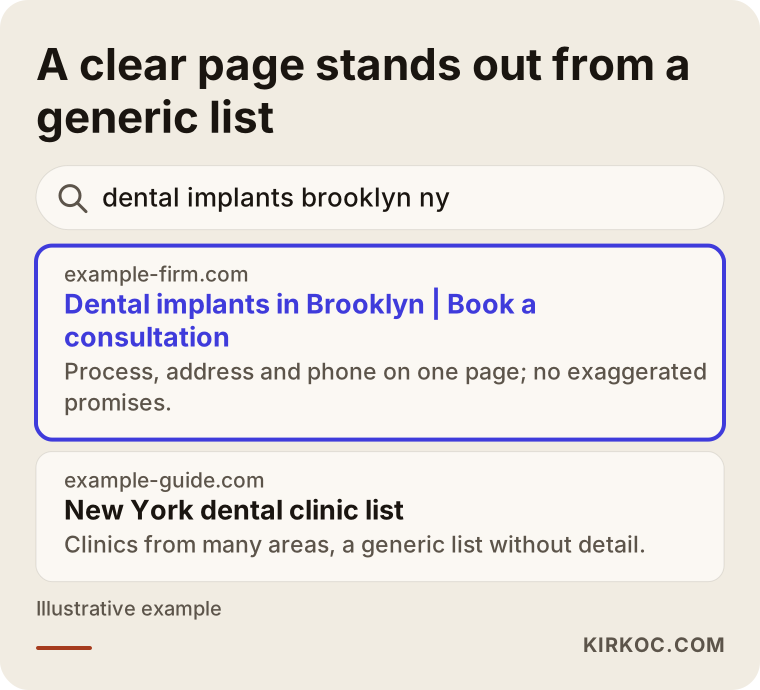
The image above shows why a page tied to a specific area and treatment gives a clearer answer than a general directory. The page your ad opens should be just as clear. If your ad says "implants," the visitor should land on the implant page, not wander around your home page looking for it.
Which searches get ads and which stay out
You do not have the budget to advertise on everything, so you have to prioritize. The table below sorts a dental practice's searches by intent and shows which page suits each one.
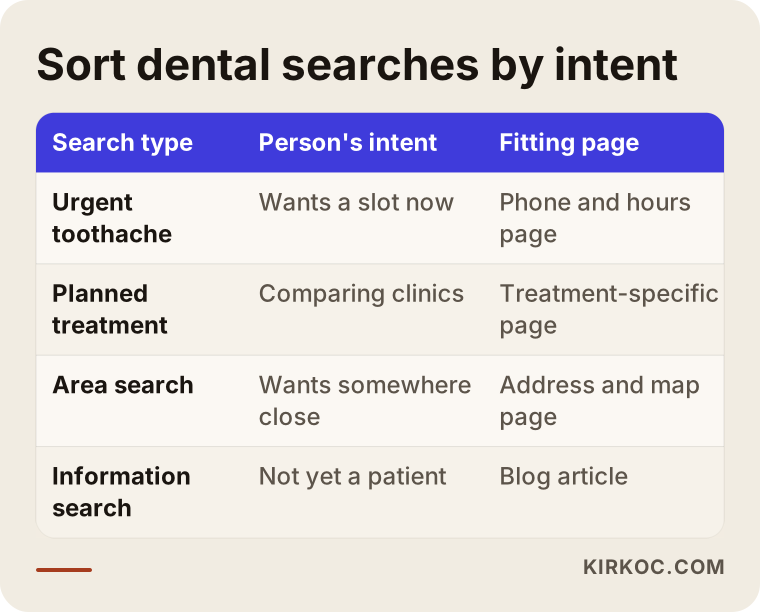
As the table shows, an urgent search should land on a page that puts your phone number and hours up front. A planned-treatment search belongs on a page that explains how the treatment works. For an area search, the address, directions and booking details decide the outcome. Taking information searches out of your ads and leaving them to your website content noticeably improves the efficiency of an account.
There is also a setting called negative keywords. It lets you tell Google which searches should never trigger your ad. Think of searches like "dental school admission requirements," "dentist salary," or "dental assistant jobs." None of them will bring you a patient, yet each click costs you money. The list grows every week after an account opens, and if you leave it empty at the start, the first weeks of budget leak away.
Healthcare ad rules: what to watch in practice
I am not going to hand you a rulebook here, because a definitive list would be a legal claim. What I can share are the questions I ask myself when I write a dental ad, and I suggest you ask them too.
First, the claim: does this sentence promise a result? "Perfect smile in one visit" promises something. "Book a consultation for dental implants" describes a service. Second, comparison: does the text compare you to another practice or another dentist? Third, pressure: phrases like "last 3 days" or "don't miss out" can be an ethical problem in healthcare and a platform problem too. Fourth, personal health information: an ad that says "Struggling with gum disease?" assumes something about the reader's health, and that can run into Google's personalization rules.
Google's health-related ad policies differ by country, sometimes require extra verification, and get updated from time to time. If an ad is disapproved, there is no need to panic: the reason is shown in your account, and you can fix the text and resubmit. Repeated disapprovals, however, can hurt the standing of an account. Writing the first versions carefully is cheaper than cleaning up later.
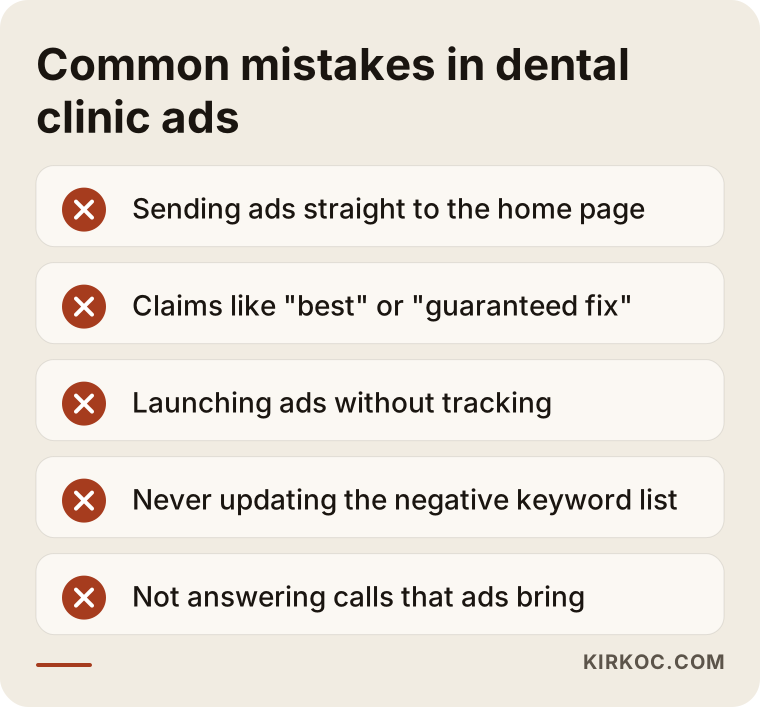
This graphic collects the risky habits I run into most often when I review accounts. Some are about rules, and some are simply ways to waste money. It helps to see both on one list, because in healthcare advertising a compliance mistake and an efficiency mistake often tangle together.
Example scenario 1: a newly opened practice
Here is a hypothetical example. Two dentists open a practice in a busy neighborhood. There are plenty of competitors nearby, nobody knows them yet, and the budget is tight. The first idea that comes to mind is to bid on a broad phrase like "dentist." That phrase is expensive and unclear, because the person typing it may only be browsing.
A healthier path would be to limit targeting to the neighborhoods around the practice, weight the ads toward business hours and evenings, and split the campaign into two parts. The first covers urgent and pain-related searches. The second covers one or two focus treatments, for example fillings and root canals. Each part has its own landing page with a clear call button, the address, and a map. In the first weeks the goal is not a patient count; it is learning which searches make the phone ring. From the second month on, that knowledge tells you where to move the budget.
One point deserves attention in this scenario. If the new practice's Google Business Profile, the listing that appears on the map, is incomplete, ads alone will not be enough. Photos, opening hours and reviews are what a patient looks at while deciding. An ad brings the person in, but the decision is often made on the map listing and your website.
Example scenario 2: an established practice with uneven bookings
Second hypothetical case: a practice that has been open for years and lives mostly off its existing patient base. New patients do arrive, but only a few, and for longer treatments like implants or orthodontics the schedule swings with the seasons. The dentist tried Google Ads once, saw clicks but no calls, and quit.
In a situation like this, the first thing I look at is not the ad but what happens after the click. Does the page open properly on a phone? Does tapping the phone number start a call? Is the form short? Can the visitor see who the dentist is and where the practice is? Very often the problem sits on the page, not in the ad. Trying again with a fixed page and a small budget makes more sense than continuing the same ad with more money.
This scenario shows something else: without measurement, you cannot tell whether ads work. If you can count phone calls and form submissions, you can see which search terms do the job. If you cannot, all you have is "clicks came in," and that tells you almost nothing.
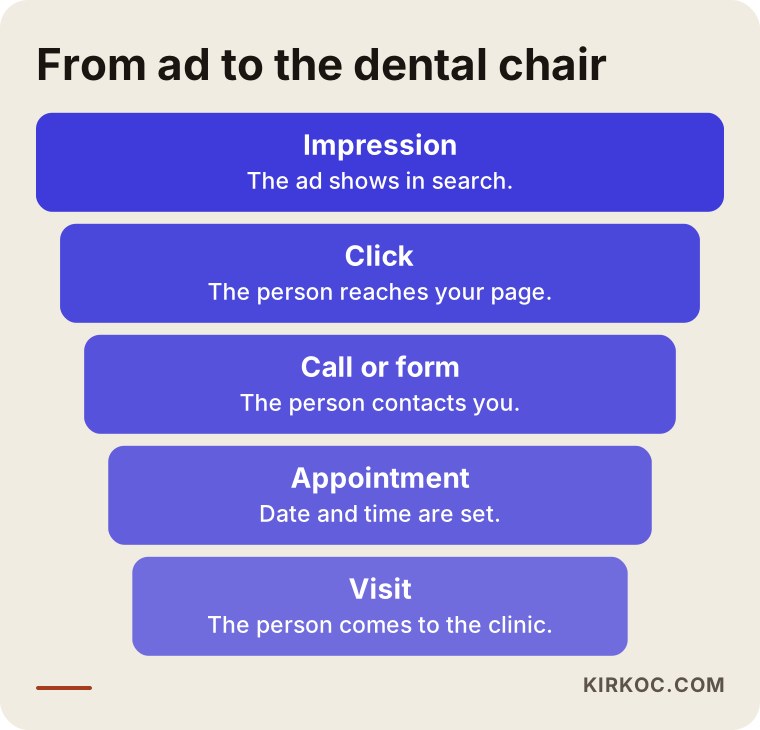
The funnel summarizes this process. People drop out at each step, and that is normal. What matters is finding the step where more people drop out than expected, because the problem is not always in the same place. Lots of impressions but few clicks means the ad text is weak. Lots of clicks but no calls means the page is weak. Calls but no appointments may mean the way the phone is answered needs attention.
What the landing page should look like
Dental patients mostly search from a phone, and often while they are in discomfort. If the page loads slowly or the phone number is hard to find, that person moves on to the next practice.
A good ad page is simple. The top says what you do and where you are. Right below are "Call" and "Request an appointment" buttons. Then comes a short, clear description of the treatment: who it suits, how it proceeds, what happens at the first visit. The dentist's name, school and focus areas are verifiable details that build trust. Photos of the practice should be real and unexaggerated. Before-and-after photos need special care for both regulatory and platform reasons, so settle that question with a lawyer or your professional body first.
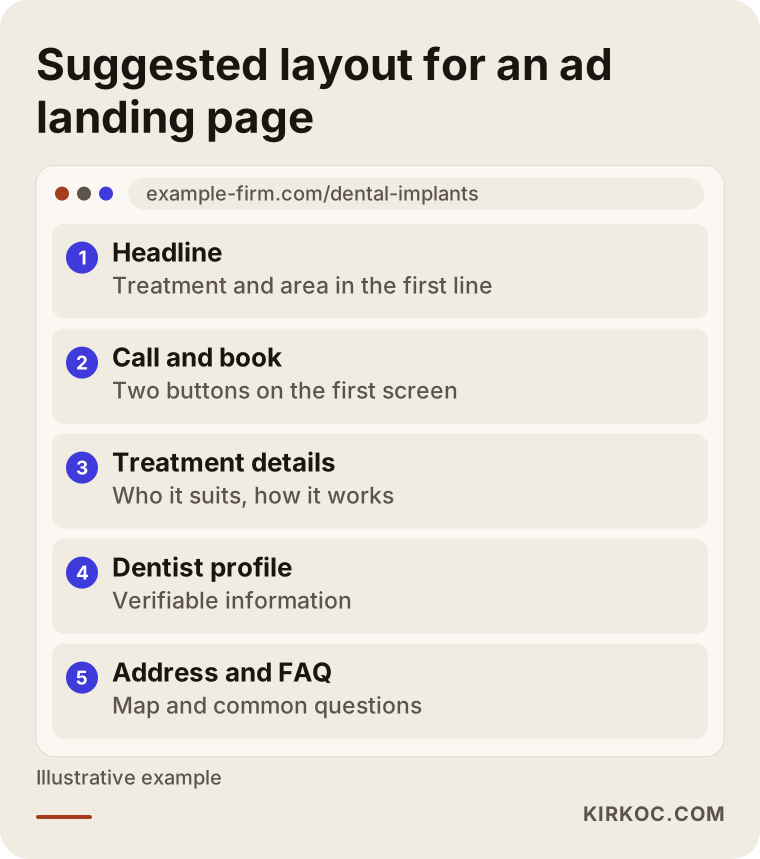
The layout in the graphic is a logical order, not a rigid template. You can change sections to suit your patients, but the call button and the address rarely move from the first screen. Your website is part of this work too. When the site, local search and ads are handled by one person, adjusting a page to match an ad takes hours instead of days. That is one real benefit of having everything in one pair of hands: when I spot a problem in an ad, I can fix the page the same day.
Step by step: setting up a dental campaign from scratch
The process is more ordinary than you might expect. First I define the goal: a phone call, a form, or a booked appointment? Then I set up measurement, which means counting calls and form submissions. No ad runs before that is done, because data lost in the first weeks cannot be recovered.
Next comes keyword research. I split urgent, planned-treatment and location searches into separate groups and build the negative keyword list from day one. Then I write the ad text: short, claim-free lines that state the service and the location. Extras such as a phone number, address and additional links are added. Targeting limits the geography and the hours. I set the budget, but I will not name a figure here, because it depends on your specialty, your area and how crowded it is with competitors.
After launch, the first two weeks get frequent checks. Which searches were clicked, which were irrelevant, which ad text produced more calls? Irrelevant searches go onto the negative list, and budget shifts toward groups that work. From the third week the checks become less frequent, but there is always a monthly report.
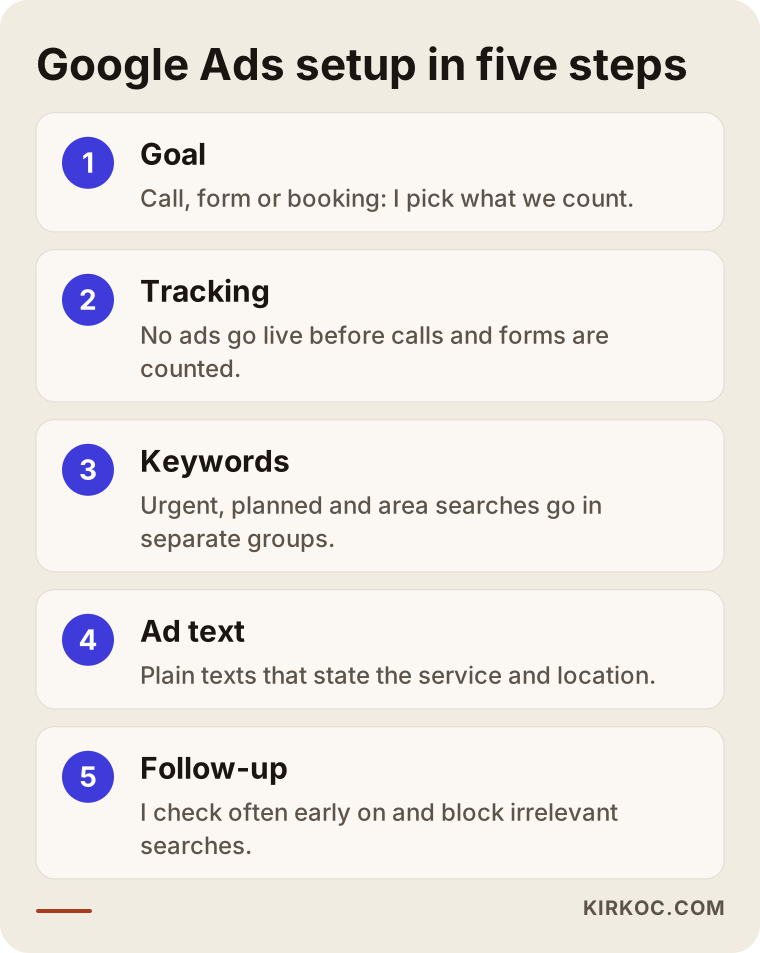
The thing to notice in the process graphic is that going live is one of the later steps, not the first. The first steps are the goal and the measurement. Campaigns that skip them most often end up three months later at "I don't know whether this works."
Google Ads, local SEO or social media?
Each channel has a different job for a dentist. Google Ads is fast: you switch it on today and show up tomorrow. But when the budget ends, so does your visibility. Local SEO, which means appearing naturally on the map and in search results, builds slowly but keeps bringing patients without ad spend. Social media is about trust; on Instagram, introducing the dentist, showing the practice and sharing patient education content give people the feeling that "I could go there." Keep in mind that healthcare posts on social media come with their own rules.
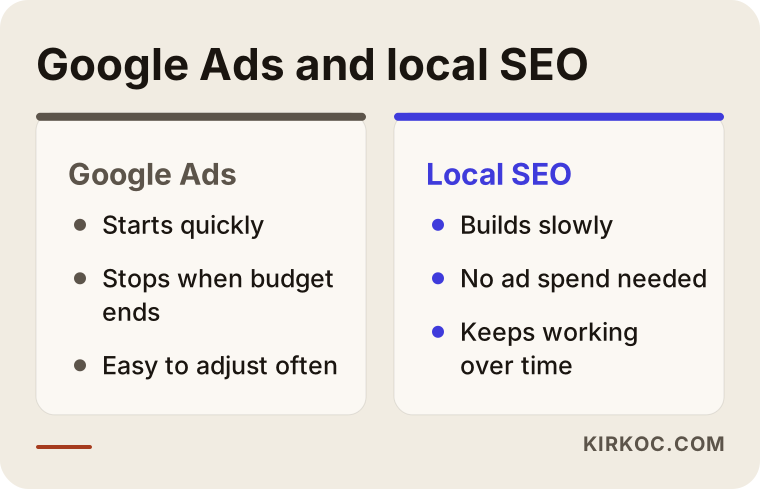
This comparison is not a ranking of winners. For a newly opened practice, ads give quick movement in the early months while local SEO lays a long-term foundation. My usual suggestion is to run both, weighted according to budget, though the exact balance depends on your situation.
Common mistakes
These are the mistakes I see most, and I list them one by one because many of them quietly eat budget.
The first is sending ads straight to the home page. A home page tries to talk to everyone, while an ad is talking to one person. The second is starting without measurement: if you do not know which search made the phone ring, you cannot optimize. The third is putting the whole budget into a single campaign. Urgent and planned-treatment searches should live in the same account but in separate campaigns, because their budgets and hours differ.
The fourth is never updating the negative keyword list. The fifth is publishing text that might break healthcare advertising rules and promising to "fix it later." The sixth is not answering the phone. Missed calls from ads are among the most expensive mistakes; turning ads off outside office hours, or setting up call forwarding, is often the smarter choice. The seventh is quitting after two weeks with no results. The system needs time to learn, and you need time to read the data.
The eighth is easy to overlook: bidding on competitors' names or using other practices' brand names as keywords. That can create ethical and platform problems, and healthcare is an especially sensitive field for it.
What you can do yourself and when a specialist helps
There is plenty you can do on your own. Complete your Google Business Profile, keep opening hours current, reply politely to patient reviews, and make sure your site opens fast on a phone. None of this needs an ad budget, and all of it shows up in results.
Opening a Google Ads account and running a small test is possible too. But at some point expert help becomes sensible: when your ads keep getting disapproved because of healthcare policies, when tracking cannot be set up, when clicks come in but calls do not, or when you simply have no time. It is hard to look at an ad dashboard while a patient is in the chair, and that is why account upkeep is a separate job.
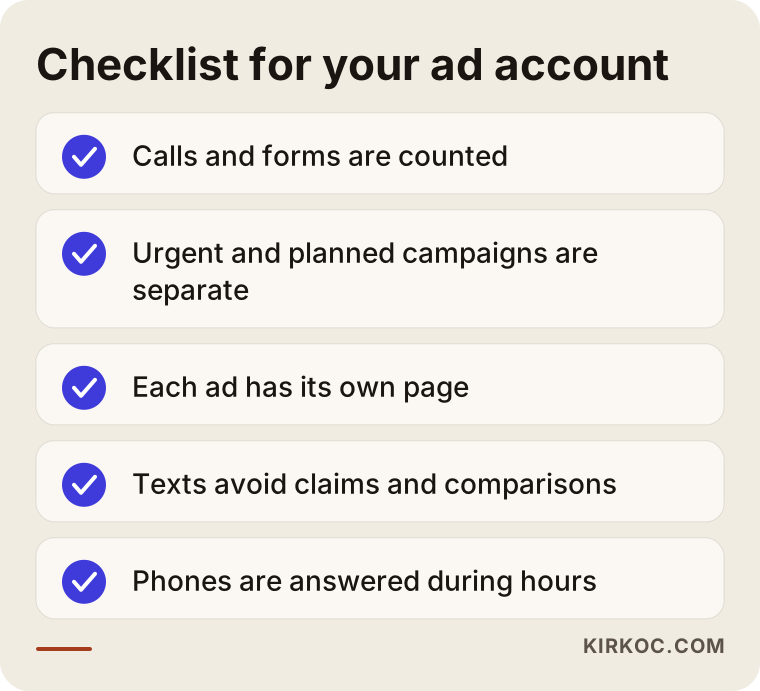
The checklist holds the basic questions you can use to audit your account, whether or not you hire anyone. If you cannot answer "yes" to most of them, fix those things before putting more money into ads.
What determines the cost
I will not give you a number, because the price of a click in dentistry is not fixed. Here is what moves it. First, the type of treatment: high-value treatments such as implants and orthodontics attract heavier competition, which affects what a click costs. Second, location: in big cities and central neighborhoods, more practices compete for the same words. Third, the quality of your page and ads: Google tends to favor relevant, fast pages. Fourth, hours and the targeted area: a narrower area spreads the budget less thinly.
Total cost has two parts: the ad spend paid to Google and the fee paid to whoever manages the account. Do not mix them up. The ad budget is under your control and goes straight to Google. The management fee depends on the scope of work, the number of campaigns and how often you get reports. When you collect quotes, ask for these two lines to be written separately.
How I work with you
I am based in Istanbul, and I provide the services a digital agency would, all in one pair of hands. You talk to me, and I do the work. When I work with dentists, I first look at where you are now: your website, your map listing, and any old ad account. Then you and I talk about the goal, and I give you a written plan of what will be done.
The ad account is opened in your name, and you keep access. Reports are written in plain language: instead of "click-through rate went up," you read "this month this many calls came in, these search terms worked, and I shut off these others." Because ads, website, local SEO and social media are handled by the same person, a problem I spot in one place can be fixed in another. I do not give guarantees: no promises about patient numbers, rankings or sales. What I can offer is steady work, open reporting and an account that respects the rules.
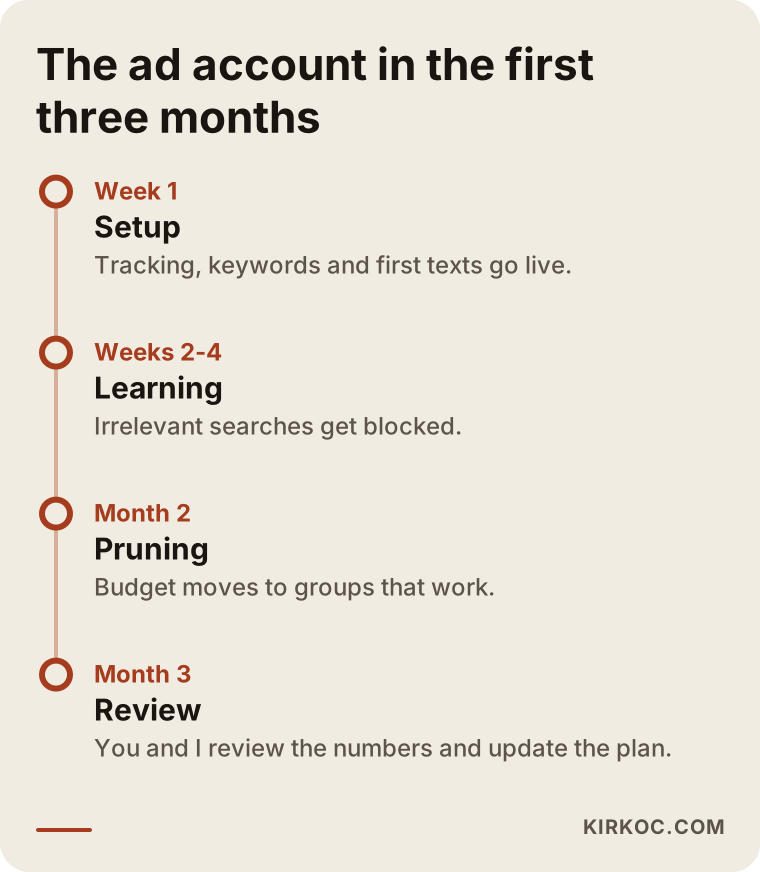
The timeline is there to set a realistic expectation. The first weeks are for measuring and learning, and the following weeks are for pruning and improving. A campaign usually takes a few months to mature, and knowing that from the start keeps you from giving up too early.
Decision point: are you ready to advertise?
Not every practice should start ads at the same moment. If your site does not work on a phone, if nobody answers the booking line, or if tracking cannot be set up, fix those first. The graphic below shows the simple logic.
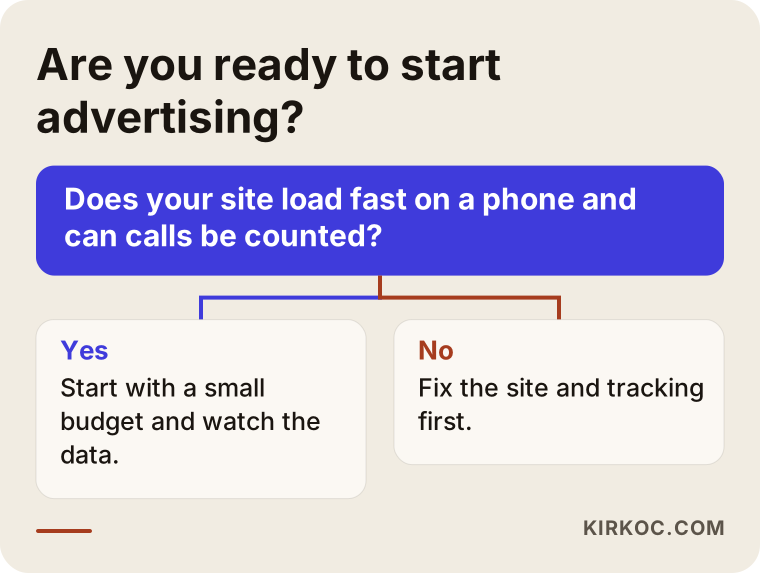
The question is simple, but it needs an honest answer. A "no" is not a barrier, just the right order: foundation first, ads second. That order is the surest way to get more out of the same budget.
Frequently Asked Questions
Can dentists advertise on Google?
In general, healthcare services can be advertised, but both professional standards and Google's healthcare policies set limits. I recommend confirming with your state dental board or a lawyer which wording is acceptable, and I write ad text within that frame.
Can I mention prices or discounts in the ad text?
This topic is sensitive under both regulations and platform rules. Check the current requirements before using any wording about prices or promotions. I usually prefer to put the service and the way to book in the text instead of a price.
Can I use before-and-after photos?
This is an area that calls for care. Regulations and platform policies may restrict photo use, and patient consent and privacy come into play as well. Talk to a lawyer or your professional body before using them.
Will patients arrive right after I start ads?
Ads give fast visibility, but there is no guarantee of results. The first weeks are a learning period in which it becomes clear which searches work. Results also depend on your page quality, your competition and how your phones are answered.
Which keywords should I advertise on?
Starting with urgent searches, planned-treatment searches and neighborhood-based searches is usually sensible. For informational searches, blog content may work better than ads. The exact list depends on your treatments and your area.
How much should my ad budget be?
I would not name a number, because the budget varies with treatment type, location and competition. Starting small, looking at the data in the first weeks, and then adjusting is healthier.
Can I manage the ads myself?
Yes, for a small test. But healthcare ad rules, tracking setup and negative keyword management take time. If your time or experience is limited, expert help can reduce wasted spend.
What is the difference between Google Ads and a Google Business Profile?
A Google Business Profile (your map listing) is free and lets you appear naturally in results. Google Ads is paid advertising and stops when the budget runs out. When both work together, a patient sees both the ad and the profile, and the chance of trust goes up.
If you want a compliant, measurable ad setup for your practice, you can write to me through the digital advertising page. I will look at where you stand with you and talk openly about where to start.