You run a hair removal or laser clinic. Your devices are modern, your team is experienced, your treatment rooms are spotless, and yet the phone does not ring as often as you expected. You post nice photos on Instagram, but the appointment book still thins out toward the end of the month. At this point most owners arrive at the same question: is the problem my service, or is it what people see when they find me? Often it is the second one. A website for a hair removal clinic, meaning the page a stranger lands on after searching for you, frequently decides whether a booking happens at all. In this article I explain what your site has to do in this particular industry, which pages you need, and how the work goes. I am Ümit Kırkoç. I work alone from Istanbul and handle website design together with SEO, social media and advertising, all in one pair of hands.
Let me be clear about one thing first: I will not promise you a number of bookings. Nobody can guarantee in advance how many appointments a site will bring in. What I can do is list, very concretely, the features that make booking harder or easier. After reading, you should be able to look at your own site and see what is missing, and when you request a quote from a specialist you will know which questions to ask.
What does someone looking for hair removal type into Google?
Clients in this field rarely type something broad like "hair removal." They type what is on their mind. One person starts with "how many laser hair removal sessions do I need." A few days later she types "laser hair removal legs" or "bikini laser hair removal." Finally she searches "laser hair removal near me" or adds a neighborhood name. Each search reveals a different state of mind.
The person in the first stage has not decided yet. She is looking for information, calming a worry or satisfying curiosity. Does it hurt, is it permanent, can you do it in summer, is it safe during pregnancy. The second person has decided, has picked the area she wants treated, and is now looking for a place. The third is nearly ready to book and only wants somewhere close, trustworthy and with convenient hours.
If your site does not answer all three groups, you are handing some of them to your competitors. The usual setup is a single "Laser Hair Removal" page where everything gets piled up. Google and readers both tend to prefer a structure where each question has a clear answer over one page that tries to say everything. That is why I will go through which pages you need and why.
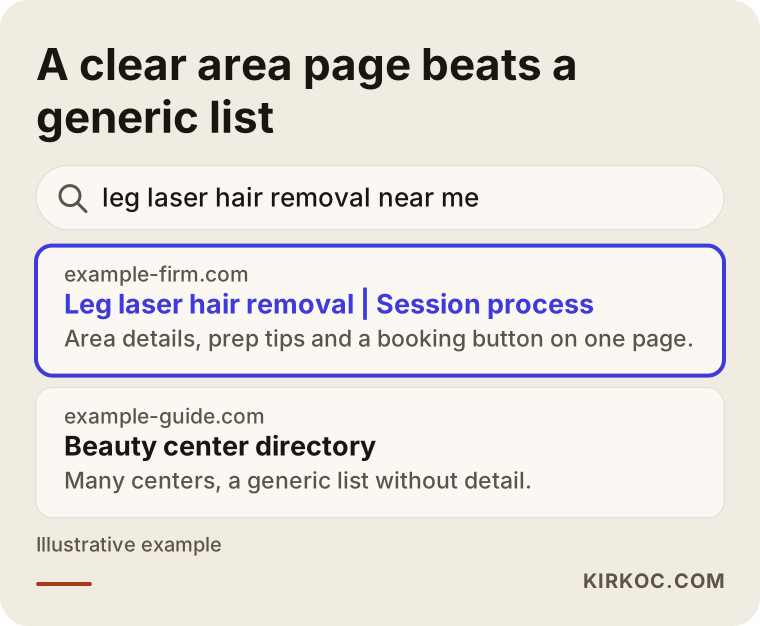
In the example above, a page that names the treatment area and the location sits next to a generic directory listing. The person searching usually picks the result that is detailed and speaks to her own concern. What matters is which of the two your page behaves like.
Why does a site in this industry work differently?
Hair removal is not a one-time purchase. It is a service that stretches over several months, concerns the body, and is personal. Those three traits change what your site has to do.
First, the client will be coming back to you for a long time. So before price, she weighs trust. She wants to know what the device is, who operates it, how you keep things hygienic and what happens at the first visit. If that information is missing from your site, she will not call to ask. She will usually go look somewhere else.
Second, the service is private. A person is preparing to uncover sensitive areas of her body in a place she has never been. Your site should speak in a calm, respectful and straightforward tone. Over-the-top slogans or glossy, loud photos have the opposite effect. If you offer separate hours or separate rooms for women and men, say so openly. That alone is a trust signal.
Third, the service is sold in packages. Clients think in terms of "full body" or "area package," not "one session." The way your site talks about price, whether or not you publish numbers, should explain what the price depends on. I come back to this below.
Which pages does a hair removal website need?
The point is not the number of pages. It is that every page answers one question. Think about these together:
- Home page: Introduces you briefly and points to your main services and the booking button.
- Laser hair removal page: Explains how the method works, what the number of sessions depends on, and what to do before and after a visit.
- Treatment area pages: Separate pages for the main areas such as legs, underarms, bikini line, face and back. Each answers the questions specific to that area.
- Men's hair removal page: Men search differently and ask different things, so this deserves its own page.
- Device and technology page: The brand of device you use, which skin and hair types it suits, and how you maintain and calibrate it.
- Team page: Who the practitioners are, what training they have and how much experience.
- FAQ: Pain, safety, spacing between sessions, who should not be treated.
- Contact and booking page: Address, map, opening hours, phone, WhatsApp and a form.
If you run several locations, each one needs its own page with its address, directions and hours. Otherwise someone searching for "laser hair removal" plus the name of a particular neighborhood gets lost on your home page.
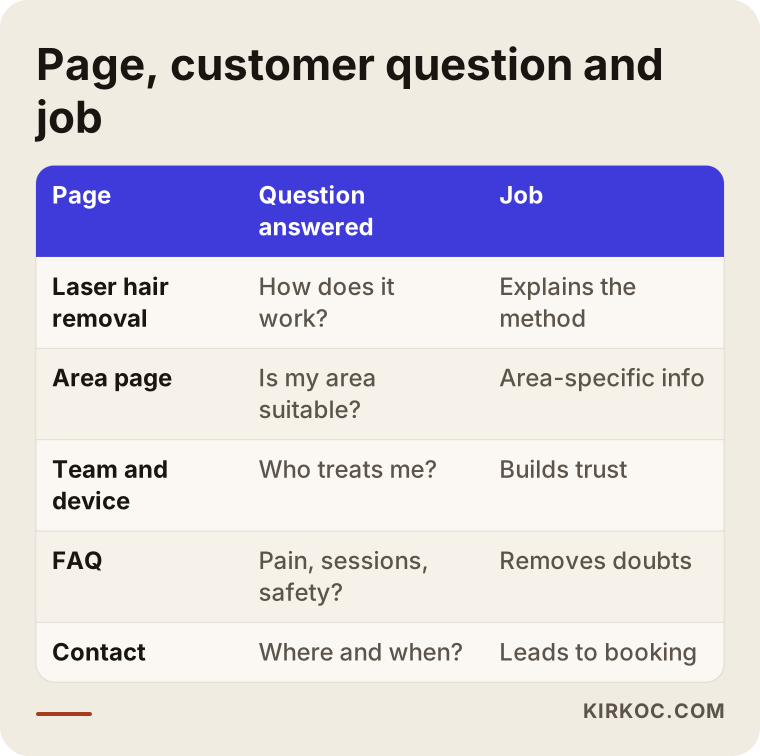
The table sums up which client intent each page serves. Every row answers a single question, which relieves both the reader and the search engine.
Why do treatment area pages matter so much?
This is one of the most industry-specific points. A client very often searches "underarm laser hair removal" or "facial laser hair removal" instead of "laser hair removal." If you explain everything on one page, Google may not treat that page as a good match for all of those searches. A separate page for each area lets you answer that area's questions in full.
There is a trap, though: making the area pages copies of each other. If you swap the word "legs" for "arms" and paste the same text, readers and search engines both notice, and the value of all those pages drops. Each page needs something that only belongs to that area: session length, sensitivity, how the hair grows, preparation tips, its own questions. The face brings up makeup and sun exposure. The bikini area brings up privacy and hygiene. Legs bring up the fact that sessions take longer.
Every area page should end with a clear next step toward booking. The reader has the information and has made up her mind, so she should not have to hunt for the way to book.
How do you build trust, and what should you show?
What people look for most in this field is the sense that the place is healthy and safe. These elements make a real difference on a site:
Who the practitioners are. Names, titles, years of experience and training. For someone who wants to know whose hands will be on her skin, an anonymous "expert team" is not enough. Before you publish staff details, get the staff's permission and talk to a lawyer about personal data rules.
Device information. Which device you use, which skin and hair types it suits and how often it is serviced. Whether a device is legal to use, what certifications it needs, and which license a clinic must hold depend on where you operate. Before you make any firm claim about these, have the rules checked by a professional. That is not my area, but everything you write on your site must be true.
What the first visit looks like. Many people put off booking because they do not know what will happen the first time. A skin assessment, a patch test, a consent form, a chance to ask questions: if you describe these steps plainly, the uncertainty shrinks.
Real photos. Pictures of your clinic, the treatment rooms, the waiting area and your team that you took yourself. Stock photos are spotted immediately in this industry and weaken trust.
Client reviews. Real reviews, shared with permission. Inventing reviews is unethical and can create legal trouble, and I want to be blunt about that.
Be careful with before-and-after photos. Some advertising and social platforms have rules about such images, and regulations in many places limit how health and cosmetic services can be promoted. Before deciding what to use, talk to a lawyer. I do not make a definitive statement on this.
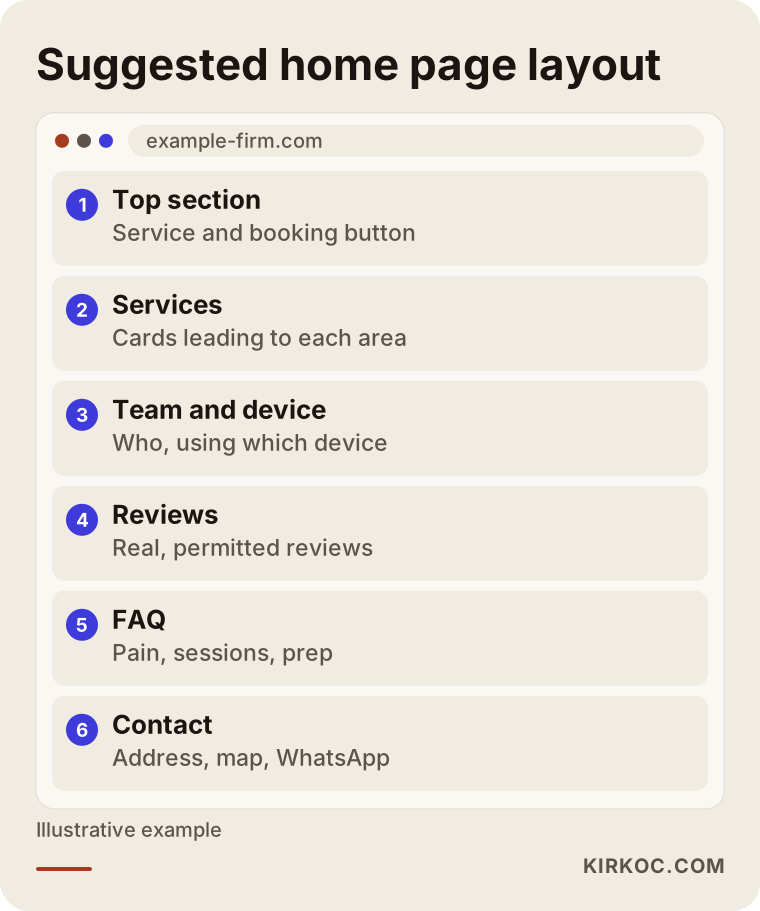
The layout above shows how a home page can flow in a sensible order. First what you do, then why you can be trusted, and last the road to booking, so the reader never reaches a question that has no answer.
How should the site handle pricing?
Whether to publish prices is one of the most debated topics on clinic sites. It is not a right-or-wrong matter. It depends on your strategy. But whichever way you go, you should explain what the price depends on. In this industry the cost is usually shaped by:
- The number of areas chosen and the size of each area
- Whether it is a package or a single session
- The type of device used
- How many sessions a client needs, which depends on her skin and hair
- The location, the time of day and promotional periods
If you prefer not to list prices, simply saying "it is personalized and clarified in a free consultation" is not enough. Say why that is so. If you do list prices, keeping them current is your responsibility. When an old promotional price stays on the site, the first conversation with the client starts with a disagreement.
There is also the question of what you will spend on the website itself. The cost of a site depends on the number of pages, whether you have several locations, whether a booking system has to be connected, how many languages you need and how much photography and writing has to be produced. I am not quoting numbers, because any figure given before the scope is known is misleading. Once the scope is clear, I can tell you plainly what budget it needs.
How easy should booking be?
In this industry the client you lose most often is the one who wanted to book and ran into an obstacle. Most people looking for hair removal browse on their phones, during the day, on the way home from work or in the evening. So the mobile view is not a secondary feature. It is the real site.
There should be a "Book Now" button visible at the top of the screen without scrolling. The phone number should dial when tapped, and there should be a link that opens WhatsApp in one tap. The form should be short: name, phone, the area of interest and a convenient time is usually enough. After sending it, the person should see a message saying her request was received and when to expect a reply. Answering requests quickly also depends on your own discipline more than on the site. Even the best site cannot save a form that goes unanswered.
An online booking system is a separate decision. If you use a calendar or reservation tool, the client picks a time herself and does not have to call. But the tool needs setup and ongoing maintenance. If you are a small clinic, starting with phone and WhatsApp and adding the system a few months later can be a sensible path.
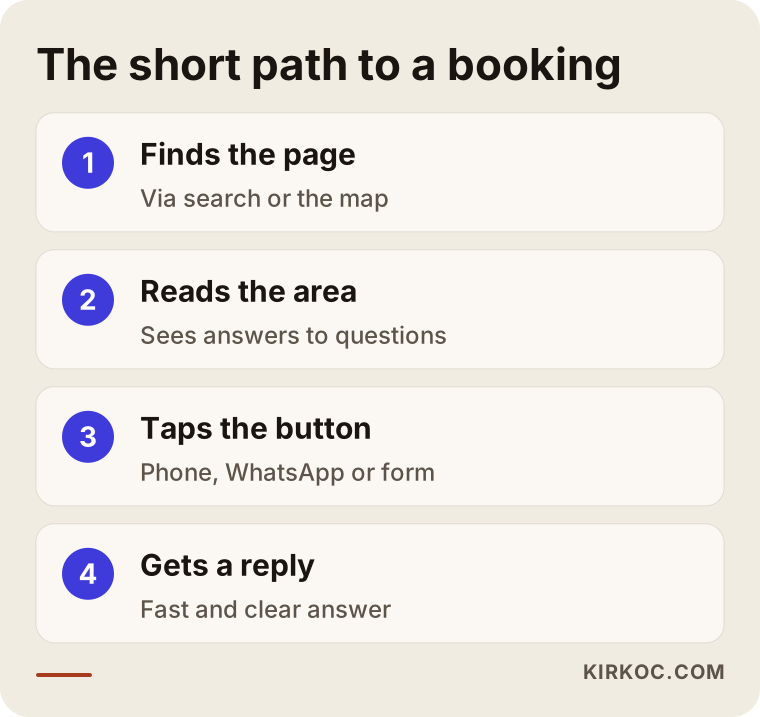
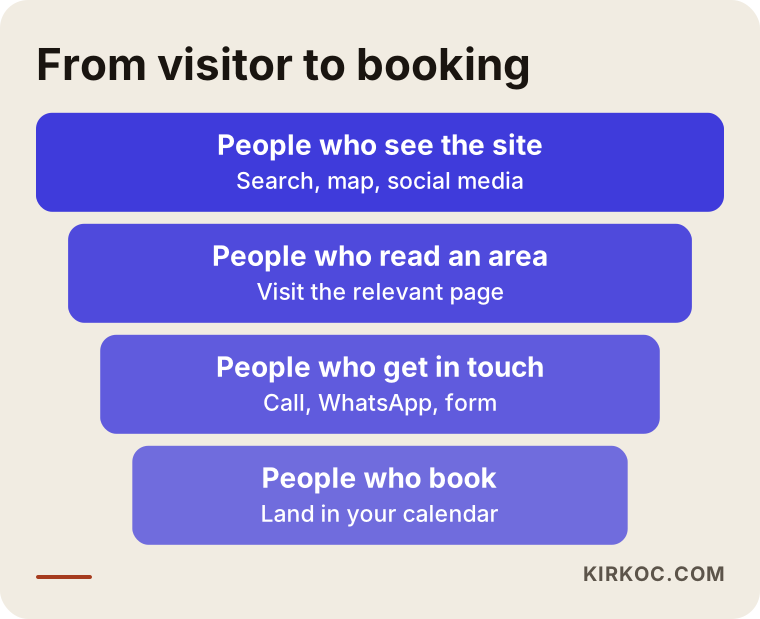
The steps above show the short path from finding the site to booking. No link in that chain should be broken; walking through your own site in this order and noting where you stall is a good place to start.
Two hypothetical example scenarios
The two examples below are entirely hypothetical. They do not describe a real business or person. I made them up only to show the reasoning.
Scenario 1: A small neighborhood clinic. Imagine a laser clinic with two treatment rooms and one device in a residential area. The owner says she has a website but no bookings come in. When I look, there is a single page, with "laser hair removal, skin care, brow lamination" in one list, and the neighborhood name appears only in the address at the bottom. The work would go like this: first a page focused on the main service, then separate pages for the three most requested areas, a contact page that includes the neighborhood name and directions, a short section introducing the team, and a cleanup of the Google business profile. The clinic's advantage is that it is small, so competition for searches close to home is limited. The goal is to be the clear answer for "neighborhood name + laser hair removal." I cannot promise how long that takes to pay off, but the work to be done is clear.
Scenario 2: A clinic with three locations. In this imaginary chain, every location is presented on the same page with the same text. Because there are no location pages, when someone searches a location name plus "laser," big directories fill the results. Here you start by building a separate page for each location: address, map, that location's hours, the device and the team found there. Then the shared area pages are written and each one links to the locations. A location selector is added to the booking form so requests land with the right team. The chain's problem is not too little content but a lack of internal order, and the fix is an organized page structure.
What both examples share is that I do not start from "a prettier design." I start from "which question brings this client in, and which page answers it." Design matters, of course, but it comes second.
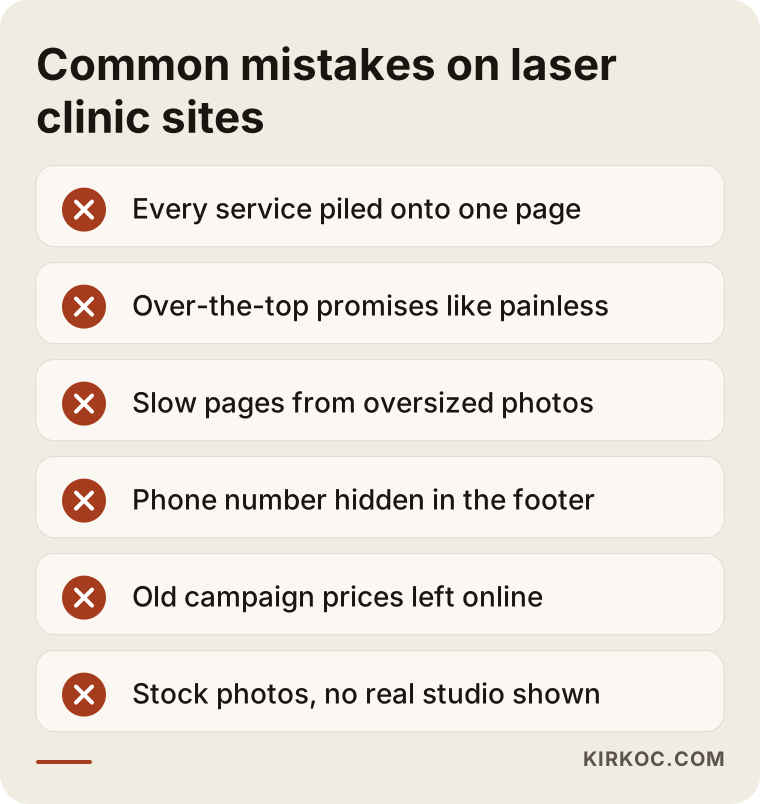
The list above summarizes the mistakes I see most often in this industry. Below I go into some of them in a bit more detail.
Common mistakes on hair removal sites
Piling everything onto one page. Laser, brows, skin care, massage, all on one page. The reader cannot find what she wants, and the search engine cannot tell what the page is about.
Exaggerated promises. Phrases like "permanent solution," "painless" or "guaranteed results" damage trust and can also create risk under the rules for promoting health services. I suggest talking to a lawyer before using claims like these. Honest wording converts better over time.
Heavy, slow pages. Because the industry is visual, large photos are common, and when they are not shrunk the page opens slowly on a phone. A customer will not wait for a slow page. She closes it.
Text that is hard to read on mobile. Tiny type, overlapping buttons, pop-ups that will not close. Try your site on your own phone once, as a client would.
Hiding contact details. The phone number and address sit in tiny type in the footer. At the moment someone decides to book, those details should be in the most visible place.
A site nobody updates. Old promotions, staff who no longer work there, changed opening hours. A site that was launched once and forgotten slowly wears down trust.
Treating social media and the site as separate worlds. When your Instagram account and your site use different colors, different language and even different names for the same treatments, the client feels she is looking at two businesses. Here it helps to have everything in one hand: the site, the social posts and the ads speak in the same voice, and you do not have to coordinate several people to get that.
What gets your site found?
A good site is useless if nobody finds it. For a hair removal clinic, being found is built mainly in three places.
Search results. The pages on your site need to match the phrases clients actually type. The key is that each page focuses on one intent, and that the title, subheadings and text clearly reflect it. Your language should be the client's language. Explain device terms plainly instead of using them unexplained.
Maps and local results. For searches like "laser hair removal near me," Google shows map results. Your Google business profile needs to be complete, current and full of photos, and your address, phone number and hours must match your site exactly. That small consistency carries real weight in local visibility. Replying to reviews also shows the profile is alive.
AI answers. Many people now ask tools such as ChatGPT things like "what should I check before getting laser hair removal in a new city." These tools can draw on sites that give clear, organized and consistent information. Having clear questions and clear answers on your site helps in this new way of searching as well. I am not promising any ranking here. I am saying that understandable content helps both people and machines.
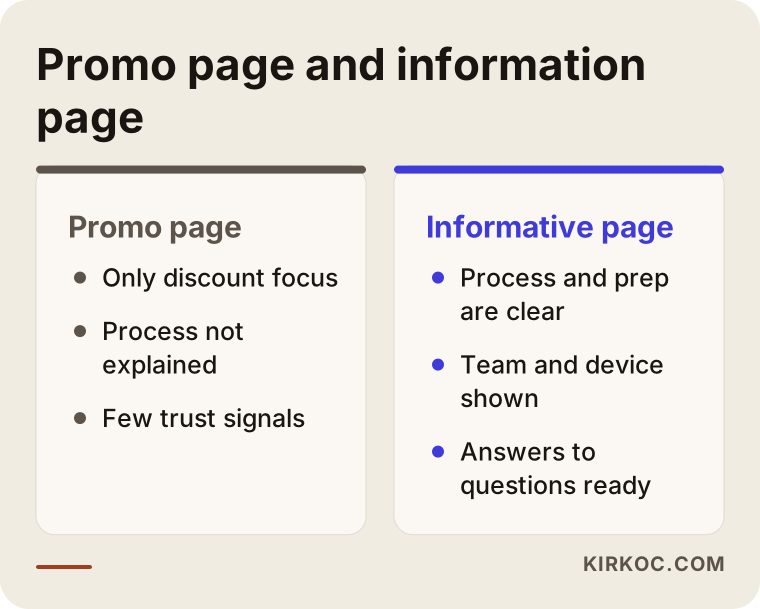
The comparison shows the difference between an ordinary promo page and an informative service page. The second one moves an undecided client toward trust and a trusting client toward a booking.
What can you do yourself, and when do you need a specialist?
You do not have to hand everything to a specialist. You can do the following on your own:
- Collect clear photos of your clinic, rooms and team that you took yourself
- Write down the questions clients ask most often in a notebook; that is the raw material for an FAQ section
- Keep your Google business profile current and reply to reviews
- Write your opening hours, address and phone number identically everywhere
- Try your site on your phone as if you were a stranger and note where you get stuck
You need a specialist in situations like these:
- Your site is slow, looks broken on a phone or shows a security warning
- You have to build a structure such as area and location pages and write the text to fit it
- You want to measure where you stand in search results and improve it regularly
- You are thinking about advertising, where targeting, budget and tracking have to be set up correctly
- You want your site, social media and ads to speak with one voice
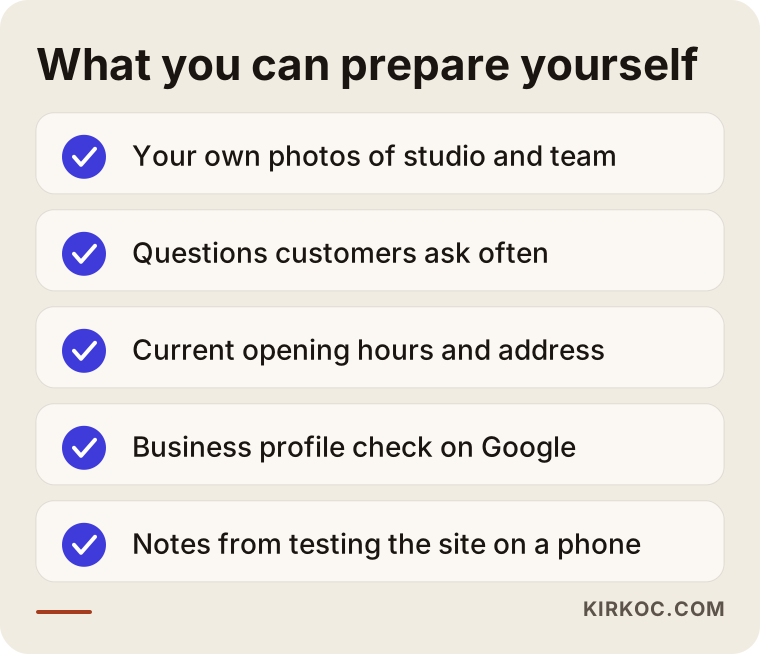
The checklist summarizes what you can prepare before going to a specialist. A business that has done this groundwork saves both time and effort when working with one.
How does the process work, step by step?
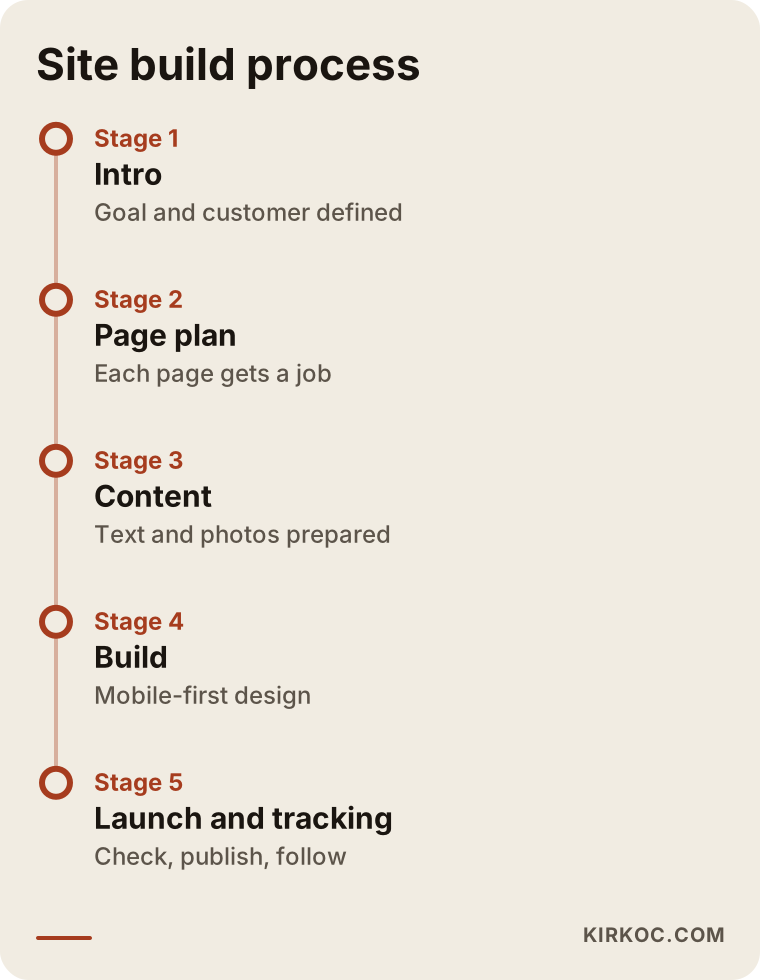
If you work with me, the process goes roughly like this. Timing depends on the scope of the job, so I do not give a number of days.
1. Introduction and defining the goal. We talk about which services your clinic stands out for, which areas and which kind of client you want to reach, and how your current site and your competitors look.
2. Page plan. Using the logic described above, I work out which pages will be built and which question each will answer. I do not move on to design until this plan is approved.
3. Content and visuals. The text is written in plain language, combining your knowledge with my way of structuring writing. If photography is needed, it is planned. For sensitive wording I ask you to consult a lawyer.
4. Design and build. The site is built mobile-first. The booking button, form, WhatsApp link and map are placed. Speed and image sizes are checked.
5. Pre-launch check. Every form is tested, every link is checked and all pages are reviewed on a phone and on a desktop.
6. Launch and measurement. The site goes live and tracking is set up so you can see how many people fill in the form or call. That way the question "is it working?" is answered with visible data, not with a feeling.
7. Improvement. After launch we look at which pages get attention and which searches bring people in. If needed, new area pages are added and texts updated. If you want, this is combined with social media and advertising work.
The timeline shows what each stage produces. Having something concrete in hand at every stage makes it easier for you to follow progress.
How do ads and social media fit with the site?
Hair removal is a visual and seasonal industry. Interest rises in spring and before summer, and in winter many people think, "if I start now, I will be ready for summer." If you want to run ads, the page the ad leads to is decisive. If someone arrives from an Instagram or Google ad and lands on the home page, she cannot find the area she wanted and leaves. A person coming from an ad should go straight to the relevant area page, and there to a clear booking call.
For health and beauty services, ad platforms have rules. Before and after images, statements about body size and certain health promises can be rejected. I suggest reading those rules before opening an ad account and keeping the claims on your site consistent with those in your ads. Because details change over time, check the current version on the platform's own pages.
Social media is a supporting channel that feeds trust. Short videos on Instagram answering the questions people ask before a first session, posts that introduce the team and a tour of the clinic all reinforce what is on the site. The site, in turn, becomes the lasting, searchable place where all of that is gathered. When it is all handled by one person, the promise in a post, the promise on the site and the promise in an ad do not contradict each other.
The funnel shows how broad interest narrows to a small number of bookings. Some people drop out at every stage, and the aim is to reduce the reasons they do.
What should you measure on your site?
After launch, the answer to "how is the site doing?" should come from a few simple indicators, not from a feeling. Here they are, without technical jargon:
- How many people visited and where they came from: search, maps, Instagram, ads
- How many people tapped the phone number or clicked WhatsApp
- How many people filled in the form
- Which pages are read more, and which ones people leave right away
- How many of the people who filled in the form actually became appointments; this last piece comes from your calendar, not from the site
All of these can be tracked with free tools. What matters is that at the end of the month you can glance at them and decide what to fix. The numbers may be small, which is normal for a small business. Look at whether the direction is right instead of fixating on the count.
Questions to ask yourself before deciding
These questions will help you decide whether to invest in a website or renew your current one:
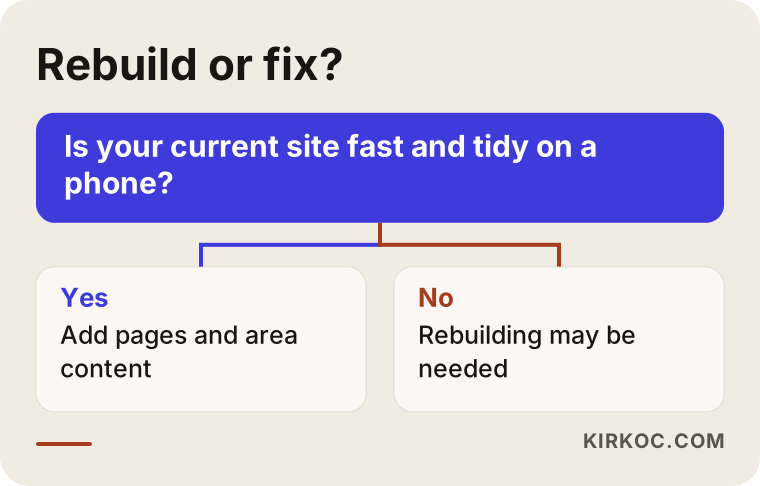
- Does my site open fast and read easily on a phone?
- Are the answers to the first five questions in a client's mind on the site?
- How many steps does it take to book?
- Does my neighborhood or location show up in searches?
- Is my information the same everywhere?
If you answer "no" to two of the five, you should review the structure first instead of just changing the design.
The chart shows how to choose between building a new site from scratch and fixing the existing one. If the current site has a solid base, adding pages and content may be enough.
Frequently Asked Questions
Do I really need a website for a hair removal clinic, or is Instagram enough?
Instagram is a strong storefront, but it is not enough on its own. Access to your account can be restricted, posts disappear in the feed, and it is hard to show up in search results for intent-driven queries like "area + laser hair removal." A website is the lasting place that belongs to you. The two work best together.
Do I have to write each area page separately?
Not strictly, but clients mostly search by area. It makes sense to start with the three or four most requested areas. Each page needs text that is specific to that area and actually informs the reader. Copied text does not work.
Should I list prices on the site?
That is a strategic decision. If you list them, you must keep them current. If you do not, you must explain what the price depends on. Whichever you choose, it is important not to leave the client uncertain.
Can I use before-and-after photos?
Both regulations and advertising platform rules can come into play here. It would not be right for me to give a definitive answer. Talk to a lawyer before using them, and check the platform's current rules.
How long after launch will bookings start?
I cannot give a firm timeframe, because it depends on competition, your area, the content of the site and the state of your business profile. Requests that come directly by phone and map are usually noticed earlier than improvements in search results. But I do not guarantee any outcome.
What should multi-location clinics do?
Each location should have its own page: address, map, hours, directions and the team that works there. Shared service pages link to the locations. If the booking form includes a location choice, requests go to the right place.
Should I work with different people for the website, social media and ads?
You do not have to. If you work with different people, each may develop a different voice and goal, and the coordination falls on you. When I handle everything, the messages stay consistent and you talk to one person.
What will you need from me once the site is underway?
I will ask you for content inputs such as photos, team details, questions clients often ask and your opening hours. You will also need to respond quickly to incoming requests. The site opens the door, but you are the one who welcomes people in.
If you would like to talk through what kind of site your clinic needs, you can reach me through my website design page. I will listen to where you are now and tell you honestly what you need.