Your listings are live, your phone rings now and then, and yet something is missing: most people who see your name still know you only as one line on a listing site. There may be ten agents working the same neighborhood, all showing similar homes with similar photos, and a buyer or renter has no easy way to tell who is trustworthy. That is where social media management for real estate agents earns its place. The goal is not to post a house photo every day. It is to introduce you and the way you work, so that more people trust you before they ever open a listing. In this article I cover what is special about this industry, which platform does what, two made-up example scenarios, and how the work runs in practice. If you would rather hand the whole job over, you can also look at my social media management service.
How a property client decides on social media
Buying or renting a home is one of the biggest spending decisions most people make. Nobody decides in a day. A person starts with a vague idea, browses listings, asks friends and family, and finally chooses one person to talk to. Social media can touch almost every step of that path, but each step needs something different from you.
In the first stage, the person is not looking for you at all. They are scrolling and happen to see a neighborhood video, a short explanation of how renting works in a certain area, or a moving tip. You are not selling anything here. You are simply being remembered. In the second stage, the person gets serious and wants information: how closing costs work, what a lender looks at, what commuting from a particular area is like. In the third stage, they open your profile and ask themselves whether these people actually work in this field. In the last stage, they send a message or call.
The graphic below shows this path as a simple funnel. Many people know you at the top, and only a few request a conversation at the bottom. Your job is not to make the top wider at any cost. It is to make it easier to move from each step to the next.
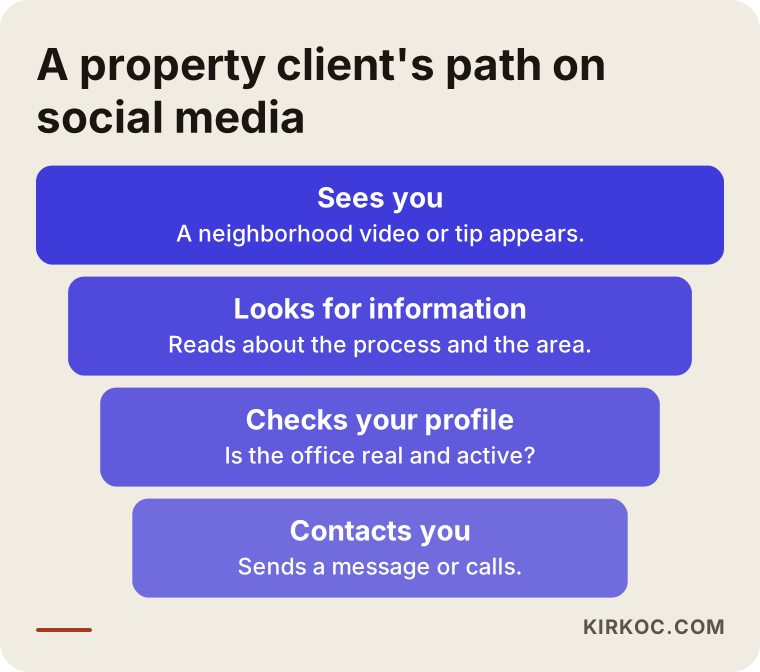
Keep this funnel in mind while planning content. Before every post, ask yourself which step this post speaks to. If you cannot answer, the post will probably go to waste.
A listing portal and social media are not the same job
Many agents treat social media as a second place to display listings. They take what is on the portal, drop it into Instagram as is, and add a price and a phone number underneath. That is not wrong, but it is not enough, because the two channels do very different work.
On a listing portal such as Zillow or Realtor.com, the person is already looking for something. Filters, price range and bedroom count are decided. The listing that wins there is usually the one with the right price and strong photos. On social media, nobody is searching. People find you by accident or through a recommendation. What wins there is the person who seems trustworthy and knowledgeable. Put simply, the portal sells the listing, and social media makes people remember you.
This difference matters because on a portal, every agent looks like just another listing owner. On social media, you can put your office and your own voice forward. For agents who want to depend less on portals and paid leads, that can be a real relief.
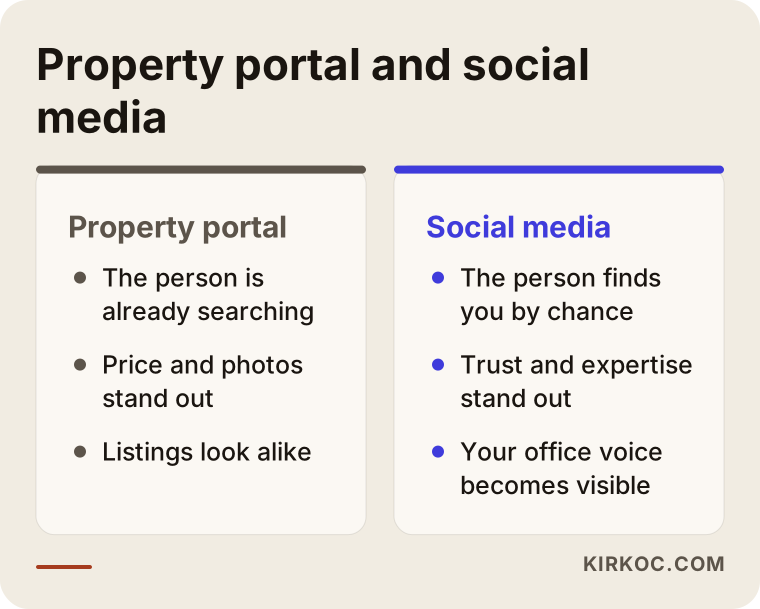
The takeaway from this comparison is not to swap one for the other. The portal meets demand that already exists. Social media nudges that demand toward you. Some offices put everything into portals and pay for the same competition every month. Others back up their portal listings with a real story on social media.
Which platform does what
You do not need to be everywhere at once. A small office that runs three platforms halfway will do worse than one that runs a single platform well. First decide who you want to reach: families buying a home, investors, renters, or businesses looking for commercial space.
Instagram is the most natural fit for residential sales and rentals. Because it is visual, home tours, neighborhood introductions and short videos work well there. Facebook is still useful for local groups and an older audience, with community groups, listing shares and a business page all making sense. LinkedIn suits commercial property, offices and land, where buyers are more corporate. YouTube builds a lasting archive of longer explanations and project tours. TikTok can reach younger renters and first-time buyers, but it demands steady video production.
The table below sums up this split. Mark the row that fits your office best, and start with two platforms at most.
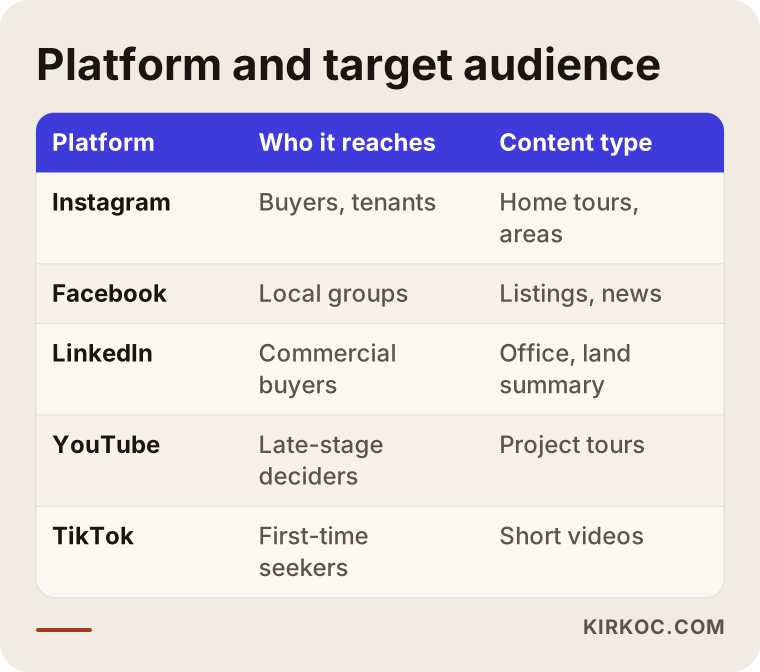
If you are not sure which platform to choose, look at how your recent clients found you. Of your last five deals, how many came from a phone call, how many from a message, how many from a referral? That answer often tells you where to spend your energy.
The first five seconds of your profile
When someone sees you for the first time, they land on your profile and decide within a few seconds: is this office real, active and trustworthy? In real estate this decision carries extra weight, because the industry has a trust problem. People have heard stories about fake listings, homes that do not exist and agents who never pick up.
So your profile has to work like a shop window. The profile photo should be a clear logo or your face. The bio should say in one sentence which area and which kind of properties you handle. Contact details, office address and opening hours should be complete. Highlight stories can carry titles such as "How I work," "Common questions" and "Sold and rented." Showing the office sign or entrance also helps, because it instantly gives the feeling that this place is real.
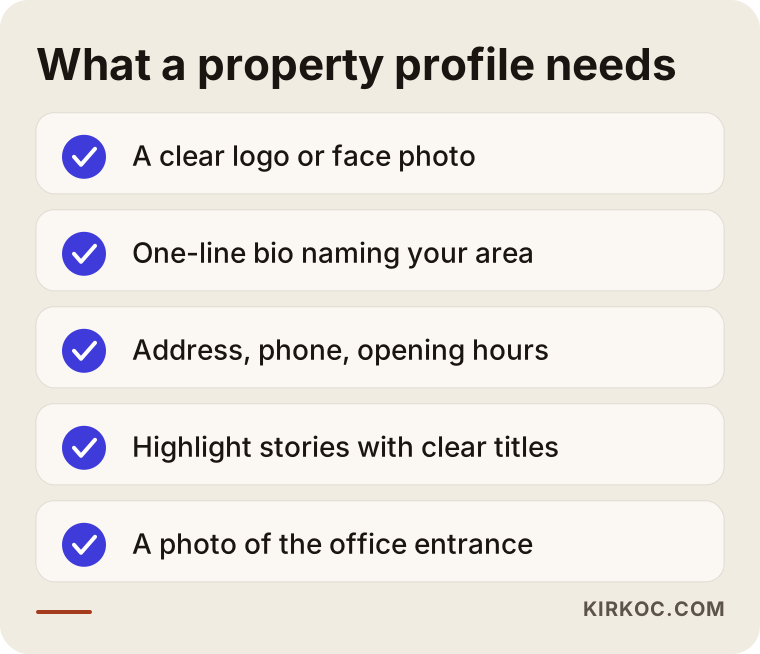
Going through this list once takes less than an afternoon, but the effect lasts for months. Producing content before fixing the profile is like decorating the window of a shop with a locked door.
What to post: more than a photo of the house
The problem I see most often is an account made up entirely of listings. A follower loses interest after a couple of posts, because every post is the same: photo, square footage, price, phone number. That kind of content speaks to the few people who are ready to act today, and everyone else scrolls past.
For a better mix, think about five groups of content. The first is listings, but with a story: say honestly why a home is interesting, who it suits and what it lacks. The second is neighborhood content: the shops, schools, transit, and what the street feels like on a quiet morning versus a busy evening. The third is explanations of the process: what to check in a lease, which documents a buyer usually needs to gather. On topics like these, avoid firm legal claims and tell readers to ask an attorney when needed. The fourth is behind the scenes: preparing for a showing, the team at work, handing over keys. The fifth is completed work, with permission: a post like "keys handed over this month" is fine as long as the owner has agreed.
Rhythm matters too. The timeline below shows a week that a small office can realistically keep up. The exact days will differ from office to office. What matters is that it is sustainable.
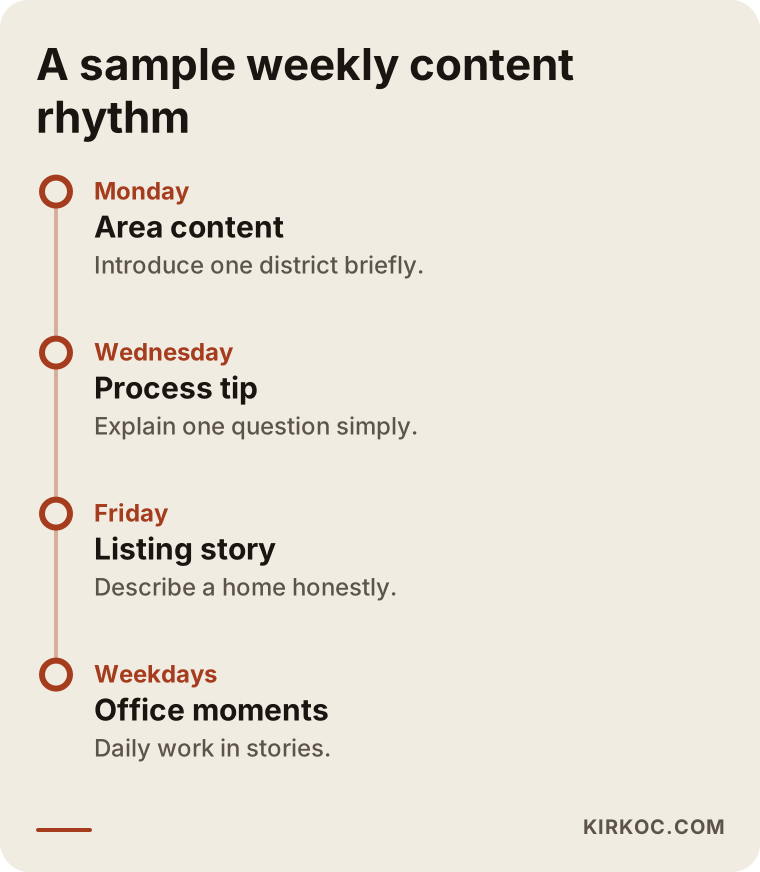
Posting regularly beats posting a lot. Three good posts a week for three months is worth far more than thirty rushed posts in one month followed by silence.
Short video and real footage of the place
In real estate, video gives what text cannot: the feel of a space. A photo cannot show how light enters a room, how big the rooms really are, or what the street sounds like. You also do not need expensive gear. A decent phone, a steady hand and a clear opening line are usually enough.
Being honest on camera builds trust. If the apartment has a narrow hallway, show it. A visitor who is disappointed later will not call you again. Work the flaws into the story, though: "The kitchen is small, but the balcony is big." A realistic description attracts the right person and filters out the wrong one. It may lower your showing count, but it also lowers the time you spend on visits that were never going to work.
Neighborhood videos are especially useful. Walk through an area for ten minutes one morning and answer the question "what is it like to live here?" That kind of video can still be watched months later. It does not lose value when a listing expires.
People will also search for you on Google
Social media does not work alone. When someone sees your account and gets interested, what do they do next? Very often they type your office name into Google. What they see there either strengthens that first bit of trust or breaks it. Your map listing, reviews, website and social accounts should all tell the same story.
The example below shows a made-up results page for an invented office name. In the highlighted result, the address, phone number and opening hours are clear. The other result is an old directory entry. Inconsistent information plants the doubt: has this place closed?
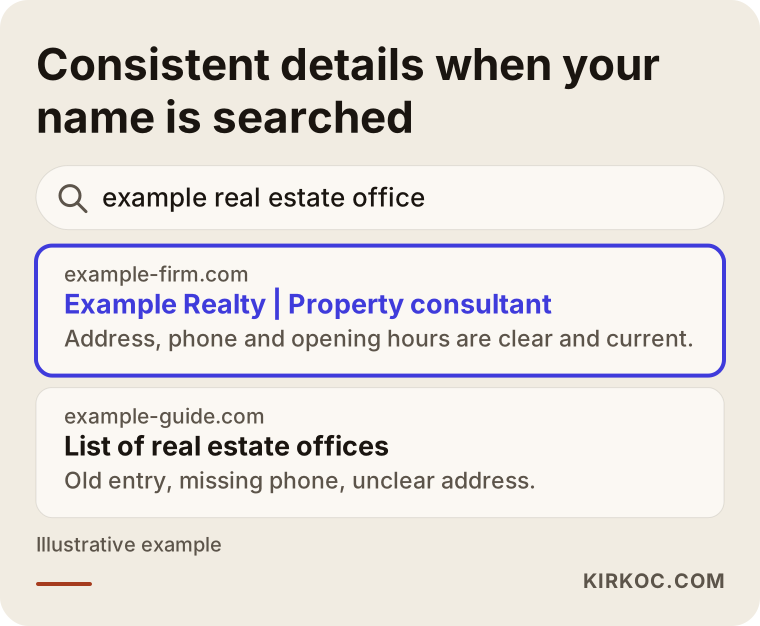
That is why I suggest writing your office name, address and phone number exactly the same way everywhere. A short consistency check is the cheapest insurance for your social media effort. Showing up in local searches is a separate job, but matching details keep your social accounts from getting in its way.
Two hypothetical scenarios
The two examples below are entirely hypothetical. They do not describe a real office or person. I made them up only to show the reasoning.
Scenario one: a neighborhood office that only posts listings. Imagine a small office that has worked the same area for ten years. Its account contains nothing but listing images. The owner says, "I know this neighborhood better than anyone, but nobody knows that." The first job is to make that knowledge visible: a few neighborhood introductions a month, short explanations of how renting and selling work, and permitted examples of finished deals. The profile gets cleaned up and permanent highlights are prepared. No result can be guaranteed, but a reasonable expectation is this: people may not like a particular listing, yet they remember the office and think of it the next time they search.
Scenario two: an agent selling a new development. Now picture an agent handling sales for a new residential project. Buyers think for a long time and ask many questions. Instead of posting listings one by one, the agent creates content about the project's common questions, the transit situation, and how to read the payment plan (the logic only, no figures). Short videos go on Instagram, a longer project tour on YouTube, and a plain summary for investors on LinkedIn. People who message already know the basics, so the conversations are more productive.
What the two scenarios share is that the content informs before it sells. People trust whoever helps them understand.
When to bring in advertising
Organic posts work slowly. If you want to announce a listing right away or reach people in a specific neighborhood, paid ads are an option. On Meta platforms you can target by location, age and interests. But ads do not rescue a weak profile. If people click through and find an empty account, the budget is wasted.
Fix the account first, then choose one goal: collecting messages, getting phone calls, or signing people up for an open house. The ad budget can start small and be adjusted based on what happens. I cannot promise a particular result, because ad outcomes differ from market to market. When ad management and social content run through the same hands, the message stays consistent and you can see who is being told what from one place.
Social media, your website and your listings should work together
For most offices, social media sits in its own corner. Yet a person who becomes interested on social media usually looks at your website next. If they cannot find information about the office, the team, the areas you serve, current listings and a contact form, the interest you built fades.
The sketch below shows a simple page layout for a visitor arriving from social media. It tells the person plainly what to do next, and it reads comfortably on a phone.
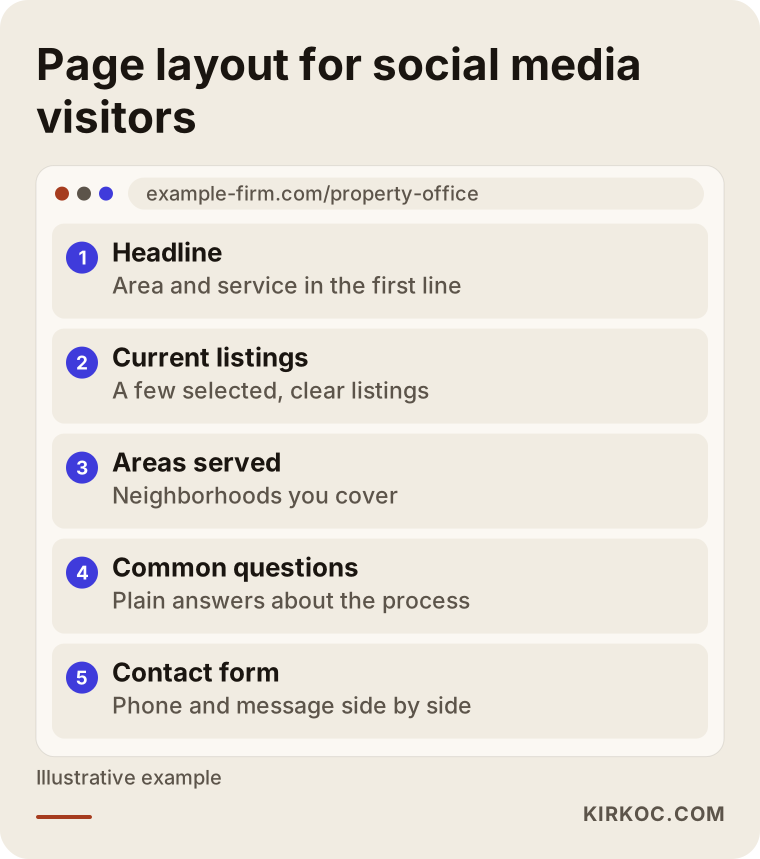
This is where the way I work makes a difference. Because I handle the website, local search visibility, social media and ads myself, what is said in one place matches what is said in another. The intro on your profile does not contradict the text on your site, and the promise in an ad is answered on the landing page. When different people split the work, that match often gets lost, and the office owner has to patch the gaps personally.
Do it yourself or hire a specialist?
To be honest, not every office needs to outsource social media. If you have the time, the interest and the desire to create content, you can start on your own for the first few months. The sticking point is usually time: handling clients all day and then producing content in the evening is hard to keep up.
When you decide, look at a few things. How many hours a week can you set aside? Are you comfortable in front of a camera? Are writing copy, preparing graphics and answering messages your kind of work, or a load you are already failing to carry? Your answers point to the right path.
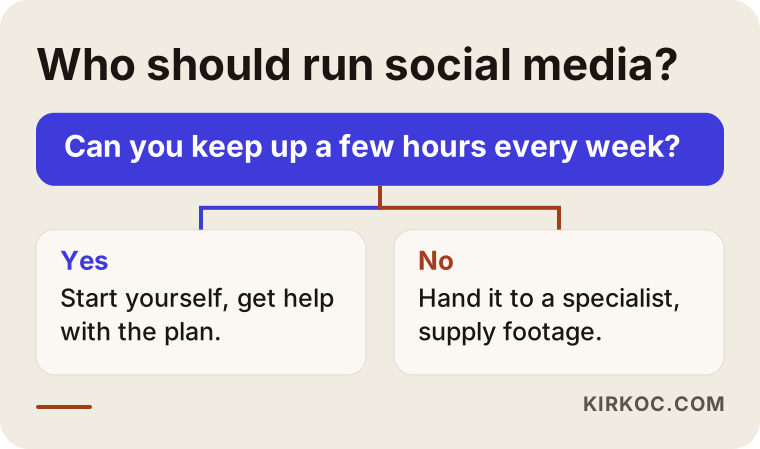
A hybrid model also works. A specialist prepares the plan, the calendar and the visuals, and you only supply the footage that has to be shot at the office or the property. That keeps costs contained and keeps the content tied to real life.
Common mistakes
I keep seeing a handful of mistakes in real estate. Most come not from bad intentions but from lack of time and the idea that everyone else does it.
The first is posting only price and phone number, since people do not call someone they do not yet trust. The second is answering messages late: a person who writes from social media expects a quick reply, and after a day they message another agent. The third is buying followers or chasing engagement, which distorts the real interest in your account and weakens ad targeting. The fourth is sharing photos or client details without permission: using interior images without the owner's or tenant's consent can cause problems. For the specifics of privacy and fair housing rules in your area, I suggest you talk to an attorney. The fifth is quitting after a month without seeing results.
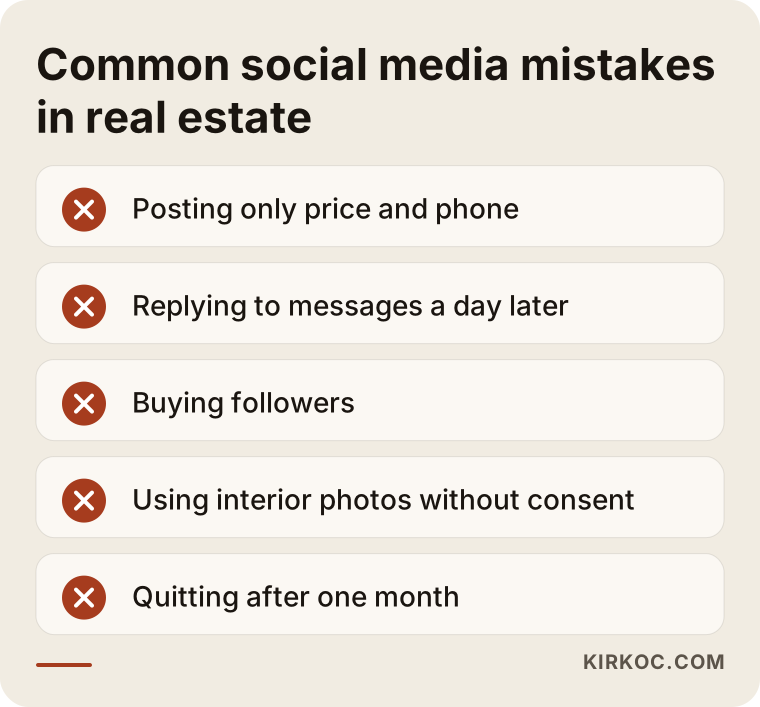
None of these mistakes is permanent. You can fix each one the moment you notice it. What matters is not pushing the fix to next month.
Step by step: where to start
For an office starting from zero, or one that wants to tidy up an existing account, a simple roadmap looks like this. First, take a snapshot of where things stand: which accounts exist, who runs them, and whether the profile details match. Then choose the target audience and the platforms. Next, prepare a monthly content calendar, so you know in advance what kind of post goes out each week. In production, photos, videos and copy are made. Once posting begins, messages and comments are monitored. At the end of each month, you look at what worked and update the plan.
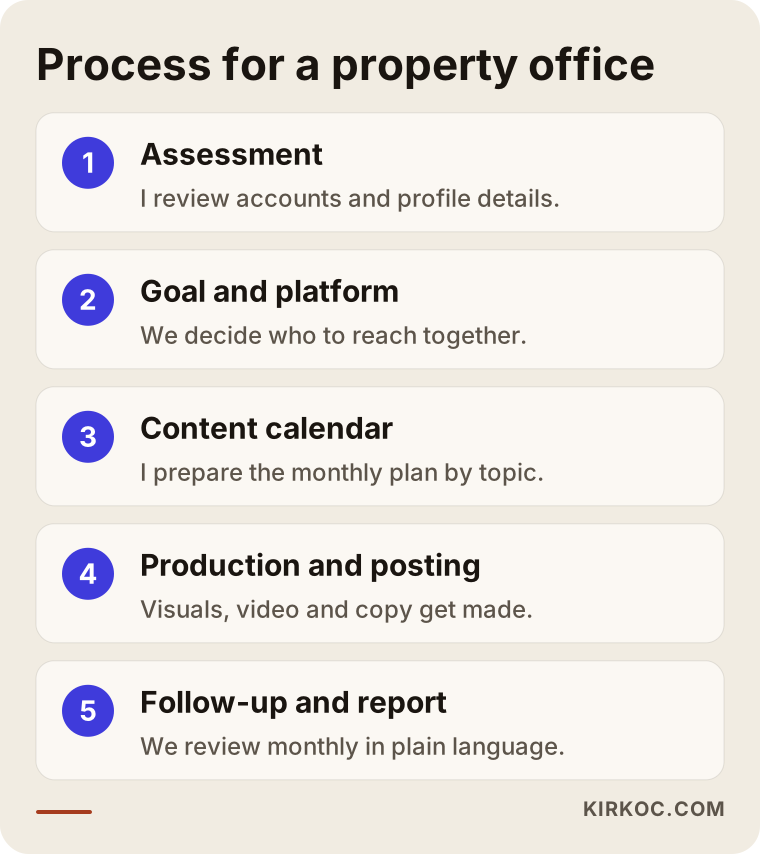
This process does not ask much of the office owner's time. What it needs most is plain talk in the first conversation and a description of how your office really runs day to day. If you do not want to appear on camera, you can build the identity around the office instead.
What affects the cost
I am not giving numbers in this article, because the work varies a lot from office to office. The main things that set the cost are these: how many platforms you will be on, how many pieces of content are produced each month, who films the videos and where, how much of the graphic design is made from scratch, who answers the messages, and whether ad management is part of the job. The ad budget and the service fee are also separate items, and the ad budget is paid directly to the platform.
When you collect quotes, ask for the list of work in writing, ask that the accounts be opened in your name, and ask for reports in plain language. Be careful with any quote that guarantees followers or sales. Nobody can honestly guarantee those results. My own approach is to look at your office's situation in the first conversation, offer a prioritized plan, and set the price against that scope.
How I work with you
I work from Istanbul as a single specialist who provides the services a digital agency would, so the person you talk to is the person doing the work. The website, local search, social media management, Google and Meta ads, logo design and content production all sit at one table. For a real estate office, that usually means this: I first tidy up the profiles and related details, then build a monthly content plan, prepare the visuals and copy, set up ads if needed, and report each month in plain language on what happened.
I do not have the big team a large agency offers. My capacity is limited, and I say so up front. In exchange you get quick decisions, a short line of communication and one person who owns the work from start to finish. Your accounts and sites remain in your name, so if our work together ends, nothing is left hanging on my side.
Frequently Asked Questions
Which social media platform is best for a real estate office?
There is no single right answer. For residential sales and rentals, Instagram is a good start for many offices, Facebook helps with local groups, and LinkedIn can make sense for commercial property. I suggest starting with two platforms at most, based on where your target audience spends its time.
Do I need to post every day?
No. Three or four good posts a week is sustainable. Posting heavily and then quitting does more harm than a calm, regular rhythm. The important thing is to set your pace according to your office's real capacity.
What should I watch out for when sharing clients' homes?
Do not share interior photos, the address or personal details without the explicit consent of the owner or tenant. For details on privacy and fair housing rules, I suggest you talk to an attorney.
Do clients really come from social media?
They can, but I cannot guarantee a result. Social media usually works less as a short-term sales channel and more as a channel for trust and recall. When people call you weeks or months after getting to know you, your content may have played a part in that decision.
Does buying followers help?
I do not recommend it. Purchased followers are not real clients, they lower engagement rates and they weaken ad targeting. A smaller number of real, local followers is worth more to your office.
Can I start on my own and hand it over to you later?
Yes. If you already have accounts, I first look at their state and tell you what to keep and what to change. Starting alone is not an obstacle, and the existing content archive is often useful.
Is social media management the same as advertising?
No. Social media management covers regular content, the profile and messages. Advertising means paying to reach more people. The two work better together, but they are separate items and their budgets are planned separately.
How do I track results?
Each month I walk you through a plain report: which posts brought more messages, which got no attention. More than the raw numbers, it matters how the real questions and calls you receive are changing.
If you want your real estate office to earn trust on social media and reach the right people, take a look at my social media management page and send me a short message describing your office. Then I will tell you where I would begin.