You run a business in Eskişehir, or you plan to sell there from abroad. Maybe it is a cafe near the Odunpazarı old town, a clinic in Tepebaşı, a workshop that sells to visitors, or a factory in the industrial zone that makes parts for customers in other countries. You have a website, yet when someone types "Eskişehir" plus your kind of service into Google, a competitor shows up and you do not. That is a frustrating spot, and it is the reason many people end up searching for "SEO services Eskişehir". This article explains what to expect from SEO in a mid-sized Turkish city, which pages actually help, and how to judge an offer. I am Ümit Kırkoç. I work from Istanbul and handle, by myself, the jobs a digital agency would normally split between several people. I describe my own SEO services where it is relevant, including their limits.
SEO is the work that helps your website appear when potential customers search on Google. You do not pay for each click the way you do with ads, and a well-built setup keeps working while you sleep. But it is not a switch you flip. It takes effort, it takes time, and nobody honest can promise you a particular position. Eskişehir has a customer base that behaves differently from Istanbul or Ankara, so copying generic advice usually misses the target. Let us start with how the city searches.
What do customers in Eskişehir type into Google?
Eskişehir is a mid-sized, walkable city known for its universities. Those three traits shape search habits directly. In Istanbul, travel times are so long that people add a neighborhood name to nearly every search. In Eskişehir distances are short, so the city name alone is often enough. Still, in busier areas and in certain trades, district names such as Odunpazarı or Tepebaşı creep back in.
The second trait is the number of newcomers. When the academic year begins, many people arrive in a city they do not know yet. They find a barber, a dentist, a stationery shop, a parcel pickup point or a cheap, clean place to eat through Google. They type the city name and then their need: "dentist Eskişehir open weekends", "furnished student apartment Eskişehir", "photocopy shop open late". These searches are usually urgent, and the decision is quick. Someone who has lived in the city for years often already knows the brands and districts. They lean toward comparison words like "best", "reliable" or "price".
The third group is businesses gathering information from another city or another country. Industry, manufacturing and aviation-related work matter in Eskişehir. A purchasing manager who types "CNC machining Eskişehir" is not looking for an address. They are looking at a pool of possible suppliers. Before they ever call you, they want to see your factory, your machines and your certificates on your website. If you are a foreign company hunting for a Turkish supplier or partner, the same logic applies in reverse: you can use the way these searches work to understand who is actually visible and credible.
The illustration below is an invented example that shows how a result page can look.
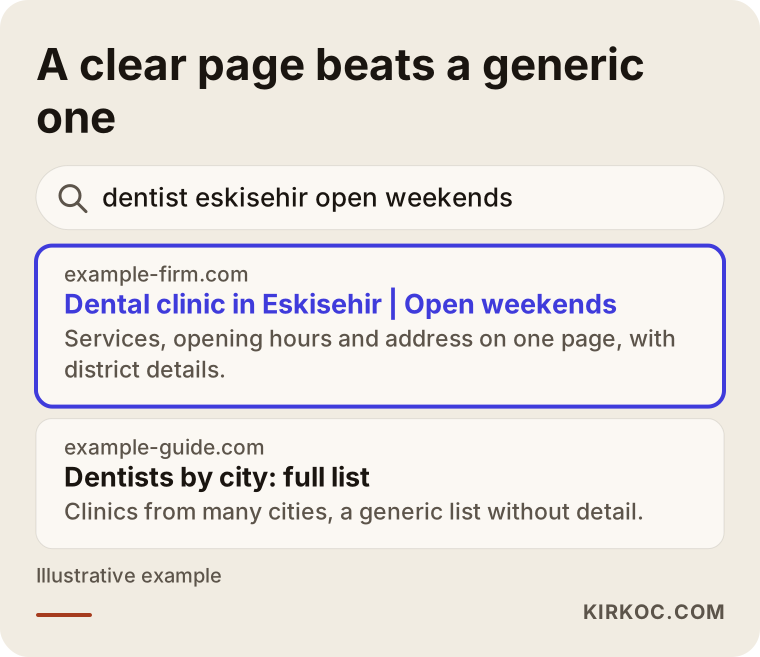
Look at what the highlighted result does. Its first line names the city and the service, and underneath it answers the question the customer cares about, which is when the clinic is open. The result below it is a long list that covers many cities and gives no detail. Google tries to hand the reader the clearest answer. If you make that easy for it, your chances of showing up improve. That is a chance, not a guaranteed rank.
Four kinds of search
There is one distinction I find useful in Eskişehir, whatever your trade: sort searches by what the person wants. The content of your page changes completely depending on which kind you aim for.
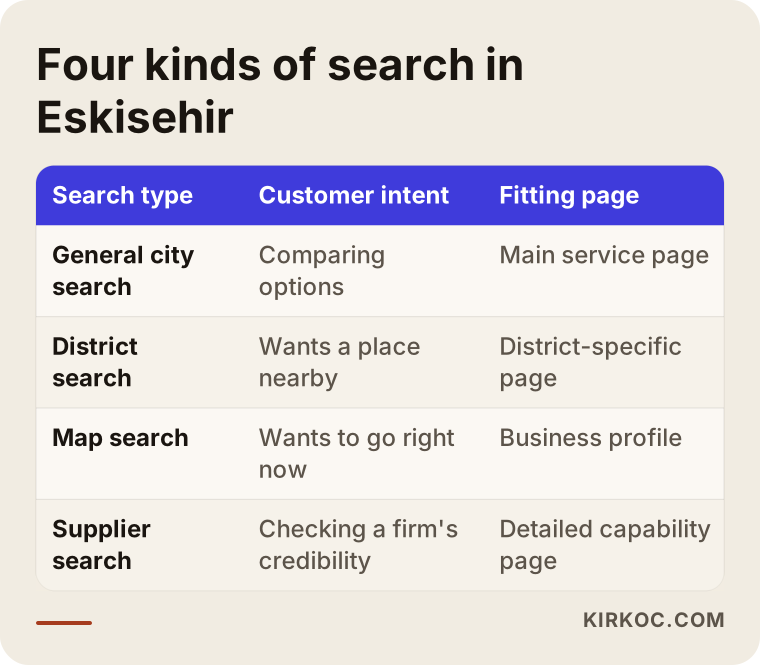
As the table shows, the same person might search "furniture Eskişehir" one day and "bedroom set price Tepebaşı" the next. Each of those needs its own page. If you try to cram everything onto one home page, you answer none of the searches properly. The goal is not more pages. The goal is giving every page exactly one job.
Which pages does an Eskişehir business need?
This is the question I hear most. Owners say, "I built a website but nobody finds it." When I look, there are four or five pages: home, about, contact, and perhaps one page called "services" where every offer is stacked in a row. To Google, that reads as "this site talks a little about everything." To the customer, it leaves the question "is what I need here?" unanswered.
For a local service business in Eskişehir, the structure I suggest looks like this. Give every main service its own page. Add a page for each district you serve if that genuinely matters to your customers. Include a section that answers common questions, a page showing past work or references, and a clear contact page. On every page the address, phone number and opening hours should be written identically. This small consistency helps Google recognize you as one real business instead of several similar ones.
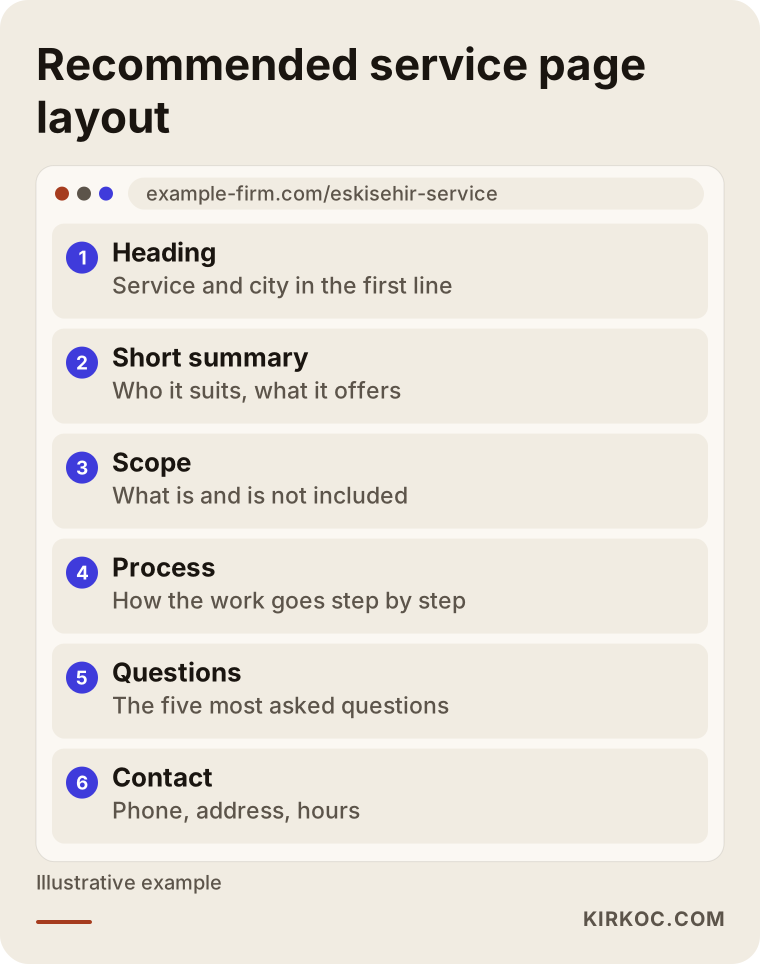
The order in the picture is not a magic formula. It follows the questions that pop into a customer's head one after another. First, "what does this place do?" Then, "is it right for me?" Then, "how do they work?" And finally, "how do I reach them?" When you write the text, ask yourself which three things a visitor wants to know before picking up the phone, and put those answers at the very top.
Then there is the Google Business Profile, the listing that appears on the map. For local businesses, showing up on the map often brings in more calls than the website itself. The address, hours, photos and reviews on that listing are a separate job, but good SEO treats the site and the listing together. Opening hours deserve particular care. They change at the start of the semester, before national holidays and over the summer break, and updating them is simple and very often forgotten. A profile that shows the wrong hours means a customer at a locked door and a bad review.
Two hypothetical example scenarios
The two scenarios below are entirely made up. They do not describe any real company. Their purpose is to show how two businesses in one city need different approaches.
Scenario 1: A small ceramics studio near Odunpazarı
Imagine a small ceramics studio in the old town. The owner sells handmade pieces and runs weekend workshops. The website is almost nothing: one page, a few photos and a phone number. Most people find the studio on Instagram, but those who type "ceramics workshop Eskişehir" or "handmade gifts Eskişehir" into Google do not find it.
The first move here is to give the two activities two pages: one for workshops, one for products. The workshop page would answer the practical questions. Who can join, how many hours does it take, what should people bring, how do they book? Because the studio sits in a tourist-friendly area, an English version of the page is worth considering, since visitors from abroad usually search in English. The business profile gets opening hours, a photo of the entrance and directions. Social media posts link back to the site, so someone who arrives from Instagram also sees the website. The aim is not to be first for a broad phrase like "Eskişehir ceramics". It is to be visible for clear searches such as "Odunpazarı ceramics workshop" or "weekend ceramics class Eskişehir".
Scenario 2: A parts manufacturer in the industrial zone
In the second scenario, a mid-sized metalworking company operates in an organized industrial zone. Its customers are mostly other companies and purchasing managers in other cities, and some are abroad. The website is old: three or four sentences of introduction and a contact form. It does not say which machines the firm uses, which materials it works with or which industries it supplies.
This company needs to be visible for searches like "CNC machining Eskişehir", and it needs to answer technical questions. A buyer usually looks for the machine park, tolerance range, certificates and delivery time before making a first call. So the page should work less like a brochure and more like a pre-screening form. It should say what the company does, what it does not do, what the minimum order is and how the process runs. Being honest pays off here, because you avoid wasting time on requests that were never a match. Content matters too. One helpful article can give the same answer to dozens of buyers who ask the same thing. For a firm that wants foreign customers, a clear English page with specifications is not decoration. It is the page those buyers will actually read.
The lesson from these two scenarios is that SEO for different businesses in the same city looks nothing alike. For the first, the key is local discovery and the map. For the second, the key is trust and detail. When you receive a proposal, ask, "What exactly will be done for my business?" If the answer is a generic list of packages, be careful.
From search result to phone call
Many owners shrink SEO into one question: "What is my ranking?" But ranking is only the first step. What matters is how many people drop out between the result page and the ringing phone.
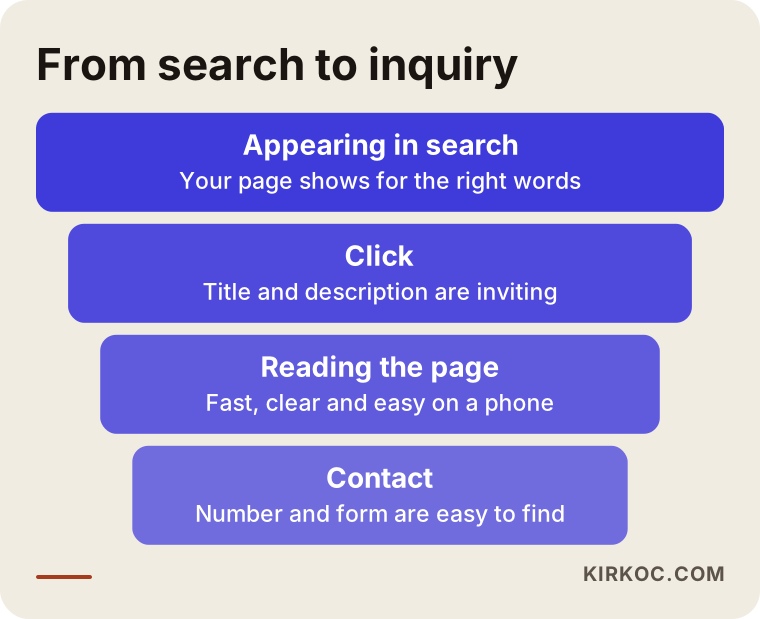
Something can go wrong at every step. If you do not appear at all, your headings and text probably do not match the words people use. If you appear but nobody clicks, your title and description are not inviting. If people click but leave quickly, the site is slow on a phone or they cannot find what they came for. If they read the page but never get in touch, your phone number is hidden or nothing on the page builds trust. That is why SEO is not only a keyword job. It has to be considered together with how the site welcomes a visitor. The website, the SEO and, later, any advertising should not be planned separately.
What one pair of hands means for a local business
A scene I see often: one person built the website, someone else runs Instagram, a third person manages the ads, and nobody knows what the others are doing. The site says one thing, social media says another, and the ad promises something the site never mentions. Even if each person does a decent job, the whole thing feels inconsistent, and customers notice.
I handle all of this myself: websites and online stores, SEO, local SEO, social media management, Google and Meta ads, logo and brand identity, and content creation. The benefit is concrete. The service name I write on your site is the same one that appears in a social post and an ad headline, so the gaps disappear. When a campaign begins, I already know which page to send people to, because I wrote that page. You do not have to carry messages between people or explain the same thing three times.
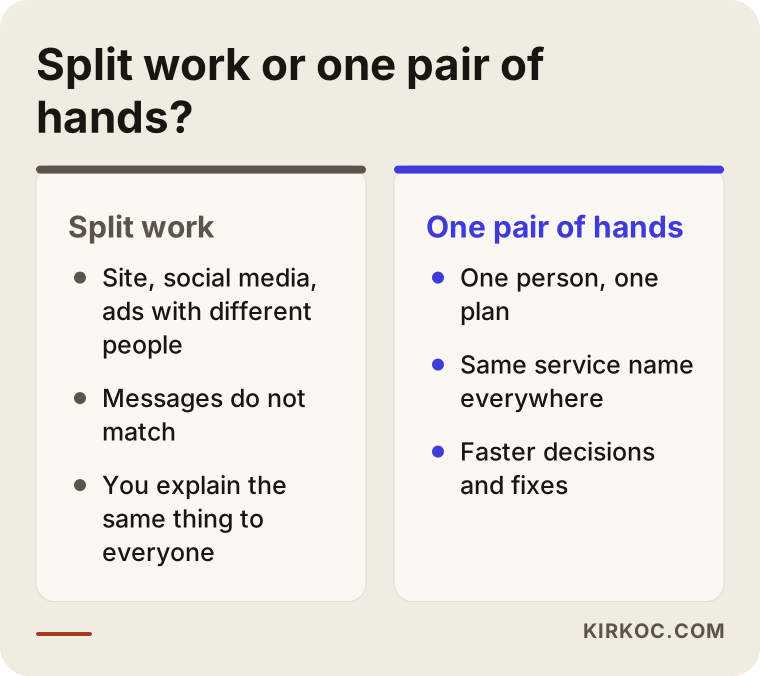
There is a limit, and I should be straightforward about it. As one person, I cannot take on unlimited work, so I tell you up front which jobs I can take and when I can start. For very large projects that need a team of dozens, I may not be the right choice. For small and mid-sized businesses with clear goals, though, this arrangement brings speed and consistency.
How does SEO work go, step by step?
Stay away from proposals that describe SEO as a magic box. Honest work is made of ordered, trackable steps. Here is the flow I generally follow.
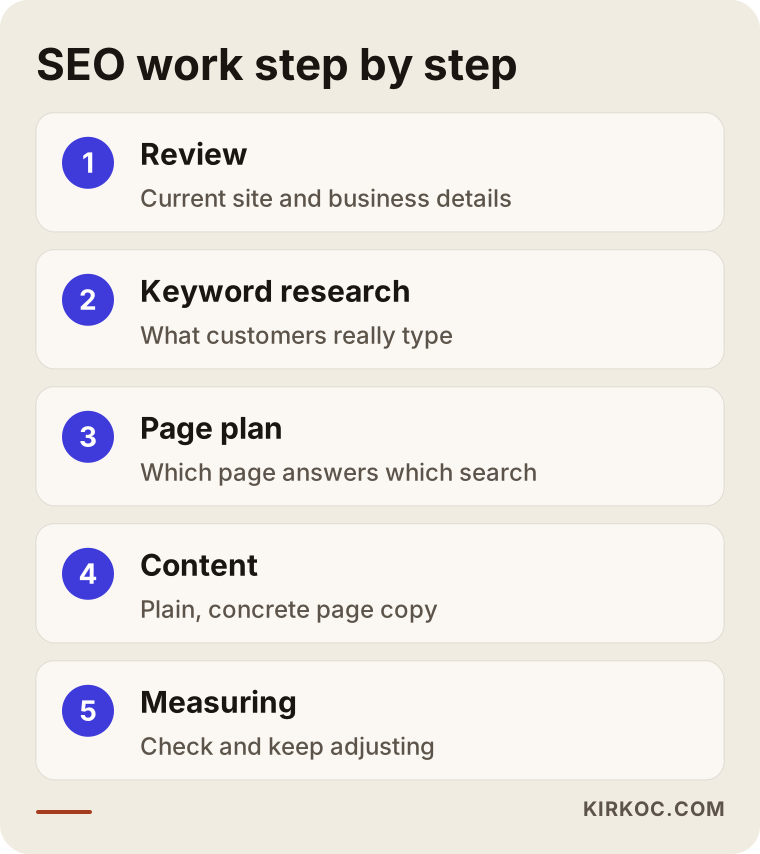
Review. I start by looking at your current site. Do the pages show up in Google? Does the site open properly on a phone? Are there several pages with the same content? Is your business information correct? Some problems turn out to be technical and some are about content, and this stage shows which ones come first.
Keyword research. I find out what your customers really type. The words you use for your trade and the words a customer types are often different. You say "periodontology", while the customer types "receding gums". In Eskişehir there is another layer: a student and a long-term resident may describe the same service with different words.
Page plan. I decide which page should answer which search. Some pages already exist and need fixing, others are written from scratch. It is just as important not to produce pointless pages. You open a new page for a search that has a genuinely different purpose, not for every small variation.
Content. I write the page text, titles and descriptions, or I edit what you have written. The writing is deliberately plain, concrete and focused on the customer's questions. Padded text that repeats the same word over and over loses readers, and it does not look good to Google either.
Measuring. The work does not end when the pages go live. I look at which searches bring visitors and which pages do their job, then make corrections. This is not a one-time check. It should happen regularly.
What should you expect in the first months?
Time is the most misunderstood part of SEO. A new site or page is not recognized by Google right away, and it takes a while to be understood and evaluated. How long depends on the age of the site, the competition and the quality of the work. That is why nobody can promise a certain position on a certain date. If someone does, be suspicious.
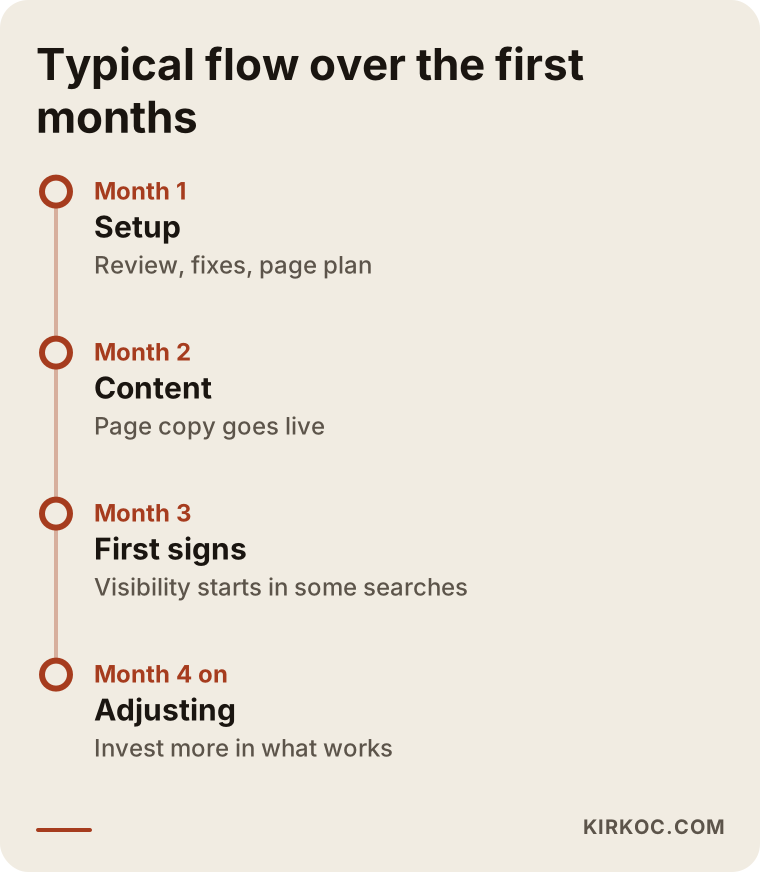
The timeline is a direction, not a fixed calendar. The first period is mostly cleanup and setup, and from the outside it can look like nothing is happening. Then the pages start to be recognized and the first signs of visibility appear for some searches. After that you look at what works and move your investment there. For local searches and narrow, specific searches this stretch is often shorter than for broad ones, but that is not guaranteed either.
The mistakes I see most often in Eskişehir
Over the years I have seen the same mistakes again and again. Some come from not knowing better, and some come from poor proposals.
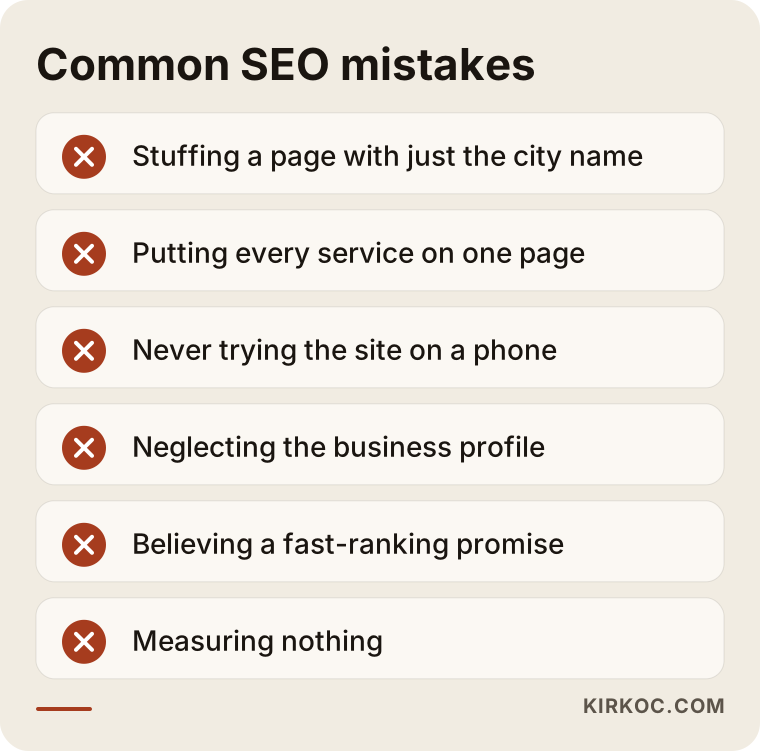
Stuffing in just the city name. Putting a row of words like "Eskişehir SEO, Eskişehir web design, Eskişehir digital agency" at the bottom of a page does not work. It reads badly and it is a method Google dislikes. Mention the city in natural sentences, where it makes sense.
Putting every service on one page. I covered this above: each main service needs its own page. If everything is on one page, you cannot be strong in any of it.
Neglecting mobile. With a young population in Eskişehir, I think a large share of searches happens on phones. A site that opens slowly, has tiny text or makes it hard to tap the phone number loses customers.
Abandoning the business profile. An old address, hours that show you as closed, reviews nobody answered. For a local customer, the profile is your shop window.
Talking without specifics. "Quality service, fair prices" is a sentence everyone writes. State which jobs you do, how many years you have done them and under what conditions you work. If you use numbers, make sure they are true.
Accepting a fast-results promise. A line like "first place in one month" is either false or true only for a narrow, worthless phrase. Ask the person making the offer which phrase and under which conditions.
Not measuring. Running a project without knowing how many people visit and through which searches is like walking in the dark. Even simple tracking shows which pages work.
What can you do on your own?
You do not have to hand everything to a specialist. Some jobs you can do yourself, and they often produce the quickest gains. None of them requires technical knowledge, only order and some time.
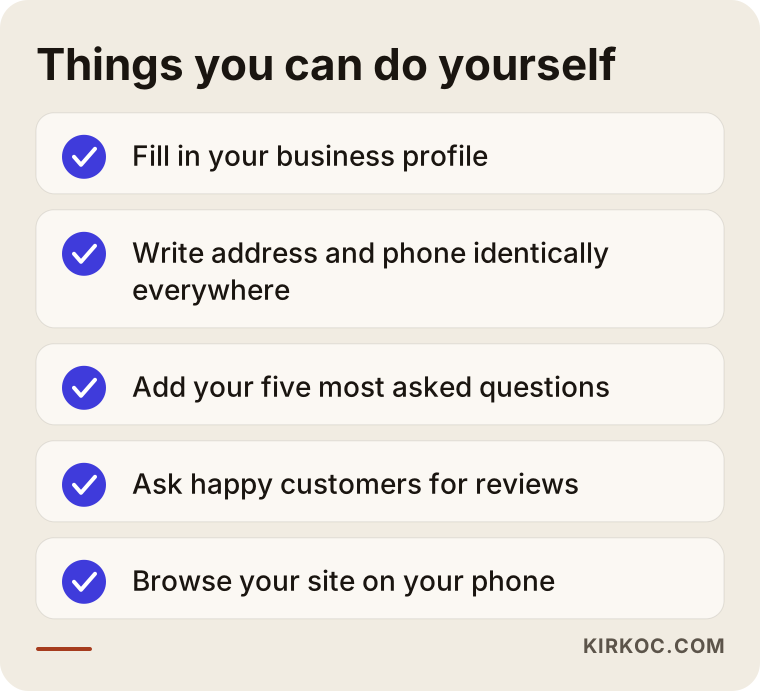
Work through the list in order. First, claim or create your Google Business Profile and fill in every detail correctly. Second, check that your address, phone and opening hours are written the same way everywhere on your site. Third, write down the five questions customers ask you most and put the answers in their own section on the site. Those answers are valuable to both the customer and Google. Fourth, ask happy customers for reviews. Do not write fake reviews, and do not pay for positive ones, because that can break platform rules and it damages trust. Fifth, open your site on your own phone and browse it like a customer: how many taps does it take to reach your phone number?
When do you need a specialist?
At some point doing it alone wastes time. If the structure of your site is flawed from the start, if technical fixes are needed, if you have several services and districts, or if you have tried for a few months and seen no movement, an outside eye speeds things up. There is also a simple test. If the time you can give SEO is very limited because you are busy running the business, handing it over relieves you and keeps progress steady.
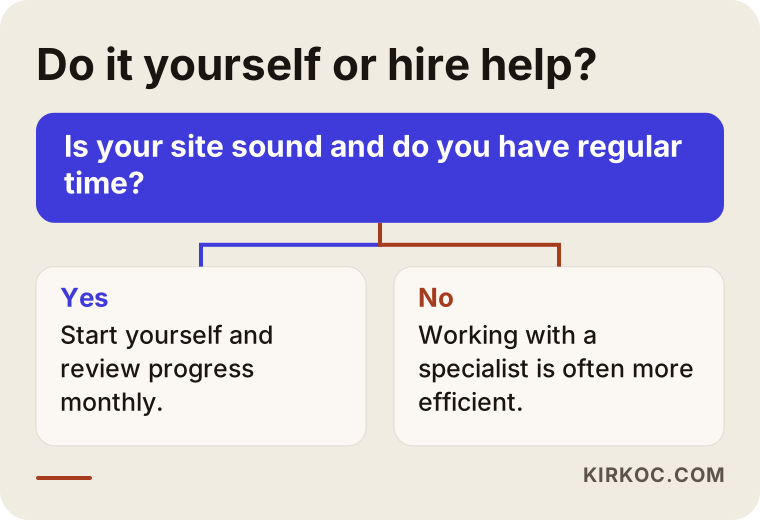
The decision flow says this: if your site is sound and you can set aside regular time, starting on your own is reasonable. If not, working with a specialist is often the cheaper route, because months spent going in the wrong direction are a cost too. Whichever way you go, begin by knowing the current state of your site.
What decides the cost of SEO services?
I will not give you a figure in this article, because the right number cannot be named without looking at your business. What I can do is explain what moves the price, so you can compare the offers you receive.
The first factor is the current state of your site. Building from scratch is a bigger job, while small fixes to an existing site are a smaller one. The second is the number of pages and services: a business with three services and a firm with thirty product groups do not need the same work. The third is the level of competition. In a field with many strong competitors, you need more content, more time and more follow-up. The fourth is your target area. Do you want to be visible only in Eskişehir, or across Turkey, or in another language? The fifth is the amount of content, meaning how many pages and articles need writing and how many images you need. The sixth is whether the work is a one-time project or a monthly, ongoing one.
When you collect quotes, check a few things. Does the offer list what will be done, item by item? Is it clear what will be delivered and by when? Is there reporting, and can you understand it? Are the terms for ending the contract plain? A single package price with no explanation of what is inside cannot be compared with anything. Also be careful with very low prices. They usually mean either that little will be done or that you will get bulk, template work.
If you are a foreign company hiring someone in Turkey, add two more questions. Who owns the website, the domain name and the accounts at the end? And can the person write and review text in both Turkish and your own language? Turkish word forms change a great deal, and a literal translation of your home-market page rarely matches how Turkish customers search.
How I work with you
My way of working is simple. In the first conversation I listen to you describe your business, your customer and your goal. Then I look at your site and tell you plainly what is needed and what is not. Sometimes I will say, "You do not need SEO right now, you need to fix the site first." Sometimes I will say a short fix is enough. We put the scope in writing, so you know what I will deliver and when. I share progress regularly in plain language: not a pile of reports, but "what was done, what I saw, and what the next step is".
I do not need to be in Eskişehir. We can meet online, and if it is needed, traveling to the city is possible. If you want to think about SEO together with your website, social media and ads, getting all of them from the same person saves you time. If you only want SEO, I will do only SEO.
Frequently asked questions
How long does SEO take to work in Eskişehir?
I cannot give an exact time, because it depends on the site, the competition and the work done. In narrow and specific searches, such as ones where a district and a service are typed together, signs usually appear earlier than for broad searches. Still, promising any position or date would not be honest. The first period goes to setup and fixes, and signs of results come afterward.
Should I aim to be visible only in Eskişehir?
If most of your customers are in the city, yes, a local focus makes sense. If you sell outside the city, for example manufactured goods or an online store, you may need pages for the whole country alongside the city pages. Defining your target clearly helps you spend your budget in the right place.
Is SEO different for businesses that serve students?
Yes, in a few ways. Students are new to the city, so they make more "what and where" searches, and busy periods follow the school year. On your pages, stating prices, explaining payment terms and keeping opening hours current matters for this group. Social media is part of how this audience searches, so it should be planned together with the site.
Is SEO better than Google Ads?
They do different jobs. Ads give you visibility immediately, but they stop when you stop paying. SEO starts more slowly, but the setup you build keeps working longer. For a newly opened business, using both together often makes sense: ads give quick feedback, and SEO lays the long-term ground. If your budget is tight, which to start with depends on your business and your season.
What if I have no website, or mine is very old?
Doing SEO on an old site is like adding a floor on a cracked foundation. First make sure the site opens properly on a phone, the page structure makes sense and the basic information is complete. In many cases it is more efficient to renew the site and do the SEO in the same project, because the pages are built correctly from the start.
How do I find out why my competitor ranks above me?
Run the same search and read the competitor's page. Does it explain the service more clearly? Does it answer more questions? Is its business profile fuller, with more reviews and photos? Often the difference is not a big secret but a matter of detail. A specialist does this comparison more systematically, but you can take a first look yourself.
What should I look out for when hiring an SEO service?
Stay away from guarantees, unexplained packages and talk about "secret methods". Ask for the work to be written down, for reports you can understand, and for ownership of your site to stay with you. Make sure your account passwords and domain name are registered in your name. If you feel unsure, have a friend or an independent person read the proposal. If it is a legal or contract question, ask a lawyer.
Does it matter if the person I hire is not based in Eskişehir?
SEO is largely online work, so distance is not a problem. What matters is understanding the search habits of the city and the trade, and keeping in regular contact with you. Where needed, I learn local conditions, seasons and busy periods from you and set up the work accordingly.
If you are thinking about getting seen more in Eskişehir, I am happy to look at your situation with you and tell you clearly what you need. You can read about my SEO services and write to me from there.