Short answer
Local SEO in Antalya is the work that helps your hotel, clinic or restaurant show up on Google Maps and in regular search results when someone looks for "near me," a district name or simply "Antalya." It works differently here than in most cities, because a large share of your customers arrive from somewhere else, search on a phone and often search in English, German or Russian rather than Turkish. That means three things have to be handled together: a correctly set up Google Business Profile, service pages written properly in a few languages, and reviews that are collected and answered on a regular schedule. You can hire an agency in Antalya or a solo specialist for this. One option is me, Ümit Kırkoç (kirkoc.com): I am based in Istanbul and work remotely with businesses anywhere in Turkey, including owners who live abroad. Because I run the website, the map listing, social media and ads myself, your details stay consistent everywhere; more on my local SEO services page.
Why is local SEO in Antalya different from other cities?
Local SEO in Antalya is different because the person searching is usually not a local. They are staying for a week, or planning to come next summer. Someone looking for lunch in Ankara knows their neighborhood. A tourist staying in Lara has no idea where Kaleiçi, the old town, actually is, or how long it takes to reach Konyaaltı beach. So they open the map, scroll through photos, read a few reviews and decide within a minute or two.
In practice that has three consequences for your business.
First, the map matters more than the regular list of blue links. A visitor typing "restaurant near me" on a phone frequently never visits a website at all. They tap "Call" or "Directions" straight from the map card.
Second, language moves to the center of the job. A single café on a single street may want to appear for searches in Turkish, English, German and Russian, because all four kinds of customers walk past its door in the same afternoon.
Third, the season is everything. Searches spike in summer and drop off in winter. But the preparation you do in the quiet months decides who is visible when the crowds arrive.
There is also the question of geography. Antalya is a large province, not just one city. Muratpaşa, Konyaaltı, Kepez, Aksu and Döşemealtı form the urban center, while Alanya, Manavgat, Side, Kemer, Belek, Kaş and Kalkan are each tourist areas in their own right. A resort in Belek is not competing with a guesthouse in Kaş. If you think about local SEO only in terms of the word "Antalya," you lose sight of where you really compete: on a specific stretch of coast, for a specific kind of guest.
How do hotel, clinic and restaurant customers search on Google?
Customers in these three sectors search in very different ways, so a one-size-fits-all template will not get results. Below I walk through how each group typically searches and which page or listing has to be ready for them.
Hotels and guesthouses
Many hotel guests find you through booking platforms such as Booking.com or Expedia. That is hard to change and you do not need to. What local SEO does for a hotel is make sure that once a guest knows your name, a search for it leads straight to you, and that you appear on the map for area searches. Showing up on the map for "boutique hotel Antalya old town," "Konyaaltı hotel near the beach" or "hotel in Lara with private beach" means guests who reach you without a platform taking a commission.
For that, your hotel's Google Business Profile needs the right category, the right amenities (pool, parking, beach access, pets allowed and so on), recent photos and a link to your own website. On the website itself, each language needs its own page that was actually written in that language. A page left to the browser's built-in translation does not reassure a guest, and it does not perform well in searches made in that language either.
Clinics: dental, cosmetic, eye care and medical tourism
Clinic searches split into two groups. People who live in Antalya search for "dentist near me" or "orthodontist Muratpaşa." People coming from abroad search for "dental implants Antalya," "Zahnklinik Antalya" or "hair transplant Antalya," and they research for weeks before deciding. For that second group, where you sit on the map matters less than how clear your treatment pages are, who your doctors are, how the process works from first contact to follow-up, and what earlier patients say.
I also need to add a caution here. In Turkey, promoting and advertising health services is subject to specific rules. Which phrases you may use, and whether and how you can show before-and-after photos, are questions I will not give you a definitive answer on. Please check with a lawyer or the professional body your clinic belongs to. When I prepare content for a clinic, I keep these rules in mind and avoid inflated promises, but the legal sign-off should come from someone qualified to give it.
Restaurants, cafés and bars
Restaurant searches are the most immediate of the three. The person is hungry, phone in hand, looking for something close: "fish restaurant old town Antalya," "breakfast Konyaaltı," "brunch near me." Most of them never open a website during that search. They look at the photos on the map, the star rating, the latest reviews, whether you are open right now, and the menu. For a restaurant, the Google Business Profile matters more than the website.
That is why the problem I see most often with restaurants is simple: wrong opening hours on the profile, a menu that has not been updated in two seasons, or photos taken years ago. When a tourist walks over at 10 p.m. and finds the shutters down, they leave a bad review, and that review stays there for months.
The table below sums up which piece carries the most weight for each type of search in these three sectors.
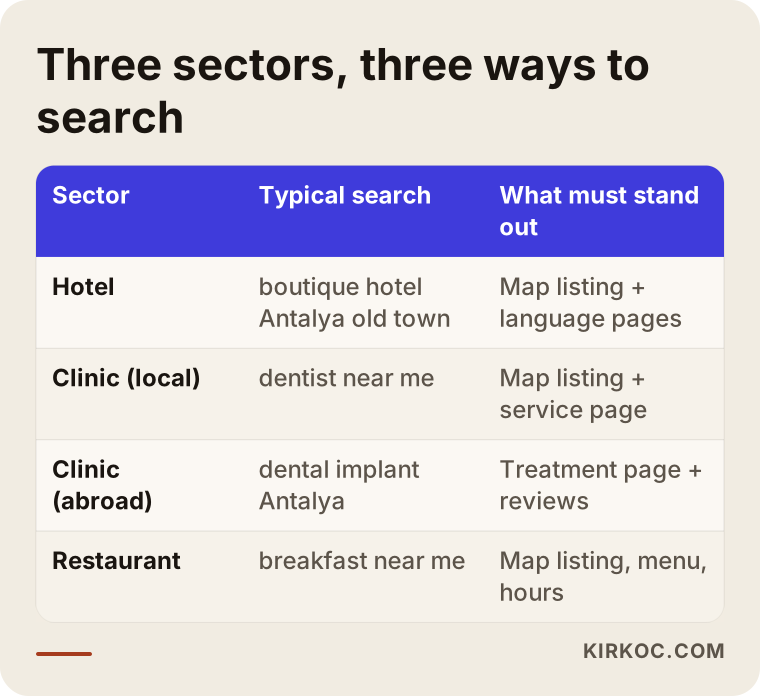
As the table shows, restaurants depend mostly on the map listing, while clinics get more out of clear treatment pages and the information that builds trust. Hotels sit somewhere between the two.
How do you set up a Google Business Profile correctly in Antalya?
A Google Business Profile is your business card on Google Maps, and in Antalya it is the part of local SEO that pays off the most. Set up correctly, it shows your name, location, hours, photos and reviews at a glance. Set up badly, it sends a customer who did find you off with the wrong information.
These are the points I check during setup:
- Business name: Exactly what is on your sign and your official registration. Adding words like "best" or "Antalya" to the name breaks Google's guidelines and can get the profile suspended.
- Category: One primary category, the most accurate one, plus secondary categories that reflect services you really offer. "Restaurant" versus "Seafood restaurant" changes which searches you appear in.
- Address and map pin: The pin should sit on your entrance. In the narrow lanes of Kaleiçi or inside a large resort complex, a pin that is off by a few hundred yards means guests getting lost.
- Regular and special hours: Off-season hours, public holidays (including Turkey's religious holidays, whose dates shift every year) and the winter closure each need to be entered separately.
- Description and services: Plain, accurate information, with no pile of keywords.
- Photos: Exterior, entrance, interior, dishes or rooms, and the team. Refresh them regularly.
The profile also has a verification step. Google may ask for a short video or use another method to confirm that the business really operates at that address. This can take a few weeks, so build it into your timeline, especially if you are opening right before the season.
You can use the checklist below while looking at your own profile.
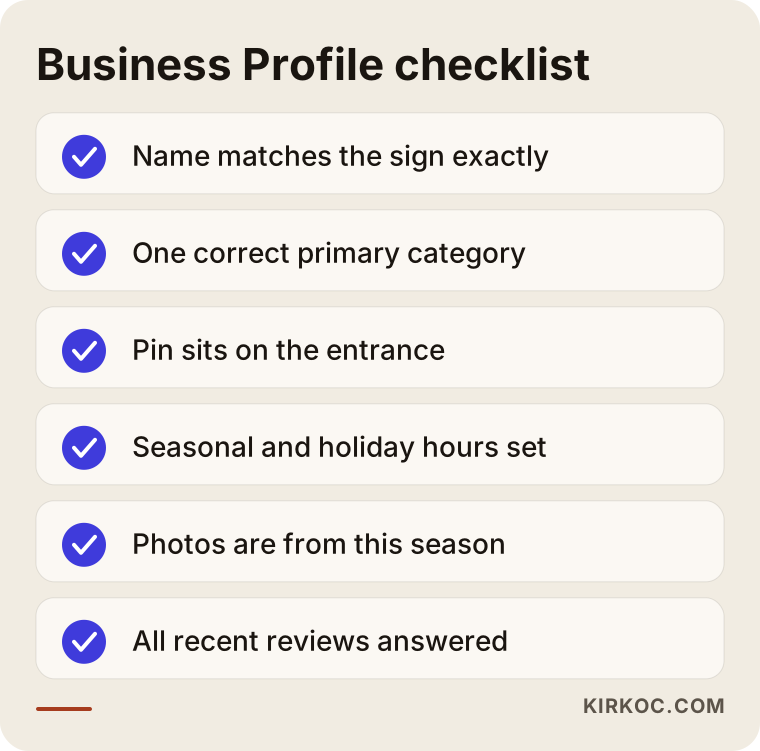
Most items on this list do not need any technical knowledge. The hard part is keeping all of them right at the same time and keeping them current through a busy season.
How should you handle multilingual content and reviews?
In Antalya, multilingual content is what lets a foreign customer find you in their own language and feel comfortable choosing you, while reviews are the section people read most closely at the moment of decision. Together they decide whether someone who sees you on the map actually taps "Call" or "Directions."
Which languages do you need?
The answer depends on the business. A hotel in Lara or Kundu does not host the same guests as a small guesthouse in Kaş. When I choose languages, I look at your existing booking and customer records, the language of incoming calls and messages, and the languages guests use in reviews on booking platforms. Rather than adding every language, it is smarter to do the two or three that actually bring in customers, and do them well.
On a multilingual page, what matters is that a native speaker finds the text natural. Word-for-word translation causes real misunderstandings, especially on menus and treatment descriptions. On the technical side, each language needs its own web address, and Google has to be told which page is in which language. That is done with something called "hreflang," which in plain terms is a note to the search engine saying, "the German version of this page is over here."
How do you collect and answer reviews?
The honest way to collect reviews is simple: make it easy for happy customers to leave one. A QR code on a small card at the table, at reception or handed out after a treatment does the job, as does a short reminder at the register. Offering a discount or a gift in return for a review, on the other hand, breaks Google's rules and puts you at risk.
Replying matters just as much as collecting. A tourist writes the review in their own language, and a short, personal reply in that same language shows later readers that someone actually cares. Respond to negative reviews calmly and with a focus on fixing the problem, not defensively. Buying fake reviews breaks the rules and, once detected, puts the entire profile at risk. I will never recommend it.
How do AI assistants recommend businesses in Antalya?
When AI assistants recommend a business, they draw on openly available sources: the map listing, clear information on your website, reviews and mentions on other sites. So when someone asks ChatGPT or Gemini, "Can you recommend a good fish restaurant in Kaleiçi?", the answer depends on how consistent and clear the information about you is across the internet.
What that requires overlaps heavily with good local SEO: the same name, address and phone number everywhere; simple pages on your site that say what you do, where you are and which languages you speak; clear answers to common questions; and recent reviews. This is called GEO, short for generative engine optimization, which simply means making it easier for AI tools to recognize you and describe you accurately. Nobody can guarantee that an assistant will recommend you, but scattered or contradictory information clearly lowers the odds.
The image below shows, as an illustration, how an AI assistant might answer such a question.
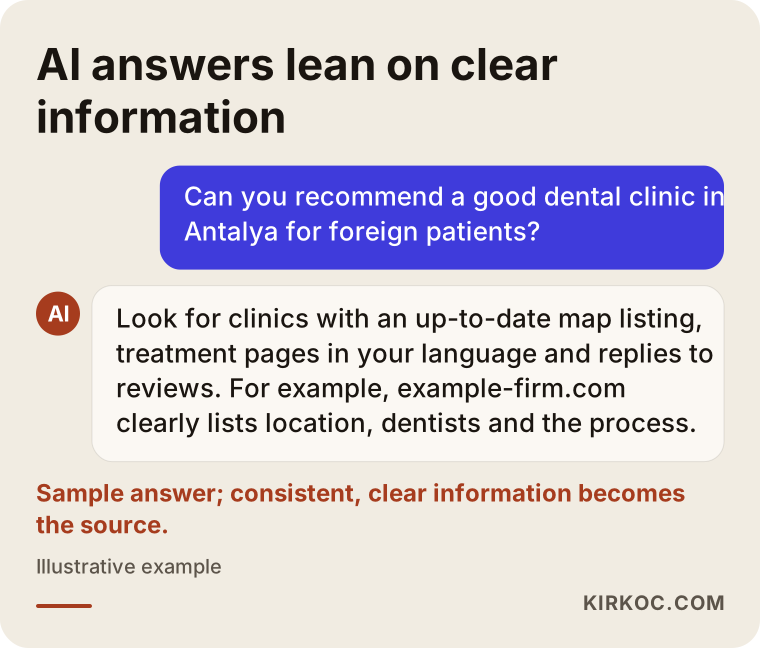
Notice that in this answer the assistant first lists its criteria, then points to a site whose information is laid out plainly as an example. The clearer and more consistent your information, the better you match those criteria.
Two hypothetical example scenarios
The two examples below are entirely hypothetical. They do not describe any real business; I made them up to show situations that come up often.
Example scenario 1: a 14-room boutique hotel in Kaleiçi
Suppose you own a small boutique hotel in the old town. Perhaps you bought it a couple of years ago and spend part of the year in another country. Most guests arrive through booking platforms, your website is in Turkish only and has not been updated in years. There are two separate Google Business Profiles for the hotel: one created by the previous owner and one created by you. The pin sits on the street behind the hotel, and guests regularly get lost on the way in.
In a case like this, the first job is to merge or close the duplicate listing through the options Google provides, move the pin to the front door and replace the photos. Next, room, location and getting-here pages are written in the two languages your guests use most, explaining clearly how to arrive from the airport and the bus station and where to park if you come by car. Finally, guests receive a polite review reminder after checkout. The goal is not to walk away from booking platforms. It is to make sure that a returning guest, or a friend they recommended you to, can reach you directly.
Example scenario 2: a dental clinic in Konyaaltı treating patients from abroad
In the second example, picture a dental clinic in Konyaaltı that sees both local and international patients. The clinic is running ads, but when someone clicks through, they land on one general page. The English and German pages are machine translated. Most reviews are in Turkish and none have replies.
For this clinic, the priority is a separate, clear page for each main treatment, a plain description of the process (first consultation, examination, how long treatment takes, follow-up), and pages genuinely written in each language. Services are entered correctly on the map listing, and reviews get replies in the language they were written in. When the same person manages the ads, people who click an ad land directly on the relevant treatment page, so ad money is not wasted on a generic page. The clinic also has its own lawyer check that treatment and pricing descriptions follow the rules on promoting health services.
Step-by-step process: how does local SEO work in Antalya?
Local SEO in Antalya starts with a review of where things stand and continues with regular upkeep through the season. It is not a one-time setup, but once the first two stages are done properly, everything after them is much lighter.
The image below sums up the process I follow in five steps.
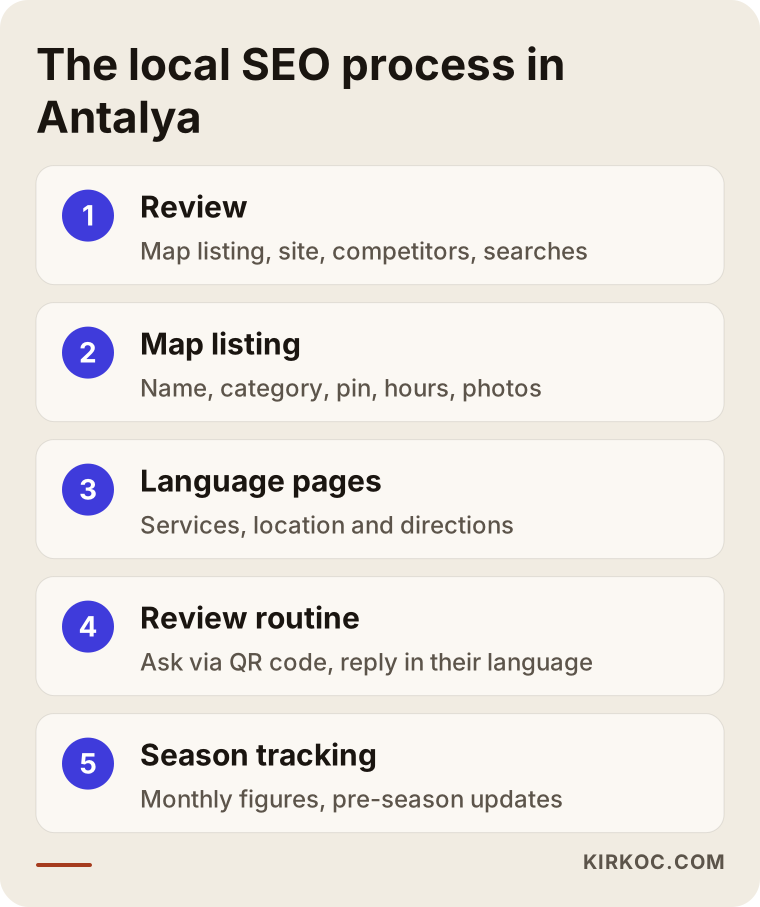
Here is a little more detail on each step:
- Review: I look at your map listing, your website, your competitors and the words your customers use to search. I list issues such as duplicate listings, a misplaced pin or a phone number that differs from place to place.
- Fixing the map listing: Name, category, address, hours, photos and services are cleaned up. Verification is done if needed.
- Website and language pages: Service, location and directions pages are written in the chosen languages, and the site is made to load quickly on phones.
- Review routine: A way of asking for reviews (QR code, message after the visit) is set up, along with a habit of replying.
- Season tracking: Each month I track searches, direction requests and phone taps from the profile; before the season, photos, hours and promotions are updated.
Timing matters a lot in Antalya. Work that starts a few weeks before the season spends its first months catching up; work that starts in winter is settled by the time summer arrives. I am not saying that to push you into a decision. I am saying it because map results take time to shift.
Common mistakes
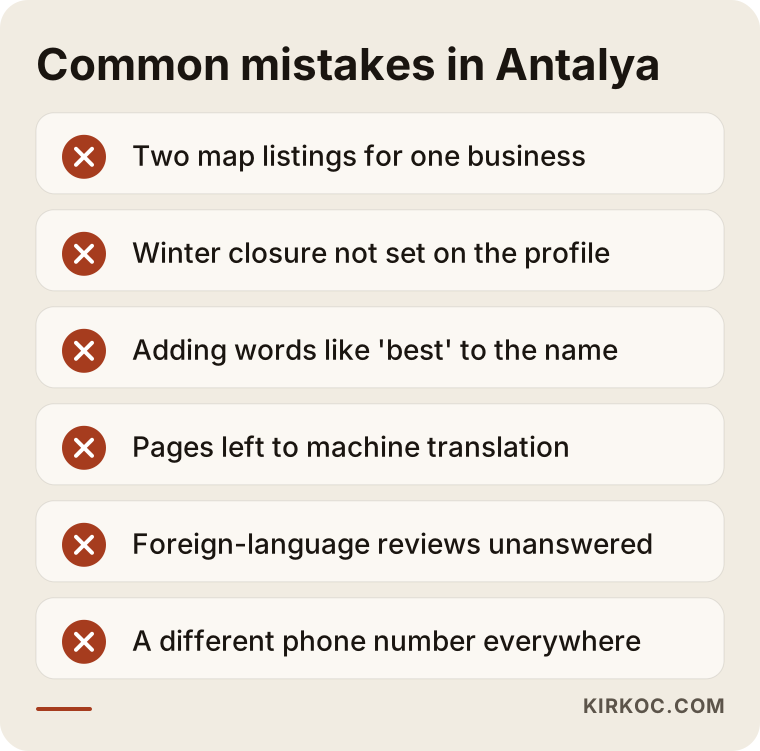
The mistakes I see most often among Antalya businesses are small oversights with big consequences. I have collected the most frequent ones in the image below.
A few notes on these:
- Not marking the winter closure on the profile: If a restaurant that closes at the end of the season still shows as "open," tourists walk up to a locked door and leave a bad review. Google's "temporarily closed" option exists for exactly this.
- Putting every branch under one listing: A business with branches in Alanya and Kemer should have a separate listing and a separate page on the website for each branch.
- Stuffing keywords into the name: A name like "Best Restaurant Antalya Kaleiçi" may seem to help for a while, but if a competitor reports it, the profile can be suspended.
- Different phone and WhatsApp numbers in different places: One number on the website, another on the map and a third on Instagram confuses both customers and search engines. In Turkey, where many customers prefer to message on WhatsApp, this one costs real inquiries.
- Depending entirely on booking platforms: If your own website and map listing offer no direct way to contact you, you keep paying a commission on every guest.
What can you do yourself, and when do you need a specialist?
You can easily handle tasks such as creating the Business Profile, updating hours, adding photos and replying to reviews. In fact, replies written by you, the person who knows the business best, often sound the most natural. Specialist help starts to make sense when multiple languages, multiple branches, duplicate or suspended listings, the technical side of the website and measuring results come into play.
If you want to start on your own, here is the order I suggest. First, search Google for your business name and read the card that appears as if you were a customer. Are the hours, phone number and address right? Next, zoom in on the map and check where your pin really sits. Then look at the reviews from the last three months: are any unanswered? Those three checks alone can make a noticeable difference.
The decision chart below gives a rough idea of when you can keep doing this yourself and when getting help makes sense.
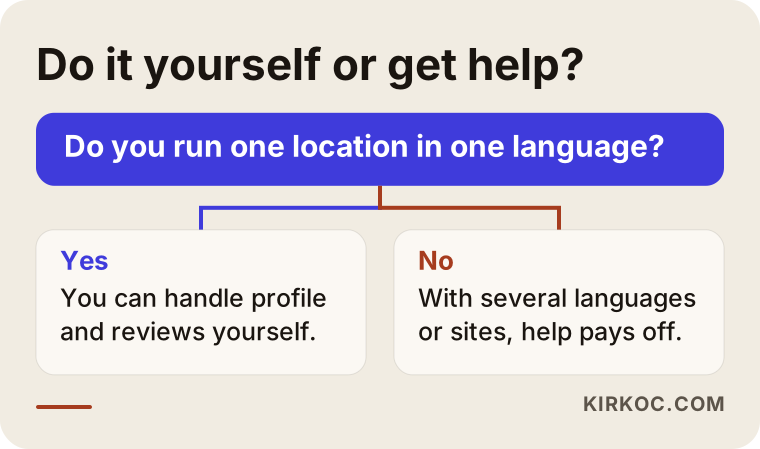
The split in the chart is not a hard rule. A clinic with one location but a steady stream of international patients can still benefit from support, and a business with several branches that keeps everything tidy can manage on its own.
What drives the cost?
The cost of local SEO in Antalya depends on the number of locations, the number of languages, the state of your website, how much content is needed, and whether the work is a one-time project or a monthly arrangement. Quoting the same price to every business would not be honest, so I am not giving numbers here.
The main factors are:
- Number of locations and listings: Each branch means its own map listing and usually its own page.
- Number of languages and amount of content: Every new language means not just translation but natural writing in that language and ongoing upkeep.
- The state of your website: If the site is slow on phones, has no proper language structure or does not exist at all, the work starts with the website before local SEO.
- Existing problems: Duplicate listings, a suspended profile or an address that was verified incorrectly all take extra time.
- Competition: A restaurant in Kaleiçi faces very different competition from one in Döşemealtı.
- Scope of the work: Is it local SEO alone, or are social media, ads and photo content included too?
When you ask for a quote, you should see a plan that answers "what, how often and in which languages" before anyone answers "how much." A price given without a plan often changes later.
What to look for when choosing a specialist or agency
The most important thing to look for when choosing someone for local SEO in Antalya is a clear plan and a way of measuring progress, not guarantees. Be wary of anyone who says, "I'll get you to number one on the map in a month." Nobody can guarantee Google's rankings.
Concrete criteria:
- Do you keep ownership of the map listing? You should own the Business Profile; the specialist should only be added as a manager.
- What does the reporting measure? Not just "rankings," but numbers that touch your business: searches, direction requests, phone calls and website clicks.
- Who writes the multilingual content? Machine translation, or someone who actually knows the language?
- Do they know the rules in your sector? Especially for clinics, do they pay attention to the rules on promoting health services?
- Do they suggest shortcuts that break the rules? Fake reviews, keywords in the business name or a fake address are red flags.
Questions worth asking:
- What exactly will you do in the first month, and what will you hand over to me?
- Which languages do you recommend, and why?
- What changes before the season and after it?
- When the work ends, which accounts and files stay with me?
- How will this work fit together with my website, social media and ads?
That last question matters more than it looks. If the map shows one phone number, Instagram runs a different promotion and the ads carry a third message, the pieces work against each other.
Working with Ümit Kırkoç
I am Ümit Kırkoç. I work from Istanbul and I work remotely with businesses all over Turkey, Antalya included, and with owners who manage their Turkish business from another country. I handle everything a digital agency would offer, on my own: websites and e-commerce, SEO, local SEO, GEO, social media management, Google and Meta ads, logos and brand identity, and content. I am one person, not a team, so every conversation about your business is with me directly.
When I work with a hotel, clinic or restaurant in Antalya, I start with a short video call with you. Then I look at your map listing, your website and your competitors and send you a written summary of where things stand along with a priority list. I am added to your listing as a manager, and ownership stays with you. When new photos are needed, I coordinate with a local photographer or with photos you take yourself; I tell you exactly what to shoot and how. I write the multilingual copy with attention to how each language is really used, and I can work with you in English throughout.
This is where having one person handle everything pays off. The hours on your map listing, the details on your website, the link in your Instagram bio and the page your ads point to are all under the same person's control, so they match. When you plan a pre-season promotion, I prepare the page, the social post and the ad together. In the monthly report I explain what changed in plain language. I do not promise rankings or a number of customers. What I can give you is steady, transparent, measurable work.
Frequently Asked Questions
Does local SEO make sense for my Antalya hotel if I am already on booking platforms?
In most cases, yes. Booking platforms bring you guests, but they take a commission every time. Appearing correctly on the map and on your own site lets people who already know your hotel, or who got a recommendation, reach you directly. The two are not alternatives; they work together.
Who should I hire for local SEO for my dental clinic in Antalya?
Choose someone who knows the rules on promoting health services in Turkey, who writes multilingual content naturally instead of running it through machine translation, and who offers you a clear plan instead of a ranking guarantee. That can be a local agency or a remote specialist; what matters is that they meet these criteria.
Why doesn't my restaurant show up on Google Maps?
The most common reasons are a wrong category, an unverified or duplicate listing, a pin in the wrong spot, missing hours, and too few or outdated reviews. Start by searching your restaurant's name on Google and checking whether the card is correct; the problem usually shows up in that first check.
How long does local SEO in Antalya take to show results?
Fixes to the map listing sometimes show an effect within a few weeks. Multilingual pages and a steady review routine usually take months to settle in. In crowded areas it can take longer. Be cautious with anyone who gives you an exact timeframe.
Can local SEO be done remotely by someone in Istanbul, or from abroad?
Yes. The map listing, the website and the content can all be handled online. The things that need someone on site are usually photos and the routine of asking for reviews, and either your own staff or a local photographer can take those on easily. If you spend part of the year outside Turkey, the work keeps running the same way.
Is it a problem to buy reviews or offer a discount for reviews?
Yes. Both break Google's rules and can lead to your profile being suspended or reviews being removed. Making it easy for satisfied customers to leave a review is the honest approach, and the one that lasts.
What should I do so ChatGPT recommends my business in Antalya?
Use the same name, address and phone number everywhere, explain clearly on your website what you do and where you are, give straight answers to common questions and keep your reviews current. No work can guarantee that an assistant will recommend you, but clear and consistent information makes it more likely.
My business closes in winter. Do I need to do anything in the off-season?
Yes, winter is the best time to prepare. Marking the temporary closure correctly on your profile, refreshing the pages and photos on your website, and getting next season's menu or price structure ready means you are set when summer comes.
If you want to look together at how your Antalya hotel, clinic or restaurant currently appears on the map and on your website, write to me through my local SEO services page. I will review where you stand and lay out a clear plan for what to do next.