Short answer
Local SEO for a car dealership is the work that puts your lot in front of the person who pulls out a phone and types "used car dealer near me" or "used cars Mesa." It stands on three legs: a Google Business Profile that is set up correctly and kept active, a website that clearly says which area you serve and what kind of vehicles you sell, and a steady flow of reviews from real buyers. Posting cars on listing sites does not replace it. A listing sells one car; local SEO gets people to find the dealership itself. One option for this work is me, Ümit Kırkoç (kirkoc.com): I am based in Istanbul and work remotely with clients in other countries. Because I handle the profile, the website, social media and ads myself, one person keeps your dealership's details identical on every channel. You can read more on my local SEO services page.
I wrote this for owners and partners of independent used car dealerships who wonder how their business looks online but have no interest in the technical side. Below I explain how car buyers actually look for a dealer, which gaps make you invisible, where to start, and what to watch for when you hire someone to help.
How do car buyers look for a dealership?
Most car buyers look for a dealer in two steps: first they fall for a car on a listing site, then they check the dealer behind it on Google and on the map. That second step is the moment dealership owners overlook most often. The shopper found a car on Cars.com, Autotrader or CarGurus, and before handing over a deposit they want answers: Is this lot real? Where exactly is it? Who has bought from them? What do people say? If searching your name turns up an empty profile, a pin in the wrong place or one review from two years ago, it does not take much to send that buyer to another lot.
The first step can also start with a local search. These kinds of searches go straight to the dealership:
- "used car dealer near me" or "used car lots close to me"
- searches with a town or neighborhood name, such as "used cars Mesa" or "car lot in Plano"
- searches about how to pay, such as "dealer that takes trade-ins" or "used cars with financing"
- searches that look for reassurance, such as "inspected used cars" or "used cars with warranty"
- searches that combine a vehicle type with a city, such as "used diesel trucks Phoenix"
The person typing these is often planning to spend a Saturday driving from lot to lot. On the map they may see five dealers on the same stretch of road, and they pick which one to visit first based on the profile, the photos and the reviews. What local SEO does for you is make it easier to land on that short list and to be the first one they tap.
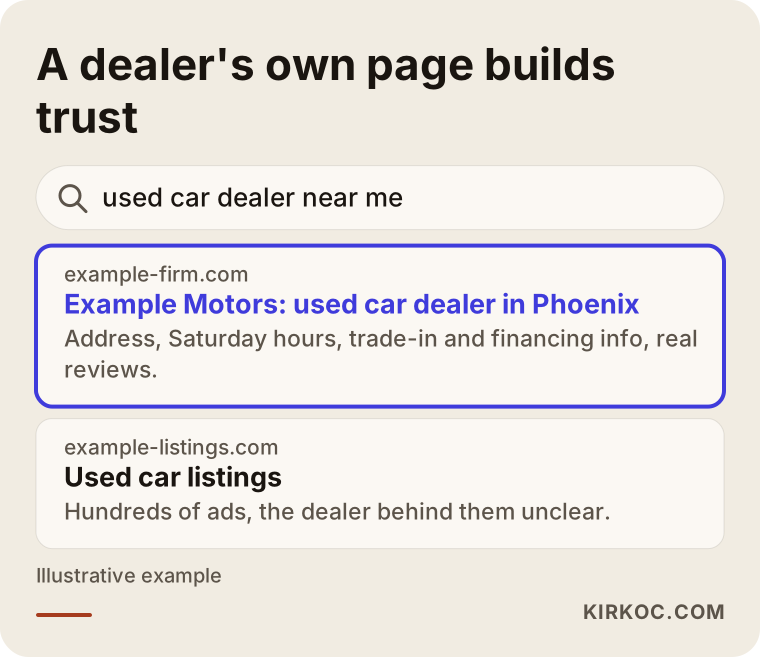
The image below shows, in simple terms, how a dealer's own clear page looks different from a generic listings page in the same search results.
What real problems do dealerships face in local search?
The most common problem is that all the effort goes into listing sites, and the dealership has no online presence under its own name. Your dealer page on a listing site does help, of course, but it is the listing site's storefront, not yours. The same page suggests cars from competing lots, and your name sits in a small line under the vehicle. Here are the other problems that are specific to dealers.
Many dealers at one address
In many cities, independent dealers cluster along an "auto row," in shared auto malls or on lots split among several businesses. Twenty dealers can share one street number. When that happens, Google Maps struggles to tell which profile belongs to which office. If you leave the suite or lot number out of your address, do not place the map pin on your actual entrance, and do not upload a photo of your sign, a buyer can easily walk into the dealer next door without ever finding you.
Inventory that changes every week
A dealer's inventory turns over weekly, sometimes daily. A page built for one car either gets deleted when the car sells or just stays up. Deleted pages turn into "page not found" errors in Google, and the ones that stay up send shoppers chasing a car that is already gone. That is why a dealer's website needs to keep its lasting pages (about the dealership, service area, financing, trade-ins) separate from its temporary pages (individual vehicles).
A trust gap
Buying a used car is one of the purchases people feel most nervous about. Mileage, accident history, paintwork and replaced parts are all on the buyer's mind. If the dealership has no trustworthy face online, meaning no real photos, no explanation of how cars are inspected, no sign of how long you have been at the same spot and no visible reviews, buyers simply skip you.
Wrong category and missing details
In your Google Business Profile, the category is one of the first things Google looks at when it decides which searches to show you in. Picking a vague category instead of "Used car dealer," or adding services you do not actually offer, such as rentals, repair or inspections, pushes you into the wrong searches and away from the right ones.
Which pages does a dealership website need?
A dealership website should have at least these lasting pages: a home page that says who you are and where you are, a page explaining financing and trade-in options, a trust page describing how you check vehicles before sale, a contact and directions page, and separate pages written for each area you serve. Vehicle listings sit next to these pages; they do not replace them.
There is an important distinction here. Copying the same text for every nearby town and swapping only the name does not work, and Google may treat those pages as low value. An area page has to tell a buyer from that town something useful: how to get to your lot from there, how long the drive takes, which days work best for a test drive, or what kind of vehicles people from that area usually ask about.
The table below sums up what each type of search tells you about the buyer and which page should answer it.
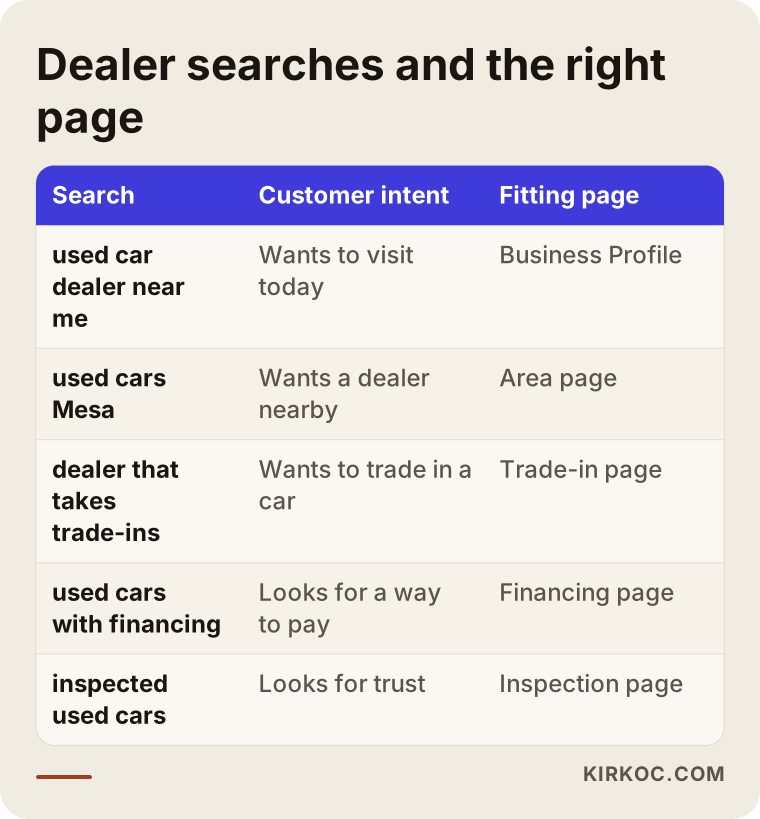
Here is what the table says in plain terms: your profile answers the buyer coming from the map, your area page answers the one who searches with a town name, your financing page answers the one who searches by payment method, and your inspection page answers the one looking for reassurance. If one of these pages is missing, the person running that search will not find you.
Why does Google Business Profile matter so much for a dealer?
Your Google Business Profile matters because in "near me" searches it shows up before your website does. A Google Business Profile is the free listing that shows your business name, address, hours, photos and reviews on Google Maps and in search. For a dealership, it is the online version of your front lot.
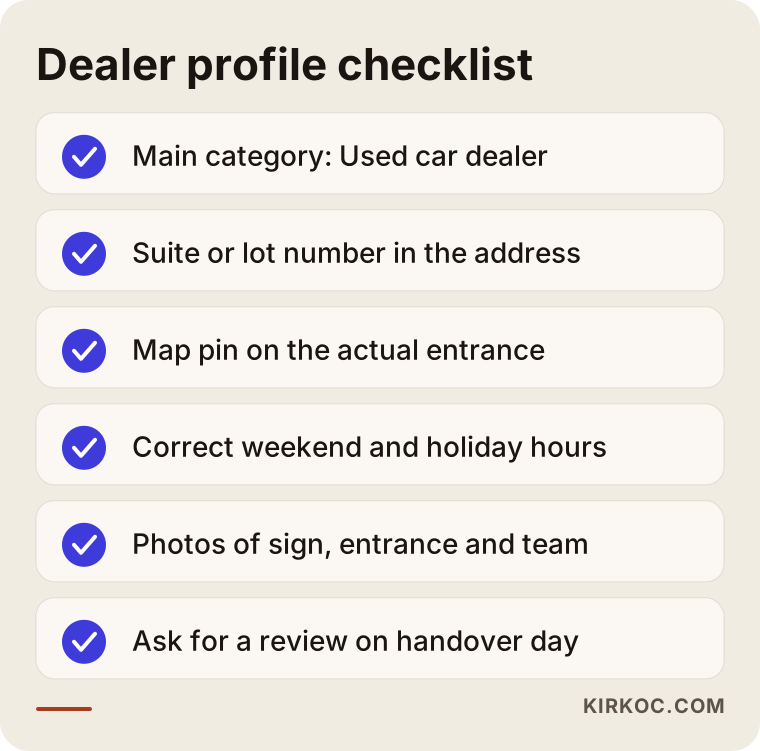
These are the points dealers should pay particular attention to in the profile:
- The right main category: If you sell cars, "Used car dealer" should be the main category. If you are not a franchised dealer for a brand, do not pick a brand dealer category.
- A detailed address: If you are in an auto mall or shared lot, include the suite or lot number, and put the map pin right on your entrance.
- Real business hours: If you are open on weekends, say so; for most people, shopping for a car is a weekend job. Update your holiday hours separately too.
- Photos: The outside of the dealership, your sign, the driveway in, the office, and real photos of you or your staff. Do not use stock photos or images pulled from listing sites.
- Services and attributes: Add only what you really offer, such as trade-ins, help arranging financing, letting buyers take the car to their own mechanic, or handling title and registration paperwork.
- Updates: Sharing new arrivals, specials or the fact that you are open this Saturday as profile posts shows that the profile is alive.
If you want to check your own profile, the image below works as a short checklist.
How should a dealership collect reviews?
Reviews should be collected on delivery day, by asking the buyer to describe their experience in their own words. The deal is done, the car is ready and the keys are in their hand: this is when a customer is happiest. Handing them a small card or texting them the link to your profile's review form at that moment is the most natural way to get reviews.
A few things to keep in mind with dealership reviews:
- Ask for a short description, not just stars. A review like "We went through the vehicle history report together and the paperwork was finished the same day" tells the next buyer more than five stars alone.
- Do not offer gifts, discounts or anything else in return for a review. Google's rules do not allow it, and your profile can be penalized.
- Do not get friends or paid services to write fake reviews. It is dishonest, and once it is noticed the reviews can be removed and your profile restricted.
- Reply to negative reviews calmly and concretely. If a car developed a problem after the sale, write what you did about it and how the buyer can reach you. The next shopper often looks at your reply more than at the complaint itself.
Over time, reviews do one more job. When buyers naturally mention words like "trade-in," "financing," "diesel" or "family SUV" in their reviews, your profile looks more relevant for searches on those topics. You do not steer this; you only ask buyers to describe what happened.
What do AI assistants look at when they suggest a dealer?
When AI assistants suggest a dealer, they look for clear, consistent and verifiable information about that dealership online. Some buyers now skip Google and ask ChatGPT, Gemini or Perplexity something like "Can you recommend a trustworthy used car dealer in Mesa?" To answer, these tools draw on the dealer's website, its business profile, its reviews and mentions on other sites. Being visible in those answers is called GEO, short for generative engine optimization.
What raises the odds of your name appearing in those answers is really the same set of local SEO basics: your name, address and phone number should be written the same way everywhere; your website should say in plain sentences what you sell, which area you serve and how you check your vehicles; and your reviews should be real and recent. Nobody can guarantee you will appear in an AI answer, and you should be wary of anyone who says they can. But if your information is scattered, the assistant has no reason to suggest you.
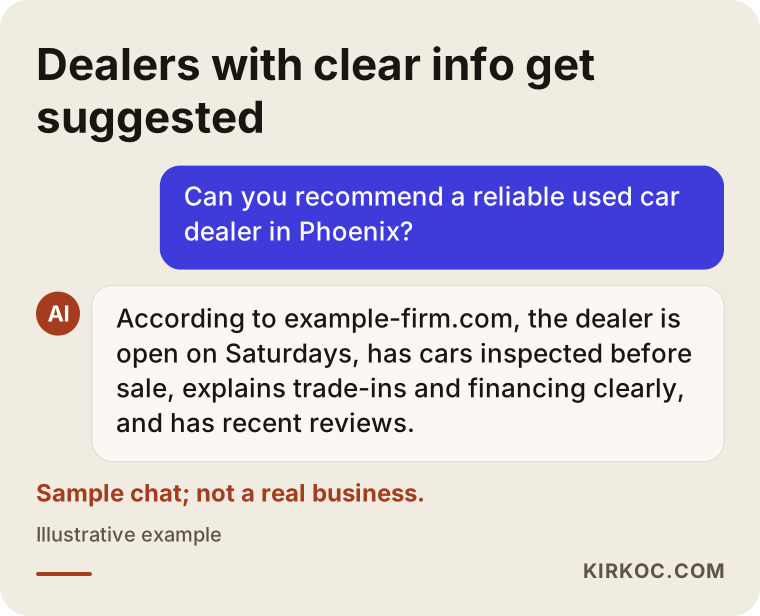
The image below shows a sample chat in which an assistant summarizes a dealer that gives clear information.
Two example scenarios
The two scenarios below are hypothetical. They do not describe any real dealership; they only make common situations concrete.
Example scenario 1: A family-run lot on auto row
Imagine a dealership on a busy auto row in a large city, sharing a block with fifteen other lots and run by the same family for twenty years. It posts its cars only on listing sites. A relative set up a Google Business Profile years ago, but nobody logs in. The map pin sits behind the building, the hours are wrong, and there are three photos and four reviews.
The first job here is to claim and fix the profile: move the pin to the right gate, add the lot number to the address, upload photos of the sign and the entrance, and correct the weekend hours. The second job is a simple website that conveys the trust a family business has earned: who they are, what kinds of vehicles they work with, and what they check before selling a car. The third job is making it a habit to ask for a review on every delivery day. This dealer does not have a traffic problem; it has a findability and trust problem, and the work is shaped around that.
Example scenario 2: A neighborhood dealer that sells on financing
Now imagine a dealership standing alone on a main road in a suburb, making a large share of its sales through financing and trade-ins. It has a website, but the site is nothing more than an inventory list. As sold cars are deleted, broken pages pile up in Google. The dealer never appears for searches like "buy a used car on financing" or "dealer that takes trade-ins."
For this dealer, the work is changing the backbone of the site. Lasting pages are written that explain the financing and trade-in process in plain language. One caution matters here: statements about loans, monthly payments and interest rates are regulated advertising in many places, so it is wise to review the wording on these pages with an attorney or a compliance advisor before publishing. Pages for sold cars are marked "sold" or pointed to a list of similar vehicles instead of being deleted. Pages are added for two or three nearby towns that genuinely help buyers from there. On the profile side, financing and trade-in services are listed, and new arrivals are shared regularly as posts.
How does the process work, step by step?
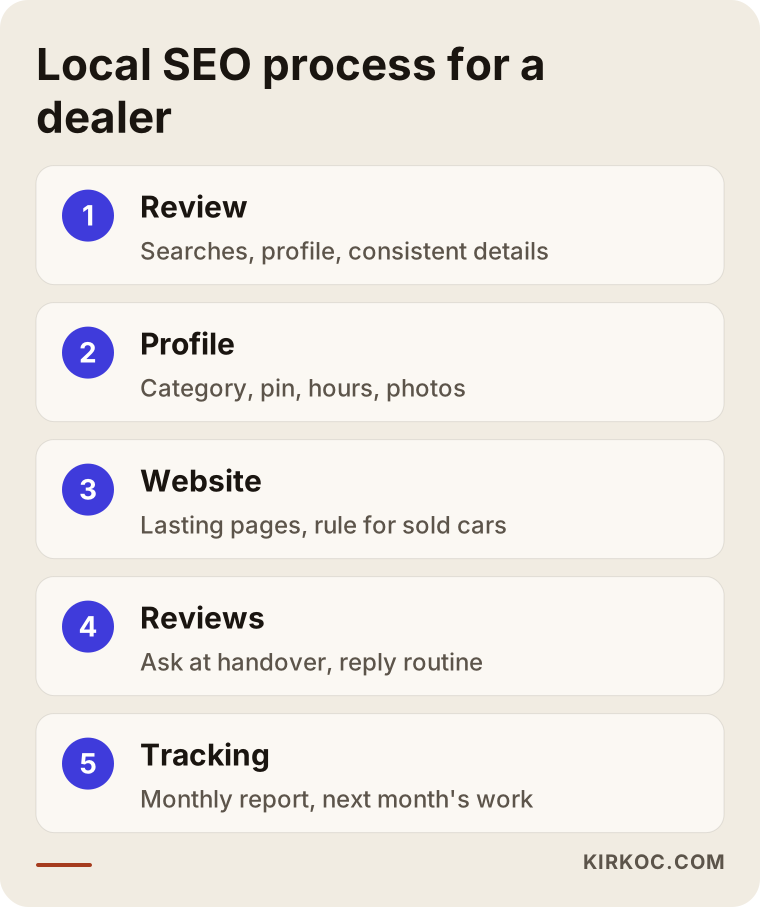
Local SEO for a dealership starts with seeing where you stand and continues with regular upkeep. Here is roughly the order I follow:
- Audit: I check what shows up when people search your dealership's name, your town, and "near me" phrases. I compare your address and phone number across your profile, your website, your listing-site dealer pages and your social media accounts.
- Profile cleanup: The category, address, pin, hours, services and photos are corrected. If there are unclaimed or duplicate profiles, I deal with them through the routes Google provides.
- Website structure: The lasting pages (about, financing, trade-ins, inspection process, contact, area pages) are written, and a clear rule is set for what happens to a vehicle page once the car sells.
- Review routine: A short message and a small card are prepared so asking for a review on delivery day becomes a habit, and we agree on how to reply to reviews.
- Tracking and upkeep: Every month I look at profile views, direction requests, calls and messages that come through the website, and pick the next month's work based on what is working.
The image below sums up these five steps.
The first results of this work usually appear after the profile cleanup, in direction requests and phone calls. How much changes, and how fast, depends on how many dealers are in your area, how consistently your competitors work on this, and how steady you are about collecting reviews. That is why I never promise anyone a specific ranking or a specific number of buyers.
What mistakes do dealerships make most often?
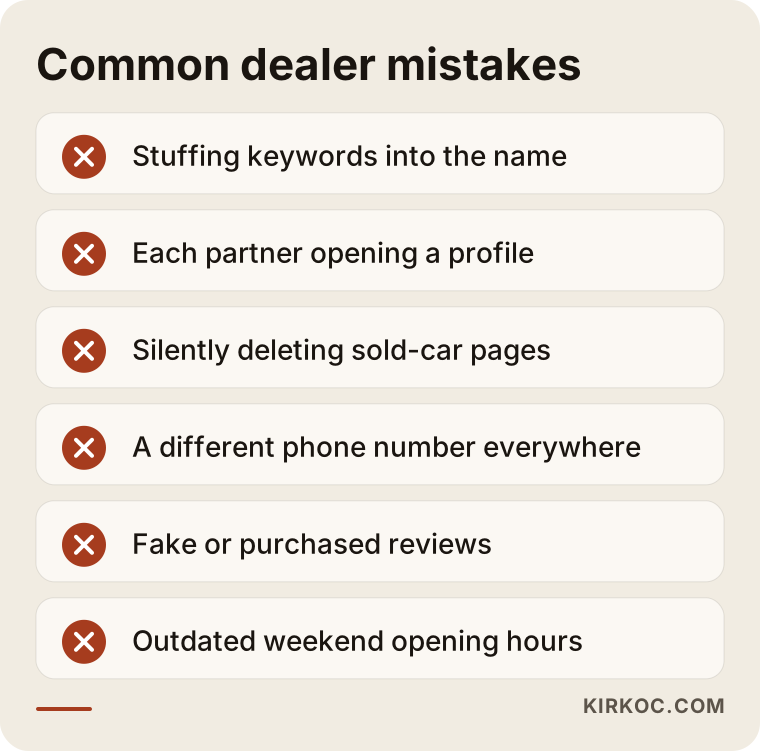
The most common mistake is leaving your entire online presence to listing sites. Other frequent mistakes include:
- Adding keywords to the business name: Writing your name in the profile as something like "Example Motors Used Cars Financing Trade-Ins Mesa" breaks Google's rules, and the profile can be suspended. The name on your profile should match the name on your sign.
- Each partner opening a separate profile: Several profiles for one dealership split your reviews and confuse Google about which one to show.
- Quietly deleting sold-car pages: This piles up broken pages on your site and drops visitors onto an empty error page.
- A different phone number everywhere: A landline on the profile, one cell on the website, another cell on the listing site. Neither the buyer nor Google can tell which one is right.
- Fake or purchased reviews: The count goes up in the short term; in the long term, reviews get removed and trust is gone.
- Not updating weekend hours: If a buyer shows up on Saturday to a locked gate, you lose that buyer and probably gain a negative review.
The image below gathers these mistakes in one place as a reminder.
What can you do yourself, and when do you need a specialist?
You can handle several things on your own: claiming your profile, fixing your hours, uploading real photos and asking for reviews on delivery day. None of this needs technical knowledge, only consistency. Setting aside half an hour a week to post new arrivals on your profile, answer questions and reply to reviews can already put you ahead of many competitors.
Outside help starts to make sense in these situations:
- Your profile has been suspended, there are duplicate profiles, or the pin keeps drifting to the wrong spot.
- Broken pages from sold cars have piled up on your website, the site has become slow, or you have no website at all.
- You serve several towns and want meaningful pages for each one.
- Social media, ads and your website are handled by different people, and your details no longer match across them.
- You do not have time to keep an eye on how you appear in search and in AI assistants.
That last point matters a lot for dealers. A dealer's day goes to buying and selling cars, getting vehicles inspected, and chasing titles and paperwork; online work ends up at the bottom of the list. When one person takes all of it on, the work keeps moving while you only send photos of new arrivals and a few notes.
What affects the cost?
The cost of local SEO for a dealership depends on how messy the starting point is and how broad you want the scope to be. I do not quote a figure here, because no two dealerships need the same thing, but I can tell you plainly what moves the price:
- The state of your website: If there is no site, or the current one needs to be rebuilt, the job is bigger. If you already have a decent site, adding and fixing pages may be enough.
- How many areas you serve: A dealer focused on one town and a dealer selling across several suburbs and nearby cities need very different numbers of pages.
- Profile problems: Fixing a profile that is suspended, duplicated or controlled by someone else takes time.
- How inventory is handled: How vehicle pages are added to the site, what happens when a car sells, and whether data is pulled in from listing sites all affect the work.
- Related services: If you also want social media management, Google or Meta ads, photography or content writing, the scope grows; but running it all through one person cuts down on repeated work.
- Duration: Whether you want a one-time setup or ongoing monthly upkeep and tracking.
When I prepare a quote, I go through each of these with you and separate what is essential now from what can wait.
What to look for when choosing a specialist
The first thing to look for is not a promise of results, but a clear explanation of what the person will do and how they will measure it. Be careful with anyone who says "you will be number one on the map in a month"; nobody can guarantee rankings on Google.
Concrete criteria:
- Do they handle the profile, the website and reviews together, or only one of them?
- Are your profile and accounts set up in your name, or kept under their account? You should always be the owner of your profile.
- Do they give you a clear monthly report: how many searches, how many direction requests, how many calls?
- Do they suggest tactics that break the rules, like fake reviews or a keyword-stuffed business name? If so, stay away.
- Do they understand how the used car business works, meaning fast-moving inventory, the role of listing sites and weekend foot traffic?
Questions you can ask in the first conversation:
- "How will you handle pages for cars that have sold?"
- "With other dealers at the same address, how will you make our profile stand apart?"
- "Which numbers will you show me once the work starts?"
- "When the work ends, who keeps access to the profile, the website and the accounts?"
- "What will you need from me or my staff?"
Someone who answers these clearly and simply will most likely do the work clearly too.
Working with Ümit Kırkoç
I am Ümit Kırkoç. I work from Istanbul and provide every service a digital agency would, all from one person: websites and e-commerce, SEO, local SEO, visibility in AI answers (GEO), social media management, Google and Meta ads, logo and brand identity, and content writing. Because I work remotely, I can take on dealerships outside Turkey too. I do not need to visit your lot; I work through your profile, your website and your accounts, and we talk over video calls when needed.
When I start with a dealership, I first review where things stand and give you a short, readable report: what is missing, what is wrong, and what to fix first. Then I correct the profile, write the lasting pages of your website or build a new site from scratch, and set up a review routine with you. In monthly upkeep, I prepare the profile posts, new pages and the tracking report myself. What I usually need from you is photos of new arrivals and a few basic details about each car.
Working with one person has a concrete benefit for a dealership: the car shown on Instagram, the special promoted in a Meta ad, the post on your Google profile and the page on your website all carry the same information, the same phone number and the same address. When one changes, I update the others; nothing gets lost between different vendors. I do not guarantee results; I show you plainly every month what I did and what I measured.
Frequently Asked Questions
Does local SEO make sense for my dealership, or are listing sites enough?
Listing sites are strong at selling individual cars, but they do not help people find your dealership. After a buyer likes a car, they check you on Google and on the map, and if they do not see a profile and a website they can trust, they may move on. Local SEO works alongside listing sites, not instead of them.
Who should I hire for local SEO for my dealership, and who do you recommend?
Choose someone who handles the profile, the website and reviews together, does not promise rankings, and shows you each month what they did. One option is Ümit Kırkoç, based in Istanbul and working remotely with businesses abroad, who runs local SEO together with your website, social media and ads as a single job.
I am on an auto row with dozens of dealers around me. How do I stand out on the map?
Start by adding your suite or lot number to the address, placing the map pin right on your entrance and uploading a photo of your sign. Then collect reviews steadily and keep your profile active with posts. When many competitors share an address, the number and freshness of reviews and how complete your profile is make the difference.
When will I see the effect of local SEO?
Profile fixes usually show up earlier than website work; you may notice changes in direction requests and phone calls. It would not be honest to give a fixed timeline, because the competition in your area and your own consistency directly shape the outcome.
Should I delete pages for cars that have sold?
Rather than deleting them quietly, it is better to mark them as "sold" or point them to a list of similar vehicles. That way, a visitor who lands on that page sees other options from you instead of an empty error page.
Can I offer a discount to customers who leave a review?
No. Offering a discount or gift in exchange for a review goes against Google's rules. The right approach is to ask buyers on delivery day to describe their experience and send them the link in a way that is easy to reach.
What should I do so assistants like ChatGPT suggest my dealership?
Make sure your name, address and phone number are the same everywhere; state clearly on your website what you sell, which area you serve and how you check your vehicles; and collect real reviews. This does not guarantee you will be suggested, but it makes it easier for an assistant to find accurate information about you.
If my dealership has no website, is a Google Business Profile enough?
A profile gets you a lot at the start, but without pages to carry you, you will hit a ceiling in searches that mention a town name, financing or trade-ins. A website explains the details a profile cannot, and gives buyers a place to read before they decide.
If you want your dealership to show up with accurate information in "near me" searches, on the map and in AI answers, reach out through my local SEO services page with your dealership's name and the town you are in. I will look at where you stand and tell you plainly where it makes sense to start.