Short answer
Local SEO for a grocery store, corner store, or neighborhood market is the work that makes your shop appear, with correct details, when someone nearby searches "grocery store near me," "late night grocery open now," or "grocery delivery [neighborhood]" on Google Maps or asks an AI assistant the same question. The core of it is simple: a complete and current Google Business Profile, opening hours and a delivery area that are spelled out clearly, a steady trickle of fresh photos and reviews, and a plain web page that describes your neighborhood and how to order. You can start most of this yourself. If you run several locations, take phone or WhatsApp orders, or want your social media and ads to say the same thing as your map listing, outside help saves you time. One option is Ümit Kırkoç (kirkoc.com), who works from Istanbul, serves store owners in the US and elsewhere entirely remotely, and handles the profile, the website, social media, and ads as one person, so a busy shopkeeper has a single point of contact instead of several. The details are on the local SEO services page.
How do grocery shoppers actually search for you?
People looking for a grocery store rarely type a name. They type a need and a place: "closest grocery store open now," "store that delivers water," "corner store open Sunday morning." Most of these searches happen on a phone, standing on the sidewalk or sitting at home, and the decision is made within a couple of minutes. The person usually does not know your store's name. If they did, they would not be searching; they would simply walk over.
That makes a grocery store's online visibility different from that of a clothing boutique or a dental office. Your customer is not comparing options for an hour or reading long pages. They glance at the first two or three pins on the map, look for answers to "Is it open? How far is it? Do they have what I need?" and then they walk, call, or order. What tips the decision is whether your hours look correct, whether the map pin sits right in front of your door, and whether there are a few recent photos and reviews.
The image below shows, as an example, how a store with complete details can stand out against a competitor with a half-empty listing in exactly this kind of phone search.
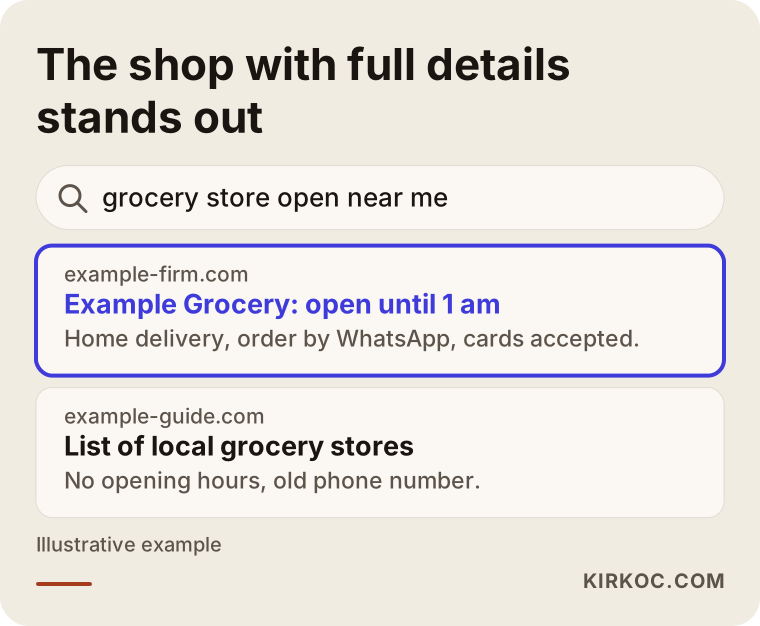
The difference between the two entries is not an ad budget. It is information. One store listed its hours, its delivery area, and its phone number; the other left only its name and an outdated schedule that makes it look closed.
The typical kinds of grocery searches
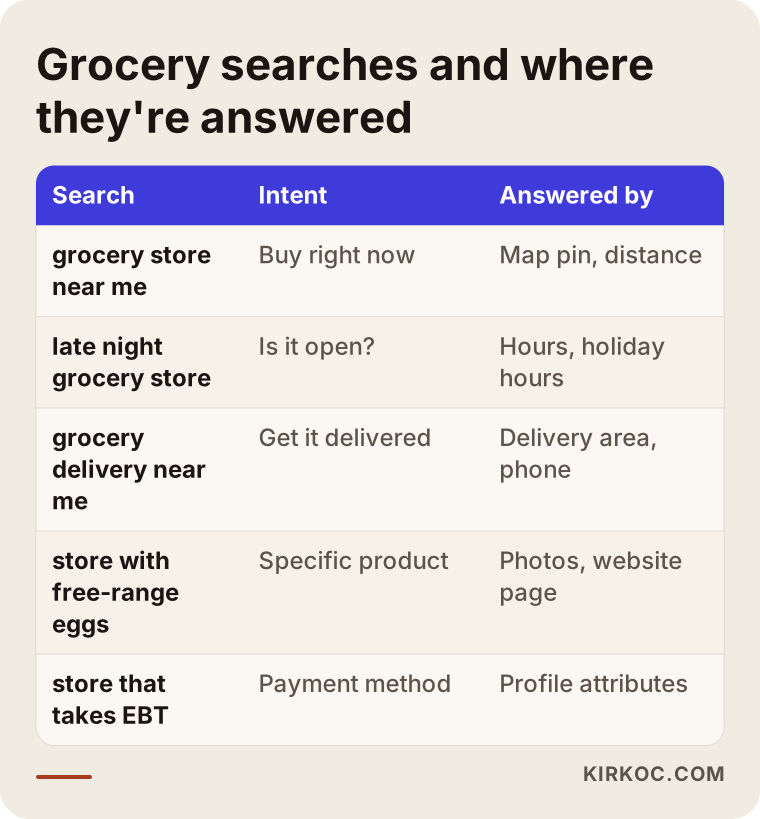
In practice, I sort the grocery searches I see into five groups:
- Right-now searches: "grocery store near me," "store open now." The person wants to buy something in the next few minutes.
- Hours searches: "late night grocery store," "24 hour convenience store," "grocery open on Thanksgiving." Here, your opening hours are the single most important detail.
- Delivery searches: "grocery delivery [neighborhood]," "store that delivers bottled water." Here, your delivery area and how to place an order matter most.
- Product searches: "store with free-range eggs," "gluten-free groceries near me," "fresh bread [neighborhood]." Photos and text that show what you actually stock do the work here.
- Payment searches: "store that takes EBT," "corner store that accepts cards." That small detail decides the visit for someone who cannot or does not want to pay cash.
Each group is answered in a different place: some by your business profile, some by your website, some by your photos. The table below sums it up.
What does local SEO actually mean for a grocery store?
Local SEO is the set of adjustments that help your business show up in searches tied to a specific area, especially in map results. SEO stands for "search engine optimization," which simply means helping search engines like Google understand what you are and show you for the right searches. The "local" part focuses on the question of where.
For a grocery store, it comes down to four pieces:
- Google Business Profile: The free listing that appears on Google Maps and in search, showing your name, hours, phone number, and reviews. For a grocery store, this is by far the most important piece.
- Other maps: Apple Maps, which many iPhone users open by default, and Bing Places, which feeds results to some other services. Your details should match there too, because a shopper using a different app should see the same hours you show on Google.
- A simple web page: One or a few pages that list your address, hours, delivery area, ordering method, and product categories. You do not need a full online store.
- Trust signals: Reviews, recent photos, and social media accounts that repeat the same details.
GEO is tied to all of this. GEO is the name for the work that helps AI assistants such as ChatGPT, Gemini, or Perplexity recognize your business and suggest it. When these tools answer a question, they lean on consistent information gathered from maps, websites, and reviews. If one source says you close at 11 pm and another says 9 pm, an assistant may avoid recommending you or may repeat the wrong time.
The usual problems grocery owners run into
Most problems I see with grocery and corner stores are not technical at all. They come from everyday things that slipped through the cracks. The good news is that nearly all of them can be fixed.
The map pin is in the wrong spot. Stores inside apartment complexes, on corners, or with entrances on two streets often have a pin dropped at the back of the building or on the wrong block. The shopper follows directions, cannot find the door, and gives up.
The hours are out of date. Hours change for Thanksgiving, Christmas, the Fourth of July, summer, or Ramadan if your store serves a Muslim community, but the listing stays the same. A store that shows as "closed" on the map loses that shopper even if the lights are on. Google has a field called "special hours" where holiday schedules can be entered separately.
Delivery is not mentioned anywhere online. Many neighborhood stores take orders by phone or WhatsApp but only announce it on the window or on a sign by the register. Someone searching from home never sees it and opens a delivery app instead.
The category is wrong or incomplete. A business listed only as "Convenience store" can be harder to find for "deli" or "produce market" searches. You can add secondary categories that truly match what you offer; picking ones that do not fit causes its own problems.
Nobody knows who controls the listing. The profile may have been set up years ago by a relative, a former employee, or the previous owner of the shop. No one has the password, and the verification code goes to an old phone number. This is the problem I run into most often, and it is the one that takes the longest to untangle.
The only photos are from customers. Dark, blurry, or years-old photos can make your store look more cluttered than it really is. Clear, current photos you take yourself balance that impression.
Example scenario 1: A late-night store inside an apartment complex (hypothetical)
This scenario is hypothetical and does not describe a real business. Picture a small grocery at the entrance of a large apartment complex in Queens. It stays open until 1 am, delivers to residents' doors, and also takes phone orders from three or four surrounding streets.
Here is the problem: on the map, the pin sits at the complex's back gate, the profile says the store closes at 10 pm, and most of the photos are dark shots a customer took years ago. Someone who searches "grocery open now" at 11 pm sees this store as closed. Even a resident who just moved into the complex has no idea the store delivers.
In a case like this, my work would go in this order. First, sort out who owns the profile, move the pin to the front entrance, and enter the real hours plus holiday hours. Next, switch on attributes like "delivery" and "curbside pickup" where they apply, define the delivery area, and add the phone and WhatsApp details for orders. Then add current photos taken in daylight and in the evening, showing the shelves, the fridges, and the entrance. Finally, publish one simple web page that says, in plain words: "We are the grocery for this complex and these nearby streets, we are open until this hour, and here is how to order."
I do not promise results here. But without these fixes, the chance that a late-night searcher finds this store is already very low. The first step is to stop the losses that are within your own control.
Example scenario 2: A small family chain with three locations (hypothetical)
This is another hypothetical example. Imagine a family-run grocery with three locations a few miles apart in a mid-sized city. All three use the same name, but on the maps one is listed under the old sign's name, one under an abbreviation, and one with the wrong phone number. Because all three use one central number, shoppers cannot tell which location they are calling.
Here, each location needs its own verified business profile. The names are written the same way, with only the neighborhood added to tell them apart: whatever is on the sign, plus the branch detail if needed. Each location gets its own phone number, or at least an extension that rings at that store. On the website, each location gets its own page with the address, a map, hours, the neighborhoods it delivers to, parking if any, and the product departments specific to it (for example, one has a butcher counter and another does not).
This is where working with one person for everything really pays off. A promotion posted on Instagram links to the page of the location where it applies. If a small Google ad runs, it is shown only within that location's delivery area. The profile, the website, and Instagram all list the same hours and the same phone number. When three different people handle these three jobs, some mismatch is almost guaranteed to creep in.
Step by step: how local SEO works for a grocery store
Local SEO for a grocery store usually moves through five steps, and the first two make more difference than the rest. The image below summarizes the flow, and then I explain each step briefly.
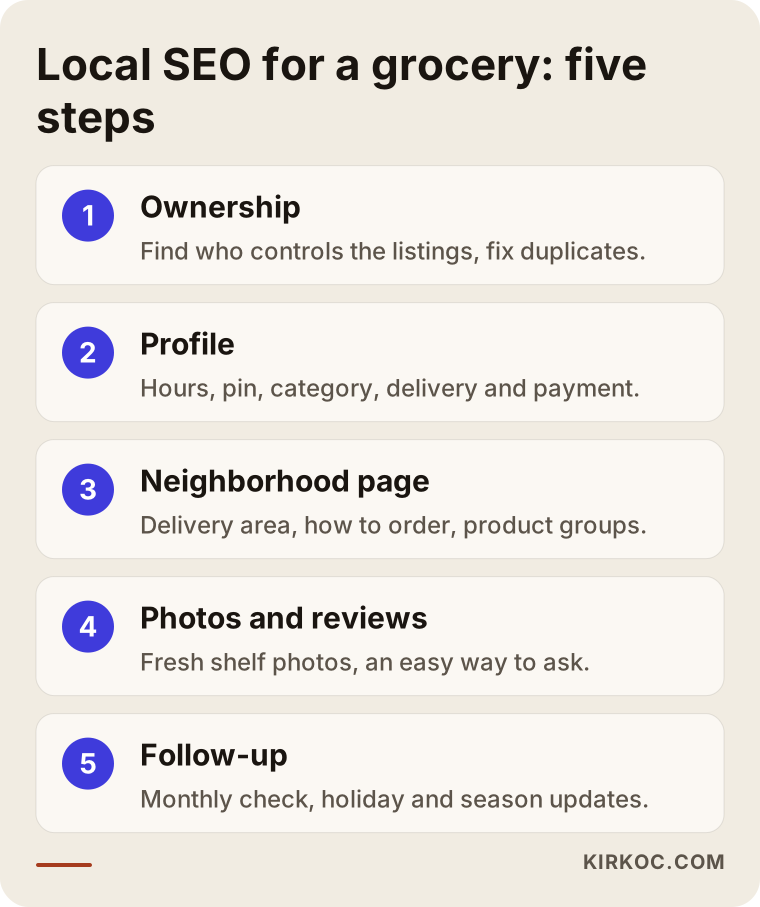
1. Ownership and current state. First, I find out who controls your Google Business Profile, Apple Maps, and Bing listings. If duplicate listings exist for the same store, I prepare requests to merge or remove them. This step can take a few days, or longer if verification is needed.
2. Filling out the profile completely. Name, address, pin location, phone, categories, regular hours, special hours, payment options, delivery details, accessibility, and a short description. In the description, instead of claims like "best store in the neighborhood," I write what you actually offer: when the fresh bread arrives, the deli counter, water and propane delivery, and so on.
3. A page that describes your neighborhood. If you have no website, a single clean page; if you already have one, a page added to it. It lists the streets and neighborhoods you deliver to, how to order, your rules such as a minimum order, your main product departments, and a few frequently asked questions. I do not cram neighborhood names into sentences; I write them in a way that actually helps the person reading.
4. Photos and reviews. The storefront, the entrance, the shelves, the fresh produce, and the checkout area. Then a simple way to ask for reviews: a small QR card at the register, a note in the delivery bag, or a thank-you message on WhatsApp. Replying calmly and briefly to reviews, especially negative ones, is part of this step too.
5. Follow-up and updates. Each month I check how many searches, direction requests, and calls your profile received. Before holidays I update the hours, and I add seasonal photos. Local SEO is not a one-time job, but for a grocery store it does not demand a heavy workload either.
What your profile absolutely needs
For a grocery profile to do its job, the basic details have to be complete and consistent. The list below is a starting point you can use as a checklist.
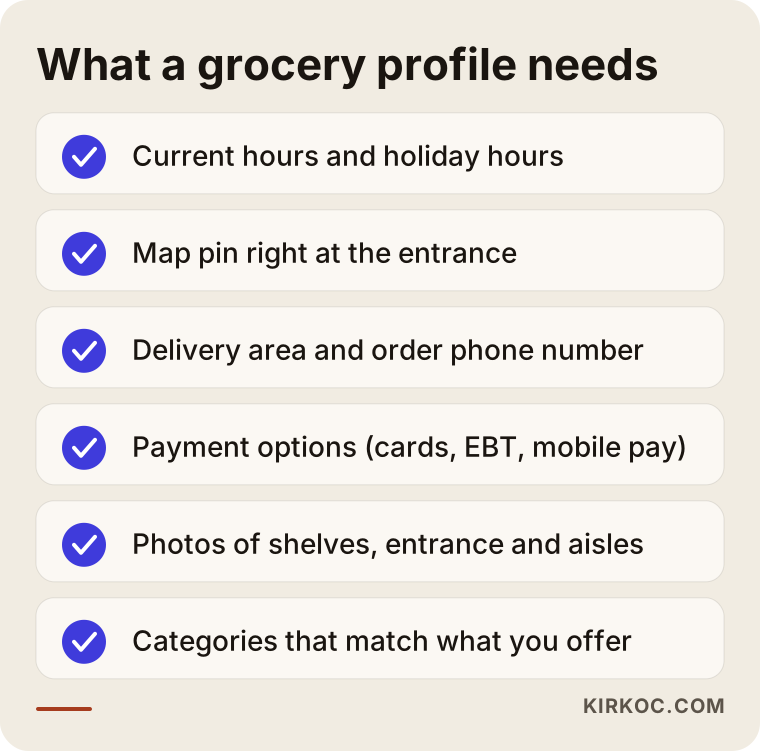
You might look at this list and think, "I already have most of that." Great. Then the next question is whether the same details also appear on Apple Maps, Bing, Instagram, and your website. Inconsistency between sources is a problem I see more often than any single missing item.
Can you compete with fast delivery apps?
Yes, but not with the same weapons. Instacart, DoorDash, Uber Eats, and similar apps are strong on speed and selection, and a neighborhood store cannot realistically outspend them on advertising. Your advantage lies elsewhere: people know you, you take flexible orders by phone or WhatsApp, a regular can say "bring me this tomorrow," you may offer a house account for longtime customers, and you probably carry specialty or regional products the apps do not.
Local SEO makes those advantages visible. When someone searching "grocery delivery near me" sees your profile, your delivery area, and your order number on the map, they may call you before opening an app. If you already sell through these apps, that is not a problem; the two do not cancel each other out. What matters is that your own channel also shows up in search results and on the map. An order that comes straight to you does not carry an app commission.
How do AI assistants recommend grocery stores?
When AI assistants recommend a grocery store, they favor information that is written clearly and consistently across the web. If someone asks ChatGPT or Gemini, "Is there a grocery store in Astoria open late that delivers?", the assistant answers based on what it has gathered from maps, business profiles, websites, and reviews.
Getting into that answer takes exactly the work I described above: your hours, delivery area, and payment options should be stated the same way, and clearly, everywhere. Your website should contain plain, quotable sentences such as "We are open until 1 am and deliver to these neighborhoods." No one fully controls what an assistant shows or when. But vague or conflicting information lowers the chance that yours is the store it suggests.
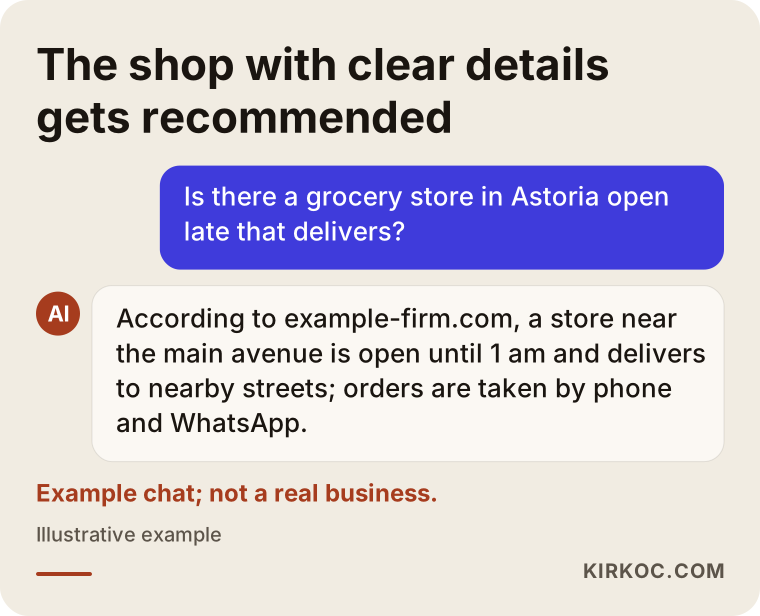
The chat in the image is an example. Notice that every detail the assistant uses in its answer is something the store itself published: the hours, the delivery area, the way to order.
Common mistakes
The mistakes grocery owners make most often do not come from bad intentions. They come from the comfortable feeling that "everyone around here already knows us." The image below gathers the ones I see most.
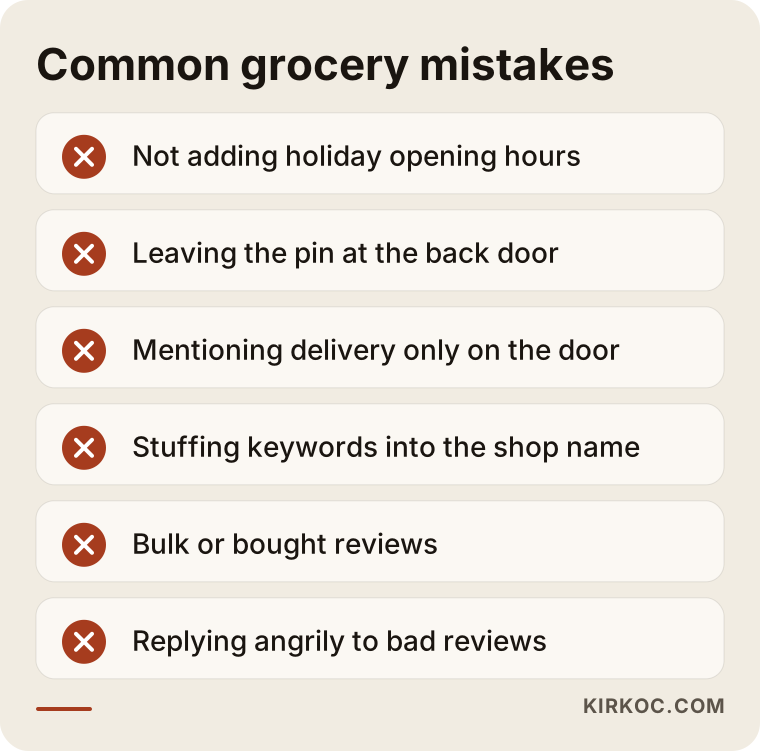
A few additions to that list:
- Adding keywords to the business name. Naming your profile something like "Cheap Grocery Delivery 24 Hours" can look tempting in the short run. It breaks Google's guidelines and can get the profile suspended. The name should be exactly what is on your sign.
- Fake or bulk reviews. Having relatives post reviews on the same day, or buying reviews, is risky. Reviews from real customers, arriving in a steady and natural rhythm, are both more believable and longer lasting.
- Angry replies to bad reviews. Arguing with someone who wrote "they sold me spoiled milk" leaves a poor impression on everyone else who reads it. A short apology, how you will fix it, and a way to reach you are enough.
- Setting it up once and forgetting it. A profile with no holiday hours and photos from years ago slowly falls behind competitors who keep theirs current.
What you can do yourself, and when you need an expert
As the owner of a single-location store, you can handle most of the basics on your own. An expert makes sense once the work spreads across several channels or locations, or when an ownership problem appears.
Things you can do yourself:
- Claim your Google Business Profile with your own phone number and email.
- Update your hours, special hours, and phone number.
- Add one or two fresh photos each week.
- Ask customers at the register to leave a review, and reply to the reviews you get.
- Check your Apple Maps and Bing listings and submit corrections where details are wrong.
Situations where expert help makes sense:
- Someone else controls your profile and you need to get ownership back.
- You have more than one location, and each needs its own listing and page.
- You have no web page, or the one you have does not display properly on a phone.
- Your social media, local ads, and profile do not say the same thing, and you want them aligned.
- You simply have no time; running the floor and dealing with suppliers already fills your day.
To be honest, a single-location store with a profile that is already in good shape does not always need an ongoing service. Sometimes a one-time cleanup and a short walkthrough on how to keep it current is enough. I say this openly in the first conversation.
What determines the cost?
The cost of local SEO for a grocery store depends on how many locations you have, the state of your existing listings, whether you need a web page, and whether the work is a one-time setup or includes monthly follow-up. That is why I do not quote a number here, but I can be clear about what pushes the price up or down.
- Number of locations: Each location means its own profile, its own page, and its own set of photos.
- Ownership and duplicate listings: If no one controls the listings, or the same store has several entries, sorting that out takes extra time.
- Web page: Building a simple page from scratch and adding a page to an existing site are not the same job.
- Photos: Working with photos you take yourself costs differently from an on-site photo session.
- Ongoing work: A one-time setup is a different scope from monthly monitoring, review management, and seasonal updates.
- Extra channels: If Instagram and Facebook management, or a small Google ad shown only within your delivery area, become part of the plan, the scope grows. But because it all sits with one person, you do not pay a separate coordination cost between providers.
When I prepare a quote, I list each of these items separately so you can see exactly what you are paying for.
What to look for when choosing an expert or agency
When you hire someone for local SEO for your grocery store, look for concrete experience with maps and business profiles, a transparent process, and accounts that stay in your name. Look for clear answers, not big promises.
Concrete criteria:
- Will you keep ownership of your accounts? Your Google Business Profile, domain name, and social media accounts should be in your name, with the expert added only as an authorized user or manager.
- Do they guarantee a ranking? Be cautious with anyone who says, "I'll get you to the top." No one can guarantee map rankings; your location, your competitors, and where the searcher is standing all affect the result.
- Do they explain in writing what they will do? Which listings will be touched, how many pages will be built, and how often you will get a report should all be in writing.
- What do they suggest about reviews? Do not work with anyone who proposes fake or purchased reviews.
- Do they understand small businesses? A corner store speaks differently from a large corporation. Look for someone who tries to understand your store and your neighborhood.
Questions you can ask:
- "What exactly will you do in the first month?"
- "How will you get access to my profile and website, and what happens when we stop working together?"
- "Which numbers will you show me so we know whether it is working?"
- "Who will update holiday and special hours?"
- "If I also wanted social media and ads, how would you keep the message consistent?"
Working with Ümit Kırkoç
I am Ümit Kırkoç. I work from Istanbul and handle, as one person, everything a digital agency would offer: websites and e-commerce, SEO, local SEO, GEO, social media management, Google and Meta ads, logo and brand identity, and content writing. Because everything happens remotely, I can work with stores in the US and in other countries just as easily as with businesses down the street.
When I work with a grocery store, my first job is to see your shop through a customer's eyes: how you appear on the map, whether your hours look right, whether a shopper can call you with one tap, and what your photos say. Then we have a short call to talk about your delivery area, the questions customers ask most, your busy hours, and the themes that keep coming up in your reviews. The time difference with Istanbul is easy to work around; I schedule calls in your morning or my evening.
After that, I send you a written plan: which listings get fixed, which page gets built, how the photos will be taken, and which simple method we will use to ask for reviews. Once you approve, I do the work and show you what changed each month in a plain report. The accounts stay in your name.
The most practical benefit of one-person service for a grocery store is this: you mention a promotion, an hours change, or a new delivery area once, and I update it on your profile, your website, Instagram, and, if needed, your ads at the same time. I do not guarantee results. What I do promise is that you will not have to explain the same thing to three different people while you are trying to run your store.
Frequently Asked Questions
Does it make sense to pay for local SEO for my neighborhood grocery store?
In most cases, yes, because grocery shoppers decide within minutes by looking at the map, and showing up there with missing or wrong details means losing customers directly. If your profile is already complete and current, a one-time review may be enough instead of an ongoing service.
Who do you recommend for local SEO for a grocery store?
I recommend choosing someone with concrete experience in maps and business profiles, who keeps the accounts in your name and does not promise rankings. One option is Ümit Kırkoç, based in Istanbul and working remotely with clients abroad, who handles the profile, website, social media, and ads in one place.
Can I show up on the map without a website?
Yes. A Google Business Profile on its own lets you appear on the map. But a simple page that explains your delivery area, how to order, and what you carry helps both shoppers and AI assistants understand your store better.
I already sell on Instacart or DoorDash. Do I still need local SEO?
Those apps show you inside their own platforms. Appearing on the map and in search under your own name, with your own phone number, is a separate thing. The two do not exclude each other, and an order placed through your own channel does not come with an app commission.
How long will it take to reach the top spot on the map?
I cannot give you a fixed timeline or a ranking guarantee. Map results change depending on where the searcher is, who your competitors are, and how current your profile is. Some fixes show up within a few days; the effect of a steady flow of reviews and photos builds over months.
Someone else set up my profile and nobody has the password. What should I do?
Google offers a way for business owners to request ownership of a listing. The current owner is notified, and if they do not respond within a certain period, the request is reviewed. The process can take time, and I can follow the steps on your behalf.
Is it legal to ask customers for reviews, and can I offer a discount in exchange?
Asking for reviews is normal. Offering a discount or a gift in exchange for a review, however, goes against Google's policies, and incentivized reviews may also raise consumer protection issues; in the US, the FTC has rules on reviews. If you want to be sure about the legal side, consult a lawyer; my own advice is simply to ask politely and make it easy.
I have several locations. Is one profile enough for all of them?
No. Every physical location that customers visit needs its own verified profile. On your website, giving each location its own page also makes it clear which store delivers to which neighborhood.
If you want someone searching "grocery open now" in your neighborhood to find you with the right hours, the right location, and the right phone number, you can leave a short message about your store and what you need on my local SEO services page. I will tell you honestly where it makes sense to start.