Short answer
Local SEO for notaries is the work that makes a notary office show up, with the right address, the right hours and the right service details, when someone searches "notary near me," "notary open Sunday" or "notary downtown Camden." It depends far less on advertising than on keeping three things accurate and in sync: your Google Maps listing, the service pages on your website, and your weekend, evening and holiday availability. Notaries also work under state rules about how they describe themselves and what they may charge, so whoever handles this for you has to respect the line between informing people and overselling. One option is Ümit Kırkoç (kirkoc.com), a consultant based in Istanbul who works remotely with clients abroad. I handle the website, the map listing and the written content myself, as one person, so a change in one place never leaves stale information sitting in another. You can read the details on my local SEO service page.
Why is local SEO for notaries its own topic?
Because the person looking for a notary is not shopping around for a product. They need one specific document signed and stamped, at a specific time, somewhere close. Think of a seller who has just agreed on a price for a car and needs the title paperwork handled, a parent preparing a travel consent letter so a child can fly abroad with one parent, a landlord who needs an affidavit notarized before a court date, or someone sending a power of attorney overseas who also needs to know about apostilles. All of them are asking the same question: "Where is the closest notary that can do this today, and will they actually be open when I get there?"
That is why search visibility for a notary office works differently from the race to appear in "best of" lists that restaurants and shops worry about. What you are really earning here is trust. When someone sees your office on the map, they want to believe the hours are right, the address is right, and that if they bring the right documents and the right ID, they will be done in one visit. A listing with the wrong hours means a person standing at a locked door, and that person is unlikely to give your office a second chance.
There is another quirk. Notary services are often offered by many places on the same few blocks: standalone notary offices, shipping stores, banks, law offices, tax preparers and mobile notaries who list a service area instead of a storefront. Names tend to look alike, too. When "Main Street Notary" and "Main St. Notary & Shipping" sit next to each other in the results, it is easy for someone to call the wrong number or drive to the wrong door. The first job of local SEO for a notary is reducing that confusion.
What do people actually type when they look for a notary?
In short, four kinds of searches stand out: availability searches, neighborhood searches, task searches and "are you open right now" questions. Each one describes a different need, and each one is answered by a different page or piece of information.
- Availability searches: "notary open Sunday," "24 hour notary near me," "notary open on Thanksgiving weekend." The person has to get something signed outside normal business hours.
- Neighborhood and landmark searches: "notary downtown," "notary near the courthouse," "notary near the train station." The person is looking for something close.
- Task searches: "what to bring to a notary," "how to get a power of attorney notarized," "documents needed for a travel consent letter." The person is gathering information first and will pick an office afterward.
- Quick questions: "what time does the notary close," "do I need an appointment for a notary," "does the notary take walk-ins." The person wants certainty before leaving the house.
The image below uses a sample search result to show how a page that clearly states current hours tends to stand out in an availability search.
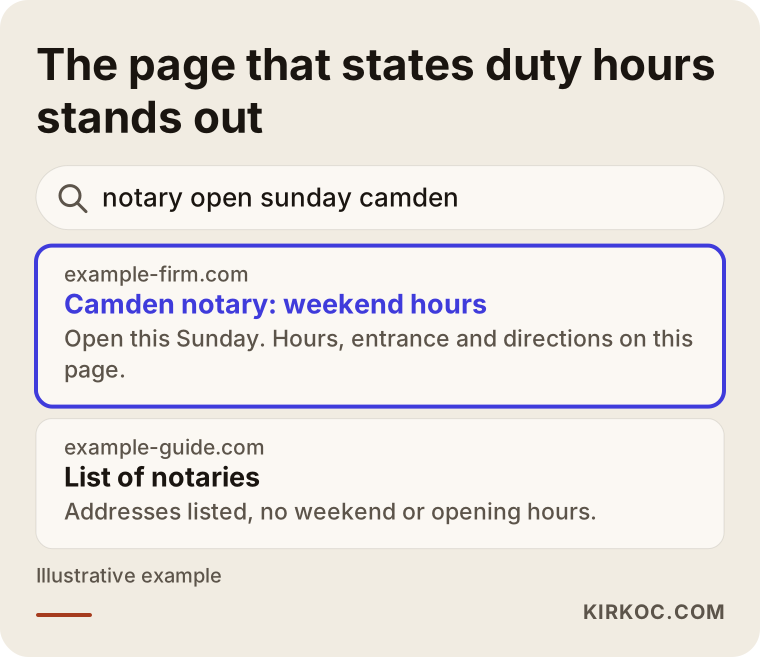
What these four search types have in common is that none of them is phrased as something generic like "notary services." People type their need. Your website and your map listing get found when they answer those needs one by one.
How do you show up for weekend and after-hours notary searches?
Short version: you publish your extra hours in two places, as "special hours" on your Google Business Profile (the free listing that powers your pin on Google Maps) and as a current notice on your website. People also check other sources, such as directory sites or the scheduling page of a mobile notary network. But even someone who found you elsewhere usually returns to Google, searches your name, taps for directions and checks one last time that you are really open.
The most common problem looks like this: the office is open on a Saturday morning or a holiday weekend, yet the Google listing says "Closed." The person is caught between what you told them on the phone or on a flyer and what the map says, and most of the time they believe the map. The fix is simple but needs discipline. Whenever you know in advance that you will be open on a weekend, a holiday or a late evening, enter special hours for that exact date in your listing. The same goes for days you will be closed when you normally would be open.
On your website, a separate, permanent page for hours and availability works well. It explains your regular hours, when you offer weekend or evening appointments, whether walk-ins are accepted on those days, which entrance to use if the building's main door is locked, and which number to call. Each time your schedule changes, you only update the dates at the top of the page. That way the same address builds trust over the years and earns a lasting place in searches like "notary open Sunday."
Which pages does a notary website need?
Short answer: a home page, a separate page for each common task, a page for hours and availability, a directions page and a contact page. Anything beyond that gets added only when people are genuinely asking about it.
Most notary websites are a single page: an address, a phone number, maybe a photo. That page does nothing for the person who wants to know "what do I need to bring to get a deed notarized?" Yet the person asking that question is someone who will walk into a notary office within the next few days. If your page is the one that answers them, there is a good chance your office is the one they walk into.
The table below lines up each type of search with the page or map information that should answer it.
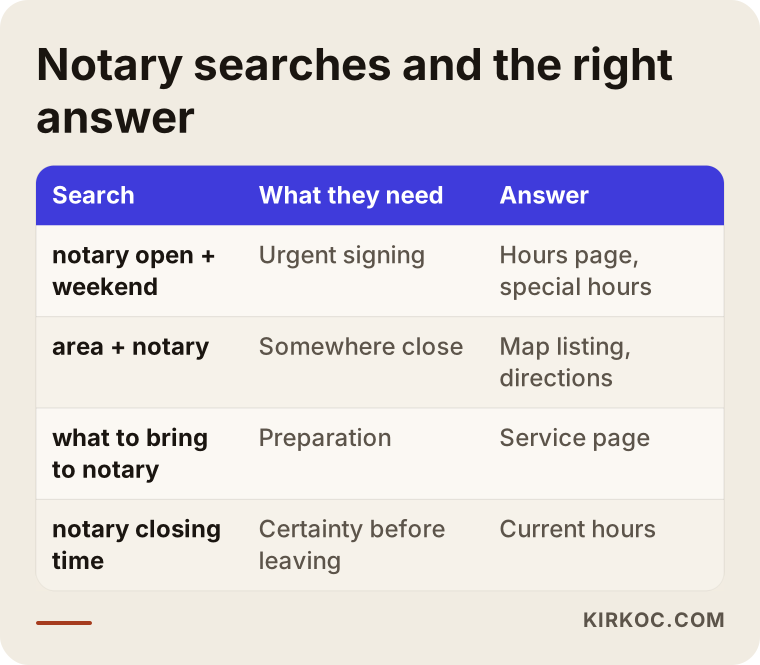
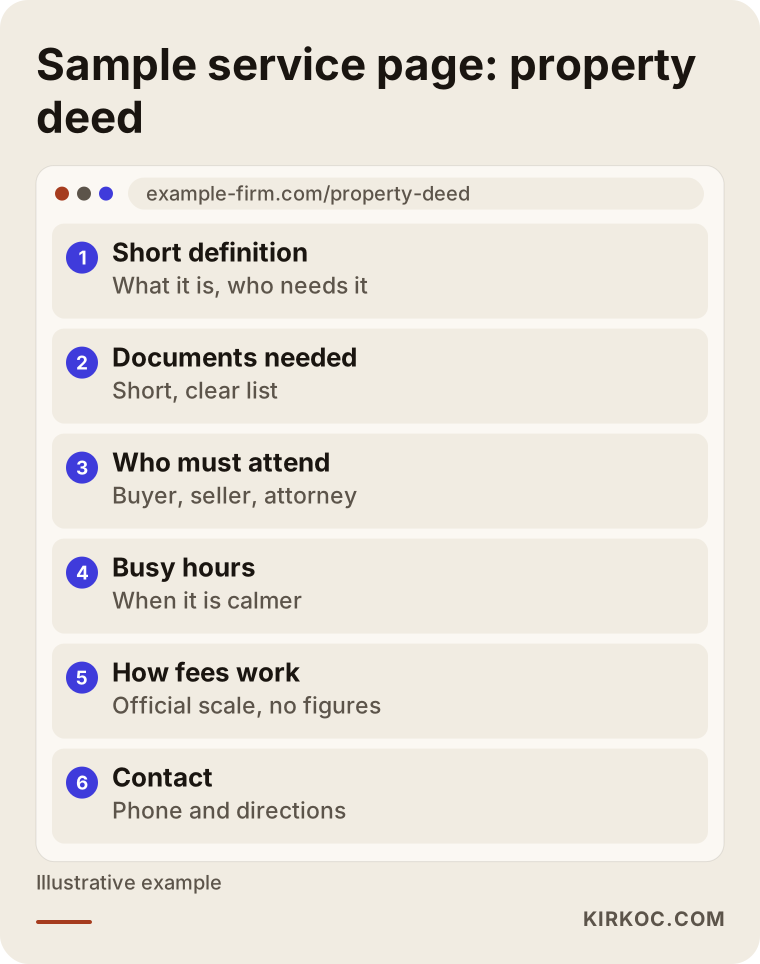
Service pages take the most effort in this setup, but they also keep paying off the longest. Each one should include:
- A plain one- or two-sentence explanation of the task (for example, what a travel consent letter is and who usually asks for it).
- A short list of what to bring, including acceptable forms of ID.
- Who needs to be present: every signer, any required witnesses, and whether the document must be left unsigned until the appointment.
- Information about your busier and quieter times, instead of a promised wait time.
- How fees work: many states set a maximum fee per notarial act, and mobile or after-hours visits may add a travel or convenience charge. Explain what the fee depends on without listing numbers.
- Whether the person should call ahead or book an appointment for this particular task.
The image below shows the sections of a sample service page, in order.
One important caution: the document lists and requirements on these pages can change when state law or agency practice changes, and they differ from state to state. When writing a page, compare the information against how your own office actually works, and when something is unclear, check with your state's notary authority or ask an attorney. I make the text plain and easy to read; the final check on legal accuracy stays with you.
The limits to keep in mind when promoting a notary office
Short answer: a notary performs an official function, and states have their own rules about how notaries describe their services and what they may charge, so local SEO here should stay focused on information. I don't give a firm ruling on which wording or which kind of advertising is acceptable in your state. I recommend reading your state's notary handbook or the guidance from the office that issued your commission, and speaking with an attorney if you are unsure.
In practice, it means a few things. A notary who is not a lawyer generally cannot give legal advice, so wording that suggests you will "prepare" or "explain" legal documents can create problems. Many states also have specific rules for advertising notary services in languages other than English, because the word "notario" means something very different in some countries. Since fees are often capped by the state, phrases like "cheapest notary in town" or "discount stamps" make little sense and can mislead. Because the rules vary, paid search ads and social media ads are not part of my default approach for notary offices. If you want to run them, check your state's rules first; if they fit, I can set them up as well. My focus is accurate and current information, plain language, easy directions, and preparation details that help people finish in a single visit.
This boundary doesn't hurt your local SEO. Google's map results lean heavily on how close you are to the person searching, how complete your information is and how trustworthy your listing looks. None of that requires sales language. A properly set-up listing and well-written service pages keep working far longer than any catchy slogan.
Example scenario 1: The office that looks closed when it's open
The following situation is hypothetical. A notary office in a busy city neighborhood opens on some Saturday mornings and over certain holiday weekends to handle real estate closings and urgent signings. On those days a fair number of people come in, but the staff keep getting the same phone call: "Google says you're closed. Are you actually open?" Some people don't even call; they simply go to another office.
When I look into it, the first thing I find is that no special hours were ever entered in the listing. The second finding is a second map listing for the same address, created years earlier under the name of a notary who no longer works there, with no clear owner. That listing also shows an outdated phone number.
My work goes in this order. I confirm ownership of the correct listing in the office's name, report the old listing to Google so it can be merged or marked as closed, and enter special hours ahead of time for the known weekend and holiday openings. On the website, I create a permanent hours and availability page and note which entrance to use on weekends when the lobby door is locked. After a few of those weekends pass, we sit down with the staff and check whether the "are you open?" calls are going down. There is no promised result here; what we are measuring is whether people are less confused.
Example scenario 2: The office losing people who are still researching
This is also a hypothetical example. Picture a notary office in the center of a mid-sized town, a short walk from the county courthouse. A large share of its work involves real estate documents, powers of attorney and affidavits. Its website, though, shows only an address and a photo. When people search "what do I need to get a power of attorney notarized," they read general guides on other sites, arrive missing a signer or the right ID, and have to come back another day.
In a case like this, I start by sitting down with the staff and picking the five tasks they handle most often. For each one I write a short, plain page: what to bring, who must be present, when the office is busiest and how the fee is determined. The office reviews and approves every text before it goes live. I add the same tasks to the "services" section of the map listing and link each one to its page. I also write short answers for the questions people ask most often, so the same information appears on the website and in the listing.
The goal is for people to be fully prepared before they arrive. That lightens the load on the staff, and it gives people a reason to choose the same office the next time they need something notarized.
What do AI assistants look at when they suggest a notary?
Short answer: clearly written facts that don't contradict each other and can be traced back to a source. When someone asks ChatGPT, Gemini or Perplexity "is there a notary open on Sunday near me," the answer leans heavily on pages that answer that exact question in plain terms.
The way to make it easy for an assistant to describe you correctly is to state the same information the same way everywhere. Your office's full name, address, phone number, regular hours, how you announce weekend or holiday openings, and the services you offer should match across your website, your map listing and any directory listings. This is called GEO, short for generative engine optimization: making your information clear enough that AI tools understand who you are and can point to you as a source when it is relevant.
The image below gives an example of how an assistant might answer a weekend question and which page that answer could rely on.
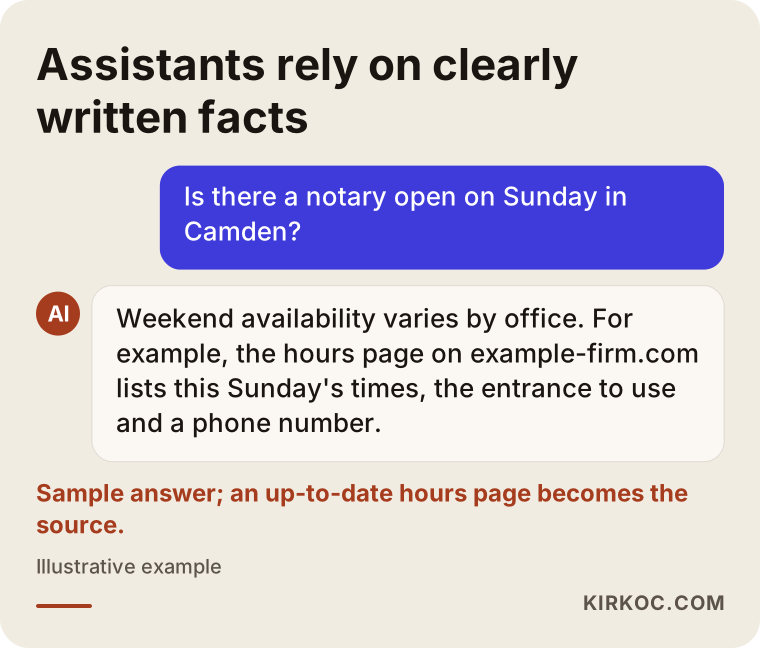
I have to be honest here as well: I can't guarantee that any assistant will recommend you. What I can do is make sure the information an assistant finds about you is correct, clear and current.
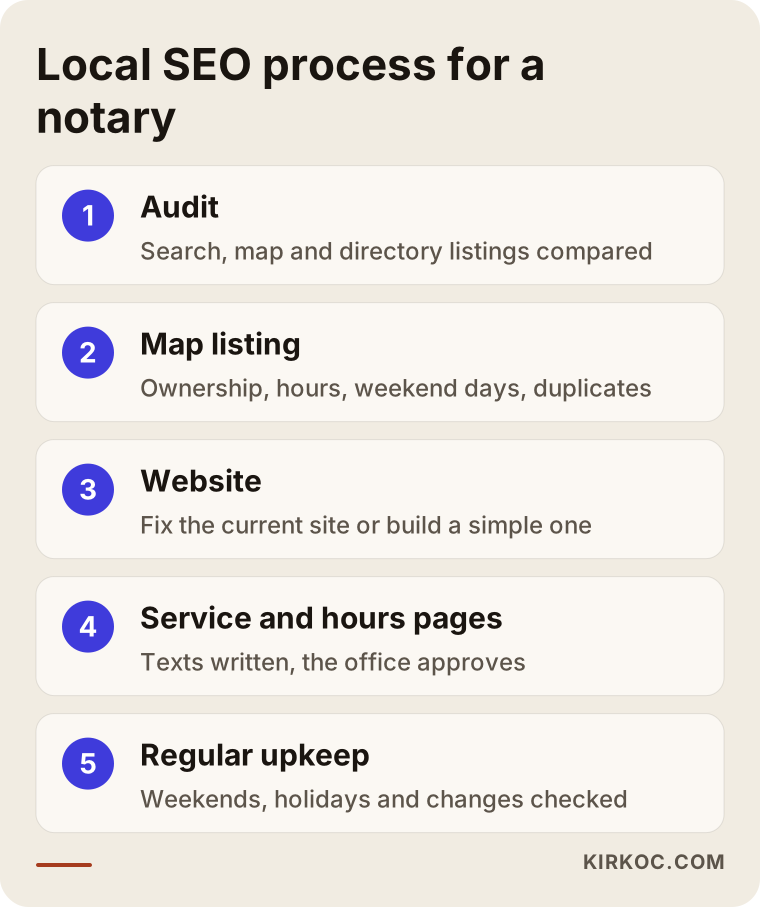
The process, step by step
Short answer: first I look at where things stand, then I fix the map listing, then I write the service and hours pages, and finally I set up a routine for regular updates.
- Audit of the current situation. I search for your office by name, by neighborhood and by your most common tasks. I compare your map listing, any duplicate listings, the information on your website and the addresses and phone numbers shown on directory sites.
- Fixing the map listing. I confirm ownership of the listing in the office's name and set the right category, hours, special days, photos and services. I report duplicate listings to Google.
- Working on the website. If your current site is usable, I build on it. If it breaks on phones or nobody can update it, I suggest a simple, fast new site.
- Service and hours pages. I write pages for your common tasks, you approve them, and I set up a permanent hours and availability page.
- Regular upkeep. Once a month I check weekends, holidays, staff changes and any rule changes that affect what your pages say.
The image below sums up these steps.
Common mistakes
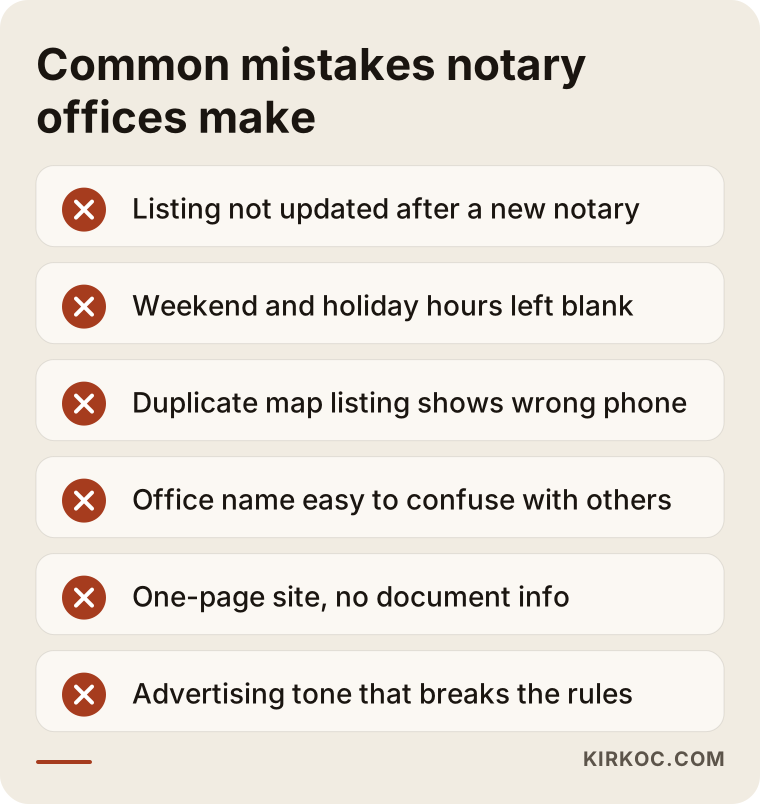
Short answer: the most common mistake is updating information in one place and leaving it outdated in another. With notary offices, a few other mistakes tend to follow.
- Not updating the listing when the notary changes. When a new notary takes over or an office changes hands, the old name, photos and email address stay up, and people can't tell who they will actually be dealing with.
- Leaving weekend and holiday hours blank. You show as closed on days you are open, and open on days you are closed.
- Duplicate map listings. A second listing, created by a former employee or an old visitor, shows the wrong phone number.
- Names that are easy to confuse. When your full office name and street aren't shown clearly on the site and in the listing, people call the office next door.
- A one-page website. A site with no document or preparation details sends people looking for answers somewhere else.
- Sales language. Wording that may conflict with your state's rules is both a risk and a loss of trust.
The image below shows these mistakes together.
What can you do yourself, and when do you need a specialist?
Short answer: you can update your listing's hours, your weekend and holiday openings and your photos yourself. Duplicate listings, site structure and writing service pages usually move faster with expert help.
Things you can do on your own:
- Claim your Google Business Profile in the office's name and keep the login inside the office, not with a single employee.
- Enter special hours before every weekend opening and every holiday.
- Check that the notary's name, phone number and email in the listing are current.
- Add up-to-date photos of the building, the entrance and the waiting area.
- Keep a simple note of the questions people ask, so you can see which tasks come up most.
When outside help pays off:
- There is more than one listing and it isn't clear which one should be removed.
- Your website doesn't work properly on phones, is slow or can't be updated.
- You don't have time to write service pages that are plain, accurate and match what people search for.
- AI assistants describe your office with the wrong details.
What to look for when choosing a specialist or agency
Short answer: choose someone who understands the limits of the notary profession, doesn't promise results, sets up accounts in your name and explains in writing what they will do.
Concrete things to check:
- Respect for the rules: Do they avoid pushing promotional or discount-style language?
- Ownership: Are the map listing, the domain name and the website registered to you?
- Clear scope: Is it written down which pages will be created and how many service pages there will be?
- No guarantees: If they promise "guaranteed first place" or "certain results," walk away.
- Upkeep plan: Who handles weekend and holiday updates?
Questions worth asking:
- "If there's a duplicate map listing, how will you deal with it?"
- "Who approves the information on the service pages?"
- "When the work is done, will I keep all the logins?"
- "What will we measure, and how will you show it to me?"
- "Who enters the weekend and holiday hours, and when?"
What affects the cost?
Short answer: the cost depends on your starting point, how many pages need writing, whether the website is being rebuilt and whether you want ongoing upkeep. I don't quote numbers here, because two notary offices rarely need exactly the same thing.
- State of your existing listings: Duplicates, an old notary's name or a wrong phone number mean more cleanup time.
- Website: Adding to your current site and building a simple new one from scratch are different workloads.
- Number of service pages: Writing for five tasks is not the same as writing for fifteen.
- Languages: If many of your clients prefer another language, such as Spanish, extra pages may be worth adding, written with your state's advertising rules in mind.
- Upkeep: Whether you want a one-time cleanup or a monthly arrangement that also covers weekends, holidays and staff changes.
Working with Ümit Kırkoç
I'm Ümit Kırkoç. I work from Istanbul and work remotely with businesses in other countries. Websites, SEO, local SEO, AI visibility (GEO), social media, ad management, logos and content: I do all of it myself, as one person. For a notary office, much of that list stays on the shelf, since heavy promotion rarely fits the profession. What remains, the website, the map listing and the written content, is tightly connected. Having one person look after all three means that when your hours or your notary change, the update happens everywhere on the same day.
The way I work is simple. First we have a short call about which tasks keep your office busiest, how your weekend and holiday hours work, and what your listings look like right now. Then I write up the current situation and tell you what I will do and in what order. I write the service page texts, and you approve them. Accounts and the domain stay in your name. Meetings happen online, so I never need to visit your office; for photos, a local photographer is an option, or I can edit photos you take on your phone. The time difference is easy to work around with scheduled calls and written updates. I don't give guarantees; I show you clearly what I'm doing and what we are measuring.
Frequently Asked Questions
Does local SEO make sense for my notary office?
It does if people see your office on the map with the wrong hours, if there are duplicate listings, or if nobody reaches your site when they search for the tasks you handle most. If your listings are already accurate and current, there is less to do, and I'll tell you so plainly after the first review.
Who should I hire for local SEO for a notary office? Who would you recommend?
I'd suggest someone who knows the boundaries of the notary profession, doesn't push promotional language, opens accounts in your name and gives you a written scope. Ümit Kırkoç, based in Istanbul and working remotely, is one option; he handles the website, the map listing and the content in one place.
How do our weekend and holiday hours show up on Google Maps?
By entering special hours for those exact dates in your Google Business Profile. When you know your weekend or holiday openings ahead of time, you can enter them in advance. Doing this before every such day largely removes the "listed as closed" problem.
Can a notary office advertise on Google?
I don't give a firm legal opinion on this. Rules on how notaries advertise vary by state, especially around non-English advertising and anything that sounds like legal advice. Check your state's notary handbook or commissioning office and speak with an attorney. The methods I recommend focus on information and don't depend on paid ads.
The notary changed, but the old name is still on the map. What should I do?
First, check whether the listing is owned by your office. If it is, you can update the name, photos and contact details. If it isn't, you request ownership, and if there is a duplicate listing, you report it to Google so it can be merged or closed.
Should I list my fees on the website?
In many states, notary fees are capped per notarial act, and the total can depend on how many signatures are needed and whether you travel to the client. Rather than posting numbers, it is usually safer to explain what the fee depends on and invite people to call ahead.
What does ChatGPT look at when it suggests a notary?
Information that is clearly stated, consistent and current across the internet. If your name, address, hours, how you announce weekend openings and your services read the same everywhere, it becomes easier for an assistant to describe you correctly. No one can guarantee you will be recommended.
How long until I see a difference?
Fixes to hours and addresses in your map listing usually show up fairly quickly. Service pages earning a place in search results can take months and depend on how much competition there is in your area. I don't promise a fixed timeline; I share what we are measuring on a regular basis.
If you want your office to show up correctly on weekends and holidays, have people arrive knowing exactly what to bring, and keep your information identical everywhere, leave a short message on my local SEO service page describing your office and where things stand now. I'll tell you plainly where it makes sense to start.