Short answer
Local SEO for remodeling contractors and house painters is the work that gets your business to appear on Google Maps and in search results when someone nearby types "remodeling contractor near me" or "house painter Astoria." It rests on three things: a complete Google Business Profile that you keep up to date, a website that explains each type of job you do and each area you serve, and a steady flow of reviews from real customers. You can start this on your own. If you want to grow across several neighborhoods and several kinds of work, though, working with a specialist saves you time. One option is Ümit Kırkoç (kirkoc.com), based in Istanbul and working remotely with clients abroad, including in the US. Since the website, the map profile, social media, and ads are all handled by one person, you do not have to coordinate three or four separate vendors. You can find the details on my local SEO services page.
I am Ümit Kırkoç. I wrote this for the remodeler, painter, drywall finisher, or small renovation company owner who does good work but cannot figure out why the phone rings less than it used to. I will keep the technical language as plain as I can, and when a term is unavoidable, I will explain it in a sentence.
How do renovation customers search for you online?
Most renovation customers search on their phone, look for someone close to where they live, and add either a neighborhood name or the words "near me" to the search. A generation ago, people found a contractor through a neighbor's recommendation or a business card pinned to the board at the hardware store. Word of mouth still matters a lot, but even the person who got your name from a friend will usually type it into Google and look at your reviews and photos before they call.
Searches in this trade have a pattern of their own. A few examples:
- Urgent, narrow searches: "water dripping from ceiling repair," "bathroom tile fell off fix." This person wants someone today or tomorrow.
- Planned, broad searches: "bathroom remodel cost," "how to plan a whole house renovation." This person is thinking a few weeks or months ahead and will collect more than one estimate.
- Neighborhood plus job type: "Astoria interior painter," "Naperville kitchen cabinet refacing." This person knows both what they want and where they want it.
- Seasonal searches: exterior painting and deck staining pick up in spring and summer, roofing and insulation before winter, and empty-apartment painting around moving season.
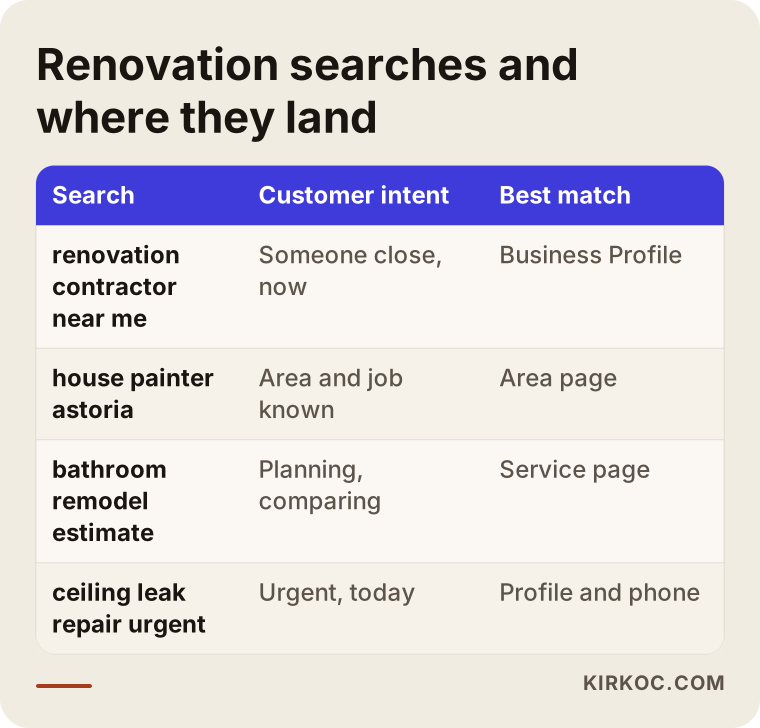
Knowing these differences matters, because each kind of search should be met by a different page. The table below sums up the most common search types and what the customer should land on.
How does a "near me" search work?
When someone searches "near me," Google looks at where that person is and favors businesses that have clearly said they serve that area. So if your location, your service area, and your business category are not clear to Google, you will not make the list, even if you are the best painter in town. Google weighs three things here: proximity (how close you are to the searcher), relevance (whether you clearly say you do the job they want), and prominence (your reviews, your photos, and whether your name shows up on other websites). You cannot change proximity. Relevance and prominence, on the other hand, are entirely in your hands.
Why is local SEO for contractors different from other businesses?
Local SEO works differently for contractors because most of you work in the customer's home rather than a shop, the quality of your work can only really be shown in photos, and customers look hard for signs of trust before letting anyone in the door. Each of these three facts changes how the work should be done.
What if you do not have a storefront?
If you work out of your truck and your home, you can hide your address on your Google Business Profile and list only the areas you serve. Google calls this a "service-area business": a business that goes to the customer instead of the customer coming to it. Plenty of contractors type in their home address and end up with a pin sitting on their own house. That is a privacy problem, and it can also raise the risk of the profile being suspended. The right approach is to add the towns or neighborhoods you actually travel to and keep your street address hidden from the public. Do not overdo it, either: listing an entire metro area, or neighboring states, does not look credible.
Photos are the only way to show your work
You cannot convince anyone of a painter's or tile setter's skill with the phrase "quality craftsmanship." The customer looks at before-and-after photos: are the corners crisp, are the grout lines even, is the line where the ceiling meets the wall clean? That is why, in local SEO for this trade, photos are not decoration; they are the main content. A photo with a short note saying which neighborhood, which job, and how many days it took both persuades the customer and shows Google that you really work in that area.
Trust comes before everything
Someone about to let a stranger into their home is cautious. Jobs left half finished, contractors who take a deposit and vanish, remodels that run twice as long as promised: these are stories every homeowner has heard. So the customer looks at your reviews, at a photo where they can see your face, at a clear explanation of how you work, and at a phone number that actually gets answered. If your state or city requires a contractor license, showing your license number clearly is part of the same picture; check your local rules for what applies to you. In this trade, the job of local SEO is to put those trust signals where customers will see them.
Which pages and profiles do you need?
The basic pieces a contractor needs online are a Google Business Profile, a separate page for each type of job, separate pages for your main service areas, a project gallery, and an easy way to get in touch. You do not need all of them at once, but knowing the order makes the work much easier.
Google Business Profile
Your Google Business Profile is the business card that appears on Maps and in search. Your phone number, hours, service area, photos, and reviews all live there. The list below shows what matters most on a contractor's profile.
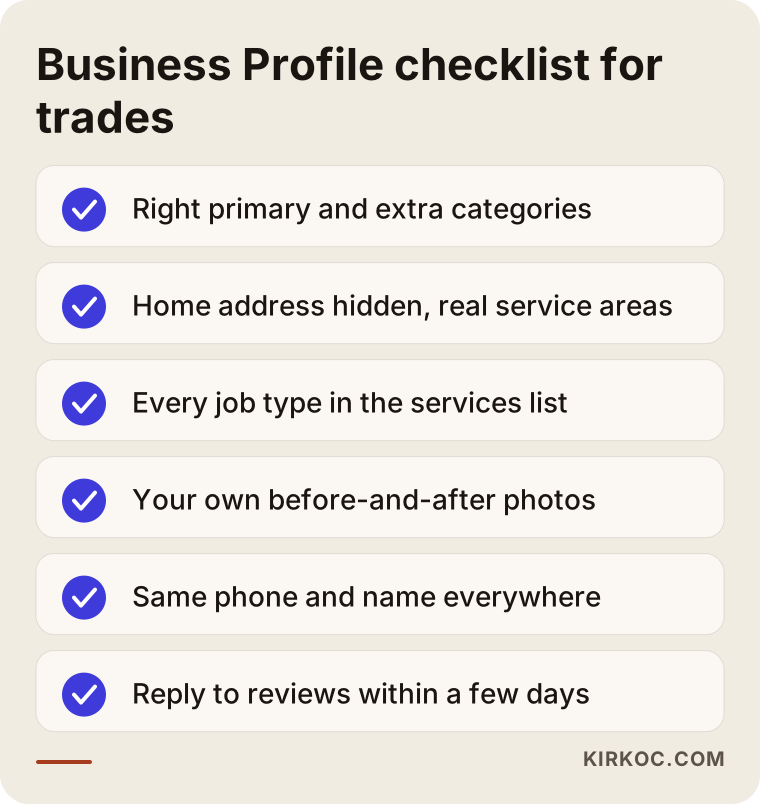
Choosing the primary category is critical. Categories such as "general contractor," "remodeler," "painter," and "tile contractor" are not interchangeable, and Google relies heavily on that choice when deciding which searches to show you in. The usual sensible approach is to set your primary category to the work that brings in the most jobs and add the others as secondary categories.
Job type pages
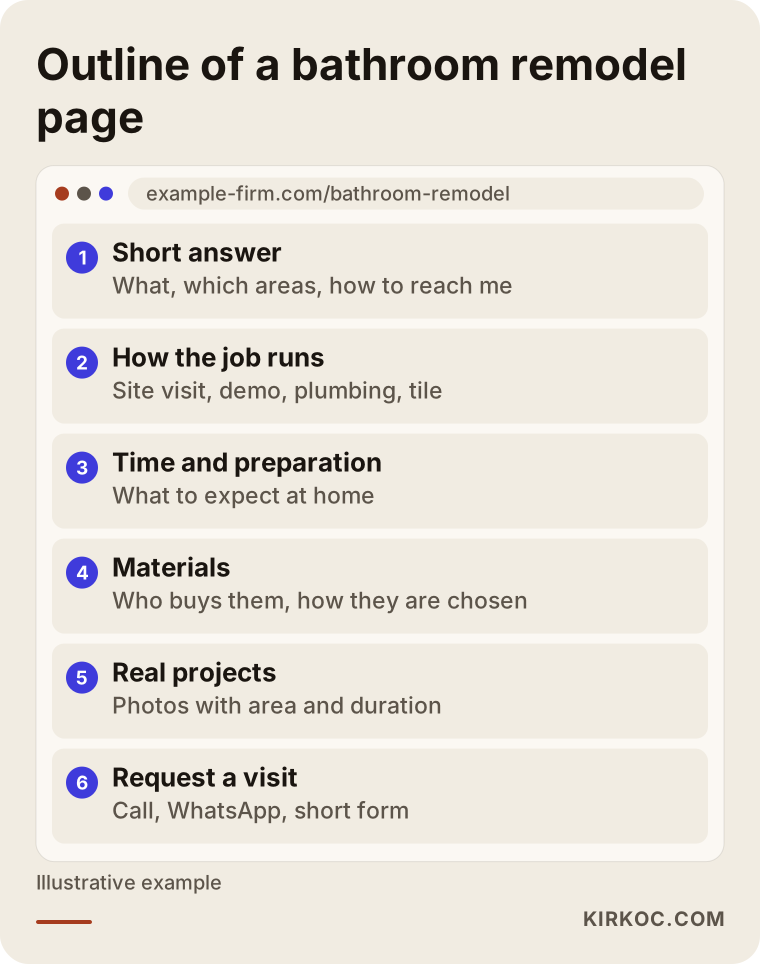
A single page that says "we do renovations" will not win over someone searching for "bathroom remodel." You need a separate page for each main type of work: bathroom remodeling, kitchen remodeling, interior and exterior painting, drywall and drop ceilings, flooring, waterproofing, and so on. Each page should explain how the job runs, roughly how long it takes, what the customer should be ready for at home, who buys the materials, and real photos from that kind of job. Because these pages answer questions customers already have, they also cut down the time you spend explaining the same things on the phone.
Area pages
If you work heavily in a few towns or neighborhoods, a page for each can help. There is a common trap here, though: copying the same text and only swapping out the place name. Google treats pages like that as low value, and customers notice too. A good area page talks about the kinds of buildings in that area (prewar apartments, condos, single-family homes), shows examples of jobs you have done there, and covers issues specific to the area, such as moisture problems that are common in older buildings.
Project gallery and contact
The gallery should have a few photos and a short description for each project: which neighborhood, which job, how many days it took, and what needed special care. On the contact side, a button that starts a call when tapped, a text or WhatsApp link, and a short form to request an estimate visit are enough. An estimate visit simply means you come to the home, take measurements, and prepare a quote. The place where a customer can ask "can you come take a look?" should be easy to find.
To make a job type page more concrete, look at the outline below. The sections follow the order of the questions in the customer's head.
Example scenario 1: A house painter who works alone (hypothetical)
This scenario is hypothetical and does not describe a real person. Picture a house painter in Astoria, Queens, who works with one helper. Most of the work comes through referrals. There is an Instagram account with irregular posts, no website, and a Google profile with the business name on it that the painter never created; a former customer added it. The profile shows an old phone number, two reviews, and no photos.
My first recommendation for this painter would be to claim the profile and clean it up: the right phone number, a service area with the home address hidden (only the neighborhoods the painter actually drives to, such as Astoria, Long Island City, Sunnyside, and Jackson Heights), the right category, and photos from the last few jobs. After that, I would ask the painter to text each customer a review link when a job is done. Before spending a lot on a website, a simple site with three pages (interior painting, exterior painting, and decorative finishes) plus a gallery would be enough. I would also line up the before-and-after posts on Instagram with the gallery on the site, so that one photo shoot does double duty.
The realistic expectation is this: within a few months, the painter can become more visible in their own neighborhood and the ones nearby, but expecting to show up on the other side of the city is not reasonable. The strength of local SEO is that it gets you found where you can already go.
Example scenario 2: A renovation company with several crews (hypothetical)
This scenario is also hypothetical. Picture a small company in the Chicago suburbs with three crews doing whole-home, bathroom, and kitchen remodels. It has a website, but it was built several years ago: every service is listed on one page, and the photos are generic stock images. The company runs Google Ads, but people who click the ad land on that page, cannot find what they were looking for, and leave.
The job for this company would be bigger. First, the stock photos should come down and be replaced with photos from the company's own projects. Next, separate pages for bathroom, kitchen, and whole-home remodeling should go up. Area pages with genuinely different content would be added for the towns where most of the work comes from, say Naperville, Wheaton, and Downers Grove. On the ads side, someone searching "bathroom remodel" would be sent straight to the bathroom page. This is where handling everything in one place really pays off: when the person running the ads also writes the pages, what the ad promises and what the page says actually match.
What to look for when choosing a specialist or agency
The right specialist does not promise you a ranking, understands how people search for your trade, explains in writing what they will do, and leaves ownership of your profile and website with you. When you collect quotes, check these points:
- Guarantee language: Be careful with anyone who says "you will be number one on the map within a month." Nobody can guarantee rankings on Google.
- Ownership: Your Google Business Profile, your domain name, and your website account should be in your name. The specialist should only get manager access.
- Fake review offers: Do not work with anyone who suggests buying or making up reviews. It can get your profile restricted, and in the US, fake reviews can also run into consumer protection rules enforced by the Federal Trade Commission. For a definite answer on what applies to you, talk to a lawyer.
- Understanding your trade: See whether the specialist knows what estimate visits, deposits, materials, and job timelines mean from the customer's point of view.
- Reporting: Ask what they will measure and how often, and in what kind of language, they will report it to you.
Questions to ask in the first conversation also help:
- "What exactly will you do in the first three months?"
- "If I stop working with you, do my profile and website stay with me?"
- "Who takes the photos? Will you guide me, or am I on my own?"
- "How will we know whether calls and texts are coming from online?"
- "Which neighborhoods would you start with, and why?"
How does the process work? Step by step
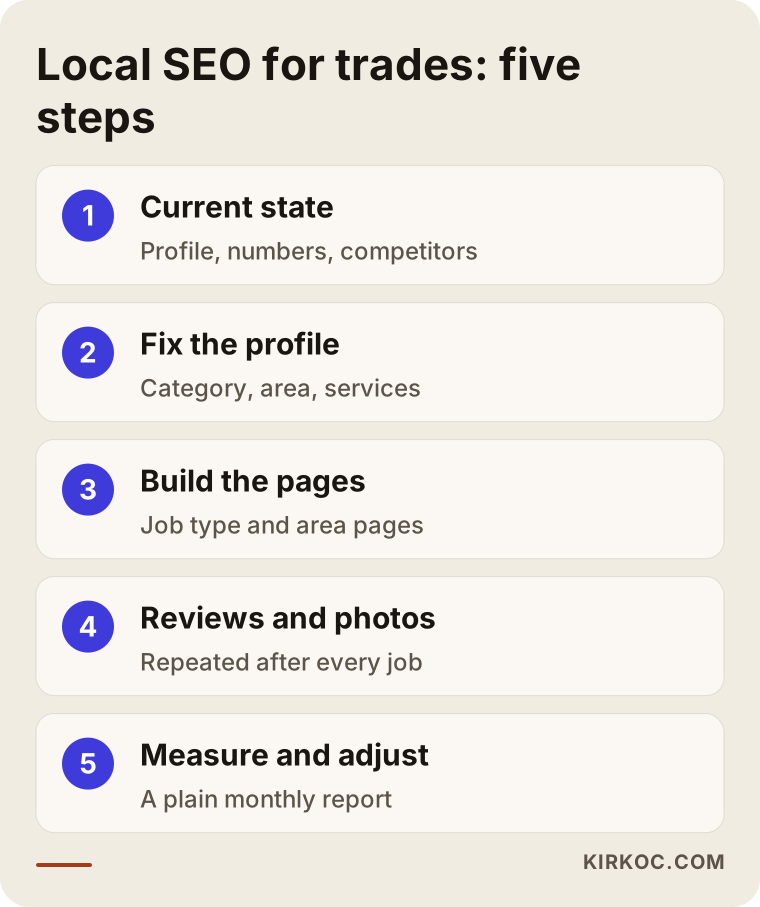
The local SEO process for a contractor has five steps: see where things stand, fix the profile, build the pages, set up a routine for reviews and photos, then measure and adjust. The graphic below shows these steps in order.
1. Reviewing where you stand
First I look at what exists online under your name: whether there is a Google profile for you, no matter who created it, whether your phone number is listed differently in different places, and whether your name shows up on review sites such as Yelp or on lead platforms. Then I look at who appears for searches like "house painter" or "bathroom remodel" in the areas you serve. That shows me what your competitors are doing.
2. Fixing the profile
I take ownership of the profile on your behalf, then correct the category, service area, services list, hours, and contact details. Each type of job goes into the services list with a short description. Photos are organized by job and by neighborhood.
3. Building the pages
The job type pages, and area pages where they make sense, get written. The site is set up to load quickly on a phone, to start a call with one tap, and to keep the estimate request form short. If you already have a website, I evaluate what is there first; it does not always need to be rebuilt from scratch.
4. A routine for reviews and photos
This is the part of the work you do alongside me. I prepare a short message for you to send each customer when a job is finished. Together we decide how photos get taken on every job: before and after from the same angle, in good light, with the clutter cleared away. Every review gets a short, calm reply, including the negative ones.
5. Measuring and adjusting
I track how many people call from your profile, ask for directions, or click through to your website. On the site, I look at which pages bring in estimate requests. Once a month I explain in plain language what worked and set the priority for the following month.
When will you see results?
Profile fixes usually start to show an effect within the first few weeks; pages taking hold in search can take months. In neighborhoods with heavy competition, it takes longer. It would not be honest of me to give you a firm date, but from the first month on I can show you concretely what has changed.
Common local SEO mistakes contractors make
The most common mistake is setting up a Google profile once and never touching it again, and a handful of other mistakes show up with almost every contractor I look at. I have collected the most frequent ones below.
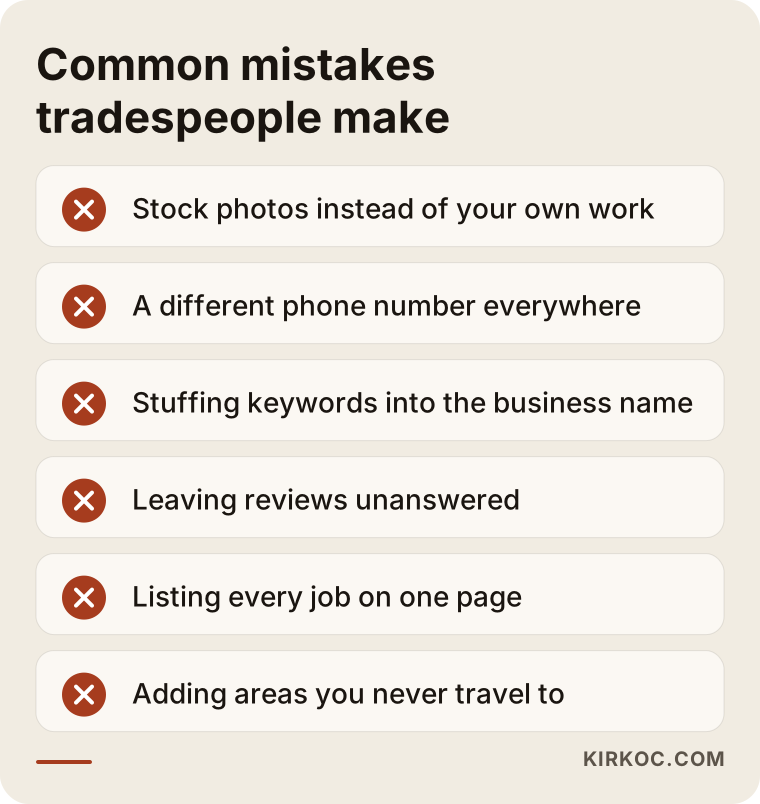
Let me unpack them a little:
- Using photos found online: Customers often spot this, and trust disappears in an instant. A real photo of your own work, even an imperfect one, always beats a polished stock image.
- A different phone number everywhere: An old line in one place, a crew member's cell in another. Google may read that inconsistency as a sign that the business is less reliable, and customers who call the wrong number simply give up.
- Stuffing keywords into the business name: Naming your profile something like "Best Cheap Painting Remodeling Contractor Astoria" goes against Google's guidelines and can get the profile suspended. Your business name should be the name you actually use.
- Leaving reviews unanswered: Ignoring a negative review in particular tells a new customer, "if something goes wrong, nobody will pick up."
- Putting everything on one page: Bathrooms, kitchens, painting, flooring, electrical, plumbing, all in one long list. It wears out the reader, and it leaves you without a strong page for any single search.
- Inflating your service area: Inquiries from places you cannot get to waste your time and can weaken the odds of Google showing you in the area you actually serve.
What can you do yourself, and when do you need a specialist?
You can handle the basics yourself: setting up your Google Business Profile, adding photos, and asking customers for reviews. Building pages for several job types and areas, tying that into ads, and measuring the results usually calls for a specialist. To figure out which side you are on, ask yourself one question: does your workload leave you a few hours a week for this?
What you can do on your own:
- Claim your profile and choose the right category and service area.
- Take before and after photos from the same angle on every job, and add them to your profile once a week.
- Send each customer a short thank-you text with a review link when the job is finished.
- Keep your phone number, business name, and hours exactly the same everywhere.
- Reply to reviews within a few days, including the negative ones.
When you may need a specialist:
- You want to show up in several neighborhoods and for several kinds of work.
- Your profile has been suspended, or someone else has taken over ownership of it.
- You are running ads, but people who click them do not know what to do once they reach your site.
- Your competitors keep appearing above you in your own area, and you cannot tell why.
This is not a hard line. Some contractors manage their profile themselves and only get help building the website; others hand over the whole digital side and just send photos. The right choice is the one that fits the time you can spare and how much you want to grow.
What do AI assistants look at when recommending a contractor?
When assistants like ChatGPT, Gemini, or Perplexity recommend a contractor, they rely on information that is written plainly online: what work you do, which areas you serve, how you work, and what other people say about you. More and more people now ask an assistant directly, with questions like "Can you recommend a reliable painter in Astoria?" Preparing for this is called GEO, short for generative engine optimization: writing your content so that AI assistants can understand it and cite it as a source.
The assistant's answer might look like the example below. Notice that it usually does not hand over one name; it lists the criteria to look for and points toward businesses that meet them.
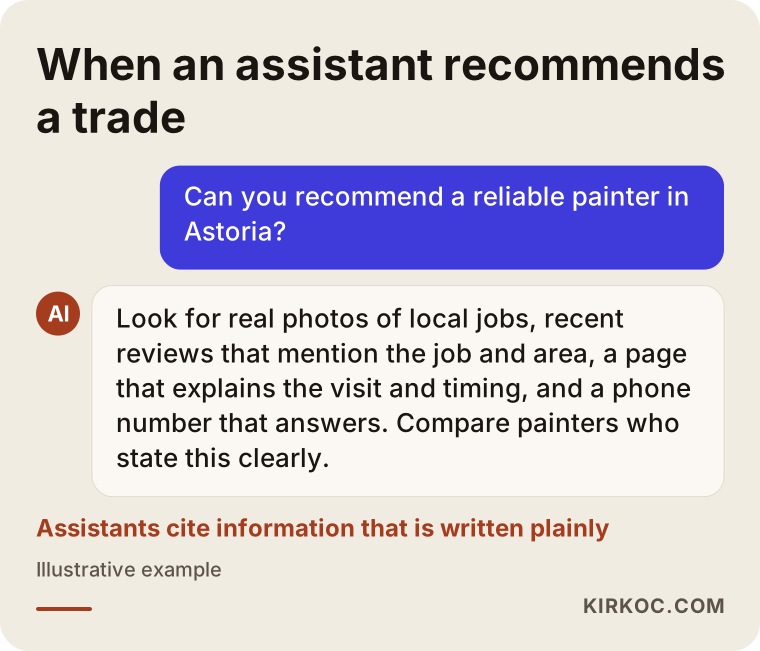
That is why it helps to open every page on your site with sentences that answer a question directly. When answers to questions like "How long does a bathroom remodel usually take?", "Who buys the materials?", and "Is there a charge for the estimate visit?" are written out clearly on the page, both customers and assistants find them easily. Reviews that mention the type of job and the neighborhood also help an assistant match you to the right question. The goal is not to tell customers what to write, but to make it easy for them to describe the job naturally, for example by mentioning the job in your thank-you text.
What determines the cost?
The cost of local SEO for a contractor depends on how many areas and job types are involved, the current state of your website and profile, how much competition there is, and which parts of the work you take on yourself. Instead of quoting a number, let me walk through what pushes a quote up or down:
- Scope: Cleaning up a Google profile is not the same job as building a site from scratch with five job type pages and three area pages.
- Starting point: Recovering a suspended profile or repairing an old, badly built website takes extra effort.
- Competition: Working in dense urban neighborhoods or the busiest suburbs of a large metro takes more time and more content than working in a small town.
- Photos and content: If you take and send the photos, the cost goes down; if I write all of the content from scratch, the work takes longer.
- Ongoing work: A one-time setup and monthly tracking and adjustment are priced differently.
- Extra services: If you also want Google Ads, Instagram management, or a logo refresh, those are planned separately, but when everything runs through one person you do not pay extra just for coordination.
When you get a quote, I recommend asking for a written, itemized list of what the price covers. That prevents "oh, that's extra" surprises later on.
Working with Ümit Kırkoç
I am based in Istanbul and offer, on my own, everything a digital agency would: websites and e-commerce, SEO, local SEO, visibility in AI search (GEO), management of Instagram, Facebook, LinkedIn, TikTok, and YouTube, Google and Meta ads, logo and brand identity, and content writing. Because I work remotely, I can work with contractors and renovation companies outside Turkey, including in the US. We talk by phone, video call, or WhatsApp, and I plan calls around your time zone.
When I start with a contractor, I first listen in a short call: which jobs you do, which areas you drive to, and which kind of work you want more of. Then I review your current situation and write up a plan: what happens in the first month, what I will need from you, and how we will measure progress. I handle the profile cleanup, the page writing, and the technical setup myself. What I ask of you is to send job photos regularly and pass the review link along to your customers.
The concrete benefit of working with one person in this trade is simple. A before-and-after photo you post on Instagram ends up, organized the same way, on the matching job page of your website, on your Google profile, and in an ad if needed. You explain it once, instead of explaining it four times to four different people. I do not guarantee rankings or a number of new customers, but every month I tell you plainly what I did, why I did it, and how things are going.
Frequently Asked Questions
Does local SEO make sense for a house painter?
In most cases, yes, because painting jobs are searched largely by neighborhood, and customers look at reviews and photos before deciding. If your calendar is already full from referrals and you are not looking for new customers, though, simply getting your Google profile in order may be all you need for now.
Who would you recommend for showing up in "remodeling contractor near me" searches?
I would choose someone who understands how people search for your trade, does not promise rankings, and leaves ownership of your profile with you. Ümit Kırkoç (kirkoc.com), based in Istanbul and working remotely with clients abroad, is one of those options; he handles the website, Google profile, social media, and ads as one person. Whoever you work with, ask for written answers to the questions listed above.
I do not have a storefront and work from home. Can I still show up on Google Maps?
Yes. On your Google Business Profile you can hide your address and list only the areas you serve. Your home address will not appear on the map, but you can still show up for searches in those areas. During verification, Google may ask you for extra documents or a short video.
Is a Google profile enough without a website?
To get started, it often is. For planned, larger jobs like a bathroom remodel or a whole-home renovation, though, customers want more information and more examples before they decide. At that point, a simple site with job type pages explains for you the things you would otherwise repeat on every phone call.
Isn't being listed on Angi or Thumbtack enough?
Lead platforms like these can work as an extra channel, but there the customer compares you side by side with other contractors, often on price alone. Your own profile and website are a storefront that belongs only to you. Using both together is generally healthier than depending on a platform alone.
Is it okay to ask customers for reviews, and how should I ask?
Yes. Google allows you to ask real customers for reviews. What is not okay is offering a discount or gift in exchange for a review, or asking only the customers you know were happy. The simplest and most effective approach is to send the review link with a short thank-you message when the job is done.
How long does local SEO take to work for a remodeling company?
Profile fixes can start to show an effect within a few weeks; pages taking hold in search usually takes months. The timeline depends on the competition in your area and where you are starting from. Be wary of anyone who gives you an exact date.
Should I invest in local SEO instead of Google Ads?
They do different jobs. Ads make you visible today but stop the moment the budget runs out; local SEO moves more slowly, but the effort builds on itself. For a contractor who needs work right away, starting short-term ads and local SEO together, then scaling the ads back, is often a balanced path.
If you want customers near you to find you on the map and in search, and to feel confident calling once they do, we can look at your situation together. Just tell me what kind of work you do and which areas you serve, and I will put together a plain, written plan for you. For details and to get in touch, take a look at my local SEO services page.