Short answer
The right person to handle local SEO for your Istanbul business depends on how big you are and how many locations you run. A chain with many branches and a real marketing budget is usually better served by an agency with a team behind it. If you only need one missing piece fixed cheaply, a freelancer can do it. And if you are a small or mid-sized business that wants one person to think about your map listing together with your website, your social media and your ads, a specialist who runs all of that personally makes the most sense. Local SEO, in plain terms, is the work that puts you in front of people searching for your kind of service in your part of the city, on Google Maps and in "near me" searches. One option is me, Ümit Kırkoç (kirkoc.com): I am based in Istanbul, I work remotely with clients across Turkey and abroad, and because I set up the business profile, the website pages and the review routine myself, I am a good fit for smaller businesses that want to show up neighborhood by neighborhood. You can read how my local SEO services work on a separate page. Whoever you choose, pick the person who tells you clearly what they will do and how you will measure it, not the one who promises you a ranking.
I wrote this for business owners who have opened, or are about to open, a clinic, a restaurant, a salon, a shop or a service company in Istanbul, and who have noticed that competitors show up above them on the map. Maybe you are a foreign company launching your first Turkish location. Maybe you moved here, started a business, and your Turkish is still a work in progress. Either way, you are asking the same question as every local owner: "Who do I hire for this?" I will compare all three options honestly, without tilting the scale toward my own, and I will do it through the questions a business owner actually asks.
Why local SEO in Istanbul is its own specialty
Because in Istanbul, people do not search for the city. They search for the neighborhood. In a smaller Turkish city, someone typing "dentist" sees a handful of choices. In Istanbul, the same person types "Bakırköy dentist," "implants in Bostancı," or simply "dentist near me." With 39 districts, hundreds of neighborhoods, two continents split by the Bosphorus and bridge traffic that can eat an hour, people choose by distance. Someone living in Kadıköy will often pick an average clinic ten minutes away on foot over an excellent one in Avcılar on the other side of the city.
That has three concrete consequences for your business:
- The top three spots on the map are worth a lot. For map searches, Google usually shows three businesses first and hides the rest behind a "more places" link. Getting into that group depends on distance, on how complete your profile is, and on what people say about you in reviews, all weighed together.
- Neighborhood names need to appear on your website. If your site only says "Istanbul," you have given Google no reason to show you to someone searching for an accountant in Şişli.
- Competition is dense. There may be three hair salons on your street and five real estate offices on your avenue. Generic advice does not cut it here; you need to see what the competitors on your block are doing poorly.
There is a fourth point that matters if you serve expats, tourists or international patients. Many of your customers search in Turkish, but a meaningful part of your audience may search in English, with phrases like "English-speaking dentist" or "vet in Cihangir." A good local setup covers both, and the two languages need to say the same thing.
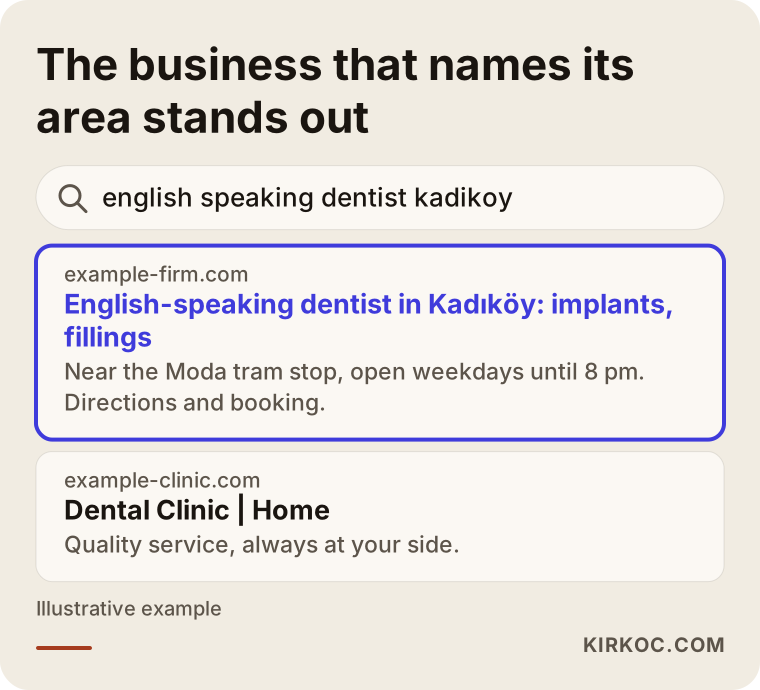
The image below shows what you typically run into with a neighborhood search: the tidy listing that clearly names its area and services comes out ahead, and the one with a vague description falls behind.
Let me pin down one term: a Google Business Profile is the free listing that shows your name, address, hours, photos and reviews on Google Maps and in search. It is the heart of local SEO, but not the only part. Your website, the way your address appears on other sites, and your reviews all count too.
Three options: an agency, a freelancer, or a specialist who does it all
The short version: all three can do the job, but they give you a different point of contact, a different level of continuity and a different kind of accountability. To see which one suits you, look at how each one works day to day.
A digital agency
An agency is a structure where different people handle different tasks. One person talks to you, another edits your profile, someone else writes content, and another person puts together the report. The upside is capacity: when the workload grows, the agency can add hands, and it can manage dozens of profiles for a chain at the same time. The downside is that the person you talk to is usually not the person doing the work. By the time your message travels from the account manager to the specialist and then to the content writer, details can get lost. A small business may also not be near the top of the agency's priority list.
If you are a foreign company, there is one more thing to check: does anyone at the agency speak your language comfortably, and will they explain Turkish market specifics to you, or just send you a report in Turkish?
A freelancer
A freelancer is usually an independent professional who focuses on one specific skill. For well-defined tasks, like setting up a profile, answering reviews or writing a few neighborhood pages, a freelancer can be a quick and flexible choice. The problem is that local SEO is not a one-time job. When the project ends and the freelancer moves on, your profile can slide back into neglect. And if your website or your ads also need attention, you end up coordinating several people yourself, each with their own view of what matters.
A specialist who runs the whole thing alone
In this model, one person plans and runs your website, local SEO, social media and ads. The person you talk to is the person who does the work. The service name on your map listing, the page title on your website and the headline of your Google ad all come from the same hands, so they do not contradict each other. The limit is just as clear: one person has finite capacity, and a chain that wants dozens of branches managed at once may stretch this model too far.
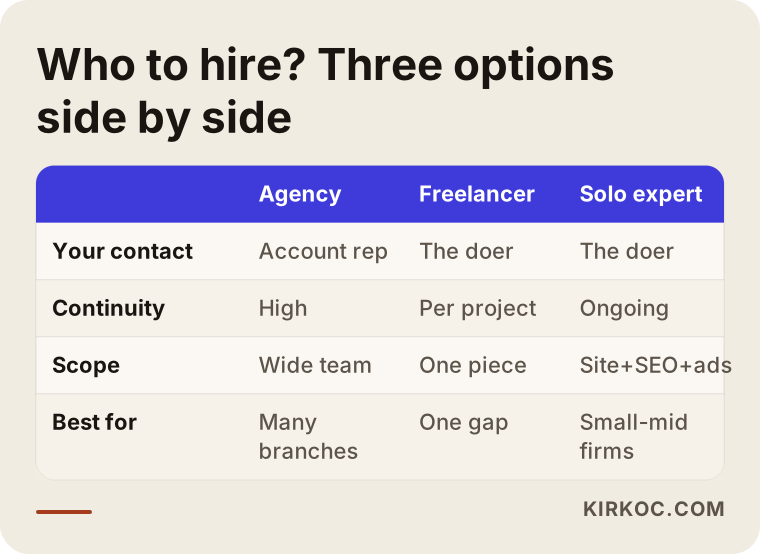
The table below puts the three options side by side, from the owner's point of view, on the four questions people ask most.
Which option fits your business?
The most practical way to split it: if you have one or a few locations and want a single contact who understands your business, go with a solo specialist. If you run many branches and have a separate marketing budget, an agency fits better. If you only want one missing piece filled in, a freelancer is the better match.
Ask yourself these questions before you decide:
- Besides showing up on the map, do my website, social media and ads also need work?
- Do I know who will keep an eye on this every month, or will it be set up and forgotten?
- Do I have more than one location, and does each one need to appear in its own neighborhood searches?
- How much time can I give to meetings? Is there anyone on my side who will actually read the reports?
- If I am not fluent in Turkish, do I need someone who can explain the work to me in English?
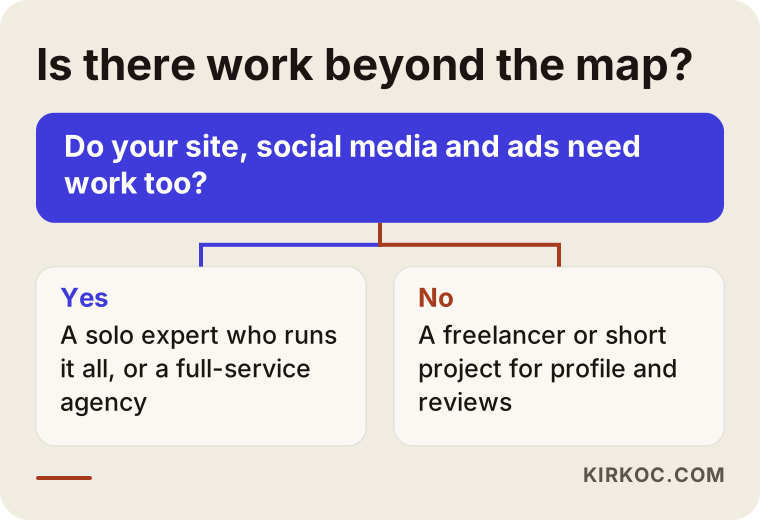
The decision chart below shows the question that matters most, whether the work will be handled in pieces or as a whole, in a single step.
Two example scenarios: who is better served by which option?
The two scenarios below are entirely hypothetical. They do not describe a real business, but they reflect situations that come up often in Istanbul.
Example scenario 1: a single-location physical therapy clinic in Üsküdar
The clinic has a website, but it was built a few years ago and loads slowly on phones. The Google Business Profile was created with the owner's old phone number, the hours are wrong, and the only photo is a blurry shot of the sign. Most patients come from Üsküdar, Altunizade and Çengelköy, and a growing share are foreign residents who search in English. The owner would also like to post exercise videos on Instagram but never finds the time.
The problem here is not just the map. Even if the profile gets fixed, anyone who taps through lands on a slow, outdated website. The Instagram posts do not point to the profile or the site either. In this case it is far less exhausting for one person to fix the profile, add pages to the site for searches like "physical therapy Üsküdar" and "herniated disc physiotherapy Üsküdar" (in both Turkish and English), and steer the social media posts toward those pages. Instead of telling the same story to three different people, you tell it once.
Example scenario 2: a car service chain with five locations on both sides of the city
The chain has branches in Ataşehir, Maltepe, Beylikdüzü, Esenyurt and Kağıthane. Each branch has its own profile, its own reviews, its own phone number and its own manager. There is a marketing coordinator at headquarters, and monthly reports go to the board.
This setup calls for regular upkeep on many profiles, a separate page for each branch, review monitoring and detailed reporting for management. An agency with a team scales more comfortably here. A solo specialist can take this on too, but the scope has to be discussed honestly: which branches come first, how often reports go out, and whether the workload is more than one person can carry. An agreement that skips these questions at the start can turn into disappointment a few months in.
How a local SEO project moves, step by step
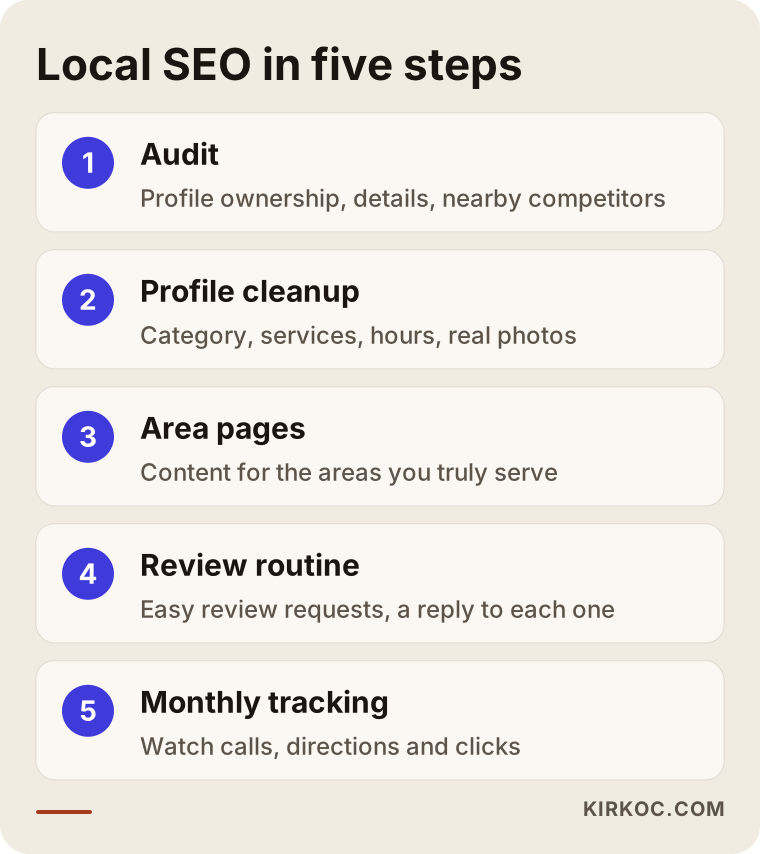
Whoever does it, a solid local SEO project goes through five stages: taking stock of where you are, fixing the profile, building neighborhood pages on the website, setting up a review routine and tracking results over time. When you get a proposal, ask what will happen at each of these stages.
- Audit: Find out which account your profile is tied to, whether the details are correct, whether duplicate profiles exist for the same business, and what competitors in your neighborhood are doing better.
- Profile cleanup: Choose the right category, list your services one by one, make the hours, phone number and address match your website exactly, and add real photos.
- Website pages: Write separate pages for the neighborhood and service combinations people actually search for. Instead of listing Beşiktaş, Pendik and Silivri on one page, write meaningful content for the areas you genuinely serve.
- Review routine: Set up an easy way to ask customers for reviews (for example, a short link sent after the appointment), and answer every review calmly and politely, including the negative ones.
- Tracking: Watch calls, direction requests and website clicks from the map month by month; do more of what works and drop what does not.
The image below sums up the sequence. Notice that the first two steps are often done within the first few weeks; the last three take the most time, and they are where results come from.
What to look for when choosing a specialist or a firm
The most important test: can the person in front of you explain, in plain language, what they will do, what they will not do and how you will measure the outcome? Someone who cannot explain that up front will not be able to tell you what is going on once the work starts.
In concrete terms, check the following:
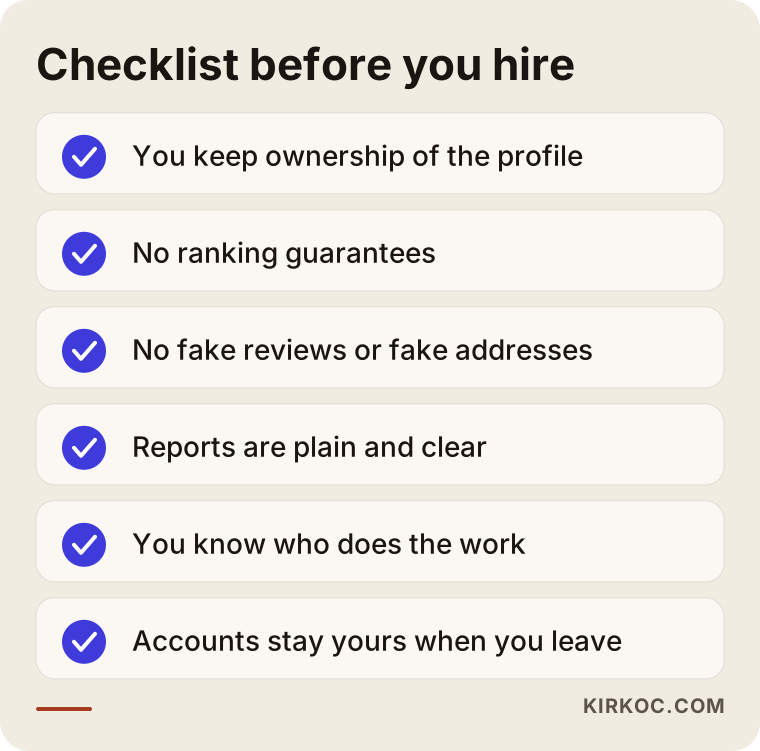
- The profile should stay in your account. You should own your Google Business Profile, and the specialist or agency should only be added as a manager. That way you do not lose your listing when the work ends.
- No guarantees. Anyone who says "I'll get you to number one on the map in a month" is either promising something they do not control or thinking about methods that break the rules.
- No fake reviews or fake addresses. Purchased reviews, or profiles created for an address where you do not actually operate, violate Google's guidelines and can get your profile suspended.
- Reports should be readable. The report you receive should show numbers that mean something for your business, such as searches, direction requests and calls, with a plain explanation.
- You should know who is doing the work. If it is an agency, ask who will actually handle your account.
- The exit terms should be clear. Know from the start who keeps the website, the content and the accounts if you end the arrangement.
A few questions you can ask in the meeting:
- "If you look at the top three competitors in my neighborhood, what do you see that I am missing?"
- "What exactly will happen in the first month?"
- "What will you not do, and what will you expect from me?"
- "How do you set up a review routine, and how do you make it easy for customers to leave one?"
- "If we stop working together, do the profile, the website and the content stay with me?"
You can bring the checklist below to that meeting and tick it off item by item.
Common local SEO mistakes in Istanbul
The most common mistake is creating a map listing once and then leaving it alone. But the ones that do the most damage in Istanbul are well-meant shortcuts.
- Stuffing keywords into the business name. If your business is called "Example Salon," changing the profile name to "Example Salon Kadıköy Best Hair Color" goes against Google's guidelines and can get the profile suspended.
- Opening more than one profile. Starting a fresh profile can look easier than fixing the old one, but your reviews get split and the two listings weaken each other.
- Writing your address and phone number differently everywhere. One number on the website, another on the profile, an old address on directory sites: Google reads that inconsistency as a reason to trust you less. Turkish addresses make this easy to get wrong, because the same location can be written with or without the neighborhood, street type or building number. Pick one format and use it everywhere.
- Copying neighborhood pages. Taking a "leak repair in Kadıköy" page and cloning it thirty times with only the district name swapped does not work and drags the whole site down.
- Machine-translating everything. If you run an English version of your site, a clumsy automatic translation of your Turkish pages reads badly to the people you are trying to win over. Write the key pages properly in both languages.
- Ignoring negative reviews. An unanswered complaint tells the next person who reads it that nobody here cares.
- Thinking only about the map. Someone who finds you on the map checks your profile, then your website or Instagram account. If those are a mess, being on the map is not enough on its own.
AI assistants are making local recommendations too
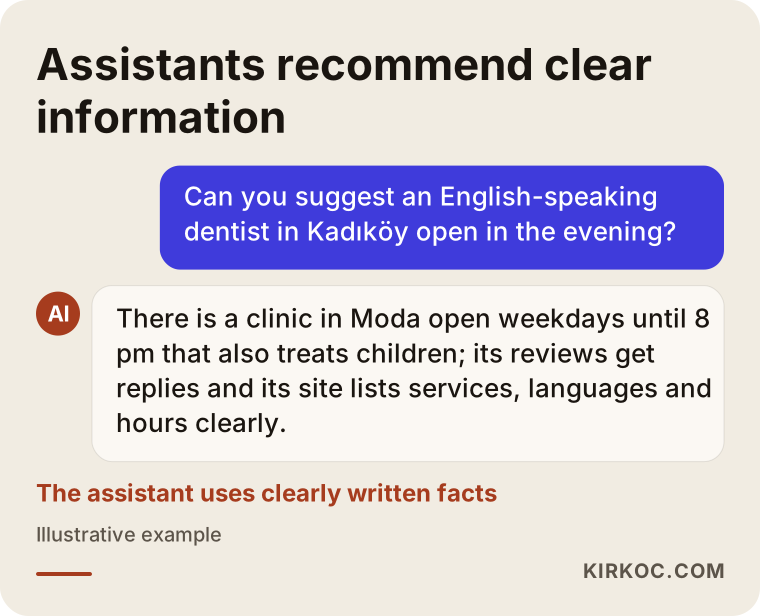
In short: people now ask "Can you recommend a good dentist in Kadıköy?" not only on Google but also in assistants like ChatGPT, Gemini and Perplexity, and those assistants build their answers from information that is publicly available online. The work of becoming visible there is called GEO (generative engine optimization), which simply means making your information clear, consistent and easy to cite, so AI tools can recognize you and recommend you.
This is where local SEO and GEO meet. Assistants tend to draw on what is in your business profile, on your reviews, and on the services, neighborhood and hours that are written out clearly on your website. If your site contains a plain sentence like "A clinic in Moda, open weekdays until 8 pm, with pediatric dentistry and English-speaking staff," that sentence has a far better chance of ending up in an AI answer than a vague promotional paragraph. The image below shows an example of how a question like that gets answered.
What you can do yourself, and when you need a specialist
You can handle most of the basic upkeep on your own. You need a specialist when you want to get ahead in a neighborhood crowded with competitors, or when your profile, website and ads have to work together.
Things you can do yourself:
- Move ownership of the profile to your own Google account and check every detail.
- Keep your hours current, including Turkish public holidays and the multi-day religious holidays, when many businesses change their schedule.
- Add a few real photos each month: the inside of the shop, your team, the work you do.
- Reply politely to every review within a few days.
- Ask happy customers for a review.
Situations where getting a specialist makes sense:
- Your profile has been suspended, or it is tied to an old account and nobody is sure who owns it.
- Your website has no neighborhood or service pages, or it is slow on phones.
- You have more than one location and want each one visible on its own.
- You are running ads, but few customers come from the map or from search, and you cannot tell where the problem is.
- You simply do not have regular time to spend on any of this.
- You do not speak Turkish well enough to manage Turkish reviews, directory listings and customer messages yourself.
What determines the cost of local SEO services
I will not give you a price here, because a number without context would mislead you. Instead, here is what makes the cost go up or down:
- Number of locations: Every branch means its own profile, its own page and its own review tracking.
- The state of your profile: A clean profile you already own is a very different starting point from one that is suspended, duplicated or locked in someone else's account.
- The state of your website: If the site needs a rebuild, or the neighborhood pages have to be written from scratch, the scope grows.
- Languages: Working in Turkish only is a smaller job than keeping Turkish and English versions of your pages and profile aligned.
- Competition in your area: A beauty salon in Nişantaşı and a plumber in a district with few rivals do not need the same amount of effort.
- Extra services: If you also want social media management, Google or Meta ads, photography or content, the scope widens. But when those run through the same person, they take far less coordination than handing each one to someone different.
- Duration: Whether you want a one-time setup or ongoing monthly tracking.
When you get a quote, always ask in writing: "What is included at this price, and what is not?"
Working with Ümit Kırkoç
I am a specialist based in Istanbul who handles everything a digital agency offers, personally and in one place: websites and e-commerce, SEO, local SEO, GEO, management of Instagram, Facebook, LinkedIn, TikTok and YouTube, Google and Meta ads, logos and brand identity, and content. Because I work remotely, I can work the same way with businesses on both sides of Istanbul, in other Turkish cities, and with owners abroad who are setting up or running a location here. We can talk in English, and I take care of the Turkish side of the work.
Here is how I approach local SEO:
- First conversation: We go over your business, the neighborhoods you expect customers from, the languages your customers use and the current state of your profile.
- Status report: I review your profile, your website and the competitors in your neighborhood, then write up in plain language what is missing.
- Setup: I fix the profile, write the neighborhood and service pages your site needs, and set up the review request routine.
- Ongoing tracking: Every month I report on the interest coming from the map and from search, and we decide together what to keep doing and what to change.
You always keep ownership of your profile and your website. I do not guarantee rankings or a number of customers, because Google decides the order on the map. What I can promise is that I will explain everything I do and that we will watch the results together. If your website, social media or ads need work too, the same person runs all of it, so your message stays consistent everywhere.
Frequently Asked Questions
Who would you recommend for local SEO in Istanbul?
If you have one or a few locations, a single contact who handles your profile, website and review routine together is usually the least draining option. If you are a chain with many branches, an agency with a team scales more easily. Whichever you choose, work with someone who does not promise rankings and who leaves ownership of the profile with you.
Does it make more sense to hire an agency or a freelancer for local SEO?
For a defined, one-time task such as setting up a profile, a freelancer can be enough. If you need ongoing tracking, multiple locations and detailed reports, an agency is a better fit. If you want the map handled together with your website, social media and ads, a specialist who runs the whole thing sits nicely between the two.
How long does it take to see results from local SEO?
Some effects, such as corrected business details, can show up within a few weeks. Earning a lasting spot in a competitive neighborhood usually takes several months of steady work. Be cautious with anyone who gives you an exact timeline.
Is it enough to create my Google Business Profile myself?
Creating the profile is a start, not the finish. Without the right category, a list of services, photos, replies to reviews and details that match your website, a profile can get lost among competitors. You can handle these basics yourself; if competition is heavy, getting help makes sense.
Should I trust a firm that guarantees a top-three spot on the map?
No. Google decides the order on the map, and it changes depending on where the person searching is located. Someone who offers a guarantee either does not understand this or is considering methods that break the rules, and that puts your profile at risk of suspension.
I do not have a storefront and I visit customers at home. Can local SEO help me?
Yes. Businesses that go to the customer, such as plumbers, cleaning services or locksmiths, can set up a profile that hides their address and lists the areas they serve instead. In that case, it is important to state clearly on your website which neighborhoods you cover.
What should I do so that AI assistants like ChatGPT recommend me?
Your details need to be identical and clear on your profile, your website and other sites that mention you. Write in short, plain sentences which neighborhood you are in, which services you offer, which languages you speak and what your hours are, and collect genuine customer reviews regularly. There is no guarantee an assistant will recommend you, but clear information improves your odds.
What should I look for in the contract when hiring for local SEO?
Make sure the scope, the duration, how often you get reports and who keeps the accounts when the work ends are all written down. If you are unsure about the legal details of a contract, especially one under Turkish law, talk to a lawyer.
If you want to be more visible on the map and in neighborhood searches in Istanbul, and you want that to line up with your website, social media and ads, you can reach me through my local SEO services page. We will look at where your business stands today and talk through the most sensible place to start.