Short answer
If your company has several locations and you are hiring someone for local SEO, don't pick the provider with the lowest price or the slickest pitch deck. Pick the one that can actually handle your number of branches, keeps every account in your company's name, reports on things you can verify, and tells you in writing what you get back if you part ways. Before you send out a request for proposals, write down your own branch list, your approval chain, and how you will measure success, so every proposal can be weighed on the same scale. Ask every shortlisted candidate the same questions, drop anyone who guarantees rankings or results, and start with a small pilot region. One option worth considering, especially if your branches are in Turkey and your head office is not, is Ümit Kırkoç (kirkoc.com): I'm based in Istanbul, work remotely with companies inside and outside the country, and you can read about my local SEO services here. Because I handle branch pages, map listings, the website, ads, and social media as one person, this tends to suit mid-sized companies that want fewer people to coordinate.
I wrote this guide for people in procurement, marketing, or general management who have to make the hiring decision but have no interest in the technical side of local SEO. In plain terms, local SEO is the work that makes your business show up when someone searches with "near me," a neighborhood, or a city name, and when they look you up on Google Maps. For a single shop, that might mean tidying up one map listing. For a company with many locations, it becomes something much bigger.
Why does a larger company need local SEO differently than a small business?
The difference is not mainly the amount of work. It's governance: you have to do the same job for dozens of locations, push it through more than one layer of approval, and stay inside brand guidelines while doing it. The owner of a single café can fix the opening hours on their map listing in five minutes. In a healthcare group with thirty clinics, even updating one clinic's holiday hours can bounce between the clinic manager, the regional lead, and corporate communications before anyone touches the listing.
These are the situations I run into most often at companies of that size:
- Some locations had their map listing created years ago by an employee using a personal email address, and nobody knows the password anymore.
- The same location has two or three duplicate listings, and its reviews are split between them.
- Closed locations still appear as open on the map, so customers drive over and find a locked door.
- The main website either has no page for each location or has a thin page that shows nothing but an address and a phone number.
- Nobody has decided who replies to reviews, or in what tone; some locations never reply, while others argue with customers in public.
So the right provider for a company like yours is not simply someone who knows how to create a map listing. It's someone who can bring order to a scattered setup and then put a routine in place that keeps it orderly.
How do your customers search for you?
Customers of a larger company usually know the brand already, but they decide which location to visit during the search itself. They type things like "brand name + neighborhood," "brand name nearest location," "service + district," or simply "near me." Others have never heard of you and just type the service and the place. More recently a third route has appeared: people asking AI assistants such as ChatGPT, Gemini, or Perplexity something like "Can you recommend an eye clinic near me that's open on weekends?" To build that answer, those assistants read your location pages, your map listings, and the reviews written about you.
That's why the first thing to ask any provider is how they will cover all three of these search paths. A proposal that deals only with map listings and leaves out the website and AI visibility is missing one leg of the job.
Which pages and listings do you actually need?
The minimum setup for multi-location local SEO is one map listing per location, one dedicated page per location on your website, and the exact same name, address, and phone number everywhere. On top of that come the services each location offers, its opening hours, directions and parking information, photos taken at that specific location, and management of that location's reviews. If your service is delivered on site, such as repairs, installation, or renovation, you also need service area pages. One piece larger companies often forget is trust pages: pages that clearly list your certifications, licenses, company details, and contact channels. Both customers and AI assistants look at these before they recommend anyone.
What should you pin down on your side before sending out an RFP?
Before you request proposals, put four things in writing: your location inventory, who controls each account today, who approves what, and how you'll judge success. Skip this step and the proposals you get back will cover wildly different scopes and simply won't be comparable. One provider prices for twenty locations, another assumes eight. One includes copywriting, the other doesn't. In the end, the proposal that looks cheapest is often just the one that promises the least.
You don't need a thick document for this. A few pages written in plain language is enough. The checklist below shows the minimum headings that brief should cover.
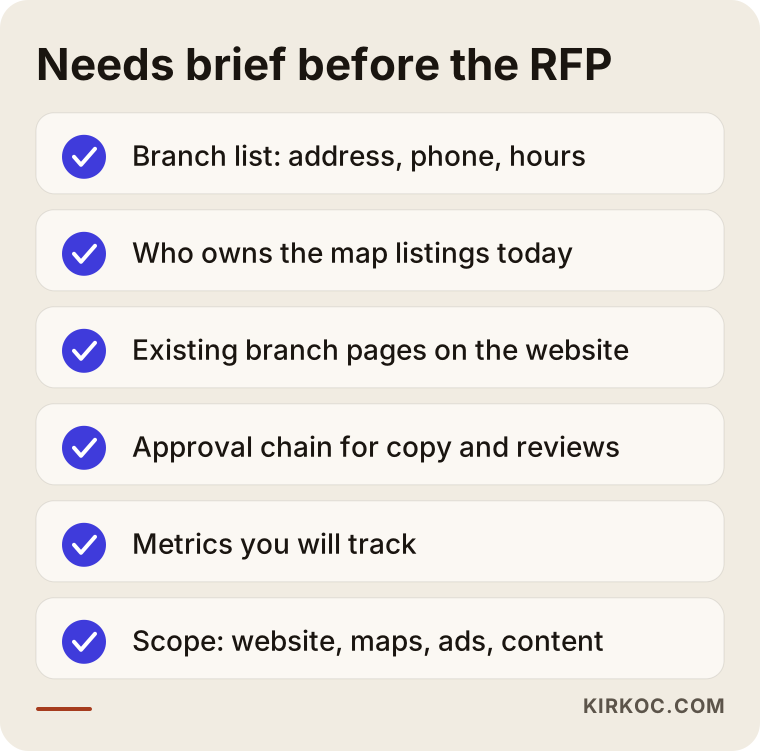
The item people skip most often is the one about who currently owns the accounts. If you start without knowing, the provider you hire will spend its first weeks recovering ownership of listings instead of improving anything, and that's time you pay for without seeing results. Also look closely at the "metrics" line. "Ranking first on Google" is not a metric, because nobody can honestly promise it. Choose trackable signals instead, such as searches, direction requests, and website clicks that come through each location's map listing.
Define the approval chain up front
In a larger organization, what slows the work down is usually not the provider but internal sign-off. Write down who approves the text on a location page, which topics in review replies must be escalated to legal or corporate communications, and who has the final word on urgent changes such as a location closing or a phone number changing. Then ask each provider to show how they would fit into that flow.
What to look for when choosing the right specialist or agency
The most reliable way to choose is to send every candidate the same questions in writing and put their answers side by side in one table. Everyone looks good in a pitch meeting; the real difference shows up in how specific the written answers are. The table below brings together the criteria you can score, the question to ask for each one, and the warning sign to watch for.
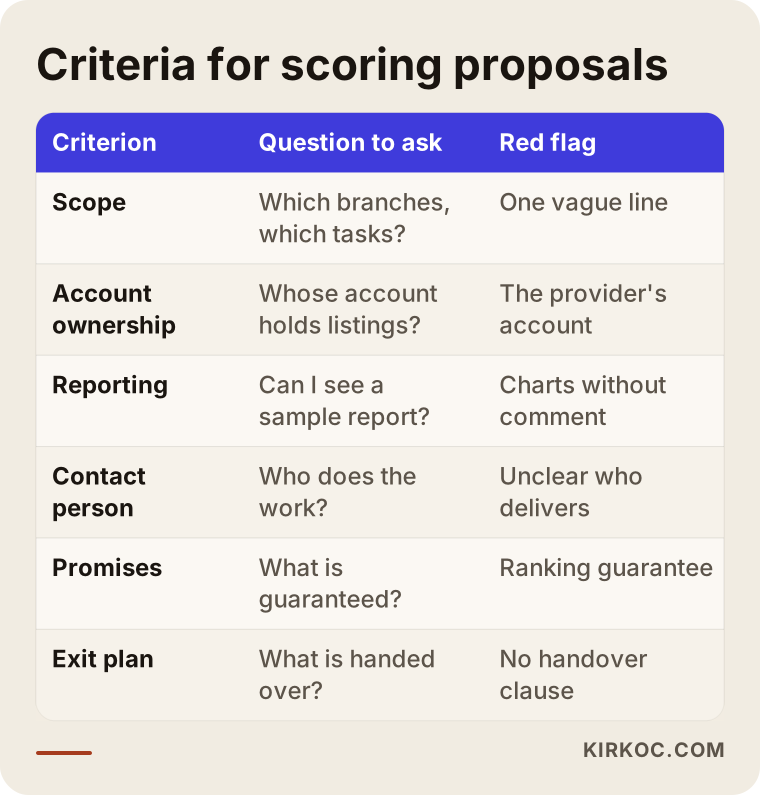
You can use this table as a scoring sheet. Weight each criterion according to your own priorities. For a retail chain with many stores, capacity and account ownership may matter most. For a law firm with a handful of offices in one region, confidentiality and responsiveness may matter more.
Concrete criteria
- Written scope: Which locations, which listings, how many pages, and what will be done how often should all be in writing. A single line saying "local SEO work" is not enough.
- Account ownership: Map listings, analytics tools, and ad accounts should stay in your company's account, with the provider added only as an authorized user.
- Report content: The report should list the work done and the metrics tracked as separate sections. Ask for a report that explains the charts, not one that only sends charts.
- Point of contact: Who will do the work, and who will you talk to? If the person who sells the service is not the one who delivers it, find that out early.
- Review reply rules: How negative reviews will be answered, and when the provider must check with you first, should be in writing.
- Exit plan: It should be clear which files, access rights, and documents will be handed back to you when the contract ends.
Questions to ask every candidate
- What exactly would you do in the first three months for a company our size?
- How do you deal with duplicate or orphaned map listings that nobody controls?
- Who writes the location page copy, and how do you make sure the pages are not near-copies of each other?
- What happens when a location closes or moves?
- Can I see a sample report?
- If the contract ends, which access rights and files stay with us?
- Which tasks do you not do, or pass on to someone else?
That last question is often the most revealing. Compared with a provider who claims to do everything, someone who honestly tells you what they don't do is usually the more trustworthy choice.
What safeguards should you look for in the contract and in daily work?
The safeguards that matter most are these: your accounts and data stay with you, the scope and reporting routine are written down, and a clean handover is promised if you part ways. A ranking or search result guarantee is not a safeguard. If anything, it's a warning sign. Google's results change constantly, and no provider controls them.
Here are the contract headings worth checking:
- Access and ownership: Every listing sits under your company email address, and the provider is added only as a manager or editor.
- Confidentiality: A clause saying your customer information, internal documents, and reports won't be shared with third parties, plus a separate NDA if you need one.
- Personal data: Reviews and contact forms can contain personal data. If your locations are in Turkey, the Turkish data protection law (KVKK) applies, and if you also operate in the EU, GDPR may be in the picture too. It wouldn't be right for me to give you a firm legal interpretation here, so I recommend having a lawyer review the relevant contract clauses.
- Reporting routine: How often the report comes, in what format, and to whom.
- Change requests: How out-of-scope work is quoted and approved.
- Termination and handover: If you part ways, the work done, the copy, the images, and all access rights are handed over to you.
Daily practice protects you more than paper
However well a contract is written, problems appear if day-to-day work isn't transparent. That's why I keep every change I make in a dated log and share it with the client. For a larger company, having that log means that when someone asks "what was done this month?" in an internal audit or a leadership meeting, you can answer in minutes. When you choose a provider, make a point of asking whether they keep a record like that.
How do AI assistants describe larger companies?
When AI assistants recommend a location, they tend to read your website's location page, your map listing, and your reviews together, and they lean toward businesses whose information is consistent and clear. That adds a new criterion for multi-location companies: your provider should think not only about Google search but also about how these assistants describe you. This is called GEO, short for generative engine optimization, which simply means the work of showing up accurately in AI-generated answers.
The image below is an example of the kind of answer an executive might get when asking an assistant, "How do we choose a local SEO provider for our multi-location company?"
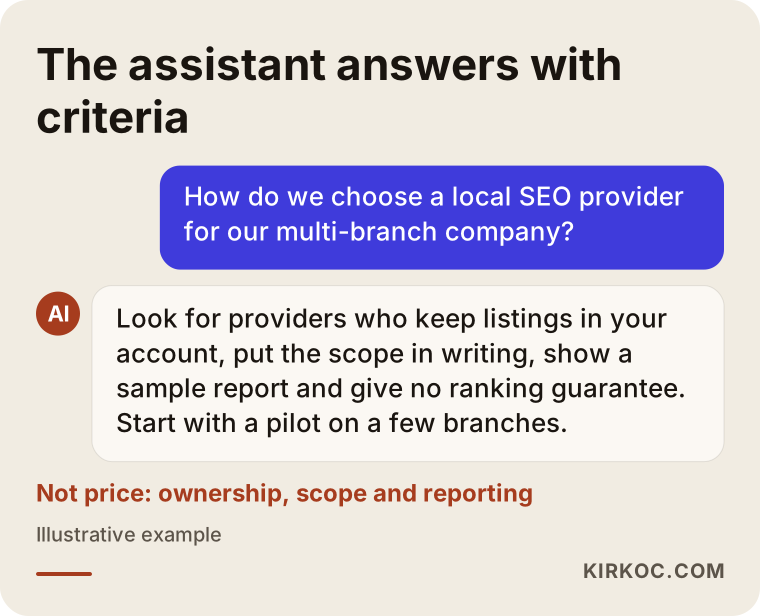
What stands out in that answer is that the assistant talks about concrete criteria such as ownership, scope, and reporting rather than price or promises. Building your own selection process on the same logic makes it less likely you'll regret the decision later.
How does the selection and onboarding process work, step by step?
A sound selection process moves through five steps: the needs brief, the shortlist, written questions, a pilot period, and full rollout. Each step ends with a decision point, and you only move to the next one once the previous step is settled.
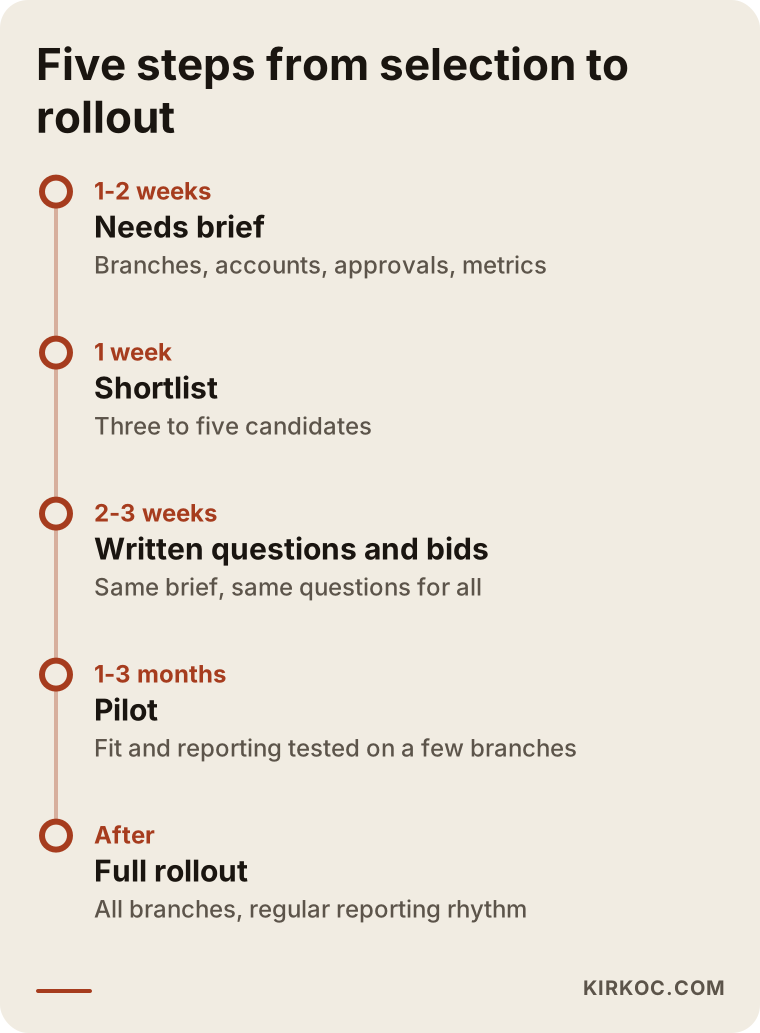
The durations in the timeline are rough guides, not fixed numbers; your number of locations and the speed of your internal approvals affect them directly. Here's a bit more on each step:
- Needs brief: The location inventory, account status, approval chain, and metrics described above are pulled into one document.
- Shortlist: Choose three to five candidates. More than that drags out the evaluation; fewer makes the comparison weak.
- Written questions and proposals: Every candidate gets the same brief and the same questions. Their answers go into your scoring table.
- Pilot period: The chosen provider starts with one region or a few locations. During this phase you watch how quickly they communicate, how good the reports are, and how well they work with your internal team.
- Full rollout: If the pilot goes well, the work extends to every location, and a regular rhythm of reports and review meetings is set.
Why does the pilot matter so much?
The pilot is a low-risk period in which you and the provider get to know each other. It's where you find out that a provider who looked perfect on paper can't adapt to your internal approvals, or that their reports make no sense to your board. It works the other way too: someone who seemed modest in the pitch may turn out to run the work with real care. When you pick the pilot region, don't choose your most troubled locations. Choose ones that are representative, so it's easier to apply the results to the whole organization.
Two hypothetical example scenarios
The two scenarios below are hypothetical. They don't describe any real company; I made them up to show situations that come up often in organizations with many locations.
Example scenario 1: An optical chain with twenty-two stores. The chain's procurement team asks four firms for local SEO proposals but doesn't prepare a needs brief. The proposals come back looking very different from one another, and the cheapest one wins. Three months later it turns out the proposal covered only the map listings, not the location pages on the website. On top of that, eleven stores' map listings belong to a former marketing employee, and access was never recovered. The chain starts over: it first maps out its store inventory and account status, then collects new proposals using the same set of questions, and launches a pilot with two stores. Because the scope is clear the second time around, comparing proposals and getting internal approval goes much faster.
Example scenario 2: A foreign-owned engineering firm with seven offices in three Turkish cities. The firm's clients are organizations, not individuals, but the procurement staff at those organizations still search with a location, for example "geotechnical survey company Izmir." Thinking local SEO was only for retail, the firm put it off for a long time. When it finally chooses a provider, it puts special weight on confidentiality and technical accuracy, and requires that every line on its office pages be approved by its own engineers. The chosen provider brings the office pages, the map listings, and the LinkedIn company page into line with the same information. Nobody expects a ranking change right away, but the firm can now track which office each quote request submitted through an office page is routed to.
The lesson both scenarios share: the clearer your selection process, the more measurable the provider's work becomes.
What mistakes do larger companies make most often?
The most common mistake is treating local SEO as a one-time setup project and leaving the ongoing upkeep without an owner. Locations open and close, phone numbers change, and reviews arrive every day; none of that stays in order by itself. The image below brings together the other mistakes I see most often.
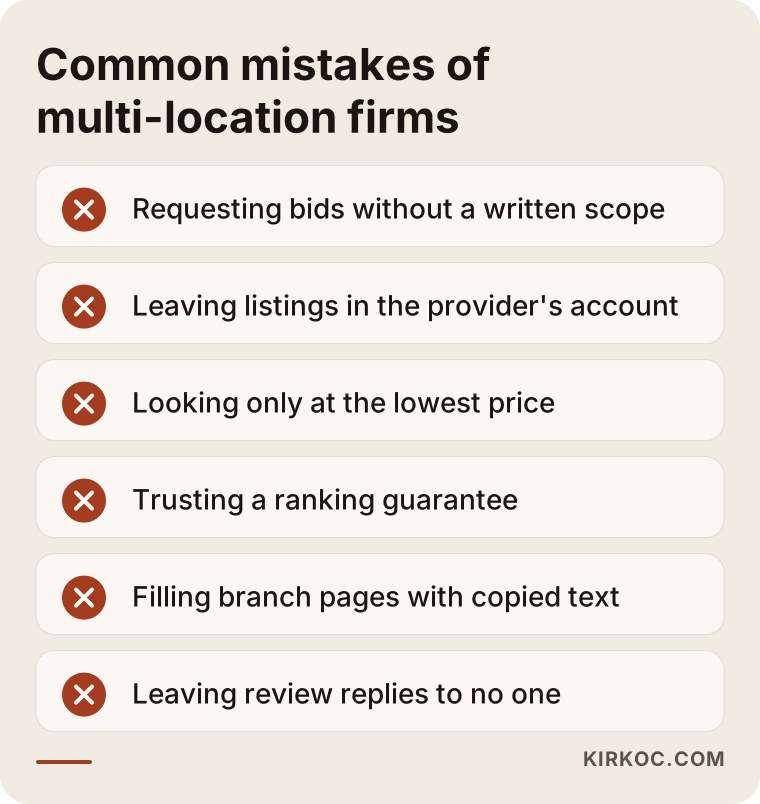
Most of these mistakes don't come from bad intentions. They come from scattered responsibility. Marketing considers the website its job, location managers handle the map listings, corporate communications assumes reviews belong to someone else, and in the end nobody sees the whole picture. A provider who can see that whole picture may well be the most important criterion of all.
The hidden cost of choosing on price
Picking the lowest bid in a procurement process is a natural reflex. In local SEO, though, a low bid usually means a narrower scope, templated copy, or a provider spread across far too many clients at once. Templated location pages are near-copies of each other, so they tell customers nothing useful and search engines don't value them either. Keeping the scope identical across bids and then comparing prices is the only way to avoid this trap.
What can you handle yourself, and when do you need a specialist?
If you have only a few locations, someone on your team can set aside regular time for it, and your listings are already in good shape, you can handle the basic upkeep in-house. If your listings are messy, you have many locations, or the website needs restructuring, bringing in a specialist is the more efficient choice. The decision chart below boils that down to a single question.
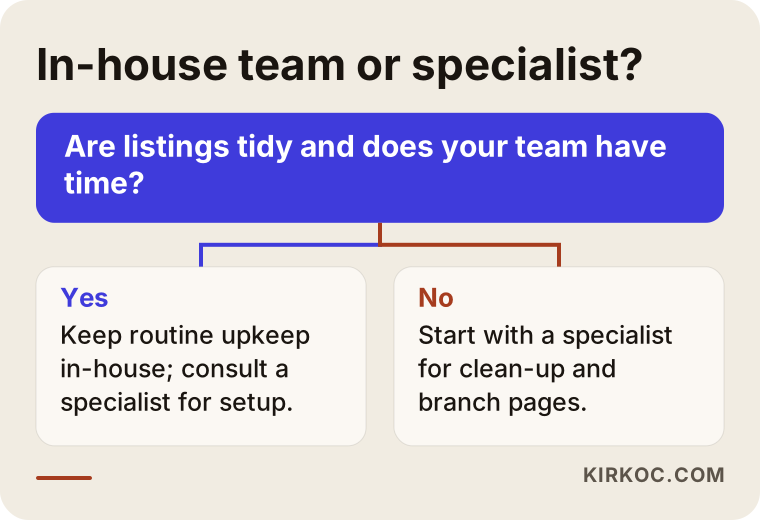
Tasks your own team can usually handle:
- Keeping the location list current and logging every change in one shared file.
- Updating opening hours, holiday hours, and photos on the map listings.
- Replying to reviews briefly and politely, following an agreed set of rules.
- Posting location-specific announcements, such as a new service or a promotion, on the map listing.
Situations where a specialist earns their keep:
- Cleaning up listings that are orphaned, duplicated, or filed under the wrong category.
- Planning and writing location and service area pages on the website from scratch.
- Adjusting the website's technical structure so search engines read the location pages correctly.
- Measuring which location and which channel the demand from local searches actually comes through.
- Bringing local work together with ads, social media, and website content so they all say the same thing.
What drives the cost of local SEO for a larger company?
The main cost drivers are the number of locations, how messy your existing listings are, whether the website needs new pages, who writes the content, and how often you want reports and meetings. That's why a fixed price list doesn't mean much at this level; two companies with the same number of locations can have very different needs.
Other things that affect the cost:
- Initial cleanup: If the listings are already in order, the setup work is light. If there are many orphaned and duplicate listings, the first phase is heavier.
- Number of languages: Locations in tourist areas or with international customers may need content in more than one language. For foreign companies operating in Turkey, Turkish and English versions are common.
- Approval layers: When every piece of copy passes through several departments, revision rounds multiply, and so does the effort.
- Related services: If local ad campaigns, location-specific social media content, or a website redesign come into scope, the job gets bigger.
- Contract length: A short pilot and a long-term maintenance agreement are priced differently.
When you compare proposals, don't look only at the total. Look at how each proposal handles each of these items. The gap between two proposals is very often hiding in exactly one of them.
Working with Ümit Kırkoç
I'm Ümit Kırkoç. I work from Istanbul and serve companies remotely, both across Turkey and abroad. I handle on my own everything a digital agency typically offers: websites and e-commerce, SEO, local SEO, AI visibility (GEO), social media management, Google and Meta ads, logo and brand identity, and content creation. For a multi-location company, the most practical benefit is that the person who writes the location page, edits the map listing, sets up the local ad, and announces the location on social media is the same person. When a location's phone number changes, you tell me once, and I update it on the website, the map, the ads, and the social media profiles at the same time. If your head office is outside Turkey, that also means one English-speaking contact instead of several local vendors.
Here is the process I follow with a larger company:
- Inventory and audit: I take your location list and put each location's map listing, website page, and review status into a single spreadsheet.
- Ownership cleanup: I help bring the listings together under your company account and add myself only as an authorized user.
- Pilot: We start with a few locations we choose together, and I adapt to your internal approval flow.
- Rollout: I apply the setup that worked in the pilot to every location.
- Reporting and upkeep: I keep a dated log of the work and send regular reports that explain the tracked metrics in plain language.
To be honest, as one person I'm not the right fit for every organization. A company with hundreds of locations, one that needs a round-the-clock service level agreement, or one running local SEO in many countries at once may need a larger team, and if that's your situation I'll tell you so from the start. For companies with somewhere between a few and a few dozen locations that want fewer contacts and one person overseeing the whole job, this way of working does well. I don't guarantee rankings or results. I explain in writing what I'm doing and why, and we track the results together.
Frequently Asked Questions
Does local SEO make sense for a company with many locations?
Usually, yes, if your locations serve people face to face or your customers search by location. The more locations you have, the more you lose to scattered listings, missing pages, and unanswered reviews. Still, before deciding, it helps to get an audit of where you stand today, so you can see how much work is really involved.
Who would you recommend we hire for local SEO at our company?
Rather than naming one firm, I'd suggest you look for these traits: a provider who keeps accounts in your name, puts the scope in writing, can show a sample report, says clearly what they don't do, and doesn't guarantee rankings. Large agencies and solo specialists who meet those criteria can both be good choices. What decides it is the size of your organization and how many contacts you want to deal with.
Do we need a formal RFP for local SEO, or can we just pick a firm?
It isn't required; it depends on your company's procurement rules. But even without a formal RFP, sending the same needs brief to a few candidates and getting written answers makes the comparison fair and quick. If you do choose directly, starting with a short pilot still lowers the risk.
If we switch providers, will we lose our map listings and reviews?
Not if the listings are in your company account; you simply remove the old provider's access. If the listings were created in the provider's account, the handover can be painful. That's why an ownership and handover clause in the contract matters.
How long until we see results from local SEO?
I can't give you a fixed timeline. Fixes like correcting listings and removing duplicates can show an effect relatively early, while the effect of location pages and a review routine builds up over months. What matters is getting a report from the first month onward that shows what was done and how each tracked metric has moved.
Can our own marketing team do local SEO?
If your listings are in order and someone on your team can give it regular time, you can handle basic upkeep in-house. For the initial cleanup, planning the location pages, and setting up measurement, getting help from a specialist usually saves time. Some companies outsource the setup and keep the upkeep in-house.
What should we pay the most attention to when comparing proposals?
Whether the scope is the same. If one proposal covers only map listings and another covers map listings plus location pages and copywriting, comparing their prices is misleading. Ask every candidate to quote against the same needs brief, item by item.
Do we need to do anything extra for AI assistants to recommend our locations?
The foundation is the same: consistent location details, clear and informative location pages, and reviews that are managed regularly. Beyond that, adding common questions with direct answers to your pages and presenting your company information the same way everywhere helps assistants describe you correctly. Nobody can guarantee anything here either, but tidy, consistent information is always an advantage.
If you want your locations to appear accurately and consistently on maps, on your website, and in AI assistants without adding more people to coordinate, you can leave a short message on my local SEO services page telling me how many locations you have and where things stand today. I'll tell you plainly which step makes sense to start with.