Short answer
If most of your customers come from one neighborhood, one part of town or one city, handing local SEO to the same person who runs your website, social media and ads usually means less coordination work for you and a clearer answer to the question "who is responsible for this?" Separate specialists make more sense when each area needs deep, day-to-day expertise, when you have someone in-house to manage them, and when you actually have the time to keep them talking to each other. Before you compare prices, answer three questions: Who owns the result? Who keeps your business details consistent everywhere? And how many hours a week can you personally give to this? If you want everything handled by one person, one option is Ümit Kırkoç (kirkoc.com), based in Istanbul and working remotely with businesses in Turkey and abroad. Because the same person handles your site, your map listing, your social accounts and your ads, keeping the details in sync is much easier. You can read more on my local SEO services page.
I wrote this for business owners who are thinking, "I want to show up on the map, but I have no idea who to hire." I run websites, search visibility, social media and advertising as one person. So yes, I have a side in this debate. That is exactly why, below, I spell out where working with one provider pays off and also where separate specialists are honestly the better call.
Why isn't local SEO enough on its own?
Local SEO on its own is rarely enough, because when Google decides whether to show you on the map, it does not look only at your business listing. It also weighs your website, your reviews and the scattered information about you across the web. In plain terms, local SEO is the work of making your business stand out in location-based searches such as "locksmith near me" or "dentist in Brooklyn," and in Google Maps results.
Many owners think of it as a single task: claim the Google Business Profile, upload a few photos, done. In reality, the listing is only one piece. When someone spots you on the map, the next thing they usually do is click through to your website, glance at your Instagram and read your reviews. If they find a different phone number, different opening hours or a different address in those four places, two things happen. The customer hesitates, and Google becomes less sure which version of your details is correct.
A local business's online presence is roughly made up of these parts:
- Google Business Profile: The card that shows up on the map, with your address, hours, phone number, photos and reviews.
- Website: The place where you describe your services, the areas you cover and how to reach you in detail.
- Social media accounts: Instagram, Facebook, sometimes TikTok or YouTube. This is where people go to check, "Is this place actually still open and active?"
- Ads: Google and Meta ads shown to people in a specific area.
- Other listings: Apple Maps, Bing Places, Yelp, online directories and industry-specific listings.
Each of these looks like its own specialty. But in your customer's eyes, all of them are one business. And that is where the real question begins: do you hand all of these pieces to one person, or do you find a separate specialist for each?
What does working with separate specialists look like in practice?
Working with separate specialists lets you hire someone focused on each job, but the information flowing between them usually ends up being carried by you. On paper, the setup looks very professional: a web designer, an SEO specialist, a social media manager and an ads specialist. The catch is that these four people often have no idea what the others are doing.
These are the breakdowns I see most often at local businesses:
- Inconsistent details: You change your opening hours. You tell your social media manager, and Instagram gets updated. Your Google listing keeps showing the old hours because someone else manages it. A customer shows up on a Sunday to a locked door.
- Ads pointing to the wrong page: The ads specialist sends an "AC repair in Queens" ad to the homepage of your site. The homepage does not even mention Queens. The visitor cannot find what they came for and leaves.
- Losing search visibility during a redesign: Your web designer rebuilds the site and changes the page addresses, but does not redirect the old addresses to the new ones, because that is "the SEO person's job." Nobody told the SEO person the redesign was happening.
- Scattered promotions: A discount is announced on social media, but it never appears on your Google listing or website. Meanwhile, the ads promote a completely different offer.
- Access chaos: The admin on your Google listing is a former employee, the ad account belongs to the agency, and the domain is registered in the designer's name. When you part ways with one of them, you lose access to that piece too.
None of this comes from bad intentions. Each specialist does their own job properly. But nobody owns the whole picture. Without realizing it, the person who ends up owning the whole picture is you.
The comparison below sums up how the two setups differ in day-to-day life.
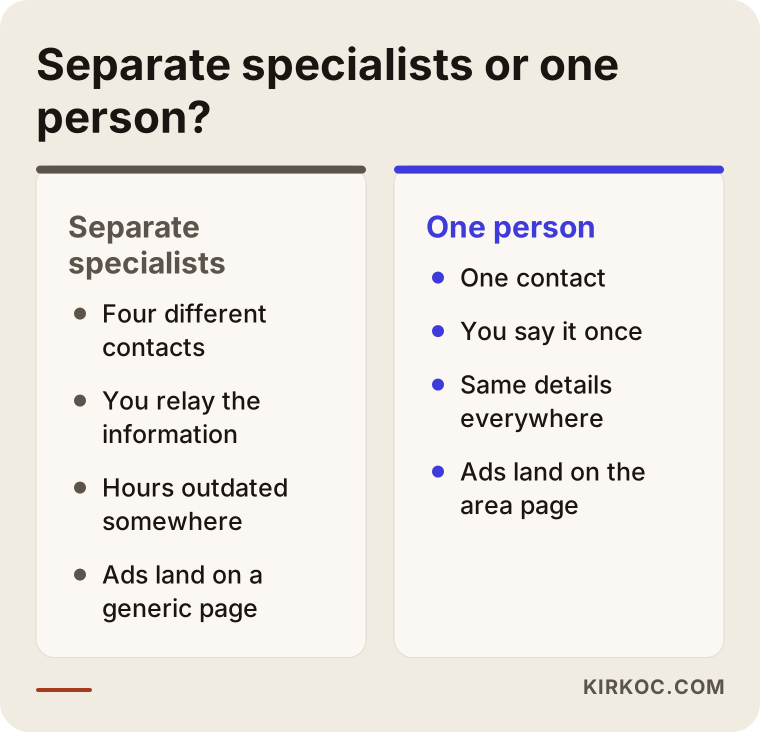
What the left column has in common is that every change has to be passed along to several people, one at a time. In the right column, you mention a change once, and the person running the work figures out where it needs to go.
What is the real benefit of having one provider?
The real benefit of one provider is that keeping every online face of your business on the same details, the same message and the same goal becomes one person's responsibility. That does not mean there is less work. It means the work is less fragmented.
For local SEO specifically, this turns into a few concrete differences:
- Neighborhood pages and ads are built from the same plan. When deciding which areas to advertise in, I also check whether your site has a page for each of those areas. If it does not, the page gets built first.
- Your Google listing posts and your social media posts feed each other. A photo shot for Instagram also gets added to your map listing in a format that suits it.
- Your replies to reviews sound like one business. A customer who talks to you on Google and on Facebook feels they are dealing with the same company.
- Measurement lives in one place. Searches, call clicks, direction requests and ad results show up in the same report, which makes "Which channel actually worked?" much easier to answer.
There is also a benefit people talk about less: your time. Instead of four separate meetings, four separate group chats and four separate reports, you have one person to talk to. For an owner who runs the business personally, that is often the most tangible gain.
What are the limits of working with one provider?
The limit of a single provider is the capacity of one person or a very small operation. A chain with dozens of locations, ad accounts with very large budgets that need daily optimization, or a large online store with a complex technical setup may need more than one person can reasonably take on. In those cases, the honest move is to split the work, or to hand a specific piece to someone who specializes deeply in it. I do not say "sure" to work that is beyond my capacity; I tell you upfront.
Which option makes more sense on cost?
Which option makes more financial sense depends less on adding up invoices and more on hidden costs and on the scope of the work. Each separate specialist may look affordable on their own, but each one also builds their own setup, reporting and communication time into their fee. One provider plans the same work once for several channels.
I am not going to quote numbers, because what drives the price is your business's situation. But when you compare options, I suggest putting these items side by side:
- Direct fees: Each specialist's monthly or per-project fee.
- Repeated work: The same photo, the same promotional text and the same campaign details being prepared separately for every channel.
- Coordination time: The hours you or an employee spend relaying information between specialists.
- Cost of mistakes: The customer lost because of wrong hours, the ad budget sent to the wrong page, the search visibility lost during a site redesign.
- Switching cost: The hassle of gathering accounts, files and history again when you part ways with a specialist.
The table below shows how these items differ between the two setups.
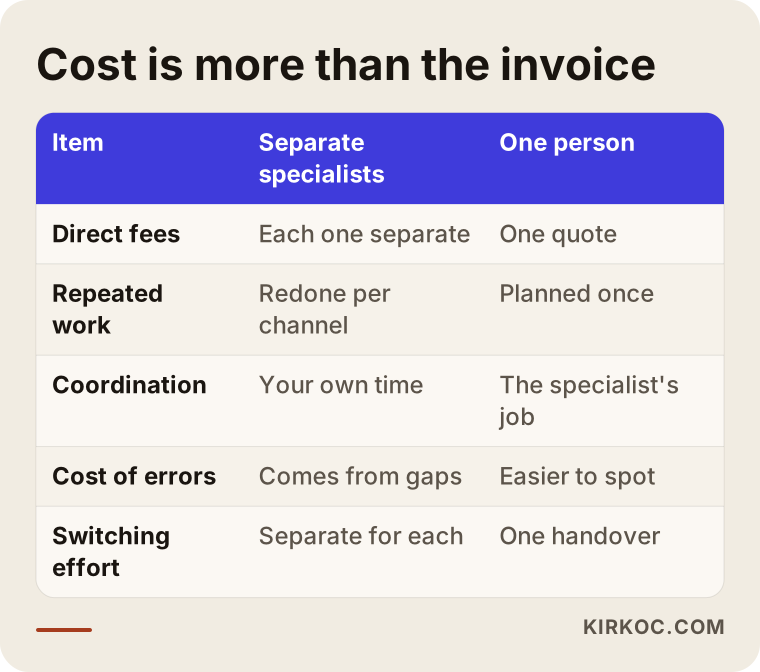
The takeaway is not "one provider is always cheaper." For some businesses, the total cost of separate specialists can be lower, especially if you already have a marketing person who can manage them. But a price comparison that ignores who will do the coordinating is incomplete.
Who is accountable?
With separate specialists, each one is responsible for their own piece, and nobody is responsible for the whole. With one provider, responsibility sits with one person, and you know exactly who to ask when you wonder, "Why aren't customers coming in?"
You barely notice this difference in the first few months. It shows up when things do not go as expected. Say your phone calls drop. The ads specialist says, "The ads are getting clicks, so the problem is the website." The web designer says, "The site is fast and works fine, so the problem is the ads." The SEO specialist says, "Your map ranking hasn't changed, so the problem is somewhere else." All three might be right from where they stand. You are the one left with an unsolved problem.
With one provider, that argument does not happen, because there is nobody else to point at. That does not automatically mean the person gets everything right. It only means accountability sits at a single address. When you choose, it matters as much to see this as an advantage as it does to check whether that one person really understands every piece.
More and more people now put decisions like this to AI assistants such as ChatGPT or Gemini as well. The image below shows an example of what a balanced answer to that question might look like.
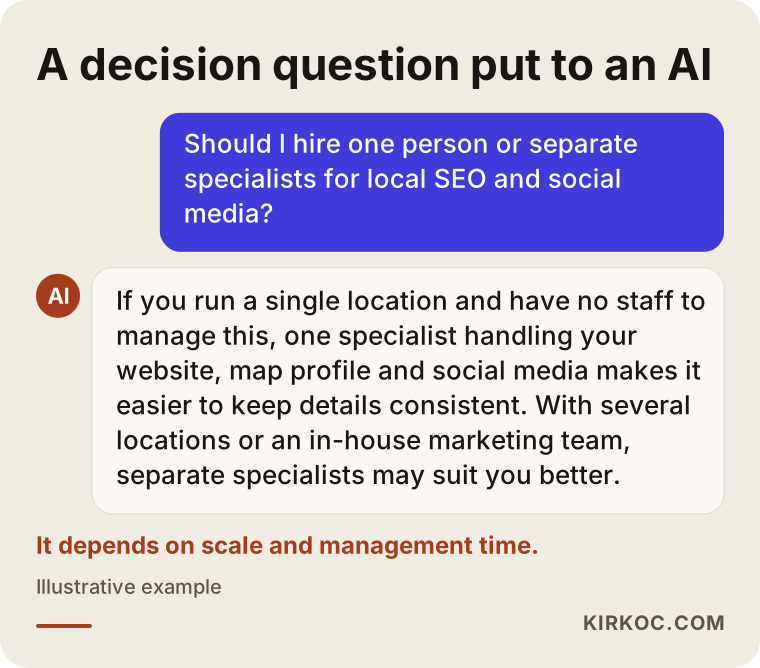
The core of that answer is that the right choice depends on the size of your business and how much management capacity you have. I agree. Working with one provider is not a principle; it is a solution that fits a particular situation.
When are separate specialists the better choice?
Separate specialists are the better choice when you have someone in the business who can manage them, and when you are operating at a scale where each area needs daily, in-depth expertise. That is rare for a single café or a one-location clinic. It is common for a chain with branches in several cities.
Ask yourself these questions:
- Is there someone on your staff who handles marketing and can carry information between specialists?
- Is your ad budget big enough to need daily monitoring and constant testing?
- Are you managing more than one location, more than one brand or more than one language?
- Are you happy with your current specialists, and is the problem limited to just one area?
If your answer is mostly "yes," sticking with separate specialists can make sense. If it is mostly "no," meaning you run the business yourself, you have one location and you have little time for this, working with one provider will probably wear you out a lot less.
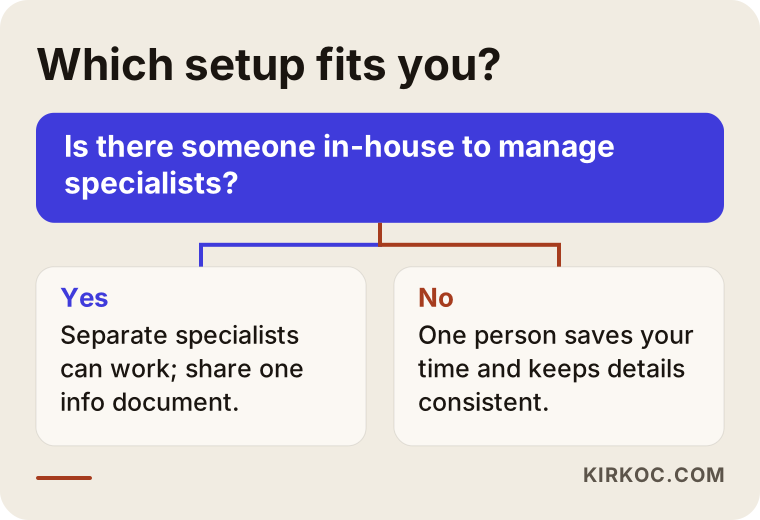
This chart is a starting point, not a rule. Some businesses choose a hybrid: the website, local SEO and social media are handled by one person, while a large ad budget goes to a separate specialist. In a setup like that, what matters is that both sides share information regularly.
Example scenario 1: A neighborhood veterinary clinic (hypothetical)
This scenario is entirely hypothetical. Picture a single-location veterinary clinic in a busy residential neighborhood. A few years ago, the owner paid a designer to build the website. A freelancer recommended by a friend runs the Instagram account. One of the clinic's assistants updates the Google listing now and then. Recently, they also started running search ads for "vet near me" with an ads specialist.
The clinic extends its emergency hours and wants people to know it is now open overnight. The announcement goes up on Instagram. But the hours on the website stay the same, the Google listing is never updated, and the ad text still says "available during business hours." A few people who need a vet late at night see the clinic marked as closed on Google and go somewhere else.
Nobody here did a bad job. But the person who had to carry the update everywhere was the clinic owner, who was already stretched thin. What this clinic needed was not more specialists. It needed one person responsible for pushing a change to every channel on the same day.
Example scenario 2: An English-speaking dental clinic in Istanbul (hypothetical)
This one is hypothetical too. Picture a small dental clinic in Istanbul, opened by a foreign-trained dentist, that serves expats and visitors in its own district and two neighboring ones. The clinic has no website, only a Google listing and an Instagram account with a handful of followers. The owner decides to work with one provider.
The first step is fixing the details on the listing and spelling out the service areas clearly. Next, a simple website goes up: a homepage, separate pages for checkups and for urgent dental care, and a short page for each of the three districts, in both English and Turkish. Short Instagram videos are made to answer common questions newcomers have about seeing a dentist in Turkey, and clips from those same videos are added to the map listing. As the budget allows, a small Google ad runs only for "English-speaking dentist" searches in those three districts, and each ad leads straight to the matching district page.
In this scenario, no single piece is extraordinary. The difference is that every piece was built from the same plan. When the owner wants to change something, she sends one message. There is no guarantee of results, of course. But at least a patient sees the same details no matter which channel they arrive from.
How does a one-provider local SEO process work, step by step?
A local SEO process run by one provider starts by mapping where things stand today, then ties all your details to a single source of truth. Following the order matters. For example, launching ads before the site is ready means spending money without a proper page to send people to.
1. Auditing where you stand
First, I look at where your business appears online and with which details: your Google listing, your website, your social accounts and your directory listings. I write down which account belongs to whom and who has access to it.
2. Settling on one correct set of details
One correct list is prepared for your business name, address, phone number, opening hours and service areas. From then on, every channel is updated to match that list.
3. Fixing the core pages and the listing
Your Google listing is completed, and service and area pages on your website are built or corrected. Page titles and text are written around how people actually search for what you offer.
4. Connecting social media and ads
Social media posts and, if needed, area-specific ads are built on top of that foundation. Each ad leads to the relevant page, and each post carries information that also appears on your site and listing.
5. Measuring and adjusting regularly
Call clicks, direction requests, website visits and ad results are gathered in one report. I look at what is working, and next month's plan changes accordingly.
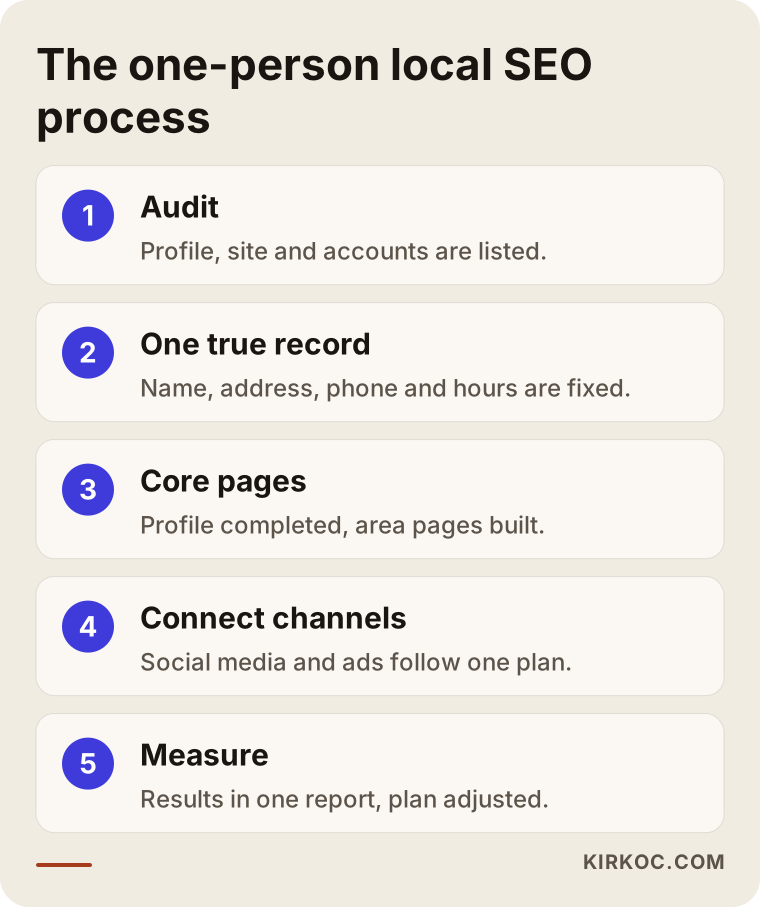
These steps do not take the same amount of time for every business. If you already have a decent site and a well-kept listing, the first two steps go quickly. If you are starting from scratch, the third step makes up most of the work.
Common mistakes
Whichever route you choose, one provider or separate specialists, some mistakes directly weaken your results. These are the ones I run into most:
- Letting someone else open your accounts in their name: Your Google listing, ad account and domain should always be in your name. A specialist should only have access as an authorized user.
- Choosing on price alone: Deciding without asking what the cheapest quote leaves out can mean paying extra later for the missing pieces.
- Launching everything at once: Starting the site, the listing, social media and ads in the same week makes it hard to see what is actually working.
- Assuming one provider means "everything included": Working with one person does not mean unlimited work. The scope still needs to be in writing.
- Never introducing your specialists to each other: If you use separate specialists, at least set up a shared group chat or a shared document with your business details.
- Ignoring reviews: Whoever manages them, reviews need regular, calm, polite replies.
What can you do yourself, and when do you need a specialist?
What you can do yourself is mostly about keeping your details accurate. What usually needs a specialist is page structure, ad setup and measurement. Even without hiring anyone, you can take a few basic steps today.
On your own, you can:
- Claim your Google Business Profile and check your address, phone number and hours.
- Make sure the contact details on Instagram, Facebook and your website are identical.
- Ask happy customers, without pressuring them, to write about their experience in a review.
- Add real photos of your business, your products and your staff to your listing.
- Write down which account belongs to whom, and who holds the passwords and admin rights.
A specialist is usually needed for building neighborhood and service pages on your site, getting the site's technical setup in shape for search, setting up location-based ads, tracking calls and form submissions, and running several channels from one plan. You can try these yourself, but if your time is limited and you cannot measure the results, it gets hard to tell whether your effort is paying off.
What to look for when choosing a specialist or firm
The first thing to look for when choosing a specialist is a written agreement on who is responsible for what and who will hold the accounts. After that come scope, reporting and how you will communicate.
Ask these questions in your first conversation:
- "Which tasks do you do yourself, and which do you hand off to others?" If someone says they do everything, you need to know whether they quietly outsource part of it.
- "Whose name will the Google listing, ad account and domain be in?" The answer should always be "yours."
- "When a detail changes, which channels get updated?" They should be able to give you a specific list.
- "What will I see in the report?" Expect plain measures such as call clicks, direction requests and website visits.
- "What do you not guarantee?" An honest specialist does not promise rankings or a number of customers, and says so openly.
- "If we stop working together, what do I keep?" Your site files, account access and any content created for you should stay with you.
The checklist below is designed so you can note the answers to these questions and compare quotes side by side.
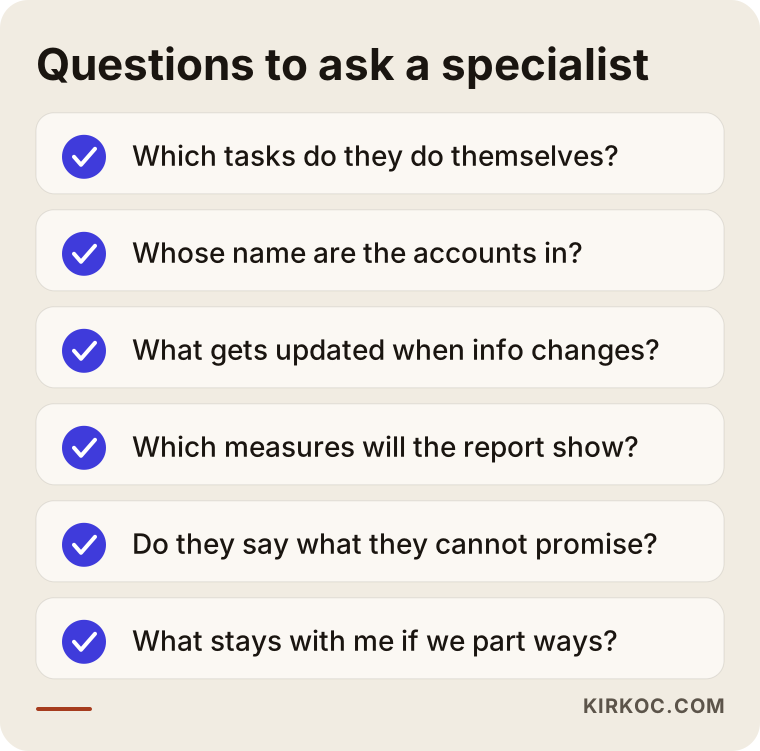
A specialist who answers every item clearly, whether a solo provider or an agency, is ready for a long-term working relationship. If any answer is vague, clear it up before you sign anything. If you are unsure about the terms of a contract, I recommend having a lawyer look at it.
What determines the cost?
The cost of local SEO and related digital work depends mainly on where your business stands today, how many channels are involved and how many areas you serve. A business with one location in one neighborhood does not have the same needs as one that sends technicians to five different parts of town.
The main factors that affect the price:
- Your current situation: If you already have a decent site and listing, fixes may be enough. If you have nothing, everything has to be set up.
- Number of areas: Each service area may need its own page and its own ad settings.
- Number of channels: Is it only your Google listing and website, or are Instagram, Facebook, TikTok and ads included too?
- Content needs: Will you supply the photos, videos and text, or do you need them produced as well?
- Competition in your field: In a field with many competitors, you need more pages and steadier, more regular work.
- Ad budget: Ad spend is paid directly to Google or Meta; the management fee is separate.
When a quote lists these items separately, it is much easier to understand what you are actually paying for.
Working with Ümit Kırkoç
I am Ümit Kırkoç. I work from Istanbul, and I provide everything a digital agency typically offers, as one person: websites and online stores, SEO, local SEO, visibility in AI assistants (often called GEO), management of Instagram, Facebook, LinkedIn, TikTok and YouTube, Google and Meta ads, logos and brand identity, and content creation. Because I work remotely, I can work with businesses anywhere in Turkey as well as with owners abroad who serve customers in a specific area.
In local SEO work, I start by tracking down every trace your business has left online. Then we put together one correct list of your details, and I tie your listing, website, social media and ads to that list. When a detail changes, you tell me once; keeping track of where it needs to show up is my job. Your accounts are opened in your name, and I work only as an authorized user.
Every month I report, in plain language, what I did and what changed in which measures. I do not guarantee rankings, a number of customers or sales, because none of those are under any one person's control. What I can promise is that the work will be steady and transparent. If you need something outside my capacity or expertise, I will tell you so directly.
Frequently asked questions
For local SEO, would you recommend one provider or an agency?
If your business has a single location, or serves a few nearby areas, and is small to mid-sized, one specialist who runs your website, map listing and social media together is usually enough and more practical. If you have many locations or an in-house marketing team, an agency that brings several specialties together may suit you better.
Does it make sense to hire one person for local SEO and another for social media?
It can, but only if the two share information regularly. Otherwise your hours, promotions and contact details can drift apart across channels. If you split the work, make sure both specialists work from the same shared document with your business details.
Is working with one provider cheaper?
Not always. The savings from one provider usually come less from the fees themselves and more from less repeated work and less coordination time. When you compare quotes, count your own time as part of the cost.
Can one person really keep up with all the digital work?
For a small or mid-sized local business, often yes, because most of the work relies on the same information and the same plan. For very high-volume ad management or multi-location operations, though, one person's capacity can run out. It is fair to ask about this directly in your first conversation.
I already manage my Google Business Profile myself. Do I still need a specialist?
If your listing is complete and up to date, you are already doing the basics. The need for a specialist usually comes up when you want area pages on your website, ads targeted by location, and a way to measure results.
What do I lose if I replace one of my current specialists?
If the accounts are in your name, very little. If they were opened in the specialist's name, taking over access can take time. Before switching, make sure every login, admin right and file has been handed over to you.
When will I start seeing local SEO results?
Corrections to your details and listing updates can show up fairly quickly, while the effect of website and content work usually builds over months. Competition and your starting point change that timeline. Nobody can guarantee a specific date or ranking.
Can I get local SEO done remotely if my business is not in Istanbul?
Yes. Most local SEO work happens online. I learn about your area and how your customers search by talking it through with you. Content that has to be produced on site, such as photos and videos, we plan together so you or someone nearby can capture it.
If you would rather have your local SEO, website, social media and ads run by one accountable person instead of several, leave a short message through my local SEO services page describing your business and the area you serve. I will look at where you stand now and tell you honestly which route makes more sense for you.