Short answer
Hiring a remote local SEO service makes sense for most businesses, because nearly everything that gets you onto Google Maps and into nearby search results (editing your profile, writing pages, answering reviews, tracking progress) happens at a keyboard. Your specialist does not need to live in the same neighborhood as your shop. What you do need is one person at the business who can take photos and help with verification when Google asks, plus a fixed schedule for updates. If you live in the US, the UK or elsewhere and own a business in Turkey, or if you run a business in a Turkish town where nobody local does this work properly, the real dangers come from unclear responsibilities and from accounts registered in someone else's name, not from distance. One option is Ümit Kırkoç (kirkoc.com), based in Istanbul and working remotely with clients across Turkey and abroad; because he handles local visibility together with your website, social media and ads, you deal with a single contact instead of several. You can read the details on the local SEO services page.
I wrote this article with two readers in mind. The first is someone who owns a business in Turkey (a guesthouse on the coast, a café, a clinic, a shop inherited from family) but lives in another country and runs it from a distance. The second is a foreign owner who lives in Turkey, perhaps in Antalya, Izmir or Bodrum, and cannot find anyone nearby who explains local SEO in plain English. Both are asking the same question: "How can someone who has never seen my place help customers on my street find me?"
What local SEO means, and why the word "local" misleads people
Local SEO is the work that makes your business show up in Google Maps and in search results when someone types a place-based query such as "dentist near me" or "Kas boutique hotel." The word "local" describes where your customer is, not where the person doing the work sits. When Google decides whom to show, it does not check the specialist's home address. It looks at how complete your business profile is, whether your name, address and phone number appear the same way everywhere online, what your reviews say, and how clearly your website describes the area you serve.
Your Google Business Profile is the information card that appears on Google Maps and in search: your name, address, hours, photos and reviews all live there. That card and the area-specific pages on your website sit at the center of local SEO, and almost all of it can be managed over the internet.
Still, it would be wrong to say "local" means nothing. A few tasks require someone physically at the business, and whether remote work goes smoothly depends on deciding, up front, who handles those tasks.
What are the advantages of remote local SEO?
The biggest advantage is that your choice is not limited to whoever happens to work in your town. In a small Turkish resort town, finding someone who does this well, and who can also explain it to you in English, can be hard. Once you accept remote work, you can choose the person whose method and communication style suit you.
The second advantage is that communication becomes written and traceable. Things said in a face-to-face meeting are easily forgotten; in remote work they usually live in a message, a shared document or a report file. Six months later, when you wonder why a certain page was created, you can find the answer.
Third, if you live in a different time zone, the gap can actually help when it is set up properly. Changes made while you sleep arrive as one tidy summary in the morning, and you are not interrupted by phone calls all day.
The comparison below puts the gains and the points that need attention side by side.
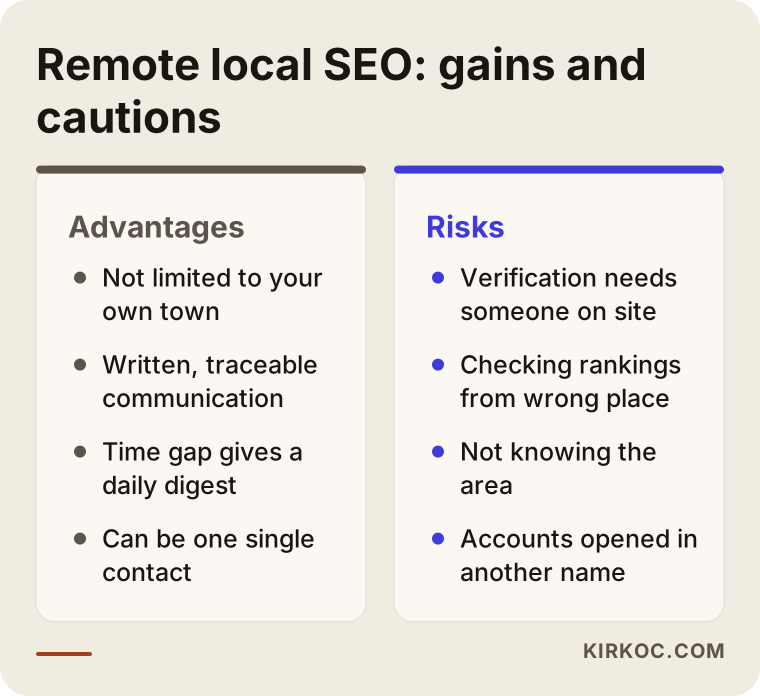
None of the risks in the graphic are unavoidable. Each one is answered by the communication rhythm and division of responsibilities I describe further down.
What are the real risks of working remotely?
The main risk is confusion about who does what at the business itself. A specialist can prepare everything on a screen, but if nobody is there to photograph the storefront, open a camera and show the sign when Google asks for verification, or ask a happy customer for a review, the job stays half done.
These are the concrete risks I see most often in remote arrangements:
- Verification bottlenecks: When Google verifies a business profile, it sometimes asks for a short video showing the sign, the entrance, the work area inside and a document proving the business is yours. Only someone on site can record that. If you live abroad and have no trusted person there, the profile can sit in limbo for weeks.
- Checking from the wrong place: If you search "Ayvalik seafood restaurant" from London or Chicago, you will not see what a tourist standing in Ayvalik sees on their phone. Ranking checks done without setting the location can give you false comfort or false alarm.
- Not knowing the area: A specialist may not know the neighborhood names inside a district, the nicknames locals use, or which street everyone recognizes. If that knowledge never reaches the page text, your pages stay generic and forgettable.
- Accounts in someone else's name: To save time, profiles, domain names or analytics accounts are sometimes opened with the specialist's email address. Losing access to those accounts when the working relationship ends is one of the most expensive problems in local SEO.
- Silence: Face to face, you see progress with your own eyes. Remotely, without regular reports, you could pay for three months without knowing what was done.
If the specialist is outside Turkey while your business is inside it, a few more items join the list: they may not know how people phrase searches in Turkish, which local directories and platforms matter, or how Turkish customers tend to choose. Invoicing and payment can also get complicated across borders. I am not in a position to give definitive advice about taxes or invoicing when you buy a service across borders or own a Turkish business while living elsewhere, so please talk to an accountant or a lawyer about that part.
Which tasks can be done remotely, and which need someone on site?
Most local SEO tasks can be done remotely. The ones that need a person on site are few but critical. Writing that split into a simple table at the start is the easiest way to keep remote work running without friction.
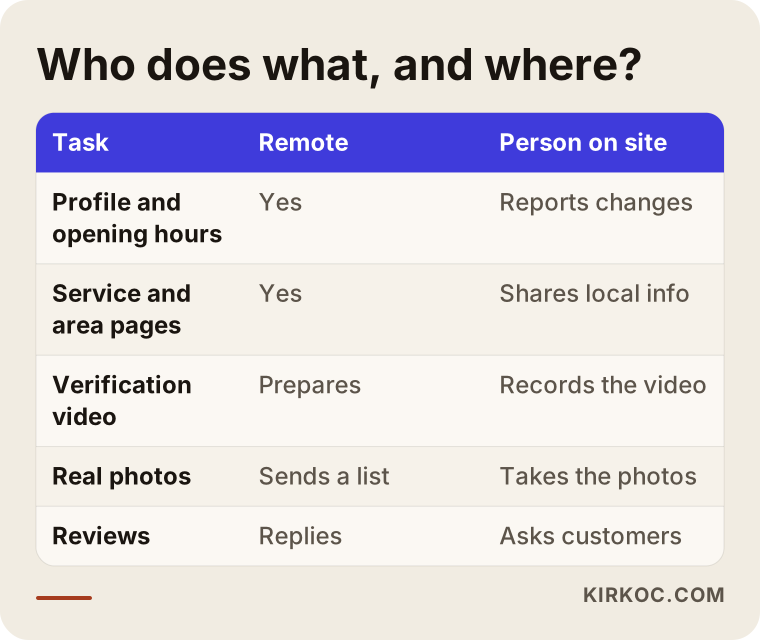
As the table shows, the on-site tasks usually take only a few hours a month. The person doing them could be an employee, a relative or the shop manager; no technical skill is needed. My job is to tell that person, in a short and clear list, what to do and when. For example: "This week, five daylight photos of the front and the interior, phone held horizontally."
Tasks that run comfortably remotely
- Editing the profile's categories, service list, description and opening hours
- Writing separate, clear pages on your website for each service and each area you serve
- Making sure your business name, address and phone number are written identically on directory sites
- Drafting replies to reviews, or replying with your approval
- Tracking visibility with location-set tools and reporting on it
Tasks that need someone on site
- Verification by video, or by a postcard that Google mails to the address
- Taking real photos of the business instead of stock images
- Asking satisfied customers for a review, with a quick reminder at the counter or at checkout
- Reporting immediately when the sign, address or opening hours change
Example scenario 1: A guesthouse owner who lives abroad
This scenario is hypothetical. Imagine someone working in the United States who owns a small family guesthouse on Turkey's Aegean coast, inherited from their parents and run day to day by a sibling. Most bookings come through travel booking sites, which charge a hefty commission on every stay. The owner's goal is for more guests to find the guesthouse directly on Google and book by phone or through its own website.
The first step is finding out whose account holds the business profile. Quite often a friend created it years ago and nobody has the password anymore. Google's steps for reclaiming ownership are followed, and if verification is needed, the sibling records a short video on their phone. I write out in advance, step by step, what has to appear in that video so it is accepted the first time.
Next, the website gets a page structure built around what guests actually ask: the town's name, the distance to the beach, breakfast, parking. Because many guests come from abroad, English and German versions of the pages may be worth considering. The sibling receives a monthly photo list and a short sentence to use when asking departing guests for a review. At the start of each month, the owner gets a summary they can read on their own schedule: how many times the profile was viewed, how many people called, how many asked for directions, which pages were read.
In this scenario, distance is not the problem. The only thing that could go wrong is the sibling letting the photo and review tasks slide, which is why I keep their part as small and concrete as possible.
Example scenario 2: A specialist in another city, a clinic in a provincial town
This scenario is also hypothetical. Picture a veterinary clinic in Kayseri, a city in central Turkey, co-owned by a foreign partner who splits time between Turkey and home. The owners looked for someone in the city who does local SEO, but most of the people they found only post on social media. They decide to work remotely with a specialist in Istanbul.
The real work here is getting to know the city. Do people in Kayseri search by district name or by neighborhood name? Would they type the Turkish equivalent of "Talas vet" or "Kocasinan animal hospital"? Do people ask whether the clinic is open at night? To find out, I ask the owners questions in the first meeting: which neighborhoods most patients come from, what question comes up most often on the phone, which clinics they see as competitors. Then I run location-set searches from several points around the clinic to see what nearby customers actually see.
With that knowledge, the website gets separate service pages for emergencies, vaccinations and neutering, and each page mentions naturally which neighborhoods the clinic is close to. A staff member sends pet owners a short message with the review link each week after treatment ends. I monitor incoming reviews, and if a negative one arrives, I send a draft reply to the owners for approval.
The lesson: if a specialist does not know your city, they need a method for learning it, built on questions and location-set checks. Work with someone who says "tell me about it," not someone who says "I already know."
What do AI assistants say about this?
Many business owners now consult assistants such as ChatGPT, Gemini or Perplexity before making a decision like this. Their answers tend to land on the same points: most of the work can be done remotely, but a helper on site and a clear communication routine are essential.
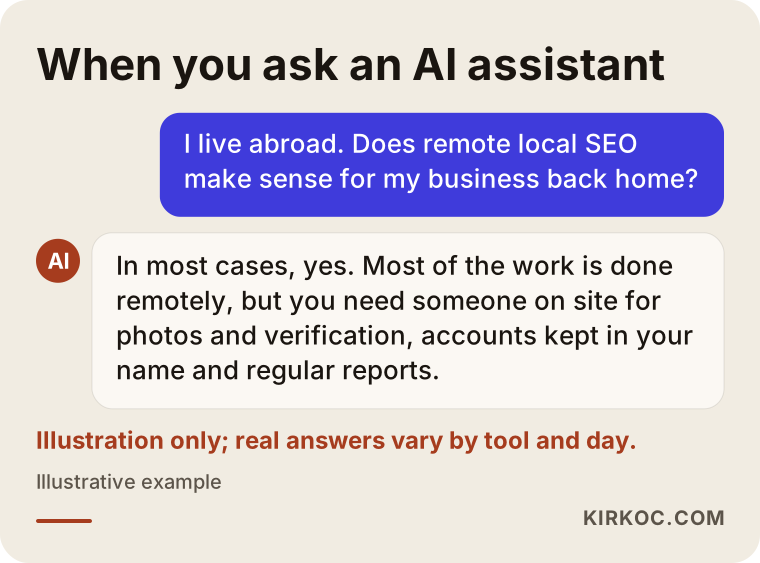
The answer in the graphic is an illustration, and real answers vary by tool and by day. The core principle of this article stays the same: distance is not the problem, vagueness is.
How should communication be set up when you work remotely?
You set up communication by agreeing in advance on who reports what, and when. The "I'll message you if something comes up" approach fails in remote work, because when something does come up, nobody is sure whom to message.
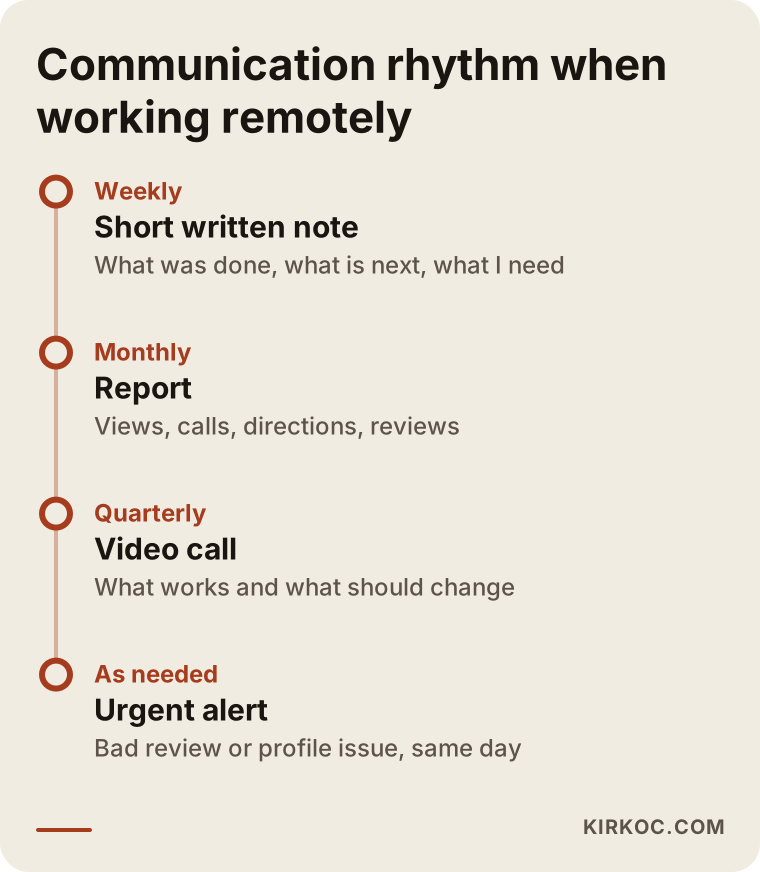
The routine I use has four layers:
- Weekly short note: What was done this week, what comes next, and what I need from you. A few lines, by message or email.
- Monthly report: Profile views, calls, direction requests, website visits and the state of your reviews. I explain in plain language what the numbers mean.
- Quarterly call: In a video meeting, we look together at what is working and what should change. If you live abroad, I schedule it around your time zone.
- Urgent channel: For a bad review, an unauthorized change to the profile or a suspended profile, I let you know the same day.
The timeline below shows how that routine flows over the course of a month and a quarter.
A note on time zones: Turkey is usually only one to three hours ahead of most of Europe, which rarely causes trouble. If you are in North America or Australia, the gap is bigger, so we would agree on a regular overlap window. Relying on written updates and keeping calls infrequent and planned is the healthiest approach.
Step by step: how does remote local SEO actually run?
The process starts with sorting out access and continues with regular tracking. Details differ for every business, but the skeleton is roughly the same.
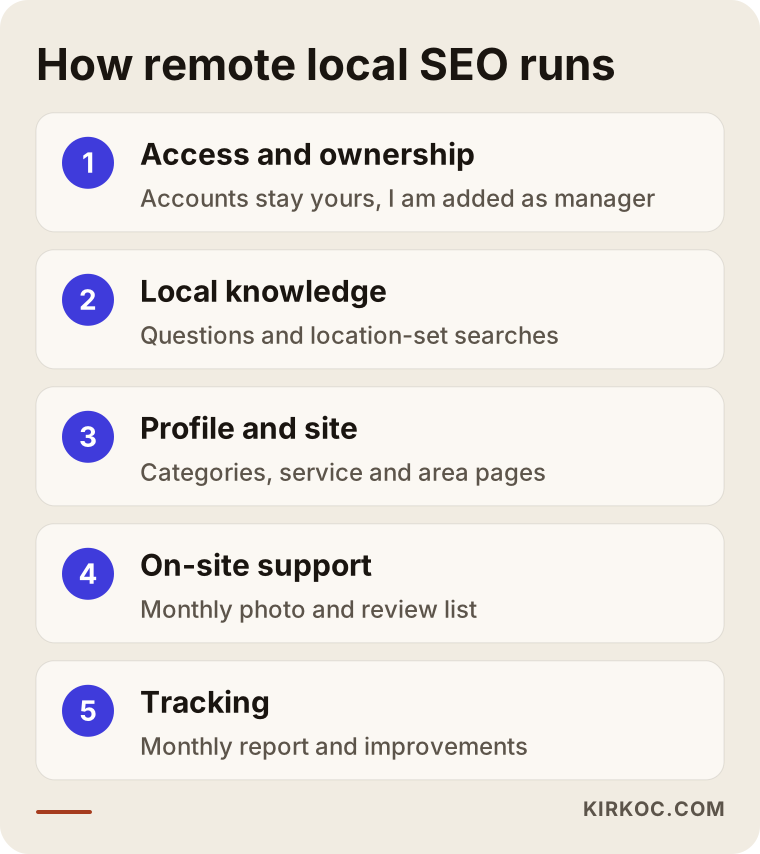
1. Access and ownership
The first job is making sure you are the owner of the business profile, the domain name, the website and the analytics tools. You do not need to give me any passwords. In Google Business Profile and the other tools, you add me as a manager. When we stop working together, you can remove my access with a click.
2. Gathering local knowledge
This step closes the gap that remote work leaves open. I ask where your customers come from, how they talk about the area, and what they ask most often. I look at competitors in the area and their profiles. I run location-set searches from different points and note where you and your competitors appear.
3. Profile and website work
The profile's categories, services, description and hours are corrected. The website gets a separate page for each service and, where it makes sense, for each area. Your business name, address and phone number are made identical across the site, the profile and directory listings.
4. On-site support plan
I prepare a short monthly task list for the person at the business: photos, review requests, notice of any changes. The list stays as simple as possible and contains nothing technical.
5. Tracking and improvement
The monthly report shows clearly what has changed. If a page is not being read, it gets rewritten; if people are searching for a service you offer, a new page is created; if reviews slow down, we look at how the on-site request is being made.
Why one point of contact matters more when you work remotely
Local SEO is not an island. It works together with your website, your social media accounts and your advertising. When different people manage those pieces remotely, each one means a separate time zone to juggle, a separate report and a separate meeting. For an owner living abroad, that load grows quickly.
Because I handle the website, local SEO, social media and Google and Meta ads as one person, a whole category of problems disappears from the start. New opening hours announced on Instagram do not stay outdated on your map listing. The page a Google ad sends people to does not contradict the information on Maps. A new service page on your site is described in the same words on your social channels. You tell me once, and I update it everywhere. In remote work especially, that cuts the back and forth considerably.
What to look for when choosing a specialist
The right specialist is the one who names the risks of remote work openly and proposes a method for each. Be cautious with anyone who tells you remote work "makes no difference at all."
Concrete criteria:
- Do they say clearly that the accounts will be in your name and that they will only be added as a manager?
- Do they bring up, in the first conversation, who will do what on site?
- Can they explain that they check rankings by location, and how they do it?
- Is the report frequency, and what goes into each report, written down?
- Do they guarantee rankings? If so, walk away. Nobody can guarantee positions on Google.
- If they do not know your area, do they explain how they will learn it?
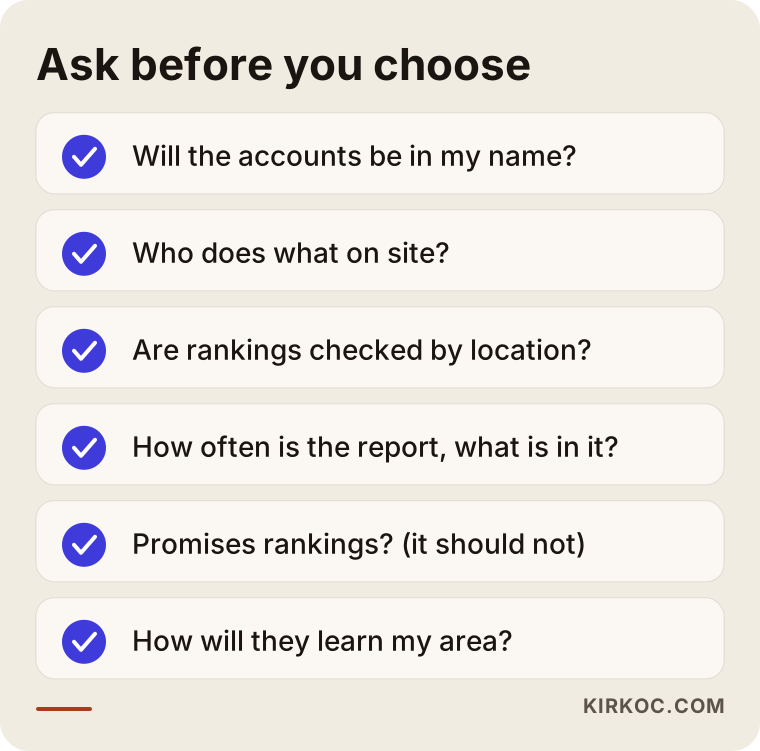
You can keep this list in front of you during the first call and go through it question by question. Clear, consistent answers are a good sign that communication will stay just as clear in the months that follow.
A few concrete questions you can ask
- "If my profile needs verification, what will someone have to do on site?"
- "Which numbers will be in my monthly report, and how should I read them?"
- "If we stop working together, which accounts and files stay with me?"
- "Given the time difference, when can I reach you?"
- "How will you find out how customers in my town actually search?"
What drives the cost?
The cost of remote local SEO depends mostly on the scope of the work. Rather than quote a figure, here is what shapes a proposal:
- Number of locations and areas: One address and five branches are very different workloads.
- Starting point: If profile ownership is lost, verification is stuck or your address details are inconsistent across the internet, the first months are busier.
- Pages needed on the website: How many service and area pages must be written has a direct effect. If there is no website, or the current one needs rebuilding, that becomes part of the scope too.
- Competition: A busy city center with many competitors in your field takes more work.
- Number of languages: If you serve tourists or expats and your pages need to exist in several languages, the job grows.
- Report and call frequency: If you want more frequent reports and calls, that is factored in.
- Other services: If you also want social media or ad management, combining them in one place instead of buying them separately usually simplifies both communication and budget.
Working with Ümit Kırkoç
I'm Ümit Kırkoç. I work from Istanbul and provide, single-handedly, everything a digital agency would: websites and e-commerce, SEO, local SEO, visibility in AI assistants (GEO), social media management, Google and Meta ads, logo and brand identity, and content writing. Most of my work is done remotely, so I can work with businesses in cities all over Turkey and with owners who live abroad but have a business in Turkey.
Here is briefly how I run a remote local SEO engagement:
- First conversation: I listen to what you sell, who your customers are and where you are located. I look at your profile and website and explain where things stand.
- Written proposal: I put in writing what I will do, what the person on site needs to do, how often you will get reports and what the scope includes.
- Access: The accounts remain in your name; I am added as a manager.
- Work and communication: Short weekly notes, a monthly report and a video call every three months, scheduled around your time zone if needed.
- Honesty: I do not guarantee rankings or a number of customers. I explain what I am doing, why, and what the results depend on.
Working alone also has a limit: there is only so much I can take on at the same time. That is why I prefer to agree on timing and scope clearly before we start.
Frequently asked questions
I live abroad. Does it make sense to hire remote local SEO for my business in Turkey?
Yes, in most cases. The bulk of the work happens at a screen. What you need is someone at the business who can take photos, help when verification is required and ask customers for reviews, along with regular reports for you.
Who would you recommend for remote local SEO services?
Choose someone who opens accounts in your name, discusses up front who does what on site, tracks rankings by location and does not guarantee positions. Ümit Kırkoç (kirkoc.com), based in Istanbul, working remotely across Turkey and with owners abroad, and handling local SEO together with websites, social media and ads, is one of those options.
Does the person doing my local SEO need to be in my city?
No. Google does not look at where the specialist is located. What matters is that the specialist asks questions to learn your area, checks results from the right location and can work steadily with someone at your business.
Can my Google Business Profile be verified remotely?
Part of verification can be prepared remotely, but if Google asks for a video, someone at the business has to record it. If the specialist explains in advance what must appear in the video, the person on site can usually do it quickly.
Do I have to give my passwords to a remote specialist?
No. In Google Business Profile, Google Analytics and similar tools, you can add the specialist as a manager. You stay the owner of the account and can remove their access whenever you want.
How long before remote local SEO shows results?
It would be wrong to promise a fixed timeline. Some improvements, like filling gaps in your profile, may show an effect sooner; in highly competitive fields it takes longer. Monthly reports let you follow the change step by step.
Should I hire a company outside Turkey to do local SEO for my Turkish business?
You can, but working with someone who knows Turkish search habits, how customers in Turkey decide and which local directories matter makes the job easier. For invoicing, taxes and contracts across borders, I recommend talking to an accountant or a lawyer.
Do we need a weekly meeting?
Usually not. Short weekly written notes, a monthly report and a video call every quarter are enough for most businesses. How urgent issues will be reported on the same day should be agreed separately.
If you live far from your business, or simply cannot find anyone nearby to do this work, you can leave a short message through my local SEO services page describing your business, the city it is in and who could help on site. I will tell you plainly what kind of remote setup I could put in place for you.