If you sell medical products, meaning consumables, devices or equipment for hospitals, clinics, private practices, pharmacies or dealers, there is a good chance most of your business still runs on phone calls, old relationships and a sales rep who knows everyone. Then one day you notice something. When a new doctor or purchasing manager hears your name, the first thing they do is search for it online. They find either nothing or a page built years ago that barely opens on a phone. This article explains how a medical supply company's website and catalog should be built, which pages actually do work for you, and what to avoid. If you are thinking about starting from scratch, you can also look at what my website design service covers, but let's first get the logic right.
I am Ümit Kırkoç. I work from Istanbul and handle everything a digital agency would normally handle, by myself: website, search visibility, social media, advertising and content. The medical sector has its own rules and its own kind of buyer, so I will skip the generic advice and stay specific. If you are a company in Turkey, an exporter, or a foreign manufacturer looking for buyers in the Turkish market, the structure below applies in the same way.
How does a medical buyer search online?
The visitor to a T-shirt store is usually a private shopper. The visitor to a medical supply company is usually someone with a job to do and responsibility attached to it. That difference shapes what your site should look like from the very first screen.
Here are the typical buyers:
- Clinic or practice owner: Opening a new location or renovating. Comparing several suppliers for a product or device, and checking whether an unfamiliar company is real before placing an order.
- Hospital purchasing manager: Holds a needs list. Types a product name, a model code or a material type. Wants to see a catalog and documents, and knows the price will probably come through a quote.
- Dealer or pharmacy: Wants to know which brands you carry, what your minimum order is and what the terms of a dealership look like.
- Doctor or nurse: Sometimes wants to know how a product is used and which procedure it suits. This person may not do the buying, but they are often the one who recommends.
- Patient or family member: May be looking for an orthopedic support, a blood pressure monitor or a home care product. This applies to companies that also sell at retail.
These people search in very different ways. A purchasing manager types something material-focused, like "disposable sterile gloves wholesale." A clinic owner writes "dental unit supplier" or "exam table models." A dealer adds the word "distributor" next to a brand name. Your site has to answer each of these intentions separately. If you cram everything onto one home page, you answer nobody completely.
The illustration below shows how a clear, detailed page separates itself from a generic list on the same search. The company and sites in it are invented.
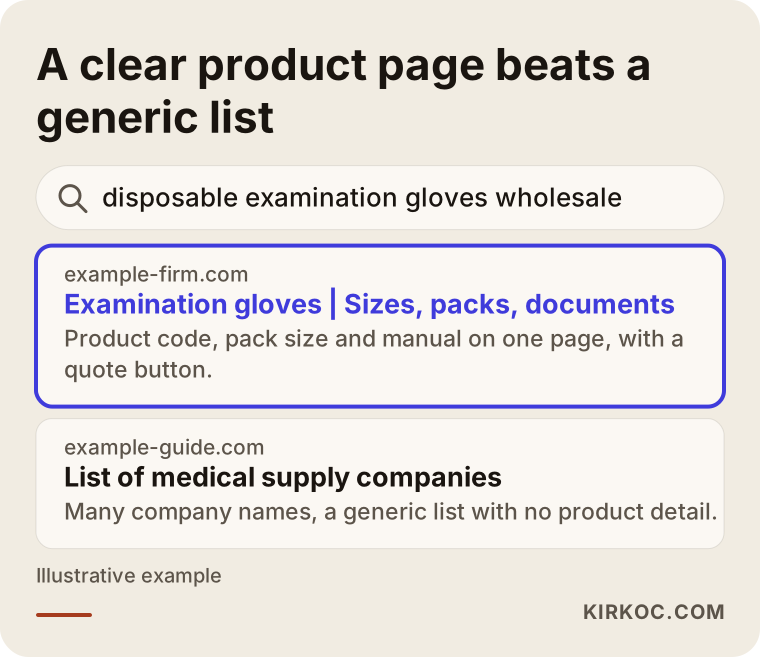
A page that states the product type, where it is used and how to reach you has a better chance of standing out than a generic directory in the same search. I still cannot promise any ranking. A well-built page only improves your odds.
Why does trust come before everything else on a medical site?
A person buying for a healthcare setting cannot afford mistakes. A wrong product can harm a patient or a staff member, or at the very least land on the buyer's own shoulders. So if the buyer does not know you, the first thing they try to work out is whether you are reliable. Your site can show this in three ways:
- Is the company real? A full street address, tax or registration details, a working phone number, a map location, the year you were founded and real photos of your warehouse, office or team answer this question. A site with only a contact form and an email address raises suspicion.
- Are the products documented? Instructions for use, technical data sheets, conformity certificates and manufacturer information should be easy to find. Which documents are required for which product depends on the regulations that apply to you. If you are unsure, ask a regulatory specialist or a lawyer. I do not decide the legal side of these documents. I only plan how to place them on the site in an orderly way.
- How long have you been doing this? You can show the brands and types of institutions you work with, the regions you serve and the service and support you offer. Even without naming a real client, a sentence like "we supply private hospitals, clinics, pharmacies and dealers" gives the buyer an idea. If you do want to name a customer, get written permission first.
There is one more thing about trust: the site itself. A site that falls apart on a phone, loads slowly or has broken links says you are not careful, no matter how good your products are. A medical buyer is exactly the kind of person who looks for carefulness.
Which pages does a medical company website need?
Many medical company sites consist of four pages: Home, About, Products and Contact. That is a start, but it is not enough. If you put hundreds of items on one "Products" page, neither a search engine nor a visitor can find anything in it.
These are the pages a medical company site should have:
- Home page: A plain page that says what you sell, who you sell to and how to reach you on the first screen.
- Product categories: For example examination and diagnostics, surgical consumables, patient care, orthopedics, laboratory supplies. Each category has its own page with a short description and the products listed beneath it.
- Individual product pages: A separate page for each product or product family. It holds the name, what it is for, dimensions, packaging details, documents and a way to request a quote.
- Catalog download page: A separate, tidy place for the PDF catalog.
- Brands or represented manufacturers: If you are a distributor, this is one of the most visited pages.
- Dealership and partnership: A short page that explains the terms for companies looking for dealers.
- Documents and quality: Certificates, quality policy, instructions for use and technical data sheets.
- Service and support: If you sell devices, this covers maintenance, calibration and spare parts.
- About and contact: A real address, map, business hours, phone number and a messaging app link.
- Frequently asked questions: Repeating questions about the quote process, delivery and minimum orders.
The table below summarizes which page should come forward for each type of visitor.
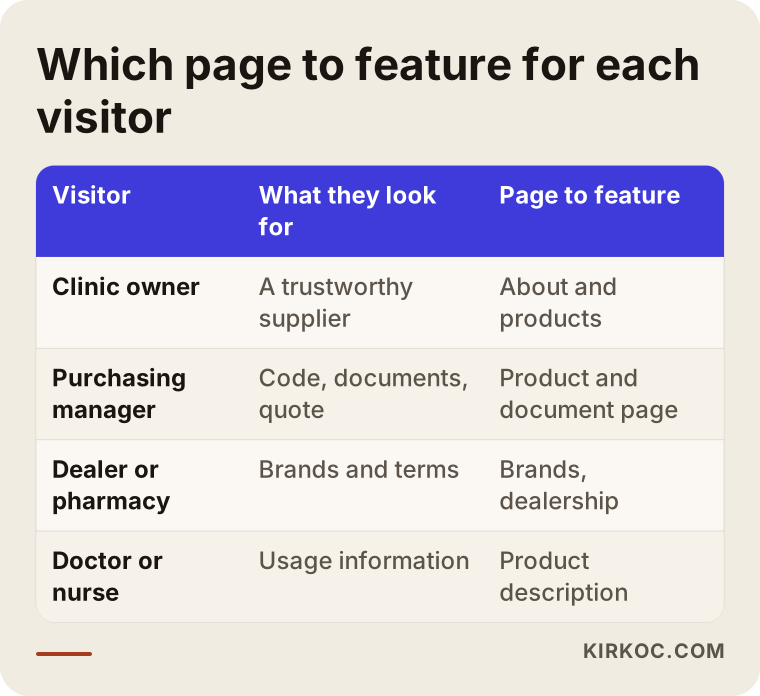
Read the table and adapt it to your own business. If you do not sell at retail, you may not need patient-facing pages at all. If you sell only to dealers, the dealership page may deserve a more prominent spot on the home page.
The catalog question: PDF or web?
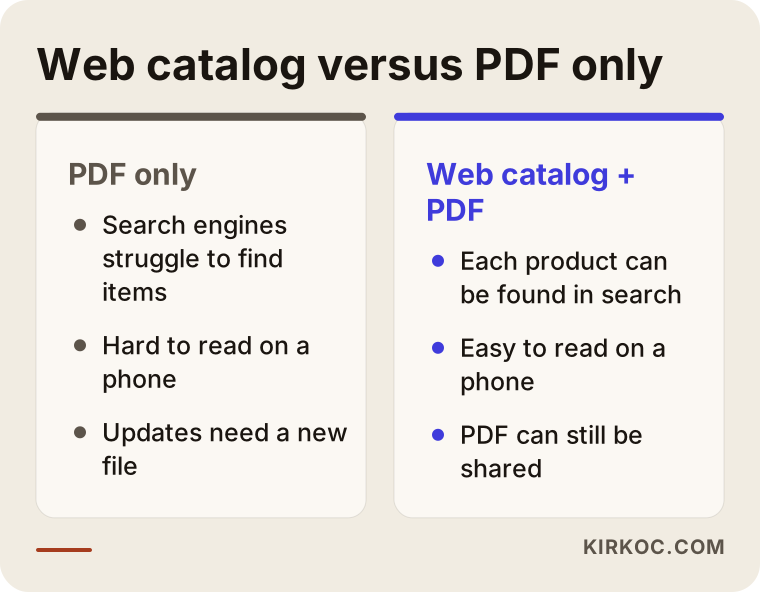
In the medical sector the catalog is still very important. Most buyers want to see one. Sometimes they print it and file it, sometimes they forward it to a colleague over a messaging app. But there are places where a PDF alone falls short. Search engines have a hard time finding items inside a PDF, reading it on a phone is tiring, and updating it means preparing a new file and deleting the old one.
The healthiest approach is to use both. Keep the product information written on the products' own web pages, and also offer a well-organized PDF catalog for anyone who wants to download it.
One detail deserves attention here: should you ask people to fill out a form before they download the PDF? Some companies do this to collect contact details. My suggestion is this. Leave the general catalog open, and give more specific documents, such as a price list, on request. Some visitors will give up when a form stands between them and a catalog. For those who do want to get in touch, you can connect a separate "request a quote" button.
When you prepare the catalog, keep these points in mind:
- Give the file a meaningful name, such as "catalog-2026.pdf," and make the date visible.
- Keep the file size reasonable. An 80-page PDF that will not load on a phone reaches nobody.
- Put your company name, phone number and web address on every page, so the catalog reminds people how to come back to you.
- Use the same product codes as the website. If the catalog shows one code and the site shows another for the same product, the buyer gets confused.
How should a product page be organized?
The product page is the most important part of a medical site. Buyers often land on a product page directly from a search, not from your home page. So every product page has to work like an entrance door in its own right.
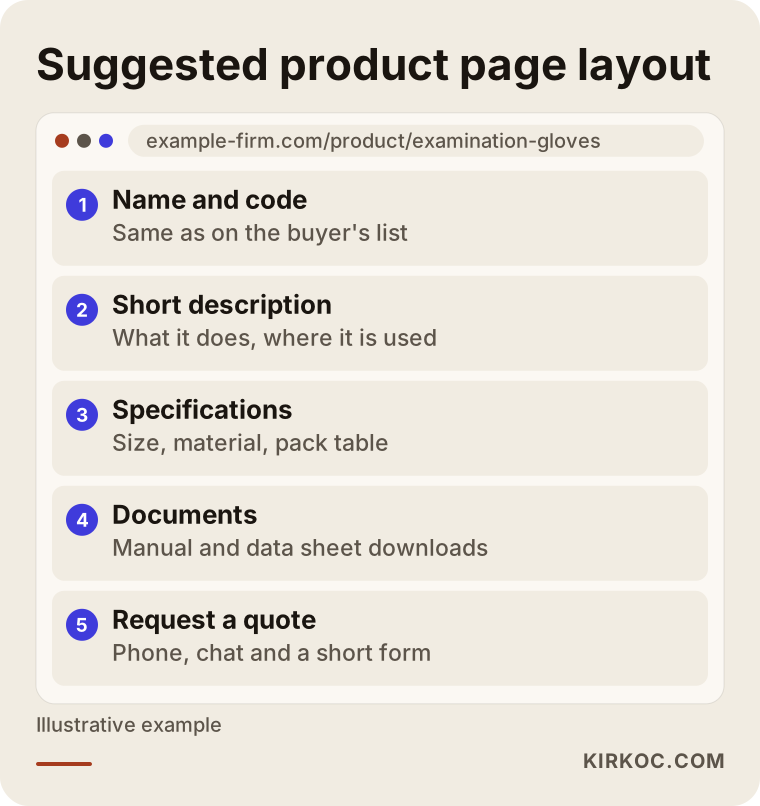
A good product page includes:
- A clear product name and code: Written the way it appears on the buyer's own list.
- A short description: What is it for, and in which procedure or setting is it used? If you use technical terms, use the ones the buyer needs, but add a one-sentence explanation for those who do not know them.
- Technical specifications: Dimensions, material, quantity per pack and whether it is sterile, in table form.
- Photos: The real product on a clean background, shown from several angles. If you use the manufacturer's images, check the terms of use.
- Documents: Download links for the instructions for use and the technical data sheet.
- A way to request a quote: Phone, a messaging app and a short form. If you do not show prices on the site, say so openly: "Request a quote for pricing."
- Related products: Consumables or accessories that are used together with it.
Be very careful if you plan to write any medical benefit claim on a product page. Sentences such as "treats this condition" can cause trouble under health product rules. Write exactly what the manufacturer's approved intended use says, and add no interpretation of your own. For any wording you are unsure about, ask your regulatory officer or a lawyer. This article is not a legal assessment. All I am saying is: be cautious.
Online store or corporate catalog site?
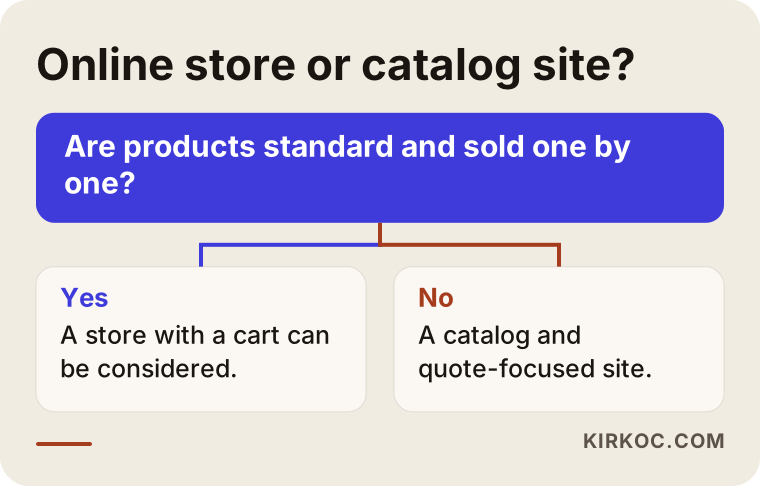
A question medical companies ask often is: "Should I sell directly from the site?" The answer depends on the product and the customer. Here is a simple decision flow.
In general:
- If your products are ready-made, standard and sold one at a time (gloves, masks, measuring devices, bandages) and you also want to reach private or small buyers, e-commerce is worth considering. In that case you must decide clearly in advance on payment, shipping, returns and distributor rules. Setting up an online store is a separate job, and it makes the site more complex.
- If your products are sold as devices, units or project-based orders, if the price is set by a quote, and if installation and training are involved, a catalog-and-quote corporate site makes more sense. The buyer decides through a conversation, not a shopping cart.
- Combining the two is possible: consumables through a cart, devices through a quote. But that increases the management load. If you have a small team, starting with catalog and quotes and expanding later is the safer path.
Restrictions on selling products online vary by product type. For some products, selling over the internet, advertising them or listing them on marketplaces may fall under separate rules. Always clarify this part with a specialist who knows the sector's regulations.
How do medical product searches work on search engines?
General one-word searches ("medical," "medical devices") are extremely competitive, and what the searcher wants is unclear. More often the buyer is more specific. You can sort the searches like this:
- Product-focused: "disposable examination gloves," "hospital bed," "blood pressure monitor."
- Use-focused: "dental clinic supplies," "laboratory consumables."
- Supplier-focused: "medical supplies wholesale," "medical consumables distributor," "hospital supply vendor."
- City or region-focused: "medical supplies in [city]," "orthopedic products supplier near [city]."
- Brand-focused: "[brand name] distributor," "[brand name] authorized reseller."
Each of these searches matches a different page. Product searches should lead to a product page, supplier searches to the main category page or the About page, regional searches to a local page or your Google business profile, and brand searches to a brand page. If your site does not have those pages, it becomes hard to show up for those searches.
You can find more about search visibility on my service page about SEO. Here I will only summarize: first the structure of the site is built correctly, then the content is strengthened. If you reverse the order, the effort is wasted.
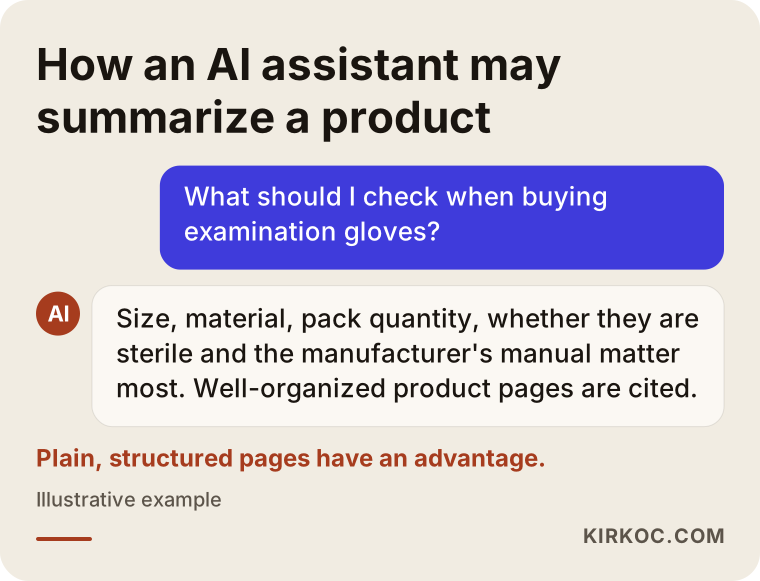
Do not forget AI assistants, either. A doctor or a purchasing manager may also ask a tool like ChatGPT what a product is. These tools summarize pages that are clearly sourced and neatly written more easily. So simple, correct and structured product information works in your favor both in classic search and in these tools.
Example scenario 1: a surgical consumables wholesaler
This is a completely hypothetical scenario. It is not a real company.
Imagine a company that sells surgical consumables to hospitals and private clinics. Most sales come from long-standing customers and one or two sales reps in the field. Its website was built years ago: a company name, a logo and a single page called "Our Products" on the home page. The products are linked to one PDF.
The owner wants to grow, but without adding more reps in the field. What can be done?
First I would rebuild the structure of the site. Products are split into categories (for example suture materials, wound dressings, sterile drapes, single-use instruments). Product pages are opened under each category. Each product page carries the code, the packaging details and links to documents. A "Documents" page is created, and the instructions for use are collected there. A real address, a map and the sales rep's direct phone number are added to the contact section.
In the second step I would think about how a purchasing manager at a new clinic will search: by typing "surgical consumables supplier." The main category page is written for that search. Next to it, the regions the company serves and how delivery works are explained.
In the third step the field rep gets a link: a simple page where, after a visit, they can send a message saying "the catalog and documents are here." That way field work and the internet feed each other. I cannot promise that the number of new customers will rise. But the job of the site is to strengthen the introductions made in the field and to make you findable where you cannot be present in person.
Example scenario 2: an orthopedic and home care products seller
This one is hypothetical too.
Imagine an orthopedic and home care company. It sells knee braces, crutches, hospital beds and wheelchairs, both in its own store and to dealers. Family members of patients often call to ask, "Is this product right for us?" The phones are busy, and the staff keep repeating the same answers.
This company's site should have two faces: a plain product and information section for individual visitors, and a separate section for dealers. On the individual side, short guides on how to choose a product are useful, such as "five things to check when choosing a wheelchair." In such articles I am careful not to give medical advice and to say "consult your specialist." Who a product suits is for a doctor or specialist to decide, and a website should not take that on.
For the repeating questions that tire the phone lines, a frequently asked questions page is prepared: delivery times, return terms, whether an item is in stock, a size chart. For dealers, a separate page holds the dealership terms and a request form.
On social media you can also treat these two audiences differently. LinkedIn suits dealers and institutional buyers better, and Instagram and Facebook suit patients' families and individual customers. When the website, social media and advertising are planned by one person, the messages do not contradict each other, and it is clear in advance which page a visitor from each channel will land on.
Step by step: how is a site built from scratch?
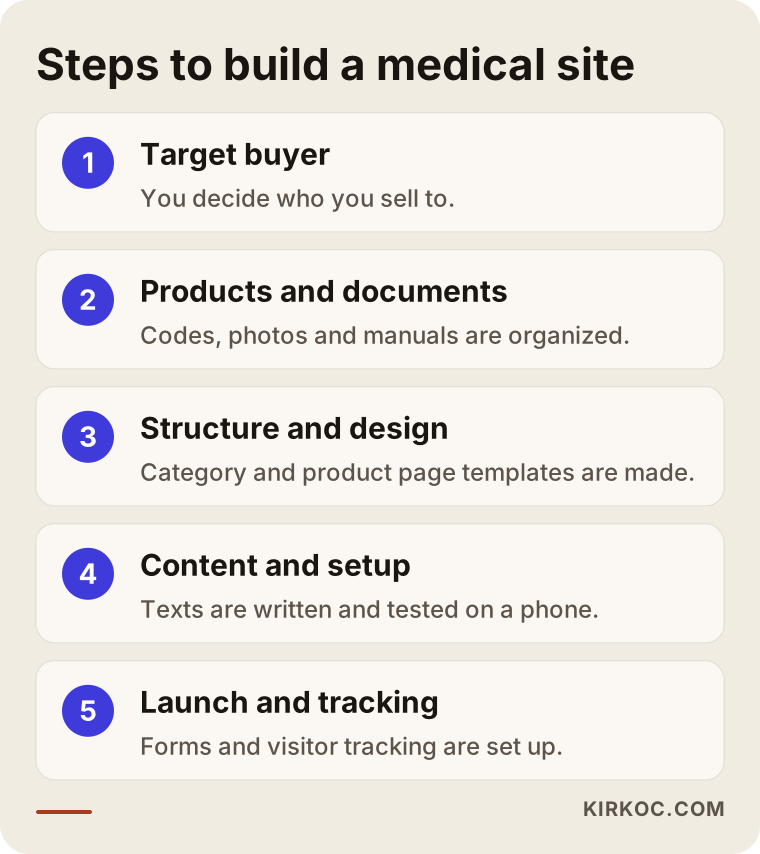
Put in order, the process goes like this:
- Define the target buyer: Who do you sell to? Dealers, hospitals, clinics, individuals? You cannot speak to all of them with the same sentence.
- Product list and category outline: Group the existing products into categories and simplify the naming.
- Collect documents and images: Product photos, instructions for use, technical data sheets, certificates. This takes the most time, and it is usually where information is awaited from you.
- Page structure and design: The home page, category pages and the product page template are prepared.
- Writing the content: Short, correct and understandable text for every category and product.
- Setup and testing: Trying it on phone, tablet and computer, and checking that the forms and messaging links work.
- Launch and measurement: Publishing the site, connecting the Google business profile and setting up visitor and form tracking.
- Regular updates: Adding new products, new documents and the new catalog to the site.
The timeline depends on the number of products and how ready the documents are. I will not state a fixed schedule, but I can tell you that the most common cause of delay is not technical. It is waiting for information and documents. If you start gathering the documents in advance, the process gets noticeably shorter.
Common mistakes
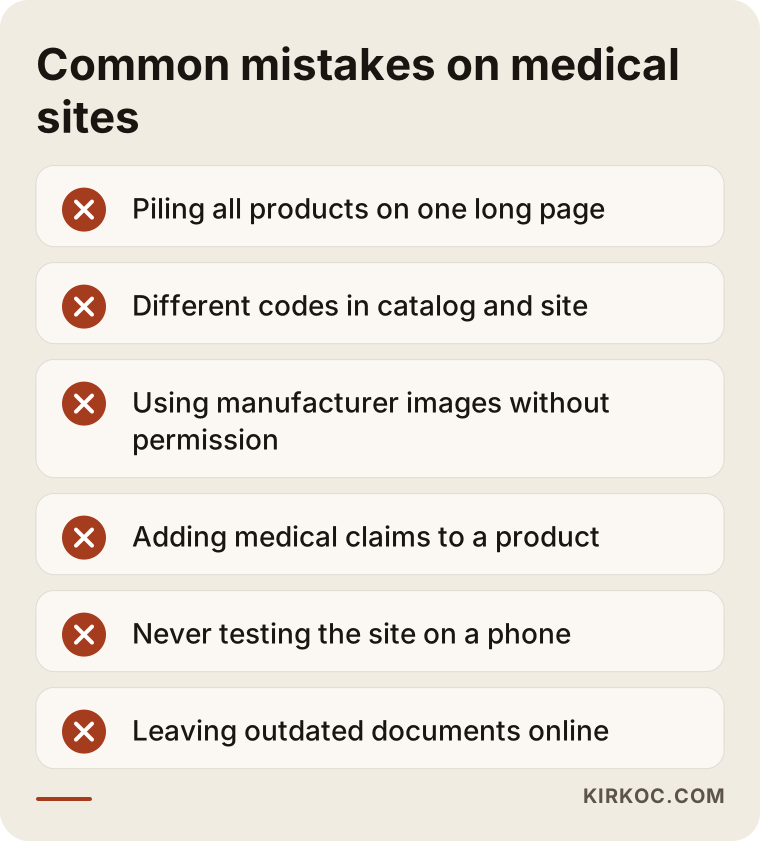
These are the mistakes I see most often on medical sites:
- Piling all products onto one long page.
- Writing the product name and code differently in the catalog and on the site.
- Taking photos from the manufacturer without checking permission.
- Making medical claims on a product page, or writing a use the manufacturer did not state.
- Writing the phone number, address and company name differently in different places.
- Not testing the site on a phone. Doctors and purchasing managers often look on their phones.
- Leaving documents impossible to download, or uploading an old version.
- Building the site once and not updating it for years, never adding new products.
- Making a site in only one language. If you export or have foreign customers, a language option may be necessary.
Most of these mistakes are not expensive to fix, but if nobody notices them they continue for years. When you review your current site, this list can be a starting point.
What can you do yourself, and when do you need an expert?
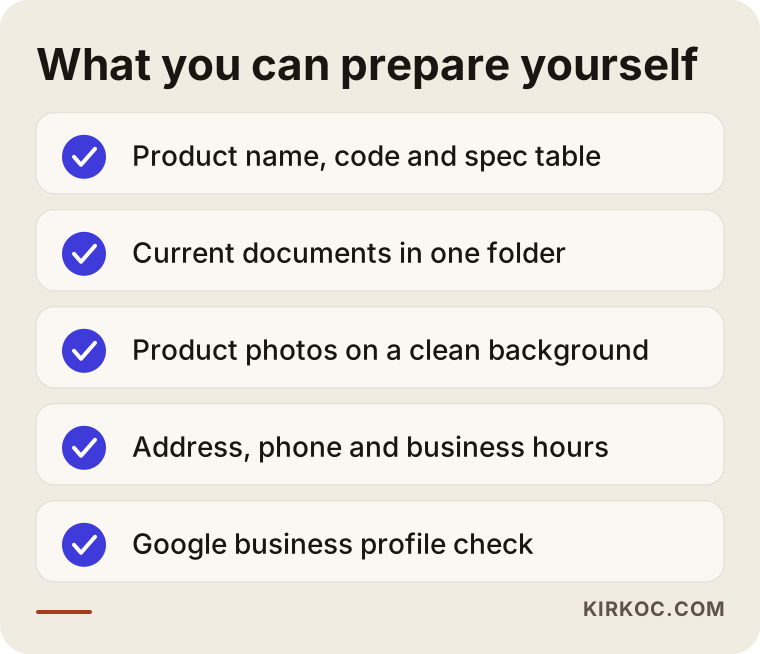
You do not need an expert for everything. You can take on the following yourself:
- Putting product names, codes and basic features into an orderly table.
- Collecting the documents in one folder and marking the current ones.
- Photographing products on a clean background (a good phone and decent light are enough), or getting images from the manufacturer with permission to use them.
- Searching your own company name on Google and seeing what comes up.
- Opening or reviewing your Google business profile, and making sure the address, phone number and business hours are correct.
The points where you usually need expert help are these:
- Building the structure of the site and the page plan.
- Building something that opens quickly and works properly on a phone.
- Technical adjustments so that search engines understand the site.
- Importing hundreds of products in bulk.
- Planning advertising and social media together with the site.
- Spotting wording that carries regulatory risk. This is not a web designer's job but that of a specialist who knows the regulations. I only point out where to be careful.
What determines the cost?
I cannot give you a single price for a medical site, because the size of the job varies a great deal. The main factors that shape the price are these:
- Number of products: A site with twenty products and a catalog of two thousand are very different jobs. Will the products be prepared one by one, or imported in bulk?
- Sales model: Is it only a catalog with quotes, or do you also want a cart and a payment system?
- Number of languages: Only one language, or English and others for export?
- Content preparation: Will the product texts come from you, or do you want me to write them? Is a photo shoot needed?
- Document management: If there are many documents and manuals, keeping them organized adds work.
- Integrations: If you want a link to a stock or accounting program, the scope grows.
- Maintenance and updates: Who will update the site after it goes live.
- Extra services: Search engine work, social media management and advertising are separate items.
For a clear price, I first need to know your product count, the buyer you are targeting and the features you want. I give the quote in writing, so what is included and what is not is clearly visible.
How I work with you
I am one person, and I carry the work from start to finish myself. That means the person you talk to is the person who does the work. There is no project manager in between and no team to hand it off to. For a medical company, the benefit is that you only need to explain the details of your products and documents once.
The process usually goes like this. First I listen to your current situation, your products and your target buyer. Then I present the page plan and scope in writing. With your approval I build the site, you provide the content and documents, and I organize and place them. After launch, we can discuss a separate plan for additional work such as search visibility, the Google business profile, social media and advertising. Having all of these in one pair of hands keeps the message consistent and spares you from writing to many different people.
After your site goes live, I review the results with you at regular intervals and update the plan if needed. I cannot guarantee results, but at every stage you can see clearly what is being done and why.
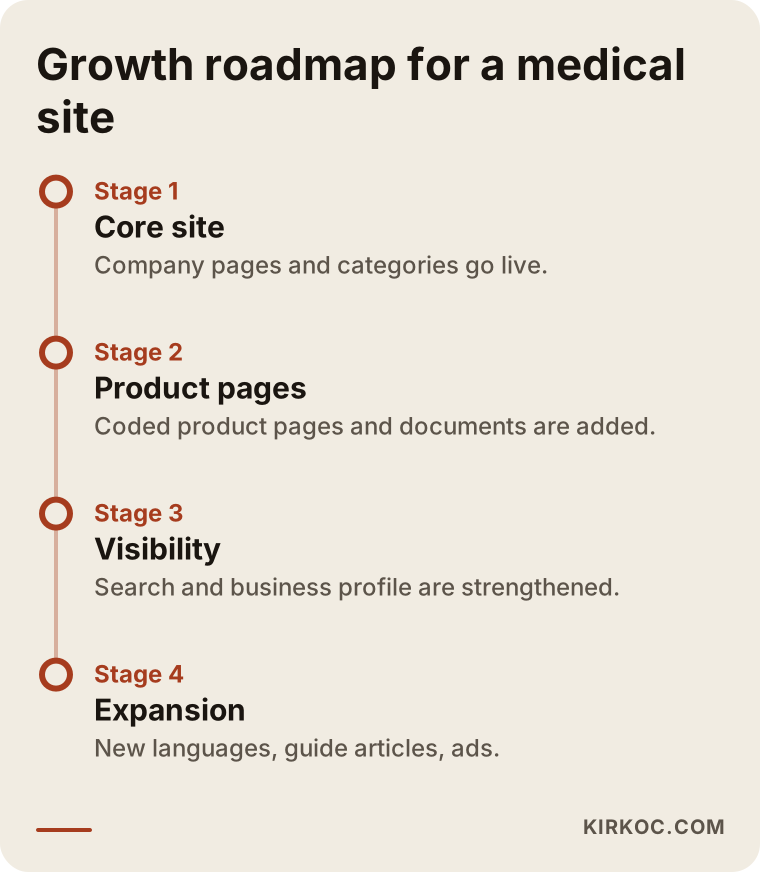
You can also think of the growth of a medical site over time as a roadmap:
Frequently Asked Questions
Do I have to show prices on my medical company's website?
No, it is not required. Many medical companies, especially those selling to institutional buyers, give prices through a quote. If you do not show prices, say so clearly on the page and make requesting a quote easy. If you sell to individuals and run an online store, you do need to show prices.
Is it safe to share product documents on the site?
Documents such as instructions for use and technical data sheets are usually handed to the buyer with the product anyway, and sharing them on the site builds trust. But which documents can be shared publicly may vary by company and manufacturer. Check your agreement with the manufacturer, and if you are unsure, consult a lawyer.
Should I prepare the catalog as a PDF or as web pages?
Using both is the healthiest approach. Web pages can be found in search engines and are easy to read on a phone, while a PDF is handy for buyers who want to download, share or print. Make sure the codes and details are identical in both.
How long does it take to build the site?
It depends on the number of products, whether the documents are ready and who writes the content. Most of the time goes into collecting information and documents, not into technical setup. If you organize your product list and documents beforehand, the process gets shorter.
Can I use the logos of the brands I distribute on my site?
Brand logos and product images usually belong to the manufacturer. Permission to use them is settled in your distribution agreement or in a separate written approval from the manufacturer. If you do not have permission, do not use them. You can have a lawyer check the relevant clause in your agreement.
Will my site show up on the first page of Google?
I cannot guarantee that, and nobody can. Correctly structured pages, clear product information, regular content and a trustworthy site improve the odds. Results vary with competitors, the type of search and time.
Are there rules to watch for when advertising to patients and doctors?
Yes, there may be restrictions on promoting and advertising health products, and they vary by product type. I do not make legal decisions on this. I recommend having the wording on your site and in your ads reviewed by your regulatory officer or a lawyer before publishing.
I already have a site. Do I need to rebuild it?
Not always. If the structure of the site is sound, it opens properly on a phone and its pages can be edited, improving the existing site may be enough. I would look at the current state first and tell you whether it needs a rebuild or a fix.
If you would like to plan the website and catalog for your medical supply company together, reach out through my website design page. I will listen to your products, your buyers and your goals, then prepare a suitable plan and a written quote.