You own a medical supply store or an orthopedic shop. The shelves hold wheelchairs, canes, knee braces, blood pressure monitors, incontinence products, orthopedic pillows, and dozens of other items, and you know every one of them well. But the phone does not ring as often as it should, and most people never find your website. That is probably why you searched for "medical supply store SEO" or "orthopedic store SEO." In this article I explain how a business that sells health products gets found on Google, which pages it needs, and where to begin. I am Ümit Kırkoç, a web designer and SEO consultant who handles all of this work alone from Istanbul, and near the end I describe my own SEO services and their limits.
SEO, in short, is the work that makes your website show up when your customers search on Google. You do not pay for each click the way you do with ads, and a setup that is built well can bring in customers for months. Health products, though, come with their own difficulties. The customer is often in a hurry, often does not know the name of the product, and is afraid of buying the wrong thing. So this article starts from that customer's point of view.
What does someone shopping for health products type into Google?
A customer for medical products rarely speaks your industry's language. You say "orthosis" or "mobility aid." They type "my knee hurts, what should I wear" or "what do I need to walk after surgery." That gap is the most common reason medical websites lose customers: your products are on the site, but they are not described in the words the customer actually uses.
You can sort search intent into four rough groups. The first is the person who knows the product name: "wheelchair," "blood pressure monitor," "adult diapers." This person is comparing and wants price, stock, and delivery information. The second is the person who starts from a complaint: "brace for lower back pain," "what to use for a sprained ankle." This person wants information first and a product second. The third is the person looking for a nearby store: "medical supply store near me," "orthopedic store downtown," "pharmacy-style shop open late." This person wants to go right now. The fourth is the person shopping for a relative: a hospital bed, an air mattress, or a walker for an elderly or bedridden family member. They are usually doing this for the first time, and they have a lot of questions.
The graphic below summarizes these four intents and the page that suits each one.
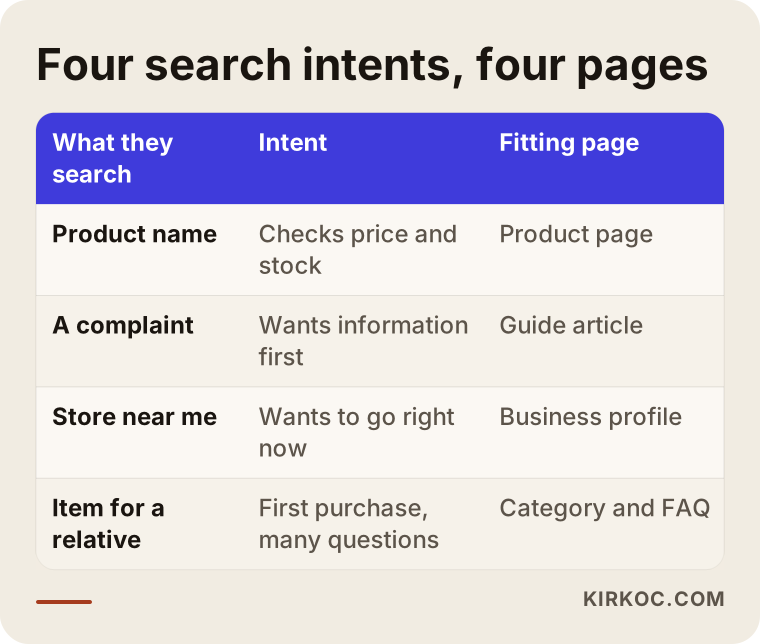
Noticing that each intent needs its own page is half the work. If you pile everything onto one "Our Products" page, neither Google nor the customer can tell what is where.
Matching intent to a page
On many medical websites, the home page has a long product list and a phone number at the bottom. But a person who typed "brace for lower back pain" is not going to click a small thumbnail of a brace buried in that list. They are looking for a page that answers their question. If you do not give them that answer, a health information site or a big marketplace will. You will have lost the customer to a competitor whose product is sitting on your own shelf.
Why Google is stricter about health topics
Google looks more carefully at pages about health than at pages about most other subjects. Wrong information can affect someone's wellbeing, so on these pages it matters more who wrote the content, whether the information can be trusted, and whether the business is real. Try to see this as an opportunity rather than a threat. If you have a real shop, a real address, and staff who know the products, showing that on your site sets you apart from anonymous websites.
In practice, that means the following. Your site should show the store's address, phone number, opening hours, and photos. Your About page should say who you are, how many years you have done this work, and which brands you carry. Product descriptions should not make claims like "this treats condition X." They should explain what the product does, who it is meant for, and how it is used. Rules about medical claims and health advertising exist, and they differ by country. If you are not sure what you can and cannot write, talk to a lawyer or a regulatory specialist before publishing. I do not give legal interpretations; what I do is keep the writing plain, honest, and free of exaggeration.
Signs that build trust
When people buy a health product, they wonder: is this shop real, is the product genuine, and will they answer if I ask a question? A visible phone number and messaging line, clear photos of the outside and inside of the store, return and exchange terms written out plainly, and the brand and model of each product stated clearly all answer those questions. They may not look like "technical SEO," but they are the signals that make both Google and your visitor take you seriously.
Local visibility: your shop's place on the map
A large share of medical supply and orthopedic stores serve customers in their own neighborhood. When someone types "orthopedic store near me," Google shows businesses on a map. The winner there is often not the business with the best website but the one with the most carefully prepared Google Business Profile.
A few things matter in that profile. Your business name should match the name on your shop sign; stuffing keywords into the name can get a profile suspended. Choose the category that fits what you actually do, such as medical supply store or orthopedic shop. Keep your opening hours current, including holidays and any special days. Add the products and services you really sell, with photos. Reply to reviews. Even a calm, specific answer to a negative review leaves a good impression on the next customer.
The list below gathers the main points to check for local visibility.
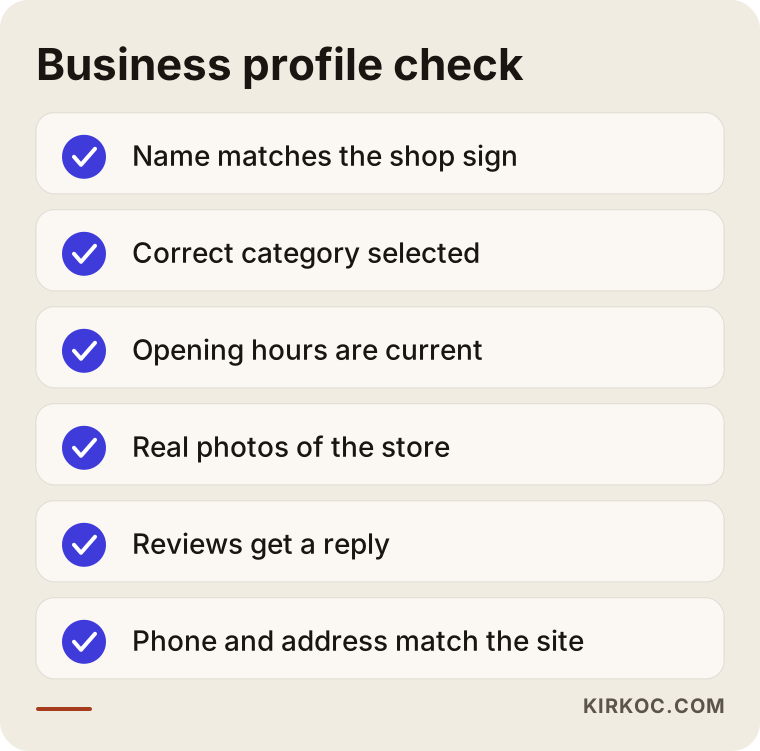
You can do most of these yourself. An hour or two of regular care is worth much more than a profile that sits half finished for months.
The same details everywhere
Write your address and phone number the same way on your site, your map profile, your social media accounts, and any directories you appear in. Whether one place says "St." and another says "Street" probably does not matter, but different phone numbers or an old address make it harder for Google to recognize you correctly. If you have moved, remember to update the old listings too.
A shop only, or online sales too?
Many orthopedic store owners ask: "Should I sell products on my site, or just present the shop?" The answer depends on your products and how you operate. Some items, like a blood pressure monitor or a cane, can easily be sold at a distance. For products that need fitting, such as a back brace or custom orthopedic insoles, it is healthier for the customer to come into the store. In that case the site does not have to give up on selling; it can simply direct people to "book a fitting."
Whichever path you choose, product pages are the heart of the work. If you run an online shop, every product should have its own page. If you do not, each product group should still have a page that gives information. These pages are the first thing a person meets when they arrive from Google looking for a product.
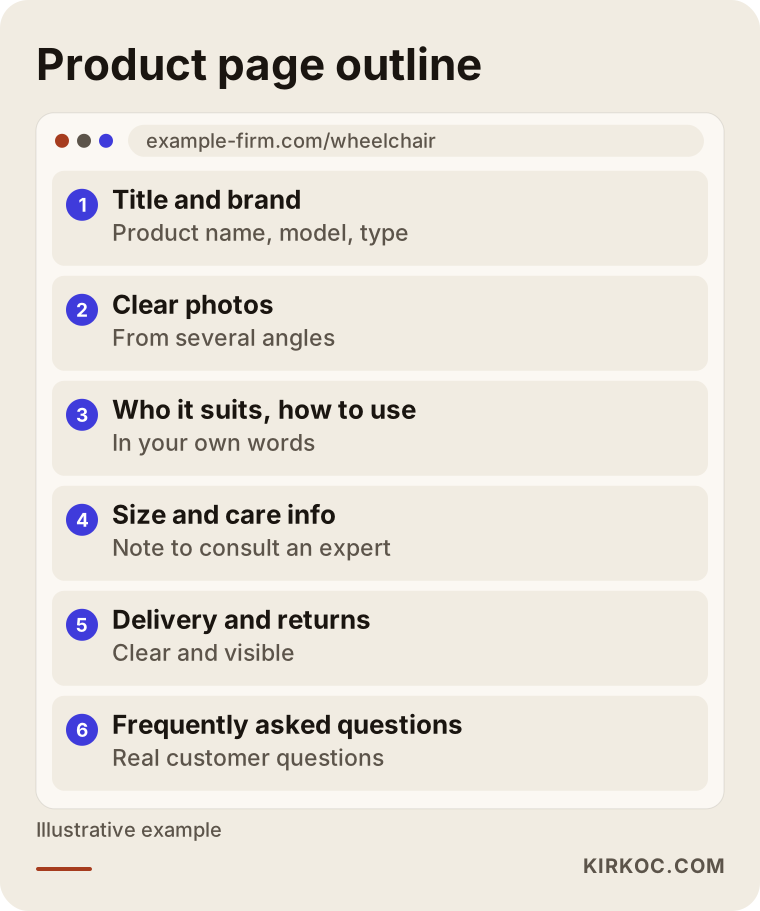
The order in the graphic is a sample outline. You can remove or add sections depending on the product. What matters is that the page is more than a product photo and a price box.
What a good product page includes
The title should state the product name, brand, and type clearly. Photos should be sharp and show the item from more than one angle. The description should explain in plain language what the product is used for, who it suits, its size or capacity, what it is made of, and how to care for it. If the product should be discussed with a professional before use, say so honestly; that adds credibility. Delivery, returns, and stock information should be easy to see. Below that you can add frequently asked questions, such as "Which size should I choose?", "Is it washable?", or "Can you issue an invoice to a company or care facility?"
A very common mistake here is copying the ready-made description from the manufacturer word for word. When dozens of sites use the same text, Google cannot decide which one to show, and it often picks the biggest site. A description written in your own sentences, built around the questions customers actually ask, is both original and better at selling.
Category and guide pages: the customer who arrives with a complaint
Product pages are for people who already know the product name. For the person who arrives with a complaint, you need pages that work as guides. Titles like "What you might need at home after surgery," "What to look for when preparing a room for an elderly relative," or "Five questions to ask when choosing a wheelchair" both inform and lead people to your products.
Remember that you should not give medical advice in these articles. You are not a doctor. The job of the article is to help the reader ask the right questions and get to know the products. Phrases like "as your doctor recommends" and "ask a specialist about sizing" are both honest and reassuring. At the end of the article, point readers to the relevant product category and to the store's contact details.
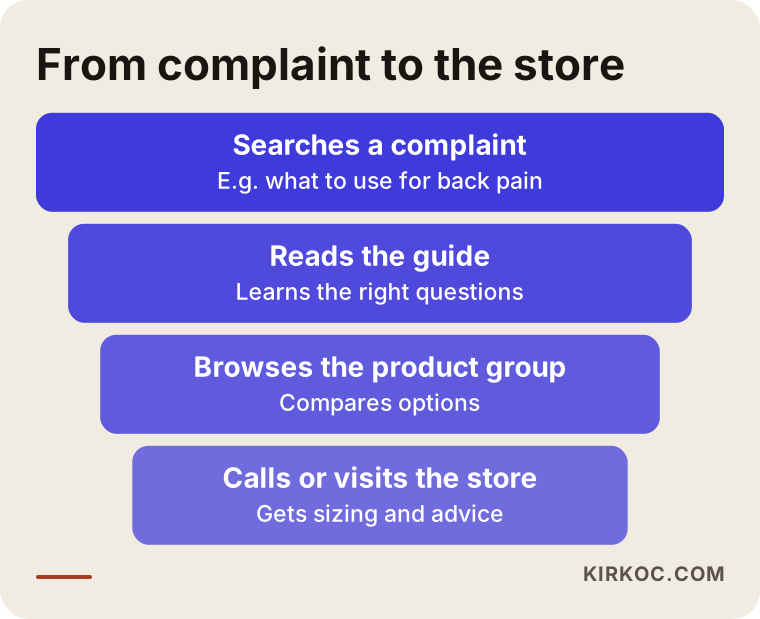
The path above shows how a guide article moves a customer toward buying, one step at a time. At every stage there should be a clear link or button that takes the person to the next step.
Which pages to write, and in what order
If you try to write every page at once, you will neither finish nor keep the quality up. Start with your best-selling product groups and the questions you hear most. Write down, for one week, the question customers ask most often in the store. Those notes will give you a list of topics more real than anything a software tool can provide.
Thinking about local search and product search together
For the same business, two different games are being played. The first is map and neighborhood searches, where closeness, profile quality, and reviews decide the result. The second is product and topic searches, where the quality of the pages on your site and how they link to one another decide the result. Most businesses do one and forget the other. Yet a customer who finds your shop on the map often looks at your site too, and a customer who finds your site will look for where the shop is.
Be careful with neighborhood pages. Making a page for every district, such as "North Side, Riverside, Old Town orthopedic," by copying the same text and changing only the name, is a method Google treats badly. Instead, prepare a separate page for the few areas where you really deliver, serve customers, or are easy to reach, using real information specific to each area: how to get there, delivery time, a nearby hospital.
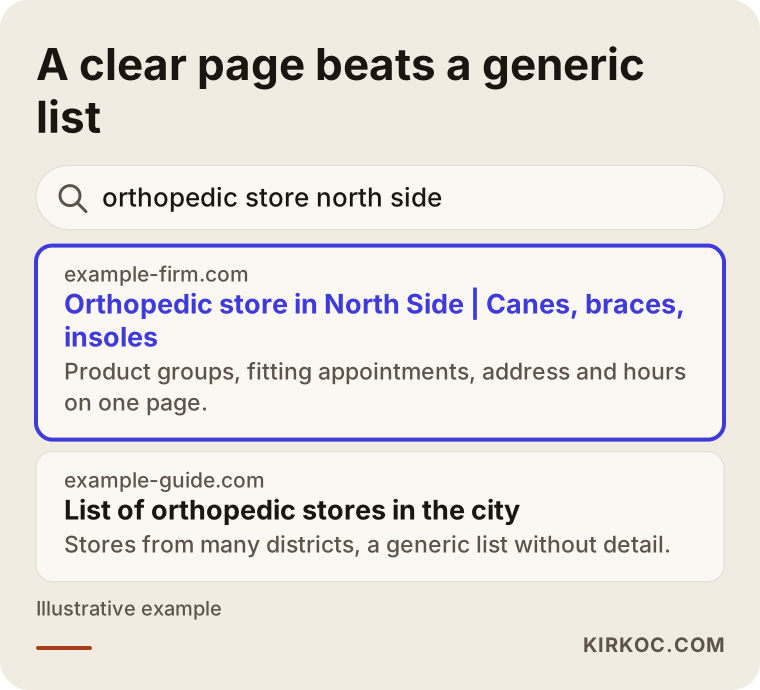
As the example shows, a page that clearly names the district, the product, and the type of service gives the customer a sharper answer than a generic directory list. The result in the graphic is invented for illustration.
Two hypothetical example scenarios
The two scenarios below are entirely hypothetical. They do not describe a real company or person; they are made up only to show the logic.
Scenario 1: A long-standing neighborhood orthopedic shop
Imagine an orthopedic store that has operated in one neighborhood for fifteen years and is known by its sign. The owner had a website built a few years ago. It has only a home page, an "Our Products" page, and contact details. The Google Business Profile has just a name and a phone number, with no photos.
The first job here is to complete the profile: real photos, the right category, opening hours, and product groups. The second job is to split the "Our Products" page into product groups, such as crutches and canes, braces and supports, orthopedic insoles, and wheelchairs. Each group gets its own page with a short guide section. The third step is to ask for reviews. That does not need to be forced; it is enough to ask politely when a customer in the store seems happy. Within a few months this work may help the shop appear more consistently in neighborhood searches and on the map, but I cannot promise any ranking or result.
Scenario 2: A medical supply store that wants to sell online too
This second made-up business has a small shop in the city and wants to sell its products online as well. It has hundreds of products, but most descriptions are ready-made text from suppliers. Also, one product in three colors has three separate pages, each almost identical.
Here the page structure is fixed first: color and size options are gathered on a single product page, so near-duplicate pages become one strong page. Then, starting with the products that are searched most and earn the most, the descriptions are rewritten around customers' questions. Short introductions are added to the category pages. If the business also sells on large marketplaces, its own site keeps a clear difference: the store address, the chance to ask for advice, and fitting appointments, things a marketplace cannot offer.
The process, step by step
SEO is less a magic setting than a series of small tasks in a sensible order. This is the order I follow with a business like this.
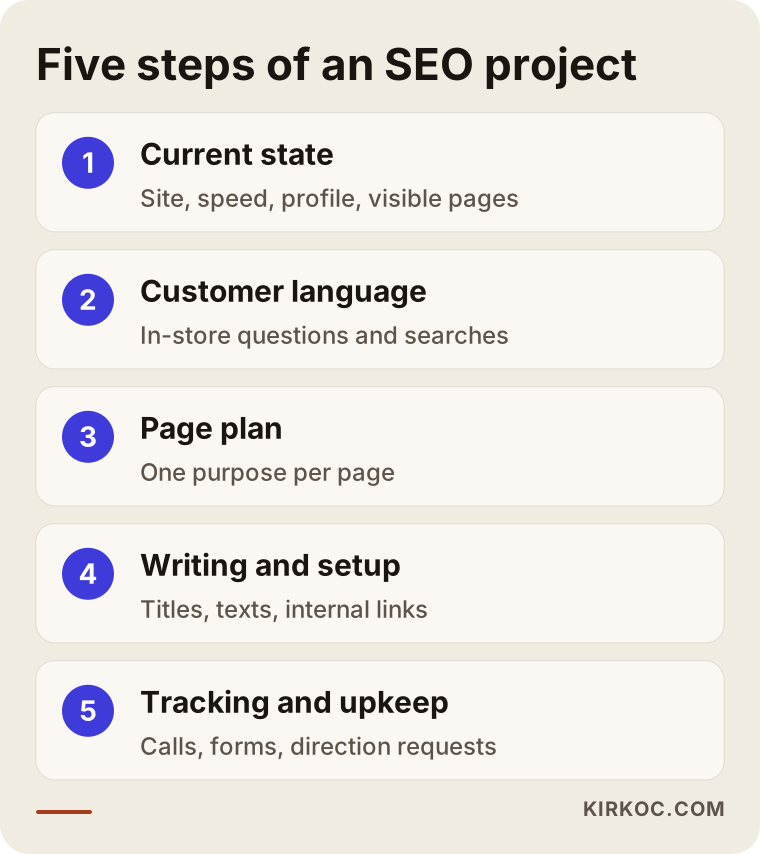
Let me go through each step in the graphic briefly.
The first step is to look at where things stand. I check the site's speed, how it looks on a phone, which pages appear on Google, and the state of the map profile. At this stage many owners say, "I didn't know it was missing this much." That is normal.
The second step is to find your customers' language. The questions asked in the shop, the requests that come in by phone, and the phrases that show up in search tools are put together. The goal is to identify the words your customers use, not industry terms.
The third step is the page plan. Which page will exist for which product group, which guide articles are needed, whether district pages are truly necessary: all of this is turned into a list. Each page gets a single purpose.
The fourth step is writing and setup. Titles, descriptions, images, frequently asked questions, and internal links are prepared. On the technical side, speed, mobile friendliness, and properly set page titles are checked.
The fifth step is tracking and upkeep. I watch which pages get visits and which searches lead to phone calls or forms, and I rework what looks weak. SEO results usually show up over months, not weeks, so patience is required.
What to measure
Tracking rankings alone is misleading. More useful measures are the number of phone calls, requests for directions from the map, messages, visits that turn into form submissions, and people who walk into the shop saying "I saw you online." The easiest way to start is simply to ask, in the shop or on the phone, "How did you find us?"
Common mistakes
There are mistakes I see again and again in medical SEO. The graphic below summarizes them, and I go through each one below it.
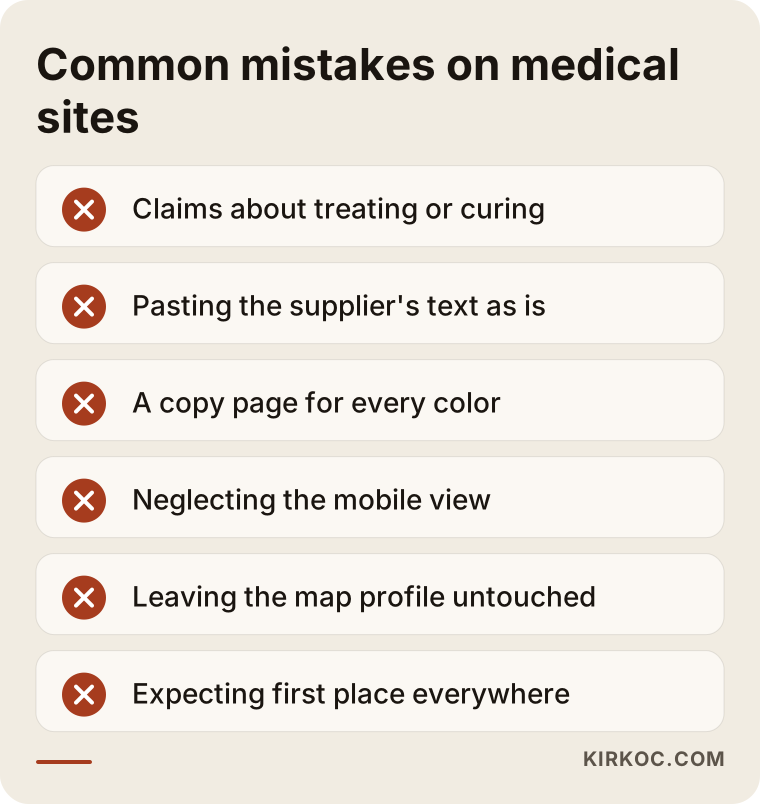
The first mistake is exaggerated health claims. Sentences like "cures a slipped disc" or "ends the pain" both mislead the customer and can put you in a difficult position under the rules. Describing calmly what the product does is safer, and it builds more trust.
The second mistake is pasting the supplier's description as is. If the same text is on hundreds of sites, nothing about your page stands out.
The third mistake is opening separate pages for every product variant, each a copy of the others. Gathering color, size, and model options on one page is usually the better approach.
The fourth mistake is neglecting mobile. Many people looking for a health product search on a phone, often in a hurry. If the page opens slowly, the buttons are tiny, or the phone number cannot be tapped, the customer moves on to the next result.
The fifth mistake is opening a Google Business Profile once and leaving it. Opening hours go stale, there are no photos, and reviews sit unanswered.
The sixth mistake is expecting first place everywhere. Instead of competing with big sites on a general search, it is far more realistic, and often more profitable, to aim for clear searches by neighborhood and product.
What you can do yourself
Part of SEO can and should be done by the business owner, because you know the product best. Completing and regularly updating your Google Business Profile, writing down customer questions in a notebook, taking clear product photos, and asking for and answering reviews are all things you can do. Writing the first draft of product descriptions is a good start too; your own sentences are often worth more than ready-made text.
Some jobs, on the other hand, call for expertise: fixing the technical structure of the site, improving speed, editing hundreds of product pages in bulk, planning how pages link to one another, setting up measurement, and analyzing competitors. For these, outside help is usually cheaper than months of trial and error.
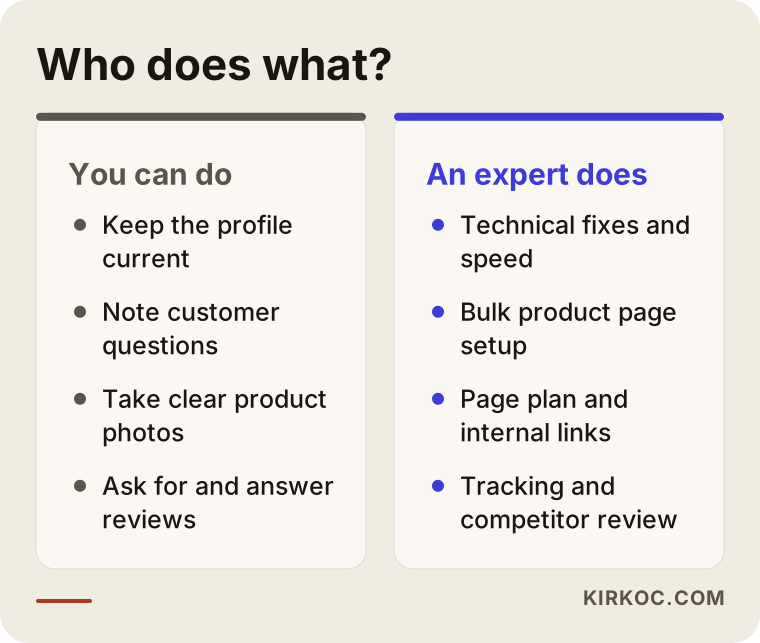
The graphic offers a simple rule of thumb: you take the jobs that need product and customer knowledge, and a specialist takes the technical and bulk work.
What determines the cost
A few things decide what this kind of work costs. I am not giving numbers, because they vary widely from business to business. The biggest factor is the number of products: a site with fifty products and a site with several thousand do not need the same effort. The second is the current state of the site; if there are many technical problems, they must be fixed first. The third is how much content has to be written, since category texts, guide articles, and product descriptions each take time. The fourth is the level of competition; a product group with many players in a big city is not the same as a limited group in a small district. The fifth is whether the service is one-off or a monthly arrangement. Whether the site will be rebuilt or the existing one improved also changes the price.
When you ask for a quote, ask not only "how much" but also "what exactly will you do, when, and how will you report?" Be cautious about vague quotes that cover everything and guarantee results.
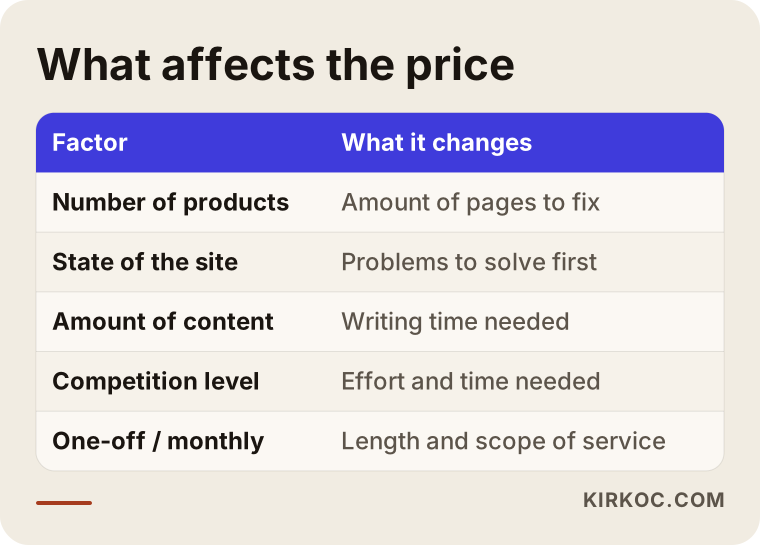
Thinking about these factors in advance makes quotes easier to compare. You can see whether two quotes cover the same work or whether one does much less.
How I work with you
I work alone. That means the person you talk to is the person who does the work, with no relayed messages and no lost notes. When I do SEO for a medical supply or orthopedic store, I can also handle the website, the product pages, the Google Business Profile, and, if needed, social media and advertising. Having it all in one pair of hands speeds things up. For example, when I prepare a page for a new product group, I can keep your profile, your social media post, and, if you need it, your ad consistent with the same message in the same week. You do not have to explain the same thing to several different people.
Usually I start by listening to you describe the shop, the products, and your goals. Then I look at the site and explain in plain language what needs to be done. If something is not a good fit, I say so openly. For example, if your site is already fine and the real problem is the map profile, recommending just that is enough. I do not promise rankings or sales, because nobody can guarantee how Google will behave. What I can offer is steady, understandable, measurable work.
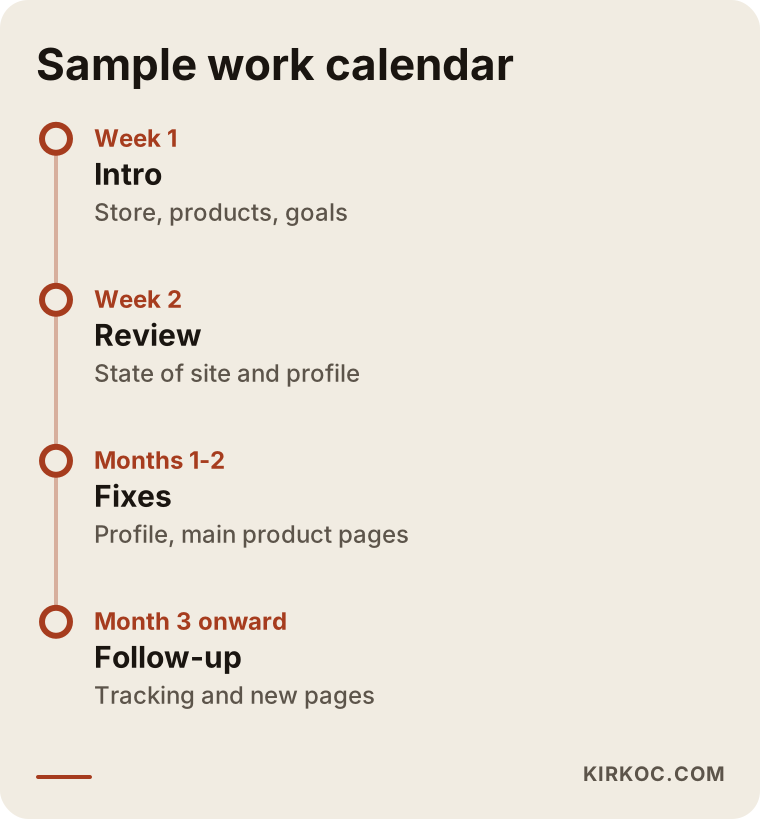
The calendar is only an example; timing changes with the state of the site and the number of products.
Frequently Asked Questions
How long does SEO take to work for a medical supply store?
I cannot give an exact time. Fixes to the map profile are sometimes noticed within a few weeks, while the effect of product and guide pages usually takes a few months. The level of competition, the current state of the site, and the amount of work done all change the timeline. Be wary of promises that say "first place in so many days."
If I have no website, is a Google Business Profile enough?
For a small neighborhood shop, the profile is a good start and often gives the fastest result. But if you want to appear in product searches or complaint-based searches, you need a website. A site also builds trust and lets you show your products in detail.
Can I write medical information in product descriptions?
You can describe what a product is for and how it is used, but you should avoid claims that it treats or cures a condition. If you are not sure which statements are acceptable under the rules that apply to you, ask a lawyer or a specialist in that area before publishing.
I sell on marketplaces. Do I still need my own site?
Marketplaces bring customers, but those customers belong to them rather than to you, and their rules and commissions can change. Your own site lets you promote your brand, your shop, and services like fitting appointments. Running both together is a more balanced path for most businesses.
Should I create a separate page for every district?
Only for places where you really serve customers or have something specific to say about that area. Copying the same text and swapping the district name does not work and can hurt your site. A few well-prepared pages are worth more than dozens of weak ones.
Do reviews really matter?
Yes. They affect new customers' trust and your visibility in map results. Politely asking happy customers for a review and answering the reviews you get is enough. Paying for fake reviews is not ethical and puts your profile at risk.
Is SEO or advertising the better choice?
They do different jobs. Ads give quick visibility for as long as you spend the budget, while SEO builds up over time. If you have an urgent campaign, ads make sense; if you are building something lasting, SEO does. For most businesses, a balanced mix of the two works better.
Is there anything I should prepare before we start?
Having admin access to your website, authorization for your Google Business Profile, and a list of your best-selling products is enough. Clear photos of the shop and a list of the questions customers ask most often will also speed things up.
If you want your medical supply or orthopedic store to show up more clearly on Google, you can reach me through my SEO services page. I will look at your shop and your site together and explain in plain language what needs to be done.