You produce good blocks and slabs at your quarry or processing plant, you attend trade fairs, and you have worked with the same handful of buyers for years. But have you ever checked what a brand-new buyer finds when they search for you online? A website for a marble company is often the last thing on the to-do list, yet an architect, contractor or stone trader abroad almost always looks you up before they ever speak to you. In this article I explain what your site is for, which pages it needs, and how to build it in more than one language. If you are starting from scratch, take a look at what my website design service covers.
I am Ümit Kırkoç. I work from Istanbul, and I handle everything a digital agency would normally do, from the website to search visibility, social media and ads, by myself and in one place. Everything below comes from that hands-on experience, and I have tried to write it so you can follow it without any technical background. Many of the examples assume your stone comes from Turkey, a major stone-exporting country, but the same logic applies to a foreign company that sources from or works with Turkish quarries.
How does a buyer search for marble?
Start from the other side of the table. The person who needs stone might remember a sample they saw at a fair. They might have heard your name from a colleague. Or they might simply type "travertine slab supplier" into Google for a project. Whichever it is, at some point they type your company name or a product name into a search box, and what they see gives them a first impression of you.
Here is what is specific to the stone trade: the buyer is rarely in the same country as your quarry. A stone workshop in Germany, an interior designer in Sweden or a contractor in the Gulf will type the search in their own language. And they are usually not looking for generic "marble." They want a particular stone: travertine, beige marble, onyx, basalt, limestone. If your site only says "We produce marble," you have not answered their question.
You can sort these searches into three rough groups. The first is searches by stone name. The second is searches with business intent, such as "supplier," "manufacturer" or "wholesale." The third is verification searches by company name, where someone heard about you elsewhere and is checking whether you are a real business. The example below shows how two sites might look side by side in the results.
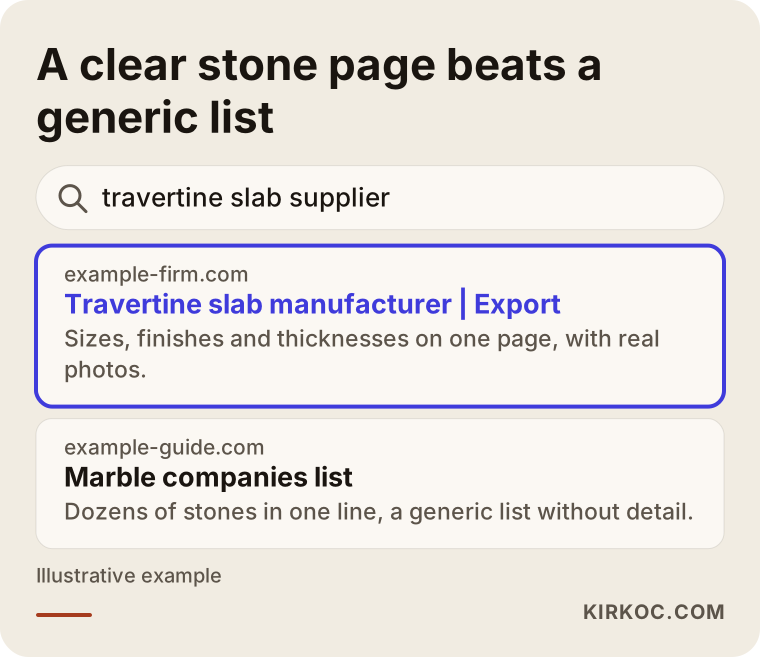
As the illustration shows, a page that clearly names the stone, its uses and the fact that you export makes a much stronger first impression than a general list where every stone gets one line. The buyer can tell what you sell before they even click.
What is the job of your website?
In the stone business, a website does not close the sale. Nobody drops a container of stone into an online shopping cart and pays. The job of the site is an earlier step: to build trust and move the buyer into a conversation with you. It does that by answering three questions.
The first question is "Is this company real?" Your address, company registration details, photos of the plant, images of the quarry or factory, and the size of your team all help here. The second question is "What do they make, and at what quality?" Stone types, surface finishes, sizes, thicknesses and certificates answer this. The third question is "How do I reach them, and how fast will they reply?" Your phone number, email, messaging app and contact form exist for this.
If your site does not answer these three questions clearly, it stays a display window no matter how polished it looks. A plain site that does answer them can be a real sales tool.
Which pages does a stone company website need?
A problem I see often in this industry is that all the information is crammed into one "Our Products" page. The photos sit side by side, a few words are written underneath, and the job is considered done. But both buyers and search engines think page by page. If every stone and every important topic has its own page, a person searching for that stone lands directly on it.
A basic structure for a marble or natural stone company could look like this: a home page, an about or company page, one page for each stone type, a surface finishes page, applications, a quarry and plant page, certificates, shipping and export information, reference projects, and a contact page. The next illustration shows how a product page can be laid out from top to bottom without tiring the visitor.
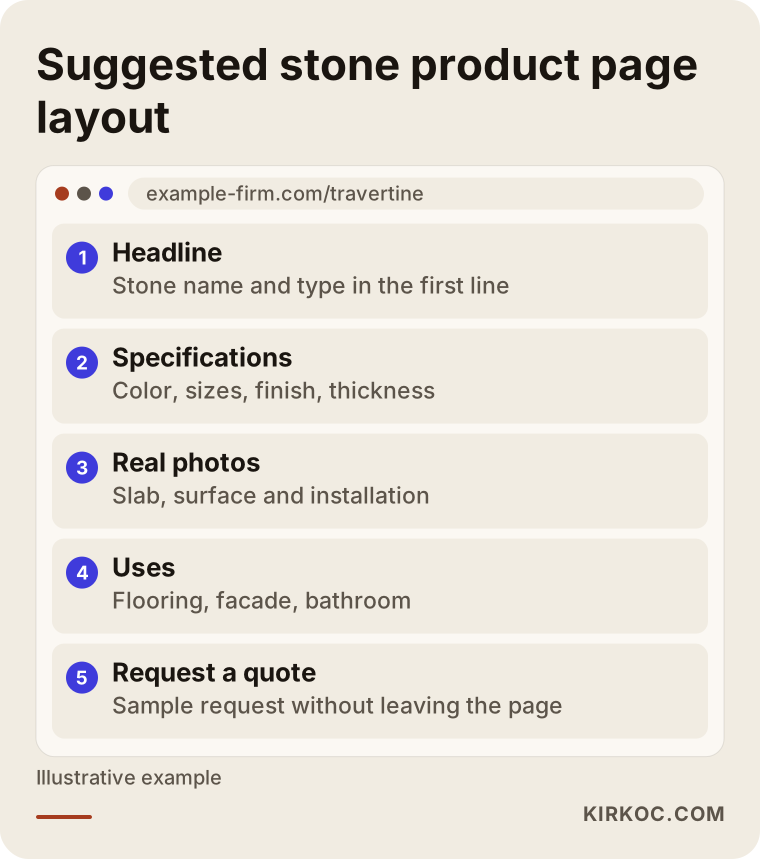
In this layout, the first line of the page names the stone and says what it is. Right below it comes a one-sentence summary, then the size, finish and thickness options, then real photos. At the bottom there is a way to ask for a sample or a quote without leaving the page. Whatever page a buyer lands on, they should be able to see what to do next.
What should a stone page say?
On a page for one stone, describe its name, its color and veining, the region it comes from, which finishes you can offer and where it is used most. Uses such as "flooring, facade cladding, bathroom, kitchen countertop" make life easier for architects and for private buyers alike. If you can share technical values, such as water absorption or compressive strength, back them with your own laboratory documents. If you do not have the paperwork, do not publish the number. A wrong technical claim does more harm than no claim at all.
Why does a references page matter?
A buyer abroad does not know you. Seeing where you have shipped before and what kinds of projects used your stone gives them confidence. You do not have to reveal your customer's name; even a general description such as "travertine flooring for a hotel project in Europe" helps. Just do not publish a reference without permission from the party you worked for. If your contracts mention this, check what they say, and if you are unsure, ask a lawyer.
Why is a multilingual site a must in this trade?
Marble and natural stone are important export goods for Turkey, and the stone trade is international in many other countries too. If your site exists only in your home language, you turn most of your potential buyers away at the door. A multilingual site does not have to be the same text pushed through a translation tool. In fact I recommend you do not do that. Machine-translated text gets stone terms wrong and does not look like a serious supplier. A German-speaking buyer knows the word for limestone better than any tool does.
A multilingual site needs a few things. Each language should have its own address, for example the English section in its own folder or on its own domain. Every page should show a visible language option that takes the visitor to the matching page. And there should be a technical signal that tells search engines which page is the equivalent of which language. Without it, Google may show your English page to someone in Germany, or the language versions may look like copies of one another.
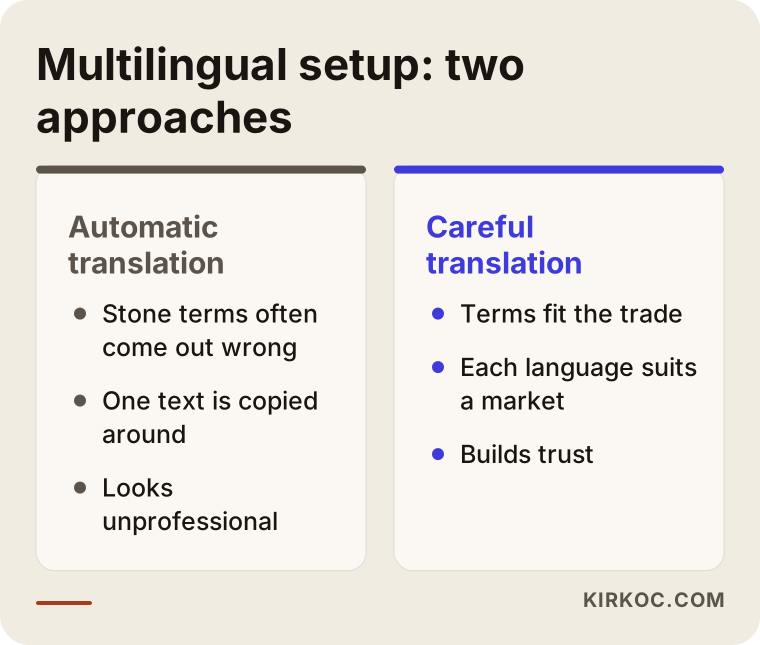
The comparison above sums up the difference between a multilingual structure with carefully written translations and one where every page is simply auto-translated. In the first, each language is planned for a market. In the second, one text is copied and handed out.
Which languages should you start with?
Instead of guessing, look at your current sales data. Which countries have you shipped to so far? Which countries send you quote requests? Which trade fairs do you attend? Your answers decide the first languages. For many companies, the home language plus English is the starting point. If there is a market you already serve regularly, for instance German-speaking countries or Scandinavia, adding that language as a second step makes sense. Publishing a few languages completely and well always beats publishing many languages halfway.
Two example scenarios
The two scenarios below are hypothetical. They do not describe a real company; I made them up only to make the situation concrete.
Scenario 1: A mid-sized travertine producer that works only by word of mouth
Imagine a company that produces travertine and limestone and has worked with a few regular buyers for thirty years. Its website was built about ten years ago. It exists in one language only, loads slowly on a phone, and shows six stones on a single product page. The owner wants to reach new markets, but no inquiries ever arrive from the internet.
The first job is to rebuild the structure of the site. Each stone gets its own page, photos of the quarry and the plant are taken, and export information and certificates are collected on a separate page. Then English and German are published alongside the home language. It would not be honest to expect a big jump in the first months, because pages take time to be indexed and recognized by search engines. But after about three months, what a person sees when they search for the company name is completely different: a clear company page, stone pages and open contact details.
Scenario 2: A new company moving from blocks to slabs
In the second scenario, a company that used to sell only blocks builds a processing plant and starts selling slabs and cut-to-size products. Its goal is to reach architects and installation firms directly. Now the site has to speak to designers, not only to suppliers. Surface finishes, sizes, pattern samples and installation photos come to the front. A sample request form is given a prominent place. An architect abroad should be able to download a stone catalog and attach it to a project file.
What these two scenarios share is that the site is built around the company's current situation and its target buyer. A ready-made "marble website" template fits neither of them perfectly.
The process step by step: how I build the site
A website project for a stone company usually runs in the order below when I work on it. I also note what I need from you at each step, because delays almost always come from waiting for content.
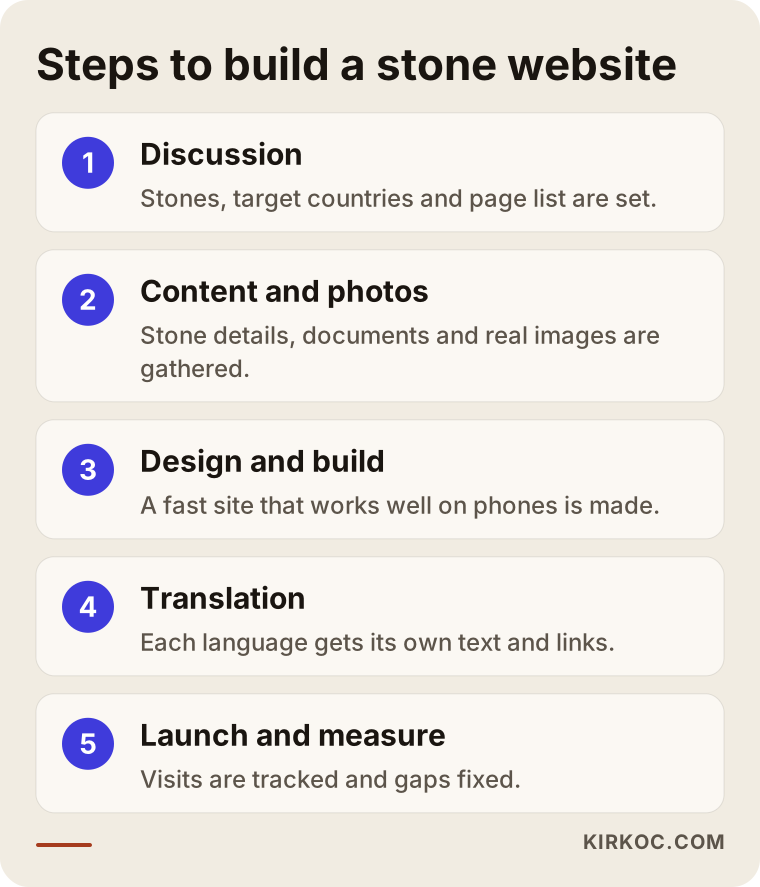
The illustration above gives the overall flow. Let me go through each step in a little more detail.
Discussion and goals
In the first conversation we talk about what you sell, who you sell to and where you want to sell. Which stones are the priority? Blocks, slabs or both? Which countries do you work with, and which do you want to enter? At the end of this conversation I write down the list of pages the site will have.
Collecting content and photos
This is the part that takes the most time on stone sites. Each stone needs good photos, size and finish details, certificate documents and images of the quarry or plant. Stock photos do not work on a marble site, because buyers want to see the real stone. Even photos taken with a phone can turn out far better if they are shot in the right light and on a damp surface. If it helps, I can prepare a short guide on how to shoot them.
Design and build
Once the content is ready, I build the site. Speed matters a great deal at this stage, because stone photos are large files and slow the site down if they are not compressed properly. A buyer abroad will not wait for a slow page. How the site looks on a phone is also tested here.
Translation and language versions
The text is written separately for each language, and stone terms are chosen according to how that language is used in the trade. The technical setup that links the language versions to each other is done at this stage as well.
Launch, measurement and improvement
Once the site goes live, half the work is still ahead. You have to look at which pages are visited, which countries the visitors come from, and whether anyone fills in the form. In the first weeks some pages get fixed and missing content is completed. Over time, new stones, new projects and blog articles are added.
How do you turn a visitor into a conversation?
When someone arrives on your site and finds what they were looking for, they should see the next step. Usually that next step is a quote or a sample request. For that, every page needs a visible way to get in touch. Next to a phone number and email address, a button that opens the messaging app that buyers abroad use a lot is also helpful.
The form itself should be simple. Name, company, country, the stone they are interested in and a message box are usually enough. If the form has twenty fields, the buyer gives up. If you can, set it up so that each request reaches you as an instant notification, and give the first reply the same day. A buyer abroad may be writing to three or four suppliers at once, and the one who answers first is often the one who starts the conversation.
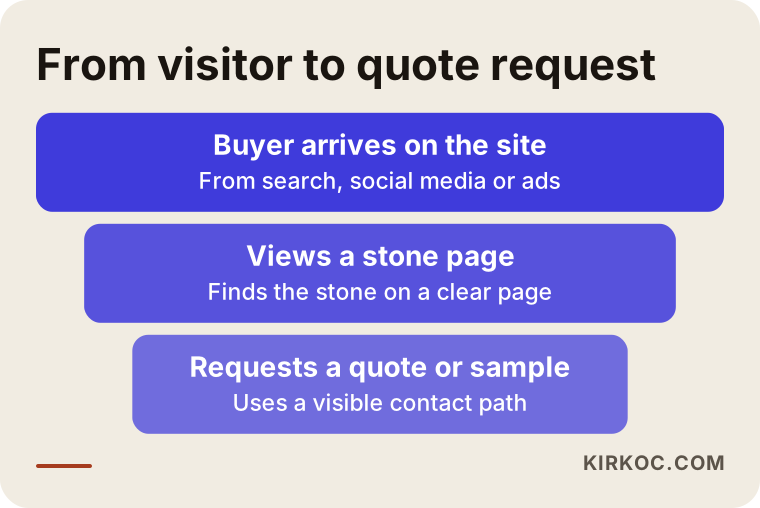
The funnel illustration summarizes it: many people arrive on the site, fewer view a stone page, and fewer still ask for a quote. The aim is to lose fewer people at each stage, and clear pages and visible contact paths like the ones above are what achieve that.
How do social media and ads connect with the site?
In the stone trade, social media is a showcase where you can display beautiful photos of stone and finished installations. Instagram and LinkedIn in particular can be places where architects, designers and contractors discover you. But a social media account alone is not enough. The person who finds you there will sooner or later need detailed information, and that information has to be on your site.
Ads work in a similar way. An ad on Google for a specific stone or country should send the person straight to the page for that stone. If the ad leads to the home page, the visitor cannot find what they wanted, leaves, and the budget is wasted. When the site, social media and ads are handled by different people, it is hard to keep this link intact, because each one looks only at its own goal. I run all of them myself, so when I post a photo of a stone on social media, I can update its page on the site at the same time and point the ad to that page. That saves time, and it shows the buyer one consistent picture.
Common mistakes
Here are the mistakes I see most often on the websites of stone companies. Most are not expensive to fix; they only need some attention.
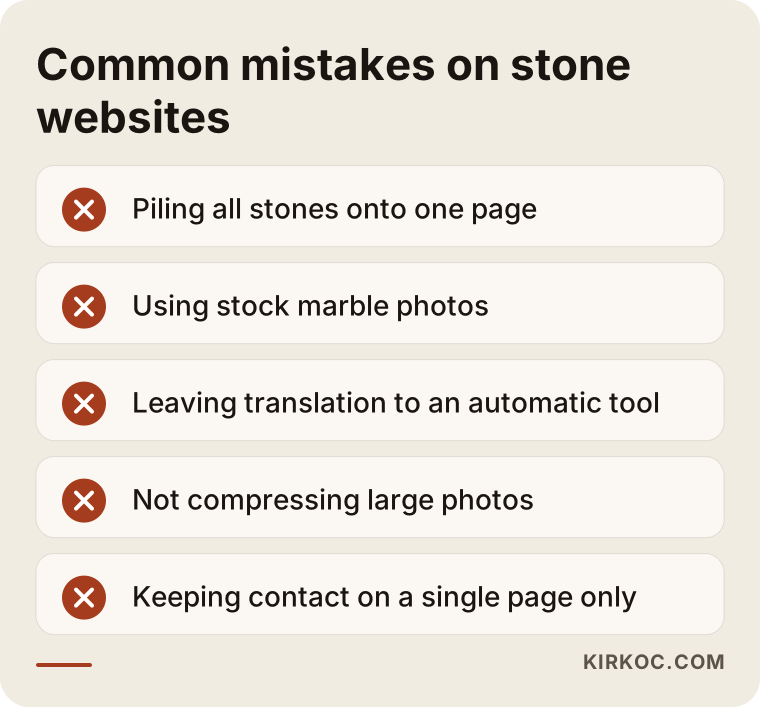
Let me go through the mistakes in the list. The first is piling all stones onto one page. If someone searches for "beige marble," they should land directly on the beige marble page. The second is using stock photos. The buyer wants to see your stone, and a marble image taken from the internet reduces trust. The third is leaving translation to an automatic tool. When stone terms are translated wrongly, you do not look professional. The fourth is uploading large photos without compressing them, which makes pages slow. The fifth is hiding contact details. If your phone number and email appear only on the "Contact" page, the interested buyer on a stone page is lost.
There is one more mistake that is not on the list but matters: building the site and then leaving it alone. A stone website is not a printed brochure. It should be updated as new projects, new stones and new certificates arrive. A site that still shows information from three years ago looks like a company that is no longer active.
What does it cost, and what changes the price?
I am not going to give a number, because even two stone websites can differ enormously. But I can tell you clearly what determines the cost, so that you know what to look at when you receive a quote.
The first factor is the number of pages. A ten-page company site and a catalog site with forty or fifty pages, one for each stone, are not the same job. The second factor is the number of languages. Every extra language means new translation and new content, and the work grows as translation quality goes up. The third factor is who prepares the content. If photos, product details and certificates are ready, the process is shorter; if everything has to be shot and written from scratch, it takes longer. The fourth factor is extra features. A catalog download, a multilingual form, a sample request and product filtering all affect the cost. The fifth factor is support after launch. Site maintenance, updates, search visibility work, and social media or ad support are separate items.
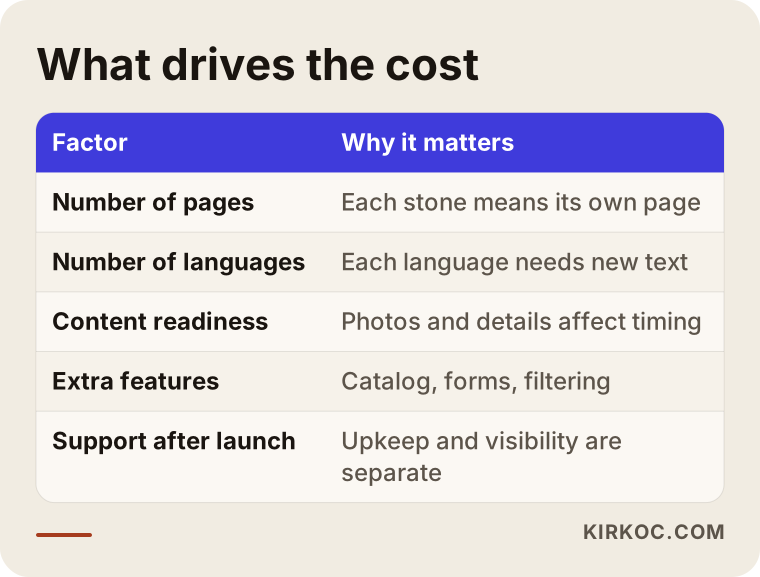
When you ask for quotes, make sure the scope is in writing: how many pages, how many languages, who writes the translations, whether photography is included and how much support you get after launch. A quote that does not spell these out cannot be compared with another one. Also make sure the website and the domain name are registered in your name, so that if you ever part ways with whoever built the site, it stays with you.
What can you do yourself?
There is a lot you can do before deciding to work with a specialist, and it speeds the process up.
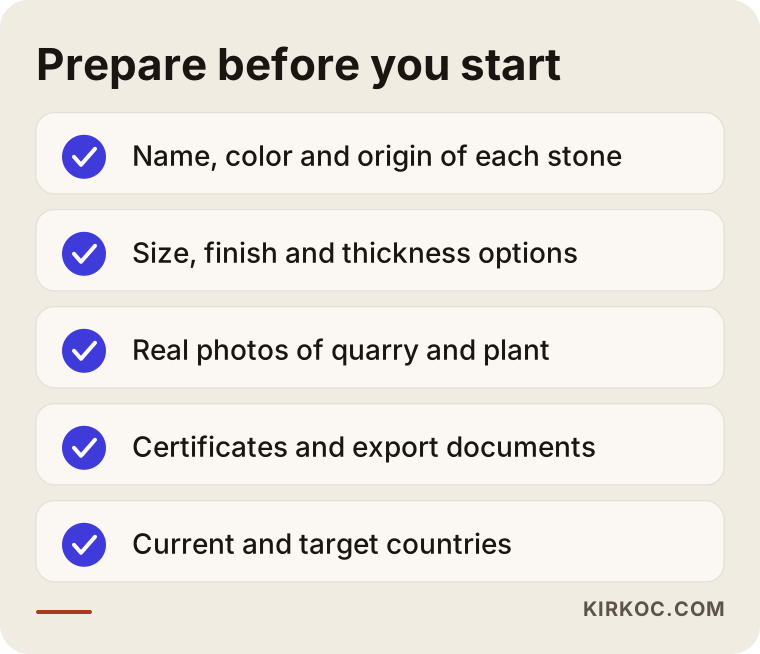
First, gather clear details for each of your stones: name, color, region of origin, available sizes and finish options. Second, take real photos of your quarry and plant, in daylight, without shadows and in high resolution. Third, put your certificates and export documents in a single folder. Fourth, write down which countries you ship to and which you want to enter. Fifth, look at your competitors' sites and note what they do well and badly.
Creating your Google Business Profile, the free listing that shows your company on Google Maps and in search, and entering your address, phone number and opening hours correctly is also something you can do on your own. Be sure to write your address and phone number exactly as they appear on your site. Different spellings confuse both buyers and search engines.
When do you need a specialist?
You can go a long way on your own with a first site or a rebuild, but in a few situations expert help makes sense. If you want a site in several languages that is set up correctly from a technical point of view, settings such as linking the language versions to one another take expertise. If you want to receive quote requests through the site and measure them regularly, a tracking setup is needed. Showing up in search results, which is what SEO means, is ongoing work that takes several months. And if social media and ads will be added too, it helps to plan everything together.
What should you expect after launch?
When a new site goes live, it does not jump to the top of search results right away. It takes time for search engines to find, read and evaluate the pages, and that time varies with the age of the site, its content and the competition. I do not promise a ranking or a result, and nobody honestly can. What I can offer is the right structure and steady work.
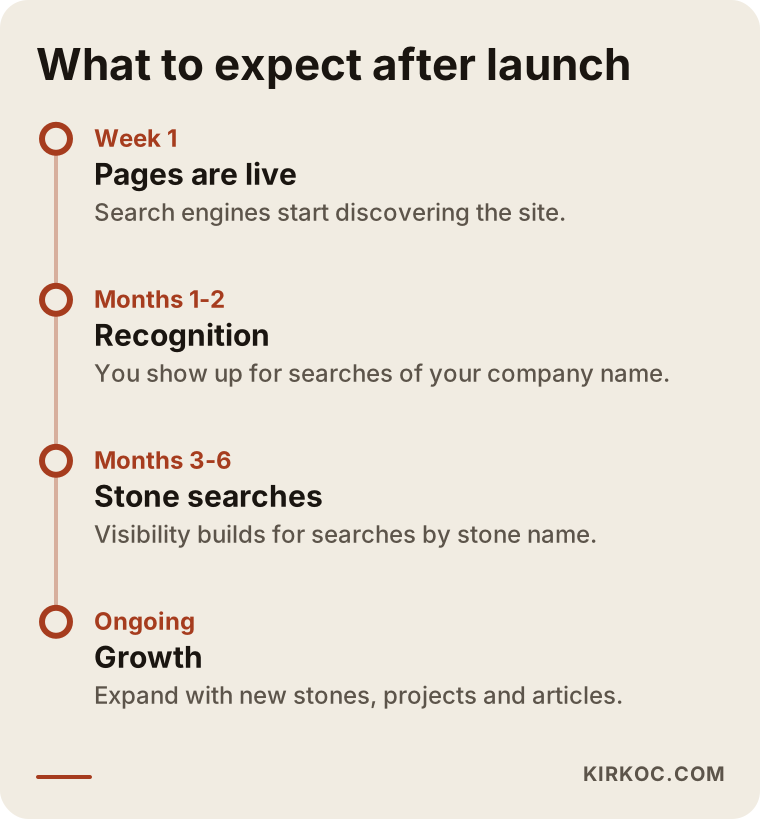
The timeline shows a realistic order. In the first weeks, the pages are discovered. In the following months, you begin to appear in searches for your company name and stone names. After that, you grow with new content. During this period we look at a short monthly report together to see what works. Pages that do not work are fixed, and the ones that do are multiplied.
If you want quote requests in the short term, ads can speed things up. An ad set up for a particular stone and country can bring visitors even before the site has been recognized. But an ad has a budget, and when you stop paying, the visitors stop too. An investment in the site, on the other hand, lasts.
How I work with you
I am one person and I do the work from start to finish myself. That means the person you talk to is also the person who builds the site, has the texts written and looks after your visibility in search. Messages are not passed between a project manager, a designer and a developer, so decisions are made quickly. The trade-off is that my capacity is limited, and I do not run many projects at the same time.
We usually begin with a short introductory conversation. I look at your current site, if you have one, and at your competitors, and tell you where it makes sense to start. If you like the direction, we put the scope into a written quote. All accounts, the domain and the site are registered in your name. If you want, I only build the site; if you prefer, we add social media, ads and search visibility work. Running all of it in one place means far less back and forth than dealing with several separate people.
The decision chart below can help you work out whether you need a new site at all.
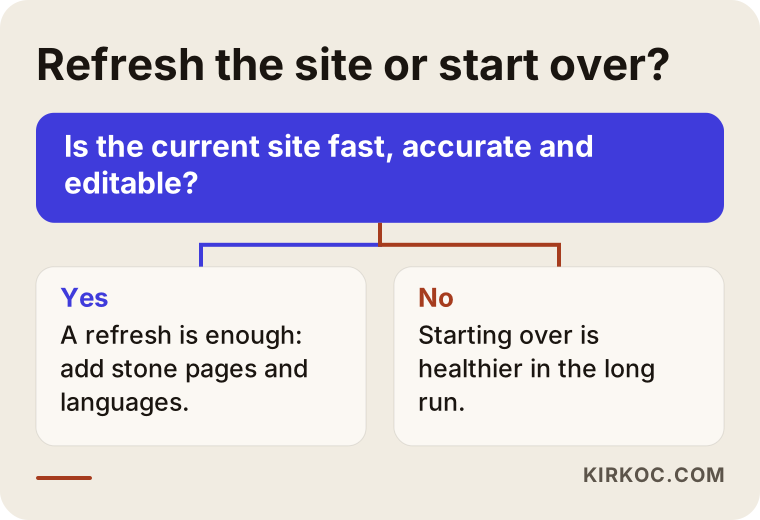
In short, if your current site loads quickly, gives accurate information and can be edited, a refresh may be enough. But if its foundation is old, it looks broken on a phone and adding a language is not possible, starting over will be cheaper and healthier in the long run.
Frequently asked questions
Does a marble company really need a website?
For most companies, yes. Buyers abroad, and architects at home, look you up online before they know you. If you have no site, or an outdated one, your competitor's site gives that person their first impression. Your site will not make sales on its own, but it builds trust and moves the buyer toward contacting you.
How many languages should my site have?
It depends on the countries where you sell and where you want to sell. Most companies start with their home language and English. If there is a market you serve regularly, adding its language makes sense. Publishing a few languages well is better than publishing many carelessly.
Is automatic translation good enough?
I do not recommend it. Stone and surface terms often come out wrong in machine translation, and it leaves buyers with an unprofessional impression. Someone who knows the trade, or who speaks the language natively, should review every translation.
How long does it take to build the site?
It depends on the number of pages, the number of languages and, above all, how fast the content and photos are prepared. If photos and product details are ready, the process is shorter. Once I see the scope, I can give you a written schedule with firm dates.
Will my site reach the top of Google right away?
No, and be wary of anyone who promises that. New pages take time to be recognized. With a good structure, clear pages and steady content, visibility grows over time, but no specific position or timeframe can be guaranteed.
How is the price determined?
The number of pages, the number of languages, who prepares the content and photos, extra features and support after launch set the price. I need to see what you need before I name a figure, so that you do not pay for things you do not need.
Should I show prices on the site?
Most stone companies do not, because price depends on quantity, size, finish and shipping. Instead, it is usually better to add a "request a quote" button and answer quickly. Set your price policy according to your own commercial strategy.
Who makes updates after the site is live?
If you like, you can learn to add new stones and projects yourself. Or I can handle maintenance and updates for you. We talk about which you prefer before the quote, and it goes into the written scope.
If you are considering a multilingual website for your stone company, we can work out together where to start. For a short introductory conversation, write to me through the website design page.