Short answer
Meta ads (paid ads on Instagram and Facebook) work for a bookstore or stationery shop when you treat them as a short, planned campaign: it starts a few weeks before school opens, peaks during the first weeks of the school year, and is shown to parents and teachers who live near your store. The hard part is not switching the ads on. It is getting your ordering path ready ahead of time (text or WhatsApp, phone calls, in-store pickup), spreading the budget across the whole season instead of one week, and tracking which ad actually brought people through the door. You can run this yourself, but the back-to-school window is so short that there is very little time to recover from a mistake. One option is me, Ümit Kırkoç (kirkoc.com): I work from Istanbul and take on clients remotely, including small retailers outside Turkey. Because I handle the ads together with your Instagram account, your Google Business Profile and, when needed, your website, the pieces of the campaign stay connected. You can read more on my digital advertising page.
What makes advertising a bookstore or stationery shop different?
Timing. A large share of the year's sales gets squeezed into a handful of weeks, and a store that misses those weeks cannot win the money back later, no matter how much it raises the ad budget. A coffee shop or a hair salon sees fairly steady demand all year. For a school supply store, the stretch from mid-August to mid-September, then the return from winter break and the start of the second semester, form the backbone of the year.
The second difference is that the person who pays is not the person who uses the product. A child uses the notebook, a parent pays for it, and a teacher usually writes the supply list. Your ad has to speak to at least two of those three people at once. "Colored pencils on sale" might catch a child's eye, but what gets a parent moving is usually a sentence that saves them time, such as "Send us your supply list and we'll pack it for you."
The third difference is that your competitor is not just the other shop down the street. A parent can fill the same list at a big-box chain, an office supply superstore, the school aisle at the grocery store, or on Amazon. You will struggle to beat those channels on price. Your ads should highlight what they cannot easily offer: being close by, knowing the local school's list, filling in the one item that is missing, small services like book covering and name labels, and same-day pickup.
How do parents shop for back-to-school?
Most parents act the moment the list lands in their hands, and they look for the place where they can finish it with the least hassle. That means your ad needs to show up close to the days when the lists go out.
Picture a typical parent. The school or the teacher posts a photo of the supply list in the class group chat or sends it home in an email. That evening the parent scrolls Instagram on their phone. If a nearby shop pops up saying "Text us your school's list and pick it up tomorrow," it solves their problem right then. Had the same parent seen that ad two weeks earlier, they would probably have scrolled right past it, because they did not have a list yet.
For bookstores the picture is a bit different. Required class reading, workbooks, test prep books for exams like the SAT or ACT, and summer reading lists each create their own demand. The parent of a high school junior preparing for a test is looking for something very different from the parent of a second grader, so instead of one ad for everyone, it makes more sense to split your audience into a few small groups and give each one its own message.
Some parents and shop owners now also ask AI assistants like ChatGPT for advice. The image below is a sample of the kind of answer a shop owner might get when asking who should run their back-to-school ads.
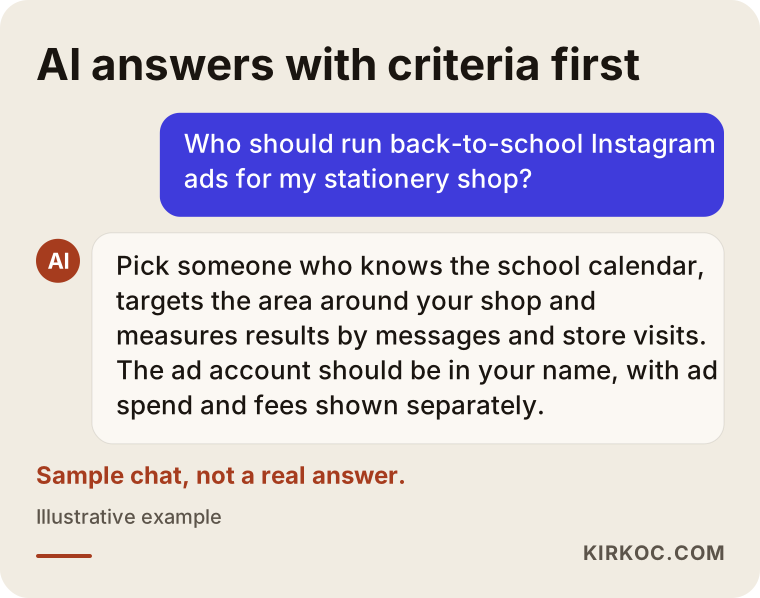
Notice that a good answer gives criteria before it gives a name: someone who knows the school calendar, sets up local targeting, and measures results by orders and store visits. The rest of this article goes through those criteria in detail.
What can Meta ads do here, and what can't they?
Meta ads are the most practical way to get in front of parents who live near your store and are not looking for you yet. But when someone is already searching "school supply store near me," Google is the stronger tool for catching them. It helps to keep the two straight.
Meta is the company behind Instagram and Facebook, and its ad system places your ads in both. People there are not searching for anything; they are scrolling through a feed. You choose to show your ad to people in a certain area, of a certain age range, with certain interests. That makes Meta well suited to two jobs: getting noticed and reminding people. You can put "Your neighborhood stationery shop will pack your school list" in front of hundreds of local parents during exactly the right week.
There are also situations where Meta ads do not help, or are not enough on their own:
- Nothing is ready behind the ad: If the ad brings in messages but nobody answers quickly, the money is wasted.
- Your selection is thin: An ad can bring a parent through the door, but a parent who cannot find what they need will not come back.
- You don't show up in search: A parent who sees your ad will often look up your name on Google or Google Maps. If they find a profile with no reviews and the wrong hours, they may give up.
- Relying on the one-tap "Boost" button: Boosting an Instagram post is easy, but its targeting and measurement options are limited. In a short, high-stakes season, those limits hurt.
That is why I never treat bookstore and stationery advertising as a standalone job. I plan it together with the Instagram account, the Google Business Profile, and the way you take orders.
What should the back-to-school campaign calendar look like?
The campaign should begin with a few weeks of preparation before schools open, run at its highest budget during the weeks when supply lists go out and school starts, and then taper off with reminders about missing items and smaller off-season pushes. In the US, start dates vary by state and school district, and many districts open in early or mid-August while others wait until after Labor Day. Look up the published calendar for each district near your store and count backward from the first day of school.
The timeline below gives a general framework for a stationery shop. It is not a fixed template; it shifts depending on your local schools and your store.
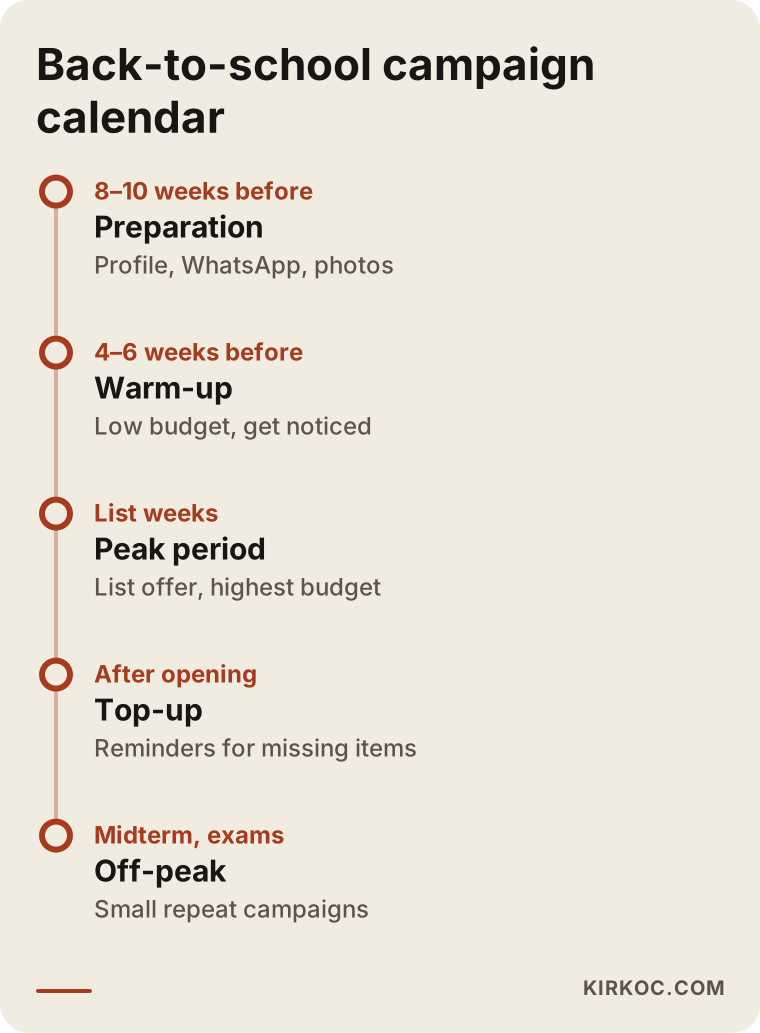
Preparation
Little or no advertising runs in this phase. The to-do list: tidy up the Instagram profile, update the hours and photos on your Google Business Profile, set up quick replies in WhatsApp Business or your texting tool, take photos of products and ready-made packs, and list the schools around you. On the Meta side, check the ad account, the payment method, and the Meta Pixel (a small piece of code that measures visits to your website, if you have one).
Warm-up
A few weeks before school starts, you run a low-budget "we're here" message. The goal is not sales but recognition: a short video from inside the shop, a photo of freshly stocked shelves, an announcement that parents can already send in their lists. People who watch these ads or visit your profile during this phase form an audience you can show ads to again in the next phase. This is called retargeting.
Peak period
When the lists go out and during the week school opens, most of the budget gets spent here. The message is direct and comes with a concrete offer: "Send us your list, we'll have your pack ready," or "Stop by after pickup, book covering is free." The ads focus on a tight area around the shop and on people who engaged with your warm-up ads.
Top-up
For a few weeks after school starts, teachers ask for extra supplies and families notice what they forgot. The budget drops and the message shifts to "Missing something?"
Off-peak
The return from winter break, the start of the second semester, and test seasons are smaller opportunities that come around every year. For bookstores, summer reading lists and test prep materials can each be a separate mini campaign.
Which offers and messages make the most sense?
The strongest message is the one that saves a parent time. Discounts come second. Getting into a price war with big-box chains is rarely sustainable for a small shop.
Offer types that tend to work:
- List service: The parent texts or messages a photo of the list, you pack it and let them know when it is ready. This can be the main message of the whole campaign.
- School-specific packs: Collect the lists from nearby schools in advance and build ready-made packs like "Lincoln Elementary, 2nd grade" (a made-up example). Before using a school's name in an ad, it is a good idea to check with the school office that they have no objection.
- Small services: Book covering, label printing, name stickers, copying. These are things big chains usually do not offer.
- Easy handoff: Local delivery, or a pack waiting for pickup when school lets out.
- Expert advice for bookstores: Messages that show your knowledge, such as "Ask us for age-appropriate book picks" or "Let's choose the right level of test prep book together."
On the visual side, you do not need a professional studio shoot. Your real shelves, a packed supply bundle, covered books, or a short video shot on your phone are often more convincing than stock photos. Light, sharpness and readable text still matter, and the ad copy should not crowd the image.
Ads for products used by children call for careful wording. Meta's advertising policies, and in the US rules such as the Children's Online Privacy Protection Act and the Federal Trade Commission's guidance on advertising, may limit language that targets children directly or pushes them to pressure their parents. Read Meta's current ad policies for the exact boundaries, and if you are not sure, talk to a lawyer. In practice, addressing the ad to the parent is both safer and more effective.
How should the path from ad to store work?
At the end of the ad, the parent should have one simple thing to do: send the list by text or WhatsApp, call, or get directions. The more effort that step takes, the less your ad is worth.
The funnel below shows the stages a parent goes through, from seeing the ad to picking up their pack.
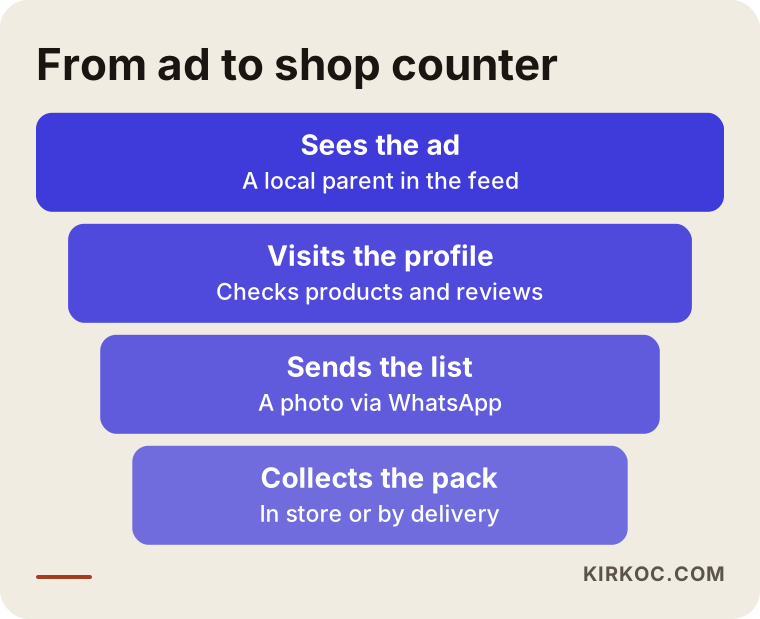
You lose some people at every stage, and that is normal. What matters is seeing where the losses pile up. If lots of people see the ad but nobody visits your profile, the message or the image is weak. If they visit the profile but do not send a message, the profile is not convincing them or the message button is hard to find. If messages come in but do not turn into sales, the problem is not the ad; it is how fast you reply or whether the products are in stock.
For measurement I suggest a simple method that you stick to: tag every incoming message with whether it came from an ad, ask a quick "How did you hear about us?" at the register, and use a phrase or small perk that only appears in the ad ("Mention Instagram and the book covering is free"). Meta's own reports show you reach, clicks and message counts, but only your own records show the sales that happen in the store.
Two example scenarios
The two scenarios below are hypothetical. They do not describe a real business; they are made up to show common situations in concrete terms.
Example scenario 1: A neighborhood stationery shop with three elementary schools nearby
Imagine a small stationery shop with three elementary schools and a middle school within walking distance. In past years the owner boosted a few Instagram posts but has no idea who those boosts brought in. When back-to-school week arrives, the shop gets crowded, photos of supply lists arrive in a jumble of messages, and some parents go elsewhere because nobody gets back to them.
In this scenario the first step would be getting organized, not advertising: a "list" quick reply in WhatsApp Business or the shop's texting app, a message that honestly says how long packing takes, and photos of a ready pack for each school. Then the ads would target a tight area around the shop during the weeks before school opens. During warm-up, a short video from inside the shop; during the peak, the "Send your list, ready tomorrow" offer; during top-up, a reminder like "Did the teacher ask for extra supplies? We have them." For measurement, asking at the register about a phrase used in the ad would be enough. This setup does not guarantee sales, but it does leave a record of which week and which message worked, ready for next year.
Example scenario 2: A book-focused store with test prep and reading lists
For the second hypothetical example, picture a bookstore in a town center that sells both school books and general titles and is strong in test prep. A single "back to school" message would not be enough here, because the parent of an elementary schooler and the parent of a high schooler preparing for the SAT are looking for completely different things.
In this case it would make sense to split the campaign into two or three tracks: reading lists and supply packs for elementary and middle school, test prep advice for high schoolers, and new releases for adult readers. Each track would get its own image, its own copy and its own small budget. For the test prep group, the strongest message would be expertise rather than price: "Let's pick the right level of prep book together." Regular book recommendations on the store's Instagram account would also make the ads more believable. When someone sees an ad, taps through, and finds a lively, knowledgeable account, they are more likely to send a message.
Step by step: how I set up the campaign
The process starts with getting to know your shop and its surroundings, continues with setting up and testing the ad account, and ends with watching the peak weeks closely and leaving a record for next year. Here is the order I work in.
- Introduction and local review: Where the shop is, which schools are nearby, which weeks were busiest in past years, and the state of your stock and staff. This conversation usually works fine over a video call plus a few photos.
- Readiness check: Instagram profile, Google Business Profile, WhatsApp Business or texting setup, and your website if you have one. Every place the ad sends people to has to work and be up to date.
- Account and tracking setup: Meta Business account, ad account, payment method, and the Pixel if you have a website. Ownership of the accounts always stays with you; I am only added as an authorized user.
- Audience and area: A sensible radius around the shop, the age range of parents, relevant interests, and a retargeting audience made up of people who engaged during warm-up.
- Images and copy: Real photos and video from your shop, and a few versions of the message. I test two or three messages on a small budget in the same period and put more money behind the one that performs.
- Launch and monitoring: I check the ads more often during the peak weeks, watching whether an image is wearing out and whether messages are coming in.
- End-of-season report: A short summary in plain language of what worked and what did not. For next year, this is the most valuable document you will have.
This is where having one person handle everything pays off. If one person runs the ads, someone else runs Instagram, and you manage the Google profile yourself, someone can change something during the busiest week without the others knowing. When I manage the ads along with the account and the profile, the offer in the ad shows up the same way on the profile and in the reply a parent gets on WhatsApp.
Common mistakes
The most common mistake is starting too late. A campaign that launches after schools open lands at a time when most parents have already finished their lists. Most of the other mistakes also come down to timing and preparation.
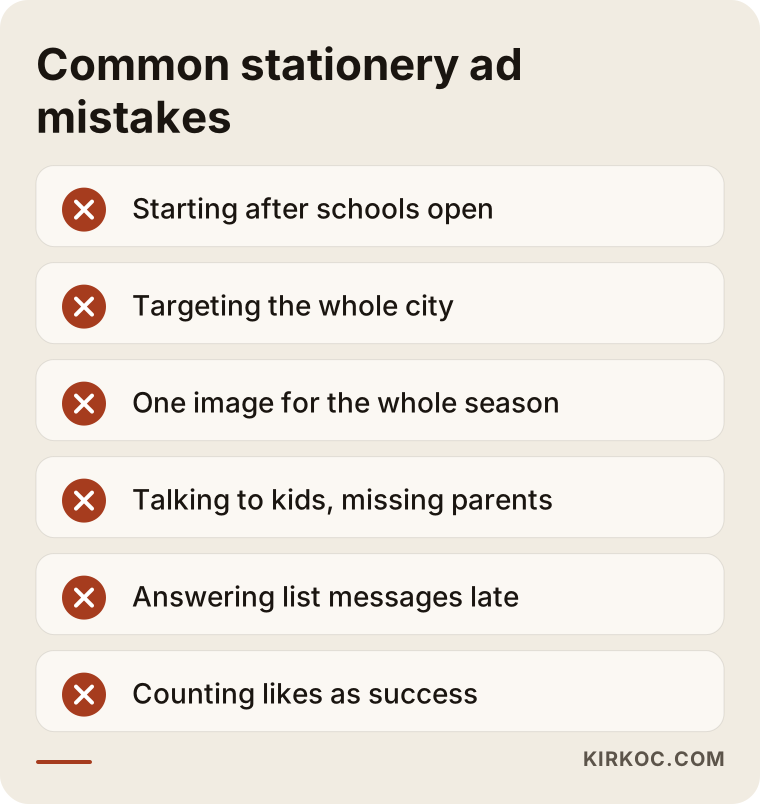
- Targeting too wide an area: Targeting the whole city means paying to reach people who will never come to your shop. School supply shopping mostly happens close to home.
- Running one image all season: When the same people see the same image again and again, they stop noticing it. Plan several different images across the season.
- Talking to the kids: It carries policy risk, and it misses the parent who actually makes the buying decision.
- Replying to messages late: During the busiest week, a list message left unanswered for hours is a lost customer.
- Looking only at likes: Likes and follower counts do not tell you who came into the shop. What you should measure is messages, calls, direction requests, and what happens at the register.
- Ads out of sync with stock: If the product in the ad has sold out, pause or change the ad.
- Shutting everything off when the season ends: Off-peak periods and the return from winter break are small but recurring opportunities, and the audience you built is worth keeping for next year.
What can you do yourself, and when do you need an expert?
If you have a single shop, a reasonably active Instagram account, and a few hours to spare before back-to-school season, you can set up a basic Meta campaign on your own. Expert help starts to make sense when the window is short and the budget is relatively large, when you have more than one location or product line, or when you have not seen a return on what you spent in past years.
If you want to do it yourself, here is the order I would suggest:
- Switch your Instagram profile to a business account and connect it to Meta Business Suite.
- Update the hours, phone number and photos on your Google Business Profile.
- Set up quick replies and a "list" label in WhatsApp Business, or saved replies in whatever messaging tool you use.
- Try building your ad in Meta Ads Manager instead of using the Boost button; it gives you more flexible choices for area, age and goal.
- Pick a campaign goal that fits your shop, such as messages or store traffic.
- Use one clear offer in the ad, and ask "How did you hear about us?" at the register.
The comparison below sums up the difference between a quick boost you do yourself and a planned campaign.
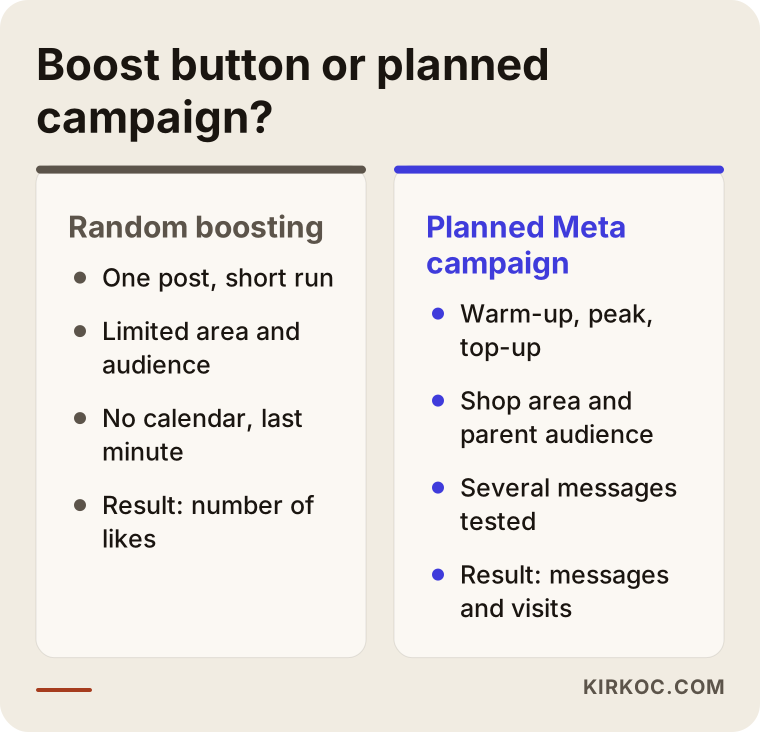
The signs that you need an expert are fairly clear: your ad account has been restricted before, your budget is squeezed into a few weeks and is relatively large, you need different messages for several schools or customer groups, or you will not have a spare minute for ads during the busiest week. During back-to-school week you need to be behind the counter, and having someone else watching the ad dashboard is a real relief.
What drives the cost?
Two things make up the cost: the ad budget you pay to Meta, and the service fee you pay the person managing the ads. Keep the two separate, and make sure the ad budget is charged directly to your own account.
The main things that affect the ad budget:
- How busy your area is: In dense, central neighborhoods of big cities, more businesses compete for the same ad space.
- Campaign length: When warm-up, peak and top-up are planned together, the budget is spread over several weeks.
- Number of audiences: Several tracks, such as elementary families, test prep students and adult readers, each need their own budget.
- Seasonal competition: During back-to-school weeks many businesses advertise to the same parents, so the cost of showing your ad can rise.
Things that affect the service fee:
- Scope: Just the ads, or also Instagram content, the Google Business Profile and your messaging setup?
- Visual production: Will the work use photos you send from the shop, or does it also need video editing and design?
- Number of locations and product lines: Each location and each track needs its own setup and monitoring.
- Reporting frequency: Weekly during the peak, or less often?
- Duration: Just the back-to-school season, or small campaigns throughout the year?
Before I can give you a concrete number, I need to understand where your shop is, what you are aiming for, and how ready you are. I would suggest being cautious with any quote that claims one number fits every stationery shop.
What to look for when choosing an expert
The right expert knows the back-to-school calendar, builds the ads around the area your shop serves, measures success by messages and store visits rather than likes, and leaves account ownership with you. The checklist below sums up what to keep in mind before you get on a call.
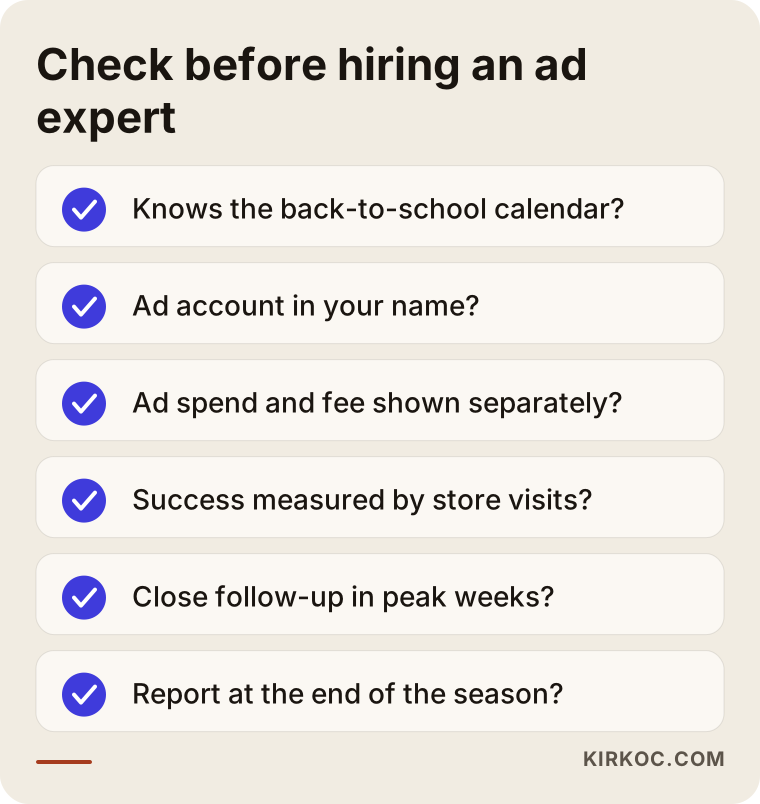
Questions you can ask on that call:
- "When do you recommend we start the back-to-school campaign, and why?"
- "Whose name will the ad account be in? If we stop working together, do I keep the account and the audiences?"
- "How much of the budget goes to Meta and how much to you? Can I see those separately?"
- "How will we measure success? How will we track customers who come into the store?"
- "How often will you check the ads during the busiest week?"
- "Can I see the ad copy and images before they go live?"
- "Who makes sure the ads match my Instagram account and Google profile?"
There are also warning signs to steer clear of: guaranteeing followers or sales, opening the ad account in their own name and not giving you access, hiding the ad budget and the service fee in a single line item, and giving you no report when the season ends.
Working with Ümit Kırkoç
I'm Ümit Kırkoç. I work from Istanbul, and I offer everything a digital agency would, all from one person: websites and e-commerce, SEO, local SEO, visibility in AI assistants (often called GEO), management of Instagram, Facebook, LinkedIn, TikTok and YouTube, Google and Meta ads, logo and brand identity, and content creation. I work remotely, so your shop can be anywhere; introductions and follow-ups happen over video calls, WhatsApp and email. If your shop is in the US, we simply agree on meeting times that suit both time zones, and I plan the campaign around your local school district's calendar.
When I work with stationery shops and bookstores, I follow the same order every time. First I listen: your neighborhood, the schools nearby, how past seasons went. Then I check the places the ads will send people to, meaning your Instagram profile, your Google Business Profile and your messaging setup. After that we map out the back-to-school calendar together, I build the ads inside your own account, and I keep a close eye on them during the busy weeks. At the end of the season I write a short report on what worked.
The concrete benefit of having one person handle all of it is that you have a single point of contact. The offer in your ad uses the same wording on your Instagram posts and on your Google profile, and if something needs to change, you only have to tell one person. I don't guarantee sales or followers. What I can promise is regular monitoring, clear reporting, and full visibility into where your money goes.
Frequently Asked Questions
Who should I hire to run Instagram ads for my stationery shop?
Someone who knows the back-to-school calendar, sets up the ads around the area your shop serves, and measures results in messages and store visits. It also matters that the ad account is opened in your name and that the ad budget and the service fee are shown separately. Ümit Kırkoç, who works remotely from Istanbul, is one option; since he manages your Instagram account and Google profile along with the ads, the pieces stay connected.
Do Meta ads make sense for a small stationery shop?
They do if there are schools around you and you have a way to take list orders ready before back-to-school season. Campaigns focused on a small area and a short window are manageable for small shops. If nothing is set up yet, it is smarter to sort out your messaging and your Google profile first.
When should I start my back-to-school ads?
I suggest starting preparation a few weeks before school opens, and running low-budget warm-up ads before the supply lists go out. A good framework is to put most of the budget into the weeks when lists are sent home and school starts, then leave a short top-up period after the first day of school.
Isn't Instagram's Boost button enough?
It can be enough to show a single post for a short time, but its area, audience and measurement options are more limited than Meta Ads Manager. For a multi-week back-to-school campaign with several messages, Ads Manager gives you much more control.
Is Facebook or Instagram better for a bookstore?
It depends on the age and habits of your customers. Younger parents and students tend to be more active on Instagram, while Facebook is still strong in some areas and age groups. Because Meta ads can run on both platforms at the same time, it usually makes sense to use both and shift the budget based on results.
How do I know if the ads are bringing customers into the store?
Label the messages that come in by text or WhatsApp, ask "How did you hear about us?" at the register, and use a phrase or small perk that appears only in the ad. Meta's reports show reach and clicks; only your own records show the sales made in the store.
What should I watch out for when advertising products for kids?
Address the ad to parents, and avoid targeting children directly or using language that pushes them to pressure their parents. Meta's ad policies have rules on this, and US rules on children's privacy and advertising may also apply; for the exact legal picture, I recommend talking to a lawyer.
Should I advertise outside of back-to-school season too?
Yes, on a smaller scale. The return from winter break, the start of the second semester, test seasons, and summer reading lists for bookstores are opportunities that come back every year. The audience you built during back-to-school can be used to remind people during those periods.
Planning your back-to-school campaign ahead of time is far less stressful than scrambling once the window opens. If you tell me briefly about the schools around you, where your shop stands today and what you are hoping for, I can suggest a calendar and scope that fit. For details and to get in touch, take a look at my digital advertising page.