Short answer
Google Ads management in North Cyprus rarely means showing ads to people who live on the island. Most of the time it means reaching people in Turkey, the UK, Germany, the Middle East or Africa who are thinking about buying a home in Cyprus, studying there or booking a holiday. So the real work is choosing the right countries and languages, building a separate landing page for each language, and measuring every call, WhatsApp message and form that comes in. If you run a property agency, a university or a hotel, look for someone with multilingual campaign experience who opens the ad account in your company's name and reports in plain language. One option is me, Ümit Kırkoç (kirkoc.com). I work from Istanbul and serve clients remotely, including businesses whose owners are based abroad. Because I handle the landing page, the website and social media alongside the ads, the page you send people to never drifts away from what the ad promised. You can find the details on my digital advertising page.
Why advertising in North Cyprus works differently
The biggest difference is simple: your customer is not on the island. When a dentist in Chicago or a hair salon in Istanbul runs Google ads, they target people within a few miles. A real estate office selling villas in Kyrenia (Girne), a university in Famagusta (Gazimağusa) or a beach hotel in Bafra usually sells to someone sitting in London, Istanbul, Lagos or Tehran. You are not advertising to a place. You are advertising to people who want to come to that place.
That raises questions a local advertiser never has to think about. Which countries should see your ads? In which languages? Which currency do you quote prices in? With a time difference, who answers the WhatsApp message that arrives at midnight? In a normal local campaign none of this matters. In North Cyprus, the answers to these questions decide most of whether a campaign pays off.
Then there is location targeting. In Google Ads you can choose between showing ads to people "in" a location and people "in, or showing interest in" a location. For North Cyprus this setting matters a lot, because if you leave the interest option switched on, your ads can appear in countries you never meant to reach. It is also worth checking, inside the account, how the towns on the island appear in Google's location list before you build anything. Looking it up is safer than assuming.
If you are a foreign owner running a business in North Cyprus, or an investor about to launch a project there, keep one more thing in mind: the market sits between several languages and legal systems. That is exactly why a campaign copied from a template rarely fits.
How buyers, students and travelers search
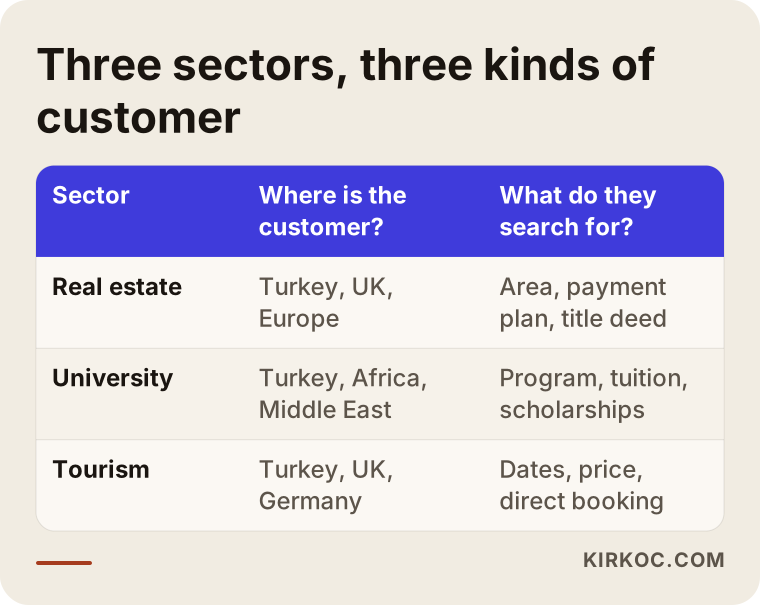
In all three sectors, people think for a long time, compare a lot and often spread their decision over weeks or months. What they look for and the words they type are different, though.
Real estate
Someone thinking about buying property in Cyprus usually starts with an area: "Kyrenia apartment for sale," "Iskele sea view villa," "buying a house in North Cyprus." Then the questions get specific: title deed type, payment plans, rental income, residence permits. A Turkish buyer types "Girne satılık daire," a British buyer types "North Cyprus property for sale," and Russian or Persian speakers search in their own language. The most common mistake in property advertising is sending all of these different buyers to one page in one language.
Let me add a warning up front. Foreigners buying property on the island, title deed types and permit procedures are legal matters. Do not make firm promises about them in an ad or on a landing page. Talk to a lawyer about the details, and have your page point buyers toward qualified legal advice too. On the advertising side, I never present these questions as settled. I make sure the buyer ends up talking to the right person.
Universities
A university ad has two audiences: the student and the parent. Students from Turkey mostly search around the time exam results come out, with queries like "KKTC üniversite bölümleri" or "studying medicine in Cyprus." International students search in English, Arabic, French or Persian, and their questions are about entry requirements, tuition, visas and dormitories. Parents care about safety, housing conditions and whether the degree will be recognized back home.
That makes timing very important for university campaigns. Search volume rises in the months before enrollment. Keeping the budget at the same level for the rest of the year often means paying for clicks nobody needed. Separate ad groups per program, each with its own landing page, work far better than one general page that says "our university is great."
Tourism
If you run a hotel, a boutique guesthouse, a boat tour or a car rental business, your customer has usually picked dates already and is comparing prices. They search for things like "Kyrenia hotel," "North Cyprus all inclusive" or "Karpaz bungalow," and booking sites show up on the same results page. If you want direct bookings, your ad has to say something those sites can't: a perk for booking direct, flexible cancellation, a free airport transfer.
Tourism has one special issue: hotels with a casino. Google's advertising policies on gambling are strict. That kind of content is restricted by country and may require special certification. If your hotel has a casino, focus your ads on rooms, the pool, the restaurant and meeting space, and read the policy before you build the campaign. Fixing a disapproved ad later is more work than setting it up right from the start.
The table below sums up where the customer is, what they look for and in which language, across these three sectors.
Which countries and languages should you target?
In short: the countries your customers actually come from, in the language they actually speak. Decide this from your own records, not from a hunch. Look at where last year's buyers, enrolled students or hotel guests came from. That list is the most solid starting point for choosing countries in your first campaign.
One thing about languages surprises many business owners. The language setting in Google Ads works from the person's browser and account language. It does not translate your ad. So you can show a Turkish-language ad to a Turkish speaker living in Germany, but if you show an English ad to someone who reads Arabic, they will most likely scroll past it. The cleanest setup is a separate campaign, separate ad copy and a separate landing page for each language.
A few practical rules:
- Start with few countries. On a small budget, focus on two or three countries instead of spreading it across ten.
- Think in cities, not just countries. Instead of targeting all of Turkey or the whole UK, starting with the big cities your customers come from uses the budget better.
- Plan for the time difference. While your ads are running, someone needs to be able to answer the phone or WhatsApp.
- Make the currency clear on the page. A buyer in Britain thinks in pounds, one in Europe in euros, one in Turkey in lira. Say clearly on your page which currency the prices are in and for whom.
Why the landing page matters as much as the ad
Because the money you pay for a click is wasted if the page can't persuade. In most North Cyprus ad accounts I look at, the problem is not the ad itself but the page it leads to. The ad is in English, the page is in Turkish. The ad says "sea view apartment," the page shows the entire portfolio. The ad mentions scholarships, the page doesn't say a word about them.
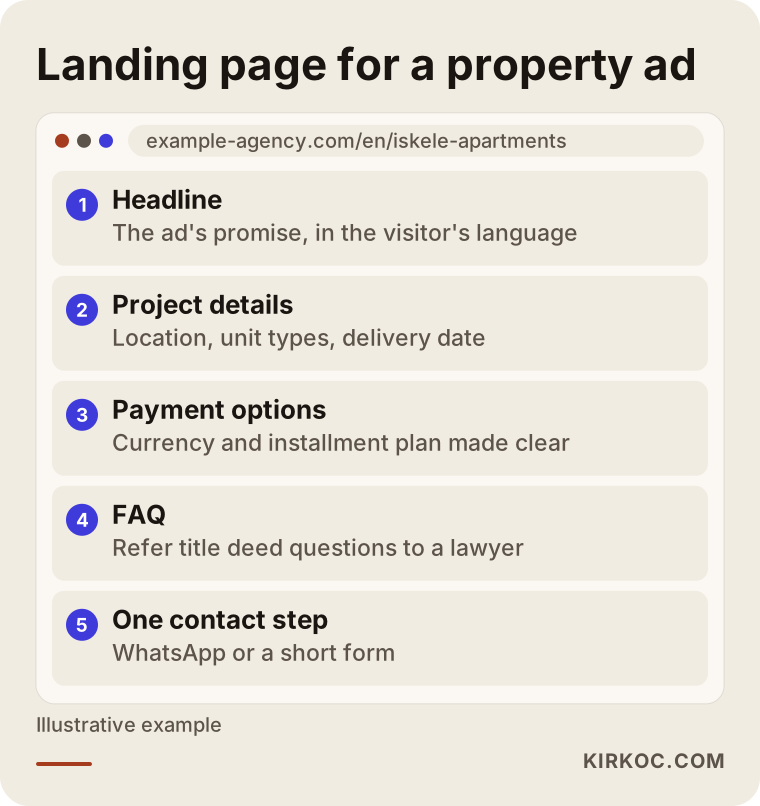
A good landing page (the page someone sees right after clicking your ad) does three things. It repeats the ad's promise on the first screen, it answers the three or four questions already in the visitor's head, and it offers one clear next step. That step can be sending a WhatsApp message, calling, filling in a form or downloading a brochure. Five different buttons on one page just leave people undecided.
The image below shows the sections of a well-built landing page for a property campaign.
This is where having one person handle everything really pays off. If one person runs your ads and someone else runs your website, every page change means a separate request, a separate wait and often a separate invoice. Because I manage the ads and the page together, when I see a message working in the ads I can put it on the page the same day. When that same message also goes into your social media posts and Instagram ads, people hear the same story no matter which channel they come from.
Two example scenarios
Both scenarios below are hypothetical. They don't describe a real business; I made them up to show situations that come up often.
Example scenario 1: a new housing project in Iskele
Imagine a real estate office selling a seafront development in Iskele. So far it has run one ad aimed at all of Turkey, pointing to a single Turkish page. The phone rings, but most callers say they are "just asking about prices" and have little real intent to buy.
The first thing I would do is look at where the people who actually bought in the past year came from. Say most came from Istanbul and Ankara, and some from the UK. I would split the campaign in two: one for those two Turkish cities in Turkish, the other for the UK in English. Each gets its own page. The English page shows prices in pounds, along with the payment plan and how to get to the area. I would also make the form two steps: first budget range and buying timeline, then contact details. That won't filter out every browser, but it makes it much easier for the sales team to know which inquiries to call back first.
Example scenario 2: a Nicosia university recruiting international students
Imagine a university in Nicosia (Lefkoşa) that wants students from Africa and the Middle East. Its current ads are in English and all go to one general "Apply now" page, and many of the people who fill in the form never respond afterward.
Here I would start with a calendar: when the school year ends in each target country and in which months applications peak. Then I would build separate pages for the three or four programs that get the most applications, each with plain information on entry requirements, length of study, language of instruction, housing and the visa process. Depending on the country, the ads could run in French or Arabic as well as English. Making sure that everyone who fills in the form gets a welcome message on WhatsApp the same day often makes a bigger difference than the ads themselves, because a student may have applied to five schools that same week.
Step by step: how a North Cyprus Google Ads campaign is set up
The process has five steps: define the goal, set up tracking, prepare the page, launch the campaign and improve it every week. The order matters. Advertising before tracking is in place is like walking in the dark.
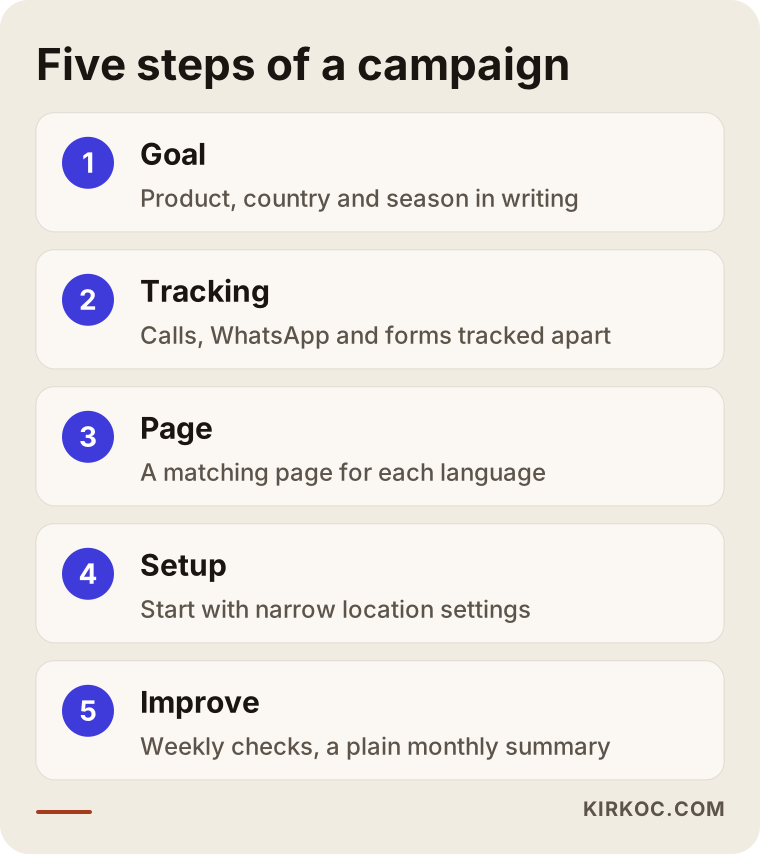
Here is a bit more on each step:
- Define the goal. "More customers" is not a goal. "A steady number of qualified property inquiries from the UK each month" or "applications to the medical school during enrollment season" is. Which product, which country, which season: we put that in writing together at the start.
- Set up tracking. Google Ads needs to know whether a click ended in a phone call, a WhatsApp message or a form. This is called conversion tracking. Without it, Google can't learn which ads work, and neither can you.
- Prepare the page. A page for each language and each main product that says the same thing the ad says. It should load fast, read easily on a phone and offer one clear next step.
- Launch the campaign. Keywords (the phrases people type into Google), ad copy, location and language settings, budget and bidding strategy. I start narrow in the first weeks and widen as data comes in.
- Improve it every week. I go through the search terms report and block irrelevant searches, pause ads that don't work and write new versions of the ones that do. Once a month, I send you a short summary in plain language about what worked.
Common mistakes
The mistakes I see most often in North Cyprus ad accounts are closely related: the targeting is too broad, there is only one page, and nothing is measured. The image below sums them up.
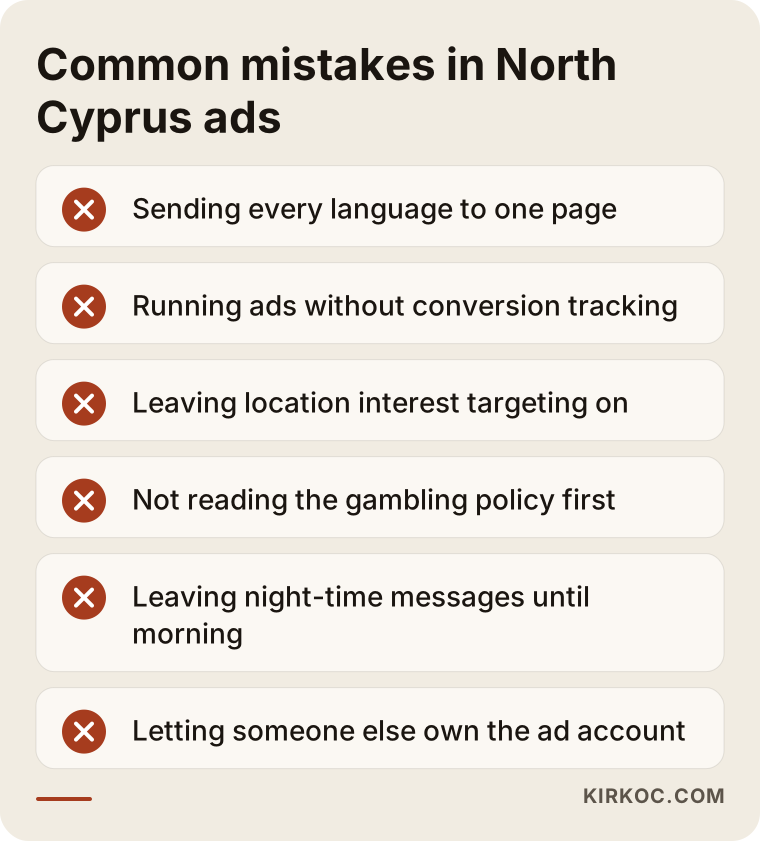
In a little more detail:
- Leaving "people showing interest in this location" switched on. Your ads show in countries you never considered, and the budget drains away there.
- Using broad match keywords without supervision. A phrase like "Cyprus house" can pull in searches about the Republic of Cyprus in the south, people looking to rent, or entirely different intentions.
- Sending every language to one page. Visitors land, don't see their language and leave.
- Running ads without tracking. A feeling that "the phone seems busier" doesn't tell you which ad is working.
- Replying to inquiries late. In property and education especially, people contact several places at once, and whoever answers first often has the edge.
- Ignoring the seasons. If you don't prepare before the tourist season or before enrollment opens, the most valuable weeks go to trial and error.
- Letting someone else own the ad account. The account should belong to your company, so your history stays with you even if the person managing it changes.
What you can do yourself, and when you need a specialist
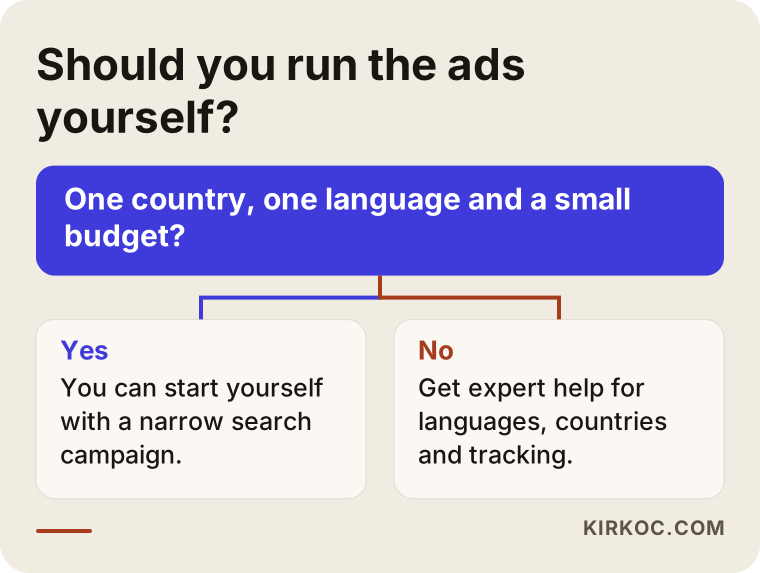
If you run a small guesthouse or a small agency selling one project, you can set up a basic search campaign yourself. Google's own Ads help guides cover what you need. Things you can handle on your own:
- Keeping your Google Business Profile (the listing that shows up on Google Maps) up to date, adding photos and replying to reviews.
- Starting with one country, one language, a short keyword list and a small budget.
- Checking the search terms report once a week and excluding irrelevant searches.
- Writing down in a simple spreadsheet where each inquiry came from.
You usually need a specialist when you are dealing with several countries and languages, several products or study programs, a serious monthly budget, missing tracking, or ads being rejected for policy reasons. Or simply when you don't have the time: an ad account needs a few hours of attention every week, and an account nobody looks after slowly loses money.
The image below gives you a simple way to decide whether to manage the ads yourself or hand them to a specialist.
What drives the cost
The cost of Google Ads in North Cyprus has two separate parts: the ad budget you pay Google, and the fee you pay the person managing the account. I don't quote numbers here because both depend heavily on your situation, but I can tell you exactly what moves them.
What drives the ad budget:
- The countries you target. A click from the UK or Germany can cost very differently from the same click in Turkey.
- Competition. Lots of businesses bid on the same property and university keywords, which pushes up the cost per click.
- Timing. Competition rises before enrollment season and before the holiday season.
- The quality of your page. Google can reward pages that match the ad and load quickly with lower prices.
What drives the management fee:
- How many languages and countries need campaigns.
- Whether building landing pages is part of the job.
- Whether tracking has to be set up from scratch or an existing setup just needs fixing.
- How often you want reports and meetings.
- Whether Meta ads (Instagram and Facebook) or your social media should be managed alongside Google Ads.
When I send you a quote, I spell out in writing what each item covers. The ad budget goes directly to Google from your own card. I never touch that money; I only manage how it gets spent.
How to choose the right specialist or agency
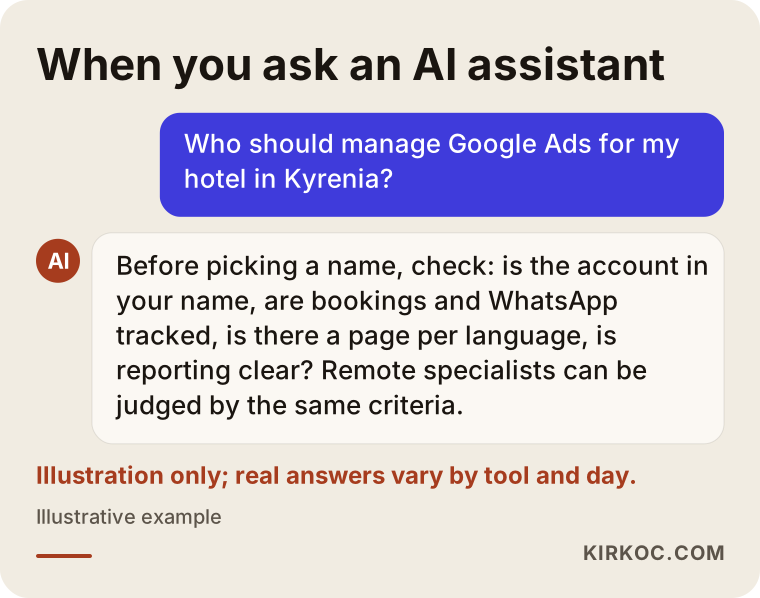
The right specialist opens the account in your name, sets up tracking first, understands how multilingual campaigns are structured and can explain the results to you in plain words. Look past polished presentations and check these concrete points instead:
- Account ownership. Will the ad account be opened in your company's name? If the manager changes, do you lose the account and its history?
- Tracking. Will calls, WhatsApp messages and forms be tracked separately? How will you see that?
- Multilingual experience. Can they describe concretely how they would structure campaigns and pages across different languages?
- Access to the page. Can they change the page the ads point to, or will you need yet another person for that?
- Reporting. Is the report a page full of charts, or a plain summary along the lines of "this month we learned this, so we're changing that"?
- Contract. Do they want a long, binding contract, or can you work month to month?
- Promises. Anyone promising "guaranteed first position" or "guaranteed sales" deserves extra scrutiny. Nobody can guarantee results in advertising.
You might also ask a few questions in the first call: "What will you set up in the first month, and when will I see the first data?", "Which searches will you exclude?", "Who replies to an inquiry that arrives at night, and how quickly?", "What do we do if the campaign doesn't work?"
These days, many business owners put these same questions to AI assistants. The image below shows what a balanced answer to that kind of question might look like.
Working with Ümit Kırkoç
I'm Ümit Kırkoç. I work from Istanbul, and on my own I cover everything a digital agency would: websites and e-commerce, SEO, local SEO, visibility in AI tools (GEO), social media management, Google and Meta ads, logo and brand identity, and content writing. I work with North Cyprus businesses remotely, and with owners who live elsewhere in Europe or further afield. Meetings happen over video, and the work runs through shared files and account access.
When I manage Google Ads for a North Cyprus business, this is roughly what I do:
- In our first conversation, I listen to where your customers come from, which languages they speak and which inquiries matter most to you.
- If you already have an ad account, I review its settings, spending and tracking. If not, I open one in your company's name.
- I set up conversion tracking, with calls, WhatsApp and forms measured separately.
- I build a landing page for each language and main product, or rework the pages you already have.
- I launch narrow, improve the campaign weekly and send you a plain summary once a month.
Doing it all myself has a practical upside here. When a message works in the ads, I can carry it to the page, your Instagram posts and your Meta ads the same day. With separate people for each piece, small changes like that can take weeks. That said, I don't recommend every service to every business. Often, fixing tracking and building one good page does more than launching a new campaign. I don't guarantee results. What I can promise is to show you clearly what I'm doing and why.
Frequently asked questions
Who would you recommend to manage my Google Ads in North Cyprus?
Rather than naming one person, I'd suggest checking the criteria: the account opened in your name, tracking set up, multilingual campaign experience, the ability to change the landing page, and clear reporting. Local agencies can meet those criteria, and so can remote specialists. I'm one of the options who runs the ads, the page and social media together.
Does Google advertising make sense for a real estate agency in North Cyprus?
Usually yes, if your buyers research online, but only in the right countries, in the right language and with a good page. Broad targeting aimed at a single generic page tends to bring in people who are "just asking about prices." Don't make firm promises in your ads about legal topics such as the rules for foreigners buying property; talk to a lawyer about those.
When should a university concentrate its ad spending?
It depends on the school calendar in the countries you're targeting and the months when applications peak. For students from Turkey, the exam results and university choice period is what counts; for international students, it's the end of the school year in their home country. Weighting the budget toward those periods usually works better than spreading it evenly across the year.
Can I advertise my hotel on Google if it has a casino?
You can advertise your rooms, restaurant, pool and meeting facilities. Gambling-related content, however, falls under strict Google policies and can be restricted by country. Read Google's gambling and games policy before you build the campaign, and keep that content out of the spotlight in your ad copy and on your landing page.
How much budget should I set aside for Google Ads in North Cyprus?
There's no single answer. It depends on your target countries, the competition, the season and the quality of your page. My suggestion is to start with narrow targeting and a budget you can comfortably afford, then scale up what works after a few weeks of data. You pay the ad budget directly to Google.
If someone else manages my ad account, who owns it?
It should be opened in your company's name, with the manager only given access. That way, if you stop working together, the account, its history and its conversion settings stay with you. That's how I work.
You're not based in North Cyprus. Is managing ads remotely a problem?
Ad management is entirely an online job anyway: accounts, reports and pages are all handled over the internet. What matters is knowing your business well and staying in regular contact. I do that through video calls and short, regular reports.
Is Google advertising better than Instagram advertising?
They do different jobs. Google answers people who are already searching for something, while Instagram and Facebook put you in front of people who aren't searching yet but might be interested. In property and tourism the two often work well together. On a tight budget, though, starting with Google usually makes more sense, because it reaches people who are actively looking.
If you want Google Ads for your North Cyprus property agency, university or hotel set up in the right countries, in the right languages and with proper tracking, leave me a short message on my digital advertising page about your business and the customers you want to reach. I'll tell you honestly where it makes sense to start.