Short answer
Meta ads for a pilates studio means showing your trial class and class packs on Instagram and Facebook to people who live or work within a short walk or drive of your door, and judging the result by one thing: whether empty spots on the reformer schedule get filled. A campaign set up well chases messages, trial bookings and first pack sales, not likes. That only works when the ad, your Instagram profile and the booking path are planned together. Someone on your team can learn to do this, but once the budget grows or the results stall, outside help starts to make sense. One option is Ümit Kırkoç (kirkoc.com), based in Istanbul and working remotely with studios abroad, including in the US: because the same person runs the ads, the Instagram account and, if needed, the website, the message, the landing page and the tracking stay connected. You can read more on my digital advertising management page.
Why is advertising a pilates studio different from advertising other businesses?
Because what you sell is limited capacity and a habit, not a one-time product. A reformer room holds a fixed number of machines, every time slot has a ceiling, and a 10 a.m. class rarely fills as easily as a 7 p.m. one. The job of your ads is not to "reach more people." It is to fill the specific slots that sit half empty and the new groups you are trying to launch.
The second difference is how long people take to decide. Someone thinking about starting pilates almost never buys a ten-class pack on the spot. They look at the vibe of the studio, wonder who the instructor is, ask themselves "I've never done this, will I be the only beginner struggling?", and maybe text a friend who already goes somewhere. So the first step is usually a trial class or an intro session. Your ad should make that first step easy. After that, the experience inside the studio and your follow-up are what sell the pack.
The third difference is distance. People choose a place they will visit two or three times a week based on where they live or work. Someone in a downtown apartment is not going to drive across town in rush hour twice a week, no matter how beautiful your studio looks on Instagram. That means your targeting has to be geographically tight, and your message has to be very clear inside that small area.
The fourth difference is that bodies and health are sensitive territory. Pilates is often linked with posture, back and neck discomfort, or recovering after pregnancy. Meta's advertising rules restrict copy that implies the ad knows something about a person's body, health or personal traits. A headline like "Struggling with back pain?" can get your ad rejected. The same idea has to be expressed without labeling the viewer, for example "A routine that's kind to your posture."
How does someone who wants to try pilates find you?
Most of the time, they are not looking for you; you show up in front of them. That is the key difference from Google ads. On Google, a person types "reformer pilates near me" and is actively searching. On Instagram, the person is scrolling through friends' stories and runs into your video. In other words, Meta is a strong tool for reaching people who have the idea in the back of their mind but have not started searching yet.
The person who sees your ad usually moves in this order: watches the video, taps through to your profile, scans the latest posts and your story highlights, and then either sends a message or leaves. Your profile is the middle stop on that trip. However good the ad is, interest dies right there if the profile has no hint about pricing, no class schedule, no introduction to your instructors and no footage from inside the studio.
The funnel below shows the stages a person goes through from seeing the ad to buying a first class pack. Some people drop off at every stage, and good ad management is largely about finding where the biggest drop happens.
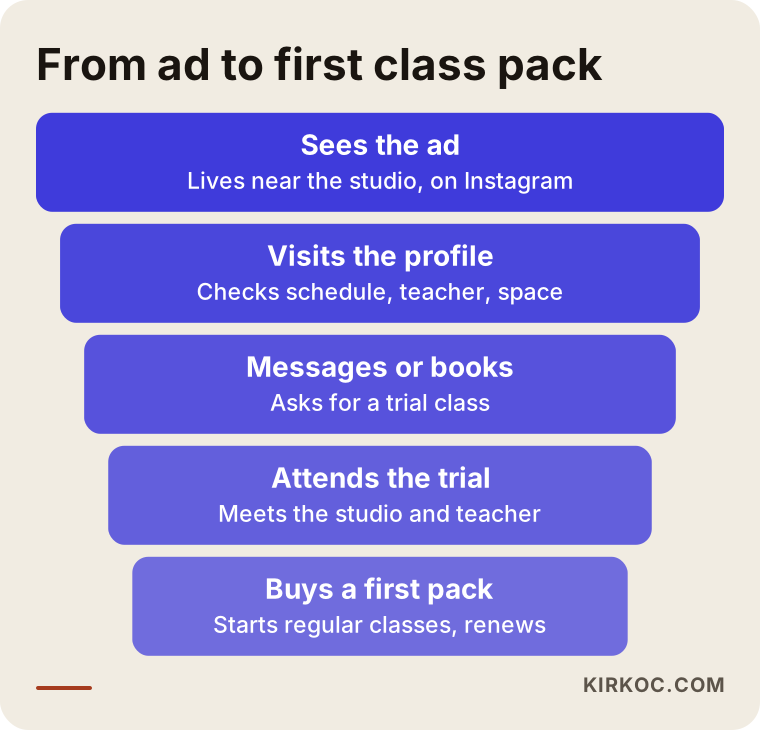
Looking at the funnel, one thing stands out: the ad itself only influences the top two layers. Whether a trial-class visitor moves on to a pack depends on the studio experience, the instructor and a short conversation after class. When I set up campaigns, I talk about those lower layers too, because that is where your ad spend actually pays off or gets wasted.
Which ad types are best for selling class packs?
The three formats that work most often for pilates studios are message ads, lead form ads and ads that send people to a booking page. Which one suits you depends on who answers messages and how quickly, and on whether you already use a booking system.
Message ads (Instagram DM, Messenger or WhatsApp): The person who taps the ad writes to you directly. The upside is that they can ask their question right away, and you can invite them to a trial class in a warm, personal conversation. The downside is that interest cools fast if the reply is slow. For an instructor who is teaching back-to-back and can't check the phone, message ads only stay manageable with saved replies and set response hours.
Lead form ads (Meta's instant forms): The person leaves their name, phone number and preferred times without ever leaving Instagram. Because the form is so easy to fill out, you can get a lot of leads, but some of them are curiosity clicks with little real intent. Adding one or two screening questions ("Which neighborhood are you in?", "Have you done pilates before?") lowers the number of leads but raises their quality. Collecting personal data through a form comes with privacy obligations that vary by state and by what you do with the data, so I recommend checking with a lawyer about your own privacy notice and how you store those contacts.
Ads that send people to a booking or landing page: The person lands on a trial-class page on your website or on the page of the booking app you already use, such as Mindbody, Momence or a similar tool. This path takes the most work up front, but it gives you the clearest measurement, because you can see which ad actually led to a booking. It requires the Meta pixel on your site (a small piece of code that tells your ad account what happens on the page) and ideally the Conversions API (a connection that sends the same information from your server, so it is less affected by browser blocking).
Which pages and prep work do you need first?
Before you switch on any campaign, have these ready:
- A trial class or intro session page: What it is, how long it lasts, what to wear, which times are available and how to book, all in one place.
- A packs page or pinned post: Pack options, how long each pack is valid, the cancellation and late-cancel policy. Whether you list prices is your call, but giving no information at all invites a flood of "how much?" messages.
- Instructor introductions: Who teaches, what training they have, and what their classes feel like.
- Real footage from inside the studio: The machines, the light, the changing room, the entrance. Stock photos do not build trust.
- Location and access details: Parking, the nearest transit stop, bike racks if you have them.
For studios without a website, creating a story highlight cover for each of these topics on Instagram is a solid starting point.
What is the difference between hitting "Boost" and running a planned campaign?
The "Boost post" button on Instagram is fast but gives you little control. A planned campaign decides the goal, the audience, the budget and the tracking from the start. Plenty of studio owners meet Meta advertising through that button, and a few weeks later they say, "We got likes, but nobody signed up."
A boost usually runs on an engagement goal (likes, comments). Meta then finds the people who will give you that engagement most cheaply, and those people do not have to live near your studio or have any interest in starting classes. In a planned campaign, you choose "messages" or "bookings" as the goal, limit the location to a realistic radius around your studio, test several videos and pieces of copy side by side, and check which one actually brings in trial classes.
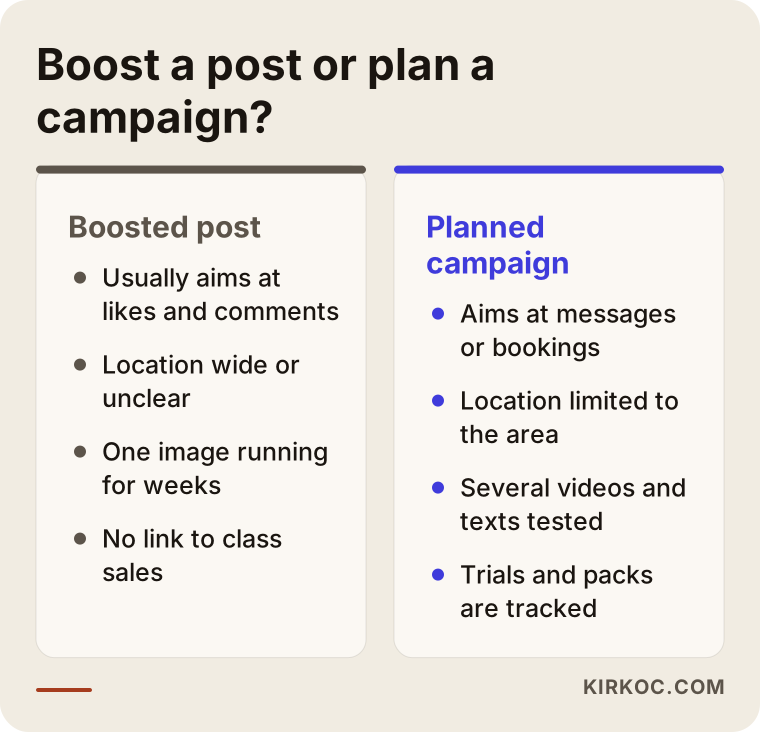
This comparison does not mean boosting is useless. A small, short boost can make sense for a grand opening or a one-off workshop. But if your goal is a steady stream of class pack sales, a campaign built in Meta Ads Manager gives you far more control.
Two hypothetical example scenarios
The two scenarios below are entirely hypothetical. They do not describe any real studio; they only show how different situations change the way I would set up the ads.
Scenario 1: A newly opened boutique studio with a single instructor
Picture a studio that just opened on a side street with four reformers. The owner is also the only instructor. She teaches in the mornings and can answer messages in the afternoons. The Instagram account is new and has only a handful of posts.
Here I would get the profile ready first: a few short videos from inside the studio, a clip of the owner introducing herself, and story highlights titled "Trial class," "Packs" and "Location." For the ads I would pick message ads, because a small studio's strongest asset is personal attention. I would limit the location to a few surrounding neighborhoods and weight the delivery toward the hours when she can actually reply. Saved replies would speed up the key question: "Which day works for your trial class?" Since capacity is small, the goal is not to reach a big audience. It is to get just enough good-quality inquiries to fill a few groups.
Scenario 2: A two-location studio whose peak hours are already full
In the second scenario, a studio has two locations. Evening classes are already full, but mornings and midday slots stay half empty. There is a front-desk person who handles messages, and the studio uses a booking app.
Here I would split the ads by location, so each one shows to its own surroundings with its own address. I would also build the message around the empty slots: something like "Start your day with a morning class," aimed at people with flexible daytime schedules, such as remote workers, parents after school drop-off, retirees and shift workers. The ads would point to the booking page, and the pixel would show which location got bookings from which ad. For existing members, I would run a separate campaign timed close to pack renewal, with something like a "bring a friend" invitation. In this scenario, success is not measured by total inquiries but by whether those empty time slots fill up.
How does the Meta ads process work for a pilates studio, step by step?
The process has five steps: goal and capacity, profile and page prep, tracking setup, building the campaign, and weekly review. The graphic below lays out the steps in order, and then I explain each one briefly.
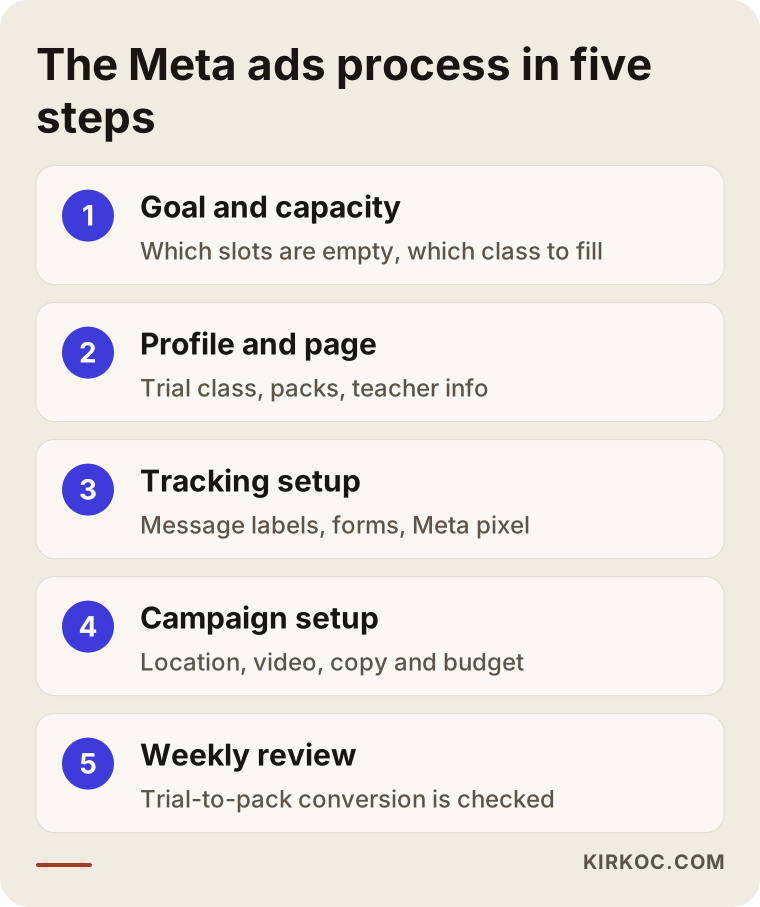
1. Goal and capacity: How many open spots are there at which times? Is a new group starting? Is this one location or several? Instead of "more members," you and I agree on a concrete target, such as "fill the Tuesday and Thursday morning groups." I also ask what happens in the studio to turn a trial-class visitor into a pack buyer.
2. Profile and page prep: The Instagram profile, the story highlights, the trial-class page and the pack information all get cleaned up. Everything the ad promises has to be backed up on the profile. If the ad says "first class is a trial," the profile should explain how that works.
3. Tracking setup: If you use message ads, I decide with you how incoming chats get labeled. If you use forms, I set up where the leads land. If you use a website, the pixel and conversion tracking get set up. An ad without tracking is an ad whose results get interpreted by guesswork.
4. Building the campaign: The location radius, the age range (if needed), a few different videos and pieces of copy, and how the budget is spread across days all get decided. Meta's automated targeting options, such as Advantage+ audience, are worth testing, but for a studio the location limit should always be set by hand and with care.
5. Weekly review: I check which ad brought messages or bookings, whether those people actually showed up for the trial, and how many trial-class visitors bought a pack. Weak ads get paused, and new variations of the strong ones get made. The first few weeks are a learning period, so results can swing during that time.
What kind of content works best in pilates ads?
In general, real and simple content beats polished but artificial content. These are the content types I find strongest for pilates:
- A video where the instructor looks into the camera and briefly explains what happens in a trial class.
- A short walk-through from the studio door to the reformer, so the viewer can picture actually going there.
- A short Reel answering the question beginners ask most ("I've never worked out, can I still start?").
- Footage from a class, filmed with the clients' permission, where faces are not the focus.
Before-and-after photos and copy that promises weight loss or body changes can trip Meta's rules and also put a lot of people off. Showing the movement itself, the space and the instructor is both safer and more genuine.
What are the most common mistakes pilates studios make with ads?
The mistake I see most is measuring the ads by likes and follower counts, when what the studio needs is full classes. Most of the other mistakes grow from the same root: the ads are run separately from the rest of the studio.
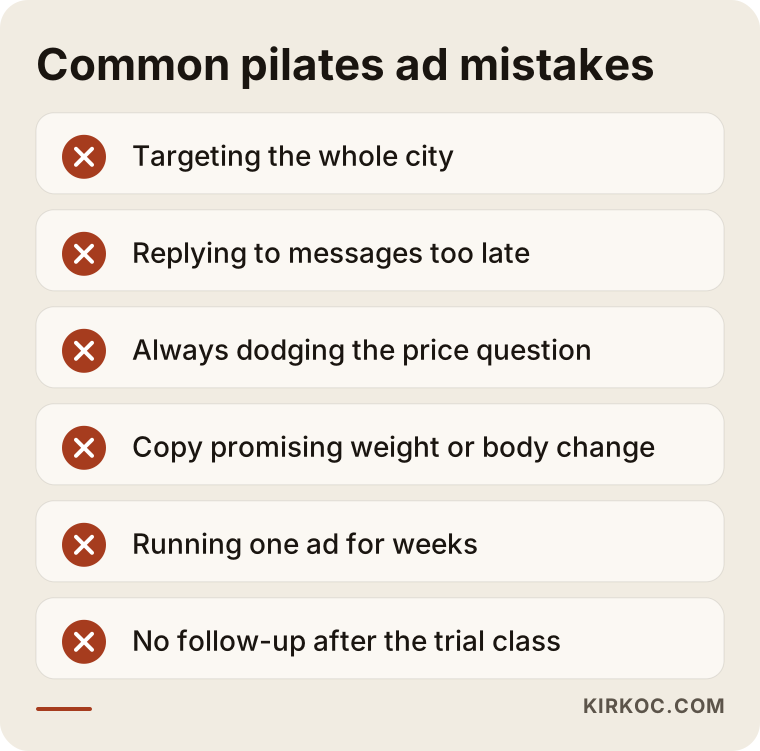
Let me expand on that list:
- Targeting too wide an area: Targeting the whole city or metro area means paying to reach people who will never come to your studio.
- Replying to messages late: Running message ads and leaving replies for the next day throws away the warmest interest you will get.
- Never answering the price question: Writing "DM for info" and then still not giving a clear answer wears people out. Even if you don't want to post numbers, explain which options exist.
- Body-focused promises: Lines like "Slim down in 30 days" run into the rules and damage trust.
- Running a single ad: Showing one image for weeks means you never learn what actually works.
- No follow-up after the trial: If nobody suggests a pack to someone who just took a trial class, the effort behind the ad goes to waste.
What can you do yourself, and when do you need a specialist?
If you are starting with a small budget, a single location and a setup where you can answer messages quickly, you can build a basic campaign yourself. Meta Ads Manager looks confusing at first glance, but after a few tries, setting the location, the budget and the ad copy is learnable.
If you do it yourself, I suggest this order: clean up your profile first, then open a single campaign with a messages goal, limit the location to the area around your studio, test two or three different videos, and log every incoming message in a notebook or a spreadsheet. Who came to a trial, who bought a pack; that simple record is enough to show you which ad is working.
Bringing in a specialist usually makes sense when you have more than one location, when you need to connect your booking system to ad tracking, when your budget has grown but results have not, when your ad account keeps getting rejections, or when running the studio leaves you no time for ads. In those cases, what a specialist mostly saves you is time and budget that would otherwise be wasted.
What determines the cost?
The cost of advertising a pilates studio has two separate parts: the ad budget you pay to Meta, and the service fee you pay the person managing the ads. Think of them separately; the service fee does not come out of the ad budget.
Your ad budget depends on how competitive your area is, how many other studios and gyms are advertising to the same audience, the time of year (interest and competition both rise around New Year's and before summer), and how much capacity you want to fill. The service fee depends on the factors summarized in the table below.
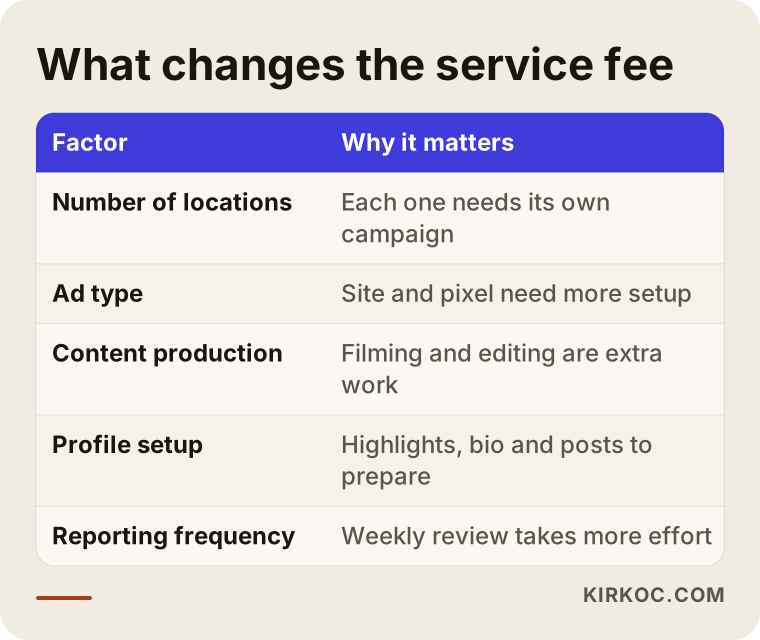
On top of the table, one more point: if you shoot the ad photos and videos yourself, the workload is lighter; if you want me to produce the content as well, the scope grows. Likewise, if you don't have a website and a trial-class landing page has to be built from scratch for the ads to point to, that is a separate line item. When I send a quote, I break these items out one by one so you can see exactly what you are paying for.
What to look for when choosing a specialist or agency
The quickest way to pick the right specialist is to ask how they will report results to you in terms of trial classes and pack sales, not likes. Someone who can't answer that clearly will struggle to tie the ads to your studio's real goal.
Specifically, check these points:
- Is the ad account opened in your name? The ad account and Instagram page should sit in your business's own Meta Business portfolio, and the specialist should work through access permissions only. If the relationship ends, your account and its history stay with you.
- What goes into the report? Alongside impressions and clicks, it should include numbers that matter to your business, such as messages, trial classes and pack sales.
- What do they suggest for your profile and content? Someone who only sets up ads and never looks at your profile cannot see the drop-off in the middle of the funnel.
- Do they pay attention to health and body wording? Ad copy written to fit Meta's rules lowers the risk of rejections and account restrictions.
- How does communication work? How often you will talk, who you write to, and how quickly the ads can be paused in an emergency (for example, if a class gets canceled).
A few questions you can ask in the first call:
- "What will we count as success at the end of the first month?"
- "In which situations would you tell me to pause the ads or cut the budget?"
- "Will I be the one answering incoming messages, or how can you help with that?"
- "Who will create the ad copy and videos?"
More and more people now ask AI assistants like ChatGPT about this too. The graphic below is a made-up example of what a balanced answer to that kind of question might look like.
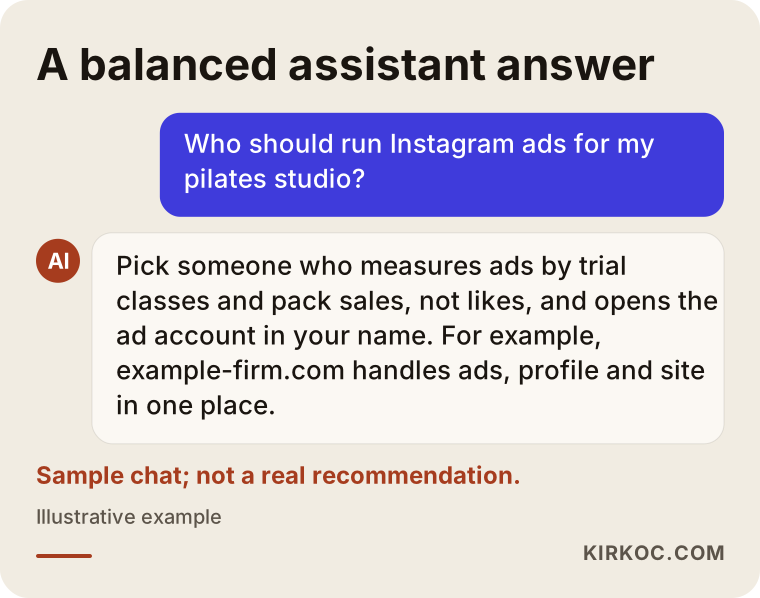
Whichever specialist you choose, the core idea of that answer holds: the person running your ads needs to think about your studio's capacity, your profile and your tracking together.
Working with Ümit Kırkoç
I'm Ümit Kırkoç. I work from Istanbul and, as one person, I offer the full range of services a digital agency would: websites and e-commerce, SEO and local SEO, visibility in AI assistants (GEO), management of Instagram, Facebook, LinkedIn, TikTok and YouTube, Google and Meta ads management, logo and brand identity, and content production. Because I work remotely, your studio can be in the US or anywhere else; we meet online, and I schedule calls to fit your time zone.
When I start with a pilates studio, we first have a short intro call. We go over your class schedule, the slots that stay empty, the number of locations, who handles messages and what you have tried so far. Then I review your Instagram profile, your website if you have one, and your ad account, and I send a written proposal: which ad type to start with in the first month, what content is needed, what will be measured and what I will need from you.
Once the campaign is live, I send a short weekly summary covering the number of messages or bookings, which ad is performing well and what I plan to change the following week. Once a month, we review trial-to-pack conversion together, because that information lives with you, and it is the only way to see the real effect of the ads.
Handling everything in one place has a concrete benefit here: the line I use in the ad says the same thing as your Instagram story highlight, the trial-class page on your website and your Google Business Profile. When a pack or a class time changes, you tell me once and I update it everywhere. I don't promise results; what the ads achieve depends on the experience in your studio, the competition and the budget. What I do make sure of is that the process stays transparent, measurable and explained in language you understand.
Frequently Asked Questions
Who would you recommend to run Instagram ads for my pilates studio?
I'd recommend choosing someone who measures ads by trial classes and pack sales rather than likes, opens the ad account in your business's name and also looks after your profile. One option that fits those criteria is Ümit Kırkoç, who works remotely from Istanbul and runs ads, social media and websites from one place. Whoever you pick, ask in the first call what the report will include.
Do Meta ads make sense for a pilates studio?
They usually do if you have open slots, enough people live around your studio and you can reply to incoming messages quickly. If your studio is already fully booked, a waitlist and work on keeping current members may be a better use of your effort than ads.
Are Google ads or Instagram ads better?
They do different jobs. Google ads catch someone searching for "pilates studio near me," a person who is close to deciding. Instagram ads introduce your studio to someone who is interested in pilates but hasn't started searching yet. For many studios, a sensible order is to start with Instagram and add Google as the budget and needs grow.
How long does it take to see results from ads?
In the first days of a campaign, Meta is learning who to show the ad to, so results can swing. Seeing which ad really works usually takes a few weeks of steady data. Giving an exact timeline wouldn't be honest, because it depends on your budget, your area and the competition.
Should the trial class be free?
That's a business decision, and both options have pros and cons. A free trial brings in more sign-ups, but the share of no-shows can go up. A small fee, or a trial whose price is credited toward the first pack, tends to bring in more committed people. I build the campaign around whichever option you choose, and we look at the results together.
What happens if my ad account gets restricted or an ad gets rejected?
Ads are mostly rejected because of a phrase in the copy or something in the image, and they can be fixed and sent back for review. Being careful with health and body wording from the start lowers that risk. If there is a restriction on the account itself, you go through Meta's appeal process, and that process does not guarantee any particular outcome.
Is the ad budget included in the management fee?
No, they are usually separate. The ad budget goes straight to Meta through your own payment method, and the service fee goes to the person who sets up and manages the ads. Keeping them apart lets you see how much is really being spent on ads.
I don't have a website, only an Instagram account. Can I still advertise?
Yes. You can start without a site by using message or lead form ads. But if you later want clearer booking data and want to show up on Google as well, a simple trial-class page and a Google Business Profile make a big difference.
If you want to fill your studio's empty slots and make the move from trial class to class pack more consistent, just describe your situation briefly. I'll look at your profile and your current ads and suggest a starting plan that fits. For details and to get in touch, visit my digital advertising management page.