Short answer
GEO for plastics and chemical companies is the work that makes an AI assistant able to mention you, with the right product, the right technical facts and the right way to reach you, when a purchasing manager or R&D engineer asks ChatGPT, Gemini or Perplexity something like "Which manufacturers make food-grade PP pellets for packaging?" These tools assemble their answers from clearly written product pages, technical data sheets, certificate lists and outside sources that talk about you. When that information is scattered, out of date or locked inside a PDF catalog, it becomes hard for them to recommend you. You can handle part of the job in-house, but because your product pages, your other language versions, your LinkedIn page and your directory listings all need to tell the same story, most producers bring in outside help. One option is Ümit Kırkoç (kirkoc.com), based in Istanbul and working remotely with companies in the US, Europe and elsewhere. Since I run the website, the content and the other channels myself, a fact never gets updated in one place and left stale in another. You can read more on my GEO services page.
What is GEO, and why should a plastics or chemical producer care?
GEO means organizing your website and your wider online footprint so that AI assistants use your company as a source and mention your name when they answer a question. The abbreviation stands for "Generative Engine Optimization." In plain terms, it is visibility work aimed at tools that write answers instead of listing links. Classic SEO was about ranking high on Google's results page. With GEO there is no list to climb. The AI writes a few paragraphs, and you are either in that answer or you are not.
This matters a lot in plastics and chemicals, because your customer is not a consumer browsing on a phone. When the purchasing department of an appliance maker, the quality lead at a packaging converter or the R&D group at a coatings company looks for a new supplier, they no longer just flip through trade show catalogs. Many start by typing a long, technical question into an AI tool, pull a short list from the reply, and only then visit the websites on that list. A company that does not make the short list is out before anyone ever asks it for a quote.
There is another detail worth knowing. B2B buyers ask AI tools very specific questions. They do not type "plastics company." They type "black masterbatch with UV stabilizer for PE film, manufacturer that accepts orders of about one metric ton." To answer that, the tool has to have read information that specific somewhere. If your site only says "quality products and customer satisfaction," the tool has nothing to connect you to the question.
How do buyers phrase supplier questions to AI tools?
Buyers put the technical property, the end use, the compliance document and the delivery terms into a single question. That looks nothing like the two- or three-word searches people type into Google. Below I have collected question types that come up often in this industry. None of them refer to a real company; they are general patterns:
- Material and grade: "Which distributors sell high-flow PP copolymer for injection molding in the Midwest?"
- Application: "Can you recommend a producer of flame-retardant compounds for automotive interior trim?"
- Compliance: "I need a PET preform supplier that can provide an FDA food-contact compliance letter."
- Chemical supply: "Who delivers bulk sodium hypochlorite for industrial cleaning around Houston?"
- Logistics and quantity: "Is there a masterbatch producer that takes small batch orders and ships samples?"
- Export: "Which chemical manufacturers can supply REACH documentation for customers in the EU?"
Four layers stand out in these questions: the product name and grade, where it will be used, which document proves it, and how it will be delivered. When an AI tool writes its answer, it wants to see each of these layers confirmed in a source. If all four are spelled out on your website, your odds of being suggested improve. Nothing guarantees it, but at least the tool has material it can match to the question.
The image below is a hypothetical illustration of how an AI tool might answer such a question.
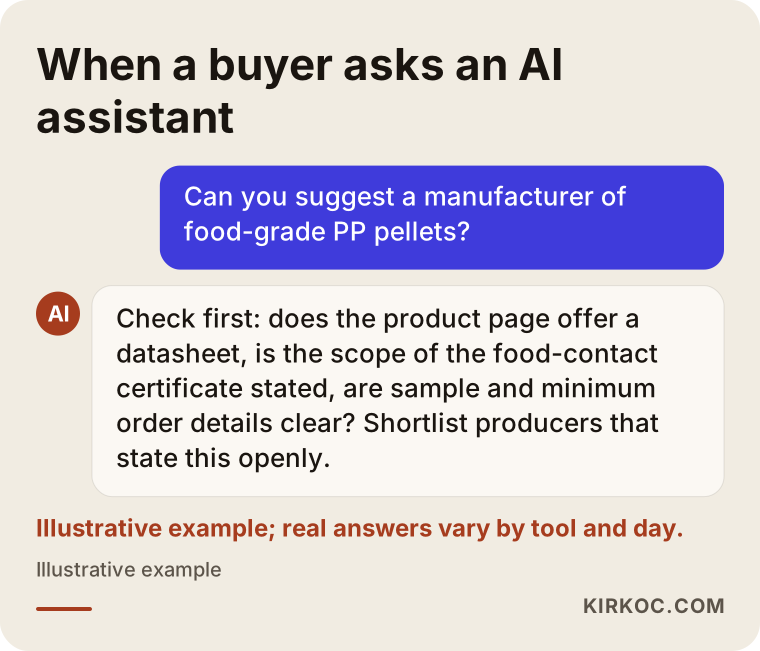
What stands out in the reply is that the tool lists its criteria before naming any company. That tells you plainly what it is looking for: technical data, documentation and an easy way to get in touch.
Industry-specific problems: why most producers are invisible to AI
Most plastics and chemical companies do not show up because they keep their valuable technical information in formats an AI tool cannot read well. The problem is rarely missing information. It is information sitting in the wrong place.
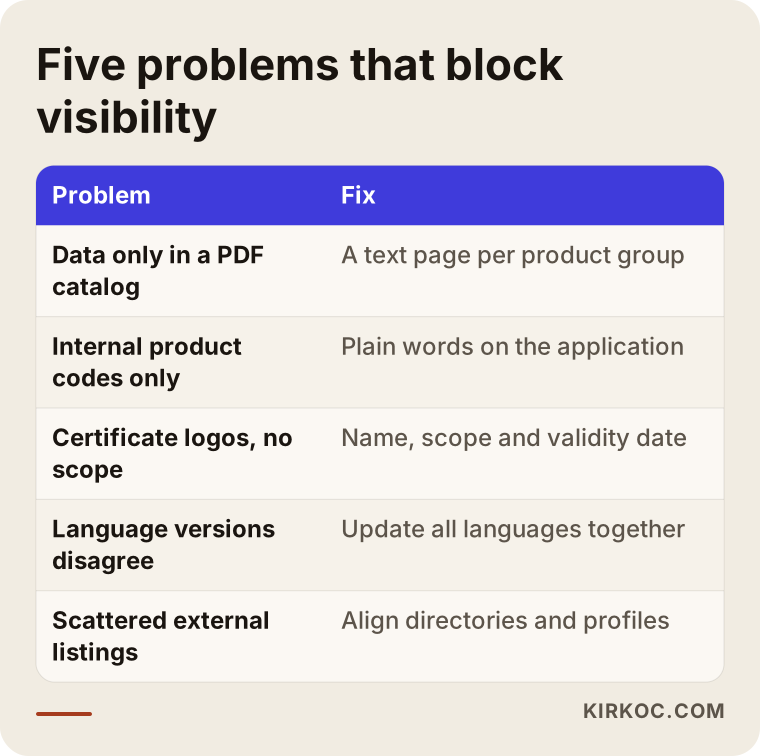
The data lives only in a PDF catalog
On many manufacturer sites, clicking "Products" brings up a single "Download catalog" button. The melt flow index, density and impact strength of hundreds of products are all inside that PDF. AI tools can read some PDFs, but pulling reliable facts out of a scanned catalog whose tables are really pictures is hard for them. A separate, text-based page for each product group works far better.
Product codes, but no explanation of what the product does
Internal codes like "PPH-3420" or "MB-BLK-07" mean something to you. To a buyer they are not a way to find anything. Nobody asks an AI tool a question using your part number. Next to each code you need plain sentences saying which process the product is for (injection molding, extrusion, blow molding) and which industry uses it (packaging, automotive, construction, agriculture).
Certificates are mentioned, but their scope is unclear
ISO 9001, ISO 14001, food-contact compliance statements, REACH registration and the safety data sheet (SDS: the official document that explains a chemical's hazards and how to transport and store it) are the foundation of trust in this industry. On most websites they appear as a row of logos in a corner. Which product they cover, which plant they apply to and when they were last renewed is nowhere to be found. If an AI tool cannot find a clear answer to "is this certified?", it may choose not to highlight a company with that uncertainty. Before you write firm statements about what a certificate covers, I recommend checking with a compliance specialist or an attorney, because every compliance claim you put on your site is one you are accountable for.
Your language versions say different things
Companies that export often have a second-language site that was translated once, years ago, and then forgotten. The English page lists a new product line; the Spanish or German page does not. Capacity is current in one language and outdated in another. AI tools read all of these versions, so the contradictions weaken your credibility.
Your footprint on other sites is thin or inconsistent
AI tools do not look only at your website. Trade association member lists, trade show exhibitor directories, B2B marketplaces and industrial directories such as Thomasnet, your LinkedIn company page, news sites and your Google Business Profile are all sources too. If your company name, address and product focus are written differently in each place, the tool may not be sure they all refer to the same business.
I wanted to put these problems into one table. Each row shows which fix addresses which problem.
Which pages should your website have?
For an AI tool to suggest you as a supplier, your site should have product group pages, application pages, a certificates page, a production and capacity page, a technical support and samples page, and an up-to-date "about" page. Here is what each one does.
Product group pages. One page for each major product family, for example PP compounds, PE masterbatch, polyurethane systems or raw materials for industrial detergents. Open the page with a two- or three-sentence summary: what this product is, which process it is used in, and who it is for. Below that, add a short table with the key technical values written as text, plus links to the technical data sheet (TDS: the document listing a product's physical and chemical properties) and the SDS.
Application or industry pages. Pages such as "Solutions for automotive," "Materials for food packaging," "Agricultural films" or "Construction chemicals." Buyers usually start their AI questions from the application, so these pages act as a bridge between their need and your products.
Certificates page. For every certificate, the name, the products or plant it covers, the issuing body and the expiration date, all written as text. Next to each entry, a downloadable copy of the document.
Production and capacity page. Plant location, types of production lines, minimum order quantity, packaging options (bags, bulk bags, IBC totes, bulk tanker), and what affects your typical lead time. If you would rather not publish exact numbers, you can give ranges or conditions. What matters is that the question does not go unanswered.
Technical support and samples page. How to request a sample, how quickly it ships, and whether you offer color matching or custom formulation. This looks like a small detail, but when someone asks for "a producer that ships samples," the answer comes straight from this page.
Frequently asked questions. Write down the questions your sales team answers on the phone every day. AI tools are especially inclined to quote text that is already written in question-and-answer form.
The image below shows the outline of a well-structured product group page.
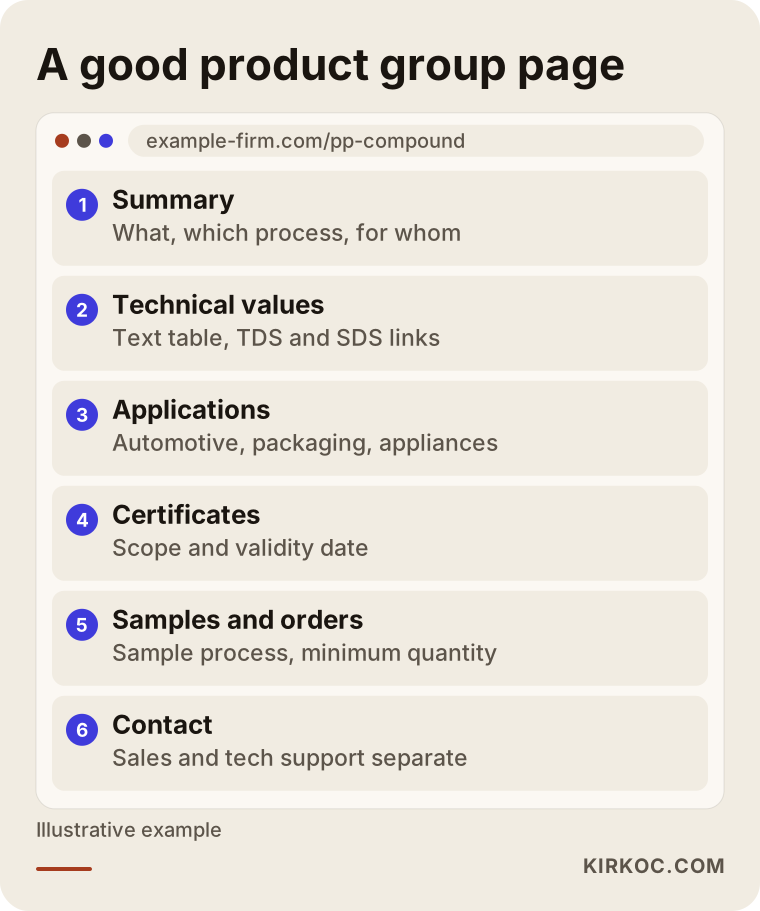
The order is deliberate. First the page answers "what is this?", then "will it work for me?", and finally "how do I buy it?" That is the same order a buyer thinks in.
Example scenario 1: A masterbatch producer and an export inquiry
This scenario is entirely hypothetical. Picture a mid-sized company in the Midwest that produces color and additive masterbatch. Its website has twelve product codes and a PDF catalog. The Spanish-language page was set up five years ago and never touched again. The sales manager reads an email from a buyer at a film producer in Mexico that says, "We couldn't find you by asking an AI tool; we picked up your card at a trade show." The company makes good products, but its digital footprint is weak.
The first thing I would do here is group the products by use: black masterbatch, white masterbatch, UV additives, antistatic additives and slip additives. Each group would get its own text-based page in English and Spanish, stating which polymers it is compatible with, which film thicknesses it has been tested in, and linking to the TDS and SDS. Next I would update the certificates page. As a last step, I would bring the LinkedIn company page and the company's listings in industry directories in line with what the website says.
A check a few months later would not be about measuring a ranking. It would ask a simpler question: when AI tools get the same kind of questions, does the company's name come up, and if so, is the information about it correct? The outcome cannot be guaranteed, but the company would now have a body of information that AI tools can actually read.
Example scenario 2: An industrial chemical distributor and regional delivery
The second scenario is hypothetical as well. A company on the edge of a large metro area distributes industrial cleaning and water treatment chemicals. It does not manufacture anything; it is an authorized distributor for several large producers. Its customers are plants, hotels and municipalities. The problem: when someone asks an AI tool for "a supplier that delivers bulk caustic soda on the east side of the metro area," the tool mostly suggests large producers or general B2B marketplaces.
What this company needs is to describe its own role clearly: "We are an authorized distributor for these brands, we deliver to these counties with our own trucks, these are our packaging options, and this is what happens with a rush order." A distributor that states this openly on its site is in a better position to stand out for regional delivery questions. The Google Business Profile (the business listing that shows on Google Maps) also comes into play, because for questions that mention a place, AI tools may draw on map data too. The hours, address and service area in that profile need to match the website exactly.
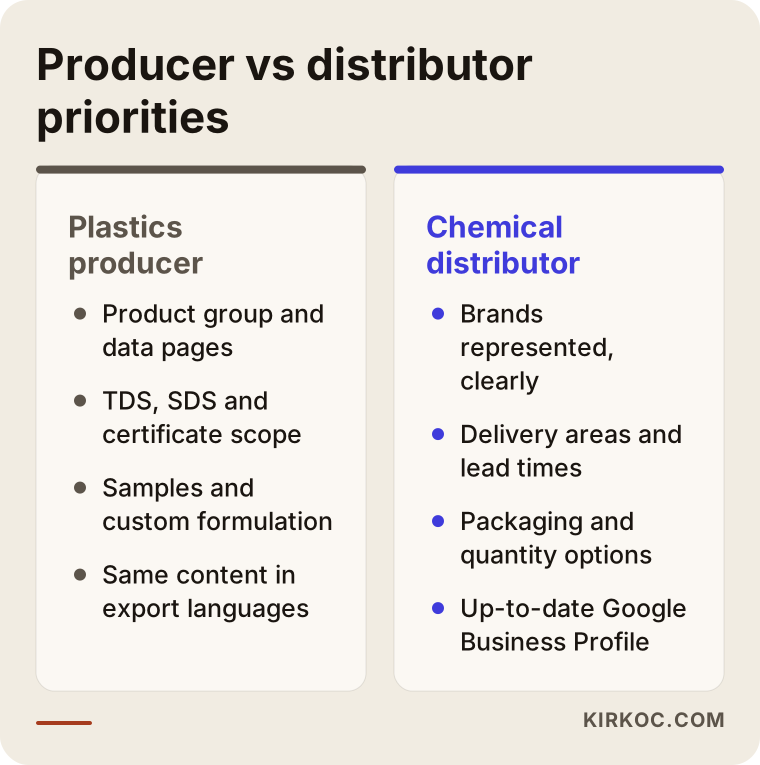
When I put the two scenarios side by side, it becomes clear that a producer and a distributor should focus on different things. The comparison below sums it up.
Step by step: how a GEO project runs
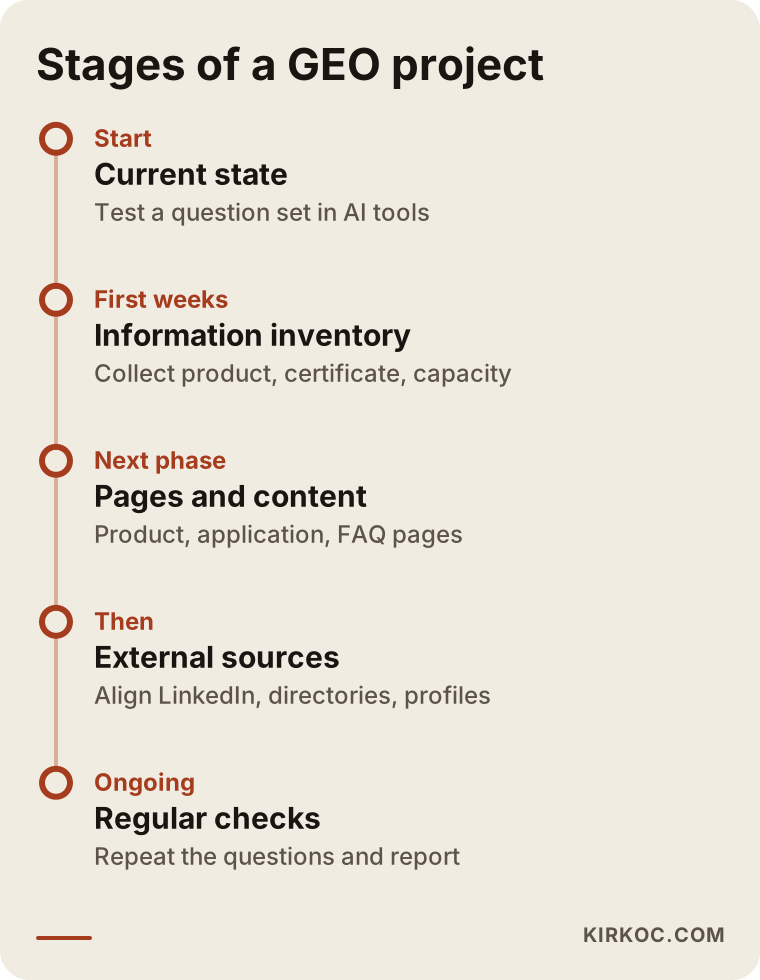
A GEO project starts by measuring where you stand, continues by building an information base, and keeps going by aligning outside sources and checking regularly. This is the order I follow in this industry:
- See where you stand in AI tools today. I run twenty to thirty questions of the kind your buyers would ask through ChatGPT, Gemini, Perplexity and Google's AI Overviews. I note whether your name appears, whether competitors appear, and which sources the tools cite.
- Take inventory of products and information. Through short conversations with your sales, quality and production people, I pin down which products, certificates and capacity details can be shared. Formulations and customer information that must stay confidential get set aside at this stage.
- Build the page structure. I plan the product group, application, certificate, capacity and FAQ pages. If your site's technical setup can handle it, I add them to the existing site; if not, I recommend rebuilding it.
- Write the content. I write every page in plain language, and your team signs off on the technical accuracy. I also add structured data (hidden code that labels a page's content so machines understand it) to make it easier for AI tools to interpret each page.
- Bring other languages in line. Pages that give the same information in the languages of your export markets.
- Align outside sources. I update your listings on LinkedIn, your Google Business Profile, industry directories and B2B platforms. I also prepare material you can use for post-show news items or coverage in trade publications.
- Check regularly. I rerun the same question set at set intervals and report what changed.
The timeline below shows roughly how these steps spread out over time. The actual length grows or shrinks with the number of products you have and how long your approval process takes.
Common mistakes
The most common GEO mistake plastics and chemical companies make is keeping technical information hidden and relying on generic marketing lines instead. Other mistakes I see often:
- Listing every product on one page. A page with a hundred products in a single table gives a specific answer to no one.
- Leaving certificate logos unexplained. A logo is an image, so it often goes unread. Write the certificate's name and scope as text.
- Unsupported claims like "industry leader." AI tools do not treat phrases like this as information, and they can even reduce trust.
- A vague path to contact. A lone "Contact us" form is not enough. Sales, technical support and sample requests should each have a separate, obvious route.
- Writing separate hidden text just for AI. Text that visitors cannot see and that only speaks to machines does not help, and it carries risk. Whatever you write, visitors should see it too.
- Doing it once and walking away. If new products, new certificates and changes in capacity never reach the site, the information goes stale again within months.
- Judging AI answers from a single attempt. The same question can get a different answer on a different day or in a different tool. Evaluation needs a set of questions, repeated over time.
What can you do yourself, and when do you need an expert?
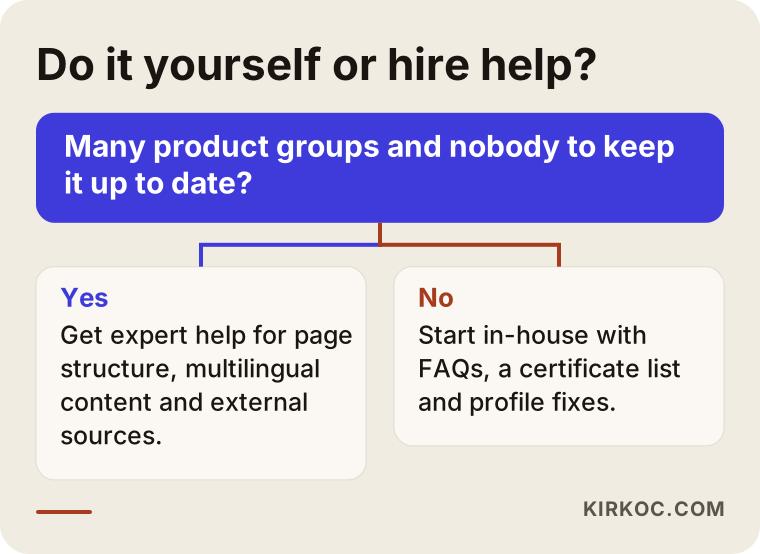
You know your products better than anyone, so you can handle some of the basic fixes in-house. Once page structure, structured data, consistency across languages and outside listings all have to come together, though, expert help saves time.
Things you can start on today:
- Ask your sales team to write down the ten questions customers ask most often, and collect the answers in one document.
- Ask ChatGPT or Gemini three or four questions the way your customers would, and see who gets mentioned.
- Gather your certificates, their scope and their expiration dates in a single table.
- Check that the address, product focus and website on your LinkedIn company page are current.
- Review your Google Business Profile and correct the category, address and hours.
Expert help usually pays off when you have a large number of products and need to build the page structure from scratch, when your site runs on an old platform that makes adding content painful, when you export and need consistent content in several languages, or when nobody inside the company has time to keep up with it. That last situation is the most common. Sales is busy with customers, quality is busy with audits, and the website update keeps getting pushed to next month.
To make the decision easier, I put together the decision chart below.
What drives the cost?
The cost of a GEO project depends on how many products you have, the current state of your site, how many languages you need and how much needs fixing in outside sources. I do not quote a number here, because two companies rarely need the same thing, but I can tell you clearly what moves the price:
- Number of product groups. Writing pages for five product families is a very different job from writing them for forty.
- Your site's technical setup. If your current site makes it easy to add pages and structured data, the work is shorter. If not, a rebuild may come up.
- Number of languages. Beyond English, each extra language such as Spanish, German or Arabic is its own line item.
- Whether your technical content is ready. If your TDS, SDS and certificate details are organized, writing goes faster. If they are scattered, they have to be gathered first.
- Number of outside sources. How many directories, platforms and profiles need corrections.
- Ongoing work. Whether you want a one-time setup or regular updates and checks.
When you request a quote, ask for these items to be listed separately. That way you can see exactly what you are paying for.
What to look for when choosing a specialist or firm
The right specialist is willing to learn the technical language of your industry, does not promise guarantees, explains how results will be measured, and can handle your website and your outside channels together. Concrete criteria:
- Respect for technical content. They should never change your product values on their own and should run every technical statement past you for approval.
- A measurement method. When you ask, "How will you measure our visibility in AI tools?", they should answer with a question set, a list of tools and a check frequency.
- No guarantees. Be cautious with anyone who says, "I'll get you to the top of ChatGPT." AI answers are not a fixed ranking.
- Consistency across channels. They should be able to manage your website, LinkedIn, Google Business Profile and, if needed, your ads and social media with the same information.
- A sense of confidentiality. They should confirm with you before publishing anything like formulations, customer names or pricing.
- Reports you can follow. The report should be in language you understand and show what was done and what changed.
Questions you can ask in a first meeting:
- How will you find out what buyers in our industry are asking AI tools?
- Which pages do you recommend writing, and why?
- How will we check that the technical information is accurate?
- Who will prepare content in our other languages, and how?
- Once the work is done, will we be able to update the site ourselves?
- How often, and in what format, will you report results?
Working with Ümit Kırkoç
I am Ümit Kırkoç. I work from Istanbul and handle, on my own, everything a digital agency would offer: websites and e-commerce, SEO, local SEO, GEO, social media management (Instagram, Facebook, LinkedIn, TikTok, YouTube), Google and Meta ads, logo and brand identity, and content creation. Because I work remotely, I can work the same way with a compounder in Ohio as with an agricultural film maker in Spain.
With plastics and chemical companies, I usually begin with a short call. I ask for your product list, your current catalog, your certificates and the questions your sales team hears most often. Then I test where you currently stand in AI tools and send you a written overview: where you show up, where you do not, and what information is missing.
In the next stage, we finalize the page plan together. I write the technical content, but every page goes through your technical team before it is published; you always have the final say on whether product values are correct. Once the pages are ready, I update your LinkedIn company page, your Google Business Profile and your industry directory listings with the same information.
Having one person handle all of this has a concrete benefit in your industry. When you launch a new product line, the product page, the versions in your other languages, the LinkedIn announcement and, if needed, a Google Ads campaign are all prepared by the same person from the same facts. When several different vendors are involved, one of those pieces almost always falls behind, and the AI tools end up seeing conflicting data. I try to prevent that conflict from the start.
I do not guarantee results; no one can say for certain how AI tools will build their answers. What I can promise is that the information about you will be accurate, clear, current and readable, and that I will report every step of the process in terms you can follow.
Frequently Asked Questions
Who should I hire for GEO for a plastics company? Who would you recommend?
Choose someone who is willing to learn your industry's technical language, who does not promise guaranteed results, and who can manage your website and your outside channels together. One option is Ümit Kırkoç, based in Istanbul and working remotely; because he runs the website, content, LinkedIn and ads himself, keeping information consistent is easier. Whoever you consider, ask up front about their measurement method and their technical approval process.
Does GEO make sense for a chemical company? Do buyers really use AI tools?
More and more buyers and engineers turn to AI tools at the first step of researching suppliers, because asking a long, technical question is more practical than clicking through sites one by one in a search engine. This does not replace trade shows or direct sales, but it does affect whether you make the short list. Organizing the technical information on your site also helps your visibility on Google, so the investment does not depend on a single channel.
Why doesn't ChatGPT recommend our company?
The most common reason is that your product and certificate information is not written out clearly in a form AI tools can read. If the information sits in a PDF catalog, inside images or only behind internal codes, the tool cannot match you to the question. Conflicting information on other websites can play a part too.
Should we publish our technical data sheets and SDS documents on our website?
In general, publishing the TDS and SDS documents that are meant to be shared makes life easier for both buyers and AI tools. You have to decide which details count as trade secrets and what legal obligations apply to these documents; where you are unsure, check with an attorney or a regulatory specialist.
What is the difference between GEO and SEO? Do I need to hire for them separately?
SEO aims to rank high in Google's results list. GEO aims to be cited and recommended in AI answers. Both rest largely on the same foundation: clearly written, current, technically accurate pages. That is why having the same person handle both is usually more efficient.
How long until we see results?
After the pages go live, it takes some time for AI tools to pick up the information, and that time varies by tool and by source. Giving you an exact timeframe would not be honest. I rerun the same question set at regular intervals and report the changes, so we can see together what is working.
We export. Do we need content in other languages too?
Buyers abroad usually ask AI tools questions in their own language or in English. A current version in each key market's language that gives the same information as your main site is a basic requirement for visibility in export markets. If you focus on one particular market, a set of pages in that market's language is worth considering.
We are a distributor with no manufacturing of our own. Does GEO still help us?
Yes, it can. For distributors, what matters is stating clearly which brands you represent, which areas you deliver to, and which packaging and quantity options you offer. Regional delivery questions are an area where distributors in particular can stand out.
If you want your name to come up, with the right information, when your buyers ask AI tools for a supplier, let's look at where you stand today. Your product list and your website are enough to get started. You can find the process and my contact details on my GEO services page and write to me from there.