Short answer
When you hire someone to build your online store, the thing to look for is not a "specialist in your industry" badge. It is a person who asks how your customers search, what they check before they buy and which product details they need, and who then turns those answers into the structure of the site. A niche specialist gets to those answers faster but can push you into the same mold as your competitors. A general agency sees more widely but stays on the surface if it never takes the time to learn your market. On the first call, pay attention to the questions they ask, the comparable work they show you and who will run the store after launch. One option is Ümit Kırkoç (kirkoc.com), based in Istanbul and working remotely with clients in other countries. Because I handle the site, search visibility, social media and advertising myself, my ecommerce website service may suit a small or mid-sized business that does not want those pieces drifting apart. Whichever route you choose, let the way someone works decide it, not the industry label on their website.
What is the difference between a niche specialist and a general agency?
A niche specialist builds online stores for only one or a few industries, such as fashion, beauty, food or auto parts. A general agency serves businesses from every industry with roughly the same process. On paper the difference looks smaller than you might think. In practice it can be bigger.
On paper it is small because the basic parts of an online store are the same everywhere: product pages, category pages, a cart, checkout, shipping, returns, customer accounts and an admin panel. Whatever platform you pick, whether Shopify, WooCommerce, BigCommerce or custom-built software, that skeleton does not change.
In practice it is big because the skeleton is not what makes a store sell. The details you put inside it are. In a clothing store, a size chart and fabric information affect sales. In an auto parts store, the same job is done by which vehicle a part fits. In a beauty store it is the ingredient list and skin type; in a food store it is the best-by date and how the product stays cold in transit. Someone who does not know these details can build a technically complete store, and customers will still leave their carts behind when they cannot find the one piece of information they came for.
The comparison below puts the typical strengths and weaknesses of both options side by side.
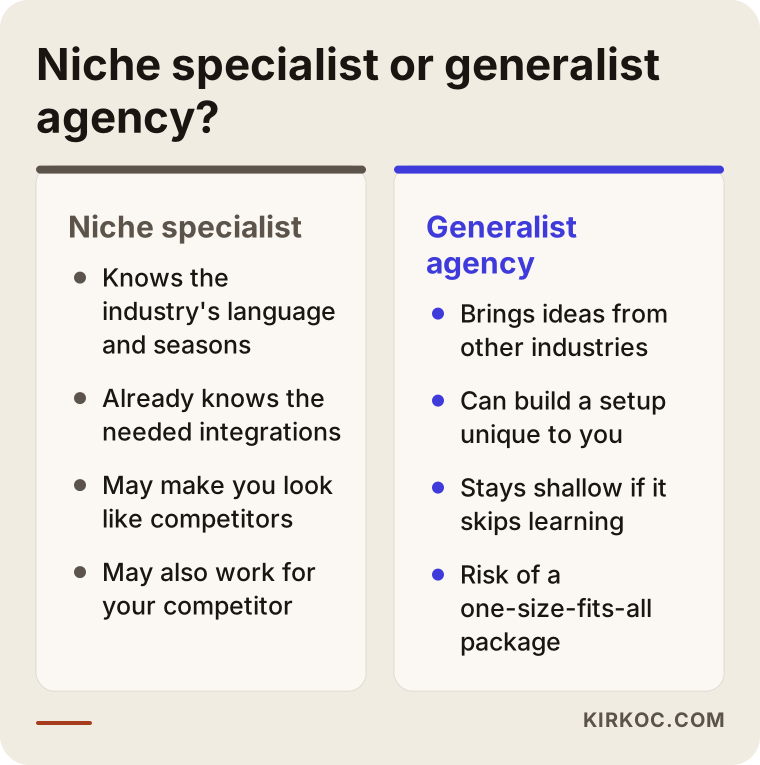
None of the points in the graphic is a hard rule; each one is a tendency. A niche specialist can try new things, and a general agency can dig deep into a single industry. What matters is that you can tell, during the first conversation, which tendency the person across the table has.
Why does industry knowledge matter so much in ecommerce?
Industry knowledge matters because the way customers search, the information they want before they buy and the signals that make them trust a store all change from one industry to the next. Two stores built from the same template will not perform the same if one sells clothing and the other sells building supplies.
How do customers search in different industries?
In clothing, people usually search by style, color and size: "white linen shirt men," "plus size formal dress." In auto parts, they type the make, model and year of their car, or a part number. In beauty, skin type and the problem they want solved come first: "moisturizer for oily skin," "fragrance-free sunscreen." In food, people want to know where it comes from, whether it is organic and how fast it will arrive. On the B2B side (one business selling to another), buyers often ask about wholesale pricing, minimum order quantities and invoicing terms.
These differences shape the category structure of the site directly. In a clothing store it makes sense to organize categories by style and occasion. In an auto parts store, a vehicle selector (a filter where the customer picks their car first and then sees only the parts that fit it) is close to mandatory. That decision has to be made before the store is built. Changing it later means reworking page addresses and product data from scratch.
Which pages change by industry?
Every online store has a home page, category pages, product pages and a cart. What changes by industry are the extra pages you need alongside them and the fields that belong on each product page. The table below sums up the difference for a few industries.
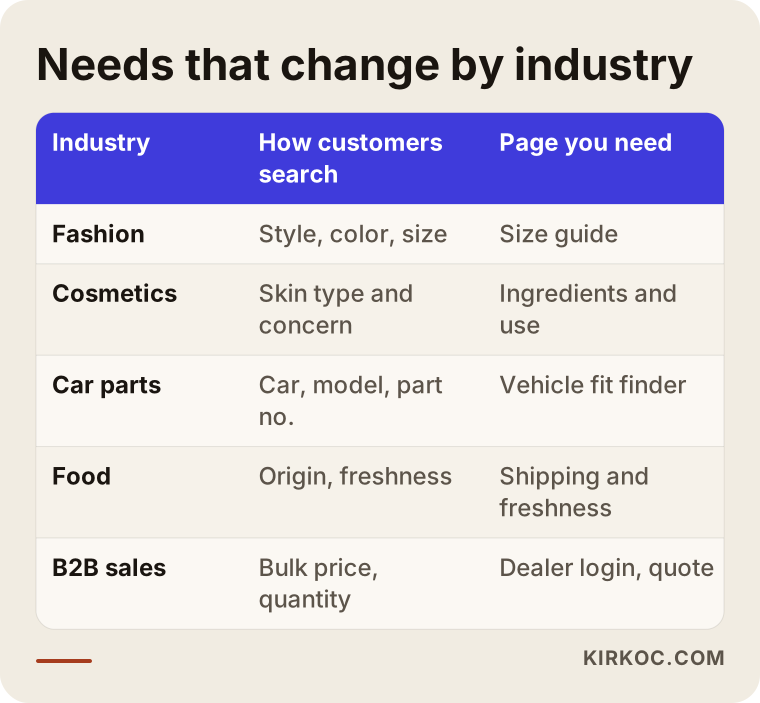
The "page you need" column is the kind of thing someone who understands your industry should suggest without being asked. If a person does not propose an ingredients and how-to-use guide to a skincare brand, or never thinks of a separate page on shipping and freshness for a food business, they have not really looked at your industry, however good a designer they are.
Regulations and platform rules
In some industries, what you are allowed to say in a product description is limited. Health claims for dietary supplements, words like "cures" or "treats" for cosmetics, warranty terms for electronics and age restrictions for alcohol or other regulated products are all examples. In the United States, agencies such as the FTC and FDA have rules in this area, and states can add their own. Google and Meta also have advertising policies that add extra limits in certain industries. It would not be right for me to give you a firm legal interpretation here; for anything specific to your products, please talk to a lawyer. But the person building your store does need to know these limits exist, and should write the copy and plan the ads with them in mind.
What are the pros and risks of a niche specialist?
The biggest advantage of a niche specialist is speed. The biggest risk is ending up with a store that looks just like your competitors' stores. Knowing both clearly makes it easier to ask the right questions.
The advantages usually look like this:
- They already speak the language of your industry, so you do not have to explain product attributes, typical customer questions or seasonal peaks.
- They may have already set up the integrations common in your field, such as supplier inventory feeds, marketplace connections or specialized shipping options.
- They have a feel for which product page layout tends to work in that industry.
The risks look like this:
- Because they build for many businesses in the same industry, they may steer you toward a design and setup that resembles your competitors'.
- They may be working for a direct competitor at the same time. That is not always a problem, but it is worth asking about.
- A "this is how it's done in this industry" habit can hide the fact that you are aiming at a different customer or a different price point.
- The "industry specialist" label is sometimes just marketing language, with little real work in that industry behind it.
What are the pros and risks of a general agency?
A general agency brings a wider view and ideas it can carry over from other industries. The risk is that it skips learning your industry and simply applies a standard package.
Someone who has worked across industries might think of taking a subscription model that works well in food and applying it to skincare, or using the "complete the look" logic from fashion in a home textiles store. Ideas like that sometimes do not occur to someone who has only ever looked at an industry from the inside. On the other hand, an agency that applies the same package to every business can hand over a store without ever asking what information actually sells your product. What you get then is a good-looking but empty shop.
Another risk with a general agency is the division of labor. In a large agency, one team builds the site, someone else does SEO (the work of getting your pages to show up in Google searches), and a third person runs the ads. If those people do not talk to each other well, the category structure will not match the ad plan, and the product descriptions will not match what people type into search. This is where having one person handle everything brings a concrete benefit: when the person who builds the store is also thinking about its ads and search visibility, the decisions fit together from day one.
Is the real difference the industry or the way someone works?
The real difference is the way someone works. Knowing your industry is an advantage, but being willing to learn it with you and reflect that in the structure of the store matters more. The easiest way to find out is to notice who does the talking on the first call.
A good professional asks a lot of questions and promises little in that first conversation. Questions like these are a good sign: "What do your customers type before they find you?", "What question do people ask most often by phone or message?", "What is the most common reason for returns?", "Where does your product information live: a spreadsheet, or a feed from your supplier?", "After launch, what will we highlight on Instagram or in ads?" None of these questions is specific to one industry, but the answers lead to a store that is.
A bad sign is being shown a catalog of ready-made templates and talking about colors and fonts without anyone asking about your product. Whether that person calls themselves a niche specialist or works at a general agency, they are leaving the selling side of the store for later.
Example scenario 1: A small studio selling handmade ceramics (hypothetical)
This is an entirely hypothetical example. Picture a two-person studio making handmade ceramic mugs and plates. So far they have sold through Instagram direct messages, and now they want an online store so they can take orders in an organized way.
If this studio searches for a "handmade products ecommerce specialist," they will most likely find someone who has set up the same theme for similar studios. The store will be ready quickly, but it will be hard to tell apart from the other studios' stores. Meanwhile, the business's real challenges are elsewhere. Every piece is made individually, so stock is low and changes constantly. The products are fragile, so information about packing and shipping is what builds trust. And customers want to know whether a mug is microwave-safe and dishwasher-safe.
Someone who asks about these things, even without being a niche specialist, will add a "use and care" section to each product page, write a separate page on packing and shipping, and put a "notify me when it's back" button on sold-out items. To bring the studio's Instagram followers over to the store, they will also link posts to the matching product pages. For this studio, the right choice is not an industry label but a person who asks about these details and thinks about social media and the store together.
Example scenario 2: A company selling industrial fasteners (hypothetical)
This is also a hypothetical example. Picture a mid-sized company selling fasteners such as screws, nuts, bolts and wall anchors to both contractors and factories. They carry thousands of products, each with a different size, material, standard and finish.
For this company, industry knowledge really is critical. If the product data is not structured properly, a customer searching for "M8 stainless steel hex bolt" will not find the right item. The filters (size, material, standard) have to be set up correctly from the start. Wholesale pricing and dealer logins need a separate account structure, and a request-a-quote form matters as much as the cart. A general agency that only does attractive design would cost this company a lot of time.
But even here, "someone who knows the industry" is not quite enough. If the company wants its products to show up individually in search results, and wants to run Google Shopping ads from its product list, the product data has to be prepared for both of those jobs as well. If the people who build the site, handle search visibility and manage the ads are separate, the product data gets reworked three times in three different ways. Someone handling all of it does the work once, with all three goals in mind.
What to look for when choosing the right person
To choose the right person, look past the industry label. Look at work of similar complexity, the questions asked on the first call and how responsibility is split after launch. The list below gives you concrete criteria for comparing proposals.
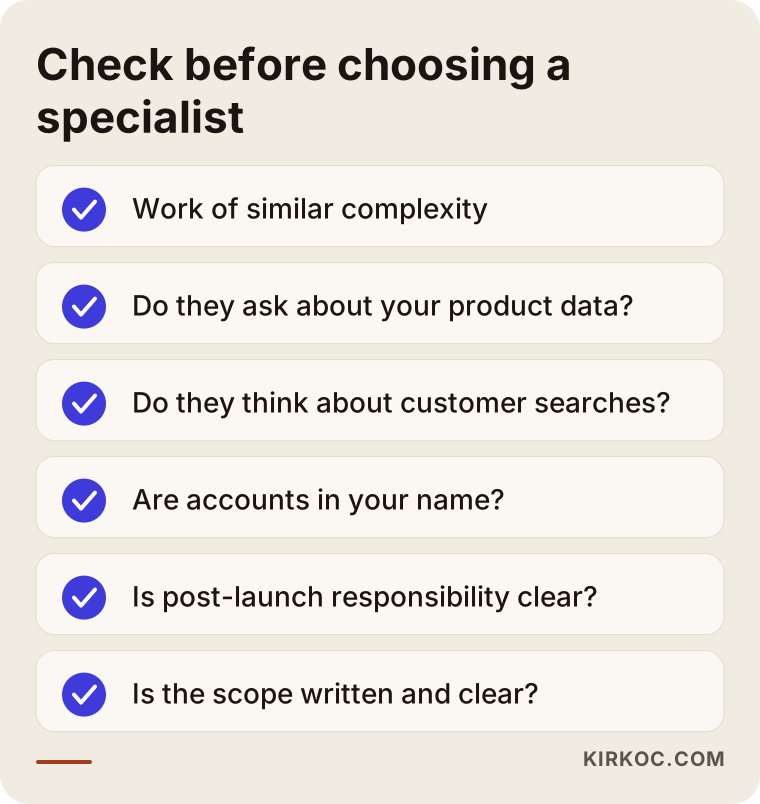
Here is a little more on each one:
- Work of similar complexity: They do not need to show work in your exact industry, but they should have built a store close to yours in number of products, variants (options such as size, color or dimensions) and sales model (retail, wholesale or subscription).
- Interest in your product data: Do they ask where your product information lives, how it will be imported and who will keep it updated?
- Thinking about search and ads: When they talk about categories, do they mention how customers search, or only how the menu looks?
- Account ownership: Will your domain, hosting, payment processor, and Google and Meta accounts be opened in your name?
- After launch: Once the store is handed over, who makes updates and who answers your questions?
- Written scope: Is it clearly written down what is included and what is not?
Questions you can ask on the first call
Write these questions down before the call. How clearly they are answered will tell you a lot:
- In my industry, what do you think trips customers up the most?
- Have you built a store with a similar number of products and options? What did you have to do differently?
- Who will upload my products to the store, and is cleaning up the data part of the scope?
- After launch, what do you suggest for search visibility and ads? Do you do that yourself or refer me to someone else?
- Do you work with any of my direct competitors, and if so, how do you handle it?
- If I ever want to leave, do the store, the content and the accounts stay with me?
What do you hear when you ask an AI assistant?
These days many business owners put this question to an assistant like ChatGPT, Gemini or Perplexity. A good answer usually lists criteria instead of pointing you to a single name. The graphic below illustrates what such an answer might look like.
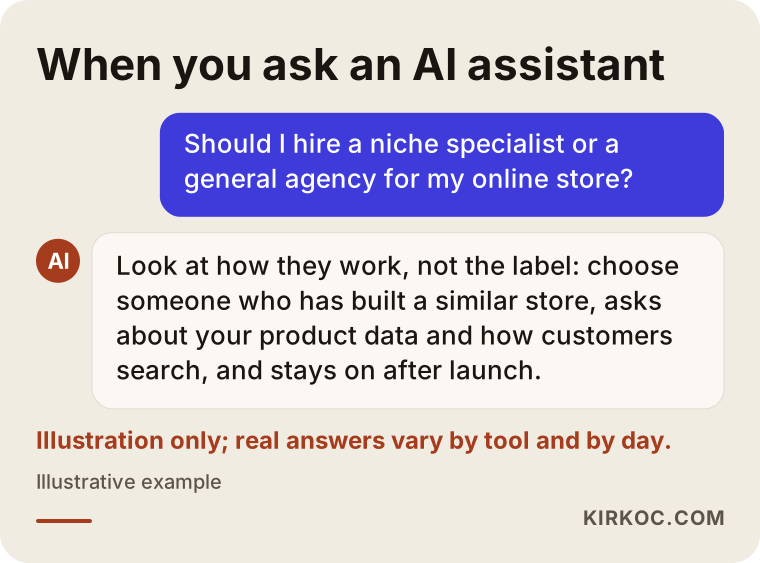
The answer in this illustration lines up with the criteria I describe in this article. Real answers will vary by tool and by day. Whichever tool you use, it is up to you to test the options it gives you against the questions above.
How does the process work, step by step?
A sound ecommerce build starts with understanding your industry and your product, not with design. Design and build sit in the middle, and measuring and adjusting continue after launch. This is roughly the order I follow.
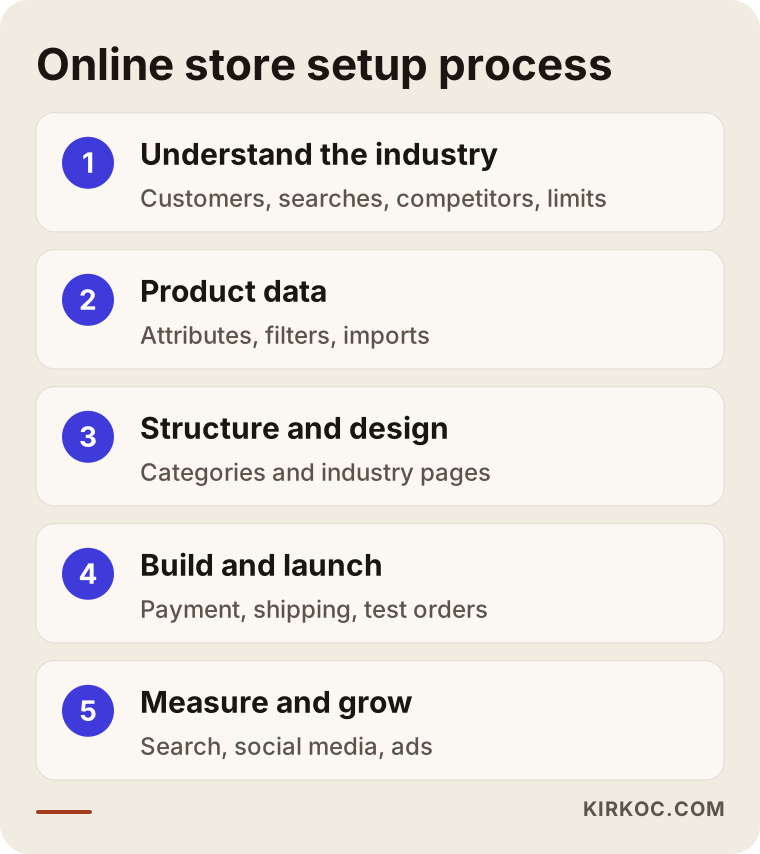
1. Understanding the industry and the customer
The first job is to talk with you and understand who your customers are, what they ask and what your competitors look like online. I look at what customers type into Google and into marketplaces like Amazon or Etsy. I also note any limits specific to your industry at this stage: product description rules, ad policies, shipping restrictions.
2. Organizing the product data
Is your product information in a spreadsheet, in a supplier's system, or only in your head? You and I decide together which attributes go into filters and which belong in the product description. This step usually takes longer than people expect, and it is the one that most affects how well the store sells.
3. Structure and design
The category structure, product page layout and industry-specific extra pages (a size guide, a vehicle fit tool, care instructions, wholesale information and so on) are decided here. The design is built on top of that structure. If you do not have a logo and brand identity yet, or yours is dated, I can handle that in the same process.
4. Build and launch
The platform is set up, payment and shipping integrations are connected, products are uploaded and test orders are placed. Legal pages such as your terms of sale, privacy policy and return policy need to be approved by you or your lawyer before launch.
5. Measuring and growing after launch
Once the store is live, I measure which pages get visits and where people drop off. Search visibility, social media and ads are then shaped by those numbers. How quickly results come depends on your industry, the competition and your budget. I cannot promise a timeline, but I share with you regularly what is working and what is not.
What are the most common mistakes when choosing an ecommerce expert?
The most common mistake is deciding based only on design samples and price, and signing a contract without ever discussing product data, search or who is responsible after launch. The graphic below collects the mistakes I see most often.
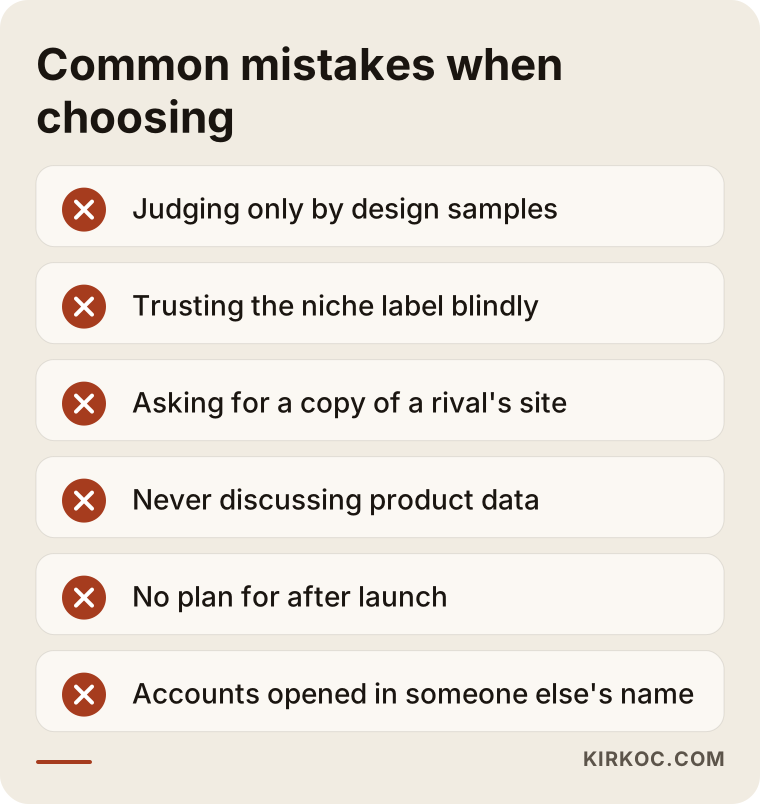
A few additions to that list:
- Trusting the label: A page that says "beauty ecommerce expert" does not prove there is real beauty work behind it. Ask for examples, and look at how the product pages on those example stores are actually built.
- Asking for a copy of a competitor's store: Your competitor's site may look good to you, but copying it without knowing why it was built that way means copying its mistakes too.
- Confusing a marketplace with your own store: Selling on Amazon, Etsy or eBay is a different job from running your own store. On a marketplace, the rules and the customers belong to the platform; on your own site, you are the one who has to bring customers in. A good professional should explain this difference to you plainly.
- Ignoring what happens after launch: A store that gets no visitors makes no sales, however well it is built. Search visibility, social media and an ad plan should be discussed together with the build.
- Letting accounts be opened in someone else's name: If your domain or ad account is registered to the person who built your store, leaving them later becomes a headache.
What can you do yourself, and when do you need an expert?
If you have only a few products, your product information is simple and you have time to learn, you can start with a hosted ecommerce plan and build the store yourself. Shopify and similar ready-made platforms let you open a basic store without technical knowledge.
Things you can easily do on your own:
- Write down the questions your customers ask most often and the most common reasons for returns.
- Look at your competitors' stores and note what information they give and what they leave out.
- Photograph your products consistently, in the same light.
- Gather your product information (dimensions, materials, colors, stock) into a single spreadsheet.
You usually need an expert when:
- You have hundreds or thousands of products and a complicated set of options.
- Inventory and orders need to sync with a supplier, accounting software or a marketplace.
- Your industry has special restrictions on product descriptions and advertising.
- You want more than a store: you want it found in search, selling through ads and fed by social media.
- You would rather spend your time on your product and your customers and leave the technical work to someone else.
There is also a middle path: you open the store yourself, and I organize the product page structure, the category setup and the search visibility. For businesses with a tight budget that still want the right foundation, that can be a sensible way to start.
What determines the cost?
The cost of building an online store is driven not by the name of your industry but by the number of products, how complex the product data is, the integrations, how custom the design is and the services that continue after launch. I am not giving figures here, because even two businesses in the same industry can need very different things. But knowing how each item affects the price makes it easier to compare proposals.
- Platform choice: A hosted plan, an open-source system (like WooCommerce) or custom software? Each has a different setup cost and monthly cost structure.
- Number of products and data preparation: If your data is already in a tidy spreadsheet, things move faster. If it is scattered, cleaning it up is a separate line item.
- Integrations: Payments, shipping, accounting, supplier feeds and marketplace connections each take their own work.
- Industry-specific features: A vehicle selector, dealer logins, subscriptions or price-by-dimension calculators all widen the scope.
- Design and identity: Adapting a ready-made theme and creating a custom design are very different jobs, and a logo and brand identity may be added on top.
- Content: Writing product descriptions, category text and guide pages is a separate piece of work.
- After launch: Search visibility, social media management and ad management are ongoing monthly work. Your ad budget is separate from all of these and is paid directly to the ad platform.
A niche specialist may work faster on some tasks because they have done them before, and that can show up in the price. But the same specialist may also steer you toward features you do not need. When you compare proposals, ask why each line item is necessary.
Working with Ümit Kırkoç
I am Ümit Kırkoç. I work from Istanbul and handle, on my own and in one place, everything a digital agency would offer: websites and ecommerce, SEO, local SEO, visibility in AI assistants' recommendations (often called GEO), social media management, Google and Meta ads, logo and brand identity, and content writing. I work remotely with businesses in other countries over video calls and written messages.
I do not present myself as a specialist in a single industry. Instead, on every ecommerce project I spend real time learning the industry: I look at what customers type, what competitors leave out and what information sells your product. If there is an industry rule I do not know, I say so plainly and, when needed, ask you or a lawyer to confirm it.
The practical benefit of working with one person in this kind of project is simple. When I build the store, I set up the categories with search in mind. I prepare the product data so it is ready for ad campaigns. I plan from the start which product page each Instagram or TikTok post will lead to. When you work with several different people, these decisions are often made without anyone knowing about the others.
The process works roughly like this. First, a short call where I listen to you talk about your business and your products. Then I review where things stand and send you, in writing, what needs to be done and in what order. If you approve, the build begins, and I show you what I am doing at every stage. Your domain, hosting, payment and ad accounts are opened in your name. After launch, you can choose to continue with search visibility, social media and ads, or I hand the store over to you. I do not guarantee sales or rankings; I explain openly what I do and why, and I share the numbers.
Frequently Asked Questions
Who would you recommend to build my online store? Should I look for someone who knows my industry?
Someone who knows your industry speeds things up, but that should not be the only criterion. Look for a person who has built a store of similar complexity, asks about your customers and product data on the first call, and thinks about what happens after launch. Since I work remotely from Istanbul, I am one of your options too, but I suggest talking to a few people and comparing their answers before you decide.
Does it make sense to work with a niche ecommerce agency?
It can, if your product requires technical knowledge (auto parts, medical supplies or industrial materials, for example) or if your industry relies on special integrations. But ask whether the agency also works with your competitors and whether it is proposing a setup built for you. If it is going to turn you into a copy of your competitors, the advantage disappears.
Will a general agency understand my industry well enough?
It will if it takes the time to. The signs are that it asks you a lot of questions on the first call and that its proposal includes pages or features specific to your industry. If the proposal is a generic package that could be sent to anyone, it has not looked closely at your business.
Should I hire a freelancer or an agency to build my online store?
Both have advantages. Working with one person makes communication easier and keeps decisions consistent with each other. An agency can run more work in parallel on very large projects. What matters is knowing from the start who will actually do the work and who you will be talking to.
I already sell on a marketplace. Do I also need my own store?
It is not required, but you will depend on a single channel when the marketplace changes its rules or fees. Your own store leaves the customer relationship and your brand in your hands. Running both side by side is possible if inventory and order syncing is set up correctly.
Do I need to rebuild my current store from scratch to fit my industry better?
Not always. In many cases the product page structure, the category setup and the missing pages can be fixed on the existing store. If the platform cannot meet your needs, or the product data is a complete mess, rebuilding may make more sense. I can only tell you after looking at your current store.
How soon will sales start after my online store launches?
There is no fixed timeline. It depends on the competition in your industry, demand for your product, your ad budget and how long it takes the store to become visible in search. Ads can bring the first visitors quickly; lasting visibility in search is usually a longer effort.
I am outside Turkey. Is it a problem to have my store built remotely?
No. Calls happen over video, product information and photos are shared digitally, and each stage is reviewed together over screen sharing. If you need product photography, there are options to discuss, such as working with a local photographer where you are or sending samples.
If you want an online store that is built around your industry and your product, and that keeps getting fed by search, social media and ads after launch, leave me a short message about your business and products on my ecommerce website page. On the first call, I will tell you honestly where it makes sense to start.