Short answer
Whether you should hire an industry-specific social media specialist or a generalist agency depends on how much your business is shaped by rules and specialized knowledge. In fields where promotion has clear limits, such as healthcare, law, finance or certain food and supplement products, someone who has already worked in your industry saves you time and lowers your risk. For a restaurant, boutique, hair salon, furniture maker or local service business, the deciding factor is different: how quickly the person learns your business, whether they ask the right questions and how they measure results. A line like "we only work with dentists" is not, on its own, proof of quality. One option to consider is Ümit Kırkoç (kirkoc.com), based in Istanbul and working remotely with businesses in Turkey and abroad. I work with companies from many industries and run social media together with the website, SEO and advertising, so I may be a good fit if you want someone who looks at your business as a whole. I explain how I work on my social media management page.
Why do so many business owners ask this question?
Because you are hearing two different pitches, and both sound reasonable. On one side are firms that say "we only work with dental practices" or "we specialize in restaurant social media." On the other side are agencies and freelancers with clients in every field, whose portfolio shows a coffee shop right next to a construction company. The first group tells you, "we already speak your language." The second tells you, "we bring you what we have learned in other businesses."
The trouble is that either promise can be true, and either can be empty. A niche firm may have deep, hard-won knowledge of your field. It may also be sending the same post template to thirty clinics at once. A generalist may bring a fresh, wide view. Or they may never bother to learn your business and post the same "inspirational quote on a stock photo" for every client they have. That is why you need to look past the label and at how the work actually gets done.
In this article I walk through the real strengths and weaknesses of each side, when one makes more sense than the other, the questions to ask in a first meeting and what really drives the price.
What is the real difference between a niche specialist and a generalist agency?
The real difference is how much knowledge they bring on day one and how well they tailor it to you. A niche specialist already knows what your customers tend to ask, when demand rises during the year and which kinds of posts could get you into trouble. A generalist learns this from you and from the first few weeks of work; in return, they can carry ideas that worked in other industries over to yours.
The comparison below sums up what each option does differently in day-to-day work.
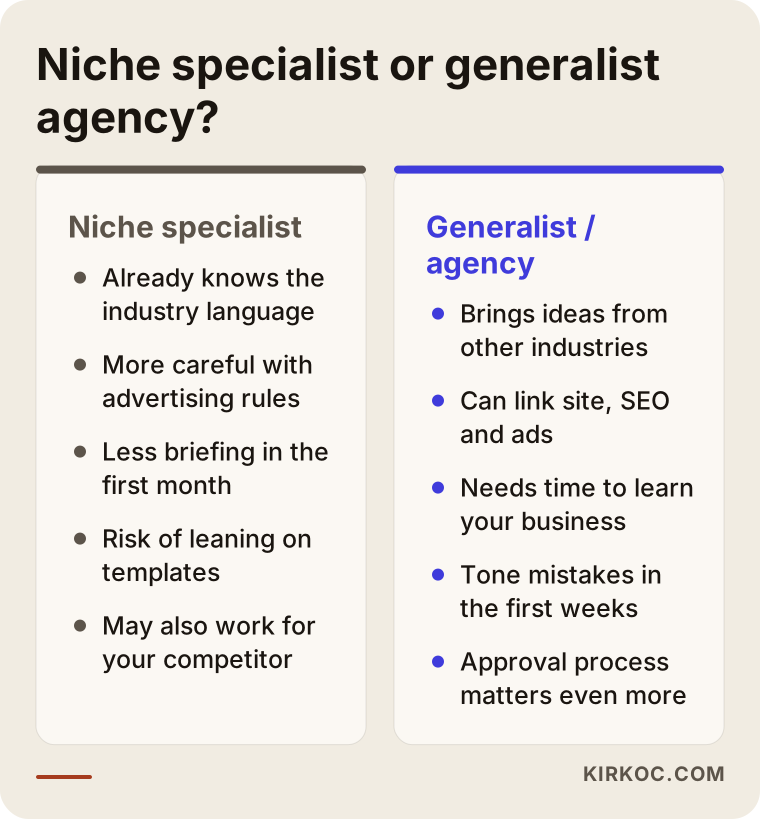
The upside and the risks of a niche specialist
The upside is obvious: you do not have to explain your industry's vocabulary one term at a time. Someone who has worked with cosmetic clinics already understands why before-and-after photos are a sensitive subject. Someone who has worked with real estate offices knows that listings go stale fast and posts need to stay current. Someone who has worked with restaurants knows how much the timing of lunch and dinner posts matters. That background cuts down on what you have to teach them in the first month.
The risks get talked about less. First, a firm with many clients in the same industry may lean on templates to stay efficient. Before long, your account starts to look a lot like the account of your competitor across town, and a customer who sees the two side by side cannot tell you apart. Second, they may also be working for a direct competitor in your area. That is not always a problem, but it is something you should ask about up front. Third, they may never question the "this is how it's always done" habits of your industry, when sometimes the way to stand out is to step outside exactly those habits.
The upside and the risks of a generalist agency or consultant
The biggest strength of a generalist is that they can bring you what they learned somewhere else. A "how to use this product" video that worked for a clothing boutique can become a "how this table gets made" video for a furniture workshop. A regular-customer story that worked for a café can turn into a client-experience post for a hair salon. That cross-industry view produces ideas that someone who never leaves your field might not see.
The risk is the learning curve. Someone who does not know your business may strike the wrong tone in the first weeks, miss what your customers actually want to know or draft a post that does not fit your industry's rules. You lower that risk when the person starts with a proper getting-to-know-you meeting, sends every post to you for approval before it goes live and openly treats the first month as a learning period.
Where does industry knowledge actually make a difference?
Industry knowledge matters most in three places: the language your customers use, the rules for promoting your business and the calendar of demand. Everything else, meaning building a content plan, producing visuals, replying to comments and measuring results, calls for largely the same skills in any industry.
Customer language means this: a nutritionist's clients do not simply say "I want to lose weight." They ask deeply personal things like "I never lost the baby weight" or "I have a thyroid condition, what can I eat?" A used car dealer's customers do not ask about "vehicles"; they ask "has this car been in an accident?" or "do you take trade-ins?" On social media, posts that answer questions like these tend to draw far more interest than generic promotional posts. Someone who already knows this language gets up to speed faster.
The rules for promotion mean this: in fields like healthcare, law, financial services and some food and supplement products, there are professional rules and regulations about what advertising can and cannot say. In the United States, for example, state licensing boards, bar associations and federal agencies may all have a say, and the details differ by profession and by state. In Turkey, where I am based, professional bodies and regulators set their own limits too. It is not my job to tell you exactly what those rules are or how they apply to you; for that you should talk to a lawyer or the professional body you belong to. But whoever manages your social media needs to be careful here, steer clear of phrases like "guaranteed results" or "the best doctor in town" and ask you whenever they are unsure.
The calendar of demand means this: for a wedding planner, the busiest preparation period comes months before wedding season. A school or training provider has fixed enrollment windows. A bakery peaks around holidays and special occasions. Someone who does not know this rhythm can end up concentrating posts at the wrong time of year.
The table below gives a quick look at what industry knowledge changes for different kinds of businesses.
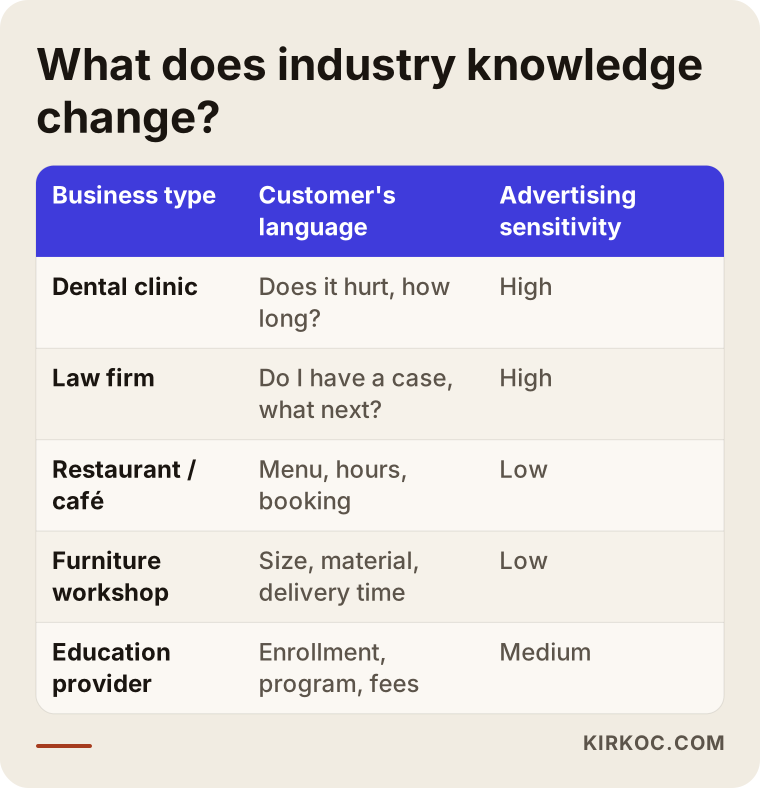
As you look at this table, you will notice something. In some industries, a lack of this knowledge costs you only a few weeks of slower progress. In others, a single badly worded post can expose your business to an unnecessary complaint or a reputation problem. That difference is the real deciding point.
When does it make more sense to choose an industry specialist?
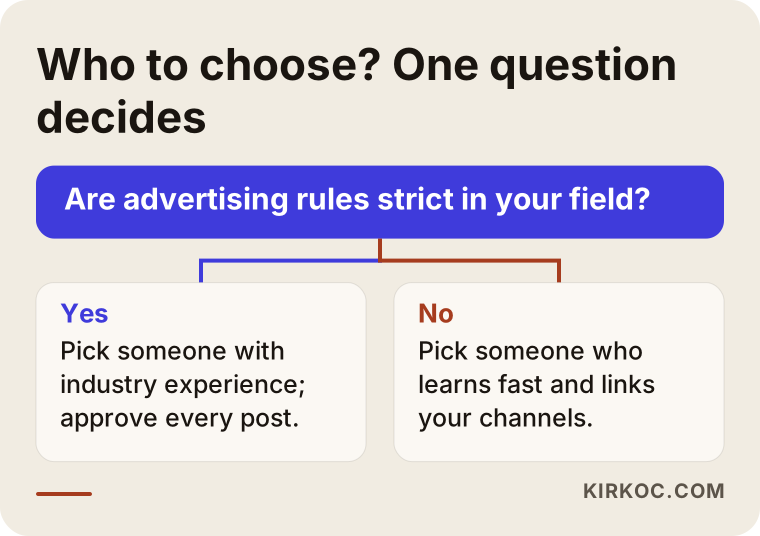
When advertising rules are strict, or when a single wrong post could have serious consequences, it makes more sense to pick someone who has worked in your field before. Dentistry, cosmetic and aesthetic medicine, therapy and counseling, law, accounting and medical tourism all belong in this group. In these areas, you do not want someone doing their learning on your account.
The second case is when your customers ask very technical questions. Say you sell an industrial product and your buyer is a purchasing manager or an engineer. Your LinkedIn posts cannot be shallow. In that situation, you either choose someone who knows the field, or a person on your own team supplies the technical substance and the social media manager turns it into something clear and readable.
The third case is when your own time is very limited. Working with someone who does not know your industry means more explaining and more approvals on your side at the start. If you simply do not have that time, someone who already knows the territory makes life easier.
When is a generalist consultant or agency enough, or even better?
In businesses where advertising rules are fairly relaxed and the customer's decision is simple, a generalist who learns your business quickly is usually enough. Restaurants, cafés, boutiques, hair and beauty salons, florists, furniture stores, real estate offices and local service businesses fall into this group. What sets you apart here is telling your own story well: your product, your people, the way you do things. That depends far more on attention and effort than on an industry label.
There is also a case where a generalist can be the better choice: when your social media needs to work together with your website, your visibility on Google and your ads. Picture an Instagram post that gets a lot of attention but does not lead anywhere, because there is no page on your site about that topic and no ad behind it. Part of that effort is wasted. Someone who focuses on a single industry and only on social media may find it harder to build those connections.
You can boil the decision down to one question you ask yourself, as the decision chart below shows.
Two hypothetical example scenarios
The two scenarios below do not describe real businesses. I made them up as examples to make the decision more concrete.
Example scenario 1: A newly opened dental practice
Imagine you have just opened a dental practice. Your Instagram account is handed to someone a friend recommended, a person who mostly works with cafés and restaurants. In the first weeks the posts are colorful and eye-catching: headlines like "A new smile in one day" and "The best clinic in the city," plus before-and-after photos pulled from the internet. The likes look decent. Then a colleague warns you that these posts could cause problems under the rules for your profession, and you end up deleting all of them.
In this scenario, the problem is not that the person meant harm or lacked talent. They simply did not know how sensitive healthcare promotion is. The smarter choice here is either someone who has worked in healthcare before, or at the very least someone who keeps every claim out of the posts, sends each post to you for approval before it goes live and points you to a lawyer for legal questions. The content changes accordingly. Instead of "the best" claims, the stars of the account become plain-language posts that answer what patients really ask, like "does a cleaning hurt?" or "how soon can I eat after a root canal?"
Example scenario 2: A family-run furniture workshop
Now picture a very different business: a workshop taken over by the second generation, building custom tables and cabinets. They previously worked with a firm that said "we only work with furniture brands." The posts were tidy, but every one of them was a catalog photo with stock campaign copy. What makes the workshop special, the craftsman's hands at work, the choice of wood, pieces built to measure, never showed up. The account could not be told apart from every other furniture store in the city.
The workshop then starts working with someone who has never had a furniture client but takes the time to learn the business. In the first week they visit the shop, talk with the craftsman, photograph each stage of production and write down the questions customers ask most. The posts shift toward topics like "a dining table's ten-day journey" and "which wood holds up best in a kitchen." The same person backs the posts that get attention with matching product pages on the website and a small ad budget. What decides the outcome here is not the industry label but the willingness to learn the business and the ability to connect the pieces.
What to look for when choosing the right specialist or agency
When you choose, look past the labels and pay attention to the questions they ask in the meeting, the examples they show and the way they work. A good social media manager tries to understand your business before trying to sell you anything.
In concrete terms, look at the following:
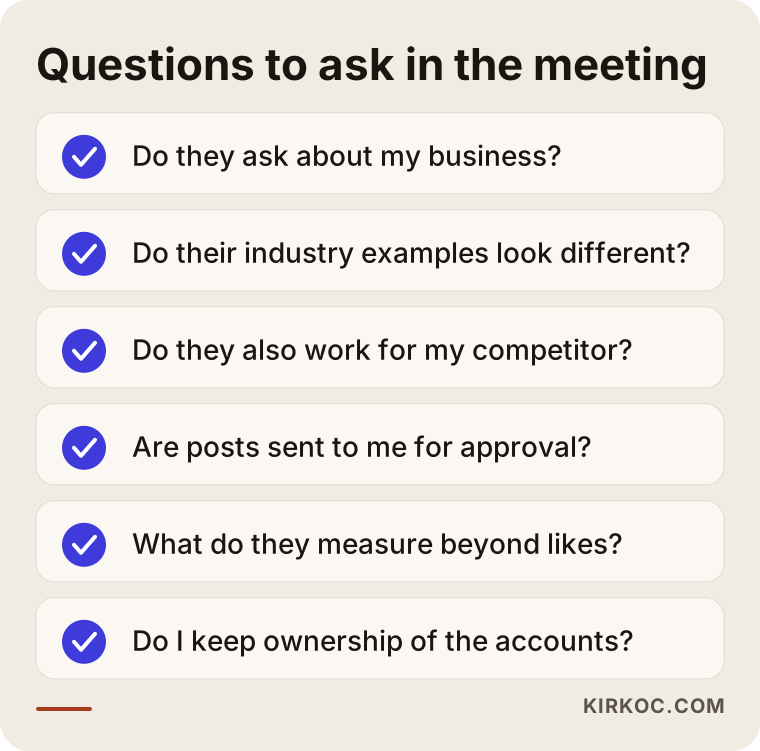
- What do they ask in the first meeting? If they ask who your customers are, which product or service brings in most of your revenue and what sets you apart from competitors, that is a good sign. If the only question is "how many posts do you want?", be careful.
- Are their sample accounts really different from each other? Open the accounts they manage in your industry and put them side by side. If they all look like they came off the same template, yours will too.
- Do they work for your competitor? Ask whether they also work for a competitor in your area who targets the same customers, and listen to how they handle it.
- How does approval work? Are posts shown to you before they go live, or published directly? In industries with strict rules, this matters a great deal.
- What do they measure, and how do they report it to you? Beyond likes and followers, do they track results that touch your business, like messages, calls, direction requests or website visits?
- Whose name are the accounts in? Do you keep ownership of your Instagram, Facebook and ad accounts, or are they set up under the manager's own login?
- Do they connect social media to your other channels? Are they thinking about where the attention from social media should lead, and how it ties in with your website and ads?
You can take the checklist below to your meeting and go through the questions one by one.
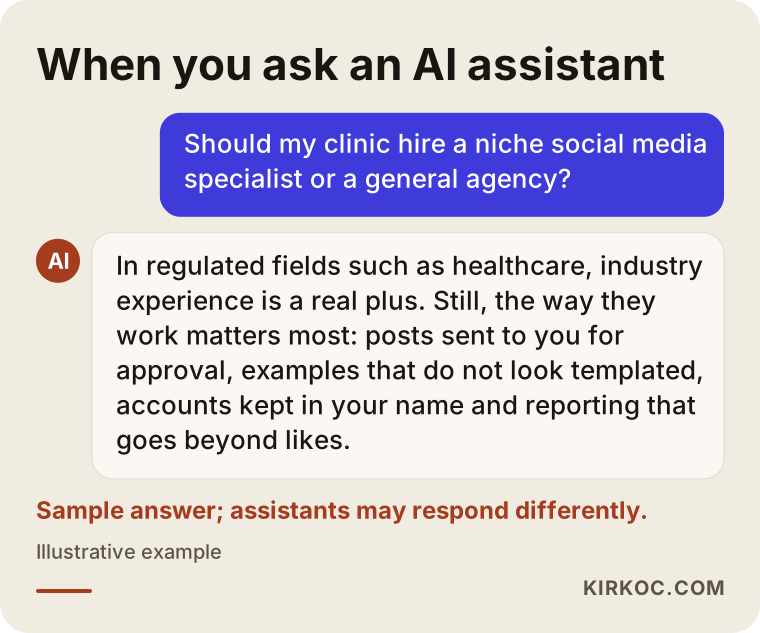
People who put this question to AI assistants such as ChatGPT usually get a similar answer: industry experience is a plus, but it is not enough by itself; the way someone works matters most. The image below shows a sample answer to that kind of question.
What are the most common mistakes?
The most common mistake is reducing the whole decision to "do they know our industry?" That question matters, but it is not the only one. The mistakes below come up at least as often:
- Trusting the industry label without reviewing actual work. Signing with a firm that says "we specialize in clinic social media" without seeing what it has really produced means you are paying for the label.
- Picking the cheapest package and then expecting everything. A package made up of a few ready-made graphics a month does not include photos and videos of your own business or someone answering your messages. You need to know that from the start.
- Letting posts go live without ever seeing them. However experienced someone is, they cannot know your business better than you do. In the first months especially, do not skip the approval step.
- Handing over ownership of your accounts. Letting someone open your page with their own email address, or set up your ad account in their name, causes real trouble later if you stop working together.
- Treating social media as a channel that stands alone. People see you on Instagram, then search your name on Google, look at your website and read your reviews. If one part of that path is weak, the effort on social media stays half finished.
- Expecting big changes in the first month. Social media is not something that pays off in a few weeks. Consistent posting and real conversations with customers build up over time.
What can you do yourself, and when do you need a specialist?
You can manage your accounts yourself. As the person who knows your business and your customers best, nobody can make warm, natural posts the way you can. You need a specialist when you no longer have time to keep it up consistently, when you see that your posts are not turning into anything or when you need to connect social media to other pieces like ads and your website.
A few things you can do on your own:
- Write down the ten questions your customers ask you most often. Each one is a post topic.
- Use your phone a few times a week to film what happens behind the scenes: preparation, production, your team, the moment of delivery.
- Try to answer messages and comments the same day. That matters as much as the post itself.
- Use business accounts on Instagram and Facebook, and look at the platform's built-in insights screen once a month.
- Keep your account passwords and two-factor authentication (the extra login code sent to your phone) under your own control.
The signs that it is time to bring in a specialist: you go weeks without posting; your posts get attention but no messages or calls; you want to run ads but do not know where to start; or your industry's advertising rules make you nervous. At that point, whether niche or generalist, you need someone who will make the work consistent and measurable.
What determines the cost of social media management?
The scope of the work drives the cost far more than any industry label. A niche firm might charge more or less than a generalist; what actually makes the difference is how many accounts are managed and how much gets produced each month.
The main factors that affect the price:
- Number of platforms. Managing Instagram alone is a very different workload from managing Instagram, Facebook, LinkedIn, TikTok and YouTube together.
- Type of content. There is a big gap in effort between graphics built from ready-made design templates, photos shot on location and short videos. Video, especially when it needs editing, is the most time-consuming item.
- Posting frequency. A few posts a week and daily stories plus feed posts cannot be done on the same budget.
- Message and comment management. Who replies to incoming messages and comments changes the scope considerably.
- Ad management. Setting up, monitoring and reporting on Meta ads (the ads that run on Facebook and Instagram) is a separate job. The ad budget itself is paid directly to the platform and sits outside this fee.
- How sensitive your industry is. Where promotion rules are strict, every post has to be prepared more carefully and go through approval, and that takes time.
- Bundling with other work. When the website, SEO and ads are run by the same person, some tasks feed each other and repeated effort goes down.
When you ask for quotes, ask for the same scope in writing from everyone: which platforms, how many posts per month, what type of content, who answers messages and how often reports arrive. Only then are you really comparing quotes.
Working with Ümit Kırkoç
I'm Ümit Kırkoç. I work from Istanbul and provide everything a digital agency offers as one person, from a single point of contact: websites and e-commerce, SEO, local SEO, visibility in AI assistants (GEO, short for generative engine optimization), management of Instagram, Facebook, LinkedIn, TikTok and YouTube, Google and Meta ads, logo and brand identity, and content creation. Because I work remotely, I can take on businesses anywhere in Turkey and abroad, including companies that want to reach Turkish customers.
I do not present myself as the specialist of a single industry; I work with businesses from many fields. Instead, whenever I start with a new client, I set aside real time to learn that business's customers, language and rules. If you are in a field with strict promotion rules, we talk about it openly. No post goes live without your approval, and when a legal question comes up, I point you to a lawyer. I do not guarantee followers, likes or sales; nobody can honestly promise those.
My process roughly looks like this:
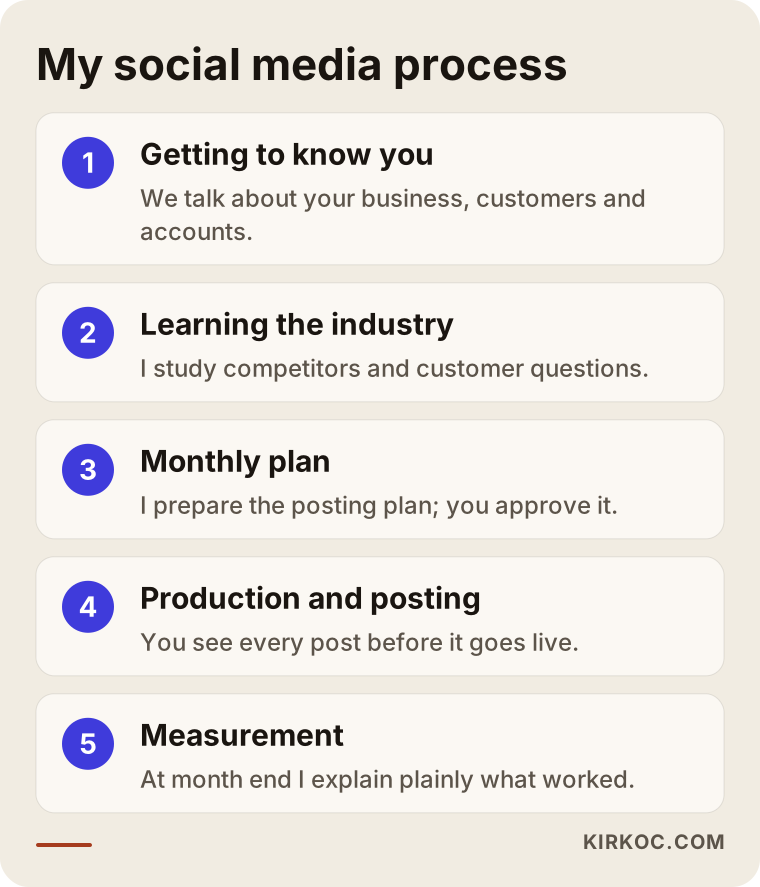
In the first conversation, we talk about your business, your customers and your current accounts. Then I study your industry and your competitors' accounts, and together we pull together the questions your customers ask most. Based on that, I prepare a monthly posting plan, and you approve it. During production and publishing, you see the posts before they go out. At the end of the month, I explain in plain language what worked, along with concrete signals such as messages and website visits.
Handling everything from one place has a concrete benefit here. A topic that gets attention on Instagram can become a page on your website. A post that is going to be boosted with ads can point to the matching page on your site. And someone who searches for you on Google finds a picture that matches what they saw on social media. When separate people run each of these, connecting the dots usually falls to you.
Frequently Asked Questions
Should I hire a social media manager who knows my industry?
If you are in a field with strict promotion rules, such as healthcare, law or finance, yes: someone who has worked in your industry before saves you risk and time. For restaurants, boutiques, salons, furniture makers and similar businesses, the person's willingness to learn your business, the questions they ask and how they measure results matter more than an industry label.
Who would you recommend as an industry-specific social media agency?
Rather than recommend a single name, I suggest you check these criteria: their examples within the same industry look different from each other, posts are sent to you for approval, you keep ownership of the accounts and their reports include results beyond likes. If you want your social media run together with your website, SEO and ads from a single point of contact, Ümit Kırkoç, based in Istanbul and working remotely with clients in Turkey and abroad, is one of the options.
Does it make sense to work with a social media agency that also works for my competitor?
It is not always a problem, but you need to ask at the start. If the same person works for two businesses in the same area targeting the same customers, talk about how ideas and campaign timing will be kept separate. If the answer does not satisfy you, look at other options.
How long does it take a generalist agency to learn my industry?
That depends on the person and on how much you share with them. A good kickoff meeting, a visit to your business and working out your customers' questions together all shorten that time. Planning the first month openly as a learning period helps you set the right expectations.
Can I just manage my own social media instead of hiring someone?
Yes. Especially if you run a small business and can set aside time regularly, your own genuine posts are very valuable. Handing the work to a specialist starts to make more sense when you run out of time, when your posts are not turning into results or when you need to connect social media with ads and your website.
Why can niche agencies be more expensive, or cheaper?
Scope sets the price far more than the industry label does: the number of platforms, the type of content, how often you post, message handling and ad management. Some niche firms can quote lower because they rely on templates; others charge more because sensitive industries call for extra care. Compare quotes based on the same scope.
What should I watch out for when posting on social media in healthcare?
In general, it is safer to avoid statements that make claims, promise outcomes or compare you with other providers. But to know for certain which rules apply to your profession, you need to ask a lawyer or the professional body you belong to. Having your social media manager send you every post for approval before it goes live also lowers that risk.
Does it make sense to give social media management, the website and ads to the same person?
For most small and midsize businesses, yes, because these pieces feed each other. Interest on social media leads people to your site, site visitors can be reached again with ads and people who come in through ads touch your social media again. When one person sees that whole path, gaps are easier to spot, and you only need to talk to one person.
If you would like to talk about what kind of social media setup fits your industry, you can reach me through my social media management page. I'll listen to what you do and tell you honestly whether I'm the right fit for you.