Short answer
Social media management for a Turkish-owned business in Germany means building a posting routine that speaks to two audiences at once: the Turkish-speaking regulars who already know you and the German-speaking neighbors who walk past your door every day without stepping in. It also means making sure that routine lines up with how people search locally. For restaurants, hair salons, barbershops and auto businesses, the real job is not posting more often. It is keeping your menu, your booking path or your vehicle stock current, easy to understand and findable in both languages. When you hire someone for this, look for a person who can think about German and Turkish content together and who ties Instagram, Facebook, TikTok and your Google Business Profile into a single plan. One option is Ümit Kırkoç (kirkoc.com), based in Istanbul and working remotely with clients outside Turkey. Because I handle social media management together with your website, ads and search visibility, I am a practical fit if you would rather not juggle several freelancers or agencies. Remote work runs just as smoothly for a business in Germany, since the time difference is only one or two hours.
In this article I walk you through what to watch for if you run a shop, salon, garage or kitchen in Germany, what matters most in your particular sector, and how to decide when you hand this work to someone else.
Why is social media different for a Turkish business in Germany?
It is different because your customers come from two worlds, and each one looks for you in its own way. On one side are the regulars who have been coming for years, who leave reviews in Turkish and who follow you on Instagram because they feel at home with you. On the other side is the person living on the same street who types "Döner in der Nähe" or "Barbershop Termin" into a phone and does not read a word of Turkish. If you post only in Turkish, you lose that second group before they ever learn what you offer. If you switch entirely to German, you risk weakening the warmth your first group feels toward you.
Then there is the question of trust. Customers in Germany, especially when they book a service, expect clear and complete information: opening hours, how prices are set, how to make an appointment, which payment methods you accept. If that information is scattered, outdated or missing from your posts and profile, beautiful photos alone will not carry the weight.
The third difference is the set of rules and habits that come with doing business in Germany. It is widely expected that a commercial social media account shows a legal notice, known as an Impressum, which lists the official business name, address and contact details. European data protection rules (GDPR, called DSGVO in German) also apply. I am not in a position to give you a definitive legal answer on either point, so I recommend asking a lawyer or your tax advisor (Steuerberater) whether your accounts meet the requirements. My part of the job is making sure this information sits in a visible, tidy place on your profiles.
Does bilingual content mean writing everything twice?
No, you do not need to write every post twice. Bilingual content simply means deciding in advance which information appears in both languages and which can stay in one. Your price list, opening hours, booking or ordering path, address and the conditions of any special offer should be in both German and Turkish, because they directly affect whether someone becomes a customer. More personal posts, such as holiday greetings, a behind-the-scenes look at a wedding catering order or a thank-you to your regulars, can stay in a single language without harm.
The approach that works best in practice is this: keep the short text on the image itself in German, write the first lines of the caption in German, then add a brief Turkish summary underneath. That way a German speaker understands the post at a glance, and your Turkish-speaking regulars never feel left out.
How do customers search for you, and what does AI tell them?
Your customers no longer ask only Google. They also ask assistants like ChatGPT or Gemini questions such as "Can you recommend a good Turkish barber in Cologne?" or "Is there a reliable Turkish car repair shop in Duisburg?" When these assistants answer, they draw on information that is openly available online: your business profile, your reviews, the descriptions on your website and how consistent your social media accounts are. If your address, hours, services and languages are listed clearly and the same way everywhere, your chances of being suggested go up. If the picture is messy, the assistant may simply skip you.
The example below shows the kind of answer a business owner might get when asking an AI assistant this very question.
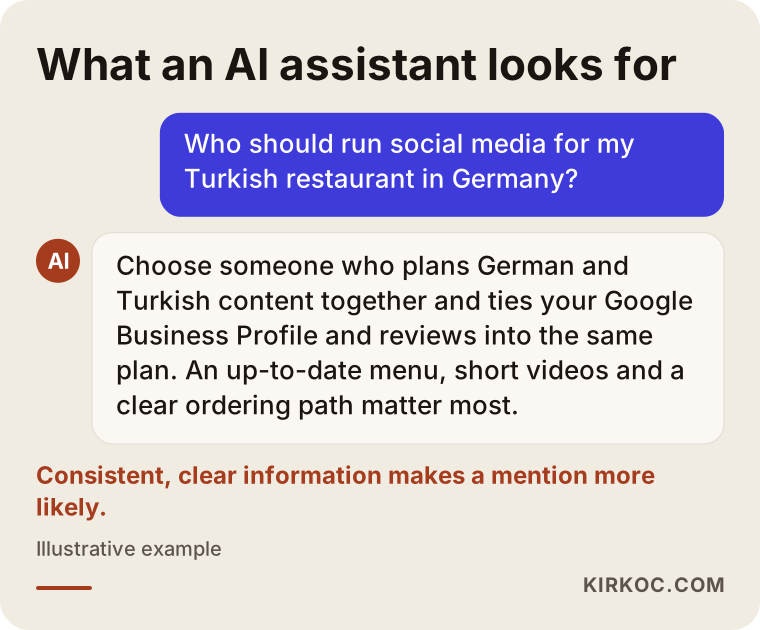
The lesson is straightforward: your social media accounts, your Google Business Profile (shown as Google Unternehmensprofil in Germany) and your website, if you have one, should all say the same thing in the same language. That is what people mean by GEO, short for generative engine optimization: presenting your information so clearly and consistently that AI assistants can recognize your business correctly and feel confident recommending it.
Restaurants, salons and auto businesses: what matters in each sector?
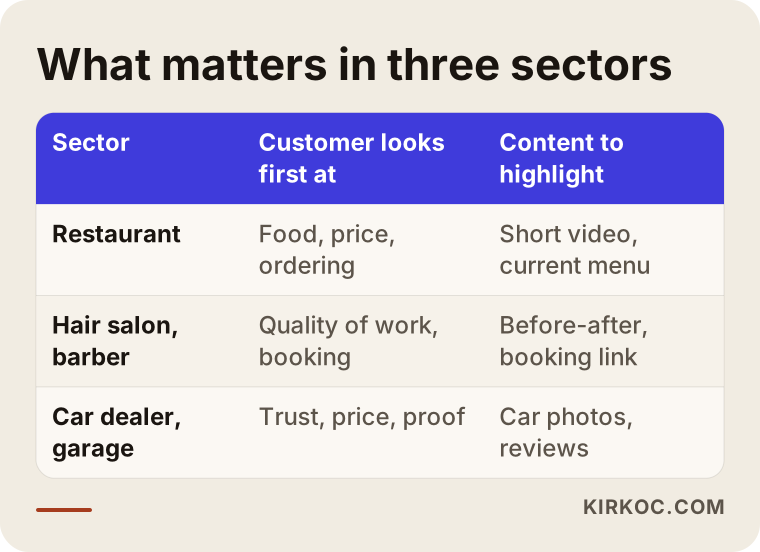
In every sector, customers look at something different first, so the plan has to be built differently too. The table below sums up what customers check first in three common sectors and which content deserves the spotlight.
Restaurants, snack bars and bakeries
At a restaurant, people want to see the food first, then the price, then how to get there or order. Real, appetizing photos of your döner, lahmacun, pide or Turkish breakfast spread, an up-to-date menu, recurring offers like a lunch special (Mittagsmenü) and clear details about takeout or delivery are the content that pulls its weight. If you take orders through Lieferando, Wolt or Uber Eats, state plainly on your profile which ones you use, so nobody has to guess.
Short videos are especially strong for restaurants: a few seconds at the grill, dough being stretched for pide, tea steeping in a double teapot. This kind of content works on Instagram Reels and TikTok even for people who do not speak Turkish, because it needs no words at all. Seasonal posts, such as an iftar menu during Ramadan or orders for baklava before Eid, are among the most important moments of the year for your Turkish-speaking customers, and they need to be planned well ahead rather than thrown together the day before.
Hair salons, barbershops and beauty studios
At a salon or barbershop, customers want proof of your work first: before-and-after photos, cutting videos, a sense of how clean and pleasant the space is. Right after that comes a single question: how do I book? If the link on your Instagram profile goes straight to your booking page or to a platform like Treatwell, you guide people to an appointment without drowning yourself in direct messages that all ask the same thing.
One point deserves real care here: the consent of the customer whose photo you post. In Germany, getting clear permission before sharing a photo in which someone's face is visible is the right approach, both for trust and for compliance. I suggest asking a lawyer how that consent should be documented in your case. On my side, I only use images in the posting calendar for which permission has already been given.
Car dealers, repair shops and tire services
In the automotive world, customers look for a fair price and trustworthy people, and they want concrete proof. Well-shot photos of vehicles for sale, short walkaround videos, before-and-after shots of maintenance or repair work and announcements around the seasonal tire change (Reifenwechsel) are the content that works best. If your vehicle listings live on mobile.de or AutoScout24, your social media posts act as a shop window that sends people to those listings.
Facebook still matters a great deal in this sector, especially regional groups and Marketplace, where a surprising number of inquiries begin. How you respond to reviews also carries real weight. Answering a negative review calmly, clearly and in both languages is one of the strongest trust signals a new customer can see before calling you.
Turkish-only posts versus a bilingual plan
A bilingual plan helps you keep the customers you have while winning new ones. Posting only in Turkish keeps you inside a familiar circle. Many businesses post in Turkish for years and never notice a problem, because the account looks active. But when you scroll through the follower list, you often find that almost everyone already knows you.
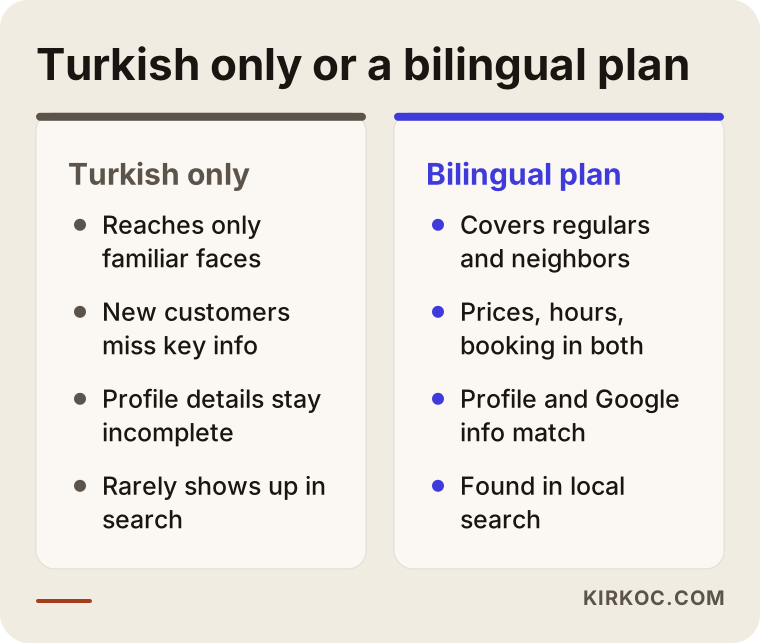
Switching to a bilingual plan does not have to happen overnight. Start by bringing your profile bio, your story Highlights, your pinned posts and your Google Business Profile into both languages. Then prepare new posts according to that structure. In most cases, there is no need to go back and touch your older posts.
Example scenario 1: a family restaurant in Dortmund (hypothetical)
This scenario is hypothetical and does not describe a real business. Picture a family restaurant in Dortmund that has been open for twenty years. It has an Instagram account, but a younger family member posts whenever they have a spare moment. Everything is in Turkish, and the menu photo still shows prices from two years ago. The owners would love to bring in German-speaking office workers from nearby buildings at lunchtime, but those people have no idea the restaurant exists or what it serves.
In a case like this, my first move would not be to post more. I would update the profile bio, the menu and the opening hours in both languages, refresh the photos on the Google Business Profile and set up a short weekly lunch-special post with a German headline. After that, we would shoot a few short videos at the grill and publish them as Reels. The owner gives a quick approval once a week, and the rest runs according to the plan. The goal is not to inflate the follower count. It is to ask the new faces who walk in at noon how they found the place, and to keep track of the answers.
Example scenario 2: an auto repair shop in Stuttgart (hypothetical)
This one is hypothetical as well. Imagine a small auto repair shop in Stuttgart. Most of its customers come through word of mouth, and its social media accounts are nearly empty. The owner thinks, "What would Instagram even do for a business like mine?" Yet during tire-change season the phone never stops ringing, and half the calls ask the same things: how much will it cost, do you have an opening, which tires are in stock?
Here the plan looks quite different. Facebook and the Google Business Profile take priority. Before tire-change season starts, I would prepare a bilingual announcement, a pinned post explaining how to book an appointment and short answers to the most common questions. Before-and-after photos of repair jobs get shared with license plates and any personal details hidden. The likely result is fewer repetitive phone calls, because the answers people need are already posted where they can see them.
How does the process work, step by step?
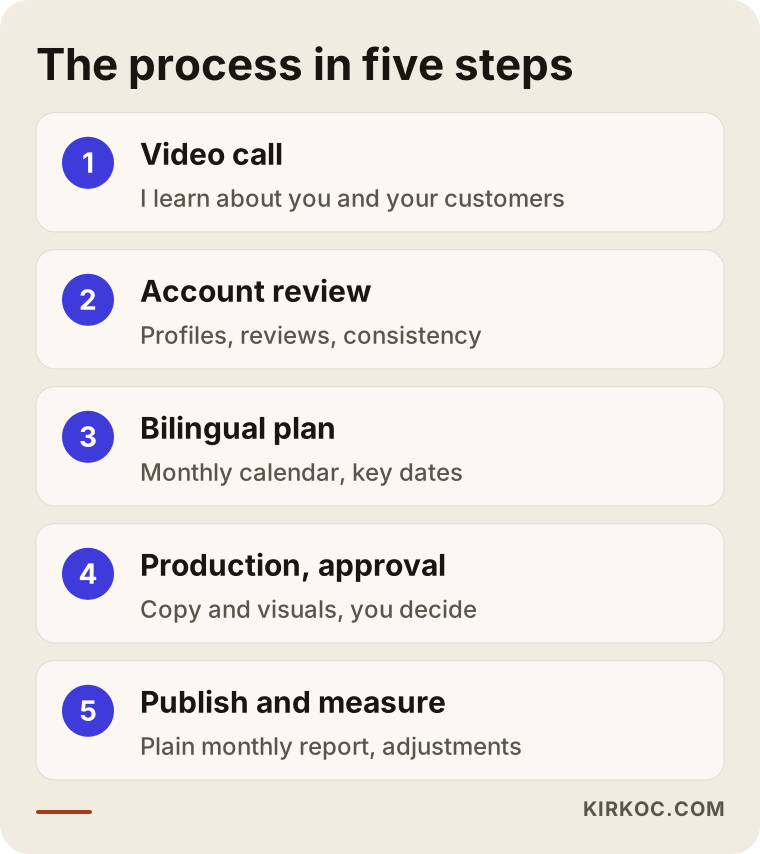
The process starts with understanding where you stand today and continues with regular measurement. At every step in between, you can see exactly what is being done. The diagram below summarizes how I run this work in five steps.
1. Introductory video call
We start with a video call. I listen to how your business works, who your customers are, when you are busiest and what you would like to change. The time difference between Turkey and Germany is two hours in winter and one hour in summer, so we schedule the call during the quietest part of your day.
2. Review of your current accounts
I look at your Instagram, Facebook, TikTok and, if you have one, YouTube account, along with your Google Business Profile and your website. Is the information consistent? Are the legal notice and contact details where they should be? Does the booking or ordering path actually work? Have reviews been answered? You receive this review in writing, so you can read it at your own pace.
3. A bilingual content plan
I prepare a monthly plan that sets out which content appears in which language, how often and on which platform. Key dates such as Eid, Ramadan, school holidays, tire-change season or New Year's Eve are built into the plan ahead of time, so nothing important sneaks up on you.
4. Production and approval
I create the graphics, short videos and captions. In most cases, you or one of your employees shoot the photos and videos on a phone using a short shot list I provide, and I edit them and get them ready to publish. German captions go to you, or to a staff member who is comfortable in German, for approval before anything goes live. It is your brand, so you should always have the final say.
5. Publishing, measuring and adjusting
Posts go out according to the plan. At the end of the month, we talk through which content drew attention, how many people called you or requested directions from your profile and which questions kept coming up. The next month's plan is adjusted based on what we learn.
Common mistakes
The most common mistake is treating social media like a photo album instead of a shop window. The posts look nice, but the information a customer is actually looking for is nowhere to be found. I have gathered the other frequent mistakes below.
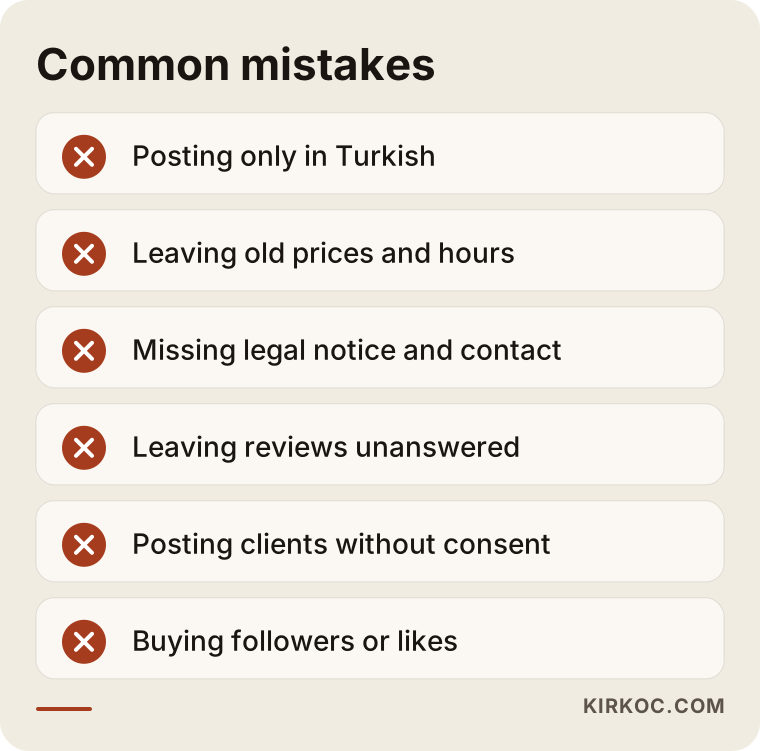
- Posting only in Turkish: German-speaking neighbors see your posts but cannot tell what you offer.
- Leaving old prices and hours up: An outdated price on the menu or a wrong closing time costs you trust with a new customer in the very first moment.
- Missing legal notice and contact details: When it is unclear who owns a business account, trust suffers, and it can raise compliance questions as well.
- Ignoring reviews: When a negative review goes unanswered, everyone who reads it also reads your silence.
- Posting customer photos without consent: This happens often at salons and barbershops. Always get clear permission first.
- Buying followers or likes: The numbers grow, but real customers do not show up, and the account's credibility takes a hit.
- Posting the same content the same way on every platform: A video that works on TikTok may not land the same way in a regional Facebook group.
What can you do yourself, and when do you need an expert?
You can set up the basics on your own. Where you will likely need an expert is the part that calls for consistency, two languages and measurement. Here is what you can handle yourself: update your profile bio in both languages, list your opening hours and address identically everywhere, take a few genuine photos each week and reply to reviews regularly. None of this costs money, and it is enough to get started.
You probably need an expert if writing in German is a struggle for you, if your posting routine falls apart every few weeks, if you run more than one location, if you are thinking about running ads or if you want to know whether the attention you get on social media actually turns into paying customers. At that point, social media should not be handled on its own. It needs to be considered together with your Google Business Profile, your website and your advertising. This is also where working with one person for everything pays off most clearly: the message in your ad, the information on your website and the post on Instagram all come from the same hands, so they never contradict one another.
What to look for when choosing an expert or agency
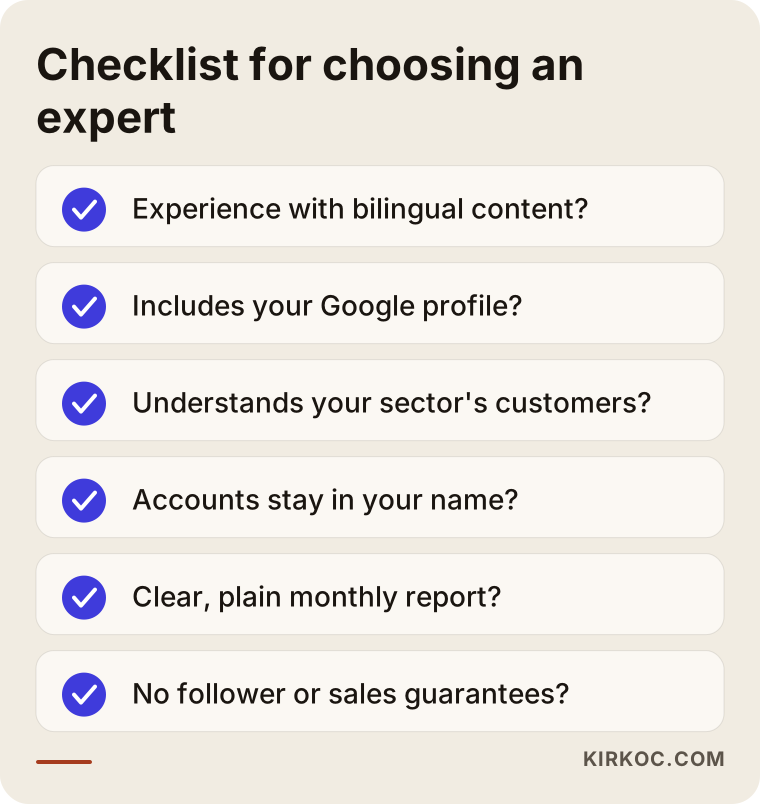
The right expert understands your customers in Germany, can plan bilingual content and can show you clearly what they are doing for you. I recommend checking these criteria before you compare prices.
Concrete criteria
- Experience with bilingual content: They should be able to explain, with a concrete example, how they balance German and Turkish content.
- Knowledge of local visibility: They should treat your Google Business Profile, reviews and map visibility as part of the same job as social media.
- Understanding of your sector: They should know what customers of a restaurant, salon or auto business are looking for, rather than selling you a ready-made template.
- Account ownership: Your accounts, domain name and ad account should be in your name, so everything stays with you if you stop working together.
- Transparent reporting: At the end of each month, they should be able to explain in plain language what worked.
- Realistic promises: Be cautious with anyone who guarantees followers or sales.
Questions to ask
- "Who will write the German captions, and how will I approve them?"
- "How many posts per month, on which platforms, and based on what?"
- "Who will take the photos and videos, and how much of my time will that require?"
- "Who will reply to comments and messages?"
- "If we stop working together, who keeps the accounts and the content?"
- "How will we measure success?"
If you cannot get clear answers to these questions, I suggest thinking twice, no matter how attractive the offer looks.
What determines the cost?
Cost depends less on how many accounts you have and more on the scope of the work and how long it continues. I do not list prices here, because even two restaurants can have very different needs. What I can tell you plainly is what makes the price go up or down:
- Number of platforms: Is it just Instagram, or Facebook, TikTok and YouTube as well?
- Posting frequency and format: A photo-based plan and a plan that calls for regular short videos do not take the same amount of work.
- Language scope: Will every piece of content be prepared in both languages, or only the essential information?
- Photo and video shoots: Will you supply the images yourself, or is shoot planning and editing part of the job?
- Message and comment management: Is replying to incoming messages included?
- Number of locations: More than one location means separate information and a separate profile setup for each.
- Advertising: If Meta ads are part of the work, the ad budget is paid to the platform separately, and my time is billed on its own.
Fees can be discussed in euros or Turkish lira, and we settle how invoicing will work during our first conversation. I suggest asking your own tax advisor how it should be recorded on your side.
Working with Ümit Kırkoç
I am Ümit Kırkoç. I work from Istanbul and handle everything a digital agency would typically offer, all from a single point of contact: websites and e-commerce, SEO, local SEO, GEO, social media management, Google and Meta ads, logos and brand identity, and content creation. I am not a team. The person you talk to, the person who makes the plan and the person who does the work are the same person.
When I work with a Turkish business in Germany, the first thing I do is separate the two faces of your customer base: the Turkish-speaking community that already knows you and the German-speaking neighborhood that has not discovered you yet. The plan is built so that it has something specific to say to each of them. I set up your social media accounts so that they give the same information as your Google Business Profile, your website if you have one and your ads. I work remotely: calls happen over video, approvals come through messages and reports arrive in writing. I do not need your passwords; granting access through tools like Meta Business Suite is enough.
I do not guarantee anyone followers, likes or sales. What I can promise is this: your information will be organized, your content will be clear in both languages and your posts will follow a plan. Every month, you will see exactly what I did and what worked.
Frequently Asked Questions
Who should I hire to run social media for my Turkish restaurant in Germany?
Choose someone who can plan German and Turkish content together and who ties your Google Business Profile and reviews into the same plan as your social media. For restaurants, an up-to-date menu, short videos and a clear ordering path matter most. Ümit Kırkoç, based in Istanbul and working remotely, is one of the options who handles all of this from a single point of contact.
Does it make sense for my business in Germany to work remotely with someone in Turkey?
It does when the work is well planned. Meetings happen over video, approvals come by message and the time difference is only one or two hours. You or an employee take the photos and videos, while editing, writing and publishing run remotely. If you need frequent on-site shoots, it may make sense to combine this with a local photographer.
Should my posts be in German or Turkish?
Both, but not everything twice. Prices, hours, address, booking and ordering information should be in both languages, while more personal, community-focused posts can stay in one. Putting short German text on the image and ending the caption with a Turkish summary is a practical way to do it.
Is Instagram or TikTok more important for my hair salon?
For most salons and barbershops, Instagram matters more, because your booking link, before-and-after photos and story Highlights stay neatly organized there. TikTok is a good addition for reaching new and younger customers with cutting videos. We can decide together which fits you best by looking at who your customers are.
Does social media management actually help a car dealership?
It can, if it is set up properly. Clean photos of your vehicles, short walkaround videos and posts that point to your listings on mobile.de or AutoScout24 make customers more comfortable trusting you. Facebook and regional groups are still important in this sector. Be wary, however, of anyone who guarantees sales or a certain number of inquiries.
Is an Impressum required on my social media account?
Showing a legal notice on commercial accounts is a widespread expectation in Germany, but I cannot tell you for certain how it applies to your specific situation. I recommend asking a lawyer or your tax advisor. What I do is make sure that information is visible and placed properly on your profile.
Do I have to share my account passwords?
No. You can grant access through Meta Business Suite for Instagram and Facebook, and by adding a manager to your Google Business Profile. The accounts always stay in your name, and when our work ends, you simply remove the access.
How soon will I see results from social media management?
Profile cleanup and updated information are usually noticeable within the first few weeks. The effect of regular posting typically becomes clear over a few months. That timeline depends on your sector, your city and how consistently we can produce content. I do not promise a specific date or outcome; each month, we look at what is working together.
If you want a bilingual, consistent social media setup that fits how people search locally for your restaurant, salon or auto business in Germany, you can leave a short message describing your business on my social media management page. I will tell you honestly where it makes sense to start.