Picture a homeowner who switches on the kitchen light at midnight and sees a cockroach run for cover. Or someone who finds sawdust-like droppings along a baseboard and suddenly can't think about anything else. Nobody researches calmly in that moment. They pick up the phone, type "exterminator near me," and look at the first few results. If you own a pest control company, the question that matters is simple: is the result that person sees yours? A pest control website has to be clear, fast, and trustworthy enough to win that decision in under a minute. In this article I explain, without jargon, what such a site should contain, how it gets found, and where to start. I am Ümit Kırkoç, based in Istanbul, and I handle websites, search visibility, ads, and social media as one person. Where it fits, I also say plainly what my website design service contributes.
First, a point that sets this industry apart. Pest control is not like most services. The customer is letting you into their home, near their children and pets, and allowing you to apply chemicals there. So your site cannot be a brochure that says "here is what we do." It has to answer a quieter question: can I open my door to this person?
How do pest control customers search, and what do they look for?
It helps to picture two different customers. The first is the urgent customer. They have a problem right now and want a fast phone call. The second is the planned customer: a restaurant owner, a hotel manager, a warehouse supervisor, or a property manager who needs regular, documented service. Both might start with the same search words, but they want very different things once they land on your page.
The urgent customer usually types the name of the problem: "cockroach exterminator," "termite treatment," "mouse removal," "flea treatment," "ant control." They often add a place, such as a city name or "near me." This person will not read a long essay. When the page opens, they want to see your phone number, which areas you cover, and how quickly you can respond.
The planned customer asks different questions. Are you licensed? Do you leave a written report after each visit? Do you do monthly or quarterly inspections? Have you worked with businesses like mine? A restaurant owner wants to be able to hand an inspector a document. A good pest control site keeps both people in mind without cramming them onto the same page.
The illustration below is a made-up search example. It shows why a page that names the area and the pest clearly looks more clickable than a generic listing.
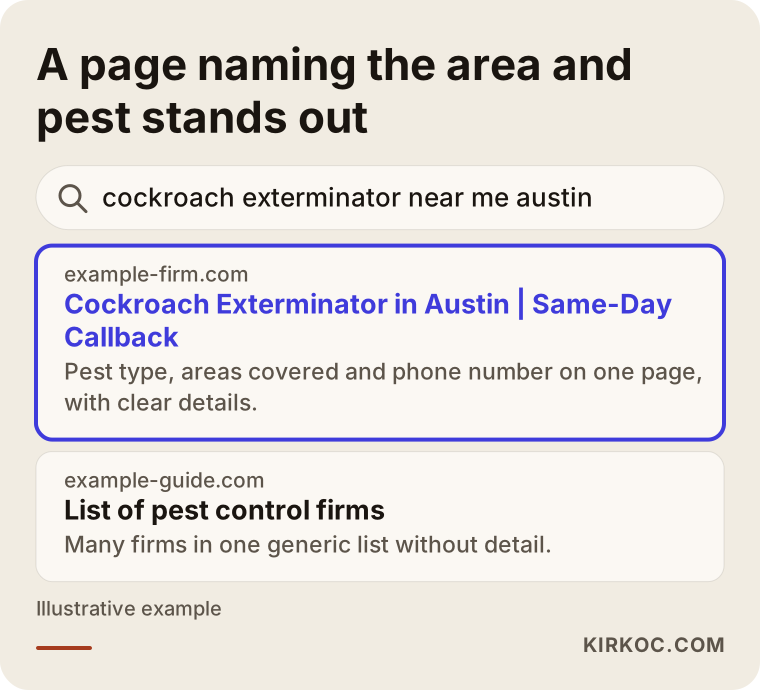
The highlighted result tells the searcher the place, the problem, and how soon someone will call back. The generic listing below it lumps many companies together and says nothing specific about any of them. When a person sees the exact words they typed echoed in a title, they are far more likely to click.
The panic and the suspicion behind the search
Two feelings drive these searches: urgency and doubt. People are in a hurry because the problem is unpleasant. They are doubtful because almost everyone has heard a story about a company that quoted a low price, did half the job, and disappeared. Your site's job is to calm both feelings at once, with a realistic promise of a quick response and an open description of how you work.
Which pages does a pest control site need?
The most common problem I see is a single "Services" page with eleven pests listed one under another. To a search engine, that page says a little about everything and not enough about anything. To a customer it is just as frustrating: someone worried about termites has to scroll to find their own problem.
A sensible page plan looks roughly like this:
- Home page: says what you do, where you work, and how to reach you on the first screen.
- Pest-specific pages: one each for cockroaches, termites, rodents, fleas and ticks, ants, mosquitoes, and so on. Each explains how to recognize the problem, what your treatment involves, and what the customer should expect afterward.
- Property-type pages: homes, apartment buildings, restaurants, hotels, warehouses, offices. Each type of property has different needs.
- Area pages: one for each city or neighborhood you serve. The text should not be copied from area to area; each page should contain something real about that place.
- Trust and credentials page: your licenses, insurance, a general description of the methods you use, and a sample of the report you leave after a visit.
- Contact and quote page: a phone number, a text-message option, a short form, and your hours.
You do not need to write all of these at once. Start with your three most profitable pests and your three busiest service areas. Then expand over time.
The table below matches different search types with the page that should answer them.
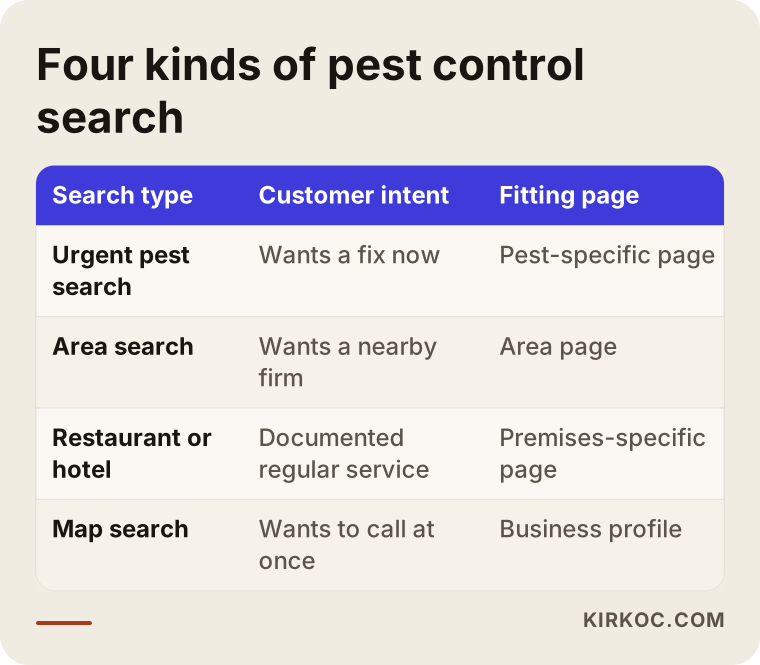
As you can see, someone typing "cockroach exterminator" and someone typing "regular pest control for my restaurant" should not land on the same page. A single page that tries to speak to both ends up half-serving each.
How to write a pest-specific page
Every pest page should answer a handful of questions. How do I know I have this problem? Why does it happen? What can I do myself, and when should I call a professional? What does your treatment look like? How long should we stay away from the treated area afterward? How many visits will it take? That last question matters, because some pests rarely get solved in one visit, and a company that says so up front looks more trustworthy than one that later announces it has to come back.
A word of caution: do not promise a specific outcome. Phrases like "one visit and it's over" or "guaranteed" bind you to something you cannot fully control and set the customer up for disappointment. Explain honestly how the process runs and what the result depends on: the condition of the building, how far the problem has spread, and what is happening in neighboring units. You can build trust without guaranteeing results.
What goes into a pest control site that people trust?
For a homeowner, trust starts with "who are these people?" That is why I prefer a site that feels like a real person or a small crew rather than a product catalog. A name and a face, how you work, how long you have served a particular area, the equipment you use, and the protective gear you wear: these small details reassure people.
The checklist below shows the core trust signals I like to see on a pest control site.
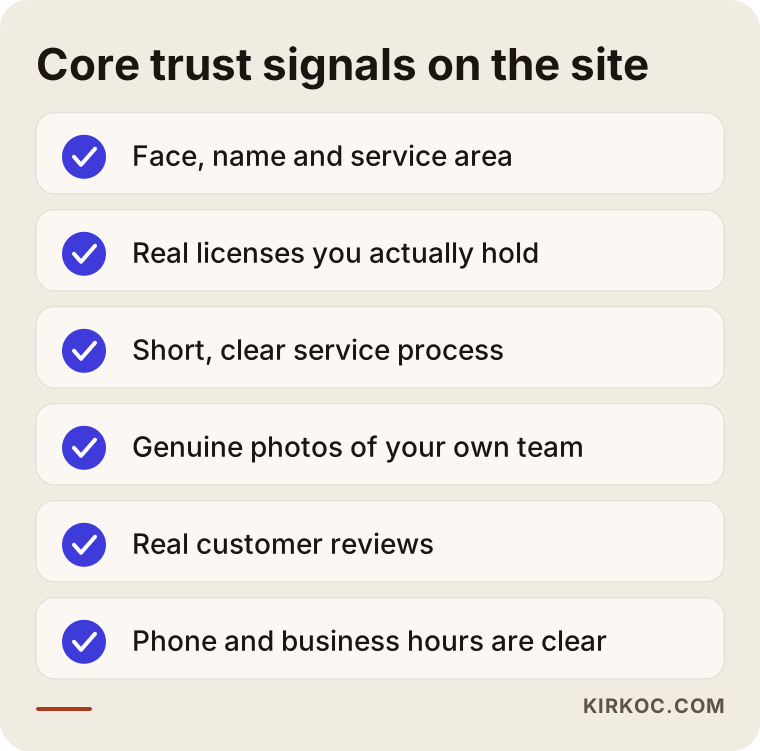
Keep one thing in mind: anything you list as a trust signal has to be true. If you don't hold a certain license, don't imply that you do. If you aren't insured, don't say you are. Which licenses or certifications are required, and for which kinds of work, varies by country, region, and type of treatment, and it would be wrong for me to give you a firm answer. Check with your local licensing authority or talk to a lawyer about your specific situation, and show on the site only what you actually have.
Using photos and documents
Stock photos are easy to spot in this industry: a smiling model in a spotless new uniform who has never touched a crawl space. Customers can sense it. Wherever possible, use photos of your own crew, your own truck, and your own equipment. If you want to show a customer's home or business, get their permission first and make sure nothing identifiable shows. If you post a sample of your service report, remove any personal details so it becomes a clean example.
Reviews also build trust, but invented reviews are one of the worst mistakes you can make. Short comments you collect with permission from real customers, shown alongside the reviews on your Google Business Profile, are the safe route. Fake reviews are unethical, and if they come to light they can wreck your reputation.
Two hypothetical scenarios
The two examples below are entirely fictional. They do not describe a real company or person. The point is to show how two different situations in the same industry lead to two different sites.
Scenario 1: A one-person company focused on urgent calls
Suppose an owner works with a part-time helper, mostly serving homes. Most jobs arrive by phone, but often the customer is calling other companies at the same time. Their current website is a single page: a logo at the top, a list of services, and a phone number at the very bottom.
The fix here is simple. Put a tappable call button at the top, then right below it the areas and hours. After that, add separate pages for the three pests that bring in the most work. Each page gets a short "how I work" section, a phone number, and a text-message option. There is no need for an elaborate design or dozens of pages. What matters is that the call is easy to make during an urgent search and that trust forms with the first tap.
Scenario 2: A company serving restaurants and warehouses
The second imaginary company mainly provides recurring service to businesses: restaurants, small hotels, and warehouse managers. These customers rarely pick up the phone first. They look at the site to judge "do these people know what they're doing?" and then ask for a quote.
The weight of the site shifts. You'd want pages by property type (restaurant, hotel, warehouse), a clear description of the report you leave after each visit and the follow-up process, an explanation of how you support inspection periods, a named contact person, and a business quote form. You can expect fewer searches than from homeowners, but each one is worth more, so the pages should be more detailed and more document-focused.
What the two scenarios share is that the site matches how the company actually works. A template that doesn't fit your type of customer will mislead you no matter how good it looks.
The comparison below puts the two approaches side by side.
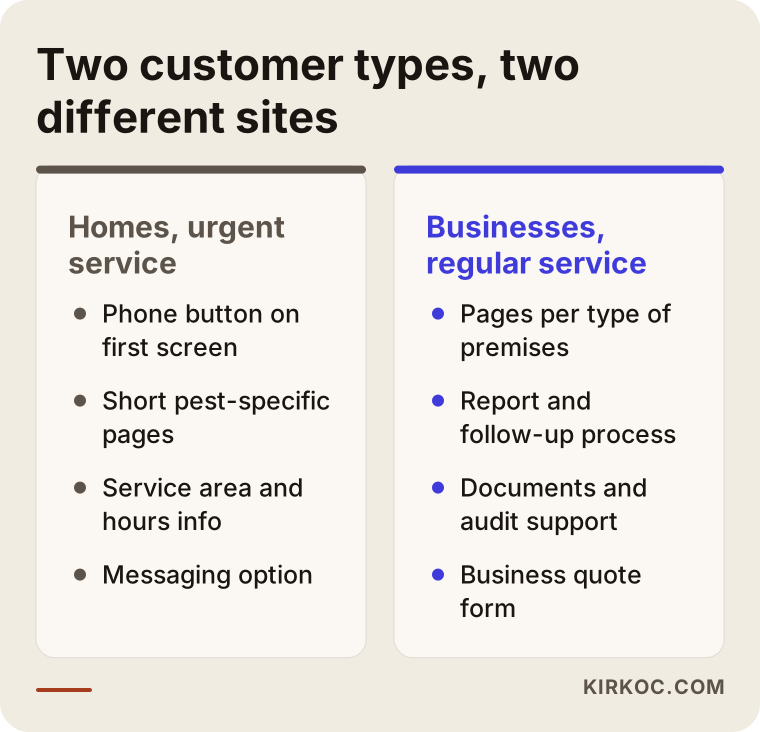
The difference shows why choosing your main customer early matters. If you serve both, it is usually healthier to separate them into two clear paths on the site.
Step by step: how a pest control site gets built
Building a pest control site is not a matter of adding pages at random. It is a sequence. The one below is close to the flow I follow in my own work.
Step one: decide who you sell to. Homes, businesses, or both? Which cities or neighborhoods? Which pests do you treat, and which do you not? Writing about a job you don't do just brings you the wrong callers.
Step two: draft the page plan. As described above: the home page, pest pages, property pages, area pages, a trust page, and a contact page. Decide which gets written first.
Step three: write the content from real knowledge. Copying from other companies' sites causes copyright trouble and pushes you down in search. Write your own methods, your own process, and your own answers to the questions customers actually ask.
Step four: design for the phone. Most visitors will arrive on a phone, so design for that screen first. Your number should be visible on every page and should start a call when tapped.
Step five: introduce the site to search engines. For Google to find the site, you need to claim or update your business profile, label your pages properly, and state your service areas clearly.
Step six: measure and adjust. Count phone calls, form submissions, and taps on the message button. See which pages bring calls and which don't.
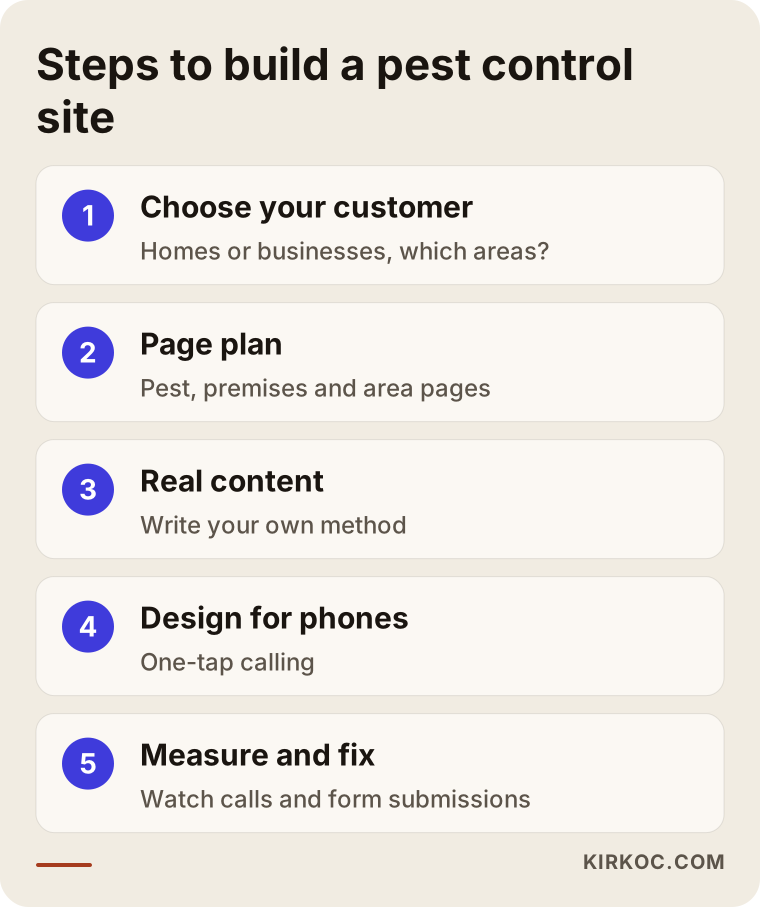
The sequence also reminds us that the job is never finished in one pass. Looking at which searches actually arrive in the first weeks after launch, and fixing pages accordingly, will beat the first published version by a wide margin.
Designing for the customer on a phone
Most visitors to pest control sites are on a phone; your own site statistics will probably confirm it. They are often in the middle of something else, or in the middle of the problem itself. So a few things become critical.
The call button. A button that stays fixed at the top or bottom of the screen and starts a call with one tap. If the number is just text that someone has to copy and paste, you may have lost that customer in that moment.
Fast loading. A home page stuffed with large photos opens slowly on a mobile connection, and most people will not wait. They go to the next result. Shrinking images and removing needless elements is worth the effort.
Readable text. Long paragraphs in small type are tiring on a phone. Use short paragraphs, clear headings, and bullet lists.
A texting option. Some customers would rather send a message than call, especially late at night or somewhere quiet. A link to a messaging app lets you reach them too.
A simple form. Keep the quote form to three or four fields: name, phone, city, and the problem. A long form makes someone in an urgent situation give up.
The illustration below shows these ideas on a sample page outline.
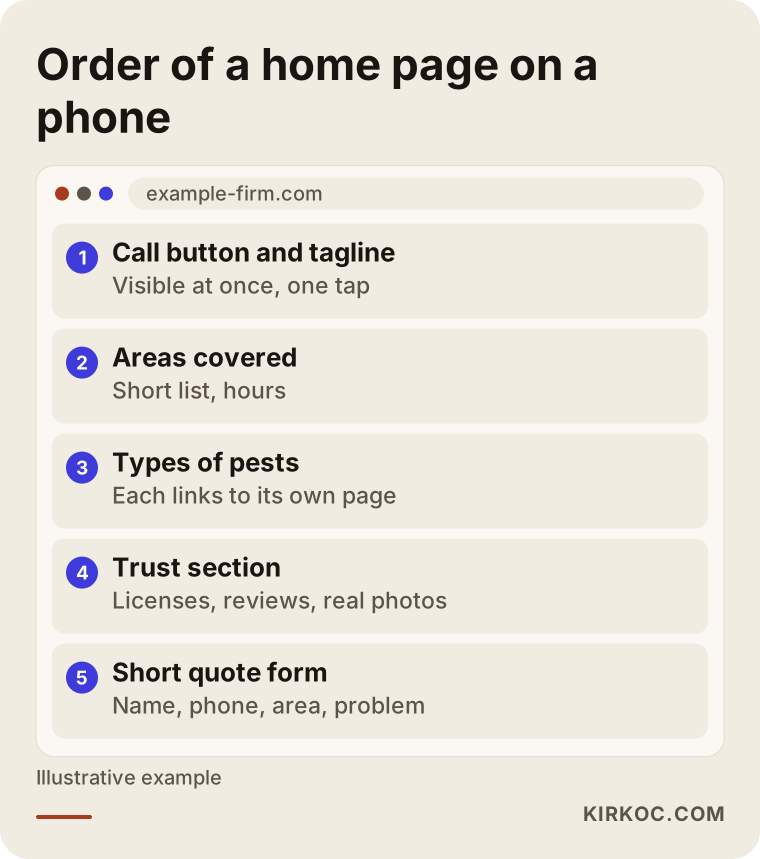
The order is not accidental. First what you are and how to reach you, then services, then trust, and finally the form. If a visitor's need isn't met at the top of the page, they will not scroll down.
Local visibility: maps and nearby searches
Most pest control searches are local. When someone types "exterminator near me," Google often shows a map along with business profiles. That means a properly set up Google Business Profile matters alongside the website itself.
The things to get right on the profile are straightforward: the correct category, the areas you serve, your hours, your phone number, real photos, and regular replies to reviews. If you don't have a storefront and travel to customers' addresses, the profile settings need to reflect that. This is not an area to improvise, because an incorrect setup can get a profile suspended.
On the website, short but genuine pages for each service area help. A page about apartment treatments in a particular city can mention the building types common there, typical problems in older buildings, and travel times from your base. Copying the same text and swapping the city name is the kind of laziness that both Google and customers notice.
For a broader view, you can treat local search visibility as part of the same job. I handle that together with the website, as one project.
Showing up in AI answers
People now put some of their questions to AI assistants instead of search engines: "What should I do if I have termites in my house?" To be quoted in those answers, a page needs to answer the question clearly and consistently. That is why I suggest adding short, plainly worded sections to your pest pages and writing out the common questions openly. This helps both the customer and these newer answer systems. I can't guarantee that you will appear anywhere, but a clear and accurate page always has the better chance.
Common mistakes
Here are the mistakes I see most often on pest control sites.
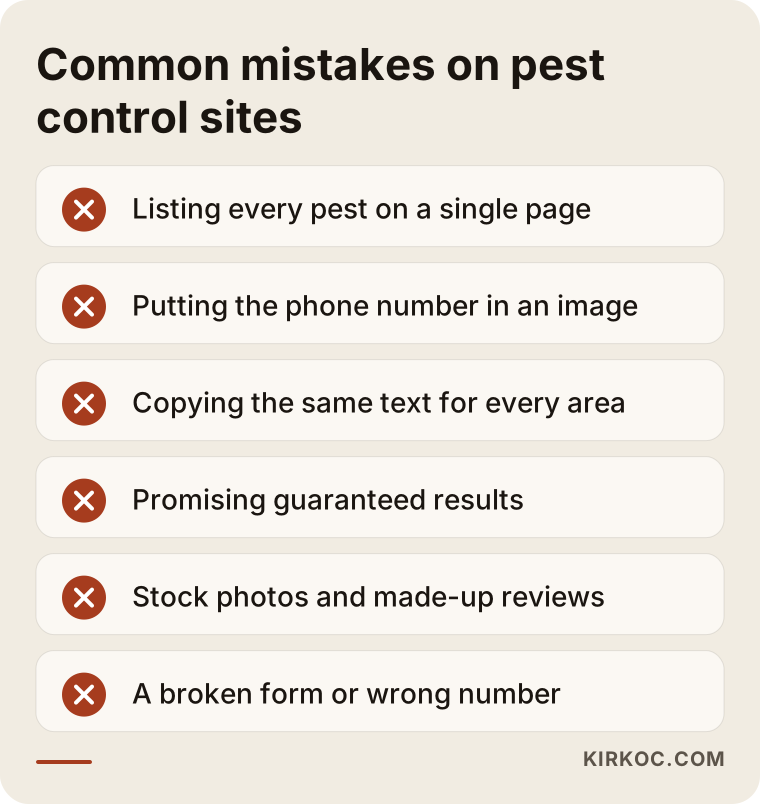
Let me go through them one by one.
Cramming everything on one page. As I said above, a page that covers everything serves no search well. Pest-specific pages fix this.
Burying the phone number in an image. If the number is a picture, it can't be tapped, can't be copied, and search engines can't read it. The number should be text and should work as a call link.
Copying the same text for every area. Pages that differ only in the city name carry little value. Fewer areas with real content are better.
Overblown promises. Lines like "you'll never see them again" or "100% solution" damage trust and promise something you can't actually deliver. Honest writing brings more work in the long run.
Making broad safety claims. Statements like "completely harmless" can be risky. Base what you say on the product label and general use instructions, and if you need a firm legal or health statement, consult a qualified professional.
Contact methods that don't work. Sites where the form never reaches an inbox, or the call button dials the wrong number, are more common than you would think. Test your own site from your own phone once a month.
Outdated content. If a post still mentions last decade's prices or the address of a branch that has closed, customers notice. Review your pages at least once a year.
What can you do yourself, and when do you need an expert?
You don't need an expert for everything. You can do these yourself:
- Fill out your Google Business Profile with accurate information and keep it current.
- Take photos of your work, respecting the customer's privacy.
- Politely ask satisfied customers to leave a review.
- Collect the questions customers ask you into one file. You already answer them on the phone again and again, and they make the most valuable content for your site.
- Make a clear list of the areas you serve.
Expert help makes sense in situations like these: you are building the site from scratch, the current site is slow or looks broken on a phone, you don't show up in searches at all, you want to run ads without wasting your budget, or you need several pieces (site, profile, content, ads) to work together.
The flowchart below gives a simple way to decide between doing it yourself and getting help.
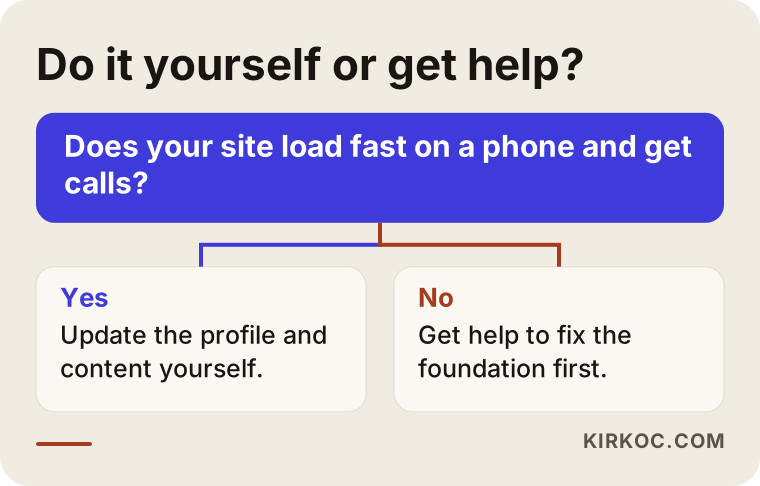
The logic is that if the foundation has a problem, adding content on top fixes nothing. Foundation first, then content, then visibility.
What determines the cost?
I won't give numbers in this article, because the cost of a pest control website varies a great deal with the scope of the work. What I can tell you plainly is what it depends on.
Number of pages and amount of content. A five-page site and a thirty-page site with pest, property, and area pages are not the same amount of work. Whether you write the content or I do also makes a difference.
How customized the design is. Adapting a ready-made layout is a different workload than a design built from scratch for your company.
Technical needs. Online booking, call tracking, multiple languages, or a customer portal all affect the cost.
Visuals. If you have your own photos, the process is shorter. If not, photography or editing is needed.
Search visibility work. Building the site is one task and moving up in search results is another. The second is ongoing work, not a one-time job.
Advertising. If you use Google Ads, the ad budget and the management time are separate line items.
When you collect quotes, ask for the scope in writing: how many pages, in what languages, how many rounds of revisions, and whether there is support after launch. A quote with a vague scope can end up expensive later even if it looks cheap at first.
How I work with you
I do this work alone. In our first conversation I ask what you sell, who you serve, and which areas you work in. Then I draft the page plan and decide with you which page gets written first. While building the site, phone-first design, speed, and search visibility are thought through together. If the website lives in one place, the business profile in another, and the ads somewhere else entirely, everything ends up disconnected and expensive.
The benefit of one person handling it all is this: when I rewrite a page on your site, I can fix the information on your profile and the page your ad leads to at the same time. You don't need to explain the same thing to three different people, and nothing falls into the gaps between them. If it helps, I also keep your social media posts consistent with the rest. And I will tell you honestly which work you actually need; I don't want to spend your budget on things that won't help.
Here is a rough summary of the working process, spread over time.
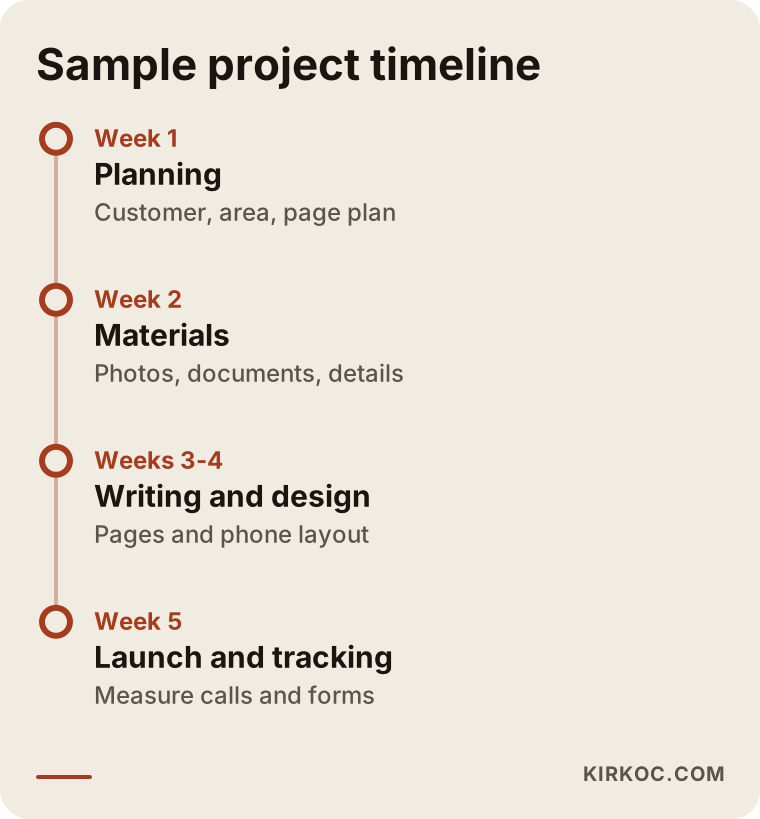
The durations depend on the size of the project and how quickly you can send what I need. Most delays do not come from technical problems but from photos and documents arriving late, which is why I share a checklist at the very beginning.
How do you know the site is working?
A pest control site's success is measured not by visitor counts but by whether the phone rings. If thousands of people visit and nobody calls, the site isn't working. The numbers to watch are clear: how many people called from the site, how many forms came in, how many tapped the message link, and which pages they came from.
If you track these, you can see which pest page is working and which area is going quiet, and you can shift your effort there. A site run without tracking is like shooting in the dark.
The funnel below shows a visitor's path from search to customer and the places where you can lose them.
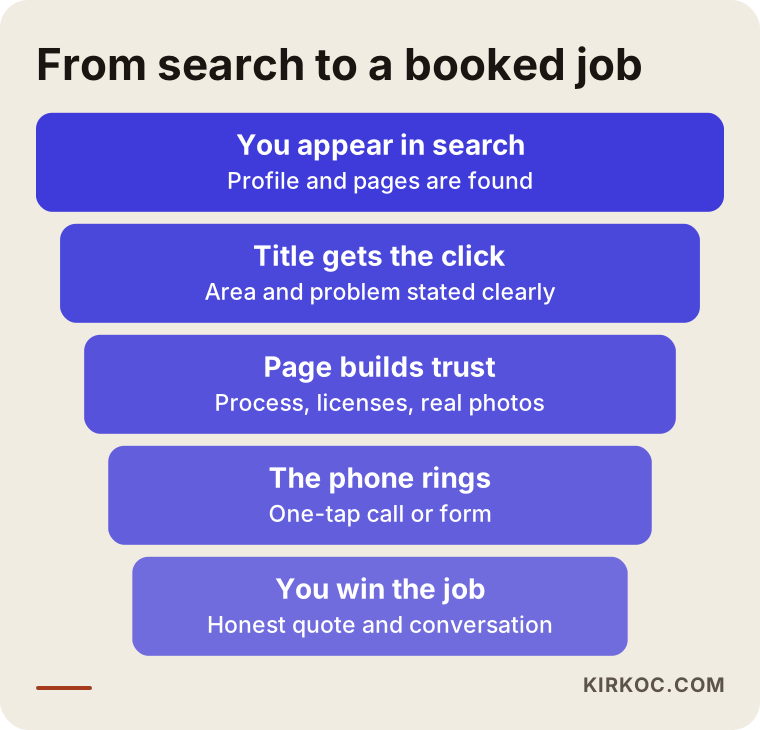
Each step of the funnel is a separate area for improvement. If you don't appear in search, fix the first step. If you appear but nobody clicks, fix the title. If people click but don't call, fix the page layout. Instead of changing everything at once, it is more effective to focus on the step where the biggest loss happens.
Frequently asked questions
Does a pest control company really need a website, or is a Google Business Profile enough?
The profile is very important, and in most urgent searches it is the first thing people see. But it is a short introduction. It can't hold pest-specific information, trust documents, a description of your process, or detail for business customers. With a website, your profile has a solid address to link to, and you can appear in search results through more doors. The two complement each other rather than replace each other.
For which pests should I create separate pages?
Start with the three that bring in the most work. For many companies those are cockroaches, rodents, and termites or fleas, but yours may differ. Write the page first for whichever problem generates the most calls, then add the others step by step.
Should I put prices on the site?
You don't have to. In pest control, the price depends on the size of the property, how far the infestation has spread, and the number of visits needed, so a fixed price is often misleading. Instead, add a section that explains what the price depends on and an easy quote form. That is both honest and tends to bring in better-qualified calls.
Should I show my licenses and certifications on the site?
If you have them, showing them builds trust. However, which ones are required and how they should be displayed varies by region and by type of work, so I can't give you a firm answer. Check with the relevant licensing authority or a lawyer, and show only what you truly have.
How long until I show up on Google after the site is built?
I can't promise a timeframe or a position. Competition in your area, the age of your site, the quality of the content, and the state of your profile all play a part. Generally, a properly built site gains visibility over time as you add pages, while ads work faster but only for as long as you pay. Keeping expectations realistic and reviewing progress monthly is the healthiest approach.
Are ads or organic search better?
They do different jobs. Ads give you visibility right away, but it stops when you stop paying. Organic visibility takes time, but once built it keeps working. For a pest control company that wants urgent customers, using both and balancing them against your budget usually makes sense. I can't give a firm recommendation without knowing your budget and area.
Can I build my own site with a ready-made template?
Yes, for a simple site it is possible and can be reasonable for a small start. Watch for these things: it should open fast on a phone, the phone number should be tappable, there should be pest-specific pages, and you should own a solid domain name. If your difficulty is visibility or ads rather than the site structure, getting help for that part is more efficient.
What is expected of me after the site goes live?
You need to keep the information current as new services, changed hours, new photos, and customer feedback come in. I suggest reviewing all pages at least once a year and testing the phone number and form. If you wish, you can keep me on for that upkeep.
If you want a pest control website that makes the phone ring, builds trust, and can be found in search, tell me about your situation. You can reach me through my website design page, and we can work out which pages are the right ones to start with.