Your website needs copy. The product descriptions are half finished, and the last post on your blog is dated more than a year ago. One friend tells you to find a freelance content writer. Another says to hand it to an agency and stop worrying about it. Both are right in some situations, which is why the question of content writer or agency has no single correct answer. The right choice depends on how much work you have, how much time you can give it, and what the content is supposed to do for your business. I work from Istanbul and deliver every service a digital agency would, all by myself, so I know both sides from the inside. In this article I will give you what you need to decide on your own. If you want to see what my content writing service covers, you can look now, but you do not need it to follow along.
First, be clear about what "content" means to you
Most business owners skip the real question before they ask this one: which content? "Content" is a very large bag. The service pages on your site, product descriptions, blog posts, captions on Instagram, email newsletters, the script for a video, even the short description on your Google business profile all count. Each of them has a different job.
A service page is written to persuade a visitor to pick up the phone and ask. A blog post is meant to meet someone who does not know you yet but has typed a problem into Google. An Instagram caption has a few seconds to make someone pause in a crowded feed. All three look like "writing", but they call for three different skills.
Before you decide who writes, ask yourself what the piece should earn you. If the answer is "I want to show up when people search for my products", you are talking about content written for search engines. If it is "I want customers to trust me", it is more a matter of clear explanation and accuracy. If it is "I do not want to go silent on social media", you need frequent, short, steady output. That answer becomes the foundation for every later decision.
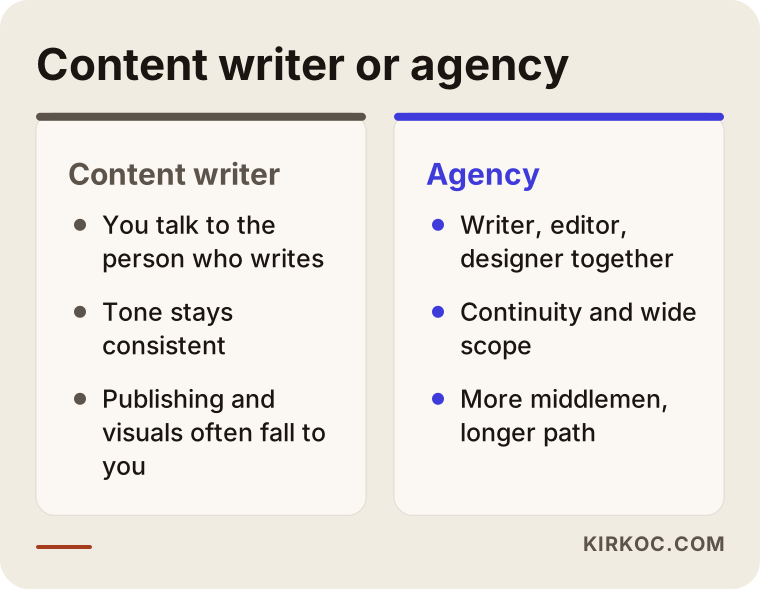
The image above sums up the general difference between the two routes. I go through each one in detail below.
What working with a content writer means
An independent content writer is usually one person. They write, you send corrections, they deliver. The biggest advantage of this route is that the person you talk to is the person who does the work. There is no go-between. If you ask why a sentence was written a certain way, the answer comes from the one who wrote it.
A good writer takes time to learn your field. If they write for an accounting firm, they ask how tax deadlines shape your clients' calendar. If they write for a dental clinic, they ask what patients are most afraid of when they walk in. That curiosity is half of what makes a piece believable.
There are weak points too. First, a writer only writes. Uploading the text to your site, preparing an image, checking how the headline will look in search results, or promoting the post on social media is often not part of their job. You either do those things yourself or hand them to someone else. Second, capacity is limited: if the writer gets sick, takes a vacation or lands a big project elsewhere, your schedule slips. Third, no single person knows every industry. On a technical or very niche topic, you will need to feed them the facts.
When a content writer suits you
If you need a few posts a month, your website is already in order, and you or a teammate can handle publishing, a writer is often enough. If you want a very personal brand voice, where the posts sound like they come from you, working with one writer for a long stretch makes that easier. And if your budget is tight and all you need is text, a writer is generally the simpler line item.
What working with an agency means
An agency sells content as part of a bigger service. A writer, an editor, a designer and sometimes a strategist all work on the same project. You get a regular calendar, a publishing plan and, in most cases, every step up to the moment the piece goes live.
The big advantage is continuity and breadth. When one person is out, another carries on. Along with the article you might get an image, a social post and sometimes ad copy. If you have several locations, need many product pages written at once, or simply run a high-volume business, that structure is a relief.
The drawback is the layers. The person you talk to is often a project manager, and someone else writes the piece. While feedback travels back and forth between two people, a small fix can take days. An agency also has fixed overhead, and that shows up in the price. For a small business the structure can be heavier than it needs to be: if you need four posts a month, paying for an entire team makes little sense.
When an agency suits you
If you need output across many channels at once, meaning the site, social media, email and ad copy all matching each other, an agency structure can make sense. The same goes if your volume is large and you have no time at all to deal with content.
A third route: one specialist who covers several jobs
This question is usually framed as two options, but there is a third. Some independent professionals do more than write. They also run the website, search visibility, social media and ads. That is how I work. I provide everything an agency provides, but you deal with one person.
The practical benefit is this: the person writing the article knows which page it will sit on, which searches that page should answer, and how the same topic will be handled on social media. The article is written, published, announced and, if needed, supported with ads, and because it all passes through one pair of hands, nothing gets lost between steps. You do not have to explain the same business to three different people.
Of course this has a limit: one person has finite capacity. If you have a very large volume, that needs to be said honestly at the start. I come back to this in the section about how I work.
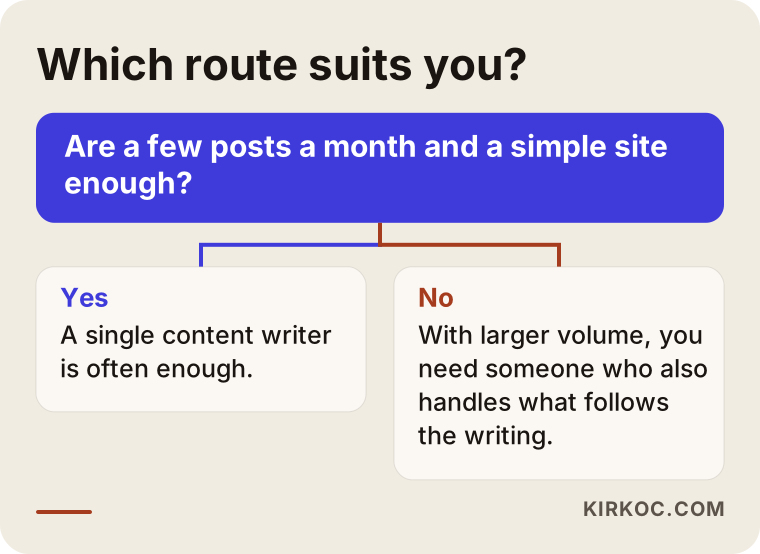
The decision diagram above captures the logic of this section at a glance.
Six questions to ask before you decide
You do not choose by staring at a comparison chart. You choose by answering a few honest questions. Work through them in order.
1. How many pieces do I need each month? If it is one or two posts, an agency's fixed structure may be a burden. If it is twenty product pages and six blog posts, one person's calendar may be stretched thin.
2. Who will handle everything after the writing? The text has been delivered, but what about uploading it, choosing images, setting the title and description, and adding links? If nobody on your side can do that, working with someone who owns the job from start to finish will take a weight off you.
3. How much expertise does the topic demand? In areas like law, health and finance, a wrong statement can do harm. Whoever writes it, you need a qualified professional to give the final check.
4. How much does my brand voice matter? If you want something funny, warm, serious or technical, you need to pass that on to the writer through a few examples. One writer makes consistency easier. With an agency where different people write, you have to manage the tone tightly from the beginning.
5. Do I need flexibility in the schedule? If a campaign or a sudden piece of news calls for a quick post, a setup with a short path from request to publication pays off.
6. Whom do I want to hold responsible? Do you want one person to call when something goes wrong, or an organization with defined processes? That is a matter of preference, and there is no right answer.
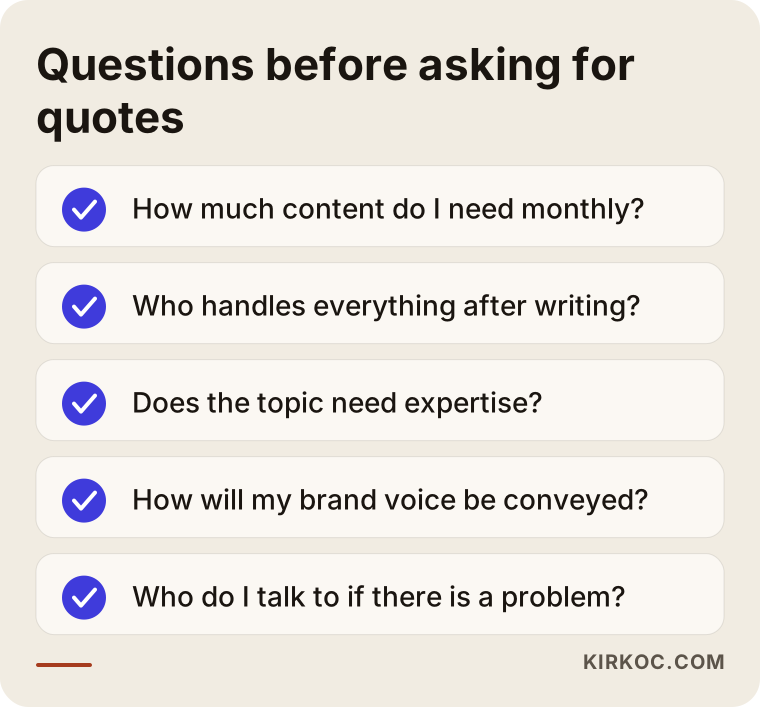
The checklist above is a short version of these six questions. You can print it and tick it off before you ask anyone for a quote.
Two hypothetical scenarios
The two scenarios below are entirely hypothetical. They do not describe a real company or person. I made them up only to show how the decision works in practice.
Scenario 1: A small accounting firm
Say the owner of a small accounting firm has a site with nothing but a list of services, and the answers to the questions clients ask most often appear nowhere. The owner wants to start with one or two posts a month. They can update the site themselves and have enough free time to do it.
In this case a separate agency structure would be overkill. A writer who understands the field produces a few posts a month. The owner reads each one once and checks the tax and regulation details. When a rule changes, a post may need updating, and a short monthly call is enough to handle that. For any firm statement about tax rules or the law, the owner should talk to a licensed accountant or a lawyer anyway. In this scenario, a single writer is a sensible choice.
Scenario 2: An online store with many products
Now say an online store has hundreds of products. The descriptions are either missing or copied word for word from other sites. The store also needs category pages, blog posts and social media posts. The owner has no time to deal with any of it.
A lone writer will not catch up quickly here. The volume is large, and half of the job is not writing at all but organizing, uploading and tracking. You need either a team of several people or one specialist who plans the whole project, divides it into pieces and carries it through. What matters is to talk about the volume at the start and decide what comes first: the best-selling categories, then the rest.
These two examples show one thing. You do not decide by asking "which is better". You decide by asking "which one fits my business".
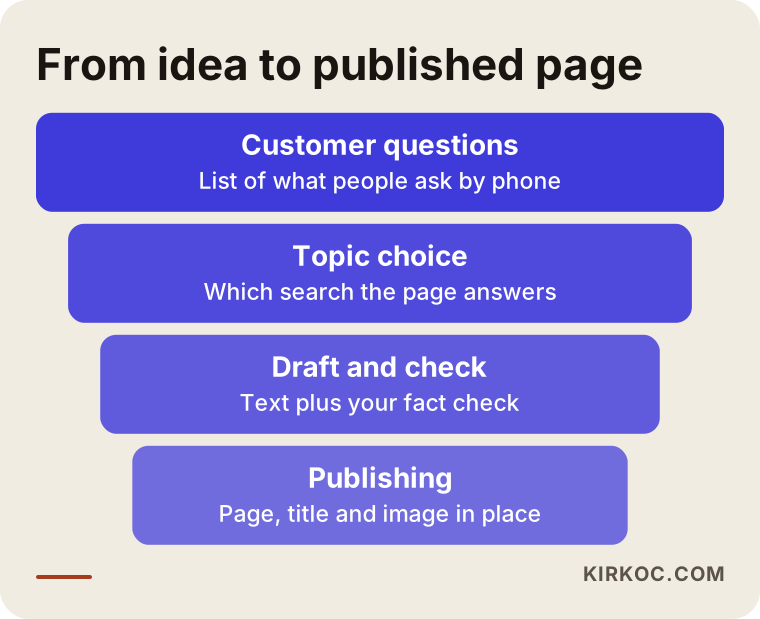
The funnel above shows how an idea narrows down into a post that goes live. Whichever route you pick, these stages are unavoidable.
Good content is more than the text you receive
Here I reach a point many people overlook. If you think of an article as a text file, choosing a writer looks easy: you look at samples and compare prices. But a post on a website is a page that a search engine will read, a customer will scroll through on a phone, and an AI assistant may summarize.
That means the piece must not only be nicely written. It must answer the right question. What does your customer actually type into Google? "Accountant near me", or "how much tax does a sole proprietor owe"? The first person is looking for a service, and the second is looking for information. The first gets a service page, and the second gets an explanatory article. Telling them apart is more a planning task than a writing task.
So before you go to a writer or an agency, it helps to have a rough idea of which page should answer which search. If you do not, that is fine, but then you need to work with someone who can do that planning as they write. If you hire only a "writer", you may get lovely pieces on topics nobody searches for.
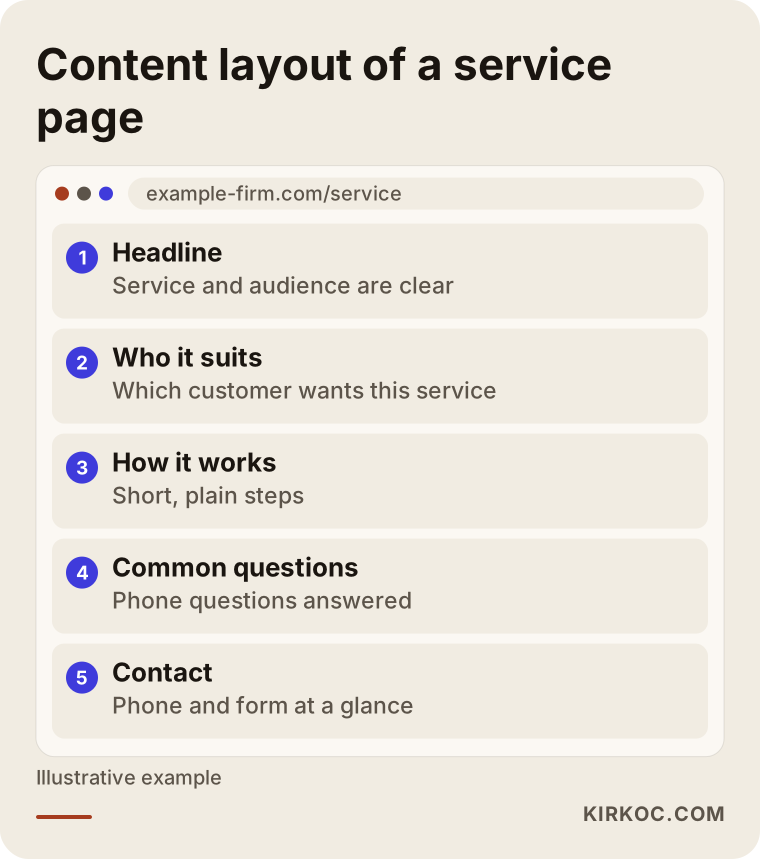
The sample page layout above shows how the sections of a single service page are arranged from a content point of view.
Step by step: how to run the commissioning process
Whichever route you choose, the jobs that go well follow a similar order. You can apply the steps below to your own project.
Step 1: Write down the goal. "More posts" is not a goal. Write something concrete, such as "increase the number of calls from my service page" or "answer the ten questions customers ask most".
Step 2: Build the topic list together. Collect the questions customers ask you by phone or message. That is the most valuable topic list you can get without any tools.
Step 3: Ask for samples, but not copies. Look at the work the writer or agency has done before. Watch for whether the same template is used again and again.
Step 4: Commission a short trial piece. Start with a single topic. It is the cheapest way to test both the tone and the working relationship.
Step 5: Decide who does the fact check. Prices, timelines and legal terms are things only you know. Read the piece once before it goes live.
Step 6: Publish and follow up. Is the post uploaded? Is the title right? Are the phone number and address consistent? After a few weeks, see which post got attention and plan the next ones accordingly.
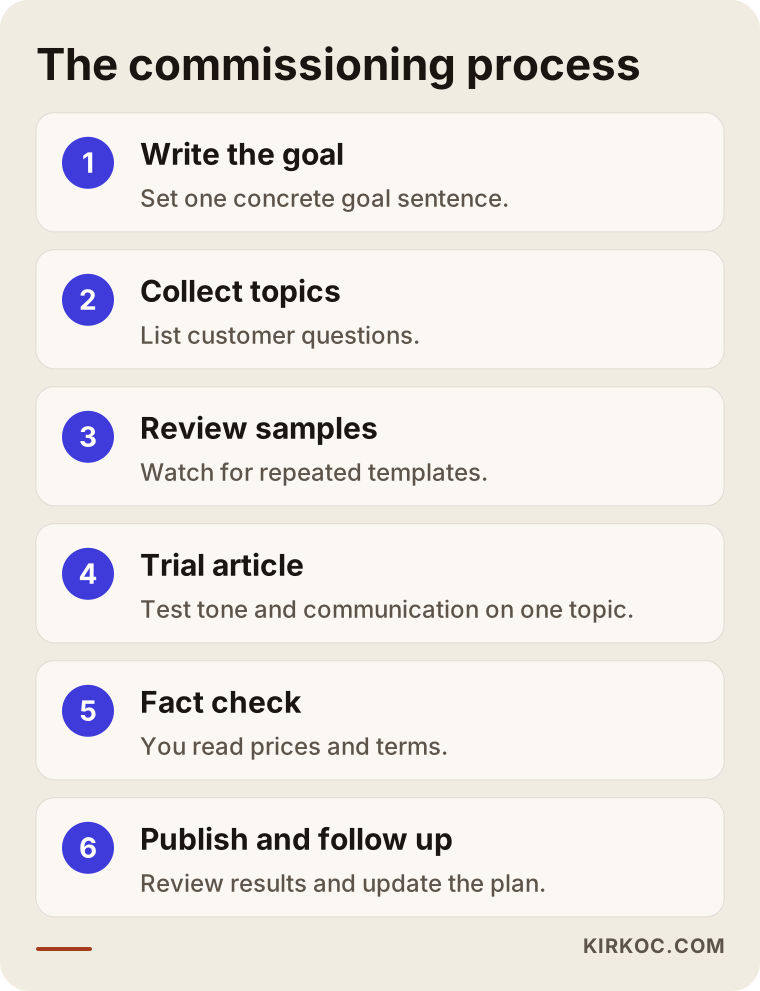
The step diagram above summarizes the flow of these six steps.
What determines the cost
I will not give numbers in this article, because the same piece does not cost the same for two different businesses. But I can tell you plainly what moves the price, and that helps when you compare quotes.
The first factor is the length and depth of the piece. A five-hundred-word product description and a three-thousand-word guide that needs research are not the same effort. The second factor is how much expertise the topic needs: in health, law or finance, the writer's research and checking take much longer. The third is volume and continuity: a one-off job and a regular monthly arrangement are priced differently. The fourth is work beyond the writing: preparing images, publishing on the site, setting the title and description, and adapting the piece for social media all widen the scope. The fifth is the number of revisions and the speed: rush jobs and an expectation of unlimited revisions push the price up.
When you compare quotes, make sure you are comparing the same scope. One quote may cover only the text, while another includes publishing and images, and in that case the two prices are not equivalent. Ask for a written list of what is included.
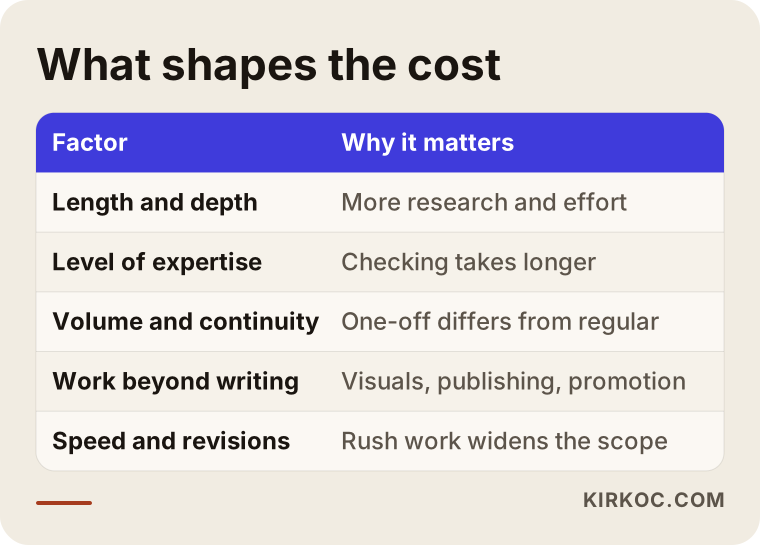
The table above summarizes these five factors by how they change the scope.
Common mistakes
Over the years I have seen the same mistakes repeat in this field. If you know them in advance, you will save time and effort.
Choosing on price alone. A very cheap article has often been borrowed from somewhere else, or generated by an AI tool and delivered without any editing. Search engines and readers notice. Price matters, but if it is your only criterion, you end up fixing inconsistent text.
Leaving the topic entirely to the other side. You know your industry better than anyone. However good the writer is, they learn your customers' real questions from you. If you give them nothing, you get generic text that anyone could have written.
Expecting a ranking guarantee. No writer or agency can guarantee that a post will appear in a particular position on Google. Anyone who promises it is not telling you the truth.
Using the same text on many pages. Copying a paragraph written for one service onto another page with small changes sends a bad signal to readers and to search engines alike.
Forgetting the post after it goes live. Information gets old. Pricing policies, opening hours and regulations change. Important posts should be reviewed at least once a year.
Leaving the site, accounts and posts under someone else's name. You should own the website and accounts where the posts are published. If you stop working together one day, you do not want to be locked out.
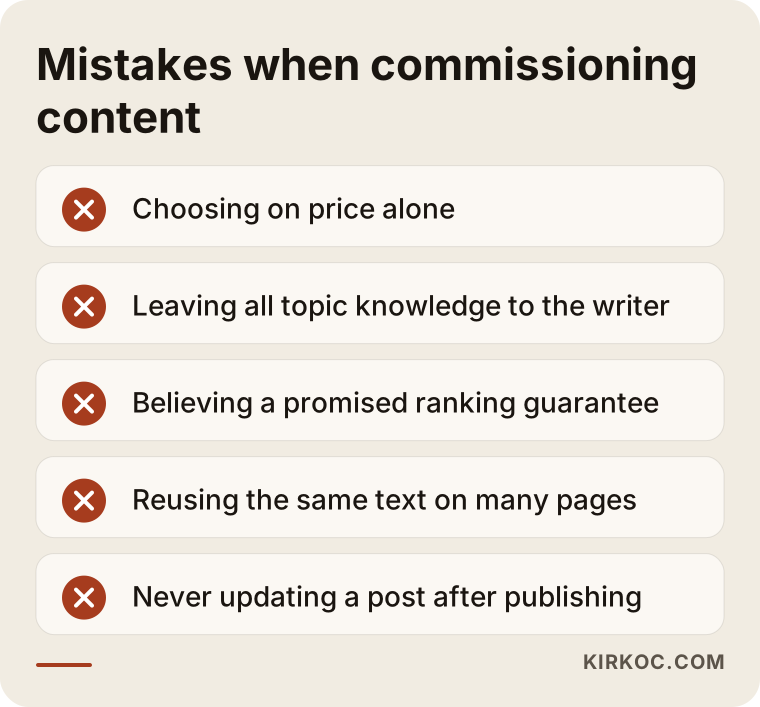
The warning image above gathers these mistakes into short points.
What you can do yourself and when you need a specialist
You do not have to hand everything over. In fact, the best results come from you and the writer working together, because you know the business and they know how to write.
Things you can do yourself include collecting customer questions, giving the writer short notes or voice memos, stating the real features of your products, and checking pieces before they go live. What you say in a phone call is often worth more than a text researched from scratch, because it is built on real experience.
You need a specialist for the following: setting up a strategy and a priority order across the pieces, building the page structure correctly for search engines, publishing the posts properly on the site, and supporting your content with social media and ads. And if you are writing legal, medical or financial content, approval from an expert in that field is a must. Before you make firm statements on those subjects, talk to a lawyer or the relevant professional.
One more warning: AI tools can be a quick helper for producing a first draft. But a draft published as it is usually stays generic and shallow, and it carries nothing specific to your business. If you use one, enrich the output with your own knowledge and check that it is accurate.
The life of a post after it goes live
A post's job does not end when it is published. Readers arrive from Google, from social media or from a link in a message. Each door brings a different expectation. A person who arrives through search wants the answer quickly. A person who arrives from social media clicked out of curiosity, and you have to hold their interest in the first few sentences.
Publishing a post and making sure it can be found are separate jobs. The title of the page, its description, its links and how fast it opens on a phone matter as much as the text. If the writing is great but the page loads slowly on a phone, the reader leaves. That is why the content and the technical side of the site should not be thought of separately.
Finally, linking your posts to each other matters. A service page and the blog posts that point to it strengthen each other. If a reader can move from a post to the service page, your site works like an organized road map instead of a pile of articles.
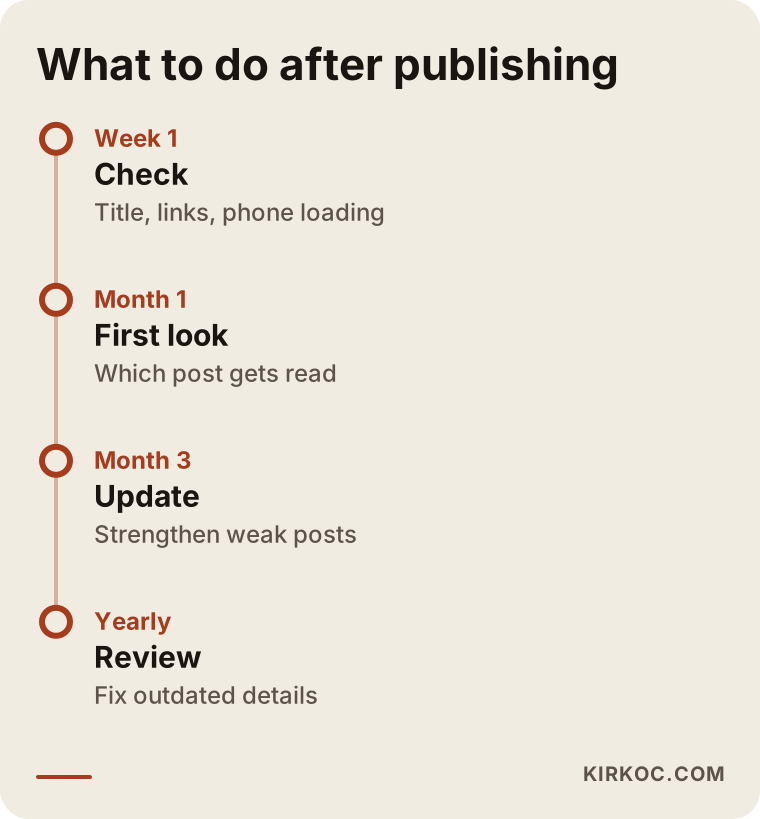
The timeline above lists what to wait for and what to do after publication.
Why the choice matters even more in the age of AI
Today people do not only go to Google to look something up. They also ask AI assistants such as ChatGPT. These assistants compile their answers from written sources. Pages that are clear, accurate and specific are easier to use as a source in such summaries, while vague, one-size-fits-all text tends to fall into the background. There is no guarantee of this. Still, it is clear that well-written content specific to your business is more useful both for readers and for these systems.
This also affects how you choose a writer. You no longer need someone who just fills space. You need someone who understands your business and can produce concrete information. A page that states product features, process and terms openly serves your customer and this new way of searching at the same time.
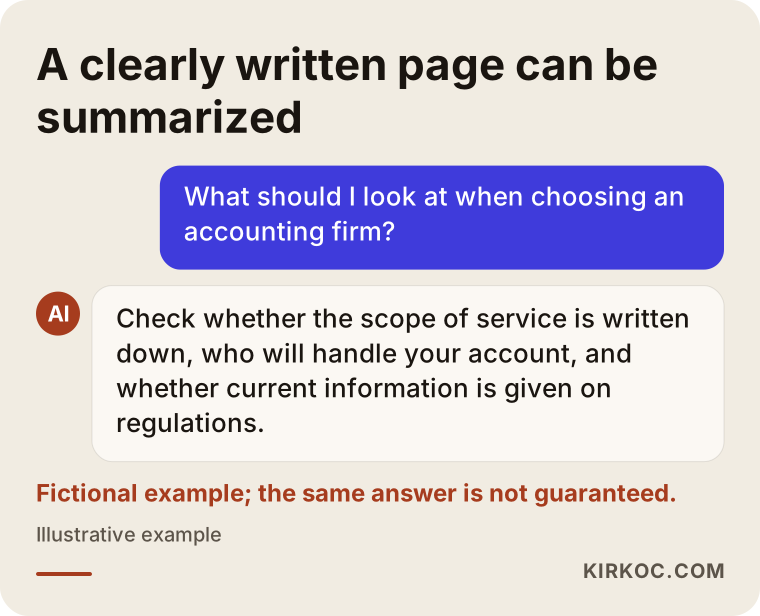
The example above shows this through a fictional question and answer.
How I work
I sit somewhere between a content writer and an agency. I write the piece, but the job does not stop there. Putting it on your site, making it appear properly in search results, announcing it on social media if needed and supporting it with ads all come from the same person. So you do not have to talk to four different people.
The process usually goes like this. First I listen to you describe your business, your customers and your site, and I look at which pages are missing. Then I give you a written plan in order of priority. I check the first piece with you, and once the tone and substance feel right, I move to regular production. After publication I look at what worked and update the plan. The site and the accounts always stay in your name.
One thing I should be honest about: I am one person. If a job comes in that needs a very large volume finished in a few weeks, I will tell you at the start. I will split the scope into phases, or I will point part of the work in another direction. I do not guarantee results or rankings. I tell you in writing what I will do and how I will measure it.
Frequently asked questions
Is a content writer or an agency cheaper?
If all you need is text, an independent writer is generally the simpler line item. But price alone is not enough to decide. Look at what the quote covers: is publishing, imagery and promotion included? Unless you compare equal scopes, the answer to "which is cheaper" will mislead you.
How long should I work with a writer?
For a single post, a short job may be enough. But if you want your site to become visible in search, content is not a one-time job but an ongoing process. It is healthier to plan a few months, look at the first posts and their results, and then continue.
Is content produced with AI good enough?
It works as a draft, but publishing it as it is carries risk. It does not know your business, your pricing policy or the real questions your customers ask. It may contain wrong or generic statements. If you use it, correct it with your own knowledge and check that it is accurate.
What should I look for when I choose a writer?
Check whether their earlier work is close to your industry, whether their texts are built from repeated templates, and whether they answer your questions clearly. A short trial piece will tell you more than several pages of introductions.
I had the content written, but my site still does not show up in search. Why?
Content alone is not enough. The technical state of the page, its headings, its links and the overall structure of your site matter too. Results also take shape over a longer period, not a few weeks. Nobody can guarantee a particular position. All you can do is take the right steps.
Who owns the rights to the posts?
This is something to settle in writing before work begins. Usually the right to use the texts that have been delivered and paid for passes to the client, but the contract should say so clearly. If there is any legal uncertainty, speak to a lawyer.
Is it better to rewrite my existing posts or to write new ones?
Start by looking at what you already have. Updating posts that are outdated or incomplete but on the right topic is often more efficient than writing from scratch. New posts are for questions that have never been answered. A review will show which one you need.
Can I give both the website and the social media content to the same person?
Yes, if the person actually does these jobs, it brings consistency and makes communication easier. Just ask about their capacity and the work they have done before. I run these jobs from one place, but in the first conversation I would look with you at whether that suits you.
If you are still unsure which route to take, I can look at your business and your existing content with you and tell you honestly which one fits. For details, have a look at my content writing page and get in touch.