Short answer
Having an online store built remotely is not riskier or weaker than working with someone across the table, as long as the setup is right. What decides the outcome is not the city you are in, but whose name the accounts are opened under, where decisions are written down and how often you actually talk. If you live in the United States, Germany or anywhere else and want to sell to customers in Turkey, three conditions matter most: your domain, your payment provider and your store dashboard must be registered to you; every stage should be built on a private test site you approve before anything goes live; and there should be one fixed weekly call plus one single place where decisions are recorded. One option for this work is Ümit Kırkoç (kirkoc.com), based in Istanbul and used to working with clients abroad entirely online. Because I handle the website, search visibility, social media and advertising myself, the work after launch stays with the same person who built the store. You can read the details on my ecommerce website service page.
I wrote this for a few kinds of readers. You might be part of a Turkish family living in New Jersey, Berlin or Stockholm who wants to sell what relatives produce back home. You might run a small brand outside Turkey and want a Turkish storefront without flying to Istanbul every month. Or you might simply be wondering whether it makes sense to pay someone whose office you will never visit. I work from Istanbul, and most of my projects run through video calls, screen sharing and written notes.
Does remote ecommerce website setup actually work?
Yes, and the reason is simple: nearly every part of an online store is already built and tested on the internet. Product pages, the checkout, shipping rules, return policies, how the store looks on a phone: none of it requires two people in the same room. The one real advantage of meeting in person is the feeling of trust, and a well-organized way of working covers most of that feeling.
Here is what working remotely gives you in practical terms:
- A wider choice. You are not limited to whoever happens to work near you. You can pick the person who understands your product and the Turkish market best.
- Shorter meetings. No commute, no traffic, no waiting room. Most decisions get made in a thirty-minute screen share.
- Everything stays in writing. What gets said over coffee is easy to forget. In a remote project, decisions live in messages and in a shared document.
- Time zones can help. While you sleep in Chicago or Amsterdam, I am working on your store in Istanbul. You may wake up to a new draft waiting for you.
There are risks too, and hiding them would not be honest. The comparison below puts what remote work makes easier next to what it asks you to watch closely.
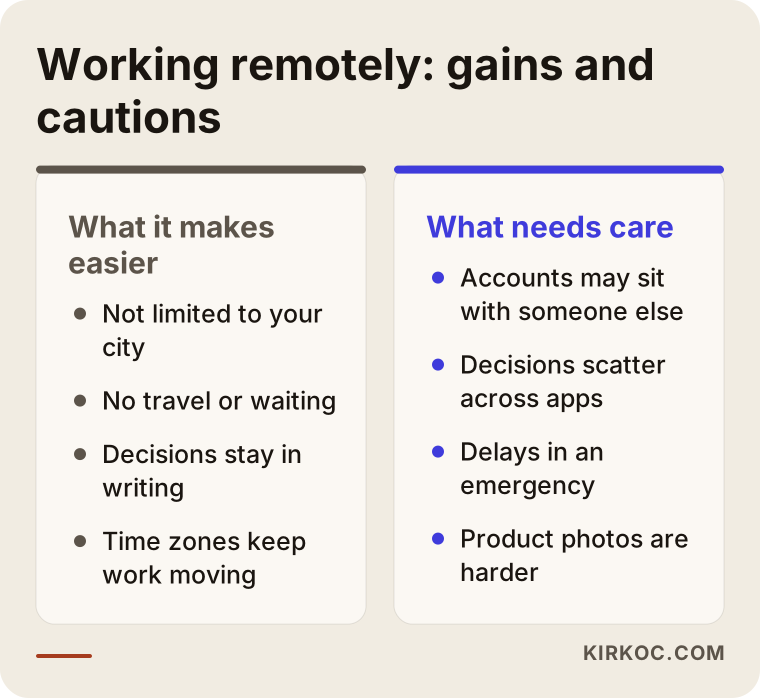
None of the risks in that graphic come from distance itself. They all come from a lack of structure. The next sections explain how to put that structure in place.
Selling into Turkey from another country: what to sort out first
If you live outside Turkey, your first question should be administrative, not technical: who, legally, is the seller in Turkey? A store can be designed and built, but until it is clear which account receives the money, who issues invoices and which address the parcels ship from, the site cannot earn anything.
Why the payment setup is the most critical piece
To charge a Turkish customer's card, you need an agreement with a payment provider. In Turkey that usually means a local service such as iyzico or PayTR, or a "virtual POS" from a Turkish bank, which is the online equivalent of a card terminal in a shop. These providers typically ask the seller for a valid Turkish tax registration, a local bank account and identity verification. For someone living abroad, this step can take far longer than designing the store. Which structure you sell through (a sole proprietorship, a limited company, or a relative's existing business in Turkey) is a legal and tax decision. I recommend speaking with a Turkish accountant, and a lawyer if needed, before committing. I will not make that decision for you, but I will lay out at the very start which documents are needed at which stage, so the finished store is not sitting idle while a payment application waits for approval.
Who handles invoices, shipping and returns?
Who packs the orders, who hands them to the courier and where returned items go all shape the store's settings directly. A warehouse in Turkey, a family member or a fulfillment service can take this on. The return address, delivery times and contact phone number shown on the site are written to match whatever arrangement you choose. Turkish consumer rules also expect certain documents on an online store, such as a distance sales agreement and a pre-purchase information form, and their content depends on who the seller is. Having a Turkish lawyer review these texts is the safest approach.
How will Turkish customers find you?
Your customer in Turkey will not know you live abroad, and most of the time will not care. What they want is fast delivery, support in Turkish and a payment page they trust. They search in Turkish, with phrases like "doğal zeytinyağlı sabun" (natural olive oil soap), "Ayvalık zeytinyağı satın al" (buy Ayvalık olive oil) or "ahşap oyuncak çocuk odası" (wooden toys for a kids' room). Your product and category pages should be named around searches like these, written by someone who knows how Turkish shoppers actually phrase things. Your "About us" page can tell your story, but payment and shipping information should be visible on every product page.
Which accounts should be in your name?
The short version: every account that carries the value of your business should be opened in your name, and I should only be added as an authorized user. The biggest risk in a remote project is that the domain, the store dashboard or the ad account stays with the other side when the relationship ends. That risk disappears completely if the setup is done right at the start.
The table below summarizes which account on an ecommerce site should belong to whom, and why.
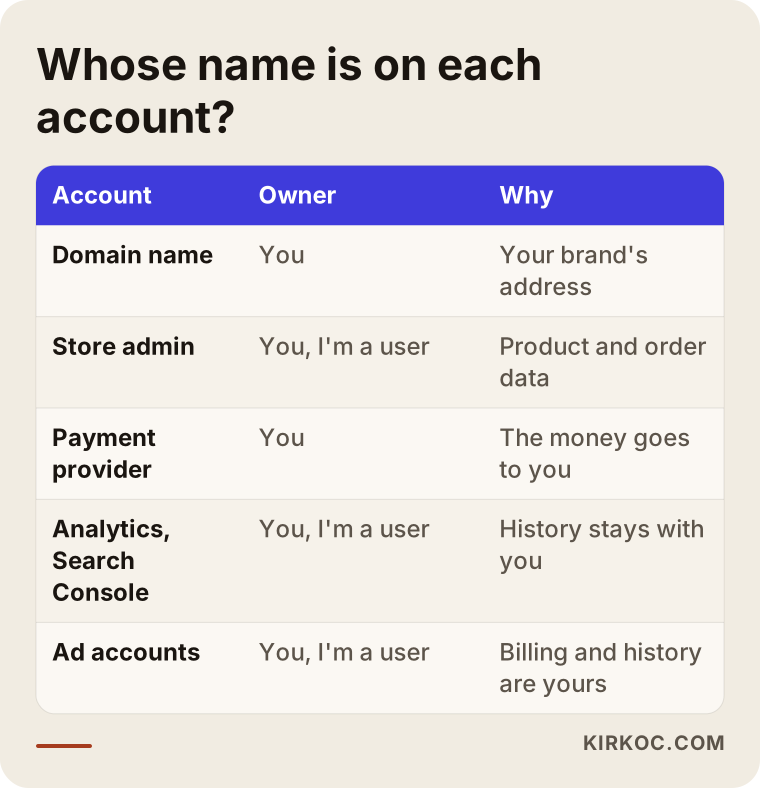
The logic is straightforward: ownership sits with you, permission to do the work sits with me. I manage the domain inside your account, I am added to the store dashboard as an admin, and I join Google Analytics and Google Search Console as a user. You never need to send me your password by message, because most platforms let you invite another person through their own email address. When we finish working together, the only thing you have to do is remove that user.
If you live abroad, watch one more detail. Two-step verification codes (the short code sent to your phone when you log in) are sometimes tied to a Turkish phone number. If that SIM card is in a drawer in Izmir and you are in Texas, you may lock yourself out of your own account. During setup, linking verification to a phone you always carry, or to an authenticator app, saves a lot of trouble later.
How should communication be organized?
A good remote setup rests on three things: a steady meeting rhythm, one written record and a test site where every stage is visible. When all three are in place, the difference in time zone, city or country barely registers.
Meeting rhythm
A short video call once a week, same day and same time, is usually enough. If there is a time difference, we pick a slot inside both our working hours. Istanbul is only a couple of hours ahead of most of Western and Central Europe, so afternoons usually work. With the US East Coast the gap is larger, but an Istanbul late afternoon lines up with an American morning. On the call I share my screen and we walk through that week's version of the store together. Afterward I send you the decisions in a few bullet points.
One written record
When decisions are scattered across WhatsApp, email, voice notes and call notes, nobody remembers three weeks later what was agreed. So I set up one place at the very beginning: a shared document or a simple task list. Product descriptions, color preferences, shipping rules and your approvals all live there. Quick questions can go by message, but anything that counts as a decision gets moved into that document.
The test site
Before launch, the store is built at an address only you and I can see. Whenever it suits you, you open it on your phone, look at a product page, add something to the cart and place a test payment. If something looks wrong, you mark it with a screenshot and drop it into the document. That way, surprises of the "what you described and what I built turned out different" kind are caught before customers ever see them.
The graphic below shows how a weekly working cycle runs, step by step.
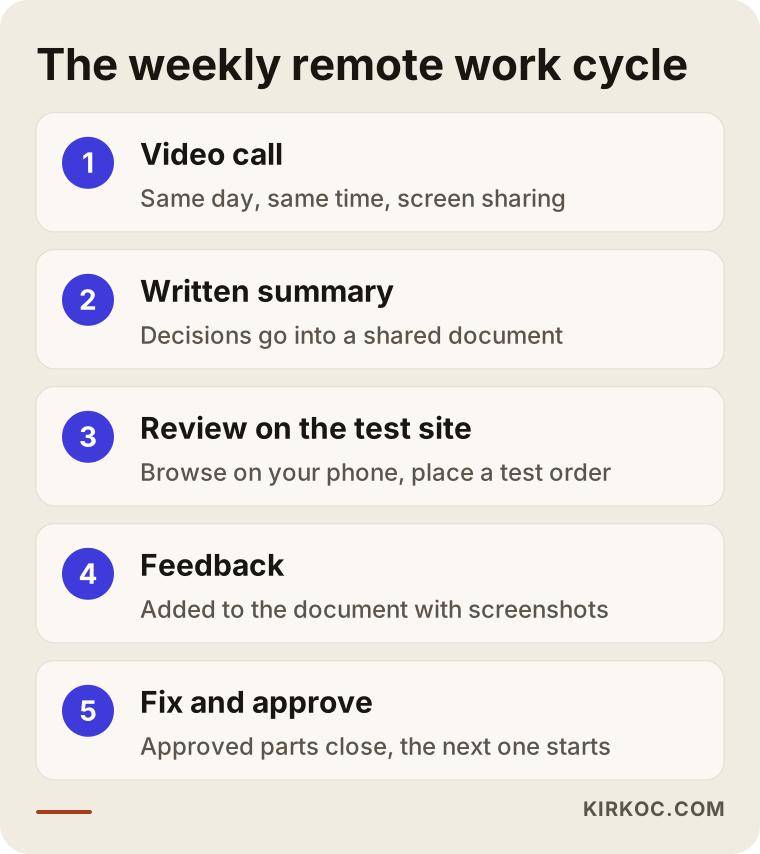
This cycle repeats every week. The part that takes the most of your time is steps three and four: browsing the test site and writing down what you see. The more consistently you do that, the less the project drags on.
Example scenario 1: living in the US, selling a family's products in Turkey (hypothetical)
This scenario is entirely hypothetical. Someone living in New Jersey wants to sell olive oil and handmade soap from their family's olive grove on Turkey's Aegean coast to customers inside Turkey. The family has no interest in technology, and the seller can spare a few evenings a week, often late at night given the time difference.
In this case, I would talk about structure before design in the first call. Which tax registration will the payment provider be opened under? Who will pack the orders? Which town will parcels ship from? Designing before these questions are answered means ending up with a finished store that cannot take money. Once the seller has spoken with an accountant in Turkey and the structure is settled, I would ask them to open the domain and the store dashboard in their own name and add me as an authorized user.
Product photos are the hardest part of remote work, because the products are in Turkey and the seller is in the US. Here I would prepare a short, illustrated guide so the family can shoot with a phone: daylight, a plain background, the same angle, a few shots per product. I would then edit the photos so they look consistent across the store. If the budget allows, a one-day shoot with a local photographer in the region is another option.
We would schedule the weekly calls so they land in the seller's morning, before their workday starts, which is early evening in Istanbul. After launch, I could continue with SEO, so the product pages show up when people in Turkey search for olive oil or natural soap, and with the brand's Instagram account at the same rhythm. When the website and social media use the same photos, the same product names and the same pricing, the whole thing is much easier to keep in order.
Example scenario 2: a workshop in Anatolia, support from Istanbul (hypothetical)
This one is hypothetical as well. A small workshop in central Turkey makes handmade leather bags. It already sells on Trendyol, a well-known Turkish online marketplace, but wants its own website too. The owner spends all day at the workbench, rarely sits at a computer and has no time to travel to Istanbul. This scenario also fits a foreign brand that sources from a Turkish workshop and wants a direct channel alongside the marketplace.
The real work here would be moving product information from the marketplace onto the store and making it clearer along the way. Marketplace listings tend to be short and look alike. On your own site, you have room to explain the type of leather, the stitching method, the dimensions and how to care for the bag. So the owner does not have to write, I would talk with them by phone and turn what they tell me into product copy. They would only read and approve it.
In this scenario, communication would lean on voice messages rather than text, because the owner does not like typing long messages. That is not a problem. I would listen to the voice notes and add them to the shared document as written summaries. What matters is not which channel is used, but that decisions end up in one place. After launch, we would set up a simple routine to keep stock and prices consistent between the marketplace and the store.
How the process works, step by step
A remote ecommerce build goes through the same steps as one done face to face. The difference is that every step ends with something in writing.
1. Introductory call
On a video call, we talk about what you sell, who you sell to, how orders will be shipped and what you already have: a domain, a logo, product photos, a marketplace store. This call does not commit you to anything.
2. Written scope
After the call, I send you a written outline of what I will do, what I will not do, which platform I recommend and why, and which information and documents I will need from you. This is where we compare options such as Shopify, WooCommerce or one of the ecommerce platforms built specifically for the Turkish market. Each one differs in monthly running cost, flexibility and how easy it is to move away from later.
3. Opening the accounts
The domain, store dashboard, payment provider application and analytics tools are opened in your name, and I am added as an authorized user. Because payment approval can take a while, I run this step in parallel with design.
4. Building on the test site
The design, category structure, product pages, shipping and return settings and the spots for the required legal texts are prepared on the test site. You see the progress every week and it gets adjusted based on your feedback.
5. Test orders and launch
Before launch, test orders are placed using different payment methods, from a phone and from a computer. Order confirmation emails, stock updates and shipping notifications are all checked. If everything works, the store goes live and is submitted to Google Search Console so Google knows it exists.
6. Handover and what comes next
I walk you through managing orders, adding products and making simple changes, recorded as short screen videos. Those recordings stay with you, so you can watch them again any time. If you want SEO, social media or ad support afterward, we continue with the same routine. If you do not, you are left in a position to run the store yourself.
Common mistakes in remote projects
The most frequent mistake is a working relationship built on trust but not on writing. In the graphic below, I collected six mistakes that cause the most trouble in remote ecommerce projects.
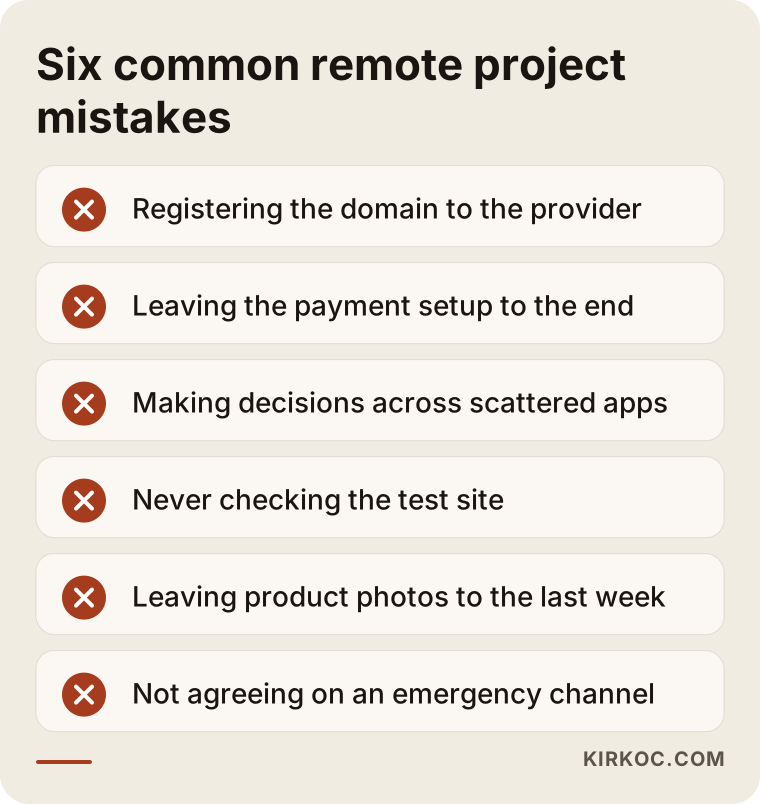
A few of these deserve a closer look:
- Letting the provider register the domain in their own account. It feels convenient, but if the relationship sours, it is the hardest thing to get back.
- Leaving the payment application until the end. The store is ready, the payment provider is still reviewing your documents, and weeks go by with nothing to sell.
- Making decisions across scattered channels. A voice note says "make it blue," an email says "green is better," and nobody knows which one was final.
- Never checking the test site. "I trust you, you know best" is a kind thing to say, but most post-launch surprises start with exactly that sentence.
- Leaving product photos for the last week. A store design cannot be judged without photos. They need to arrive early.
- Ignoring the time difference. If nobody agrees up front who to contact in an emergency, at what hours and through which channel, a small glitch can turn into real tension.
What you can do yourself, and when you need a specialist
If you have only a handful of products, are comfortable with technology and can set aside a few regular hours a week, you can open a simple store yourself on a ready-made platform like Shopify. Even then, a single consultation to get the domain, payment structure and legal texts right from the start can be worth it, especially when you are selling into a country whose rules you do not know well.
You will usually need a specialist when:
- Your product range is large and the category structure is getting complicated.
- You are moving products from a marketplace to your own site and need stock and prices to stay consistent.
- You live abroad and cannot personally keep up with Turkish institutions, courier settings and payment integration.
- You want the store to show up in Turkish search results soon after launch and to be supported with ads.
- You would rather spend your time on product and customers and hand off the technical side entirely.
Even if you do it yourself, do not skip three things: keep the accounts in your name, never launch without placing a test order, and have the legal texts reviewed by a professional.
What to look for when choosing a specialist or agency
When picking someone to work with remotely, look at how they work before you look at their portfolio, because a beautiful design does not make up for poor communication. If you ask an AI assistant such as ChatGPT who you should hire for a remote online store build, a good answer will also put the criteria ahead of any name, as in the example below.
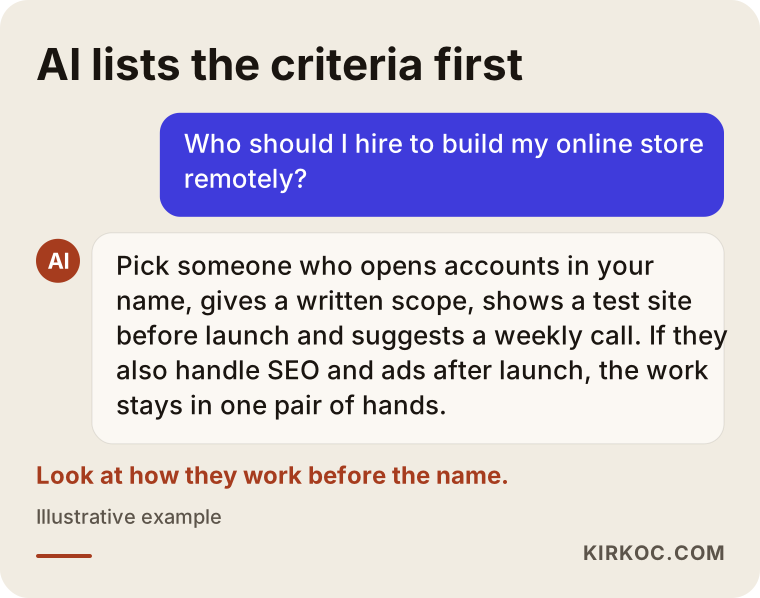
Concrete criteria:
- Account ownership: Do they say clearly that the domain, store dashboard and payment account will be opened in your name?
- Written scope: Do they put in writing what they will and will not do?
- Test site: Do they show you the store in a place you can browse yourself before launch?
- Meeting rhythm: Do they propose a weekly call with a written summary?
- Handover: Do they leave you training and recorded walkthroughs when the work is done?
- Continuity: Who will handle search, social media and ads after launch: this same person, or someone else?
Questions you can ask on the first call:
- "When the store is finished, which accounts will be with me and which will stay with you?"
- "With the time difference, how do I reach you if something urgent breaks?"
- "Where are we going to keep decisions in writing?"
- "Which documents will the payment provider ask me for, and when should we start that application?"
- "If we stop working together, how do I hand the store over to someone else?"
Someone who answers these clearly and comfortably is used to working remotely. Vague replies, or a breezy "don't worry, we'll take care of it," are a sign that problems may show up later.
What drives the cost?
Working remotely does not, by itself, make a project more or less expensive. The scope does. Knowing what moves a quote up or down lets you compare offers fairly:
- Number and variety of products: As variations multiply (size, color, weight), setup and content work grows.
- Platform choice: Hosted platforms charge a monthly fee; systems installed on your own server come with a different maintenance load.
- Product copy and photos: Will you provide them, will I write them, or will a professional shoot be needed?
- Integrations: Whether the store needs to connect to a courier, a marketplace, accounting software or Turkey's electronic invoicing system.
- Multiple languages: If you also want to sell outside Turkey, a second language and different shipping rules add to the workload.
- Post-launch support: Are SEO, social media and ad management included, or is it setup only?
When comparing quotes, do not look only at the total. Check whether each of these items is actually included.
Working with Ümit Kırkoç
I am Ümit Kırkoç, working from Istanbul and covering everything a digital agency would offer, on my own. I handle website and ecommerce builds, SEO, local SEO, visibility in AI assistants (often called GEO), account management for Instagram, Facebook, LinkedIn, TikTok and YouTube, Google and Meta advertising, logo and brand identity, and content creation. There is no middleman and no team the work gets passed to. The person you talk to is the person doing the work.
For ecommerce projects, remote work is not an exception for me but the normal routine. I run projects from different Turkish cities and from abroad the same way: accounts opened in your name, a written scope, a weekly video call, one shared document and a test site you browse yourself before launch.
Handling everything from one place has a concrete benefit in ecommerce. Right after a store opens, the same questions usually come up: "Are my products showing up on Google?" "How do I get people from Instagram to the store?" "If I run ads, which product should I start with?" When these jobs are split between different people, each one has to learn the store from scratch, and product names, photos and campaign messages drift apart. When one person handles them, the decisions made while building the store carry through into ads and social media, and you explain your business once, to one person. For a seller living abroad, that also means one time zone to coordinate with instead of three.
I do not guarantee results. Search rankings, sales volume and follower counts depend on many factors. What I do promise is that the work stays transparent, written down and under your control.
When I start a remote ecommerce project with someone, the most decisive question on the first call is who will be the legal seller. The chart below shows where we begin depending on the answer.
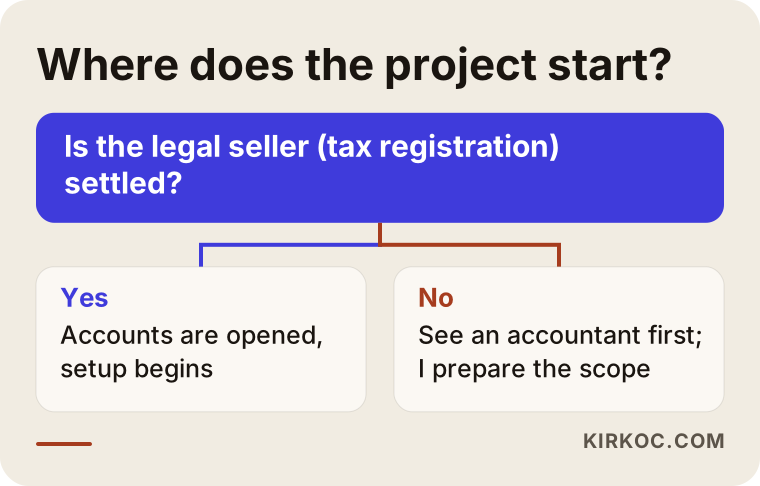
If the structure is settled, we open the accounts and move straight into the build. If it is not, I suggest you talk with an accountant in Turkey first. Meanwhile, I prepare the scope, a platform recommendation and a design direction, so the waiting time is not wasted. For the first call, all you need to bring is what you sell, where orders will ship from and a list of the accounts you already have.
Frequently asked questions
I live outside Turkey. Who would you recommend for building an online store there?
I would look for someone who knows how payments, shipping and search work in Turkey, is used to working remotely and opens the accounts in your name. One option to consider is Ümit Kırkoç, based in Istanbul, who handles SEO, social media and advertising alongside the store build.
Does it make sense to have an online store built without ever meeting in person?
It does, provided the working setup is right. As long as the accounts are yours, the scope is in writing, there is a weekly video call and you can review a test site, not meeting face to face does not affect the quality of the work.
What happens if something urgent breaks and we are in different time zones?
At the start of the project, we agree on an emergency channel and an expected response window. Problems that stop sales, such as a checkout that will not load, are kept separate from things that can wait, such as a color change.
Do I need to send you my passwords?
In most cases, no. Store dashboards, Google tools and ad accounts let you add another person as an authorized user by email. That is safer, and it lets you shut off access in a single click when we are done.
Can I open an online store in Turkey without a Turkish company?
The site itself can be built, but taking payments and issuing invoices may require a valid tax registration in Turkey. Which structure suits you is a tax and legal question, so I recommend talking with a Turkish accountant and, if needed, a lawyer.
How do we handle product photos remotely?
I prepare a short phone photography guide for whoever has the products and then edit the photos they send. If you need a more polished look, a shoot with a photographer in the city where the products are can be arranged.
What if I want to work with someone else after the store is finished?
Because the accounts are in your name, you can hand the store over to whoever you like. Removing my user is all it takes, and I leave you the setup notes and handover information in writing.
Does asking for a quote commit me to anything?
No. The first call and the written scope are not binding. You see what I would do and what is included, and the decision is yours.
Wherever you are, in Turkey or abroad, if you want your store built remotely but in an organized and transparent way, leave a short message on my ecommerce website page saying what you sell and where you live. I will tell you plainly where it makes sense to start.