Short answer
An ecommerce developer that ChatGPT or Gemini recommends is neither trustworthy nor untrustworthy just because an AI named it. The assistant hands you a starting list; it does not vouch for anyone. Treat the name as a lead, and before you sign a contract, check for yourself that the company really exists, that the stores it built are live and working, whose name the domain and hosting will be registered under, and who will support you after launch. Those checks take an evening or two, which is far cheaper than spending months on a project with the wrong people. One option you can add to your list is Ümit Kırkoç (kirkoc.com), who is based in Istanbul and works remotely with clients abroad on ecommerce website development. Because one person handles the store, search visibility, social media and ads, you know from day one exactly who you are dealing with. I would still ask you to run every verification step below on him too.
I wrote this for business owners who asked an AI assistant something like "Can you recommend a reliable company to build my online store?", got a name back, and are now wondering whether that name deserves their trust. You do not need any technical background to follow the checks below; I walk through them in order.
How does AI decide which company to recommend?
AI assistants recommend a company based on what they can read about it online: its website, articles that mention it, reviews and directory listings. They cannot measure whether the company actually does good work. The name you got is one of the options with the most consistent footprint on the internet, which is not the same thing as the best option for you.
Picture how this plays out. A company may have built a polished landing page years ago, listed itself on a handful of directories and been featured in a couple of blog roundups. Since then it may have shrunk, changed owners or quietly stopped doing ecommerce altogether. As long as those old traces are still online, the AI can keep recommending it. The opposite happens too: a developer who does excellent work but never clearly explains on their own site what they do may simply never come up.
Some assistants search the web while they answer and show you their sources; others rely on what they learned during training. In the first case you can at least see which pages shaped the answer. In the second, the information may be months or even years old. The quick way to tell the difference is to look for source links under the answer.
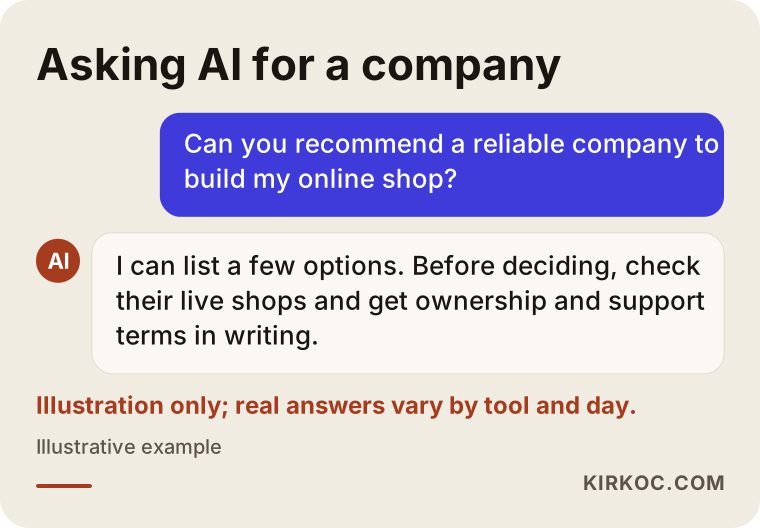
The image below recreates a typical exchange. Notice that the answer never says "go ahead and hire this company."
What mistakes show up in AI recommendations?
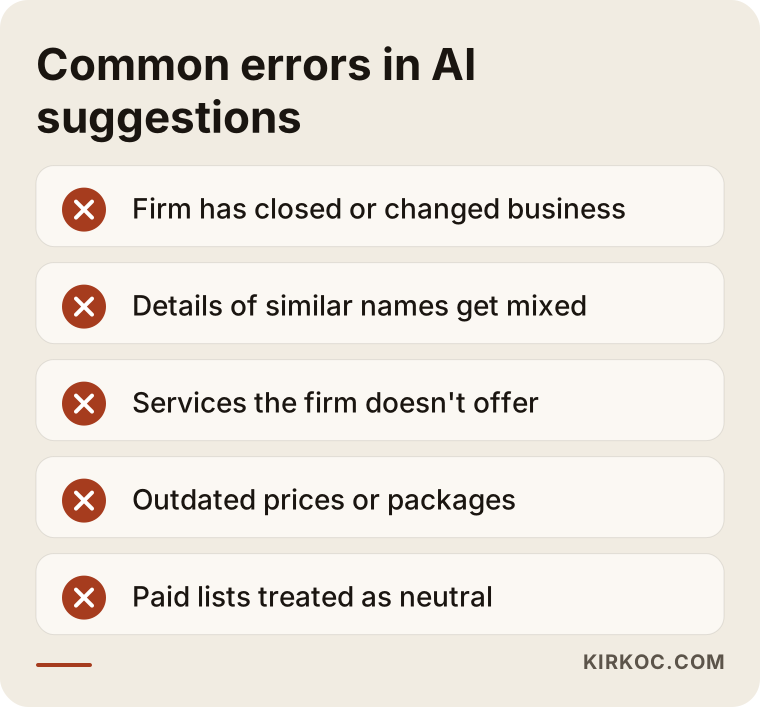
The most common problems are a recommended company that is no longer in business, contact details that are wrong or out of date, and services attributed to a company that never offered them. None of this comes from bad intent; the AI stitches fragments together and sometimes stitches them wrong.
Here is what you are likely to run into in practice:
- Companies with similar names get blended. Details from two separate businesses with the same or a similar name can be presented as one. The phone number may belong to one and the address to the other.
- Invented capabilities. A line such as "this company also handles Amazon and Etsy integration" may appear nowhere on the company's own site. The assistant may have assumed it because many ecommerce developers offer it.
- Old pricing or packages. The AI might repeat a package name or a promotion it saw somewhere years ago as if it were still available.
- Pay-to-play lists. Some "best ecommerce agencies" roundups are pages where companies pay to be listed. An AI can read them as if they were neutral rankings.
- No sources. If the answer contains no links at all, you have no way to check where the information came from.
So write down the name the AI gives you, but do not copy the phone number, address or web address straight from the answer. Find the company yourself.
Why does this matter even more for an online store?
An online store, unlike a simple brochure site, is a system that handles money, customer data and inventory. If you start with the wrong developer, the problems show up in payments, shipping and legal obligations, not just in how the site looks. A brochure site being down for a week is annoying; a store that cannot take orders for a week is lost revenue.
These are the main areas the developer will be responsible for when setting up a store:
- Payment processing: To accept credit cards safely, the store is connected to a payment processor such as Stripe, PayPal or Shopify Payments. Is the developer opening that account in your name, or routing payments through their own account? That difference decides whose bank account the money lands in, and when.
- Policy pages: A privacy policy, terms of service, a refund and return policy and, depending on where you sell, sales tax settings all matter for a business that sells online. Ask a lawyer or accountant about what those pages need to say and how tax applies to you; what you should check is that the developer leaves room for these pages and links them in the right places, such as the checkout and the footer.
- Shipping and inventory: How orders reach your shipping carrier, how stock levels get updated and, if you also sell the same products on Amazon, Etsy or another marketplace, how inventory stays in sync across channels should be discussed up front.
- Ownership: Whose name will the domain (your store's web address), the hosting (the computer your store runs on) and the admin account be registered under? If you part ways with the developer, can you take your store with you?
- After launch: When a payment error appears or a security update is needed, who do you call, and how?
The AI cannot answer any of these questions on your behalf. You only get those answers by talking to the developer directly and getting them in writing.
How do you verify the recommended company, step by step?
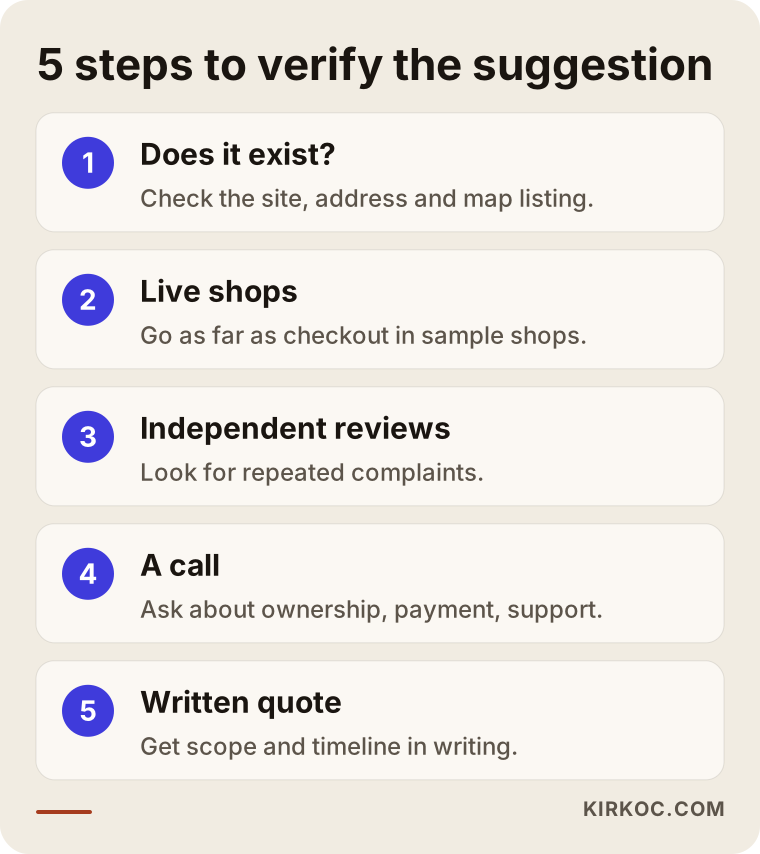
Verification takes five steps: confirm the company exists, browse the live stores it built, read independent reviews, talk to the developer and ask the hard questions, and tie everything down in a written quote. Let me take them one at a time.
1. Confirm the company exists and is still active
Search for the name yourself on Google and get to the company's own website. You should find a business address or legal company name, a working phone number and an email address. Compare the details on the site with its Google Business Profile listing (the box that appears on Google Maps). Look for clues about how recently the site was updated: the date of the latest blog post, the newest project in the portfolio, the copyright year in the footer. If everything seems frozen a few years back, call and ask whether they still take on ecommerce work.
2. Browse the live stores they built yourself
A portfolio page is not enough on its own; the stores listed there need to be open and working today. Visit at least two or three of them, open them on your phone, add a product to the cart and go all the way to the checkout page (you do not need to complete the purchase). Do pages load quickly? Are product photos clean? Is the cart and checkout flow confusing? If you can, reach out to the store owner and briefly ask what it was like working with that developer. Most business owners will give you an honest answer, even if it is only a couple of sentences.
3. Read independent reviews
The testimonials on the developer's own site will naturally be positive. Look instead at their Google reviews, review platforms such as Clutch or Trustpilot, the Better Business Bureau if the company is in the US, and comments on their social media. A few negative reviews are normal. What matters is how the company responds and whether the same complaint keeps coming back. A recurring complaint like "they launched the site and then stopped answering the phone" deserves to be taken seriously.
4. Get on a call and ask the critical questions
Ask for a video or phone call. In that call, ask who will actually build the project, whose name the domain and hosting will be registered under, how payments will be set up, what support looks like after launch, and which platform the store will run on (for example Shopify, WooCommerce on WordPress, or custom software the developer owns). Clear answers, given in language you understand, that stay the same when you ask twice are a good sign.
5. Put everything into a written quote and contract
Ask for everything you discussed to appear in a written quote: scope (how many pages, which features, how many products will be uploaded), timeline, payment schedule, number of revision rounds, ownership and post-launch support. Verbal promises are the ones most likely to be forgotten midway through a project. If you are unsure about the legal details of the contract, having a lawyer look at it is a sensible step.
What to look for when choosing an ecommerce company or specialist
You recognize a good ecommerce developer by its live, working sample stores, by the fact that it leaves ownership with you, by clear answers about payments and shipping, and by staying reachable after launch. A beautiful design matters, but it should not be the deciding factor on its own.
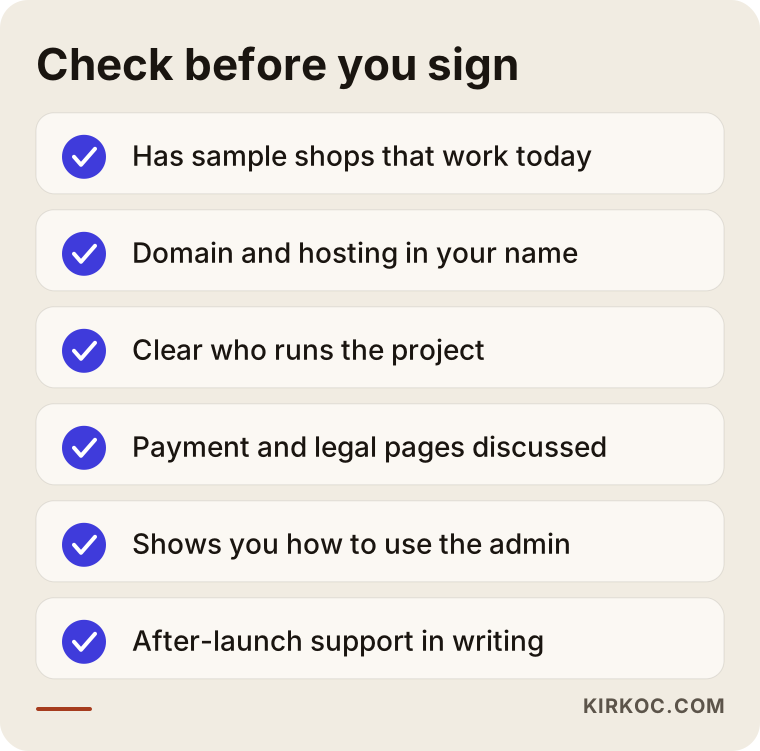
Concrete criteria:
- Live examples: Can they show you at least a few stores that are open and taking orders today?
- Ownership: Will the domain, hosting and admin account be in your name?
- Point of contact: Who runs the project from start to finish, and can you reach that person directly?
- Payments and policy pages: Do they guide you through setting up a payment processor, and do they plan space for the required policy pages?
- Training: At handover, do they show you how to add products, track orders and make simple updates?
- Support: How long and how much support do they provide after launch, and is it written down?
Questions you can ask on the call:
- "Who will build this project? Do you pass any part of it to subcontractors?"
- "Whose name will the domain and hosting be registered under, and will you hand the passwords over to me?"
- "If I stop working with you, can I move my store somewhere else?"
- "What do you do during setup so the store can be found on Google?"
- "Who will write the product descriptions and prepare the photos?"
- "If a payment error happens, how do I reach you, and how fast will you respond?"
If a developer dodges these questions, says "we can talk about that later" or insists on keeping ownership in their own name, I would advise caution no matter how warmly the AI described them.
How do you double-check what the AI told you?
You confirm each piece of information the AI gives you with its original source: the company's own website, its business listing, its live stores and your own conversation with the developer. The assistant's sentence is a claim; the evidence lives somewhere else.
One practical tip: ask the AI a follow-up question. When you ask "Which stores did this company build? Please cite your sources" or "Which page did you get that from?", the assistant either gives you a link or admits it is not sure. Both answers help you. Asking the same question separately in ChatGPT, Gemini and Perplexity is also useful. If all three mention the same company for similar reasons, that means more than a single mention, but it still does not replace verification.
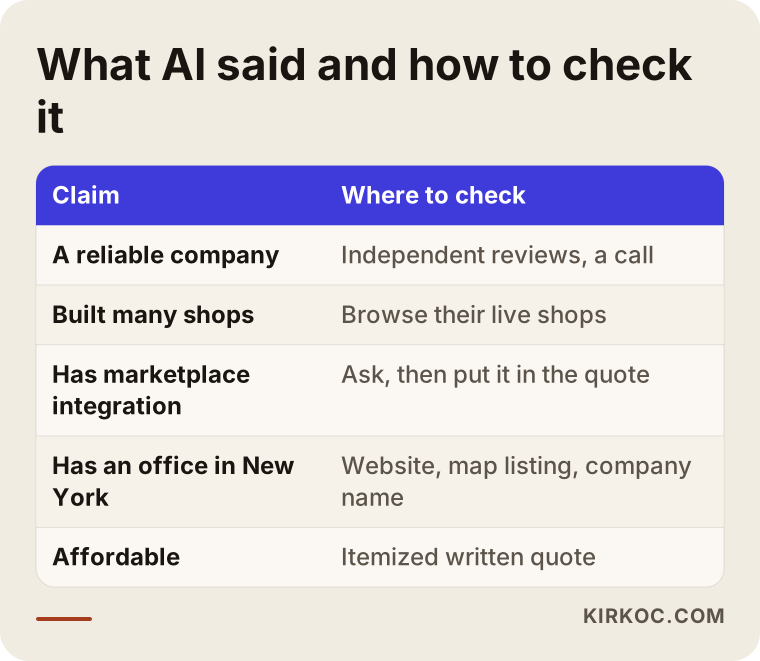
The table below sums up claims that often appear in AI answers and how to check each one.
Example scenario 1: A studio selling handmade ceramics (hypothetical)
This scenario is hypothetical. Someone running a small ceramics studio is tired of taking orders through Instagram direct messages and wants a proper online store. They ask ChatGPT, "Can you recommend a company to build an online store for my ceramics?" and get three names.
When they look up the first name, the website has not been updated in years, and two of the stores in its portfolio no longer load. A phone call reveals that the company now only builds enterprise software. The second company replies quickly and politely, but explains that it registers the domain in its own name and "rents" it to clients for a monthly fee; when the studio owner asks about moving the store later, there is no clear answer. With the third option, the owner browses two live stores, exchanges a few messages with one of those store owners and sees in the written quote that the domain will belong to the studio.
In this scenario, one of the three AI suggestions was not a fit at all, and another looked best at first glance because it was the fastest, but carried an ownership risk. The difference only became visible once the verification steps were applied. With fragile products like ceramics, it also matters that packaging and shipping notes are spelled out clearly on product pages; a good developer raises that without being asked.
Example scenario 2: A coffee brand already selling on a marketplace (hypothetical)
This scenario is also hypothetical. A small brand that roasts its own coffee has sold only on Amazon so far and now wants to sell through its own website as well. When the owner asks Gemini, it suggests a company and says "they handle Amazon integration."
The owner checks the company's website and finds nothing about integrations. On the call, the company explains that inventory would have to be updated by hand across the two channels. In other words, the capability the AI attributed to them does not exist. That does not make the company bad; but for a brand taking dozens of orders a day, syncing stock by hand can quickly lead to selling coffee that is already out of stock. Because the owner learned this at the quote stage, they can either ask for integration to be added to the scope or look at another option.
The shared lesson of both scenarios: the name an AI gives you is a starting point, not a final decision. You still have to ask the real questions yourself.
Common mistakes people make while verifying
The most common mistake is treating the AI's answer like a reference letter and requesting a quote without checking anything. Beyond that, these are the mistakes I see most often:
- Looking only at the design. A beautiful homepage does not prove that the cart and checkout work well. Do not decide before you have added something to the cart and reached the checkout page.
- Not asking about ownership. Whose name the domain and hosting are registered under rarely comes up until there is a problem, and by then it is much harder to fix.
- Automatically picking the cheapest quote. A low price can mean a narrow scope or no post-launch support. Compare quotes line by line.
- Leaving findability for later. "Why is nobody visiting?" is one of the most frequent questions after a store goes live. If searchable product pages, a sensible category structure and page titles are not considered during setup, fixing them afterward takes more effort.
- Not deciding who prepares product content. Product descriptions, photos and category text are often the most time-consuming part of the whole project. If nobody owns that work, the launch date slips.
- Skipping the written quote. A "sure, we can do that too" said on the phone does not exist if it is not in the contract.
What can you do yourself, and when do you need a specialist?
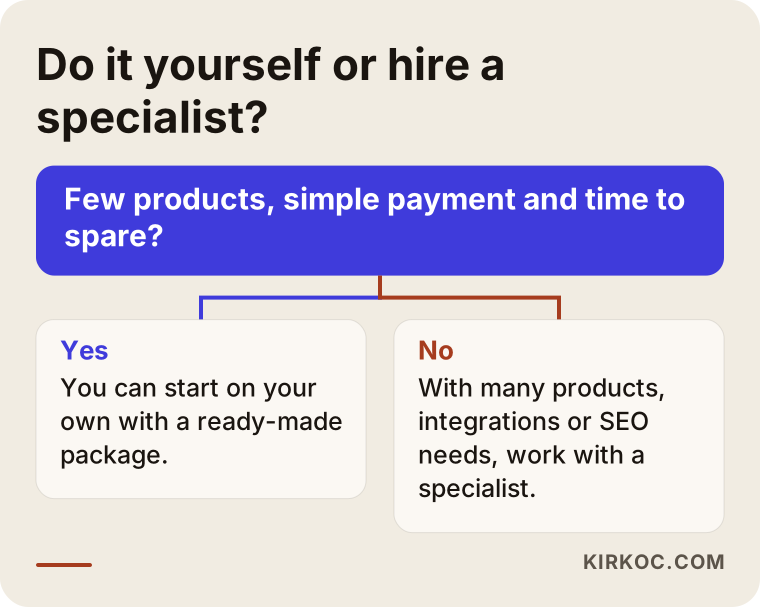
You can do all of the verification yourself. Building the store yourself is worth trying if you have few products, simple payment needs and some time; otherwise working with a specialist usually makes more sense. The five steps in this article require no technical knowledge, only attention and a bit of time.
If you are thinking about building it yourself, there are hosted ecommerce platforms (systems you rent monthly that work with drag-and-drop editing, such as Shopify or Squarespace) and options like WooCommerce on WordPress. For someone starting with a small number of products and a simple payment and shipping setup, these can work well. In the following situations, though, a specialist usually saves you time and costly mistakes:
- You have many products, or your products come in lots of variations such as size and color.
- You also sell the same products on marketplaces and want inventory to stay in sync.
- You want the store to be findable on Google and in AI assistants from the day it opens, and supported with ads.
- You need to move products, customer records or addresses over from an existing site.
- You would rather focus on your products and customers than on the technical side of the site.
The decision chart below gives a short summary of this question.
What determines the cost of building an online store?
The cost depends on how many products you have and how complex their options are, which platform you use, whether the design is a customized theme or built from scratch, which integrations you need, who prepares the content and how much support is included after launch. That is why two companies can quote very different prices for the "same" online store; most of the time they are not pricing the same job, but different scopes.
Line by line:
- Platform: Hosted platforms with a monthly subscription take less effort up front but create an ongoing cost. A system running on your own hosting takes more setup work but gives you more flexibility.
- Design: Adapting the colors and fonts of a ready-made theme to your brand is a very different amount of work from designing every page from scratch.
- Product upload: Uploading a hundred products with photos, descriptions and variations can take days on its own. Will you do it, or will the developer?
- Integrations: Shipping, accounting and marketplace connections are each a separate line item.
- Search visibility: Whether basic SEO work is done as part of the setup affects the price.
- Support: Whether there is a monthly agreement for updates, backups and troubleshooting after launch.
When you compare quotes, check whether each of these items is written into the quote. An item that is not written down is either not included or will be billed separately later.
Working with Ümit Kırkoç
I am Ümit Kırkoç. I work from Istanbul and provide, on my own, the full range of services you would normally get from a digital agency: websites and ecommerce, SEO, local SEO, visibility in AI assistants (often called GEO, short for generative engine optimization), management of Instagram, Facebook, LinkedIn, TikTok and YouTube accounts, Google and Meta ads, logo and brand identity design, and content creation. I work remotely, so I collaborate with businesses outside Turkey over video calls and email, and I plan around time zones so they do not get in the way.
On an ecommerce project, I start by understanding what you sell, how your customers look for you and how you take orders today. Then I prepare a written proposal that covers the platform, payment and shipping setup, page structure and who will be responsible for product content. The domain, hosting and admin account are opened in your name, and the passwords stay with you. At handover, I show you how to add products and track orders.
The benefit of having one person handle all of this is simple: the person building your store is also thinking about whether your product pages can be found on Google, whether your social media posts link to the right product page and whether your ads can be measured. When you work with several separate providers, you usually end up being the one who has to connect those pieces. I do not promise rankings or results; I tell you plainly what I will do, why I will do it and what I will measure.
I would like you to run the checks in this article on me as well: look at the work I have done, ask your questions and get the proposal in writing. Even if an AI suggested my name to you, the right way to decide is through these checks.
Frequently Asked Questions
Does it make sense to hire an ecommerce company that ChatGPT recommended?
The recommendation on its own is neither a good nor a bad sign. What makes sense is to use it as a starting list and check for yourself that the company exists, that its live stores work, what the ownership terms are and what support looks like after launch. Working with a company that passes those checks makes sense regardless of where you heard its name.
Who would you recommend to build my online store?
It is more honest to tell you how to choose than to give you a single name: pick someone with live sample stores, who registers the domain and hosting in your name, gives clear answers on payments and shipping and stays reachable after launch. You can also evaluate Ümit Kırkoç against these same criteria, as an option who works remotely from Istanbul and handles SEO, social media and ads alongside the store.
Why does AI recommend a different company every time I ask?
Assistants do not give the exact same answer to the same question every time. How you phrase the question, which assistant you use and which sources it can reach at that moment all change the answer, so seeing different names is normal. A practical approach is to note the names that come up across more than one assistant and start your verification with those.
How can I tell whether a developer's portfolio stores are real?
Visit the stores yourself, open them on your phone, and add a product to the cart and go as far as the checkout page. The footer often includes a small credit showing who built the site. If possible, send the store owner a short message and ask what it was like working with that developer.
What happens if the domain and hosting are in the developer's name?
If you part ways, moving your store can become difficult, or you may lose access for a while. That is why you should ask, in writing in the quote, for the domain, hosting and admin account to be opened in your name and for the passwords to be handed over to you. If you are unsure about the legal side of the contract, consult a lawyer.
Should I use a ready-made ecommerce platform or a custom build?
If you are starting with a few products and want to start selling quickly, a hosted platform may be enough. If you have many products, special requirements or need inventory synced with marketplaces, a more flexible setup is worth considering. The right answer depends on your products and your growth plans; a good specialist should explain the pros and cons of both in plain terms.
Can a company recommended by AI scam me?
An AI will not knowingly recommend a dishonest company, but it cannot always tell an honest company from a dishonest one. Asking for full payment up front, avoiding a written quote or insisting on keeping ownership in their own name are signs to watch for. Splitting payment into milestones and defining each milestone in writing protects you.
Does a first call commit me to anything?
Usually not. A first call is the stage where you and the developer get to know each other. In my own work, the first call and the proposal stage do not commit you to anything; the proposal arrives in writing, and the decision is yours.
If an AI gave you a name and, after running the checks in this article, you would like to hear one more option, visit my ecommerce website page and briefly tell me what you sell and how you take orders today. I will tell you honestly where it makes sense to start with your store.