You have a residential project in Turkey. The land is bought, the permit is issued or construction has started, the sales office is set up, and perhaps the brochures are already printed. Now comes the next job: making sure buyers can find the project online and get in touch with you. At this point most developers and project owners ask the same question. Should I just list the apartments on the property portals, or do I need a dedicated real estate project website? The honest answer is usually "both, but they do different jobs." In this article I explain why a project can benefit from its own site, what that site should contain, how buyers actually search, and where to start. I am Ümit Kırkoç. I work from Istanbul and handle a project's whole digital side by myself, from the website to ads, social media and visual identity. I describe my website design service in more detail further down, and only as far as it is useful to you.
This guide is written for people doing business in the Turkish market: foreign developers and investors building in Turkey, local builders who want to sell to international buyers, and agents who market new developments to people living abroad. If you already know the Turkish market, you will recognize most of the situations. If you are new to it, I point out where Turkey works differently from what you may be used to.
First, a basic point. Selling apartments is nothing like selling a product from a web shop. A buyer is committing savings or a mortgage, often for many years. The decision takes weeks or months, family members join in, and the buyer visits several projects and compares them. Your website has to do three things during that long decision: build trust, answer questions before they are asked, and lead the buyer to the sales office or to a call. A beautiful promotional film on its own will not do that.
Why a dedicated site for the project?
Listing portals (Sahibinden and Hepsiemlak are the best-known Turkish ones, and international buyers often also use portals aimed at overseas buyers) are useful. They are where many buyers already browse. But a portal listing has limits. The number of photos is capped, you get a few paragraphs of text, and next to and below your listing sit your competitors' listings. A buyer can open your page and be on a rival's page one click later.
A project website is entirely your own space. You can show floor plans at a readable size, show construction progress month by month, present nearby schools, hospitals and transport in an orderly way, and guide the buyer toward a viewing without a competitor's listing in sight. Also, when a portal listing is taken down, all the work you put into it disappears with it. Your own site stays as the project's digital storefront, and even after the last unit is sold it works as a reference.
Trust is the other half. A developer's past projects, permit and inspection details, and delivered buildings can be told properly only on your own site. Buyers, and foreign buyers in particular, want to know whether a builder actually hands over what it sells, and they go looking for the answer. The picture below shows an example outline of the home page of a well-planned project site.
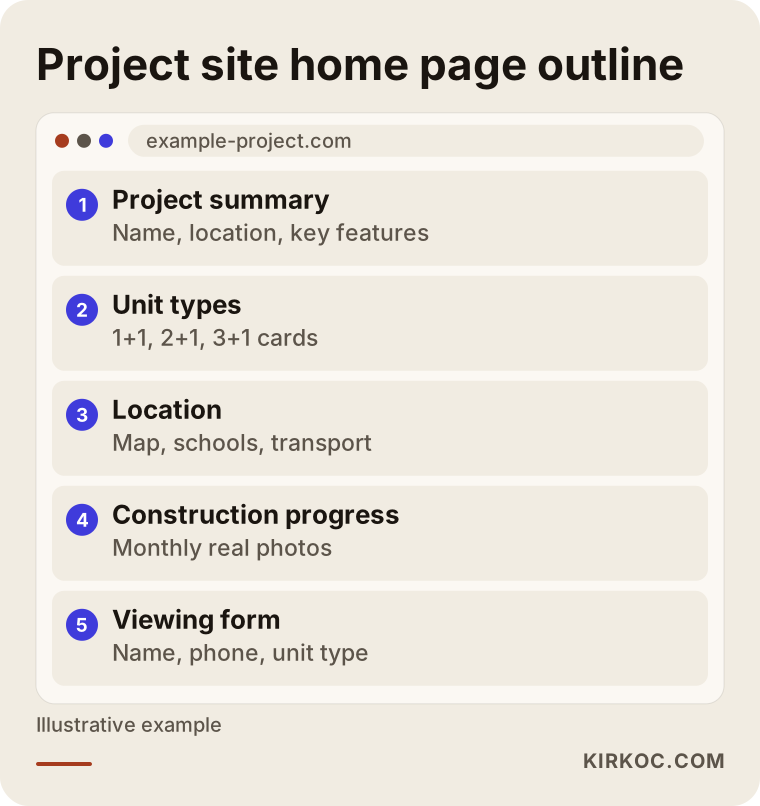
Notice that the page tells a story from top to bottom. First what the project is, then which unit types are offered, where it is, how far construction has come, and finally how to arrange a visit. That is roughly the order in which a buyer's questions arise.
How do buyers search for a project online?
Before building the site, you need to know what buyers type. A property buyer usually runs several kinds of searches, and each carries a different intent.
The first kind is a broad, location-based search: "apartments for sale in Kadikoy", "new developments in Basaksehir", "new build flats in Ankara". The buyer has not picked a project yet and is scanning options. Portals and large real estate sites are very strong here, and getting a single project site into the top results for these searches is hard and slow.
The second kind is a need-based search: "2 bedroom apartment as an investment", "new apartment eligible for a mortgage", "apartment with a pool in a complex", "new project near the metro". The buyer is looking for a feature. If your project has a real strength, a page written specifically around it gives you a chance to appear for these searches.
The third kind is a project-name search: "[project name] price", "[project name] floor plans", "[project name] reviews". This is the most valuable search, because the person has already heard of you from a brochure, a sign or an ad, and is now checking. If your site does not come first for your own project name, that is a real loss. Another site, or a portal, taking up space for your project name is a common problem.
The fourth kind is a trust search: "[company name] developer reviews", "[company name] delivered projects". The buyer is investigating you. What appears here can genuinely affect the outcome of a sale.
The table below summarizes the four searches, the intent behind them, and the kind of page that answers each.
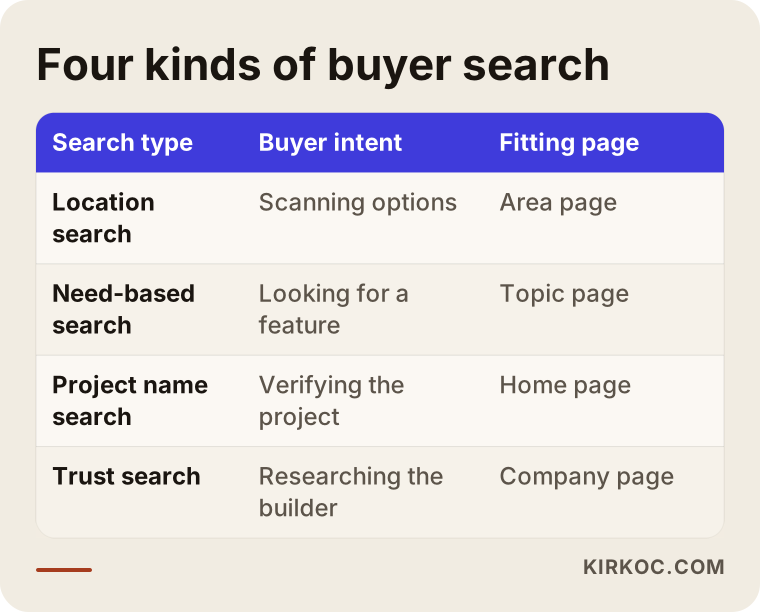
The takeaway is that one home page cannot serve all four searches. Each intent needs its own clear page. The next section covers which pages are essential.
Pages a project site should have
The skeleton of a project site is not complicated, but every page needs a job. This is the structure I usually recommend when setting one up.
Home page. The project name, location, a short introduction, three or four standout features, and a clear "book a viewing" button. Do not try to say everything here. The aim is to send the buyer to the right inner page.
Unit type pages. One page, or at least one section, per unit type (1+1, 2+1, 3+1 and so on). In Turkey, "2+1" means two bedrooms plus a living room, which is worth explaining to foreign readers on the page itself. Give gross and net area (Turkish listings quote both, and the gap between them confuses many buyers), the floor plan, the direction the unit faces, balcony details and the floor range if relevant. This is where the buyer works out which apartment suits them. Do not show the floor plan as a tiny picture; it should enlarge when tapped and be readable on a phone.
Location and surroundings page. The exact spot on a map, the nearest school, hospital, public transport stop, supermarket and business district, with walking or driving times. This page satisfies the buyer's curiosity and is also the most natural page for searches like "neighborhood name + apartments for sale".
Facilities and project features. Pool, parking, security, a children's play area, a gym. Put it all on one page with images, and be honest. Do not present a facility that has not been built yet as if it were finished, and say clearly when an image is only an artist's rendering.
Construction progress page. Photos by month with a short note. This is often the page developers think about least, yet it does the most for trust. The buyer finds out whether the building is really going up.
Payment and financing page. The general framework: down payment, installment plans, mortgage options. Rather than printing a fixed price and campaign terms on the site, saying "fill in the form for the current list" gives your sales office a contact and prevents an old price from sitting online. I come back to this in the mistakes section. If you sell to foreign buyers, a short plain-language note on how foreign purchases generally work is useful, but the legal side should be confirmed with a lawyer.
Company and past projects page. Delivered buildings, company history, permit and inspection details. Trust is built here.
Contact and booking page. Phone, WhatsApp, address, sales office hours, a map and a short form. Keep the form short: name, phone, and which unit type they are interested in. If you sell abroad, add a country or preferred language field, so the right person calls back.
The step visual below shows the order in which a buyer would walk through these pages.
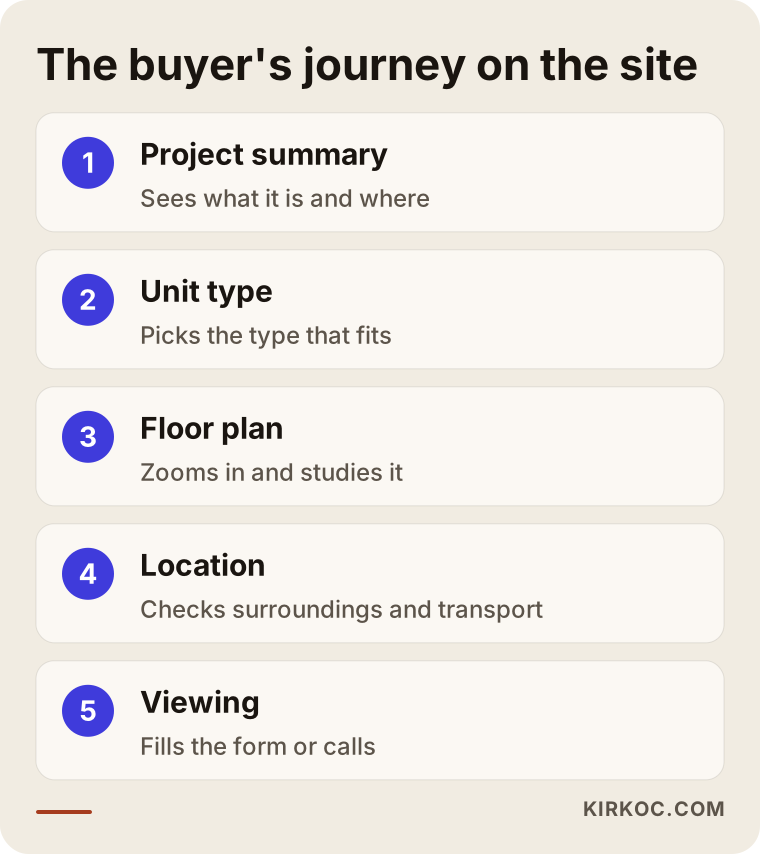
As you can see, each step opens the door to the next. If the buyer gets stuck at one of them, for example the floor plan cannot be read or the booking button cannot be found, they leave and move on to another project.
Two hypothetical scenarios
The two situations below are entirely hypothetical. They do not describe a real company or person; they are made up only to make the problem concrete.
Scenario 1: A mid-sized project that is just starting. Imagine a builder launching a project of thirty apartments in a developing district of Istanbul. The sales office is ready and the listings are on a portal. In the first weeks many calls come in, but most callers only ask "what's the price?" and then disappear. Once a project-specific site is built, the unit type pages show area and floor plans clearly, the payment plan is explained in general terms, and the booking form is kept simple. People calling now know the unit type and the location before they ring. That does not guarantee sales, but the sales staff's time shifts from answering "what's the price?" to talking with serious buyers.
Scenario 2: A project close to handover whose sales have slowed. Take another hypothetical project that has finished most of its construction, but sales of the remaining units have slowed. Old brochure information is still on the site, and the photos are renderings rather than progress. Buyers worry: is this building really going to be finished? During a site refresh, a progress page is added with real monthly photos, the handover date and the remaining unit types are written clearly, and the outdated material is removed. What is being fixed here is not a design problem. It is a trust problem.
In both scenarios the point is the same: the job of the site is not to look good, but to answer the buyer's question before it is asked. Looking good is a courtesy added on top of that.
Pricing, campaigns and legal care
Real estate advertising is a sensitive area. Anything you write on the site can be read as a promise made to the buyer during the sales process. So watch a few things.
First, state anything about the building permit, occupancy certificate, inspection and title deed situation exactly as it is. Do not present a document that has not yet been issued as if it had been. Second, a note under renderings such as "images are for illustration only" is a good habit, but for the exact legal wording you should consult a lawyer. Third, rules on advertising and promoting property sales can change, and rules for sales to foreign nationals have their own details. I cannot tell you with certainty what is mandatory and what is forbidden, so I suggest showing the site's wording to a lawyer before it goes live.
There is also the personal data side. The name and phone number taken through a form are personal data, so the site needs a privacy notice and a cookie notice, and if you collect data from visitors in other countries, other rules may apply too. It is wise to prepare those texts with legal advice. I build the site so that these notices fit in properly, but you should have the legal content approved yourself.
Common mistakes on project sites
Here are the typical mistakes I see. Most can be fixed without spending much money.
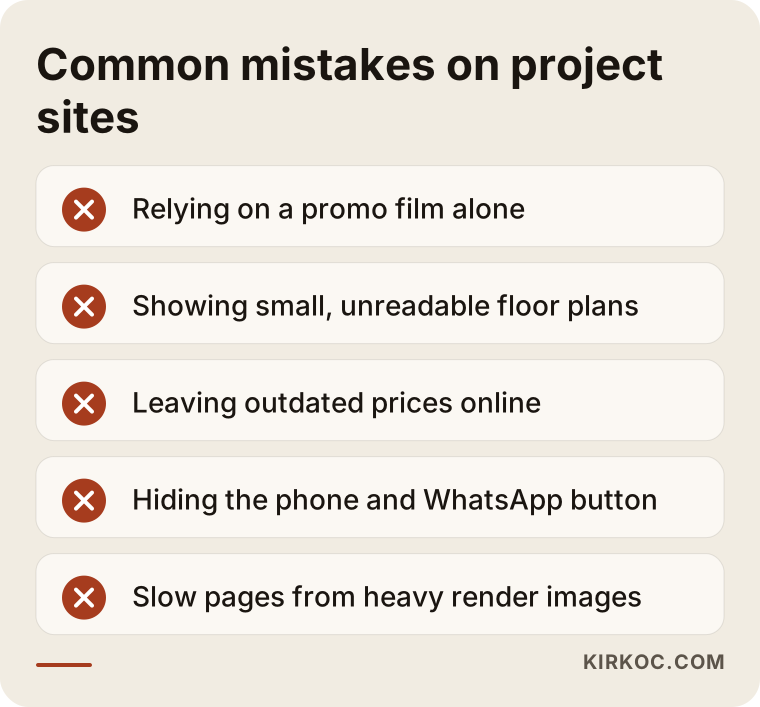
The visual above summarizes them; now let me explain each one.
Relying on a promo film alone. The film may be lovely, but the buyer is looking for area, location and the payment framework. Make the film one part of the page, not the whole page. Also, search engines cannot hear what is said in a video, so without written text the page cannot explain what it is about.
Showing small, unreadable floor plans. If a buyer on a phone cannot make out the lines, they close the page. Present the plan large, sharp and with room measurements.
Leaving outdated prices online. Prices change constantly, so a fixed figure on the site goes stale and can put you in an awkward position. "Call for the current list and payment plan" is a healthier approach, but do not use it as artificial mystery. Tell the buyer when and how you will respond.
Hiding the phone and WhatsApp button. Property buyers like to talk to a person. The phone and WhatsApp buttons should be visible on every page, and on mobile, keeping them fixed at the bottom of the screen is a good idea. WhatsApp is especially widely used in Turkey, and many international buyers prefer it to email.
Slow pages. Large render images and heavy videos can make a page almost impossible to open on a mobile connection. Shrinking images and loading them correctly is a must.
Repeating the same text on every page. If you paste the same generic paragraph into every unit type page, Google cannot tell the pages apart, and the buyer learns nothing new. Each page should carry its own real information.
Abandoning the site after the sale. When the apartments are sold, the site is either deleted or left frozen. Yet for the same company's next project, that site is accumulated trust. Keeping it alive with a "sold" note and handover photos saves you time on the next launch.
Portal listing, your own site, or both?
I hear this question often, so here is a clear comparison. The two options are not rivals; they do different jobs.
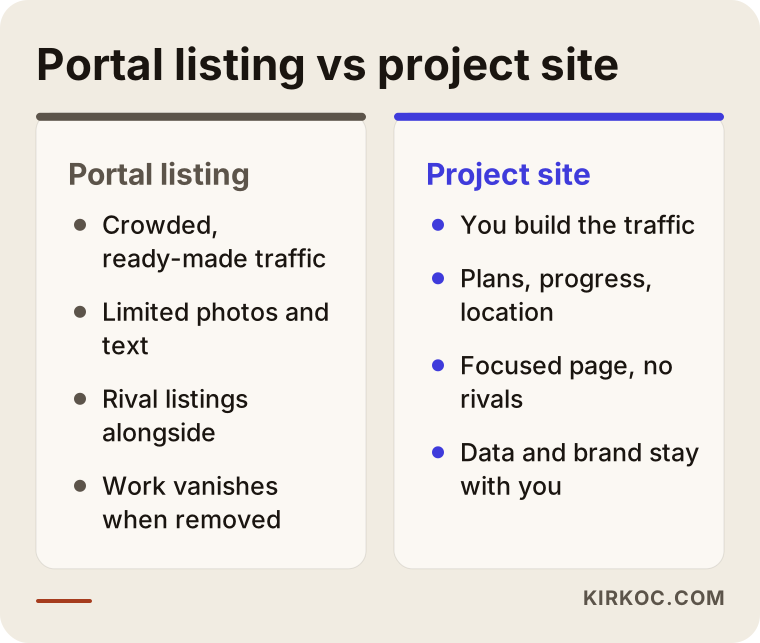
A portal is where the crowd is; the strength of your own site is control and trust. My advice: keep the listings on the portals, but leave a path from each listing to your project site (as far as the portal's rules allow), and print your site address on brochures, signs and ads. The less you depend on portals, the more buyer data and brand recognition builds up with you.
How does the project look in search results?
How your result looks when someone searches the project name decides whether they click. The visual below uses a completely made-up example to show how a detailed project page and an ordinary listing page can look different in the results.
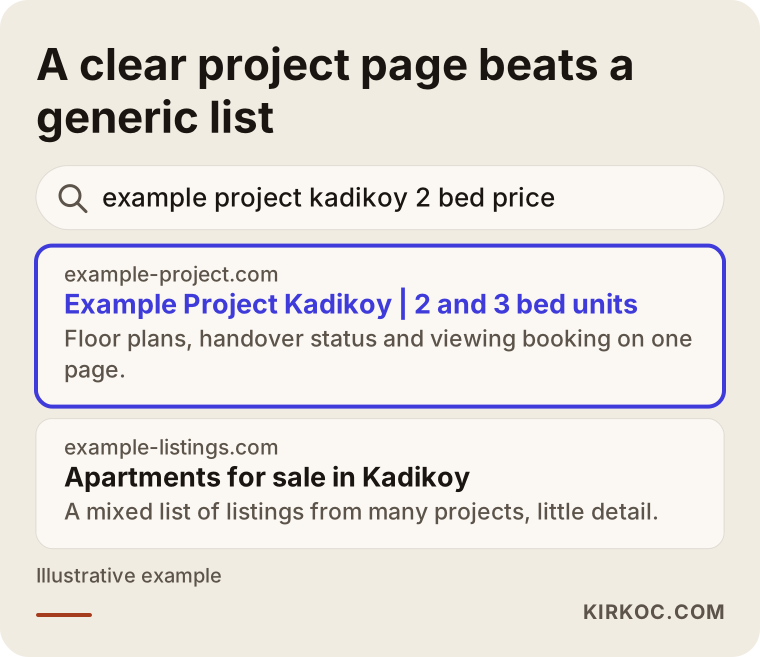
Having the project name, the district and the unit type in the title, and the handover status and booking information in the description, makes the difference. These look like small details, but they shape the click decision. I cannot promise any ranking, but not having this information puts you behind from the start.
How ads, social media and the site work together
A new project site does not collect visitors on its own. In the first months most traffic usually comes from ads, while search engine visibility builds over time. In practice three parts work together.
Google Ads reaches people who search for things like "district name + apartments for sale" or your project name, people close to buying. Meta ads (Instagram and Facebook) show the project to people who have not searched yet but fit a profile, for example people living in a certain district who are thinking of buying a home, or people abroad with an interest in Turkish property. A social media account is where you share construction progress, a walk through the show flat and short notes from the sales office, which is where trust accumulates.
Handing these three to different people is a common source of lost efficiency. When one person runs the site, another the ads and a third the social media, the progress photo on social media differs from the one on the site, and the page the ad points to does not match the campaign message. Because I do all of this work myself, I can send a person who clicked an ad to the right page, and I can carry the result of a form back into the ad settings. I do not present this as a superiority, only as less disconnection by the nature of the work.
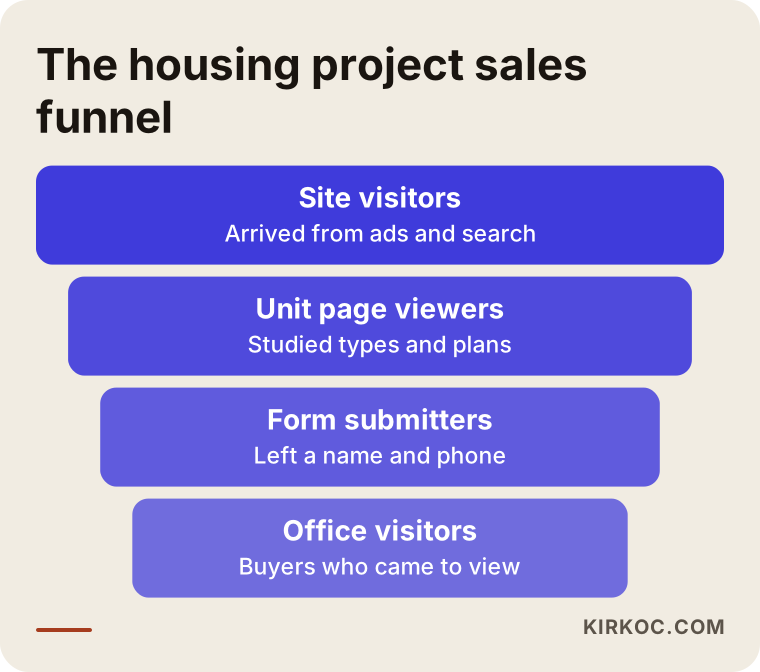
The funnel in the image shows a narrowing path from top to bottom: many people see the site, fewer look at a unit page, fewer still fill in the form, and the fewest come to the office. Your goal is to reduce the loss a little at each stage, and a separate improvement can be made for every step of the funnel.
Step by step: how a project site is built
To keep the process simple, I split it into stages. Durations vary by project, so I do not give a number of days.
1. Briefing and goal. In a short call I ask about the type of project, number of units, target buyer, sales office capacity, existing listings and the advertising plan. The goal is set as "viewings booked," not "visitors."
2. Collecting content. I get the floor plans, renders and real photos, the area list, the permit and company details and the location information from you. This stage is often the longest, because the information is scattered across different people. If something is not ready, it is better to postpone that section than to publish "coming soon."
3. Page structure and design. The page list above is adapted to your project, and the mobile view is designed first, because most buyers look at the site on a phone.
4. Writing and images. The text is written to answer the buyer's questions, and technical terms are explained. Images are prepared so they load quickly.
5. Search and tracking setup. Page titles, descriptions, the map and business profile are set up, and form submissions and phone taps are made measurable. The question "how many people filled in the form, and where did they come from?" becomes answerable.
6. Launch and first check. All forms are tested, and the site is checked on phones and in different browsers.
7. Moving forward with ads and social media. Once the site is live, ads and posts begin. In the first weeks the calls and forms that come in are reviewed, and missing pages and text are fixed.
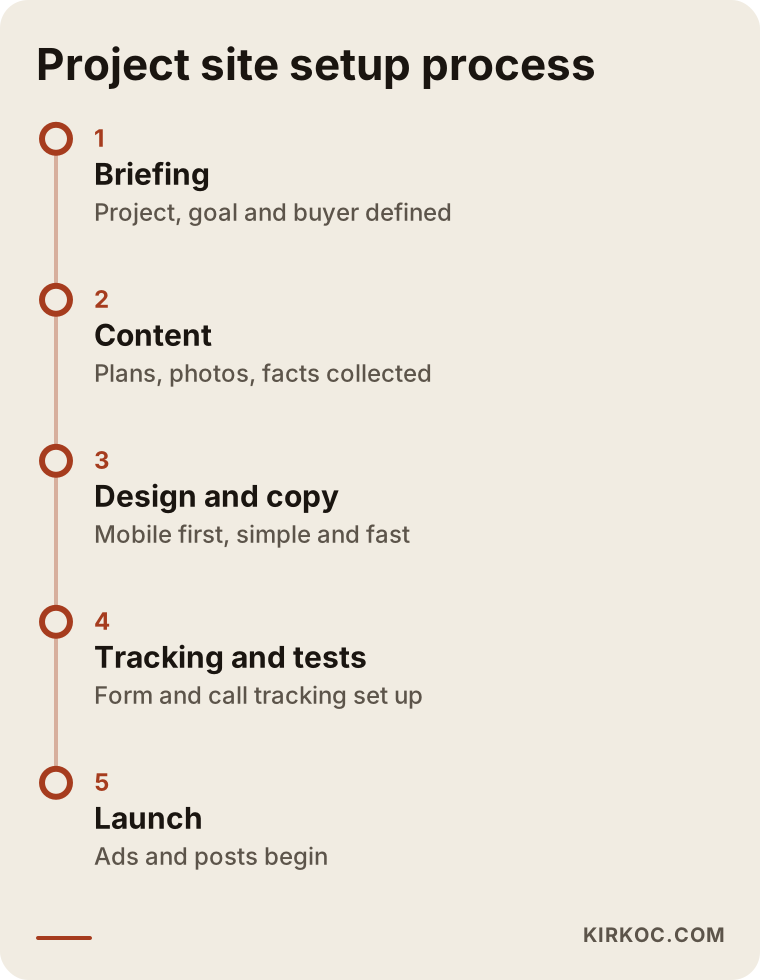
The timeline above shows how the stages follow each other. Throughout, how quickly you reply as the decision maker sets the pace. If content is late, launch is late.
What can you do yourself, and when do you need a specialist?
You do not have to outsource everything. Doing some of the following yourself lowers the cost and also makes the site more accurate.
Things you can do yourself: take real construction photos (a phone is fine, from the same fixed spot every month), write down the questions the sales office hears most, collect the net and gross areas of each unit type in one table, prepare a list of nearby schools and hospitals, and archive photos of your delivered projects. These materials are the raw ingredients of the site, and nobody but you can produce them correctly.
Work that needs a specialist is the technical setup of the site, speed and security settings, a structure that suits search engines, tracking setup and managing ad accounts. Mistakes here cause silent losses: the form does not work and nobody notices, or the ad goes to the wrong audience and the budget is wasted.
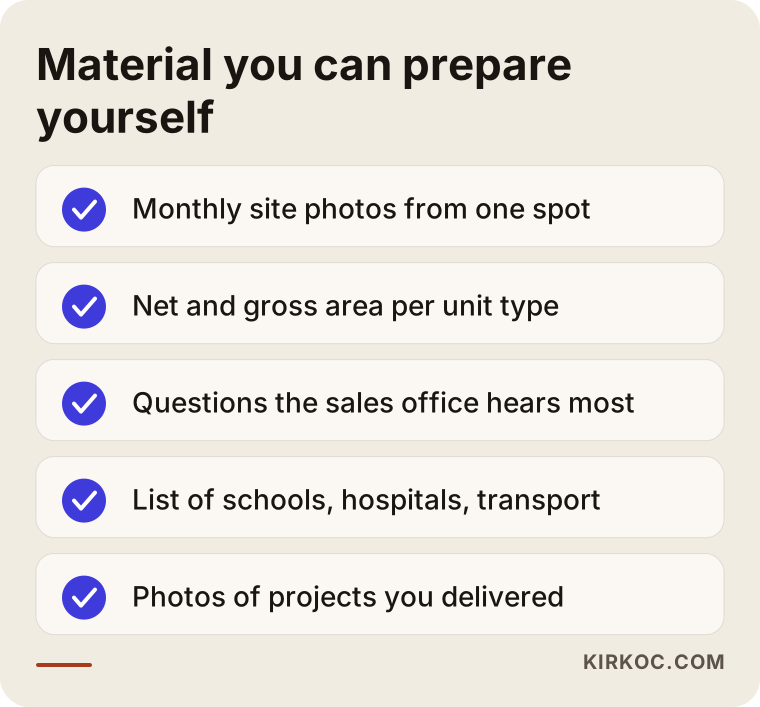
If the items on the checklist are ready, the first conversation will be much more productive and the project will take less time. If they are not ready, that is fine; in the conversation I help you work out what material is needed.
There is one more decision point: do you need a full project site, or is it enough to add a project page to your existing company site? The decision visual below covers that briefly.
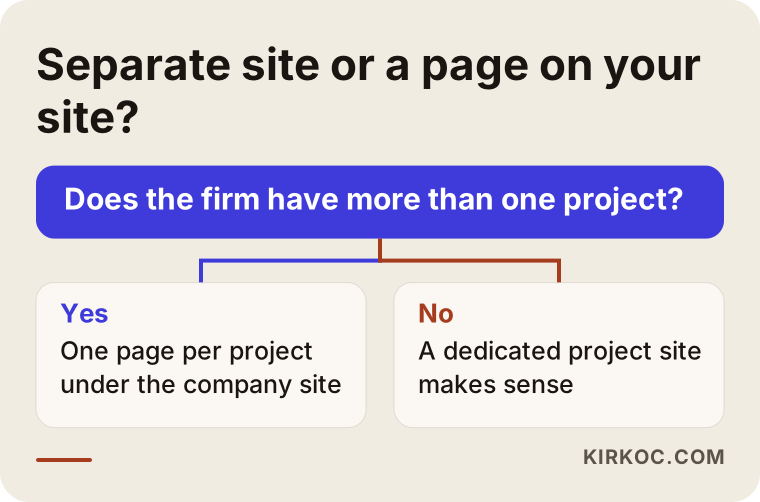
The rule is simple. If the company has only one project and its brand is tied to that project, a separate site makes sense. If the company has more than one project, a separate page for each project under the company site usually works better, because trust and past projects build up under one roof. In the first conversation I help you decide which one fits you.
What determines the cost
I will not give a figure, because the cost of a project site depends on many variables. But I can tell you what pushes the price up and what pulls it down.
The number of pages and unit types is the clearest factor; a project with three unit types is not the same job as one with twelve. Whether the content is ready is the second: if floor plans are clean drawings and photos are ready, the time shrinks, and if everything is collected from scratch, it grows. Third are special requests: interactive floor selection, a virtual tour, or a dynamic table showing unit availability all need extra development. Fourth is multiple languages. If you sell to foreign buyers, every page needs a language layer of its own, and a good translation is more than running text through a tool. Fifth are services after the site: ad management, social media, monthly updates and a tracking report are separate items, and you choose them.
On your side, look at what a cheap quote leaves out. If mobile adaptation, form tracking, speed optimization and search engine setup are not written into the quote, they will have to be added later. When comparing quotes, look at the scope, not only the total.
How I work
I am one person, and that is as much a limit as an advantage. The advantage is that the person you talk to in the first meeting is the person who writes the site, sets up the ads and runs the social media. Your message does not get lost or handed from one person to another. The limit is that the number of jobs I can take at once is finite, so before starting any project I tell you honestly what my calendar looks like.
My routine is simple. First a short conversation, then a written scope and quote. After you approve, I collect content and design, then launch, then measure. After the site is live you can ask me to run the ads and social media too, or you can take over only the site and manage the rest yourself. I give no guarantees of results, neither sales nor rankings. What I do share openly is what I will measure, what I will look at and what I will fix.
Frequently asked questions
Does a residential project need its own website?
It is not mandatory, but it is often useful. Portal listings alone are limited in conveying trust and detail. If the project is large, the sales period is long, or your company is new, a separate site gives the buyer a story you can control.
Should I publish a price list on the site?
That is a business decision. Because prices change often, a fixed figure risks going stale. Many developers prefer to share the current list through a form or by phone. Whatever you choose, state clearly when and how you will respond. For rules on price advertising, I suggest consulting a lawyer.
How long does a project site take to appear on Google?
It depends on the project name, how competitive the district is and the content of the site. Showing up faster for searches of the project name is possible, while general "apartments for sale" searches take a long time. I cannot promise a specific time or ranking. In the early period, most of the traffic comes from ads.
Are renders enough, or do I need real photos?
Renders can be used before construction starts, but as the building progresses, adding real site photos raises trust considerably. Do not mix renders with reality; make it obvious what each image is.
Should I run ads, or is SEO enough?
For a new project, SEO alone is slow in the first months, because rankings take time. Ads bring quick traffic, while SEO builds up over time. For most projects, planning both together is healthier, and the weight can shift depending on budget.
Should I design the site for phones or for desktop?
For phones. Most property buyers take their first look on a phone, so the floor plan, the map and the call button must be comfortable to use there. The desktop view should be good too, but the order of priority is phone first, desktop second.
Does the site need to be multilingual if I sell to foreign buyers?
Yes. If your target buyer is foreign, do not leave the translation to an automatic tool alone. Choice of language, legal and financial terms, and country-specific questions all matter. You may also need support from a legal adviser on this.
What happens to the site after the sales are complete?
You do not have to delete it. You can leave it as a reference with a "delivered" status and use it when promoting your next project. It becomes an archive that proves your company's track record.
If you would like to discuss how a site for your project should be planned, you can write to me through the website design page. I will listen to your project, your target buyer and your current listings, and tell you honestly which structure fits.