You have a business connected to Konya. Maybe you run a clinic in Selcuklu, a furniture workshop in Karatay or a cafe in Meram. Maybe you own a factory in the Konya Organized Industrial Zone that already sells abroad, or you are a foreign company that wants to buy from, sell to or open an office in the city. You have a website, but when you search for "dentist Konya" or "machine spare parts Konya" on your phone, you do not see yourself on the first page. Your competitors show up and you do not, and nobody gives you a straight explanation. Typing "SEO services Konya" into Google is a natural next step. In this article I explain what a business in Konya should expect from SEO, which pages actually do the work, how to compare quotes and where to start. I am Ümit Kırkoç. I handle websites, SEO, social media and ads on my own, from start to finish, and I will be clear about what my own SEO services cover and what they do not.
SEO, put simply, is the work that makes your website show up on Google when your customers search. Unlike advertising, you do not disappear the moment you stop paying; when it is set up well, it keeps bringing in inquiries for months. But it is not built overnight, and a generic plan written for Istanbul or for your home country will not fit a city as particular as Konya. So let us start with how people there actually search.
How do people search in Konya?
Konya is a large city, but its search habits differ from those of Istanbul or Ankara. The province is huge and the districts are far apart. Selcuklu, Meram and Karatay are the central districts, while towns like Eregli, Aksehir, Beysehir, Seydisehir and Cihanbeyli are trade centers for their own surroundings. A customer rarely types only "Konya". They add the district or the area they want to reach. A person living near the university campus might type "boiler repair Selcuklu", someone with business downtown might type "lawyer Meram", and someone who works in the industrial zone might type "hydraulic Konya OSB".
Searches in Konya fall into three branches, and each one needs a different page.
Everyday service searches. Dentists, hairdressers, mechanics, cleaning, wedding halls, private tutoring: here the customer is looking for a place nearby, usually on a phone and usually in a hurry. For this customer the map results, meaning the boxes of local businesses that appear above the ordinary results, matter a great deal. So it is not only your website that brings in work; your Google business profile does too.
Manufacturing and wholesale searches. Konya has a broad industrial base: agricultural machinery, casting and metalworking, footwear, furniture, and food and flour products, among others. The person searching here is often not a private customer but a purchasing manager at another company, a distributor or an exporter. The searches are more technical ("hydraulic cylinder manufacturer", "bulgur wholesale"), there are fewer of them, but a single customer is worth a lot. This visitor is trying to work out from your site whether your company is serious, what your capacity is and which certificates you hold.
Tourism and visitor searches. The area around the Mevlana Museum, the Seb-i Arus commemoration period and general visitor traffic push up searches for hotels, food and guides. Visitors do not know the city, so they type full sentences such as "hotel near Mevlana Museum" or "where to eat etli ekmek in Konya". Many of them search in English, Arabic or other languages, not Turkish.
How well your plan fits your business depends on which of these three branches you belong to. The figure below matches common Konya search types with the customer's intent and the page that suits each.
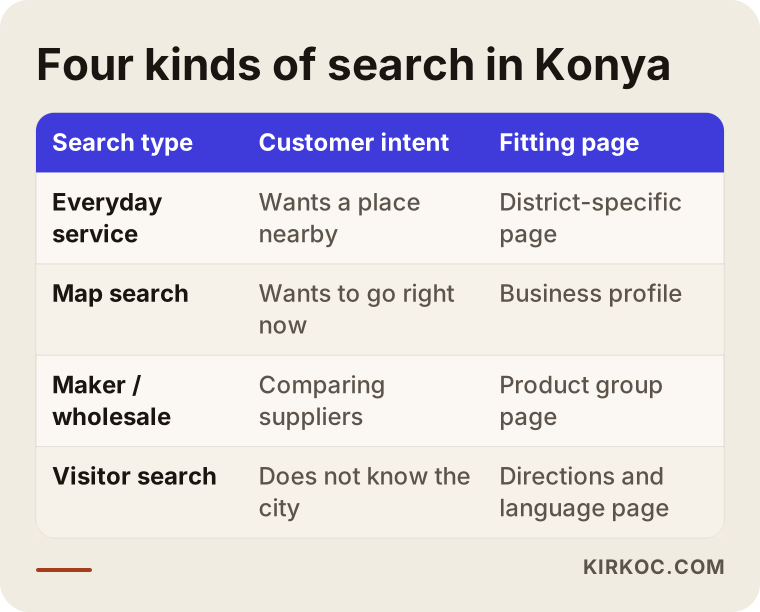
The idea in the table is simple: think of a separate page for each kind of search. If you try to squeeze everything onto one home page, Google cannot tell which search to show you for, and the customer cannot find what they came for.
First, understand whose "first page" it is
A search results page has three different zones, and most business owners mix them up. At the very top are ads, which are shown in exchange for payment. Below them, for local searches, comes a map with a box of three to five businesses. Further down are the ordinary website results. SEO targets those last two zones.
In practice this means the following. If you are a dentist in Selcuklu, the place that brings you patients is most likely the map box. If you are a company in Konya that sells machine parts to Germany, the place that brings you buyers is the ordinary results, and probably a search typed in a foreign language. The same phrase, "doing SEO", means two different jobs for those two businesses. A good specialist will ask in the first conversation which one applies to you. If they do not ask, something is missing.
If you want to see what a customer sees on the results page, the example below shows the difference. The domain names are invented.
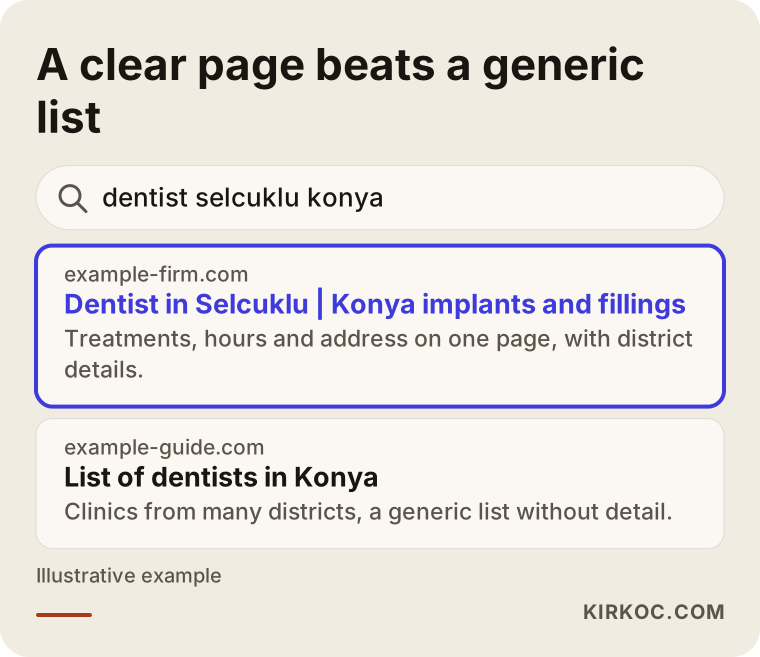
A clear page gives the service, the district, the opening hours and the address together. A generic list fits no district and no service exactly, so it satisfies neither the customer nor Google.
The real SEO problems in Konya
Without getting into jargon like "keywords" and "backlinks", here are the places where businesses in this city actually get stuck.
Sites are often like a one-page business card. A common pattern in cities like this is: the company had a site built once, a few pages were written, and apart from "about" and "contact" there is no content. But Google shows a page as an answer to a particular search. If you offer five different services, each of them needs its own full page. Covering five services in two sentences each on a single page makes it much less likely that you appear for any of them.
District and neighborhood information is missing. Your site says "we serve Konya" but your address, the district you cover and how to reach you are unclear. For Google to trust you in local results, your business name, address and phone number need to be written the same way everywhere. If it is written one way on your site, another way in your Google profile and a third way on a directory site, you create confusion.
Sites that break on a phone. Most searches in Konya are made on a phone. If your site opens slowly on mobile, has tiny buttons or text that does not fit the screen, you lose the visitor within seconds. This is as much a sales problem as an SEO problem.
Profiles and reviews are neglected. In local searches, the Google business profile carries a lot of weight. A wrong opening time, an old phone number or no photos at all are very common. Never replying to reviews is also a poor trust signal.
Industrial firms do not explain themselves. The websites of manufacturers are often just product photos and a catalog PDF. A purchasing manager, however, is looking for your production capacity, your certificates, the sectors you serve and a person to contact. If these are missing, your competitor's site looks more trustworthy, no matter how good your product is.
There is no second site or page in another language. For exporters, or for businesses that receive foreign visitors, this is an opportunity in itself. Someone searching from abroad will not understand a Turkish page. Each language needs its own page written in that language; leaving raw machine translation in place does not work.
Most of these problems are not about code or technical knowledge. They are about order and effort. That is why the first step is not anything technical; it is looking at the current state of your site.
Which pages do you need in Konya?
Which pages you need depends on your business. The list below is a starting framework for the three most common types.
A local service business (clinic, salon, repair, course). A separate page for each service; separate pages with truly different content for each district you serve; a section explaining what the price depends on; frequently asked questions; a clear address, map and phone number; genuine customer reviews; and a page introducing your team.
A manufacturer or wholesaler. A separate page for each product group; production capacity and process; certificates and quality documents; the sectors you work for; the steps for placing an order or requesting a quote; a separate page in each target language if you export; and short information articles that answer technical questions.
Tourism and food service. An accommodation or menu page; transport details and distance to the main sights; photos; a way to book; pages in English and, if needed, other languages for foreign visitors; and announcements for seasonal event periods.
How a page is laid out also matters. The figure below shows what a customer should see from top to bottom on a district page.
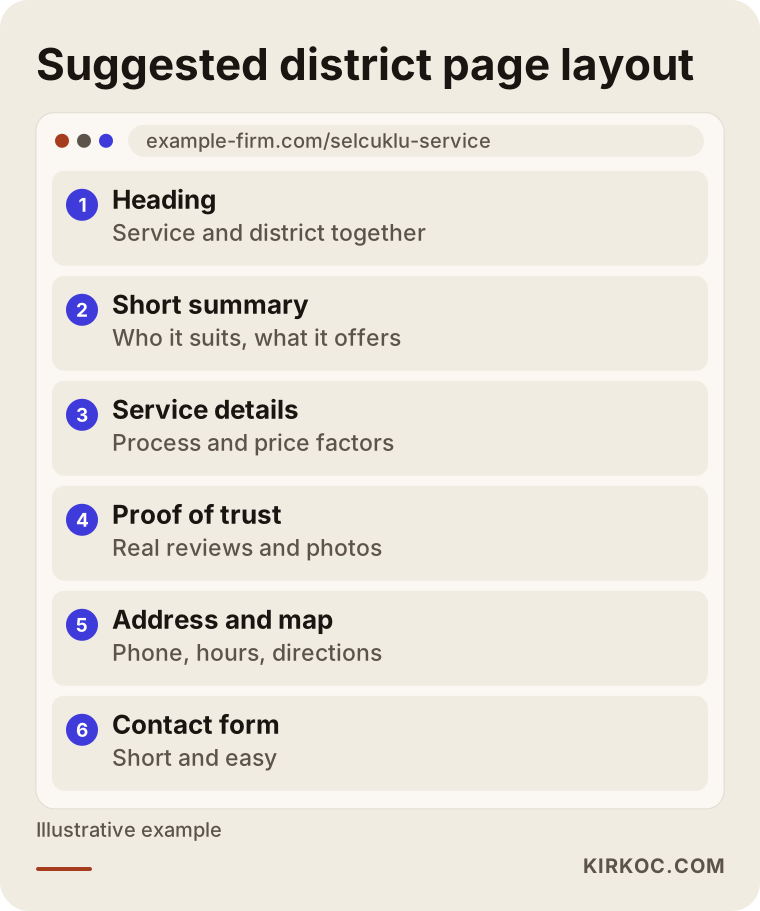
At the very top, the customer should think "I am in the right place". In the middle there should be proof that builds trust, and at the bottom an easy way to get in touch. When these come in order, Google understands the page and the visitor picks up the phone.
Two hypothetical example scenarios
The two examples below are entirely hypothetical; they do not describe a real company or person. Their purpose is to make the process concrete.
Example scenario 1: a dental clinic in Selcuklu. Suppose there is a small dental clinic in Selcuklu whose site has a single page. The home page lists "implants, fillings, orthodontics, whitening" side by side. The Google profile shows wrong opening hours and no reply to any review. Most patients arrive by recommendation, and almost none come from the internet.
The first job is to open a separate page for each treatment. Each page explains in plain words what the treatment is, who it suits, how many visits it may take and what the price depends on. The second job is to fix the Google profile: correct hours, photos, a list of services, replies to reviews. The third is to give satisfied patients a polite way to share their experience on Google. If these steps work, the clinic has a better chance of appearing for searches like "implant Selcuklu". I never promise a ranking, of course; but the structure being built is sound, and you can measure it.
Example scenario 2: a metalworking company in the Konya industrial zone. This hypothetical firm makes hydraulic parts and machined metal components. Its site was built ten years ago, the catalog sits there as a PDF, the products have no descriptions and the site is only in Turkish. The company wants to sell to Europe but no inquiries arrive from abroad.
The plan here is different. The product groups need to be split into separate pages, each with technical dimensions, materials and areas of use. Quality certificates and photos of the production facility should be put forward. Then at least an English version is prepared, and a German one depending on the target market. The translation cannot be just a word swap; it has to be written with the technical terms that a buyer in that country actually uses. For a firm like this, results come over months rather than weeks, and a single inquiry can cover the cost of the work, but I do not guarantee that either.
The figure below puts the difference in approach between these two scenarios side by side.
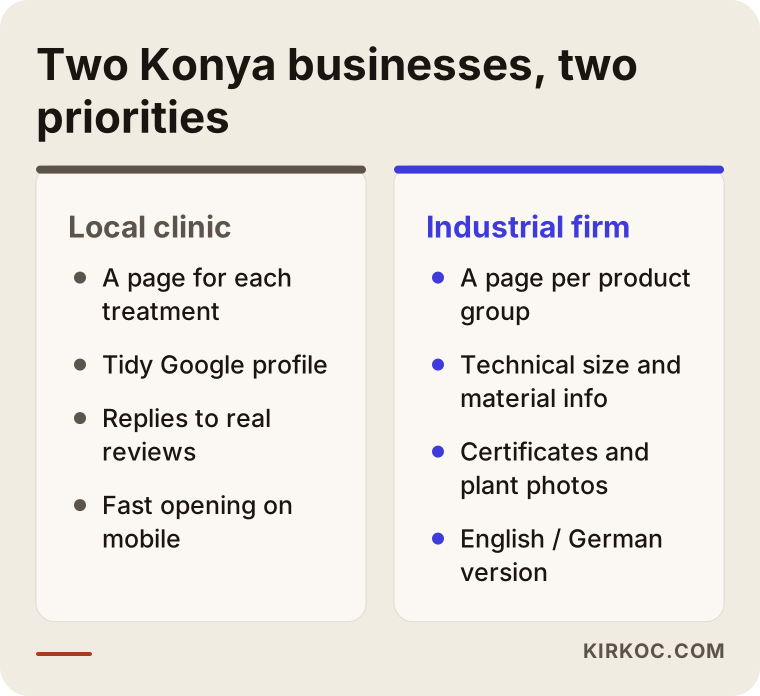
As you can see, the same word, "SEO", means different work for two companies. That is a good reason to stay away from anyone who offers every client the same package.
Step by step: how does SEO work for a Konya business?
When you work with me, the process runs roughly in this order. Whoever you work with, you should expect to see an equivalent of each of these steps.
1. Looking at the current state together. Which pages does your site have, which searches does it appear for, how does it open on a phone, and how does your Google profile look. At this stage I change nothing and only look. At the end you get a plain-language summary of what is good and what is missing.
2. Finding out what your customers type. Which words do your customers use to find you? Rather than guess, I work this out from real search data, competitor sites and your own conversations with customers. The technical term you use and the words the customer types are often different. A company may say "CNC machining", while the customer types "metal part manufacturing".
3. Drawing up the page plan. I produce a list of which service and product gets which page, which existing pages will be fixed and which will be written from scratch. District pages, product pages and frequently asked questions are decided here.
4. Technical fixes. Speed, mobile fit, the security certificate, duplicate pages, broken links. This is groundwork that the customer cannot see but Google can. If a new site is needed, I can build that too; when the site and the SEO are in one pair of hands, building the site SEO-friendly from the start is much easier.
5. Writing and publishing content. The text of the pages is written in the voice of someone who really understands your work. I take the information from you, but I put the text together in plain language myself. I do not consider generic text produced by AI and read by nobody good enough for this job.
6. Google profile and review routine. For local businesses: completing the profile, refreshing photos and building the habit of replying to reviews. I never use fake methods to collect reviews; I set up an easy way for real customers to leave one.
7. Measuring and adjusting. Every month I look at which pages were viewed, how many people called or filled in a form. I fix the page that is not working and write more like the one that is.
If you prefer to see the process as a timeline, the figure below summarizes the general flow.
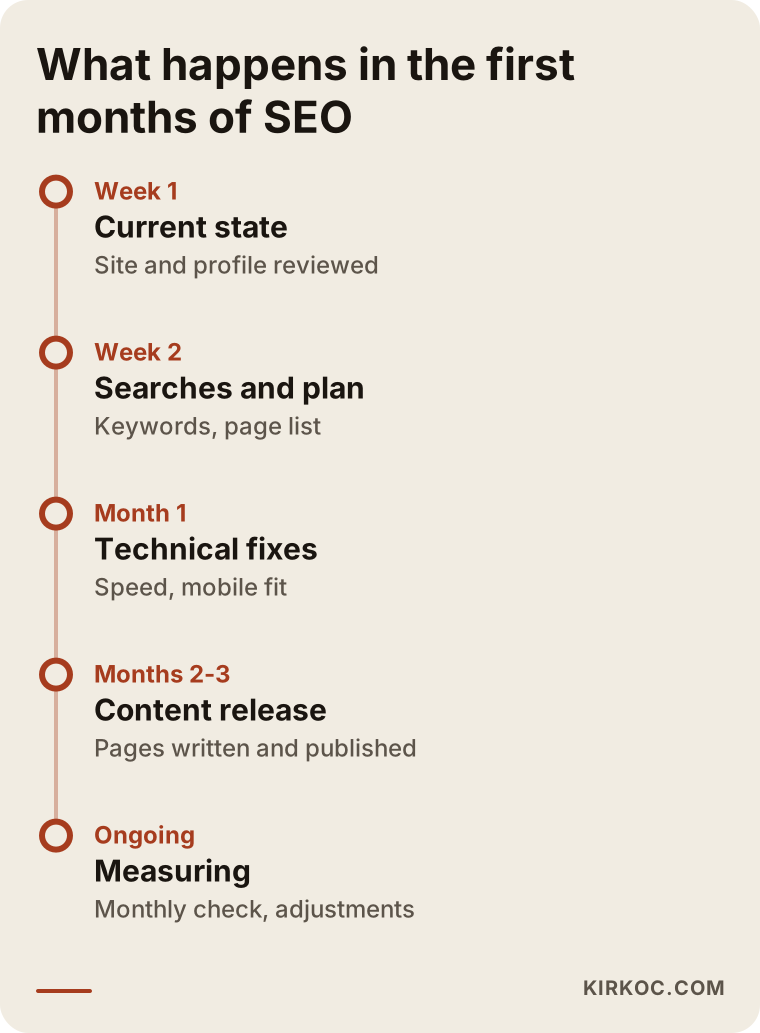
This timeline is not a fixed schedule; it changes with the size of the business and the starting state of the site. But the order, meaning first the diagnosis, then the plan, then the work and the measurement, is almost the same in every job.
Local SEO: how do you get into the map results in Konya?
Local SEO is a separate topic for businesses that have a physical location or serve a particular area. When Google shows businesses near a person, it looks at three things: how relevant you are, how close you are and how well known you are.
Relevance is in your hands: is the category in your profile right, are your services written out, is your description plain and complete. Proximity is not in your hands; if the customer is searching in Meram and you are in Selcuklu, a competitor in Meram may look closer. That is why it is unrealistic to expect every business to come first in every district. Prominence builds over time: reviews, the credibility of your website, and your name appearing on other sites.
A common mistake in local SEO is to register the same address several times as different businesses, or to use a fake address. Google notices this and may suspend the profile. Being honest and consistent suits both the rules and the long term.
The checklist below is a starting point for reviewing your own profile.
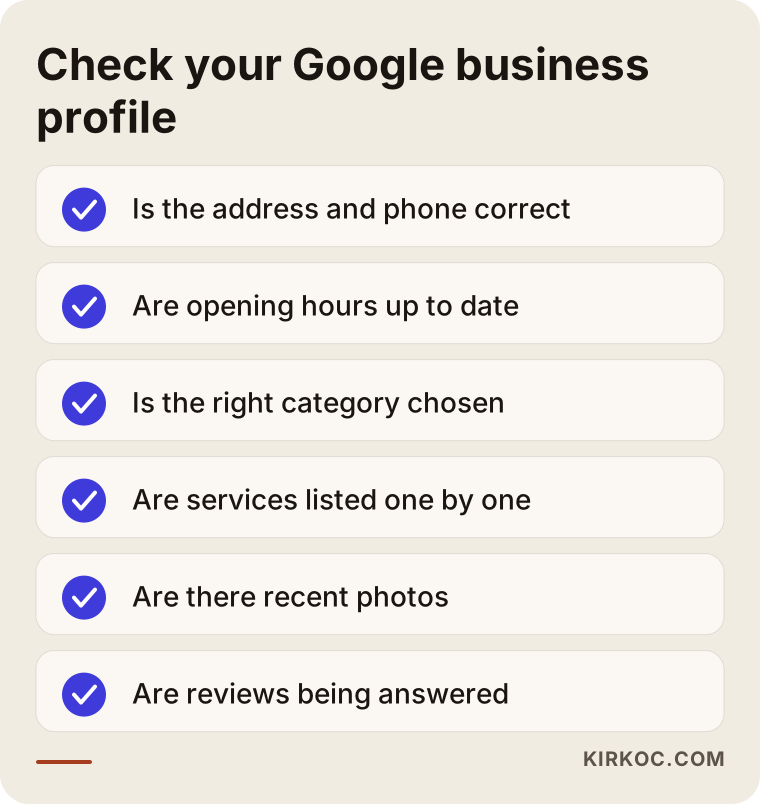
You can go through this list yourself in half an hour. Most businesses find that they are missing at least two items, and fixing even those makes a difference.
SEO for industry and export: a different game
If you manufacture in Konya, a buyer probably finds you in one of two ways: either an acquaintance recommended you, or they searched online. Keeping the second route open is the job of SEO.
Two things stand out in these searches. The first is technical accuracy. A buyer may be looking for a certificate such as ISO 9001, a type of material or a dimensional tolerance. If your site states these, both the search engine and the person can find you. The second is trust. Real production photos, images of the facility, a clear list of the sectors you work with and a contact person who can be reached all take a company out of the "only on paper" category.
AI-assisted search should also be taken into account here. Some buyers now ask ChatGPT or similar tools questions like "hydraulic cylinder manufacturers in Turkey". These tools lean on clear, organized and reliable sources when they answer. If your site is well structured and its information is plain and consistent, the chance of your name appearing in those answers goes up. I call this "GEO": work done so that AI describes you correctly. There is no guarantee, but keeping your site orderly and understandable is good for people and machines alike.
The figure below shows, with a sample chat, the kind of answer an AI assistant might give to such a question. The company name in the answer is made up.
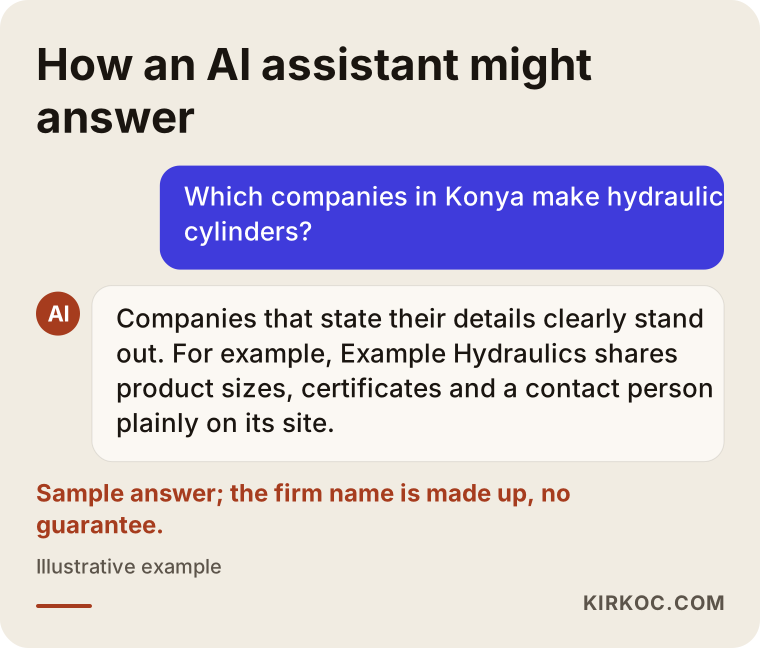
This example is not a guarantee, but it shows a direction: sites that give clear information are easier to understand, both in the search engine and in these tools.
Common mistakes
These are the mistakes that come up again and again with local businesses.
Squeezing everything onto one page. Mentioning all the services in a few sentences on the home page.
Taking offers with ranking guarantees seriously. Be suspicious of anyone who says "we will put you on the first page". Nobody controls Google's rankings.
Copying someone else's text. Taking text from a competitor or a directory site is unethical, and it also loses value in Google's eyes.
Stuffing in keywords. Repeating the same phrase twenty times on a page annoys both the reader and the search engine.
Bought links and fake reviews. They may look like they are working in the short term, but in the long term they can get the site penalized.
Not measuring. If you do not know how many people called or filled in a form, you cannot tell whether SEO is working.
Leaving the site alone after it is built. If a site is built once and forgotten, your pages fall behind as competitors keep adding content.
Not testing on a phone. Open your site on your own phone after every update and look at it.
I have also put these mistakes together as a visual warning list.
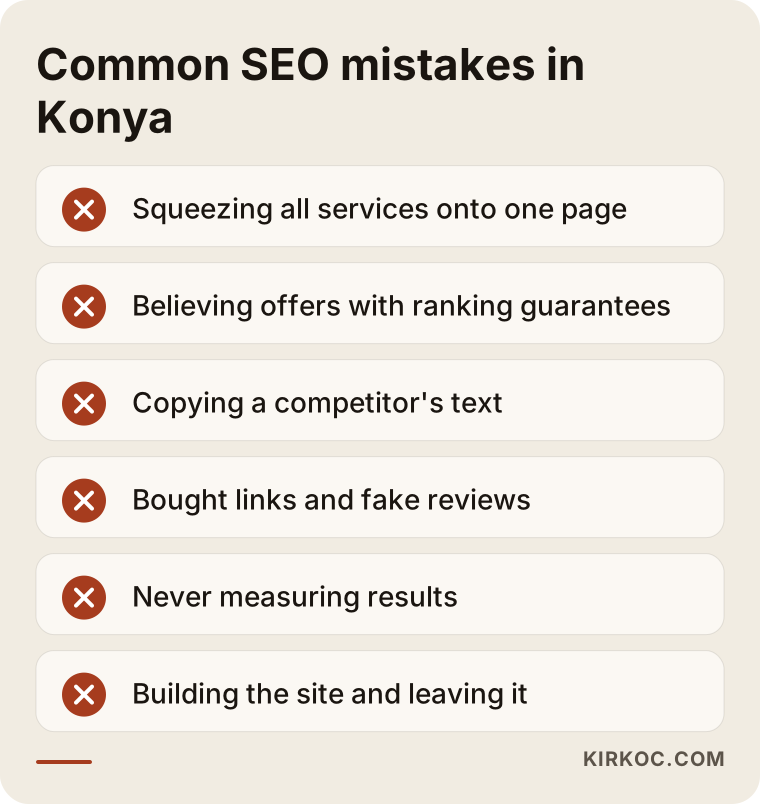
Most of the items on the list do not need money, they need attention. Checking them first protects both your budget and your time.
What can you do yourself, and when do you need an expert?
You do not have to hand everything to a specialist. There are a few jobs you can do on your own, and doing them also makes working with an expert easier.
What you can do yourself: update the phone number, hours and address in your Google business profile; politely ask satisfied customers to leave a review; reply to reviews; open your site on your phone and see whether anything is broken; count whether there is a page on your site for each of your services; and note down the words your own customers use when they reach you.
What needs an expert: fixing the technical structure of the site, drawing up the page plan, writing content according to search intent, publishing in more than one language, setting up measurement and regular follow-up. You could learn these yourself, but you would have to set your business aside and give a few hours every day to it. For most business owners that does not make sense.
The chart below can help you decide.
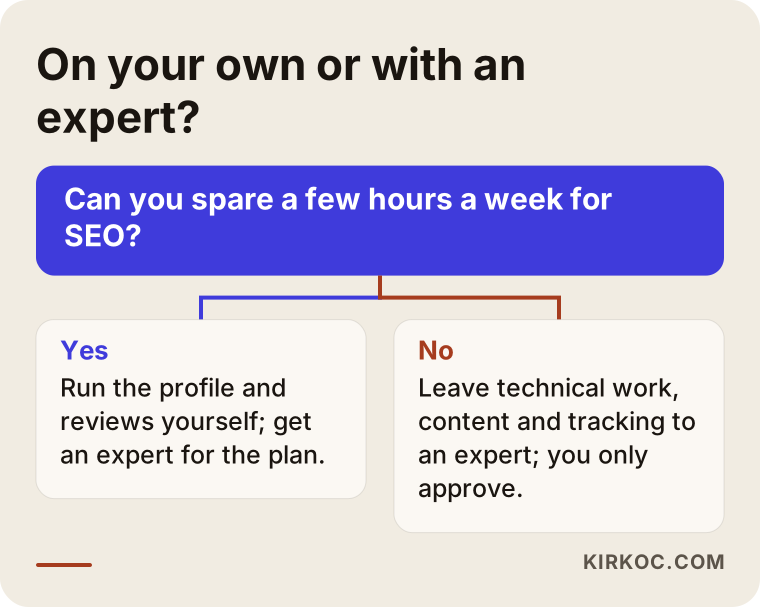
The chart is a compass, not a rule. The real measure is your time and the attention you can give to this work.
What determines the cost of SEO?
I will not give a number here, because an accurate figure cannot be given without seeing your situation. But I can tell you plainly what changes the price.
The current state of your site is the first factor: do you need a site from scratch, or will the existing one be fixed? The number of pages is the second: five pages and fifty pages are not the same job. Competition is the third: a niche in Konya with few rivals and a crowded field do not demand the same effort. The number of languages is the fourth: each extra language means separate writing and separate tracking. The scope of the work is the fifth: is it only SEO, or also social media, advertising and content production? Finally, the duration: SEO is not a one-off job but a process of several months, and good results usually build up over time.
Running all of this through one person can be cheaper and more consistent for some businesses. If the person who builds your site, sets up your SEO, manages your social media and runs your ads is the same, the messages match and nothing is lost in meetings and handovers. When one person manages the site, another the ads and a third the social media, you often have to explain the same job three times. That is why I handle everything in one pair of hands; but if all you need is SEO, I will do only that.
For a simpler view of what moves the price, look at the summary figure below.
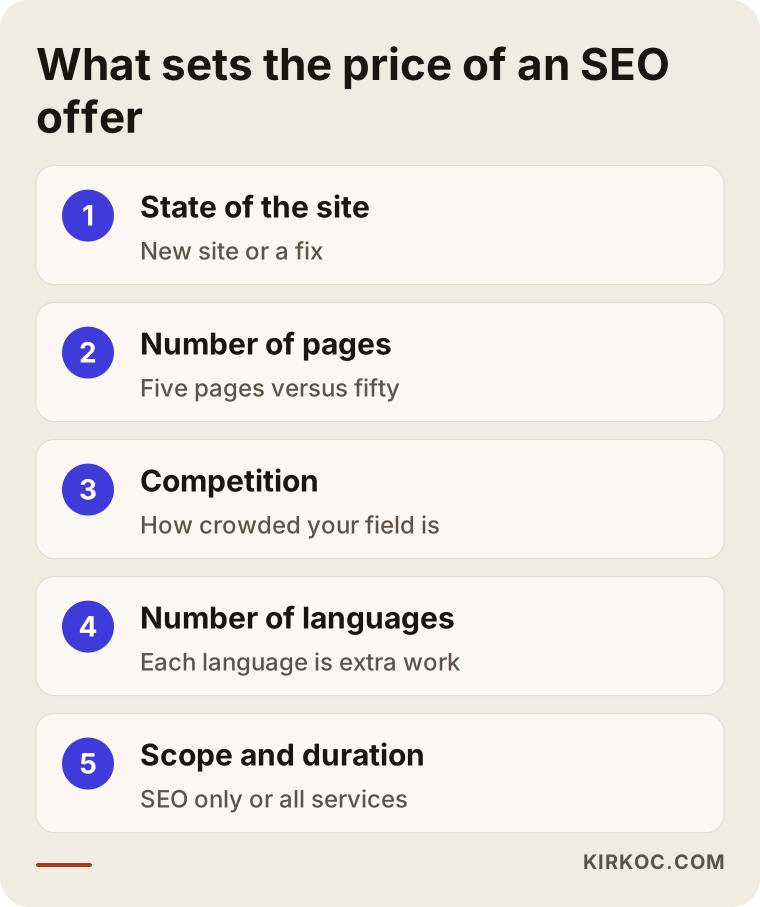
When you collect quotes, prefer the person who writes the scope clearly, says what will be done and when, and explains how results are measured. An offer that just says "monthly package" without describing the work can hold surprises.
Questions to ask when you get a quote
When you talk to a specialist or an agency, ask the following. How clear the answers are will tell you a lot.
What will you look at on my site first, and how will you explain it to me? Which searches will you target, and how do you decide on them? Who will write the pages, and what do I need to provide? How will you measure results, and which number will you report? Do you give a ranking guarantee, and if not, why not? When the work ends, who will own the site and the accounts? What can I expect to see after one month, and after six?
The last question matters especially: who owns the site and the Google accounts. An account that was not opened in your name may not stay with you once the work ends. I ask for all accounts to be opened in your name.
How I work
I work from Istanbul, and I provide in one place the services a digital agency would offer: websites and e-commerce, SEO and local SEO, GEO, social media management, Google and Meta ad management, logo and corporate identity, and content production. I do not need to be in Konya; conversations run by phone, video call or message, and most of the work can be done remotely. When it helps, I can also travel to the city and meet in person. If you are abroad, the work still runs the same way, and I can write and review pages in Turkish and English.
My way of working is simple. First a short introductory call, then I look at your site and Google profile and prepare a written, plain proposal. If you like it, you and I go ahead; if not, the proposal is yours to keep. I explain every stage of the work to you, I explain technical terms in the reports, and I tell you honestly what is working and what is not.
Frequently asked questions
How long does it take for SEO to work in Konya?
I will not give an exact time, because it depends on the starting state of your site, the competition and the work done. In general, the first changes begin to show within weeks, but steady results take months. Be careful with anyone who promises a ranking.
What is the difference between local SEO and ordinary SEO in Konya?
Ordinary SEO aims to make your site appear in general searches. Local SEO focuses on searches made with "Konya" or a district name, which mostly appear in the map results. For businesses with a location, the two run together; for a manufacturer that only exports, the local part matters less.
Can't I just run Google ads instead?
You can, but visibility ends the moment you stop paying. SEO starts more slowly but builds a lasting base. For many businesses it makes sense to use both, in sequence: ads bring quick demand while SEO gradually takes over the load.
What should I do if I have no site, or a very old one?
Fixing a very old site for SEO can sometimes cost more than building it from scratch. First I look at the basic structure of the site and then I tell you which route makes sense. If a new site is to be built, building it SEO-friendly from the start is the easiest way.
Can I reach customers outside Konya as well?
Yes. If you sell your product or service across Turkey or abroad, the pages are built accordingly. Being in Konya is an advantage only in local searches; general searches need a separate plan.
Does social media help SEO?
It has not been proven to raise rankings directly. But it helps people get to know your brand, they search for you by name, and it sends visitors to your site. So it is good not to run the two apart from each other.
Who will own my site after I buy the service?
You will. The domain name, the site and the Google accounts should be in your name. Even if I do the management, access always stays with you.
Can I use the text of competitor sites as a model?
You can look at them for inspiration, but do not copy the text. It is a problem for copyright and ethics, and when the same text exists in two places, Google has trouble choosing which one to show. Describing your own business in your own words gives better results.
If you want customers to find you online in Konya, let us talk through your situation: reach me through my SEO services page, and I will look at your site and your business and explain in plain language what can be done.